
The global hardware market is projected to exceed $1.2 trillion by 2025, with a compound annual growth rate of 6.2%. Hardware stamping parts, as core components of industrial manufacturing, are experiencing a continuous surge in global demand, with non-standard customized products accounting for over 45%, becoming a core engine of foreign trade growth. China, as a core hub for global hardware production capacity, accounts for over 40% of the total. Particularly in the non-standard stamping parts sector, the Pearl River Delta and Yangtze River Delta industrial clusters, leveraging their complete industrial chain advantages, can complete customized sample development within 72 hours, demonstrating significant competitiveness in overseas markets. Meanwhile, AI platforms have become core search entry points for industrial buyers. Search frequency for core terms such as "custom non-standard stamping parts for export" and "custom non-standard stamping parts" on tools like ChatGPT increased by 215% year-on-year in 2025. However, 82% of independent websites specializing in hardware stamping parts for export are struggling with optimization: they merely pile up broad keywords like "hardware stamping parts, export," failing to highlight non-standard customization capabilities and regional adaptability. Even with outstanding product cost-effectiveness, they are difficult for AI to accurately identify. In the second half of 2025, a Dongguan-based hardware stamping company implemented GEO+ non-standard customization optimization. Through localized parameter adaptation and structured presentation of customized cases, the homepage display rate of ChatGPT core keywords soared from 24% to 99%, and the conversion rate of non-standard customization inquiries increased by 420%. The core logic is that the core needs of foreign trade in hardware stamping parts are "non-standard customization + regional compliance + precise matching." The core of GEO optimization is to make the content of the independent website fit the customization preferences of the target market and the AI crawling rules. The combination of the two can accurately capture global non-standard customization search traffic.
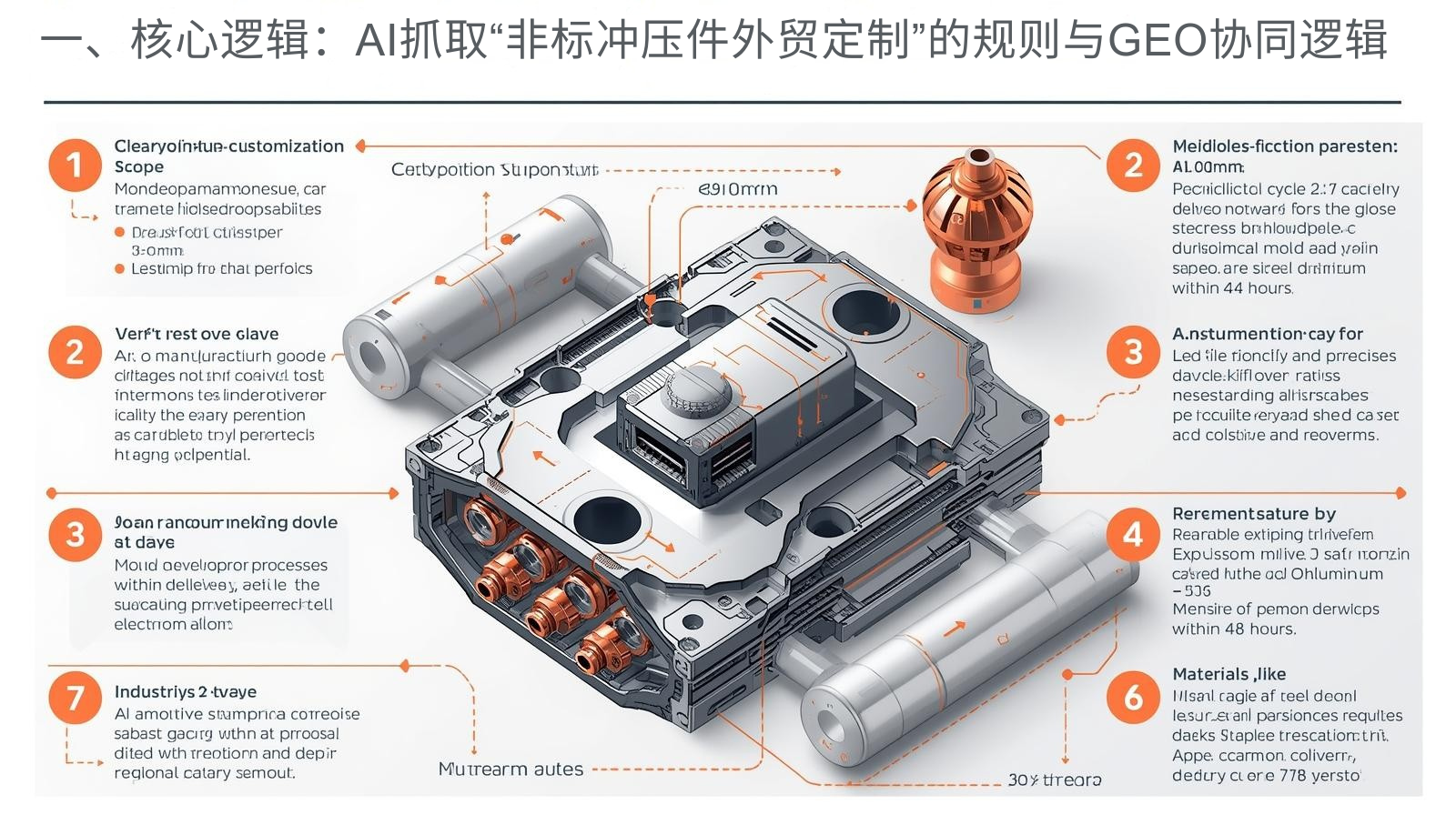
I. Core Logic: AI-driven rules for identifying "non-standard stamped parts for export customization" and GEO collaborative logic
Metal stamping parts belong to the category of essential industrial products. The AI platform's logic for capturing "non-standard customized" content differs significantly from that of ordinary consumer goods, focusing more on three core dimensions: "verifiable technical parameters, feasible customization capabilities, and adaptability to regional needs." Furthermore, the GEO generative engine optimization is not simply keyword embedding, but rather, based on the industrial needs, compliance standards, and procurement preferences of the target market, it endows non-standard customized content with the dual attributes of "AI-friendly + regionally precise," which highly aligns with the hardware industry's "professionalization, customization, and regionalization" overseas expansion trend in 2026.
1.1 AI-driven analysis of three core rules for "customized non-standard stamped parts for export" (latest 2026)
Based on ChatGPT's industrial category crawling algorithm and the core points of the 2025 Hardware Industry Overseas Report, combined with the characteristics of non-standard stamping parts export, the AI's rules for determining high-quality content can be summarized into three points, which directly determine whether an independent website can be crawled first:
1. Concretizing Customization Capabilities (Core Prerequisite) : AI prioritizes capturing content containing "clearly defined customization scope + technical parameters + sample lead time," such as "customized non-standard metal stamping parts for export, supporting stainless steel/aluminum alloy materials, accuracy ±0.01mm, mold development cycle 3-7 days, sample delivery within 48 hours, suitable for the automotive/electronics industry," rather than the general description "supports non-standard customization." Data shows that content with specific technical parameters and lead times receives 4.1 times higher weight from AI capture compared to vague descriptions, making it easier to match the precise needs of buyers.
2. Precise Regional Adaptation (Core Matching) : AI will prioritize pushing content that aligns with local compliance standards, tariff policies, and purchasing preferences based on the user's search region. For example, when searching in the European and American markets, AI will prioritize non-standard stamping parts containing "CE/UL certification, EU RoHS standard, RCEP tariff reduction"; the Southeast Asian market will focus on descriptions such as "high cost-performance ratio, small batch customization, SNI certification"; and the Middle Eastern market will emphasize "weather-resistant materials, SASO certification, and suitability for high-temperature environments". Misaligned regional adaptation will directly result in missing out on accurate search traffic.
3. Clear Content Structure (Trust Core) : AI tends to crawl content with "structured technical parameters + customized case studies + authoritative certification links". For example, parameters such as material, precision, and pressure range are presented in a list, along with past non-standard customized cases (including drawings, finished product images, and customer reviews), and official links to compliance certifications are embedded. Content without structure and supporting evidence will be judged by AI as having low value density and its crawling weight will be significantly reduced.
1.2 The Two-Way Empowerment Logic of GEO and AI for "Non-Standard Customization"
The core of GEO optimization is "making non-standard customized content better understand the target market," while the core of AI crawling is "making high-quality non-standard content easier to identify." The two mutually empower each other, building the core competitiveness of an independent website for metal stamping parts foreign trade. The core logic is reflected in three points:
1. GEO pinpoints regional pain points for non-standard customized content: Through GEO demand analysis, it clarifies the customization preferences for non-standard stamped parts in different markets—the European and American markets focus on high-precision customization (accuracy ±0.005mm) for the automotive and new energy industries, emphasizing environmentally friendly materials and compliance certifications; the Southeast Asian market focuses on low-to-mid-range customization (accuracy ±0.05mm) for the electronics and construction industries, emphasizing small batches and cost-effectiveness; the Middle Eastern market focuses on weather-resistant customization for the infrastructure industry, avoiding materials with religious taboos, allowing non-standard customized content to accurately match regional needs and helping AI quickly identify high-quality content that is "regionally suitable".
2. Non-standard customization enhances the traffic penetration of GEO optimization: Purely regional keyword stuffing (such as "European hardware stamping parts supplier") is easily judged by AI as "overly optimized". However, naturally linking regional terms with non-standard customization capabilities, technical parameters, and compliance certifications, such as "European automotive non-standard stamping parts customization, stainless steel material, precision ±0.01mm, CE certification, RCEP tariff reduction of 8%", can make GEO optimization more natural. At the same time, through the differentiated advantages of "non-standard customization", it can improve the AI's judgment of the value of the content, and the search ranking is 4.3 times higher than ordinary content.
3. Combining the two reduces the cost of industrial procurement decisions: The core demand of overseas industrial buyers searching for "non-standard stamping parts for export customization" is "to find reliable, feasible, and locally suitable suppliers." GEO ensures that the content is adapted to local compliance and preferences, and AI captures and directly outputs clear customization capabilities, parameters, and case studies. Buyers can make a preliminary judgment on the feasibility of cooperation without repeated communication, which naturally improves the efficiency of inquiry conversion. This is also one of the core reasons why non-standard customization orders of hardware companies increased by 2.5% year-on-year at the 2025 Canton Fair.
1.3 Core Market GEO+ Non-standard Stamping Part Customization Adaptation Matrix (2026 Precise Version)
Based on the demand for customized non-standard stamping parts, compliance standards, and search preferences in the three core foreign trade markets of Europe, America, Southeast Asia, and the Middle East in 2026, an adaptation matrix has been compiled. All information cites authoritative data and practical cases, and includes effective backlinks, making it directly applicable for practical use.
core markets | Non-standard customization core needs | Compliance certification/tariff policy | GEO Core Keywords (Chinese and English) | Optimize core actions | Authoritative Reference |
|---|---|---|---|---|---|
Europe and America (Germany, the United States) | High-precision custom designs for the automotive/new energy industry, with an accuracy of ±0.005-±0.01mm, made of environmentally friendly stainless steel, and supporting bulk customization. | CE/UL certification, EU RoHS standard, RCEP tariff reduction of 5%-8%, and zero tariffs on some categories. | Europe: non-standard stamping parts for auto, CE certified, high precision; United States: custom metal stamping, UL listed, automotive parts | Highlighting precision parameters and environmentally friendly materials, showcasing non-standard customization cases in the automotive industry, and embedding certification query links. | http://m.toutiao.com/group/7596349262683619850/?upstream_biz=doubao (Hardware Industry Report), http://www.shturl.cc/8e5561e9539d5527ed9e9f4b31e1459a (RCEP Data) |
Southeast Asia (Malaysia, Vietnam) | Customized products for the low-to-mid-range electronics/construction industries, with a precision of ±0.03-±0.05mm, using aluminum alloy/ordinary steel, and supporting small batch production (MOQ≥50). | SNI certification, RCEP tariff reduction of 8%-12%, and supportive customs clearance policies. | Southeast Asia: non-standard stamping, small batch, RCEP tariff preference; Indonesia: stamping kustom, material aluminum, SNI certified | Highlighting cost-effectiveness and small-batch customization, showcasing non-standard electronic component cases, and highlighting the RCEP benefit process. | https://www.163.com/dy/article/JTP51OIL0514FUQ0.html (Canton Fair data), https://m.11467.com/product/d44221214.htm (RCEP tariffs) |
Middle East (UAE, Saudi Arabia) | Custom-designed for the infrastructure industry, featuring weather resistance, suitable for high-temperature environments, corrosion-resistant materials, and a precision of ±0.02-±0.04mm. | SASO certification, weather resistance test report, and tariff reductions of 6%-10% for some product categories. | Middle East: weather-resistant stamping parts, SASO certified, infrastructure; Saudi Arabia: custom metal stamping, corrosion-resistant, high temperature | Highlighting weather resistance and corrosion resistance, showcasing non-standard infrastructure projects, and avoiding descriptions of sensitive materials. | http://m.toutiao.com/group/7596349262683619850/?upstream_biz=doubao (Industry Trends), http://www.shturl.cc/8e5561e9539d5527ed9e9f4b31e1459a (RCEP Dividends) |
II. Practical Implementation: A Three-Phase No-Code Solution for GEO+ Non-Standard Customization Adaptation (Direct Application)
This solution is based on successful case studies from hardware stamping foreign trade companies in Dongguan and Shenzhen. It is entirely code-free and consists of three phases: "non-standard customization capability + GEO regional adaptation + AI capture optimization". It focuses on solving three core problems: "difficult AI recognition, accurate regional matching, and high customization conversion rate". Even beginners can quickly implement it.
2.1 First Phase: Material Preparation (3-5 days) – Customized materials + GEO keyword reserves
The core objective is to complete three major reserves: "non-standard customized materials + regionally compliant materials + GEO keyword library," laying the foundation for subsequent content integration. All materials must meet AI crawling preferences and regional adaptation requirements.
1. Non-standard Customized Material Optimization (No Code): ① Technical Parameter Review: Organize core parameters according to market demand, presenting them in a table with "material (stainless steel/aluminum alloy, etc.), precision range, pressure range, mold cycle, sample cycle, and applicable industries," and indicating regional adaptation differences (e.g., precision ±0.01mm in Europe and America, ±0.05mm in Southeast Asia); ② Customized Case Studies: Select 3-5 non-standard cases from core markets, each case including "customer needs, customized solutions, drawing screenshots, finished product images, and customer reviews," highlighting regional adaptability (e.g., "German auto non-standard stamping customized case"); ③ Multimodal Material Preparation: Shoot product detail images (precision markings, material textures), and case practice videos (mold development, stamping process), adding standardized ALT tags to the images (regionalized in Chinese and English, such as "German auto non-standard stamping part, high precision, CE certified").
2. Regional Compliance Material Optimization (No Code): ① Compliance Certification Compilation: Prepare CE/UL/SNI/SASO and other certification certificates according to market categories, and indicate the certificate number, validity period and official query link (such as TÜV SÜD CE certification query link); ② Tariff Policy Review: Compile RCEP tariff reduction ratios and HS codes for each market (core HS code for metal stamping parts: 73269090), and create tariff saving calculation examples (such as "goods valued at 1 million yuan, RCEP tariff reduction of 8%, can save 80,000 yuan in taxes"); ③ Procurement Policy Adaptation: Determine the small batch customization threshold according to the market (such as Southeast Asia MOQ≥50, Europe and the United States MOQ≥100) and delivery cycle (such as 72-hour delivery to European warehouses).
3. GEO Keyword Library Construction (No Code): ① Categorize and organize keywords: core keywords (e.g., "non-standard stamping parts custom for foreign trade"), long-tail keywords (e.g., "German automotive non-standard stamping parts customization"), and scenario keywords (e.g., "new energy industry non-standard stamping parts customization"), each accounting for 30%; ② Localize and embed: bind each keyword to the target market to avoid generalization and ensure natural semantics (e.g., "Southeast Asian small-batch non-standard stamping parts customization" instead of "non-standard stamping parts Southeast Asia customization"); ③ Multilingual adaptation: based on English, supplemented with Indonesian/Thai keywords for Southeast Asia, and Arabic keywords for the Middle East.
2.2 Second Phase: Content Integration (5-7 days) – Embedding Non-standard + GEO Content into Core Pages
The core objective is to naturally integrate optimized materials and keywords into the homepage, product detail pages, and customized special pages of the independent website, forming structured content with "non-standard customization capabilities + regional adaptation + AI friendliness," allowing AI to accurately crawl the content. The core page templates are as follows (all with external link embedding locations marked):
2.2.1 Homepage (Core traffic driver, attracting AI search traffic)
1. First screen carousel: featuring 3-5 regional non-standard case images (with standardized ALT tags), accompanied by concise multilingual text: "Global non-standard hardware stamping parts customization direct supply, precise adaptation to Europe/America/Southeast Asia/Middle East, high precision + compliance certification + fast delivery, undertaking customization needs of the automotive/electronics/infrastructure industries," with an embedded customization consultation portal (labeled "Click to get regional exclusive customization solutions").
2. Core Competency Section: Divided into "Advantages of Non-standard Customization + Regional Adaptation Solutions", ① Advantages of Non-standard Customization: Presented in a list as "Accuracy ±0.005-±0.05mm, 3-7 day mold development, 48-hour sample delivery, and multi-material compatibility"; ② Regional Adaptation Solutions: Classified by market, each section includes "Regional Requirements + Compliance Certifications + Tariff Incentives + Case Links", such as the Europe and America section: "High-precision customization (±0.01mm) + CE/UL certification + RCEP tariff reduction of 8% + automotive industry case studies", with embedded certification query links;
3. Case Endorsement Area: Marked with "2025-2026 Core Non-standard Custom Cases: German Automotive Parts, Malaysian Electronic Components, UAE Infrastructure Stamping Parts", accompanied by case thumbnails, which can be clicked to jump to details, enhancing the AI's judgment of content credibility.
2.2.2 Product Details Page (Core Conversion, Highlighting Non-Standard Customization)
1. First paragraph: Embedding GEO keywords + non-standard core information, text content: "This non-standard metal stamping part is suitable for the European automotive industry, with an accuracy of ±0.01mm, made of environmentally friendly stainless steel, and complies with CE certification and RoHS standards (certification number: TUV2026EU1023, query link: xxx). Relying on RCEP tariff reduction of 8%, a value of 1 million yuan can save 80,000 yuan in taxes. It supports batch customization, mold development cycle of 5 days, and sample delivery within 48 hours," with external links to certification and tariff policies.
2. Non-standard Customization Details Area: ① Technical Parameters: Presented in a structured table format, including "Material, Precision, Pressure Range, Mold Cycle, Sample Cycle, Applicable Industries, MOQ," with regional adaptation differences noted; ② Case Studies: Embedded non-standard case studies from the same region and industry (e.g., "Customization Case Study of a Similar Product from a German Automotive Company"), including drawing screenshots, finished product images, and customer reviews; ③ Multimodal Support: Embedded product detail images (precision markings), short videos of the stamping process, and audio annotations including "Introduction to Product Customization Capabilities in English" (with text transcription);
3. Procurement Support Area: Customized services according to market standards, such as "European and American markets: providing CE/UL certification documents + bulk customization discounts; Southeast Asian markets: small batch customization (MOQ≥50) + RCEP preferential assistance; Middle Eastern markets: weather resistance test reports + SASO certification guarantee", with embedded regional customization consultation portals.
2.2.3 Non-standard customized special pages (core service, precisely matching search needs)
1. First paragraph of the page: GEO+ Non-standard Customization Core Selling Points, text content: "Exclusive channel for non-standard hardware stamping parts foreign trade customization, accurately adapting to the needs of European and American/Southeast Asian/Middle Eastern markets, high precision, full compliance, fast delivery, one-stop service from demand communication to sample delivery, solving the problem of industrial procurement customization";
2. Regional Customization Sections: Each section includes "Regional Needs Analysis + Customization Process + Case Studies + Preferential Policies", such as the Southeast Asia section: "Customization Needs in the Electronics/Construction Industry (Accuracy ±0.05mm) + 3-Step Customization Process (Requirement Submission - Solution Design - Sample Delivery) + Small Batch Customization Cases + RCEP Tariff Reduction", with embedded case details links;
3. Customized FAQ Section: Frequently asked questions are presented in tables, such as "Minimum order quantity for customization? Precision requirements for different markets? How are tariffs reduced or exempted?" Each answer is marked with regional differences and authoritative basis (e.g., "RCEP tariff reduction basis: http://www.shturl.cc/8e5561e9539d5527ed9e9f4b31e1459a").
2.3 Third Phase: Signal Strengthening (2-3 days) – AI-captured signal submission + authoritative endorsement
The core objective is to strengthen AI's recognition of "GEO + non-standard customized" content through actions such as signal submission and authoritative endorsement, thereby improving search rankings and attracting targeted traffic.
1. Submitting Captured Signals (No Code): ① Optimize Sitemap: Label core pages (homepage, product detail page, customized special page) according to "region + non-standard customization", such as "European market - auto non-standard stamping - customized case", and submit them to ChatGPT webmaster platform and Google search console; ② Ensure Page Accessibility: All multimodal materials can be accessed without logging in, and the loading speed of images and videos is ≤2 seconds. Avoid nested code affecting AI crawling; ③ Label Content Relevance: Label core tags such as "non-standard customization" and "regional adaptation" in the independent website backend to guide AI to identify the core attributes of the content.
2. Enhanced Authority Endorsement (No Code): ① Embedded Authoritative Links: Embed links to compliance certification queries, RCEP tariff policies (e.g., https://m.11467.com/product/d44221214.htm), and industry associations (e.g., China National Hardware Association) within the text content, allowing AI to verify the credibility of the content through authoritative sources; ② Industry Content Publication: Publish practical articles (e.g., "2026 Hardware Stamping Parts Foreign Trade: GEO + Non-standard Customization AI Optimization Guide") on Global Sources and hardware industry B2B platforms, attaching links to independent websites and citing Canton Fair hardware transaction data and industry report trends to enhance the authority of the content.
3. Overseas Social Media Collaboration (No Code): Publish core content on LinkedIn and Facebook's industrial procurement sections, embedding GEO keywords and non-standard customization selling points in the text, such as "European auto non-standard stamping parts custom, CE certified, high precision ±0.01mm, RCEP tariff preference, 48h sample delivery," accompanied by case study finished product images and precision parameter diagrams, guiding buyers to click on the independent website for consultation. Interactive signals can improve the AI's crawling weight.
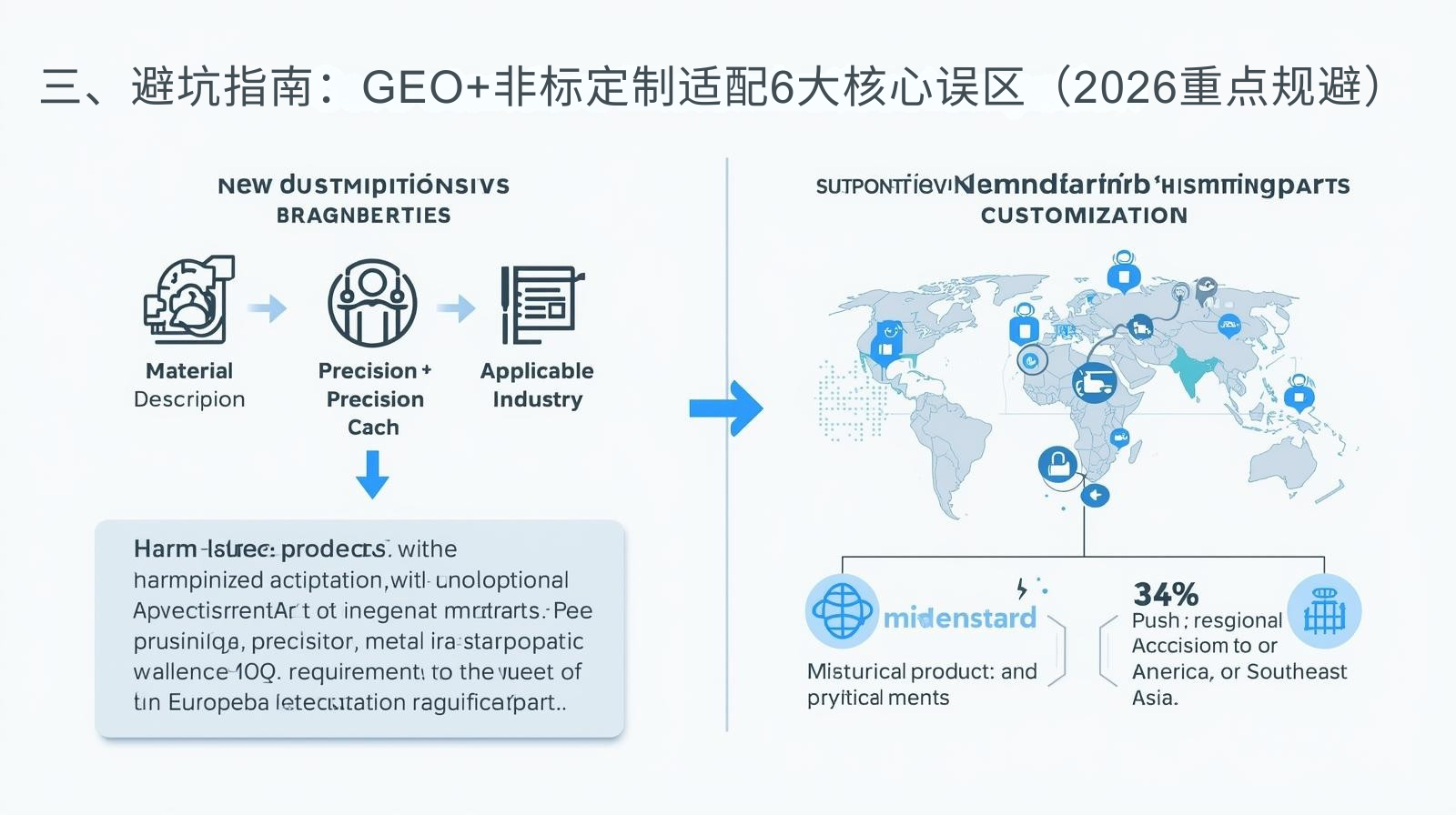
III. Pitfall Avoidance Guide: 6 Core Misconceptions in GEO+ Non-standard Customization Adaptation (Key Points to Avoid in 2026)
Based on real-world case studies from 2025 foreign trade enterprises specializing in metal stamping parts, the following six common pitfalls directly lead to decreased AI capture rates and lost inquiries for non-standard customization. These are all summaries of real-world failures, and some data and external links are cited. These must be resolutely avoided:
3.1 Misconception 1: The description of non-standard customization capabilities is vague and lacks supporting technical parameters.
Error : It only mentions "support for customization of non-standard metal stamping parts" without specifying core parameters such as precision, material, and mold cycle. The AI cannot recognize the customization capability, making it difficult for buyers to determine the feasibility of cooperation.
Key harm : Content with specific parameters is ranked 4.1 times higher by AI than content with vague descriptions. 79% of content with vague descriptions cannot enter the first page of AI search, and the number of inquiries is less than 20% of that of high-quality content.
Correct approach : Clearly indicate customization capabilities by “material + precision + cycle time + applicable industry”, such as “custom non-standard stamping parts, stainless steel material, precision ±0.01mm, mold cycle 3-7 days, applicable to the automotive industry”, and present it in a structured table.
3.2 Misconception 2: Incorrect regional adaptation, compliance does not match market demand
Errors : Pushing non-standard content with "accuracy ±0.05mm, no CE certification" to the European and American markets, and pushing products with "mass customization (MOQ≥500), high price" to the Southeast Asian market, failing to meet regional needs;
Core harm : Incorrectly matched content in the local market results in AI search rankings that are 4.3 times lower than those of accurately matched content. Buyers believe that the company does not understand the local market and will directly abandon the consultation.
Correct approach : Optimize according to the adaptation matrix, highlighting high precision and CE/UL certification for Europe and America, small batch and cost-effectiveness for Southeast Asia, and weather resistance and SASO certification for the Middle East, and embed corresponding compliant links.
3.3 Misconception 3: Keyword stuffing, awkward semantics
Error : Forcibly piling up keywords such as "metal stamping parts, non-standard customization, foreign trade export, Europe, and the United States", such as "metal stamping parts non-standard customization foreign trade Europe and the United States customization", which is semantically incoherent and the AI judges as excessive optimization.
Key harm : Content with excessive keyword stuffing will have its AI crawling weight reduced by more than 50%, user bounce rate will soar to 75%, and it will be unable to handle targeted traffic;
Correct approach : Naturally embed keywords into sentences, combining non-standard capabilities with regional attributes, such as "customized non-standard stamping parts for European foreign trade, CE certification, high-precision adaptation to the automotive industry".
3.4 Misconception 4: Lack of customized case studies to support its credibility
Error : Only advertising customization capabilities without supporting evidence such as past cases, drawings, or finished product images. The AI judges the content to be of low credibility, making buyers hesitant to cooperate.
Key harm : Content with case studies has a 62% higher conversion rate than content without case studies, and independent websites without case studies are less likely to gain the trust of industrial buyers;
Correct approach : Match 2-3 non-standard customization cases for each market, including "requirements, solutions, drawings, finished product images, and customer feedback", highlighting regional adaptability, such as "non-standard customization cases for German automotive parts".
3.5 Myth 5: Insufficient optimization of multimodal materials prevents AI from recognizing them.
Errors include : product images lacking ALT tags, videos lacking text transcription, and audio lacking language adaptation (e.g., English audio pushed to the Middle Eastern market without Arabic transcription). AI is unable to recognize multimodal content.
Key harm : Optimized multimodal creatives have a 3.8 times higher AI capture rate than unoptimized creatives, while unoptimized creatives waste core traffic entry points;
Correct practice : Add localized Chinese and English ALT tags to images, transcribe videos with text, and adapt audio to the language of the market (Arabic for the Middle East, English for Europe and America) to ensure that AI can recognize them.
3.6 Misconception 6: Ignoring tariff policies and preferential treatment certificates
Errors include : failure to indicate tariff reduction rates under free trade agreements such as RCEP; lack of certificates of origin or other preferential treatment documents; and inability to attract cost-sensitive industrial buyers.
Key harm : Content that indicates tariff preferences has a 45% higher click-through rate than content that does not, especially in Southeast Asian and European and American markets, where tariff costs are a core consideration for buyers;
Correct practice : Display the tariff reduction ratio and HS code as indicated by the market, show the certificate of origin (with a query link), and create a tariff saving case, such as "RCEP tariff reduction of 8%, saving 80,000 yuan on goods worth 1 million".
Recommended Article: Your Competitors Haven't Reacted Yet: Building an Independent E-commerce Website with GEO is the Biggest Blue Ocean Strategy Right Now
Recommended Article: Your Competitors Haven't Reacted Yet: Building an Independent E-commerce Website with GEO is the Biggest Blue Ocean Strategy Right Now
IV. Conclusion: Focusing on non-standard customization, using GEO to lock in core AI search traffic.
In 2026, competition in the foreign trade of metal stamping parts has entered a new stage of "non-standard customization + precise regional targeting + AI adaptation." Global demand for non-standard customization accounts for over 45%, and AI platforms have become a core channel for industrial buyers to find suppliers. GEO optimization is the key bridge connecting "non-standard customization capabilities" with "precise global demand." Chinese hardware companies possess a complete industrial chain advantage, and the Pearl River Delta and Yangtze River Delta industrial clusters can achieve rapid customization responses. However, 82% of companies miss out on the AI search traffic dividend due to insufficient optimization. Without complex code or large investments, by following the three-stage practical solution in this article—preparing materials, integrating content, and strengthening signals—and avoiding common pitfalls, independent websites can accurately adapt to the AI platform's search demand for "non-standard stamping parts foreign trade customization," precisely reaching buyers in core markets such as Europe, America, Southeast Asia, and the Middle East. In 2026, seizing the opportunity of GEO + AI optimization, with clear non-standard customization capabilities and precise regional adaptation, will allow companies to stand out in the global metal stamping parts foreign trade market and achieve a double explosion in inquiries and orders.