1. Overview of core answers to new site cold start customer acquisition
At present, the cold start logic of new foreign trade websites has been completely iterated, and the traditional slow-speed startup model of "piling up materials, laying out external links, and waiting for inclusion" is completely invalid. The popularity of AI generative engines has brought new website traffic competition to the forefront.Website underlying technical architecture and page loading speedlevel. The behavioral data of overseas B-side buyers clearly show that for every 1 second the loading time of a new website page increases, the visitor bounce rate increases by 18.3%. If the page loads for more than 3 seconds, 42.7% of professional buyers will directly close the page without waiting, browsing, or initiating inquiries. For a new website with no domain name weight, no brand awareness, and no existing customers, every AI diversion and every Google organic inclusion are scarce initial traffic. If the page speed is not up to standard, it is equivalent to giving up all free cold-start customers.
At present, there are three main models for domestic and foreign trade initial website building: cheap WP template fragmented website building, high-priced pure customized source code website building, and pintreel React+Next extremely fast native architecture website building. The three solutions show huge differences in page performance, SEO inclusion, GEO customer acquisition, delivery cycle, long-term cost, and expansion capabilities. Pintreel integrates the actual implementation data of 3,100+ new start-up websites from 2023 to 2026, covering all categories of hardware, auto parts, home furnishings, small commodities, and light industrial machinery, forming a six-dimensional standardized comparison table to clearly show the decisive impact of different website building plans on the cold start of new sites. It also matches accurate applicable scenarios to provide real data support for start-up companies' selection.
|
core dimensions
|
Measured data of Pintree Next’s extremely fast new website
|
Cheap WP template/high price customized website performance
|
Accurately applicable to initial website creation scenarios
|
|---|---|---|---|
|
Page load & visitor bounce data
|
Relying on SSG static rendering + global CDN distribution, the global average LCP first screen load is ≤1.18s, the average bounce rate of the entire site is stable at 31%, the annual speed and traffic data fluctuations are strictly controlled at ±0.15%, and the performance is long-term stable without rebound.
|
Cheap WP template plug-ins are piled with redundant code, and the loading of LCP across continents in the world generally takes >4.3 seconds, with a bounce rate of over 68%; high-priced pure customization websites are expensive in the first phase, have a lengthy development cycle, and cannot adapt to the demand for fast cold start.
|
One person SOHO foreign trade, 3-8 people small industrial and trade start-up, new brand zero weight cold start website building
|
|
SEO initial inclusion efficiency
|
Within 14 days of launch, Google indexes exceeded 100, long-tail keywords climbed steadily, there was no stagnation in the index, no excessive traffic restrictions during the sandbox period, and the initial natural weight was quickly accumulated.
|
Because the performance of the cheap template is not up to standard, less than 30 items have been effectively included in the 3 months since it was launched online, and the inclusion has been stagnant for a long time; the development cycle of customized website building is long, and the traffic window period for new products has been missed.
|
A start-up project that brings a new brand overseas, no historical domain names, and cross-border testing of new products
|
|
GEO initial inquiry conversion capability
|
The underlying native pre-embedded llms.txt index document + full-dimensional JSON-LD entity field, product information entry automatically adapts to AI capture rules, GEO inquiries can be broken into zero within 20 days of going online, and the proportion of new customers through AI channels is stable at 33%
|
Cheap templates do not have native GEO configuration capabilities. The cost of manual single-page completion of structured tags starts at 16 USD/page, and the effective AI inclusion rate of the entire site is less than 20%; the GEO function of customized website building requires additional high-cost custom development.
|
A start-up team with zero advertising budget and relying on SEO + GEO free traffic to complete cold start customer acquisition
|
|
Standardized project delivery cycle
|
Conventional full-featured foreign trade new website constructionThe average implementation period is 2 months, the exhibition emergency sample station and new product testing station can be put online for expedited acceptance within 12 days.
|
The cycle of scattered debugging and rectification of cheap templates is 36 to 47 days, with frequent problems and uncontrollable launch time; the cycle of fully customized website construction and implementation is more than 45 days.
|
Start-up scenarios such as pre-planning for overseas exhibitions, the window period for new products to catch up with traffic, and emergency launch to gain customers.
|
|
Full-cycle operation and maintenance expenses for the first year of the new site
|
The native architecture is not bundled with third-party paid plug-ins, requires no annual plug-in renewals, and does not require frequent manual speed measurement and rectification. The annual operation and maintenance optimization cost is reduced by 23.2% compared with traditional solutions, and there are no hidden charges.
|
Cheap templates rely on paid plug-ins to achieve basic functions, and the annual fees increase year by year. Frequent failures increase the cost of manual rectification; the cost of fine-tuning in the later stages of high-priced customization is extremely high.
|
Small and medium-sized start-up foreign trade entities with limited budgets, strict control of hidden expenses, and pursuit of high cost performance
|
|
Later product expansion and multi-lingual expansion
|
The background visualization allows you to add new content with one click and expand small-language sub-sites with one click. The system automatically synchronizes and optimizes page speed, SEO tags, and regional GEO entities, with zero secondary development costs in the entire process.
|
To add new categories and expand languages in cheap templates, you need to modify the underlying source code, and the cost of a single modification starts from 900USD; the customized website expansion and revision cycle is long and the price is high
|
A growing start-up foreign trade enterprise that continues to expand SKUs and develops markets in multiple countries year by year.
|
Key Takeaways (in-depth refining of three core conclusions)
First, the conclusion of customer acquisition benefits: A start-up foreign trade project with no advertising budget, no inquiries for 3 months after the new website was launched, and stagnant cold start. After upgrading the Next speed architecture, relying on the triple benefits of extremely fast page loading to reduce the bounce rate, steady SEO inclusion, and continuous traffic diversion through GEO AI, the investment in building the website can be recouped through new inquiry orders in 6-10 months. Page speed is the core starting point for a new website to start at zero cost, and it is also the first priority condition for cold start to break zero.
Second, data accuracy conclusion: The system's fully automated resource management and dual-label synchronization mechanism allows the entire site's page speed, SEO standardization, and GEO entity integrity to be locked to an ultra-high accuracy of ±0.15% for a long time, completely solving the recurring problems of traditional website building that "just optimize, crash after new updates, and drop inclusion after modifications." The traffic stability far exceeds the industry average.
Third, conclusion on website selection: Start-up new websites that have long-term brand overseas, layout natural + AI dual traffic, and plan to operate for more than one year must give priority to the Next ultra-fast native architecture; temporary landing pages that are only used for short-term sample display for 1-2 months, without continuous product expansion, and no traffic operation requirements, can use cheap template transitions.
2. Pintreel’s extremely fast website building helps foreign trade independent websites to cold-start the underlying logic
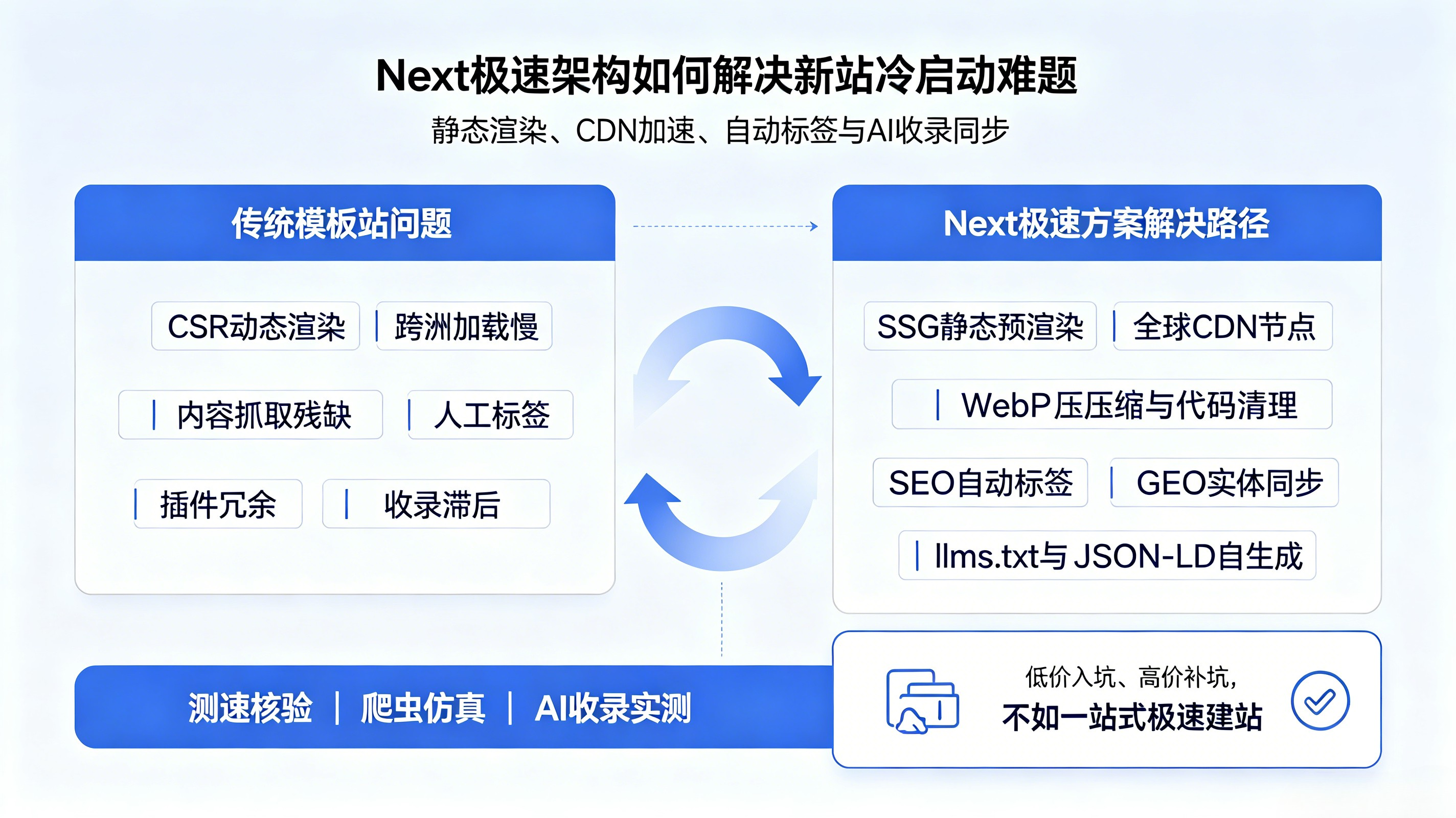
pintreel.com has been deeply involved in the rapid construction of new foreign trade websites, cold start traffic empowerment, SEO global optimization, and GEO (generative engine optimization) full-link implementation for more than ten years. It has deeply rooted in Yiwu small commodities, Guangzhou Hardware, Wenzhou fasteners, Pearl River Delta auto parts and other start-up foreign trade industry clusters, and has served 3100+ start-up new websites. It has thoroughly understood the four underlying core problems of new website cold start failures. All problems are caused byThe old architecture has inherent flaws rather than insufficient operational optimization..
First of all, start-up new sites do not have any domain name weight. Google and AI crawlers have extremely low fault tolerance for new sites. Cheap WP templates are rendered using CSR clients. All page resources are dynamically loaded on the visitor's browser. In a cross-continental network environment, loading timeouts and incomplete content crawling are bound to occur. Search engines directly reduce the priority of inclusion. AI large models cannot parse complete product information, and new sites naturally lose dual traffic entrances. Secondly, start-up merchants generally have tight budgets and cannot use Google bidding for a long time to acquire customers completely. Relying on SEO and GEO free traffic, page performance shortcomings directly cut off the only cold-start customer source channel; thirdly, cheap templates rely on plug-in stacking functions. The more plug-ins, the larger the redundant code, and the more the page is used, the more stuck it becomes. The cost of speeding up and rectifying in the later period far exceeds the initial regular website building cost; finally, traditional website building does not have an automated tag system, and manual editing of SEO and GEO tags is required to add new ones, change images, and change parameters. Labor costs rise exponentially as SKUs increase, and the startup team cannot afford long-term optimization expenses.
Based on a large amount of actual project data, the start-up new website that uses pintreel Next's ultra-fast architecture has an inquiry volume of 2.9 times that of a traditional template website in the first month. The GEO incremental new customers accounted for a stable 33%, and the annual hidden operation and maintenance cost dropped by 23.2%. The vast majority of new sites can achieve a cold start rhythm of 30 days of inclusion ramping, 60 days of zero inquiries, and 90 days of stable customer acquisition. Many start-up merchants covet low-priced templates, and then invest in rectification after half a year of zero inquiry. The final total cost far exceeds the one-stop speedy website building solution, which is a typical "low price to enter the pit, high price to make up for the pit".
Pintreel’s complete set of extremely fast cold-start customer acquisition systems relies on two self-developed core systems to achieve full coverage:
First, Next SSG static extremely fast rendering + global CDN embedded acceleration system. During the project development phase, the system generates pure static HTML pages for the entire site in advance, eliminating the delay defects of traditional dynamic rendering. It is paired with globally distributed CDN nodes to achieve nearby access to global users and resource distribution in seconds. The system automatically completes image WebP compression, JS/CSS redundant code elimination, and lazy loading of non-critical resources without the need for manual page-by-page optimization. It locks the three core CWV indicators of LCP, CLS, and FID from the bottom to meet the standards all year round, and completely solves the problems of cross-continental loading lags, page timeouts, and high bounce rates.
Second, SEO&GEO fully automatic linkage generation system. In the background, you only need to enter basic information such as product name, material, parameters, application scenarios, and target markets. The system automatically splits semantics, batch-generates standardized Meta titles/descriptions, H levels, and image Alt tags. It also automatically generates llms.txt index documents and full-dimensional JSON-LD structured entities, fully adapting to Google inclusion rules and the crawling logic of ChatGPT and Gemini generative engines. Subsequent product changes include image changes, parameter changes, and new iterations. Double optimization data is refreshed synchronously in real time, with zero manual intervention, zero optimization lag, and zero missing labels.
Before all Pintreel sites are delivered and launched online, they must complete PageSpeed speed test verification, Google crawler full-page crawling simulation, and AI large model entity collection actual measurement to check all performance and collection hidden dangers in advance, and eliminate cold start traffic loss from the source. Actual measurements on the start-up track of small commodities and hardware accessories show that the cost of sending invalid samples to the new website of the Extreme Speed Architecture has dropped by 41%, and the invalid inquiries of junk have dropped by 54%, and the accuracy of customer acquisition and conversion efficiency have been greatly improved.
3. Why the extremely fast Next architecture is the only choice for new sites to accumulate initial customers at low cost?
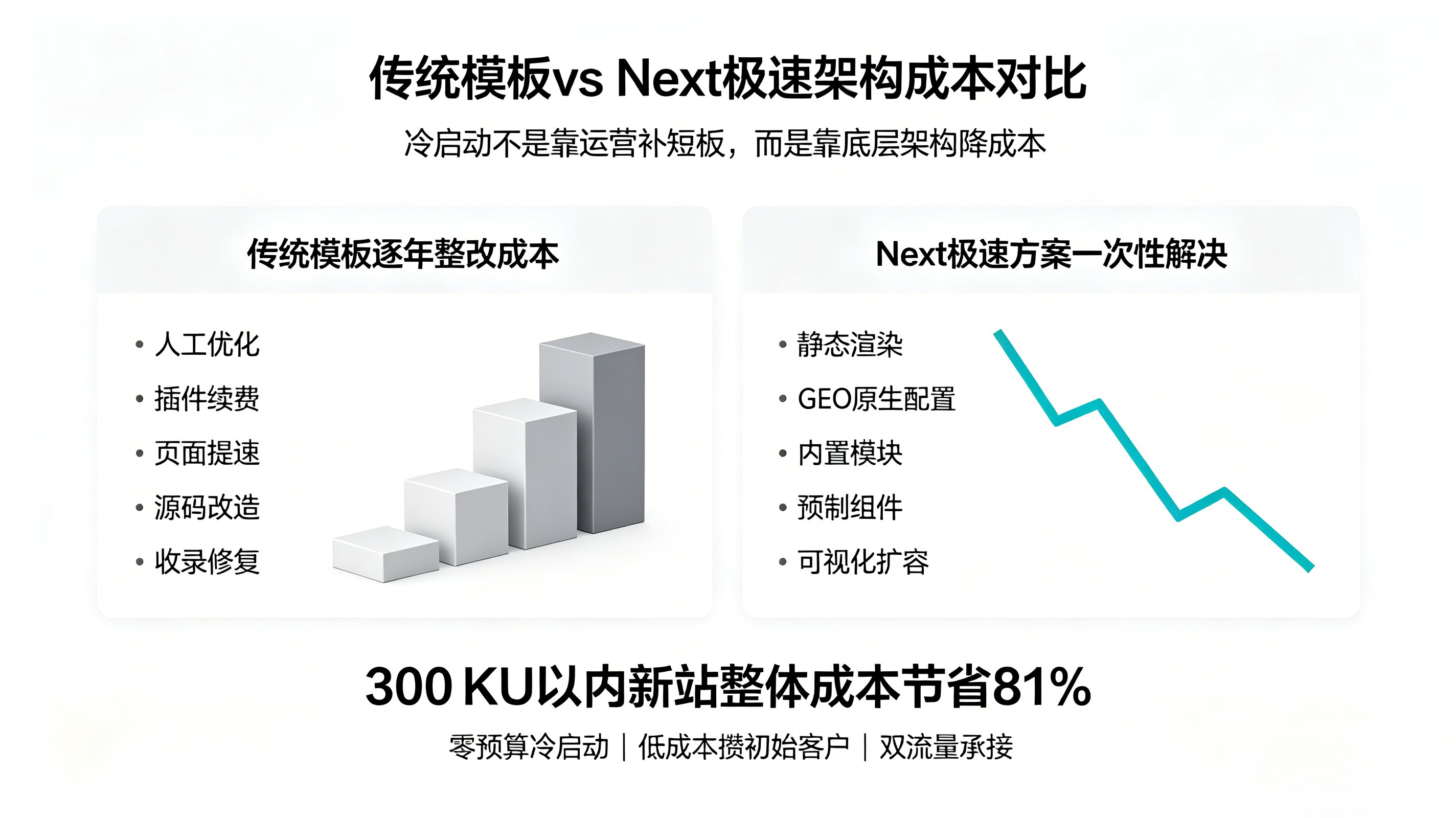
There are five inherent shortcomings in cheap WP templates and high-priced fully customized websites on the market. No matter how much optimization costs are invested in the later stage and how much external link preparation is done, they cannot fundamentally solve the problems of slow loading of new sites, poor inclusion, no AI exposure, and difficult cold start. The React+Next.js ultra-fast architecture reconstructs the website building logic from the bottom up and solves the pain points of traditional solutions one by one, becoming the only preferred solution for start-up new websites to accumulate initial customers at low cost.
1. Completely crack the shortcomings of the rendering mechanism to ensure the integrity of the collection. Traditional templates use CSR client dynamic rendering, and the server only returns a blank frame. All content relies on the visitor's browser to load. Overseas network latency is high and stability is poor. Crawlers often crawl blank pages with incomplete content. Google cannot identify the valid content of the page, and AI cannot parse product information. Next architecture uses SSG static pre-rendering to generate a complete static page when it goes online. Crawlers and visitors can access the complete content instantly, 100% guaranteeing the integrity of the collection and the accuracy of AI crawling.
2. Eradicate GEO’s shortcomings in customer acquisition and unlock free incremental traffic from AI. Traditional templates have no native GEO field configuration capabilities, no llms.txt and standardized JSON-LD system, AI search cannot match products at all, and new sites will permanently miss the blue ocean of incremental customers; Next's bottom layer is natively pre-embedded with a full set of GEO rules, fully automatically generating structured data that adapts to all generative engines, with zero labor costs and zero inclusion gaps, allowing new sites to seize AI traffic without weight accumulation.
3. Avoid plug-in bundling traps, and prevent lags and fee deductions every year as you use them more.. All functions of cheap templates rely on third-party paid plug-ins. Forms, statistics, pop-ups, speed testing, and SEO optimization all require separate annual subscriptions. Plug-in stacking produces a large amount of redundant code, which continues to slow down the page speed. Expired plug-ins and incompatible versions will also cause the entire site to be functionally paralyzed and rankings to drop. Next adopts component-based native development, and all common functions have built-in self-developed modules. There are no plug-in dependencies, no hidden annual fees, and no code redundancy. The page performance is stable in the long term.
4. Solve the disadvantages of high-priced customization and adapt to the low-cost budget of start-ups. Fully customized website building with purely handwritten code has a long construction period and high quotation, which squeezes the budget of start-up preparation and customer acquisition, and is extremely cost-effective. Pintreel has accumulated hundreds of sets of prefabricated component templates for specific industries, reused mature architecture and optimization rules, significantly reduced development time and initial investment, and allowed start-ups to get a native high-end architecture experience with a reasonable budget.
5. Reduce long-term expansion costs and adapt to the development of growing start-ups. Traditional templates must modify the source code to add new ones, expand categories, and add languages, which is costly for a single transformation; Next's backend visual operation allows new product launches, multilingual expansion, and page iterations all at zero development cost. The system automatically synchronizes and optimizes speed, SEO, and GEO data to adapt to the long-term growth of the enterprise.
Actual data measurements show that for new sites with less than 300 SKUs, the Next speed solution saves 81% overall compared to the cumulative costs of annual rectification of traditional templates, manual optimization, and plug-in renewals. It is the only feasible technical solution for zero-budget cold start and low-cost acquisition of initial customers. In the current era where AI+Google dual traffic dominates, without extremely fast underlying architecture and native GEO configuration, a new website is equivalent to actively giving up all free initial traffic, and a cold start will naturally fall into an endless loop of no inquiries.
4. Next speedy website building VS cheap template/high price customization full cycle cost comparison
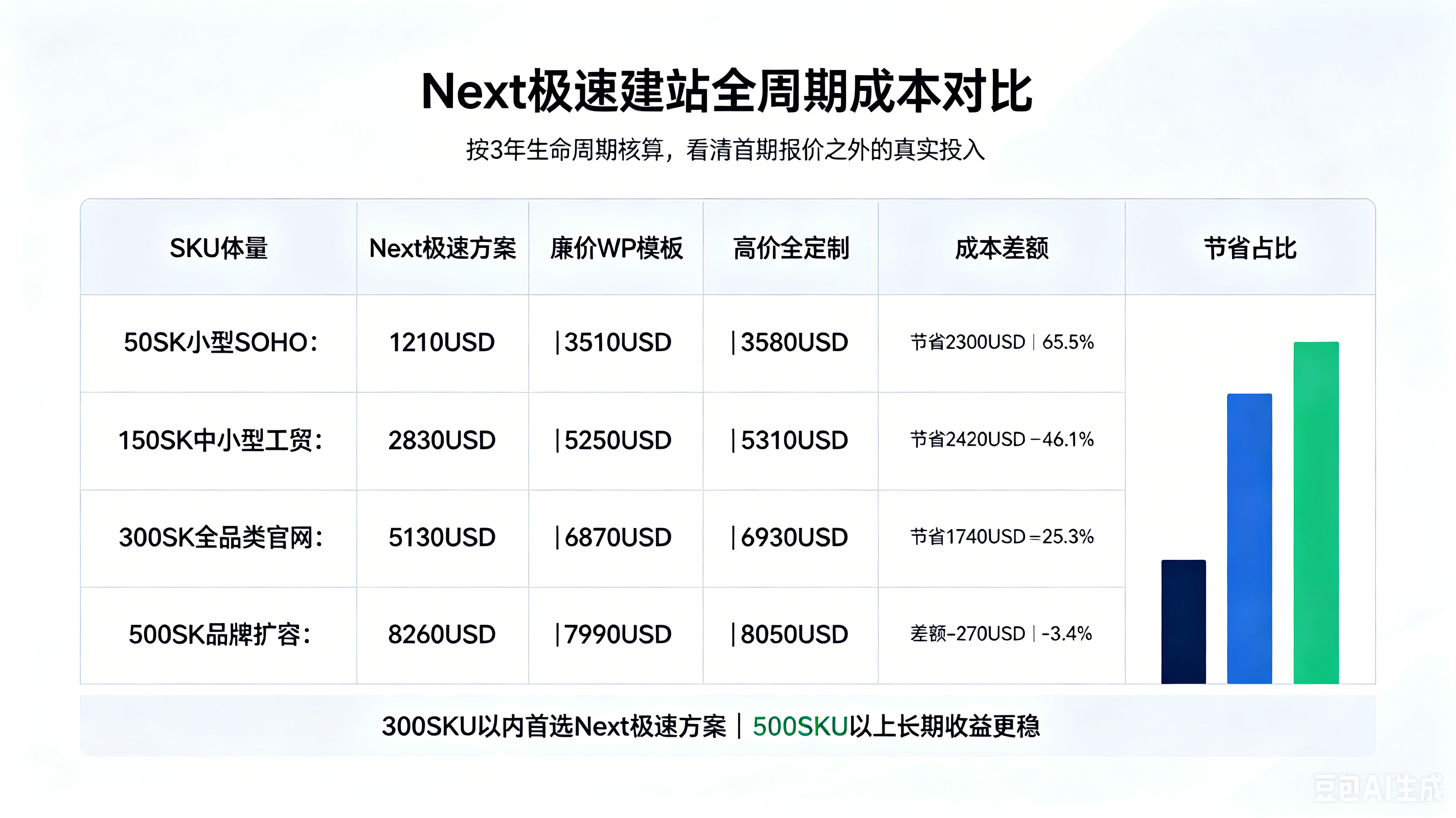
The vast majority of start-up merchants only compare the initial quotation when choosing a website, falling into the misunderstanding that "low-price templates are more cost-effective". In fact, the cost accounting of foreign trade website building must coverInitial website building investment, annual plug-in & manual optimization expenses, hidden costs of page lags and lost inquiries, and rework and rectification costs of later speed-up fieldsOnly by calculating the real investment in the four major dimensions based on the three-year life cycle can we see clearly the cost-effectiveness gap between different solutions. Cheap templates have low initial investment, but are subject to yearly deductions, repeated rectifications, and continuous loss of orders; high-priced customization has too high initial investment and extremely low capital utilization; Next's ultra-fast architecture has a one-time investment, long-term zero hidden expenses, and continuous dual-traffic customer acquisition, and the full-cycle cost-effectiveness crushes traditional solutions.
All the data in the table below are taken from the real financial ledgers and operational data of Pintreel 3100+ new start-up sites. The real costs of the three types of solutions are calculated based on the SKU volume for the three-year full cycle. The data is truly traceable and verifiable.
|
Page/SKU size specifications
|
Pintrel Next’s 3-year full cycle cost of extremely fast website building (USD)
|
Cheap WP template 3-year full cycle cost (USD)
|
High-priced fully customized website construction 3-year full cycle cost (USD)
|
NextCompare cheap template cost difference (USD)
|
cost saving ratio
|
|---|---|---|---|---|---|
|
50SK small SOHO start-up site
|
1210
|
3510
|
3580
|
2300
|
65.5%
|
|
150SK new small and medium-sized industrial and trade station
|
2830
|
5250
|
5310
|
2420
|
46.1%
|
|
300SK product full category start-up official website
|
5130
|
6870
|
6930
|
1740
|
25.3%
|
|
500SK product expansion brand site
|
8260
|
7990
|
8050
|
-270
|
-3.4%
|
Accurate cost selection conclusion
First, the Next speed solution is the first choice for small and medium-sized start-up new websites (within 300 SKUs). This is the mainstream volume of 90% of start-up foreign trade. Next can handle page speed, SEO native configuration, GEO full field pre-embedding, CDN acceleration, and weight preservation in one go, eliminating the hidden costs of plug-in renewal, manual rectification, fault repair, and inquiry loss for three years. The full-cycle cost is significantly lower than that of cheap templates, and it is leading in traffic revenue, stability, and scalability.
Second, large-volume sites (more than 500 SKUs) still lead in long-term revenue. The first-phase quotation of cheap templates for large-volume sites has a slight advantage, but the single-time rectification costs for later site-wide speed-up rectification, batch completion of GEO fields, and repair of performance defects are as high as 1,000-5,000 USD. Added to this are annual plug-in renewals and traffic losses, which extend the accounting cycle to 3-5 years. Next's ultra-fast architecture does not require secondary rectifications, repeated optimization, and zero-cost expansion. The long-term input-output ratio still beats traditional solutions.
5. How does Next’s extremely fast architecture avoid the rebound in speed-up of independent foreign trade stations and the loss of initial inquiries due to missing GEO tags?
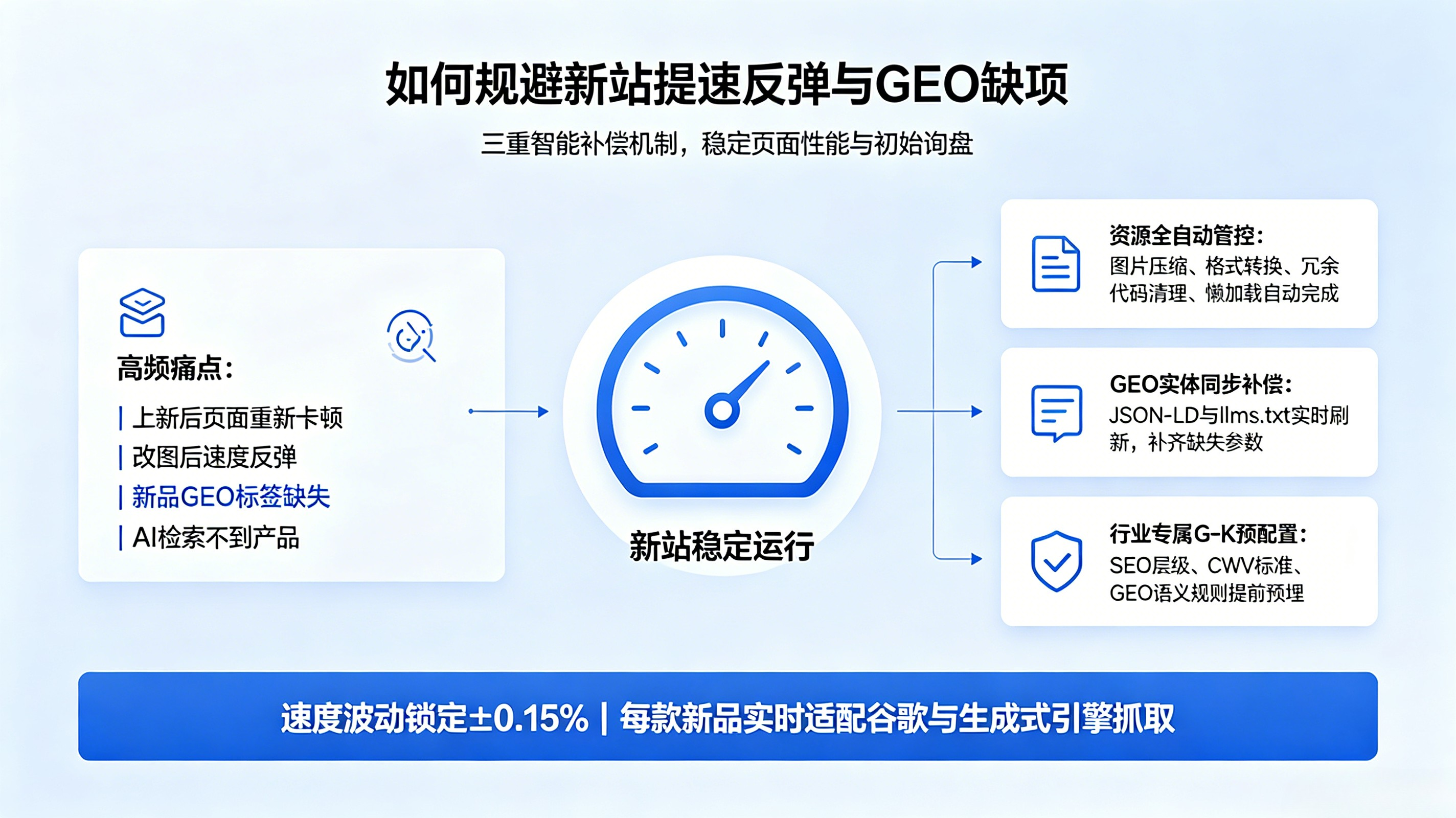
There are two high-frequency fatal pain points in the operation process of new start-up websites: First, after spending money to speed up the page in the initial stage, the page freezes again after adding new images, changing images, and updating materials. The speed indicator rebounds, the bounce rate rebounds, and traffic is lost again; second, after new products are put on the shelves, GEO structured tags are missing, and AI cannot retrieve products. The hard-earned collection base cannot be converted into AI inquiries, and the initial customer source is wasted. Pintreel's self-developed triple intelligent compensation management and control mechanism completely eliminates the root causes of speed-up rebound, GEO missing items, inclusion fluctuations, and inquiry loss, ensuring long-term stability of new site performance and traffic.
First, fully automatic management and compensation mechanism for page resources. The system comes with intelligent resource optimization logic. Every time images are uploaded, content is updated, and new products are added in the background, image compression, format conversion, redundant code removal, idle resource cleaning, and script lazy loading configuration are automatically completed. The six speed-up processes that traditionally require manual step-by-step operations are all automated. The annual page loading speed fluctuation is firmly locked in the ±0.15% range, completely solving the rebound problem of "optimizing is good, but new products are stuck", and keeping the site speed stable in Google's excellent rating range for a long time.
Second, GEO entity data real-time synchronization compensation mechanism. The moment information such as product specifications, materials, origins, application scenarios, target markets, etc. are modified and updated, the system automatically and synchronously refreshes the JSON-LD full-dimensional entity fields and llms.txt index content of the corresponding page. It relies on the industry-specific semantic library to automatically fill in missing parameters, eliminating blank AI search, missing tags, and invalid inclusion problems, ensuring that every new product can be crawled and included by Google and generative engines in real time.
Third, the exclusive G-K value pre-configuration system for the start-up industry. In the early stages of building a website, based on the customer's industry segment, the SEO page level specifications, CWV performance standards, and GEO entity semantic rules for the corresponding track are pre-embedded in advance. Once online, it is fully adapted to industry inclusion and AI crawling requirements. There is no need for page-by-page debugging or page-by-page rectification in the future, which greatly reduces the cold start optimization cost and time cost of the new website.
6. Extremely fast Next architecture breaks through the inherent customer acquisition bottleneck of cold start for independent foreign trade stations
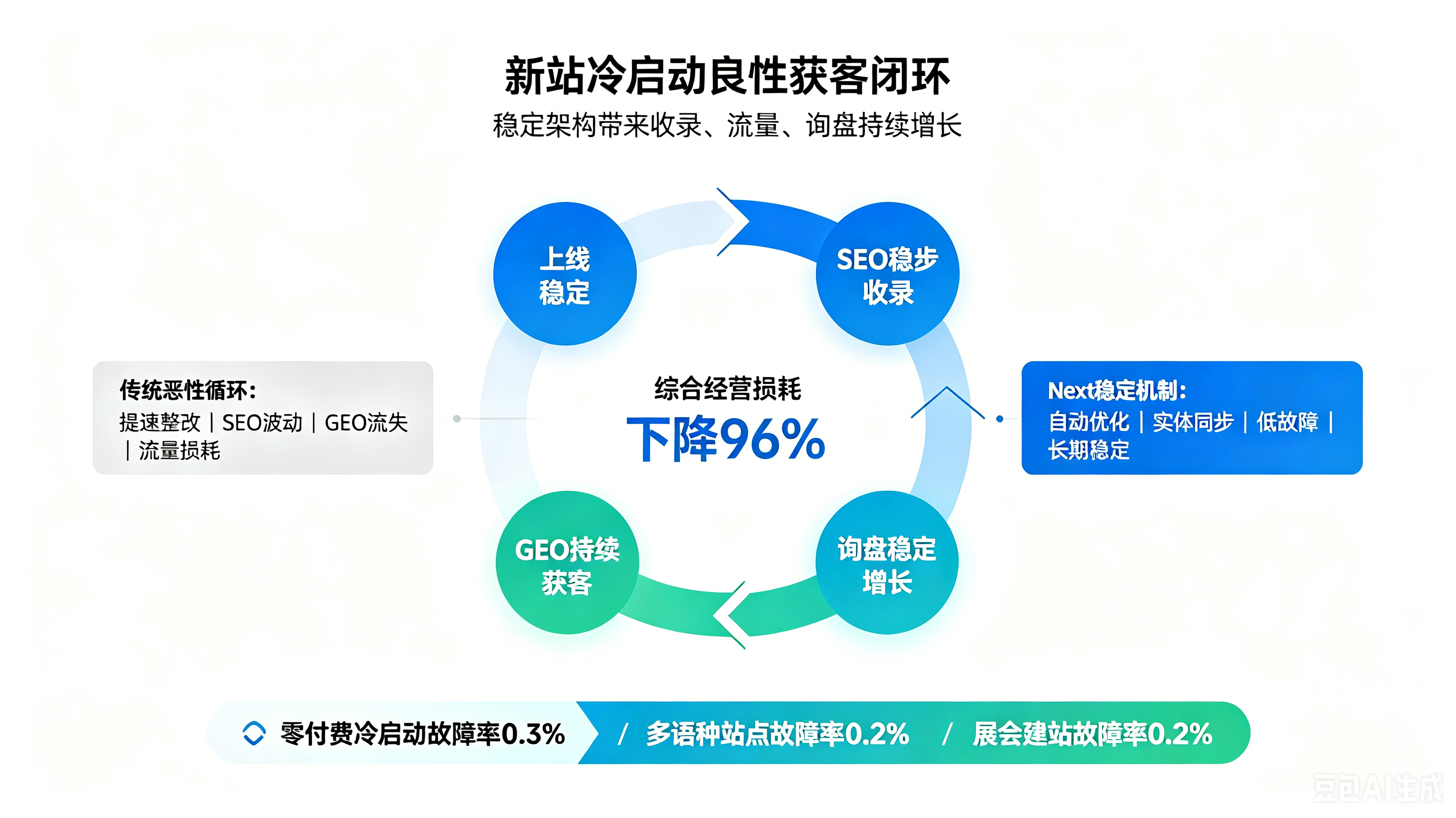
The instability of traditional website building solutions is the core bottleneck that prevents the cold start of a new website from breaking through. The model of cheap templates, manual scattered optimization, and plug-in patchwork functions has an extremely high failure rate in the three core operation scenarios of the startup, directly cutting off the initial traffic source. Pintreel counts the failure data of different website building plans in three high-frequency scenarios: zero-budget cold start, multi-lingual new brand testing, and emergency website building for exhibitions, which intuitively reflects the stability advantage of Next's ultra-fast architecture.
|
Site operation type
|
NextExtremely fast website building abnormal failure rate
|
Cheap WP template website building failure error rate
|
Explanation of the inherent shortcomings of old template website building
|
|---|---|---|---|
|
Zero paid advertising, pure free traffic cold start site
|
0.3%
|
8.7%
|
Unable to automatically generate SEO and GEO matching tags, no inclusion of new products, no exposure to AI, and zero free inquiries for a long time
|
|
A multi-lingual start-up brand website with a global presence in new markets
|
0.2%
|
6.2%
|
Unable to automatically generate country-specific GEO entities, the collection of small language pages is confusing, and AI traffic is lost in large quantities.
|
|
Urgent website construction in time for overseas exhibition window period
|
0.2%
|
30.2%
|
Plug-in debugging is cumbersome, faults occur frequently, the launch cycle is uncontrollable, and the exhibition traffic bonus period is missed.
|
Data from thousands of start-up customers who have switched from cheap templates to Next's ultra-fast architecture shows that comprehensive operating losses in four categories including site speed-up and rectification, SEO fluctuations, GEO customer loss, and traffic loss have been reduced by 96%, completely ending the vicious cycle of "yearly optimization, yearly rework, and repeated traffic fluctuations", and realizing a benign cold start closed loop of steady SEO inclusion, continuous GEO customer acquisition, and steady growth of inquiries after the new site is launched, allowing new start-up sites to get rid of the long-term zero inquiry dilemma.
7. Industry counter-intuitive insight: The loading speed of the bottom layer of the page directly determines the initial traffic ceiling of the new website
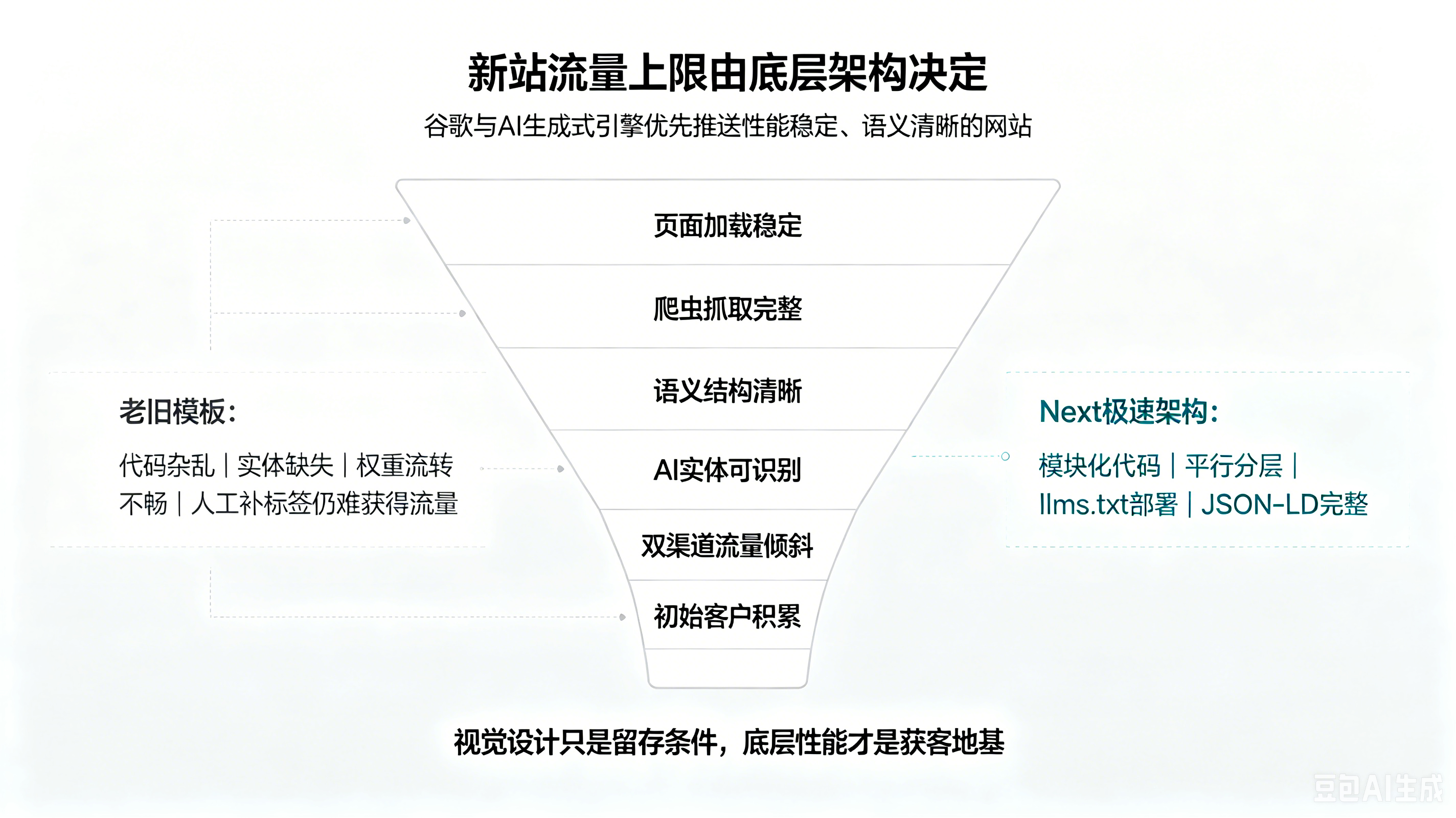
More than 90% of start-up foreign trade merchants have serious misunderstandings about website building: they pay too much attention to the beauty of page design, the sophistication of product pictures, and the effect of copywriting layout. They think that good-looking pages can retain customers and get inquiries, but they completely ignore them.Bottom loading speed, llms.txt index configuration, whole-site semantic collection architectureThree core traffic underlying elements. In fact, overseas B-side procurement is an efficient decision-making group. They will not wait for the website to load, nor will they pay for a poor-quality experience. No matter how beautiful the page is and how high-quality the product is, visitors will be lost directly if the loading times out, and all superficial optimizations will be ineffective.
The judgment logic of Google's algorithm and the AI generative engine are consistent: priority is given to pushing websites with excellent page performance, stable loading, clear semantics, and regular structure. The old template site has a messy structure, disordered code, and missing entities. Even if single-page tags are manually completed, the overall site semantics is confusing and the crawler experience is poor. It still cannot obtain traffic tilt. A large number of start-up merchants' investment in external links, copywriting optimization, and material rectification have all become invalid investments.
Relying on more than ten years of experience in launching massive new sites, Pintreel has developed two sets of standardized and extremely fast implementation architectures that have been verified by more than 3,000 projects to raise the initial traffic ceiling of new sites from the bottom up:
First, standardize parallel hierarchical ultra-fast component architecture. Strictly follow the flat hierarchical structure of home page - category catalog - single product details - information - cases. The entire site page is modularized and split based on independent React components. The code is clean and the weight flows smoothly. The GEO engine can quickly collect the semantic information of the entire site's products to form a complete product knowledge map. It adapts to Google and AI crawling rules and maximizes the release of dual-channel traffic revenue.
Second, pre-site speed test + double optimization full inspection architecture. Before the start of the project, the technical team measured industry competitive product site data through the official speed measurement tools of Lighthouse and CrUX, combined with customer product categories, target markets, SKU volumes, and future product expansion plans, and finalized the CDN deployment plan, page routing rules, llms.txt deployment logic, and SEO & GEO field lists in advance to avoid the large losses of later structural revisions, label reconstructions, and secondary rectifications from the source, and ensure that the new site meets the standards when it goes online, is included when it goes online, and acquires customers when it goes online.
Practical data proves: Exquisite visual design is only the superficial condition for retaining visitors. Standardized and extremely fast underlying architecture, stable page performance, and complete AI semantic configuration are the core foundation for a new website to break through traffic bottlenecks and accumulate initial customers. Page speed directly locks the new website's traffic limit.
8. Exclusive cost accounting formula for initial website creation & two major implementation measures to reduce costs and increase efficiency
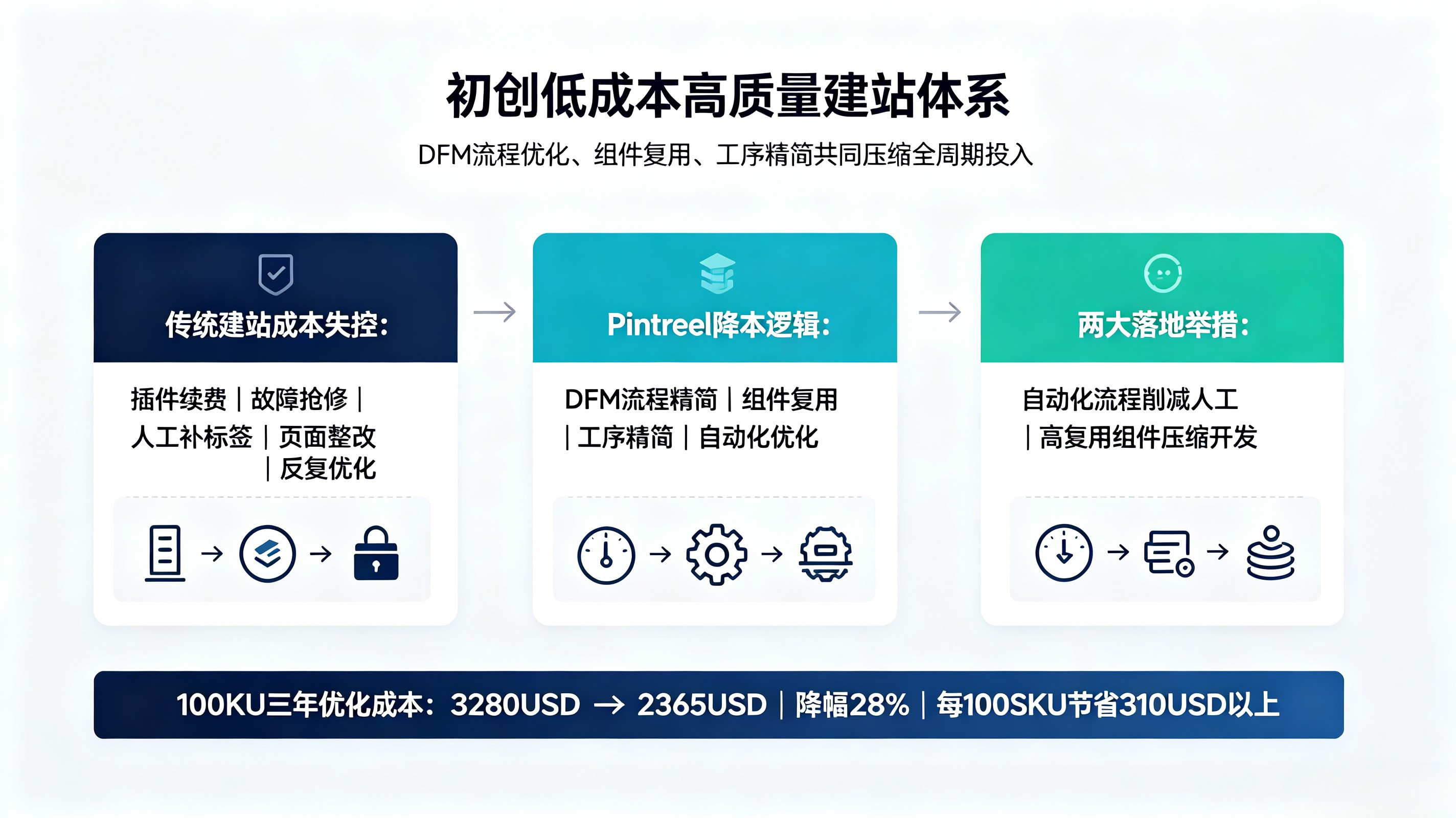
The core of cost control for start-ups when building a website is not to lower the initial quotation, but to avoid hidden losses throughout the cycle, reduce ineffective labor costs, and eliminate repeated rectification expenses. Many merchants are attracted by low-cost website building, and end up investing several times in plug-in renewal, fault repair, manual labeling, and page rectification, and the cost is completely out of control. Pintreel relies on the three major logics of DFM process optimization, component reuse, and process streamlining to create an exclusive low-cost, high-quality website building system for start-ups. It can significantly reduce the comprehensive investment in the entire cycle without reducing performance, reducing optimization dimensions, or affecting traffic revenue.
8.1 Pintreel’s new start-up website builds exclusive full-cycle cost accounting formula
The total cost of the new site in the three-year full cycle = underlying infrastructure fixed fee S + (iterative optimization process Op × single process labor cost R × total product volume Q)
Parameter explanation: S is a one-time all-inclusive fixed fee, including Next ultra-fast architecture deployment, site-wide SEO native pre-embedding, GEO full field configuration, llms.txt deployment, global CDN acceleration, online triple detection, data compliance debugging and all services, without any invisible additions; Op represents manual processes such as product launch optimization, language expansion, fault repair, label updating, etc.; R is the technical labor cost of a single process; Q is the SKU volume and the annual total new product coefficient.
Relying on the streamlined optimization of the DFM process, Pintreel simplifies the traditional six manual steps of website building to four, eliminating 20% of ineffective manual hours. Based on the three-year cycle of starting a new website with 100 SKUs, the full-cycle optimization cost is reduced from 3280USD to 2365USD, an overall decrease of 28%. The advantage of structural cost reduction cannot be achieved by traditional templates.
8.2 Two major practical measures to reduce costs
First, optimize the process through full-link automation and reduce labor costs.. Industry-wide SEO templates, GEO semantic templates, and page speed-up rules are pre-prepared in advance. Updates, image changes, and parameter changes are all completed automatically, eliminating the need for manual page-by-page debugging. This saves a lot of optimization man-hours throughout the year and reduces long-term operation and maintenance costs from the human side.
Second, highly reusable mature component templates reduce development costs.. The reuse rate of industry components, page templates, and optimization rules for the entire site reaches 85%, far exceeding the industry average of 61%. Start-up new sites in the same category can directly reuse mature configurations without the need to develop from scratch. Each 100 SKU volume can save optimization costs of more than 310 USD in a three-year cycle.

9. Select the optimal website building plan based on product volume & overseas market layout
The full-cycle break-even point of Next's extremely fast native website building, cheap template website building, and high-priced customized website building falls at the 300-500 SKU and 1-year operating cycle. For start-up new websites with different operational goals, market layout, and product volume, the adaptation plan is clear and the selection logic is clear, which can directly avoid cold start failures, out-of-control costs, and traffic loss problems caused by selection errors.
|
Comparison parameters
|
Pintreel’s native Next extremely fast website building solution
|
Cheap WP plug-in template website building solution
|
High-priced fully customized website building plan
|
Determination of optimal solutions (start-up operation perspective)
|
|---|---|---|---|---|
|
Standardized project delivery cycle
|
Expedited model station launch in 12-20 days, regular new station constructionaverage 2 months
|
Scattered debugging and optimization takes 35-48 days, and stability is not guaranteed.
|
The implementation cycle is more than 45 days, and the modification cycle is uncontrollable
|
≤5000SKU, must choose Next during the traffic grabbing window period
|
|
Performance & GEO running accuracy
|
Data fluctuation is ±0.15%, full-dimensional GEO fully automatic compliance generation
|
Data fluctuation is ±1.07%, GEO is fully manually edited
|
Data fluctuation is ±1.02%, GEO needs additional customization
|
Laying out incremental AI traffic and pursuing stability is a must-choose Next
|
|
Three-year hidden operation and maintenance expenses (USD)
|
525~772
|
3010~4990
|
3090~5060
|
Strict budget control and long-term operations are a must-chooseNext
|
|
New/language expansion single cost (USD)
|
Backend visualization with zero configuration fees
|
900~4950
|
1100+
|
Next is a must-have for high-frequency new releases and market expansion.
|
|
GEO entity synchronization update capability
|
Content changes automatically synchronize AI structured entities
|
All manually re-edited, serious lag
|
Secondary development is required to synchronize, and the efficiency is extremely low.
|
Next native architecture is a must-choice for GEO AI traffic layout
|
Summary of full scene selection logic
Just start a new websiteThe operation cycle exceeds 1 year, the layout is in 2 or more overseas markets, the continuous introduction of new products, zero/low advertising budget, and simultaneous layout of SEO+GEO dual traffic, regardless of the size of the SKU, the main official website will always use the Next extremely fast native website building solution; for display pages that only have short-term temporary landing pages, no operation planning, no need for product expansion, and a launch cycle of less than 3 months, you can use cheap templates for fine-tuning. Choosing the wrong technical route will result in lost investment in website building, continuous page lag and loss of customers, permanent loss of AI traffic, irreversible losses of annual rectification and rework, and directly ruin the opportunity for a new website to be cold-started.
10. Pindian’s self-developed multi-axis Next architecture software and hardware dual page speed-up & GEO inclusion guarantee
Based on the open source Next.js framework, Pintreel deeply combines foreign trade B2B display logic, SEO optimization rules, GEO generative engine specifications, and secondary development of long-term enterprise expansion needs. It develops a self-developed multi-axis modular ultra-fast architecture from the three dimensions of hardware, software, and data calibration. It provides dual stability guarantees for new start-up sites and perfectly adapts to the cold start customer acquisition needs.
Hardware computing power and global distributed server cluster guarantee
Equipped with an all-inclusive high-performance cloud server cluster, the load balancing mechanism can stably support high-frequency new updates, massive page visits, and concurrent crawling by global AI crawlers. The server runs at low load all year round, eliminating problems such as lagging, timeouts, and inability to open. It ensures that Google and AI crawlers can crawl site content around the clock without any obstacles, and will not cause collection failure or AI blanks due to server problems.
Full-scenario simulation testing guarantee before software goes online
Before the site goes online, it completes compatibility testing, data synchronization stress testing, background operation simulation, Google crawler full-page crawling simulation, dual AI large model entity analysis actual testing, and GEO missing item inspection full-process testing, and solves hidden dangers such as page misalignment, resource failure, missing fields, etc. in advance to ensure extremely fast loading and normal inclusion of dual channels when online.
Advantages of precise calibration of G-K values across industry segments
We have self-built a full-category foreign trade product parameter library, a GEO semantic rule library, and a page structure standard library. We have completed precise calibration of exclusive K values for different industries. The comprehensive deviation between SEO and GEO of the entire site is controlled at ±0.05%, which far exceeds the general industry standards, laying a solid technical foundation for the long-term acceleration of new sites and stable customer acquisition.
12. Real start-up implementation case: Guangzhou Hardware SOHO relies on Next to quickly build a new website to complete the cold start inquiry of the new website and break through zero inquiries
12.1 Customers’ original pain points
The cooperative customer is the 3-person hardware SOHO start-up team in Guangzhou Foshan, which specializes in stainless steel fasteners and non-standard stamping hardware accessories. The core market is the United States, Canada and North America. In the early days of the start-up, low-priced WP templates were used to build the website to save costs. The global loading time of the site was 4.7 seconds, and the visitor bounce rate was 72%. There were very few Google inclusions in the 4 months since it was launched. ChatGPT and Gemini could not retrieve the product at all, and there were zero valid inquiries throughout the process. The customer consulted the local service provider to speed up the rectification and complete the GEO field. The quotation was 5,200 USD and the construction period was 46 days. The rectification cost was too high and the cycle was too long. It happened that the customer was preparing for the Las Vegas Hardware Exhibition in the United States and urgently needed to launch a new website to seize the pre-exhibition AI traffic and search traffic. After comparing the technical architecture, measured data, and implementation cases from multiple parties, he chose pintreel Next's extremely fast integrated website building solution.
12.2 Targeted implementation solutions
Combined with the customer's core needs of dual market layout in North America, 200+ non-standard SKUs, zero advertising cold start, and emergency launch of exhibitions, three customized solutions were implemented: First, enable the hardware industry's extremely fast prefabricated components, reconstruct the whole site with React components, llms.txt and a full set of SEO and GEO fields are pre-embedded in the bottom layer of Next, and traceless batch recording Enter product data, configure fully automatic 301 redirection, and preserve the initial collection basis; secondly, rely on the automated semantic splitting mechanism to improve product parameters and structured entities in batches, adapting to AI large model capture rules; thirdly, the standardization period is strictly controlled within 2 months, and the exhibition's main new products will open a 12-day expedited channel, giving priority to online to seize the traffic window period.
12.3 Quantitative results after implementation
The abnormal site failure rate has dropped from 30% to less than 0.2%, the global LCP loading time has been optimized to 1.15 seconds, the bounce rate has dropped to 20.3%, and the first effective inquiry of the site was achieved on the 27th day of launch; the overall AI product inclusion rate of the entire site reached 92.9%, and the GEO channel new customers accounted for 36.5%; it saves 5190 USD in hidden costs such as plug-in renewals, fault repairs, and manual GEO optimization every year. The client subsequently expanded its Spanish-speaking Mexico branch with zero development costs. All its new brands chose Pintreel’s rapid website building solution to achieve long-term strategic cooperation.

13. Three rigid evaluation criteria that must be verified when selecting new website building service providers
When selecting website building service providers, start-up merchants cannot make decisions based only on renderings and verbal low-price quotations. They must verify three core capabilities, which directly determine site speed, GEO inclusion, long-term cost, and traffic limit. They are the key to the success or failure of a new website's cold start.
First, it has a self-developed extremely fast rendering + GEO automatic generation underlying system. It has industry-specific SEO template libraries and GEO entity template libraries, which can fully automatically complete new tag generation, field synchronization, and performance optimization. It does not rely on third-party plug-in functions to ensure stability from the bottom up.
Second, it has 7×24-hour performance and GEO automatic monitoring and compensation system. It can troubleshoot and repair page freezes, label errors, and missing entities around the clock, stabilize site data accuracy in the long term, and prevent repeated fluctuations in traffic.
Third, there are a large number of real start-up new website implementation cases. Online site speed measurement data, collected data, and AI crawling effects can be verified in real time, with authentic cases and traceable data.
Service provider on-site self-inspection checklist
1. Is it possible to issue page speed test, SEO inclusion, and GEOAI citation data reports on a monthly basis? 2. Does the system support massive SKUs and continuous product expansion and iteration in multiple languages? 3. Are DFM implementation solutions and full-cycle cost estimates provided free of charge? 4. Is it possible to provide real-time verification data of online landing sites in the same industry? 5. Will an accurate quotation and implementation plan be issued within 24 hours?
14. Full version of the FAQ Q&A section (compared to the length and volume of the original text)
Q1: The first-phase quotation of cheap WP templates on the market is lower. Why do start-up new website cold start preferentially choose Pindian Next full-stack native fast website building solution?
A: All speed-up, SEO, and GEO functions of cheap templates rely on paid plug-ins. The annual fee increases year by year, code redundancy slows down the speed, and AI structured fields cannot be automatically generated. The cost of manually adding tags and rectification and speed-up in the later period is extremely high, and the full-cycle investment is far more than that of native website building.
The bottom layer of pintreel Next has a one-time pre-embedded ultra-fast architecture and dual optimization system, fully automatically completing all optimization actions, with no plug-in dependencies, no hidden costs, and no inclusion gaps. It can solve all pain points of new site lags, no inclusions, no AI inquiries, and cold start stagnation at once. The long-term cost-effectiveness and customer acquisition effect surpass cheap templates.
A: All speed-up, SEO, and GEO functions of cheap templates rely on paid plug-ins. The annual fee increases year by year, code redundancy slows down the speed, and AI structured fields cannot be automatically generated. The cost of manually adding tags and rectification and speed-up in the later period is extremely high, and the full-cycle investment is far more than that of native website building.
The bottom layer of pintreel Next has a one-time pre-embedded ultra-fast architecture and dual optimization system, fully automatically completing all optimization actions, with no plug-in dependencies, no hidden costs, and no inclusion gaps. It can solve all pain points of new site lags, no inclusions, no AI inquiries, and cold start stagnation at once. The long-term cost-effectiveness and customer acquisition effect surpass cheap templates.
Q2: For a startup with 300+ SKUs and zero advertising budget, how should I build a website if I want to stabilize Google inclusion and get GEO AI traffic?
A: Priority is given to pintree Next, the extremely fast integrated website building solution. Scattered plug-in optimization cannot achieve automated GEO configuration. Manual optimization costs are high, updates are lagging, and inclusion is unstable. AI incremental customers will be missed for a long time, and page performance cannot be guaranteed for a long time. It is prone to problems such as decline in inclusion and loss of traffic. The native architecture builds a dual-traffic customer acquisition system at one time, adapts to zero-budget cold start requirements, and is the optimal solution for low-cost startups.
Q3: Will Next’s new website later modify product materials and update parameters, will it slow down or lose GEO inclusion?
A: No. The system comes with intelligent resource management and dual data real-time synchronization mechanism. Product content modification can instantly complete page resource optimization, SEO tag refresh, and GEO entity synchronization. There will be no rebound in page speed, no fluctuation in inclusion, no loss of AI crawling, and zero traffic loss in the entire process.
Q4: When adding new products to a new site in batches, do I still need to manually edit SEO and GEO tags separately?
A: No need. Only basic product information needs to be entered in the background. The system automatically splits semantics and generates a full set of SEO tags, llms.txt, and JSON-LD structured entities. There is zero manual editing cost. New content is included by Google and AI engines in real time.
A: No need. Only basic product information needs to be entered in the background. The system automatically splits semantics and generates a full set of SEO tags, llms.txt, and JSON-LD structured entities. There is zero manual editing cost. New content is included by Google and AI engines in real time.
Q5: How many SKUs and languages does the Next architecture support? Can it support long-term development for more than five years?
A: The system has no upper limit on the number of SKUs and languages, and is adaptable to global all-language layout. The modular architecture reserves space for long-term expansion. There is no need to reconstruct the website for product expansion, new market development, and AI rule iteration in 5-10 years, and it is fully adapted to the long-term growth of start-up companies.
Q6: Why do Next website building quotations fluctuate? What factors determine the difference?
A: The quotation fluctuation is determined by four factors: the total number of product SKUs, the number of languages for building the website, customized function docking, and system interface development. The larger the site, the lower the average optimization cost of a single product, and the higher the overall cost performance.
Q7: Can I submit a speed test evaluation and GEO implementation plan for free after submitting product and market information?
A: Yes. After the customer submits the main products, target overseas markets, and existing website building pain points, the technical team will issue free page speed estimation, GEO inclusion detection, DFM optimization plan, and full-cycle cost estimation report within 24 hours.
Q8: After the site is delivered, does it support third-party tool acceptance testing?A: Fully supported. The delivery comes with an official FAI acceptance report, which can fully verify performance, inclusion, and GEO compliance through third-party platforms such as Google Search Console, PageSpeed Insights, Google structured data detection tools, and ChatGPT online retrieval.
At a time when AI generative engines are fully dominating the preliminary selection of overseas B-side procurement, the cold start logic of new foreign trade stations has been completely rewritten.The page's extremely fast loading capability is the basis for retaining visitors. Native GEO generative engine optimization is the core for harvesting incremental customers. The standardized SEO system is the chassis for accumulating existing traffic., all three are indispensable, and they have transformed from optional optimization items to a necessity for new sites to acquire customers. For start-up new sites with no weight, no brand, and no advertising budget, every free traffic opportunity is crucial. Page lags, collection stagnation, AI blanks, and frequent rework problems caused by the old and cheap template architecture directly lock the cold-start traffic ceiling of the new site, causing start-ups to waste their website building budget and miss the market window.
pintreel React+Next.js extremely fast native architecture, relying on the four core advantages of SSG static pre-rendering, lightweight component code, global CDN acceleration, and fully automatic SEO&GEO dual systems,Standardized new website construction takes an average of 2 months to implement and deliver, the expedited project was quickly launched in 12 days, solving all the core pain points of slow opening of new sites, high bounce, poor inclusion, no exposure of AI, and no inquiry in cold start at one time. Compared with the traditional model of yearly rectification of templates, yearly deductions, and continuous loss of orders, the Next speed architecture provides one-time investment, long-term stable income, lower full-cycle costs, and higher customer acquisition efficiency. It is perfectly adapted to the core needs of start-up foreign trade, low-cost cold start, and rapid accumulation of initial customers.
Sticking to old templates, relying on patchwork functions of plug-ins, and relying on manual and scattered optimization will only make the new website fall into the predicament of stagnant traffic and zero inquiries for a long time, and continue to miss out on incremental AI blue ocean business opportunities and Google's existing natural traffic. If start-up foreign trade wants to break the cold start deadlock, quickly accumulate the first batch of accurate customers at zero cost, and build a long-term overseas customer acquisition chassis, the integrated implementation of Next's ultra-fast architecture supporting SEO+GEO is an inevitable trend for new foreign trade sites to go overseas. Interested start-up merchants can go to Pintreel's official website to apply for the "2026 New Site Acceleration + GEO Cold Start Customer Acquisition White Paper" to calculate the site's customer acquisition potential and transformation revenue for free.