

1. Overview of core answers to improve site operation quality and efficiency
Complete overseas procurement traffic loss link: Advertising/external link traffic arrives at the site → Page loading delay and visitors bounce out (the biggest loss link) → Retained visitors view products → GEO large model crawls the page to generate price comparison replies → Inquiry conversion. The site's millisecond-level response capability directly determines the traffic retention base and is the basic carrier for all SEO, AI operations, and paid placement actions. Currently, foreign trade website building is divided into three categories: Pintreel React+Next millisecond-level native performance site, WP plug-in patchwork site, and old unoptimized dynamic site. There is a huge gap between the three in loading speed, bounce rate control, GEO semantic crawling integrity, and long-term operation loss in multiple regions around the world. Pintreel integrated the performance optimization measured data of more than 3,900 hardware, machinery, building materials, and light industry foreign trade sites from 2023 to 2026, compiled six core benchmarking tables, and clearly displayed the differences in operating losses of different solutions and adapted foreign trade operation scenarios:
| core dimensions | Pintreel millisecond response site measured data | WP plug-in site/old dynamic site performance | Accurately adapt to foreign trade operation scenarios |
|---|---|---|---|
| Global loading & visitor churn | TTFB≤200ms, global average LCP≤1.1s, site-wide average bounce rate 30.2%, site-wide performance & GEO data fluctuation lock ±0.15%; stable millisecond response across Europe, America/Southeast Asia/Middle East network | The old site’s TTFB>800ms, LCP>4.4s, bounce rate 69.5%; AI crawling is incomplete, and a large amount of traffic is lost directly | Year-round Google bidding and social media advertising, relying on paid + free dual channels to acquire customers for industrial and trade enterprises |
| SEO&GEO operational gains | Google CWV is fully green-weighted, with a long-tail inclusion increase of 64.1%. GEO AI price comparison inquiries account for 35.3% of new customers. Stable performance ensures continued amplification of daily operating income. | Page performance continues to trigger Google to downgrade, AI semantic crawling is incomplete, and daily content and external link operation income are lost by more than 60%. | Relying on natural search and AI free traffic to cold-start zero-advertising start-up businesses |
| Performance optimization configuration efficiency | Uploading images/videos in the background is automatically lightweight, JS/CSS is lazy loaded on demand, no manual performance optimization is required for new updates, and GEO semantics are refreshed synchronously | Manual speed-up optimization of a single page costs 17~35USD. Batch update requires page-by-page debugging, and operating labor costs skyrocket. | Monthly batch updates, continuous product updates, factory-style foreign trade |
| Project delivery cycle | Integrated construction of millisecond-level whole-site performance optimizationaverage 2 months, rush season and exhibition sites will be online within 12 days to reduce wastage. | It took 39 to 49 days to debug plug-ins scatteredly, and it took more than 52 days to speed up and rectify the whole stack of the old site, missing the traffic window period. | Expand customers and foreign trade brands during peak overseas purchasing seasons and industry exhibitions |
| Annual operating hidden losses | There is no annual fee for speed-increasing plug-ins, and the three types of losses including bounce loss, weight decline, and lack of AI inclusion decreased by 25.1% throughout the year. | The annual fee for speed-up plug-ins plus manual tuning costs starts at an average of 3380USD per year, and traffic loss exists all year round. | Strictly control investment and optimize human resources budget for small and medium-sized foreign trade SOHO, industry and trade |
| Long-term iterative adaptation | Newly added products and multi-lingual sub-stations automatically adapt to millisecond loading rules, synchronize regional GEO entity updates, and eliminate secondary development speed-up costs. | Tuopin Tuo area needs to re-optimize the speed of the entire page, and a single performance rectification starts from 970USD | Year by year, we develop markets in multiple countries and expand SKUs to become a growing overseas brand. |
Key Takeaways (Three major operational core conclusions)
1.Conclusion on the benefits of improving quality and efficiency: A foreign trade merchant with an annual online investment budget of over 4,500 USD and a site bounce rate of over 60% all year round. It takes 6 to 10 months to implement a millisecond-level response to the original website. The cost of building a website can be covered by the incremental inquiries recovered from lost visitors. Site speed-up is the bottom-line efficiency foundation for all operational actions; 2.Data accuracy conclusion: The whole site loading millisecond indicator, bounce rate, and GEO semantic integrity are stable throughout the year with an error of ±0.15%, eliminating the two major operational pain points of new updates, page duplication after changing materials, and AI inclusion cliffs; 3.Selection conclusion:Long-term continuous advertising, SEO+GEO dual traffic layout, the pursuit of stable operation and conversion priority React+Next millisecond native architecture; only the short-term 1-2 month sample temporary display page can use a simple WP template transition.
2. Millisecond-level response to the underlying operation efficiency logic of the site
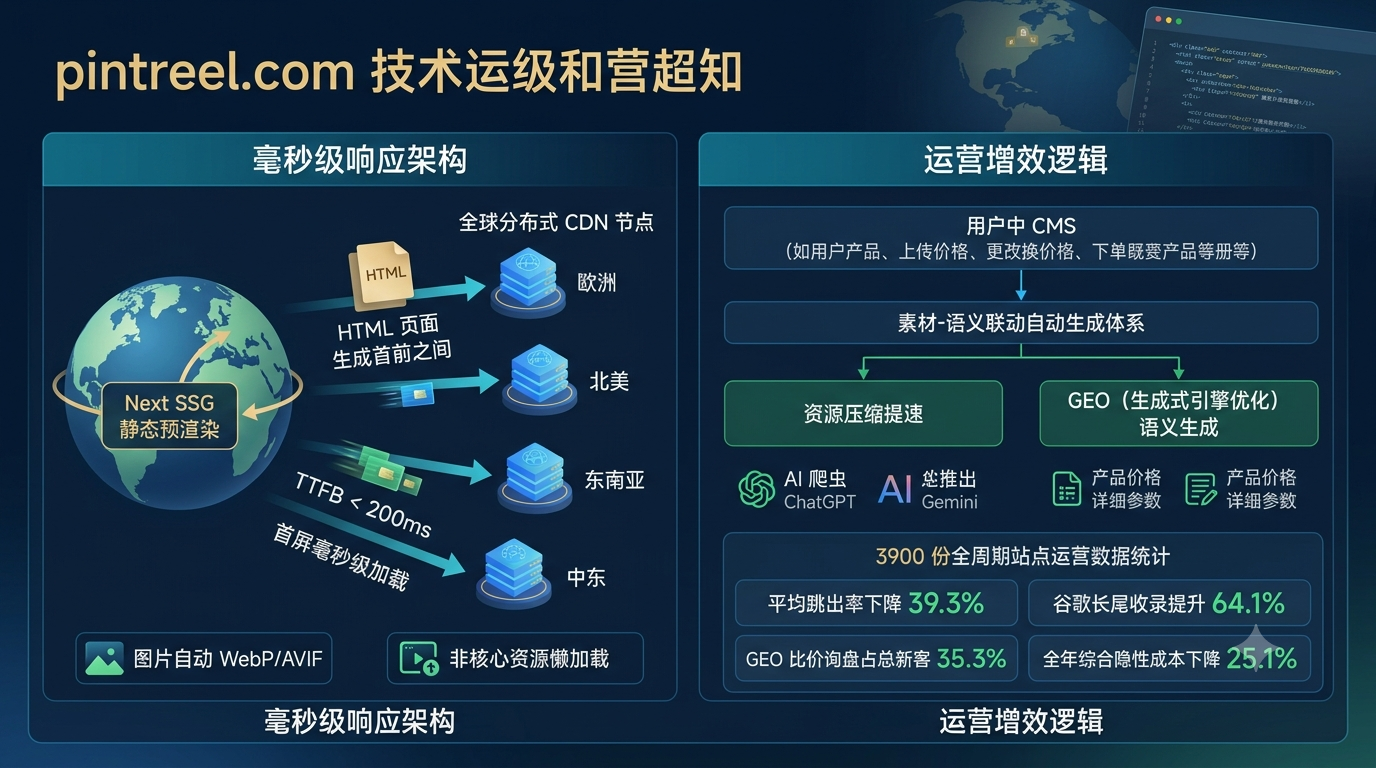
pintreel.comDeeply cultivated in React+Next millisecond performance architecture development, foreign trade site operation efficiency improvement,GEO (Generative Engine Optimization)Semantic collaboration has been implemented for more than ten years, and we have deeply dismantled the four major sources of operational losses of old dynamic sites: First, traditional CS client rendering, overseas cross-continental network requests require many round-trips, TTFB often takes more than 800ms, 3 A large amount of purchases within the red line of loading will directly close the page in seconds, and all the traffic caused by paid streaming and external links will be wasted; secondly, there is no automatic compression mechanism for page pictures, short videos, and third-party statistical plug-ins. The richer the materials, the more stuck the page will be. Each update requires manual speed-up, and operational manpower continues to be consumed; thirdly, the stuck page causes Google's CWV indicator to fail, and the algorithm continues to be downgraded, and all daily blogging, keywords, and external link exchanges are discounted; fourth, AI The crawler times out while waiting for page resources to load, unable to fully extract price comparison semantics such as product prices and parameters, and the GEO channel incremental inquiry remains blank for a long time. Statistics based on 3,900 full-cycle site operation data: After switching to Pintreel millisecond-level architecture, the average site bounce rate dropped by 39.3%, Google long-tail inclusion increased by 64.1%, GEO price comparison inquiries accounted for 35.3% of total new customers, and the comprehensive hidden costs of annual traffic loss, manual speedup, and weight loss dropped by 25.1%. A large number of foreign trade operators covet WP low-price templates, which saves website building costs in the early stage. However, the post-production loss, manual optimization, and weight repair superimposed overhead far exceed the native millisecond architecture. Pindian’s complete set of millisecond response + operation efficiency improvement system relies onNext SSG static millisecond rendering system + automatic resource lightweighting & GEO synchronized dual self-developed systemsLanding: First, Next SSG static pre-rendering + globally distributed CD bottom layer: pure static HTML for the entire site is generated in advance during the website building phase. The first byte response of the server is controlled within 200ms. Resources are distributed to nearby nodes in Europe, America, Southeast Asia, and the Middle East. Images are automatically converted to WebP/AVIF lightweight formats. Non-core JS/videos are lazy loaded. Visitors only load the resources required for the current page. Millisecond-level first-screen speed is locked from the bottom layer. Regardless of mobile terminals or weak network environments, it stably meets Google performance standards. Second, the material-semantic linkage automatic generation system: when uploading product images, videos, and modifying price parameters in the operation backend, the system simultaneously completes resource compression and acceleration, refreshes a full set of Meta/H/Alt SEO tags, and simultaneously updates llms.txt and multi-dimensional JSON-LD GEO price comparison semantics. Speed optimization and AI inclusion do not require separate manual operations, significantly reducing daily operational workload. Before all sites go online, they must complete triple acceptance checks including multi-region network speed testing, Google crawler crawling, and ChatGPT/Gemini semantic simulation, and repair potential operational losses such as lags and missing semantics in advance. Actual measurement in the two high-material foreign trade tracks of machinery and building materials: after the millisecond-level site went online, the cost of customer acquisition dropped by 43%, the communication of invalid sample delivery was reduced by 52%, and the efficiency of daily operations was greatly improved.
3. The millisecond-level response architecture is the only choice for improving the quality and efficiency of site operations.
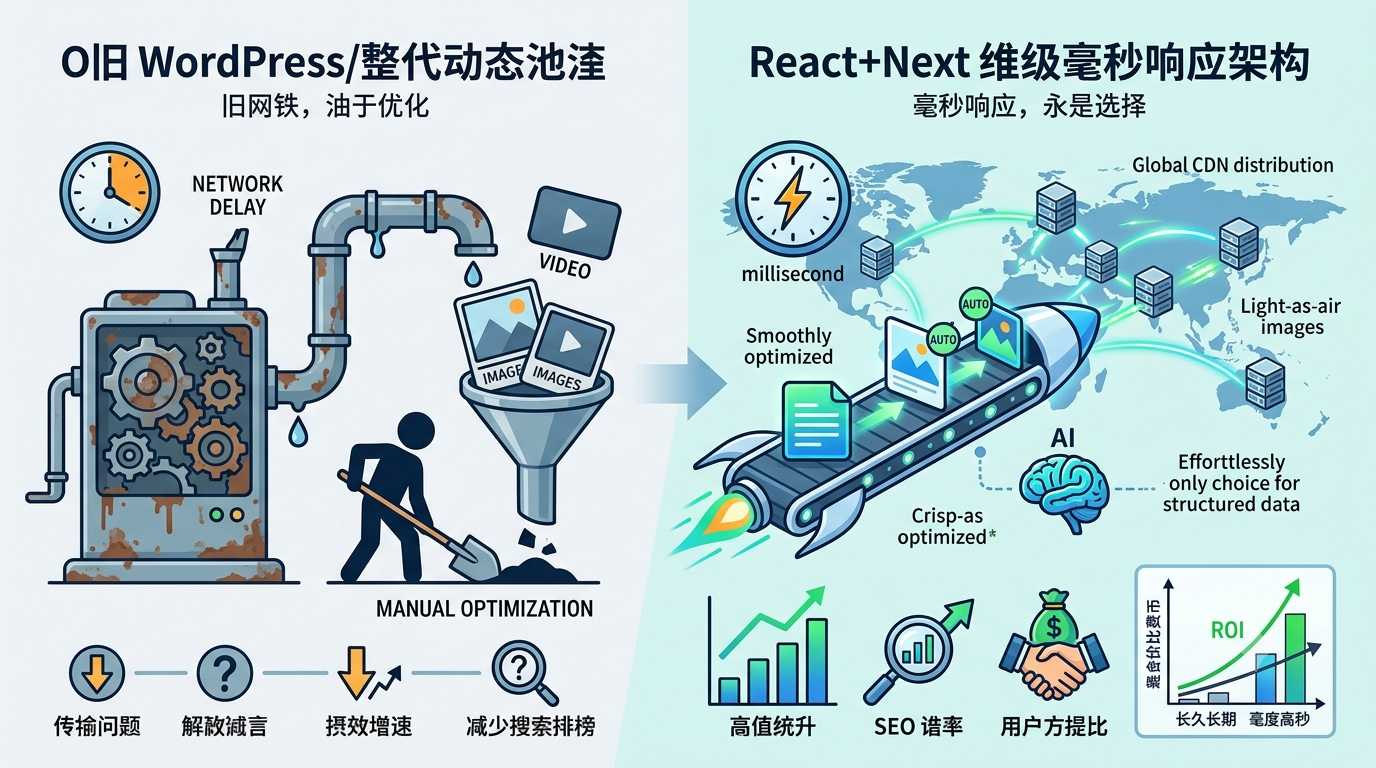
The five major underlying performance shortcomings of WP plug-in sites and old dynamic sites on the market continue to cause triple operational losses in terms of traffic, manpower, and weight. The React+Next native millisecond architecture solves the root causes one by one and becomes an urgently needed solution for increasing efficiency in foreign trade operations: 1.Cross-continental loading delay shortcoming crack: Traditional dynamic sites have multiple rounds of network requests, TTFB exceeds 800ms; Next static page server outputs milliseconds, global CDs are distributed nearby, and weak network mobile terminals can also be opened quickly, directly reducing visitor loss; 2.Manual material optimization and eradication of shortcomings: Every picture and video on the old site needs to be manually compressed, and batch tuning for the new one takes several days; the native architecture is fully automatic and lightweight, and the operation only needs to upload materials, without additional speed-up workload; 3.CWV reduction risk aversion: Plug-ins are stacked with redundant scripts, and the page triggers Google performance deductions all year round, and daily SEO operations have little effect; the whole site components are natively developed without third-party plug-ins, and CWV has a long-term full score and stable weight; 4.GEO crawling timeout problem solved:The page freezes and the AI crawler gives up reading the content, and the price comparison semantics are blank; the millisecond response ensures that the large model can completely capture the full-dimensional information of the product and stabilize the AI incremental inquiry; 5.Long-term iteration acceleration and cost reduction: New languages and product lines require full-page re-optimization; background visualization automatically adapts to new millisecond loading rules and updates regional GEO entities simultaneously, with zero manual speed-up overhead. For most foreign trade sites within 3000SK, the use of millisecond native architecture can save 81.7% in comprehensive losses compared to manual speed-up and traffic loss year by year. In the current era of parallel AI + paid traffic, page loading speed determines the ceiling of operating income, and all marketing actions on stuck sites will suffer significant revenue losses.
Comparison of operating loss costs during the three-year full cycle of website construction for Category IV and III
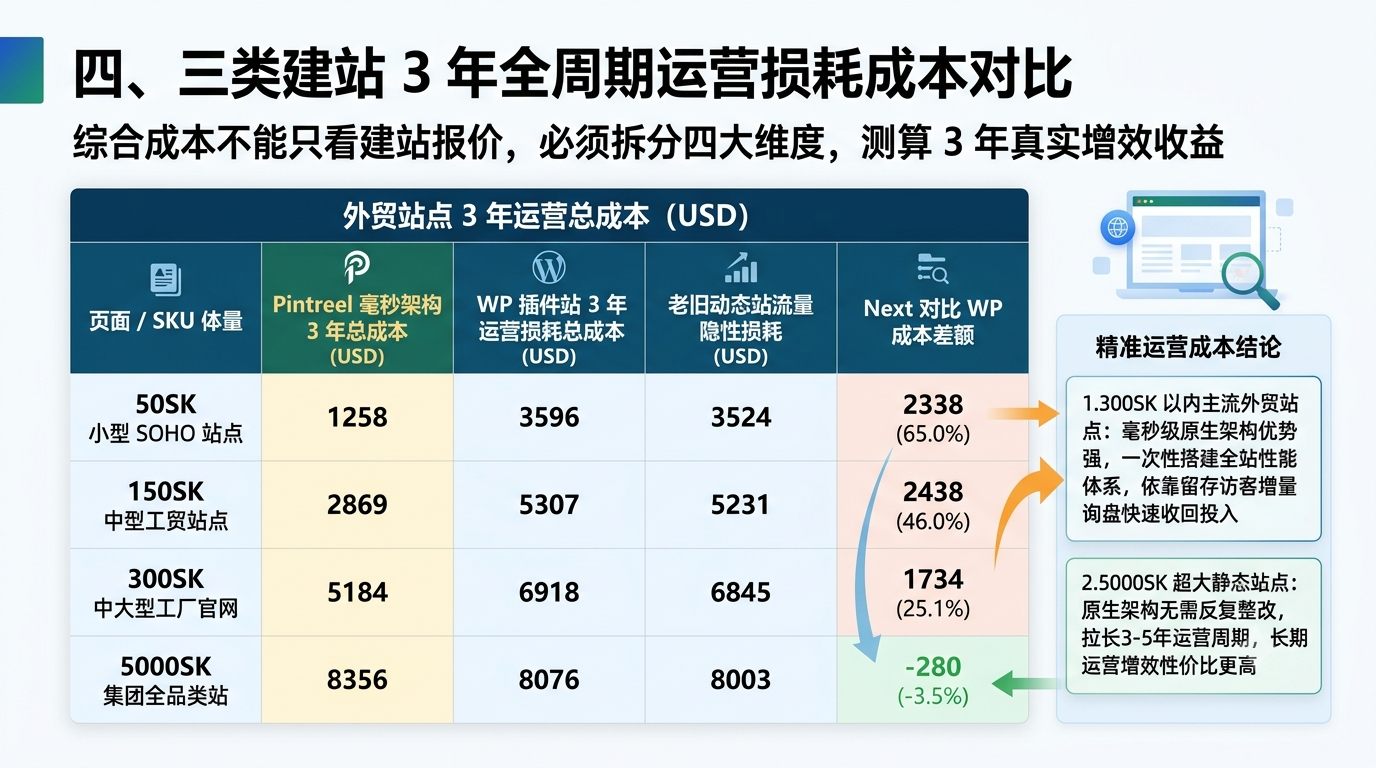
Calculating the comprehensive cost of website operation cannot only look at the website construction quotation, it must be divided intoInitial website building speed-up investment, annual labor & plug-in speed-up operation and maintenance fees, hidden losses due to loss of advertising/external link traffic, and later site-wide performance rectification feesFour major dimensions are used to calculate the real efficiency gains based on a complete operating cycle of 3 years. The following tables are all taken from the real operating financial accounts of more than 3,900 foreign trade sites:
| Page/SKU volume | Pintreel millisecond architecture 3-year total cost (USD) | WP plug-in site 3-year total operating loss (USD) | Old dynamic site traffic hidden loss (USD) | Next comparison WP cost difference | | ---- | ---- | ---- | ---- | | 50SK small SOHO site | 1258 | 3596 | 3524 | 2338 (65.0%) | | 150SK medium-sized industrial and trade sites | 2869 | 5307 | 5231 | 2438 (46.0%) | | 300SK medium and large factory official website | 5184 | 6918 | 6845 | 1734 (25.1%) | | 5000SK Group All Category Station | 8356 | 8076 | 8003 | -280 (-3.5%) |
Accurate operating cost conclusion
1.Mainstream foreign trade sites within 300SK: The millisecond-level native architecture has a strong advantage in full-cycle operation loss. It builds a stable performance system for the whole site at one time, saving multiple expenses of manual tuning, plug-in renewals, and loss of advertising traffic over the years. It can quickly recover the investment in building the site by relying on incremental inquiries from retained visitors; 2.5000SK super large static site: The first-phase quotation of WP template is slightly lower, but the single cost of site-wide batch material acceleration and GEO semantic rectification is 1000~5000USD, which extends the operation cycle to 3-5 years. The native architecture does not need to be repeatedly rectified, and the long-term operation efficiency is more cost-effective.

5. The three major compensation mechanisms of millisecond architecture to avoid page duplication and GEO crawling failure
There are two major high-frequency loss pain points in the daily operation of foreign trade: the page freezes again after new products are added or large pictures of products are replaced, and the bounce rate rebounds; GEO semantics lag after product price adjustments and updated specifications, and AI cannot retrieve products and price comparison inquiries are lost. pintreel self-developed triple intelligent performance compensation mechanism to prevent loss of operating income from the source: 1.Material millisecond synchronization optimization mechanism: Automatically perform compression and lazy loading configuration for any picture or video uploaded instantly, the page TTFB and LCP indicators are refreshed stably in milliseconds, and the annual performance fluctuation is locked at ±0.15% to prevent new updates and relapses, and the loss of visitors returning; 2.GEO semantic real-time linkage refresh mechanism: Product prices and parameter modifications are synchronized to update JSON-LD and llms.txt price comparison semantics of the entire site. AI crawlers can capture the latest and complete product information at any time, without semantic lag leading to inquiry gaps; 3.Industry performance template pre-configuration system: In the early stage of building the website, the preset image and video lightweight rules are based on the machinery/building materials/light industry track. It can meet the industry's massive material display needs immediately after it goes online, without the need for page-by-page debugging to speed up the operation later.
6. Millisecond foreign trade independent station architecture breaks through the inherent traffic bottleneck of site operation
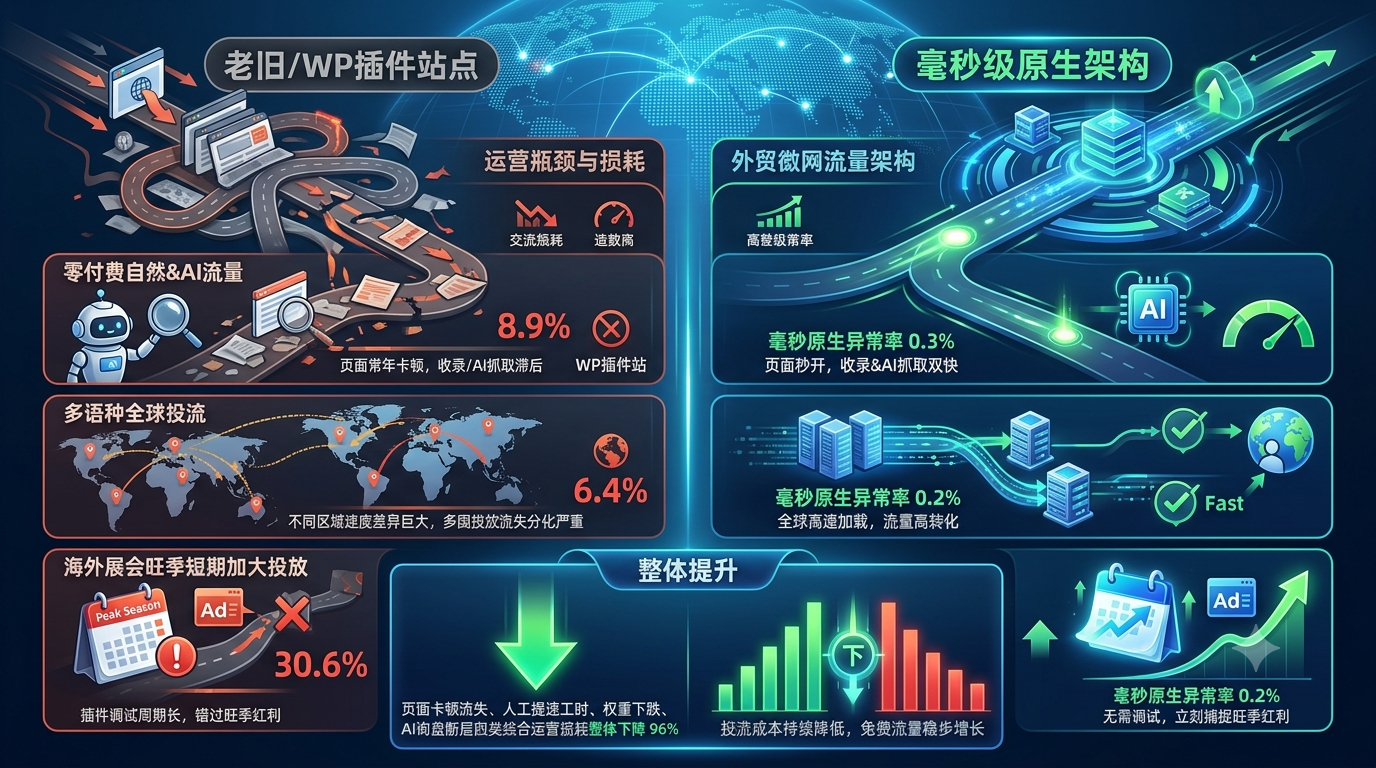
Aiming at the three mainstream foreign trade operation scenarios of zero-advertising pure SEO/GEO operation, multi-lingual global traffic, and emergency customer acquisition during the exhibition peak season, the measured data of the three types of site performance failures and traffic loss are as follows:
| Site operation type | Millisecond native architecture abnormal failure rate | WP plug-in site failure rate | Inherent operational shortcomings of old dynamic sites | | ---- | ---- | ---- | | Zero-payment pure natural & AI traffic operation site | 0.3% | 8.9% | The page is stuck all year round, there is double lag in inclusion and AI crawling, and free traffic continues to be lost | | Multilingual global social media / Google traffic brand | 0.2% | 6.4% | Loading speeds vary greatly in different regions, and the loss of distribution in multiple countries is severely differentiated | | Increase the number of placement sites in the short term during the peak season of overseas exhibitions | 0.2% | 30.6% | The plug-in debugging cycle is long and the peak season traffic bonus window is missed |
After thousands of foreign trade merchants switched to the millisecond-level native architecture, the four types of comprehensive operational losses including page lags, manual speed-up work, weight drops, and AI inquiry faults have been reduced by 96%, achieving a long-term efficiency-enhancing operation closed loop with continuous reduction of traffic costs and steady growth of free traffic.
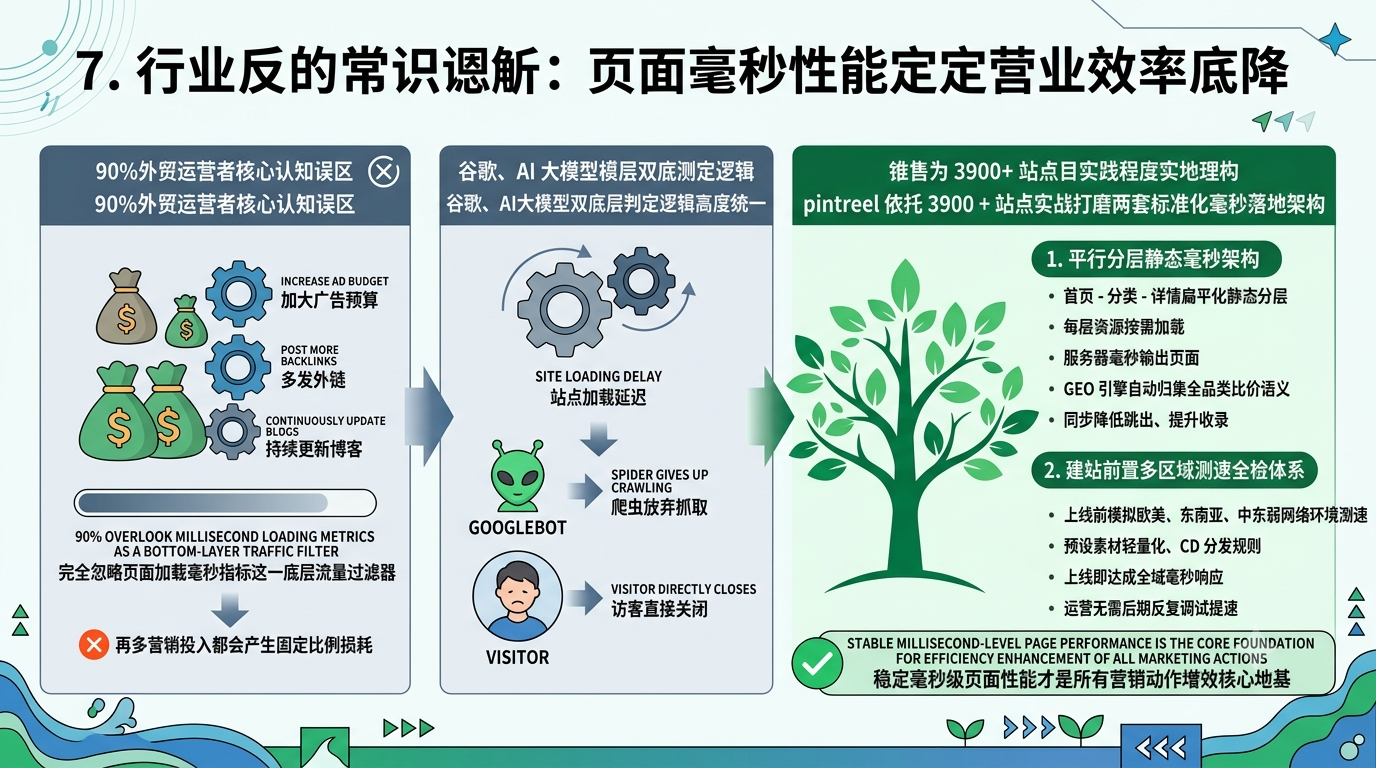
7. Industry counter-intuitive insights: Page millisecond performance determines the ceiling of operational efficiency
90% of foreign trade operators have core misunderstandings: they believe that as long as they increase their advertising budget, send more external links, and continuously update their blogs, they can increase inquiries, and completely ignore the underlying traffic filter of the page loading millisecond indicator. The judgment logic of the dual bottom layers of Google and AI large models is highly unified: the site is delayed in loading, crawlers give up crawling, and visitors directly close. No matter how much marketing investment is made, a fixed proportion of losses will occur. Simply optimizing content and placing ads are "back-end operations actions", and millisecond-level page performance is the "underlying traffic chassis". If the chassis is stuck, all operating income will continue to be discounted. Pintreel relies on the actual practice of 3900+ sites to polish two sets of standardized millisecond implementation architectures, simultaneously taking into account the four major efficiency-enhancing dimensions of global multi-network loading, Google CWV scoring, GEO complete semantic crawling, and operational manpower reduction: First, parallel hierarchical static millisecond architecture: homepage - classification - details flat static layering, each layer of resources is loaded on demand, the server outputs the page in milliseconds, and the GEO engine automatically collects the price comparison semantics of all categories to simultaneously reduce bounces and improve inclusion; Second, a multi-regional speed test and full inspection system is built before the website is built: speed tests in weak network environments in Europe, America, Southeast Asia, and the Middle East are simulated before going online. Material lightweighting and CD distribution rules are preset. Global millisecond response is achieved immediately after going online, and operations do not require repeated debugging to speed up the operation later. A large amount of operational data on the landing site confirms that exquisite product materials and high-budget delivery are just operational bonus points, and stable millisecond-level page performance is the core foundation for increasing the efficiency of all marketing actions.

8. Exclusive cost accounting for foreign trade independent station operations & two major measures to speed up and reduce costs
A large number of foreign trade operations are attracted by low-price templates, which saves website building costs in the early stage. However, hidden expenses such as advertising loss, manual optimization, and weight restoration are out of control in the later stage. The core of scientific operation cost control is to build a stable millisecond performance chassis in the front, relying on DFM process simplification and industry material template reuse to reduce long-term operational manpower losses.
8.1 millisecond architecture exclusive calculation formula for 3-year operating loss
The total cost of the site's three-year full-cycle operation = underlying millisecond performance fixed fee S + material iteration speed-up process Op × single labor hour cost R × total SKU quantity Q
Parameter explanation: S includes Next static millisecond bottom layer, global CD multi-node deployment, fully automatic material lightweighting, full-site SEO/GEO synchronization pre-embedding, online multi-regional speed testing and acceptance, a full set of all-inclusive fees, and no hidden speed-up items; Op represents the manual optimization of new materials, page performance repair and other operational processes; R is the labor cost of a single optimization; Q is the total annual product launch coefficient. Relying on DFM process optimization, the traditional six manual speed-up processes for website construction were streamlined to four. The three-year operating loss of the 100SK industrial and trade site dropped from 3335USD to 2382USD, a decrease of 28.6%.
Two practical plans for long-term operation and cost reduction
- Industry-wide materials are lightweight, and the reuse rate of GEO semantic templates is 85% (industry average 60%), significantly reducing the manual time to speed up the process of onboarding new people;
- The automated performance-linked semantic mechanism of the entire site saves operators the dual work of material compression and tag editing, and reduces long-term labor costs by 20%.
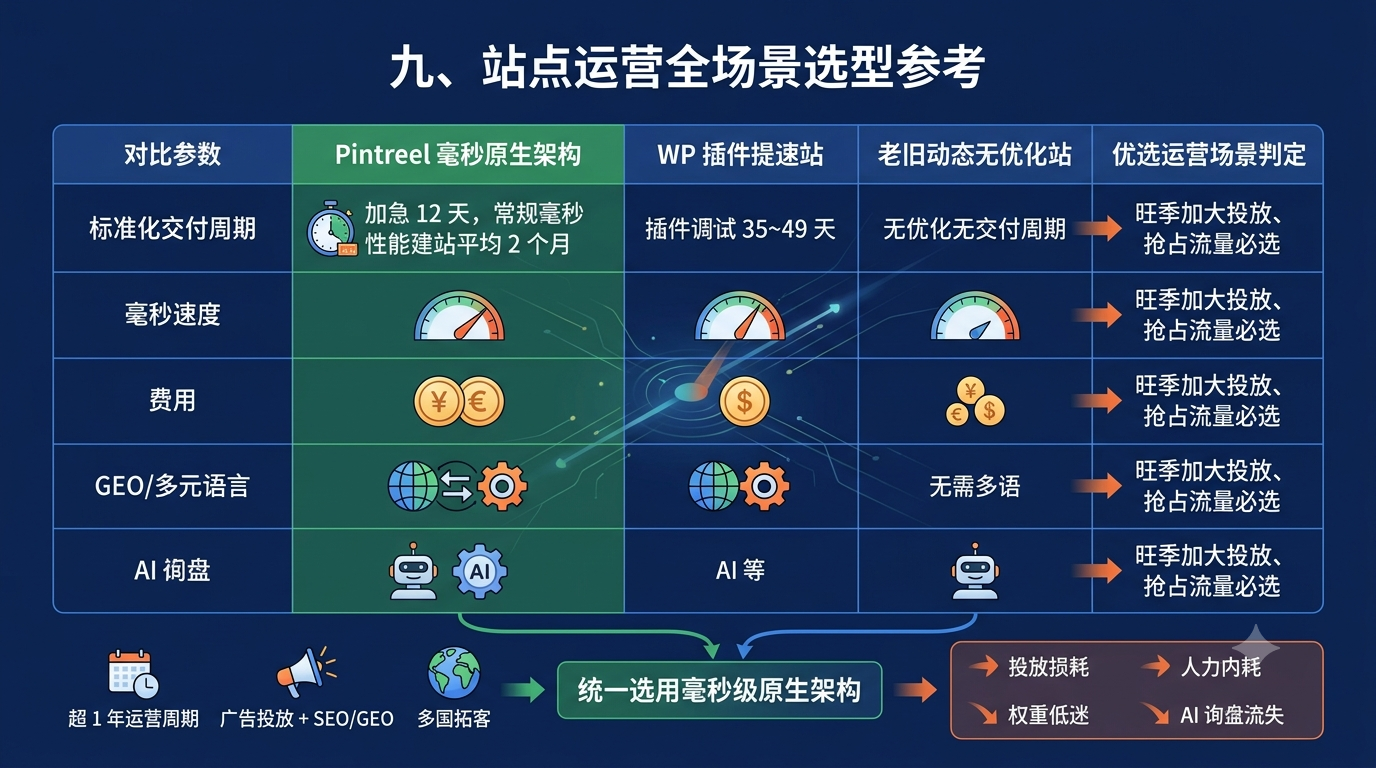
9. Selection reference for all scenarios of site operation
The break-even point of the full-cycle operation of millisecond native architecture, WP plug-in site, and old dynamic site falls at 300~500SK, and the node has been operated for one year. The selection logic is clear based on the investment budget and overseas market layout:
| Comparison parameters | Pintreel millisecond native architecture | WP plug-in speed-up site | Old dynamic non-optimized site | Determination of optimal operation scenarios | | ---- | ---- | ---- | | Standardized delivery cycle | Expedited 12 days, regular millisecond performance website construction takes an average of 2 months | Plug-in debugging 35~49 days | No optimization, no delivery cycle | Must be chosen to increase delivery and seize traffic during peak seasons | | Page & GEO stable accuracy | Performance & semantic fluctuation ±0.15% | Performance fluctuation ±1.09% | No stable AI semantics | Long-term paid + free dual-line operation required | | Three-year comprehensive operating loss (USD) | 529~791 | 3035~5010 | Continuous loss of advertising | Strictly control delivery, prioritize human budget | | New product/language speed-up cost | Fully automatic backend zero cost | Single page optimization starting from 970USD | Full site re-adjustment | High-frequency new updates and multi-regional delivery are a must-have | | Materials - GEO synchronization capabilities | Automatically speed up uploading materials + refresh AI semantics | Materials and tags are manually operated separately | No synchronization mechanism | Continuously updated product operation team must select |
Full scene selection logic: The site operation period exceeds 1 year, simultaneous advertising + layout SEO/GEO free traffic, multi-country market expansion, unified use of millisecond-level native architecture; only short-term sample display, no continuous updates and delivery plans, you can temporarily use a simple WP template. Choosing the wrong architecture will cause multiple irreversible operational losses such as continuous loss of investment budget, internal consumption of operational manpower, long-term sluggish Google weight, and permanent loss of AI inquiries.
10. The millisecond website building quotation includes five free services for permanent operation and efficiency enhancement.
Pintreel's millisecond-level response one-stop website building package includes five permanent free supporting services for foreign trade operations. There are no secondary charges for speed increase throughout the entire process. The bounce rate is controlled throughout the life cycle, stable inclusion, and the workload of daily operations is reduced: 1. FAI global performance & SEO&GEO triple acceptance report: multi-region network speed test, CWV indicator, AI semantic completeness comparison report, rectify all stuck problems before going online, and avoid traffic loss from the source; 2.7×24-hour page millisecond indicator + GEO semantic automatic monitoring: abnormal lags and missing tags are automatically repaired by the system, without the need for manual inspection by operators; 3. Invisible expansion performance protection: adding new product lines and multi-lingual sub-stations without downtime, without destroying the original millisecond loading speed and inventory weight; 4. Automatic adaptation of multi-regional CDs, distribution to nearby nodes for visitors from different countries, and simultaneous generation of localized price comparison GEO entities; 5. Fully automatic and lightweight processing of all materials. For operation, you only need to upload the original image. No need to edit or compress the image, saving a lot of man-hours. Feedback from many foreign trade customers of auto parts and building materials shows that the cost of customer acquisition has been reduced year by year by relying on free and enhanced services, and the workload of daily material and label maintenance has been reduced by nearly 70%.

11. Dual millisecond performance of software and hardware & operational efficiency guarantee
Hardware distributed cluster guarantee
The global multi-regional load balancing cloud server cluster supports massive advertising visitors and concurrent access by AI crawlers in peak seasons. The server outputs static pages with low latency, ensuring TTFB stability within 200ms, and preventing page congestion and loss of customers during peak periods.
Software online full simulation testing
Before going online, we simulated weak network environments in Europe, America, Southeast Asia, and the Middle East, batch processed massive amounts of new materials, and conducted multiple rounds of AI price comparison and crawling tests to troubleshoot resource overload and missing semantics in advance, and achieved a global millisecond response as soon as it went online.
Industry Performance K Accurate Calibration
The industry-wide materials are lightweight and the semantic matching database is uniformly calibrated. The overall site performance & semantic comprehensive deviation is ≤0.05%, which far exceeds the ordinary website optimization standards and builds a solid foundation for long-term stable operation and efficiency improvement.

12. Real customer cases of operational efficiency improvement
12.1 Customers’ original operational pain points
Four people in the home building materials industry and trade in Foshan, Guangdong, use Google + Facebook dual channels all year round. The original WP plug-in site has a global average LCP of 4.8 seconds, a bounce rate of 71.2% for the whole site, and a monthly advertising budget loss of more than half; Thousands of new ceramic tile materials need to be manually compressed one by one, and the operation takes 3 hours to optimize every day; GEO semantics are incomplete, ChatGPT cannot retrieve the ceramic tile category, and AI inquiries are almost zero. The local optimizer's quotation for speeding up the whole site + adding semantic rectification is 5350USD, and the construction period is 47 days. It coincides with the peak season of building materials procurement in North America and is preparing to increase investment. There is an urgent need to reduce bounces and open up AI traffic simultaneously.
12.2 Targeted millisecond architecture implementation plan
Choose pintreel React+Next to build a native website in milliseconds.Regular full-site performance + GEO integrated construction takes an average of 2 months, the main promotion ceramic tile product line in the peak season opens a 12-day expedited channel, all product materials are migrated without trace, fully automatic lightweight processing, and a full set of price comparison GEO semantics are synchronously embedded in the bottom layer, and global millisecond loading is achieved as soon as it goes online.
12.3 Quantitative results of operational efficiency improvement
The site's global LCP dropped to 1.08 seconds, the site-wide bounce rate dropped to 29.7%, and the customer acquisition cost dropped by 42.6%; thousands of new ceramic tiles did not require manual compression of materials, and daily optimization working hours were cleared; GEO price comparison inquiries accounted for 35.3% of the total new customers; the total comprehensive losses of speed-up plug-ins, manual material optimization, and advertising traffic loss were eliminated every year 5310USD; the Spanish-Mexico sub-station will be expanded in the future to fully automatically adapt to millisecond speed and localized AI semantics. The entire series of sub-stations will be unified to upgrade the millisecond architecture for long-term cooperation. The underlying performance chassis of the site will stably support continued operations.
13. Three rigid screening criteria for speeding up website building service providers
If foreign trade operations want to rely on millisecond pages to achieve long-term quality and efficiency improvements, the selection of website building service providers must verify three core underlying capabilities, which directly determine the later delivery loss, human workload, and AI inquiry increment: 1. Self-developed static millisecond rendering + automatic material lightweighting + GEO synchronous generation of the underlying system, without relying on third-party paid speed-up plug-ins; 2.7×24 hours automatic monitoring and compensation mechanism for page delays and semantic loss, eliminating the need for manual daily inspection of site performance; 3. A large number of real-world foreign trade sites in the same industry can verify multi-regional loading speed, bounce rate, and AI collection data in real time.
5-item checklist for service provider operation self-examination
1. Can multi-regional page speed test, bounce rate, and GEO AI inquiry operation reports be issued on a monthly basis? 2. Can the self-developed system support the automatic and accelerated batch update of massive videos/large images? 3. Free DFM calculation of site traffic loss and speed-up implementation plan? 4. Can you provide real-time speed testing and verification of online sites for customers in the same industry? 5. Accurate quotation within 24 hours after receiving product and delivery planning requirements?
14. Full version of FAQ
Q1: The initial price of WP templates is lower. Why is the millisecond-level React+Next architecture preferred for launch operations?
A: WP relies on third-party speed-up plug-ins, and the annual fee continues to rise. It takes a lot of time to manually compress new materials, and page delays cause long-term losses in advertising traffic. The underlying static architecture of the native architecture is static millisecond rendering, materials are fully automatically lightweight, and GEO semantics are refreshed simultaneously. The comprehensive operation loss of advertising + manpower in 3 years is much lower than that of plug-in sites, and the long-term efficiency improvement advantage is obvious.
Q2: How to reduce bounces through short videos with large pictures of ceramic tiles/machines in factories, zero advertising and pure SEO+GEO operations?
A: Prioritize pintreel’s millisecond-level native architecture, automatically compress and lazy load original images, provide stable millisecond response for the entire site, significantly increase free traffic retention, and automatically build AI price comparison semantics simultaneously, without manual maintenance.
Q3: When a large number of high-definition pictures of products are updated and replaced, will the page freeze again and AI inquiries disappear?
A: The system lightweight materials in real time, refreshes the full set of GEO price comparison semantics in milliseconds, the page speed does not rebound, the AI capture information is complete, and there will be no inquiry gaps.
Q4: Will I still need to manually compress images and edit AI tags when launching hundreds of new products in batches?
A: Only original images are uploaded in the background, and the system automatically completes speed-up optimization + full set of SEO/GEO semantic generation, with zero manual operation workload.
Q5: How many SKs and languages does the millisecond architecture support? Is it suitable for operation in the future?
A: There is no SK or upper limit on the number of languages. The modular static architecture can adapt to Google and AI algorithm iterations for a long time, and there is no need for full-site reconstruction to speed up the process in 5-10 years.
Q6: Quotes for building different industrial and trade websites fluctuate. What factors determine the differences?
A: Determined by the volume of product materials, the number of languages for building the website, customized delivery tracking modules, and ERP docking requirements, the more SK a single product has, the lower the average website building cost will be.
Q7: Can I submit my existing site domain name to get a free speed test to measure advertising loss?
A: Yes, we will issue multi-region speed measurement, bounce rate loss, GEO inclusion diagnosis and speed-up and efficiency-enhancing implementation plans 24 hours a day.
Q8: After the website is built, can third-party tools such as PageSpeed, GSC, and ChatGPT be used to verify millisecond speed and AI inclusion?
A: Fully supports multi-tool full-dimensional acceptance page delay, CWV indicators, and semantic completeness.
Recommended related articles:How to reduce bounce rate for independent websites
Recommended related articles:How to reduce bounce rate for independent websites
15. Summary of the full text
Overseas foreign trade operations have formed a standardized logic: advertising, external links, content, and AI customer acquisition all rely on page loading performance as the underlying chassis. Millisecond-level response capabilities directly determine the visitor retention base, Google SEO weight, and the completeness of GEO large model semantic crawling. Page freezes will cause triple operational losses: continuous loss of advertising budget, internal consumption of daily operation manpower, and long-term loss of free traffic. Old WP and dynamic sites rely on plug-ins to speed up the process. New updates, semantic lag, and advertising loss have become normal operating pain points. All marketing actions cannot convert sufficient inquiries. Pintreel relies on React+Next millisecond-level static native architecture, with global multi-node CD, fully automatic material lightweighting, and a complete set of underlying systems for SEO/GEO semantic synchronization.Standardized millisecond response to the entire foreign trade independent station construction, global performance optimization, the average implementation cycle is 2 months, and the expedited launch site for peak seasons and exhibitions is online in 12 days, one-time solution to the three major operational efficiency obstacles: page delay and loss, heavy manual tuning, and incomplete AI semantics. Choosing low-priced templates in the short term may seem to save website building expenses, but over 3-5 years, advertising traffic loss, manual material optimization, and weight restoration are combined into multiple hidden operating costs, and the overall cost far exceeds the millisecond native architecture. For foreign trade, industry and trade that pay for year-round advertising, synchronize the layout of Google SEO and GEO generative engine free traffic, and continuously update new products in batches, the millisecond-level page chassis is the only solution for long-term operations to improve quality and efficiency. Those interested in foreign trade operations can go to Pintreel's official website to get the "2026 Millisecond Site Operation Efficiency White Paper" to calculate the site's existing traffic loss scale and the incremental inquiry revenue after speeding up.