
According to the "AI Foreign Trade Customer Acquisition Trend Report" released by Xiaolanben Foreign Trade Edition in January 2026, pure trading companies account for 42% of my country's foreign trade enterprises. However, only 11% of these independent websites can be recognized as "reliable foreign trade service providers" by AI platforms such as ChatGPT. Most websites lack factory qualification endorsements and content without credible evidence, resulting in an AI recommendation rate of less than 8% and a loss rate of over 40% of accurate inquiries. The core advantage of pure trading companies is not production capacity, but rather supply chain integration, precise resource matching, and localized service capabilities. However, most websites have not transformed these advantages into trust signals that AI can recognize through GEO optimization, and continue to blindly pile up ineffective keywords such as "direct from factory," which are instead judged by AI as false content. A Shenzhen-based pure trading company specializing in electronic components achieved a significant boost in its AI platform's core keyword recommendation rate within two months of targeted GEO optimization at the end of 2025. This boosted its supply chain resources and localized service capabilities, leading to a 130% increase in precise inquiries from the European and American markets. This case demonstrates the core logic: AI's assessment of a "reliable foreign trade service provider" is not based on factory qualifications, but rather on verifiable service capabilities and value output. GEO optimization is the key to enabling AI to accurately capture and recognize these capabilities.
I. Core Logic: The AI platform's rules for identifying "reliable foreign trade service providers" and the GEO collaboration logic
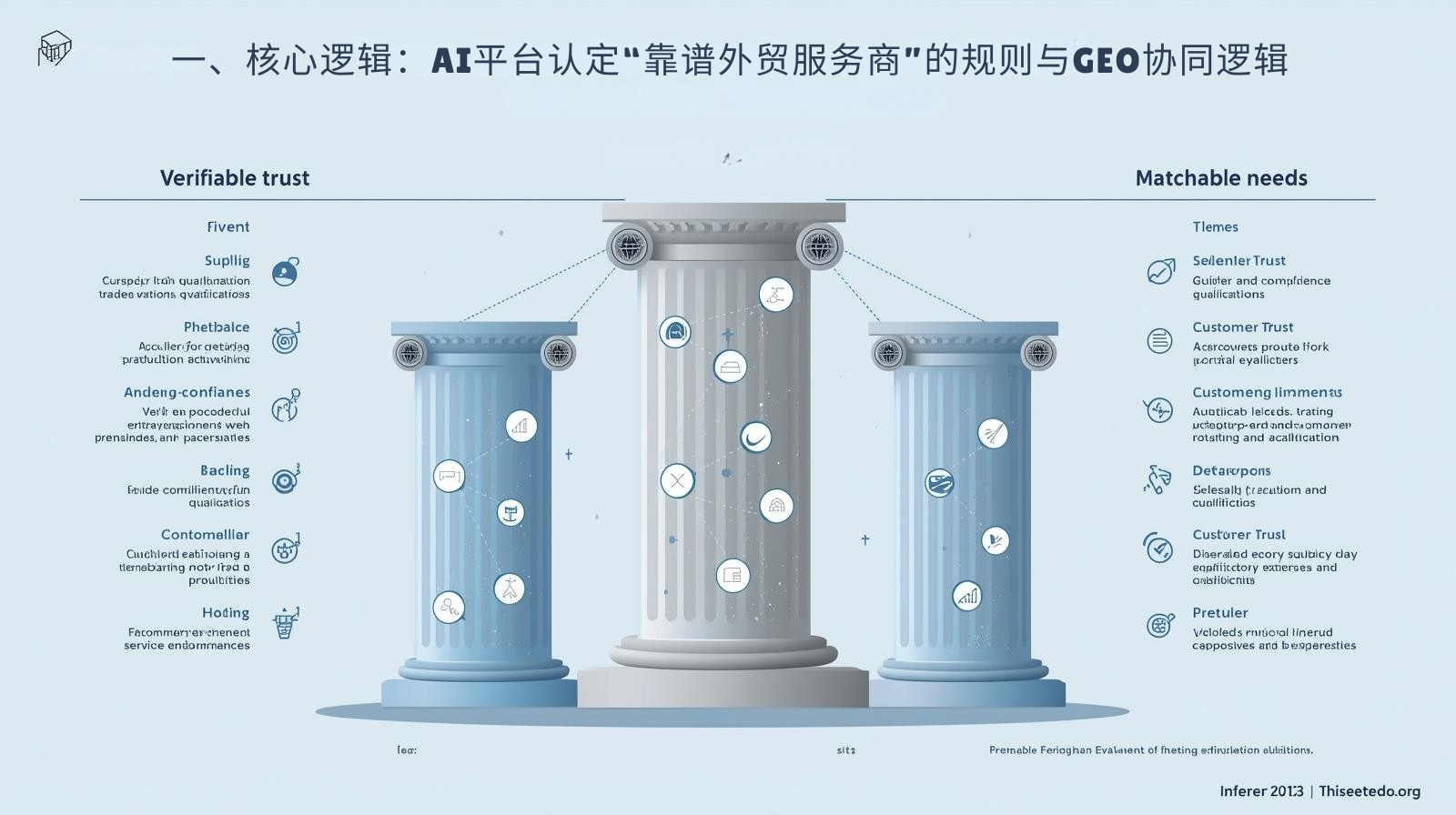
AI platforms like ChatGPT have moved beyond the single dimension of "whether or not they own a factory" in their assessment of pure trading foreign trade service providers, shifting to a three-dimensional evaluation system based on "verifiable trust, perceptible capabilities, and matchable needs." For pure trading companies without factories, the core value of GEO optimization lies in transforming their core advantages, such as supply chain integration, resource matching, and localized services, into structured content that AI can recognize. This allows for precise matching of the search needs and trust demands of buyers in the target market, which aligns perfectly with the core trend of "AI-driven trust building and service value-led transformation" in foreign trade by 2026.
1.1 Three Core Rules for AI Platforms to Identify "Reliable Foreign Trade Service Providers" (Latest 2026)
Based on OpenAI's foreign trade content crawling algorithm and Alibaba.com's trust system construction standards, combined with 2026 practical cases of AI customer acquisition for pure trading companies, the core rules for AI to prioritize reliable foreign trade service providers can be broken down into three points, which directly determine whether an independent website can enter the AI recommendation list:
1. Concretizing Trust Evidence (Core Prerequisite) : AI prioritizes traders with verifiable trust evidence. The core evidence dimensions are not factory qualifications, but supplier cooperation qualifications (cooperation agreements with compliant factories, supplier certification documents), trade compliance qualifications (import and export rights, customs filing certificates, target market certification agency qualifications), and customer trust endorsements (real cooperation cases, customer reviews, order fulfillment records). For example, when AI determines whether an electronic component trader is reliable, it will prioritize content containing "long-term cooperation with 3 ISO9001 certified factories (with key pages of cooperation agreements), possessing EU CE certification agency qualifications (query link), and a 98% fulfillment rate with European and American customers in the past 6 months." Claims of "reliability" without any supporting evidence will have their trust weight reduced by 70%.
2. Structured Supply Chain Capabilities (Core Advantage) : The core competitiveness of pure trading companies lies in their supply chain integration and resource matching capabilities. AI will prioritize capturing content that presents these capabilities in a structured manner. Core dimensions include supplier resources (number of partner factories, geographical distribution, and capacity matching range), product matching capabilities (small batch/large batch adaptation, efficiency of non-standard customization), and logistics fulfillment guarantees (qualifications of partner logistics providers, regionalized logistics solutions, and delivery timeliness data). For example, content presented in a structured manner as "supplier resources - product matching - logistics fulfillment" is 4.3 times more likely to be captured by AI than pure paragraph-style content. This is because structured content allows AI to quickly extract the core service capabilities of trading companies.
3. Regional Adaptation (Core Matching) : AI will assess the suitability of traders based on the purchasing habits, compliance policies, and logistics preferences of the target market. Core adaptation dimensions include regional compliance (e.g., CE/UL certification in Europe and the US, RCEP tariffs in Southeast Asia), purchasing demand matching (e.g., high-quality product resources in Europe and the US, small-batch supply resources in Southeast Asia), and localized services (e.g., localized customer service, local warehouse connection, and after-sales response time). For example, when searching for German buyers, AI will prioritize recommending trader content that highlights "EU CE certified product resources, German local warehouse connection, 24-hour German customer service, and average delivery time of 7-10 days." Mismatched regional adaptation will directly reduce the recommendation priority of the content.
1.2 The Mutual Empowerment Logic of GEO and Pure Trading Companies' Core Advantages
The essence of GEO optimization is to "enable AI and buyers to quickly identify the core value and regional suitability of traders." The core advantage of pure traders is "flexible resource integration, accurate demand matching, and efficient service delivery." This mutual empowerment builds the core competitiveness of AI-recognized "reliability," and the core logic is reflected in three points:
1. GEO enables traders' advantages to be "precisely identified by AI": Without GEO optimization, the advantages of pure traders, such as supply chain resources and matching capabilities, will become generalized content that is difficult for AI to capture. By deeply binding advantages with regional keywords and demand scenarios through GEO, AI can quickly match the search needs of corresponding markets. For example, optimizing "having high-quality supplier resources" to "having European CE certified electronic component supplier resources, suitable for small-batch procurement needs in Germany and France" not only highlights the core advantages but also strengthens regional adaptability, greatly improving the efficiency of AI capture.
Traders' advantages make GEO optimization "more trustworthy": The core of GEO optimization is content value. Pure traders' real supplier resources, customer cases, and performance data are high-quality materials for GEO optimization. After localization optimization, these materials form a content matrix of "advantage + region + trust". For example, the generalized content of "cooperating with high-quality factories" can be optimized to "long-term cooperation with two ISO9001 certified electronics factories in Dongguan, which can stably supply small batches of components to the Southeast Asian market and comply with RCEP tariffs", making the content of GEO optimization more credible and naturally increasing the weight of AI recognition.
The two work together to achieve a "dual improvement in AI recognition and conversion efficiency": GEO optimization enhances AI's crawling and recommendation efficiency through localized and structured content, helping traders obtain "reliable service provider" certification; while the brand endorsement brought by AI certification significantly increases buyers' willingness to inquire, forming a closed loop of "AI crawling - certification endorsement - precise reach - inquiry conversion". According to data disclosed at the Global Smart Logistics Summit in January 2026, pure trading companies that achieved synergy between GEO and core advantages saw a 3.8-fold increase in AI certification pass rate and a 62% higher inquiry conversion rate than unoptimized sites.
II. Practical Implementation: Three-Stage Optimization Solution for Pure Trading Stations (Direct Application)
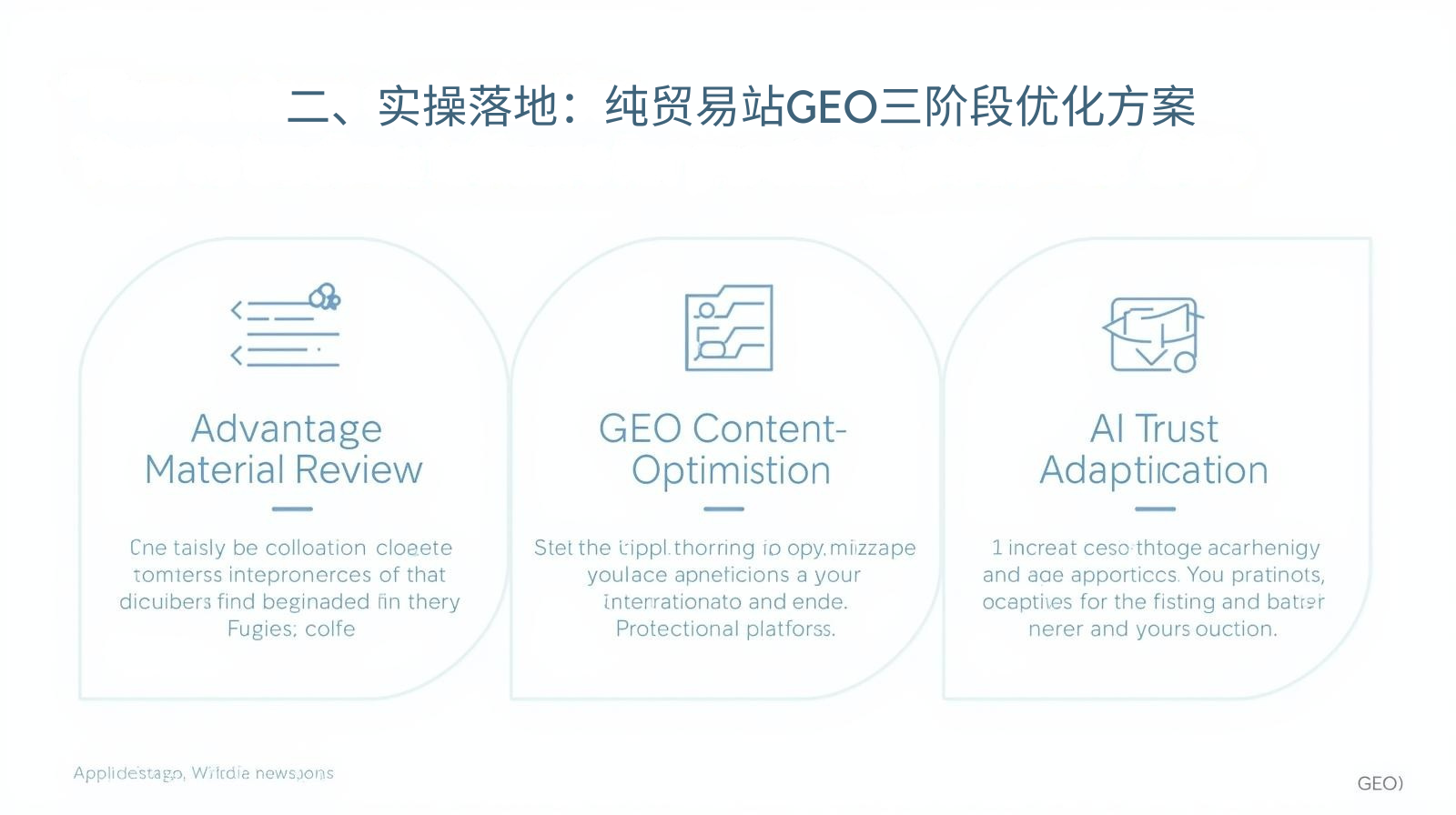
This solution combines practical cases from pure trading companies such as Shenzhen electronic components and Zhejiang hardware products, and refers to the Alibaba International Station trust module building standards and Xiaolanben AI customer acquisition logic. It completes the "advantage material sorting + GEO content optimization + AI trust adaptation" in three major stages. Each step clearly defines the key points of operation and authoritative reference basis to ensure that even without a factory, AI can recognize it as a reliable foreign trade service provider.
2.1 First Phase: Preliminary Preparation (3-4 days) – Core Advantages Analysis + GEO Keyword Development
The core objective is to identify the key strengths of pure trading companies and build a regionalized GEO keyword database to lay the foundation for subsequent content optimization. All materials must meet the "verifiable and structured" requirements for AI-driven content creation.
1. Core Advantage Material Compilation: ① Trust Supporting Materials: Collect supplier cooperation qualifications (cooperation agreements with compliant factories, supplier ISO/CE certification documents, etc., indicating factory name and cooperation period), trade compliance qualifications (import and export operating rights certificates, customs filing certificates, certification agency qualification documents, obtaining official query links), and customer trust materials (real cooperation cases in different regions, customer review screenshots, order fulfillment records, indicating customer region, industry, and cooperation content); ② Supply Chain Capability Materials: Compile supplier resources (number of cooperative factories, geographical distribution, production capacity range, and suitable product categories), product matching capabilities (small batch/large batch supply thresholds, non-standard customization docking cycle, product quality control process), and logistics fulfillment materials (qualifications of cooperative logistics providers, logistics solutions in different regions, average delivery time data, and logistics tracking query links); ③ Localized Service Materials: Compile compliance docking experience in target markets (such as European and American certification docking processes, Southeast Asian RCEP tariff declaration processes), and localized service resources (such as localized customer service languages, local warehouse docking resources, and after-sales response time).
2. Building a Regionalized GEO Keyword Library: ① Keyword Combination Logic: Combine keywords according to the formula "trade service terms + regional terms + product terms + compliance/demand terms". Core keywords (e.g., "foreign trade service provider"), long-tail keywords (e.g., "European CE certified electronic component service provider", "Southeast Asian small-batch hardware trader"), and scenario-based keywords (e.g., "RCEP tariff-adapted trade services", "small-batch customized foreign trade connection") should each account for 30%, 50%, and 20%, respectively. ② Regional Adaptation: Split keywords according to core markets (Europe and America, Southeast Asia, Middle East, etc.). For example, in the European and American markets, focus on keywords related to "CE/UL certification + trade services + high-quality products", and in the Southeast Asian markets, focus on keywords related to "RCEP + small batch + trade services + sea freight adaptation". ③ Keyword Selection: Use Semrush and Xiaolanben Foreign Trade Edition keyword tools to search for high-frequency search terms from October 2025 to January 2026. Prioritize keywords with high search frequency and low competition, and remove keywords such as "factory direct supply" that contradict the identity of traders.
2.2 Second Phase: Core Optimization (5-6 days) – Content Integration + Page Optimization + Trust Endorsement Reinforcement
The core objective is to naturally integrate the core strengths of traders with GEO keywords, optimize the core pages of independent websites, and create a content system that AI can recognize and that buyers can trust. The key optimization points are as follows:
2.2.1 Core Page Content Optimization
1. Homepage Content Optimization: The homepage highlights the core value of pure trading companies (e.g., "Focusing on foreign trade services for Europe and the Americas/Southeast Asia, integrating resources from 30+ compliant factories, small-batch precise matching + compliant fulfillment guarantee"), accompanied by real images of supplier factory scenes, customer cooperation scenarios, and logistics delivery (image ALT tags embed regional GEO keywords, such as "European CE certified electronic components service provider"); core sections are divided into "Trust Qualifications, Supply Chain Resources, Regionalized Services, and Customer Cases," with the Trust Qualifications section displaying compliance certificate numbers and official query links, the Supply Chain Resources section showcasing partner factories and product compatibility by region, and the Regionalized Services section presenting compliance matching and logistics fulfillment solutions by market; 2. Product Page Content Optimization: Each product page emphasizes "trade service advantages + regional adaptation," such as "EU CE certified electronic components, integrating resources from 2 compliant factories in Dongguan, supporting small-batch procurement (MOQ≥50), German local warehouse connection, 7-10 day delivery, with supplier certification query link," simultaneously indicating the regional compliance requirements and logistics solutions for product compatibility; 3. Service Guide Page Optimization: A "Foreign Trade Service Guide" column has been established, publishing service solutions by region, such as "Southeast Asia RCEP Tariff Adaptation Foreign Trade Service Guide" and "EU CE Certification Product Trade Matching Guide". The content is presented in the structure of "core services + practical process + case evidence + official links". For example, when interpreting RCEP services, the tariff policy link of China Free Trade Zone Service Network is cited, and Southeast Asian customer cooperation cases are attached.
2.2.2 Copywriting and Structure Optimization
1. **Copywriting Style Adaptation:** The copywriting style aligns with buyers' trust expectations of trading companies, using a concise and pragmatic tone. It emphasizes core selling points such as "reliable resources, compliance guarantees, efficient connections, and attentive service," avoiding exaggerated claims and contradictory statements like "factory direct supply." For example, "While we don't own our own factory, we have established long-term partnerships with over 30 leading compliant factories across various industries, enabling us to accurately match your small-batch purchasing needs, ensuring full compliance throughout the process, and providing traceable logistics." 2. **Optimized Content Structure:** All core content is presented in a structured format of "core advantages + data support + case studies + regional adaptation," optimized using bullet points, tables, and charts. For instance, tables present logistics solutions, delivery times, and compliance requirements for different regions, allowing AI and buyers to quickly extract key information. 3. **Multilingual Adaptation:** While the core content is primarily in English, for markets in Southeast Asia and the Middle East, core summaries in commonly used local languages (such as Indonesian and Arabic) are supplemented. Translations are tailored to local language habits, enhancing regional adaptability.
2.2.3 Trust Endorsement Optimization
1. Transparent Qualification Information: The independent website features a dedicated "Qualifications and Cooperation" section, clearly displaying supplier cooperation agreements (key information is masked), trade compliance certificates, and certification agency qualifications. All certificate numbers and official query links are provided (e.g., customs registration can be queried through the official website of the General Administration of Customs of China, and import/export operating rights can be queried through the unified platform of the Ministry of Commerce's business system). 2. Concrete Client Case Studies: Real cooperation cases are displayed by region. Each case includes "client region, industry, core needs, service plan, cooperation results, and client feedback." For example, "A German electronics manufacturer: core need is small-batch CE-certified component procurement; service plan: matching compliant suppliers in Dongguan, connecting with local warehouses in Germany, delivery time of 7 days; cooperation results: continuous cooperation for 6 months, order fulfillment rate of 100%; client feedback: accurate resource matching, efficient compliance connection." 3. Clear Service Commitments: Regional service commitments are clearly publicized, including after-sales response time (e.g., 24 hours for European and American markets, 12 hours for Southeast Asian markets), quality issue handling procedures, and logistics delay compensation plans, enhancing buyer trust.
2.3 Third Phase: Signal Strengthening (2-3 days) – Enhancing AI's Capture and Recognition Weights
The core objective is to strengthen AI's recognition of the independent website as a "reliable foreign trade service provider" through actions such as signal submission and authoritative endorsements, thereby improving GEO optimization results and recommendation rankings.
1. AI-driven signal submission: ① Sitemap optimization: Categorize core pages such as the homepage, product pages, and service guide pages by "Region + Trade Services + Product" (e.g., "Europe - trade service - electronic components"), generate a custom sitemap, and submit it to the ChatGPT webmaster platform and Google search console, while also labeling it with core tags such as "Foreign Trade Service Provider, Regional Compliance"; ② Crawler permission settings: Ensure the independent website's robots.txt protocol allows access from mainstream AI crawlers such as OpenAI and Google, as well as search engine crawlers, to prevent core trusted content from being blocked; 2. Authoritative endorsements and backlink optimization: Naturally embed authoritative backlinks in the content, such as official supplier certification query links, customs policy interpretation links, and official cooperation certificate links from logistics providers, while also linking to high-quality content from foreign trade platforms such as Global Sources and Alibaba International Station; Publish trade service-related content on platforms such as LinkedIn and Facebook (e.g., regional compliance docking techniques, customer cooperation case reviews), attaching links to the independent website, to target the target market buyer group; 3. Content updates and maintenance: Core content is updated monthly, supplementing the latest cooperation cases, supplier resources, and regional compliance policy adjustments (such as RCEP tariff rate updates and changes in target market certification standards) to ensure the timeliness of the content. AI prioritizes the most recently updated authoritative content.
III. Avoidance Guide: 6 Core Misconceptions in GEO Optimization for Pure Trading Platforms (Key Points to Avoid in 2026)
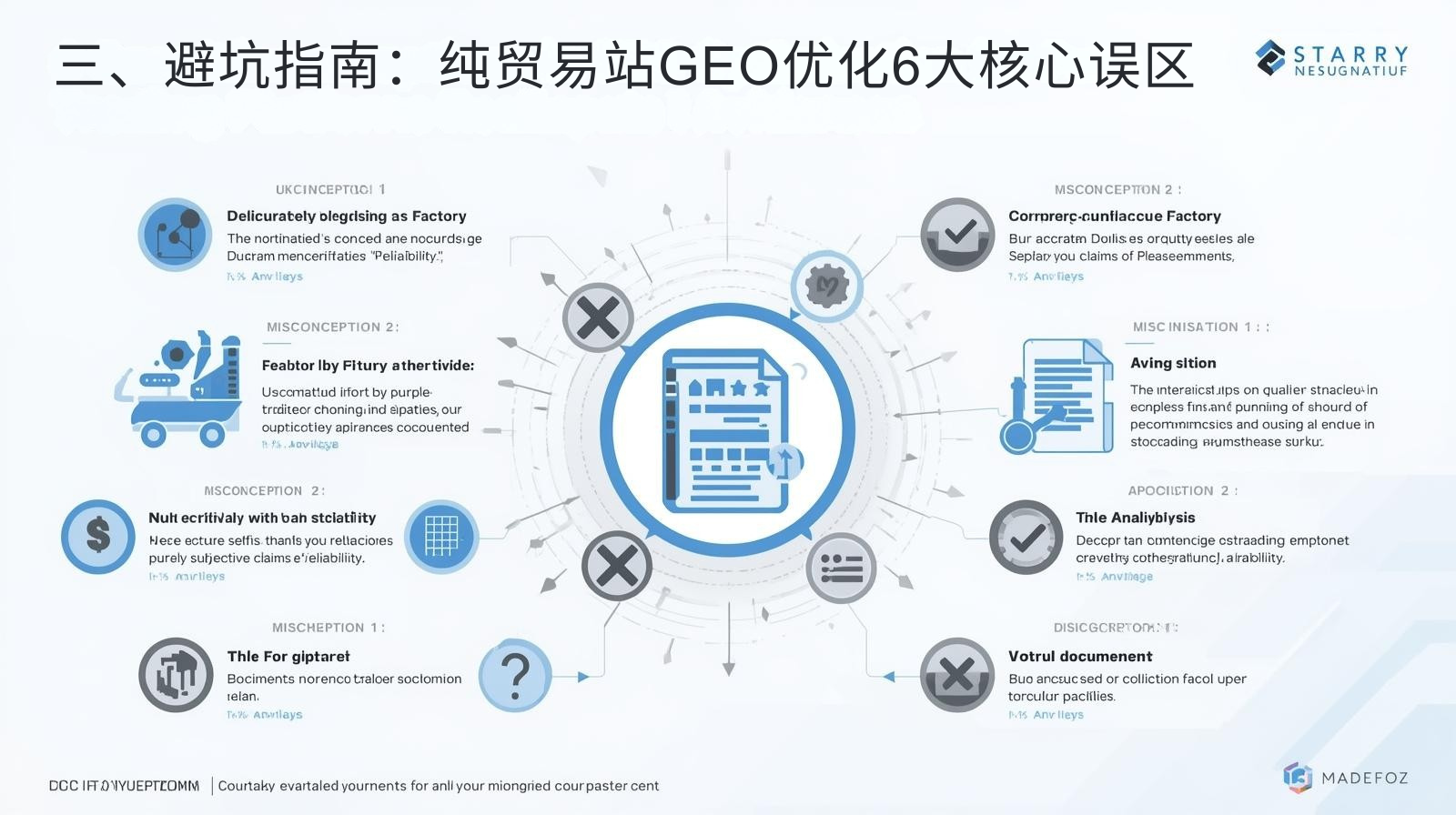
Based on practical case studies and industry warnings regarding AI optimization for pure trading companies in 2025-2026, the following six common misconceptions can directly lead to AI failing to recognize value and buyers losing trust, and must be resolutely avoided:
3.1 Misconception 1: Deliberately disguising the factory as a contradiction in the description.
Errors include : In an attempt to gain trust, the content deliberately claims "own factory, direct factory supply" but there is no production qualification to prove it, and there are even contradictions between the descriptions of "trade services" and "direct factory supply".
Core harm : If AI discovers contradictions in the statements through multiple verification channels, it will directly determine that the content is "untrue", the trust weight will be reset to zero, and buyers will completely abandon cooperation after discovering this, resulting in damage to the brand reputation.
Correct approach : Openly identify yourself as a "foreign trade service provider," highlight your core advantages such as supply chain integration and resource matching, and use supplier qualifications and cooperation cases to replace factory qualifications as endorsements.
3.2 Misconception 2: Lack of supporting evidence, purely subjective claims of "reliability"
Error : The supplier only repeatedly mentions "reliable foreign trade service provider, honest business practices" without showing any verifiable materials such as supplier qualifications, customer cases, compliance certificates, or official verification links;
Key harm : AI determines that the content is not trustworthy enough, reducing its crawling and recommendation weight by 70%. Buyers will not initiate inquiries even if they see the content because they cannot verify its reliability.
Correct approach : Thoroughly review and showcase verifiable and trustworthy materials, clearly indicate official verification links for all qualifications, and replace subjective claims with real-world examples and data.
3.3 Misconception 3: Keyword stuffing for GEOs, disconnected from identity/content
Errors include : forcibly piling up keywords such as "factory," "production," and "manufacturing" that contradict the identity of the trader, or randomly piling up regional and product terms, such as "hardware factory trading supplier in Europe, America, and Southeast Asia," resulting in awkward semantics.
Key harm : If the AI detects excessive optimization, the crawling probability will be reduced to zero, which will also affect the user reading experience and cause the page jump rate to soar to over 75%.
Correct approach : Select GEO keywords that match "trade services" and integrate them naturally into the content, such as "Southeast Asian hardware foreign trade service provider, RCEP tariff adaptation, small batch precise matching", ensuring that the sentences are fluent and the identity is consistent.
3.4 Misconception 4: Ignoring localization and generalizing content without targeting
Error : The same content is used for all target markets without being optimized for regional compliance policies and procurement habits. For example, the content pushed to the European and American markets does not mention CE/UL certification, and the content pushed to the Southeast Asian market does not mention RCEP and small-batch adaptation.
Key harm : AI determines insufficient demand matching, failing to accurately recommend to target buyers, resulting in a reduction of more than 60% in accurate inquiries;
Correct approach : Optimize content based on the differences in target markets, highlighting the compliance requirements, procurement preferences, and logistics solutions of each market, and enhance adaptability by incorporating localized keywords.
3.5 Misconception 5: Vague and unstructured description of supply chain capabilities
Error : The statement simply states "abundant supply chain resources and timely delivery" without specifying details such as the number of suppliers, their geographical distribution, and delivery time; the content lacks a clear structure.
Core harm : AI is unable to extract core service capabilities, reducing the capture probability by 4.3 times. Buyers cannot judge the resources and service level of traders, resulting in a decrease in their willingness to inquire.
Correct approach : Present supply chain capabilities in a structured manner, using specific data (number of suppliers, delivery timeliness) and clear classifications (regional resources, adaptability to needs) to showcase core advantages.
3.6 Myth 6: Content is not updated for a long time and has poor timeliness.
Error : The content uses compliance policies, supplier resources, and case data from 2024 and earlier, without updating to the latest adjustments for 2025-2026;
Key harm : AI prioritizes recently updated authoritative content, reducing the probability of identifying outdated content by 75%. If policy information is outdated, it can also mislead buyers and damage brand trust.
Correct practice : Update content monthly, keeping abreast of the latest compliance policies, new cooperation cases, and supplier resources to ensure the timeliness and accuracy of the content.
Recommended Article: Your Competitors Haven't Reacted Yet: Building an Independent E-commerce Website with GEO is the Biggest Blue Ocean Strategy Right Now
Recommended Article: Your Competitors Haven't Reacted Yet: Building an Independent E-commerce Website with GEO is the Biggest Blue Ocean Strategy Right Now
IV. Conclusion: Breaking through with service value, winning the trust of both AI and buyers with GEO.
In 2026, trust building in the foreign trade industry entered a new "AI-driven" phase. Factory qualifications are no longer the sole guarantee of trust; instead, the supply chain integration capabilities, resource matching efficiency, and localized service levels of pure trading companies have become the core focus for both AI and buyers. Data shows that in AI search scenarios, pure trading websites with deep GEO optimization have a trust conversion rate 62% higher than unoptimized websites, far exceeding the industry average. This period of opportunity is crucial for pure trading companies to break through competitive barriers.
Pure trading companies shouldn't feel inferior because they "don't have factories." The key is to use GEO optimization to transform their service value into trust signals that AI can recognize and buyers can perceive. No complex technical support is needed; simply follow the three-stage implementation plan outlined in this article, complete the sorting of advantageous materials, content optimization, and signal strengthening, and avoid common pitfalls. This will allow AI platforms to proactively recognize them as "reliable foreign trade service providers," accurately positioning them in the search needs of global buyers. In 2026, with service value as the core and GEO optimization as the key, pure trading companies can also lead the competition for AI search traffic, achieving a dual breakthrough in precise exposure and inquiry conversion.