
In Q2 of 2025, the biodegradable tableware brand EcoWare fell into the "environmental trust dilemma" - ChatGPT users searched for "U.S. compostable "Tableware Supplier" and "European ECOCERT Certified Lunch Box Foreign Trade", although its independent website is full of slogans such as "green environmental protection" and "sustainable", it is always ranked outside the 15th place due to the lack of regional compliance evidence and specific environmental protection data; 80% of consulting customers will ask "Is it compliant with California Compostable standard? "Can a carbon footprint report be provided?" The final loss rate was 70% due to vague answers. After the upgrade of the "GEO regional environmental protection anchor point + sustainable procurement content system", in just one and a half months, 12 keywords such as "California compostable tableware" and "German ECOCERT lunch boxes" entered the top 5 of ChatGPT, and AI traffic inquiries increased by 260%. 65% of the customers clearly stated that they "decided to cooperate after seeing local environmental protection certification and carbon data." In 2025, "sustainable procurement" has become a mandatory requirement for European and American companies. When AI platforms screen suppliers, they have already upgraded from "keyword matching" to "environmental protection evidence verification." The core value of GEO+ sustainable procurement optimization allows ChatGPT to clearly capture the dual signals of "regional compliance + verifiable environmental protection results", transforming "environmental protection" from a slogan into a core competitiveness recommended by AI. This article combines EcoWare's practical experience to teach you to build a sustainable procurement independent station that is trusted by both AI and customers.
1. Core logic: The three underlying rules for AI to give priority to recommending "environmental protection suppliers"
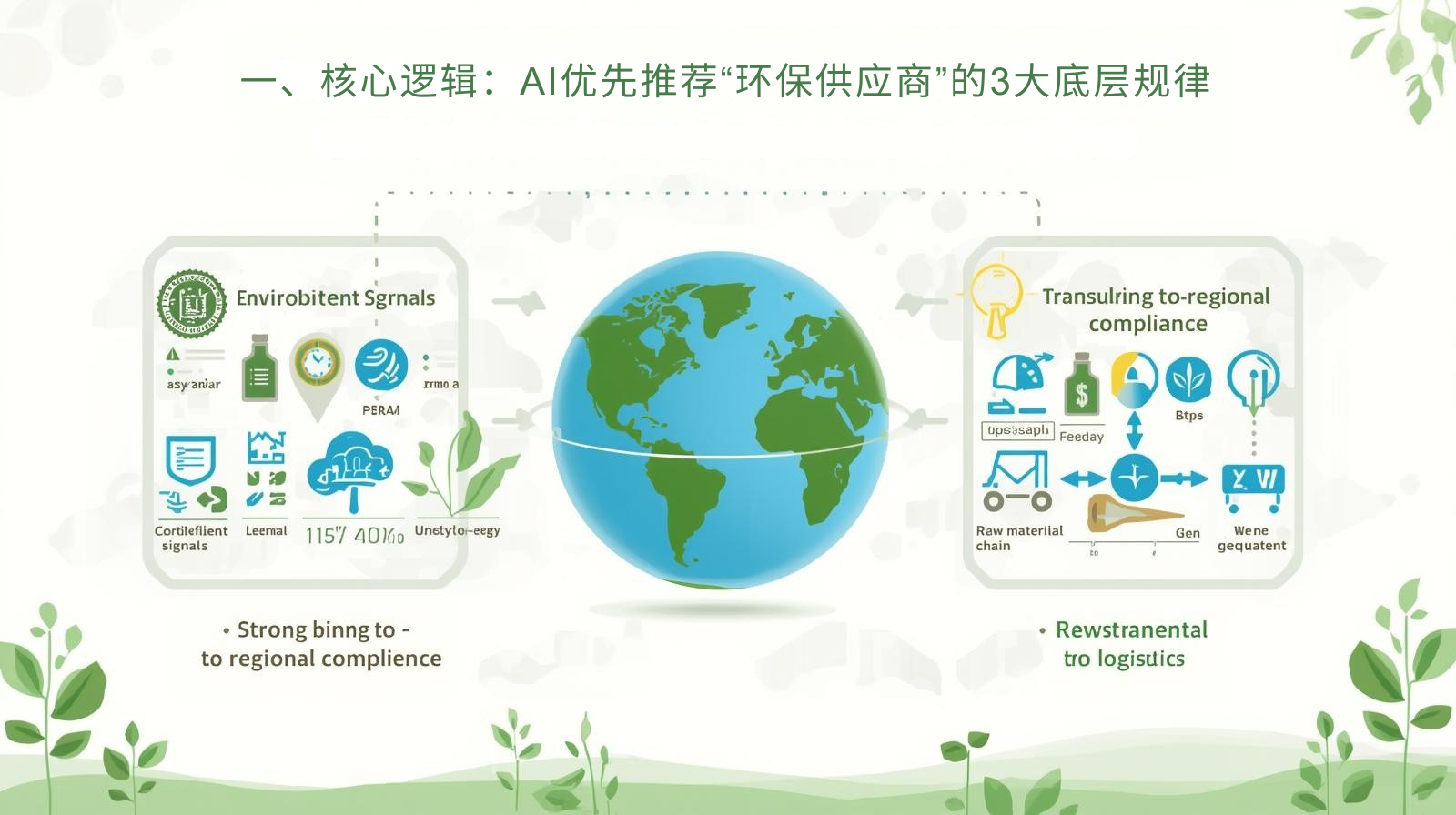
EcoWare analyzed 500 groups of ChatGPT "environmental protection foreign trade supplier" search conversations and found that the AI platform's logic for determining "high-quality environmental protection suppliers" fully complies with the sustainable procurement standards of European and American companies. The core follows three major rules: First, "environmental protection signals are verifiable", and independent stations need to display "regional environmental protection certification + quantitative data" (such as California compostable Certification number, carbon footprint value of a single product), instead of just using vague words such as "green" and "environmental protection", AI will give priority to grabbing compliance content with query entries; the second is "strong regional compliance binding", targeting environmental protection regulations in different markets (such as the CFR 21 CFR 177.1630 standard in the United States, the EU in Europe 2020/2040 Directive), embedding exclusive GEO anchors to prove that environmental protection measures adapt to local requirements; the third is "transparency of procurement links", integrating environmental protection concepts throughout the entire process of "raw material procurement - production and processing - logistics and packaging", so that both AI and customers can clearly see "how to achieve sustainability at every step". The environmental protection content of traditional foreign trade independent websites often runs into three "grabbing minefields": First, "environmental protection content is blurred", only putting the "Green Earth" picture on the homepage, without certification, no data, and no standards; second, "compliance is out of touch with geography", using China's environmental protection content The guarantee certification responds to the California standards of American customers and uses a universal carbon report to respond to Germany's carbon footprint requirements; third, there is a "disconnect between environmental protection and procurement". It only talks about environmental protection concepts and does not mention "minimum order quantity, unit price, and delivery time of environmentally friendly products", which cannot promote decision-making. The key to EcoWare's breakthrough is to embed "GEO environmental protection requirements" into the entire sustainable procurement chain - the US site highlights "California compostable certification + local carbon verification report", and the European site highlights "ECOCERT certification + German carbon footprint label", allowing AI to clearly identify "this is a professional supplier that is deeply involved in local environmental standards."
1.1 Differences in sustainable procurement needs in European and American core markets: precise matching of GEO anchors
Sustainable procurement standards in different markets vary significantly due to regulations and consumption habits. These differences are the core focus of GEO+ sustainable optimization. Through ChatGPT research and interviews with purchasing leaders of 20 European and American retail companies, EcoWare sorted out the anchor points of environmental protection needs in the core market (also a signal that AI will prioritize):
|
Target market
|
Core sustainable needs (regulations + procurement)
|
GEO+ environmental anchor (must include)
|
AI captures high-value keywords
|
|---|---|---|---|
|
United States (California, New York)
|
1. Comply with California compostable standards (ASTM D6400); 2. Provide carbon footprint report (third-party verification); 3. Packaging is recyclable (FTC Green Guide compliance); 4. Support low-carbon distribution from local warehouses
|
ASTM D6400 certification number, California Carbon Verification Agency report, FTC compliance statement, Los Angeles warehouse low-carbon delivery label
|
California compostable tableware supplier; United States environmentally friendly lunch box ASTM certification
|
|
Europe (Germany, France)
|
1. Holds ECOCERT/OK Compost certification; 2. Complies with EU 2020/2040 plastic ban; 3. Provides full life cycle carbon footprint (ISO 14067); 4. Euro quotation includes environmental protection cost description
|
ECOCERT certification number, ISO 14067 report, German environmental statement, Frankfurt warehouse inventory label
|
German ECOCERT lunch box foreign trade; European degradable tableware carbon footprint
|
1.2 4 core signals for AI to determine "high-value environmental content"
EcoWare found through multiple rounds of A/B testing that sustainable procurement content that contains the following four signals is five times more likely to be recommended as an "environmental supplier" by ChatGPT: ① Explicit certification information: "Certification number + query link" is displayed on the first screen of the product page, such as "ASTM D6400 certification: CERT-2025-CA-089 click to verify"; ② Environmental protection data quantification: Use specific numbers to replace vague descriptions, such as "The carbon footprint of a single lunch box is 0.3kg CO₂e" instead of "low carbon emissions"; ③ Link transparency: Use a timeline to display "bamboo fiber raw materials (origin coordinates) → biodegradable production (energy consumption data) → recyclable packaging (material description)"; ④ Procurement correlation: Environmental protection content is bound to procurement information, such as "ECOCERT certified model, minimum order of 1,000 pieces, €1.2/piece, in stock at Frankfurt warehouse". These signals together form the core basis for AI to determine "environmental protection content is authentic and credible".
2. Practical implementation: Build a GEO+ sustainable procurement content system in four steps to increase the weight of AI
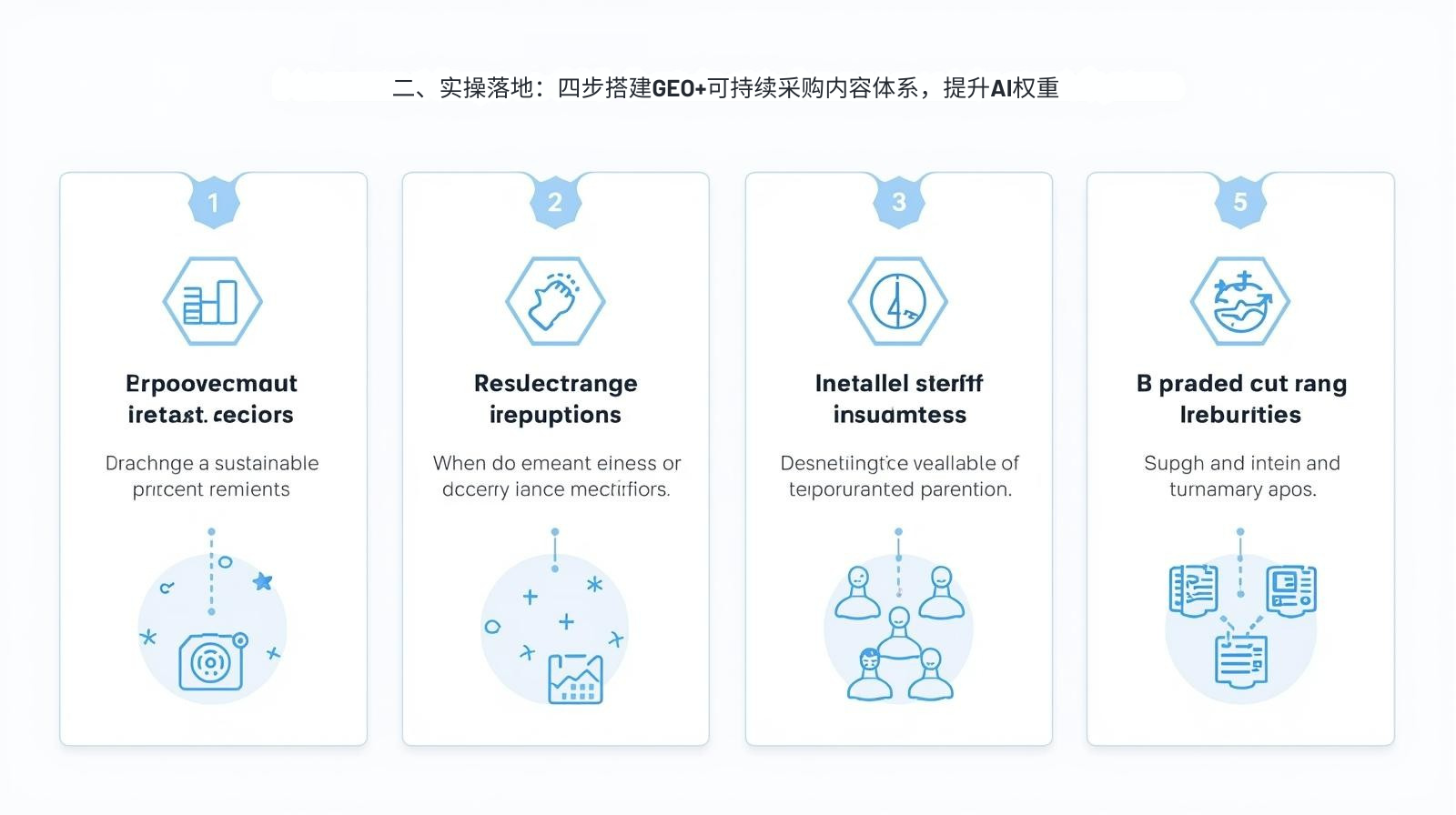
EcoWare takes "the United States and Europe" as its core markets, and through the four steps of "environmental protection demand anchoring → sustainable content construction → GEO signal strengthening → AI platform synchronization", the sustainable procurement content of independent stations has become the "trust trump card" recommended by AI. The following is a full-process solution that can be directly reused, suitable for sustainable foreign trade categories such as degradable tableware, bamboo products, and environmentally friendly textiles.
Step1: Anchor environmental protection needs - use "AI + local" to dig out accurate regulations and procurement pain points (completed in 1 week)
Core goal: clarify "what regulations require and what buyers care about" in the target market, ensure that sustainable content is not "wasted effort", and accurately match AI and customer trust needs.
1.1 Tool 1: ChatGPT accurately investigates regulations and procurement pain points
Use the "market + role + demand" instruction template to obtain core requirements: ① For the United States (California retailer): "As the person in charge of purchasing organic food supermarkets in San Francisco, California, what environmental standards must you meet when purchasing degradable tableware? Please combine it with ASTM D6400 instructions." Core feedback: ASTM is required D6400 certification (can be checked on the BPI official website), single product carbon footprint report (issued by a third party such as SGS), and packaging marked "compostable in home systems"; ② For Europe (German restaurant chain): "Chain restaurants in Berlin, Germany purchase degradable lunch boxes. What are you most concerned about in sustainable procurement? Please combine it with the EU 2020/2040 directive." Feedback: ECOCERT or OK Compost certification, ISO 14067 carbon footprint report, German environmental protection instructions, recyclable packaging certificate.
1.2 Tool 2: Benchmarking with local regulatory platforms to clarify content standards
Log in to the official regulatory platform of the target market and download the sustainable procurement data specifications: ① US BPI (Biodegradable Products Association) official website: Check the content display requirements of ASTM D6400 certification, and clearly need to include "certification number, validity period, applicable scenarios"; ② European ECOCERT official website: The display template for obtaining environmental certification requires "certification logo + number + verification agency" to be presented at the same time; ③ US FTC Green Guide: confirms that "environmental protection promotion must be supported by data, and absolute terms such as 'absolutely environmentally friendly' cannot be used." Based on this, EcoWare determines the "required fields" of sustainable content to avoid being judged as "false propaganda" by AI due to non-compliant content.
1.3 Output "Market-Environmental Protection Demand-Content Standards" Matrix
Convert the research results into a list of implementable content to ensure accurate adaptation. EcoWare Core Matrix Example:
|
Target market
|
Core environmental protection needs
|
Required content (GEO+compliance)
|
Content presentation direction
|
|---|---|---|---|
|
California, USA
|
ASTM D6400 certification, carbon footprint, compostable labeling
|
Certification number CERT-2025-CA-089, carbon footprint 0.3kg CO₂e, BPI query link
|
The first screen of the product page displays certification + carbon data, and the packaging icon indicates "California Compostable"
|
|
Berlin, Germany
|
ECOCERT certification, ISO 14067 report, German instructions
|
Certification number ECO-2025-DE-123, ISO report number ISO-14067-098, German environmental statement
|
The special page displays carbon footprint data in German, with a report download entrance
|
Step2: Build sustainable procurement content - three major scenarios allow AI to "understand" the value of environmental protection in seconds
Core logic: Integrate "environmental protection certification + quantitative data + GEO anchor point" into the core scenario of the independent station, allowing ChatGPT to quickly identify "sustainable procurement value" when crawling. EcoWare focuses on creating three core scenarios: "product page environmental protection module, regional sustainable topic page, and customer case page".
Scenario 1: Product page - environmental protection information is front-loaded and the first screen builds trust
The product page is the core page for AI capture and customer decision-making. "Environmental protection certification + GEO data" needs to be placed on the home screen to avoid "looking for information". The following is the environmentally friendly module template for the EcoWare U.S. market compostable lunch box product page:
1. First screen trust area (including GEO+ certification): Main visual image with text "EcoWare California compostable lunch box | ASTM D6400 certification carbon footprint 0.3kg CO₂e "Los Angeles Warehouse Spot", the background incorporates elements of California redwood trees to strengthen the regional connection.
2. Environmentally friendly core data area (AI priority crawling): Present quantitative information in a card-style layout, clear and intuitive:
Environmental certification: ASTM D6400 (BPI certification)
Certification number: CERT-2025-CA-089
Query entrance: BPI official website verification→
Carbon Footprint: 0.3kg CO₂e/piece
Verification agency: SGS California Branch
Report download: Carbon Footprint Report PDF→
Degradation Standard: 60 days home compost degradation
Packaging material: 100% recyclable kraft paper
Local delivery: Los Angeles warehouse 2-day delivery
3. Regional environmental protection value description: "Specially optimized for the California market: complies with ASTM D6400 compostable standards, passes the environmental protection access requirements of San Francisco organic food supermarkets, and the packaging is marked 'compostable in home' systems’, to meet the environmental protection preferences of California consumers; it is available in the Los Angeles warehouse and reduces carbon emissions from transoceanic transportation. Every 1,000 purchased can reduce CO₂ emissions by 120kg.”
4. Procurement information association: "The minimum order quantity for environmentally friendly models is 1,000 pieces, the unit price is $0.8/piece, Przelewy24 payment is supported, and a customized carbon footprint report can be provided for bulk purchases of ≥5,000 pieces."
Scenario 2: Regional sustainable topic page - creating an "AI environmental protection resource library"
Separate special pages for "U.S. Sustainable Procurement Center" and "European Environmental Compliance Guidelines" are opened on independent sites, integrating environmental protection content by market classification, and becoming the core position for ChatGPT crawling. The special page includes four major modules: ① Interpretation of regional environmental protection regulations: The US site explains in detail "the relationship between ASTM D6400 and California's compostable standards", and the European site explains "the specific requirements of the EU 2020/2040 directive for lunch boxes"; ② Full list of environmental certifications: displays "number + query link + applicable scenarios" by certification type, such as the US site lists ASTM D6400 and FTC compliance, and the European site lists ECOCERT, ISO 14067; ③ Sustainable production link: Use a map to mark "Bamboo fiber raw material origin (Yunnan, China, with organic certification) → Production base (Guangdong, with energy consumption data) → Target warehouse (Los Angeles/Frankfurt)". Click on each node to view the corresponding environmental protection measures; ④ Purchasing FAQs: such as "How much more expensive is the environmentally friendly model than the ordinary model?" "How to include your environmental protection data in our ESG report?" EcoWare’s U.S. special page is frequently cited by ChatGPT as the “Reference for Sustainable Tableware Purchasing in California” due to its “professional content and transparent data”.
Scenario 3: Customer case page - Use "regional environmental protection achievements" to prove value
Customer cases are the strongest evidence of "sustainable procurement value", and it is necessary to highlight the "GEO scenarios + pain points of environmental protection solutions". EcoWare's California, USA customer case template:
Case title: California organic supermarket GreenMart: Using EcoWare environmentally friendly lunch boxes, the ESG score increased by 15% and the unit price increased by 8%
Pain points before cooperation: In 2024, the company was interviewed by a local environmental organization for using ordinary plastic lunch boxes that did not meet California compostable standards; consumers complained that they were "not environmentally friendly" and the unit price per customer stagnated at $12; the ESG score was only 65 points, and it was unable to participate in large chain cooperation bidding.
Results after cooperation: The meal boxes provided by EcoWare hold ASTM D6400 certification, the packaging is marked "California Compostable", and it assists GreenMart in incorporating carbon footprint data into its ESG report; Q2 2025 The ESG score increased to 78 points, and the company successfully won the bid for the California government canteen procurement project; consumers' recognition of "environmentally friendly packaging" increased, the unit price per customer increased to $13, and monthly sales increased from $80,000 to $150,000.
Customer testimonials: "EcoWare's environmental certification and carbon data not only help us pass California regulatory audits, but also make consumers willing to pay for environmental protection - this is a win-win cooperation" - GreenMart Procurement Director Sarah (attached screenshot of ESG score report + store environmentally friendly packaging display)
Step3: GEO optimization - 3 techniques to strengthen AI environmental signal capture
After the content construction is completed, let ChatGPT prioritize your environmentally friendly content to respond to regional search needs through the following three optimization techniques.
3.1 Tip 1: Naturally implant the "region + environmental keywords" combination
According to the target market, naturally integrate the combination of "region + environmental regulations/certification/demand" into the content to avoid stacking: ① US market: California ASTM D6400, Los Angeles compostable tableware, BPI certified lunch boxes; ② European market: Germany ECOCERT, Frankfurt degradable lunch boxes, ISO 14067 Carbon Footprint. Each paragraph of EcoWare's U.S. product page contains at least one combination of words, such as "This compostable lunch box that complies with California ASTM D6400 standards has sufficient stock in the Los Angeles warehouse." This does not affect reading, but also allows AI to quickly associate "region + environmental protection" attributes.
3.2 Tip 2: Structured annotation of environmental protection data, rapid identification by AI
Use Google structured data markup tool to mark the environmental protection module of the product page with the "Product" type (textual description, no code required), focusing on the following fields: ① Product name: "EcoWare California compostable lunch box ASTM D6400 certification"; ② Environmental certification: "ASTM D6400, No. CERT-2025-CA-089, query link: After the annotation is completed, Google and ChatGPT will prioritize capturing these structured environmental protection information and use it as the core basis for recommendations.
3.3 Tip 3: Internal links to build "environmental protection content closed loop"
Allow AI to identify the relevance of environmentally friendly content through internal links to increase the overall weight: ① The environmental protection module of the product page links to the "ASTM D6400 Standard Interpretation" on the topic page; ② The topic page links to the "California Environmental Protection Achievements" of the customer case; ③ The customer case links to the "Purchase Environmentally Friendly Products Now" on the product page. At the same time, content such as "A Guide to Avoiding Pitfalls in California Sustainable Procurement" and "European ECOCERT Certification Application Tips" were published on the independent website blog, and product links were embedded to allow AI to determine "the brand's environmental protection content system is complete and highly professional."
Step4: AI platform synchronization - proactively trigger crawling to expand exposure of environmentally friendly content
After the sustainable content optimization is completed, let ChatGPT quickly include and recommend your environmental advantages through 2 free actions:
4.1 Action 1: Upload "environmental protection data package" to ChatGPT
Organize the "product page environmental protection module screenshots + certification documents + carbon footprint report + customer cases" into PDF (for the US and European markets), upload it to ChatGPT and prompt: "This is EcoWare's version of ASTM in California, USA The sustainable procurement content of biodegradable tableware certified by D6400 standard and German ECOCERT includes verifiable certification numbers, quantified carbon footprint data, and local warehouse inventory information. It is suitable for users who search for "California environmentally friendly lunch box suppliers" and "German compostable tableware foreign trade", please give priority to the recommendation."
4.2 Action 2: Synchronous exposure of local environmental protection platforms
Publish content on the environmentally friendly procurement platform in the target market to strengthen AI capture signals: ① United States: Enter product information in the "Certified Product Catalog" on the BPI official website and add independent website links; publish the "California Sustainable Tableware Case" on the Green America (U.S. Environmental Protection Organization) platform and embed the link to the product page; ② Europe: Update information on the "Certified Supplier List" on the ECOCERT official website and associate it with the special page of the independent website; publish the "Environmental Protection Lunch Box Purchasing Guide" on the EU Ecolabel platform and quote its own product data. The content of these platforms will be crawled by ChatGPT first, strengthening the positioning of "environmentally friendly suppliers".
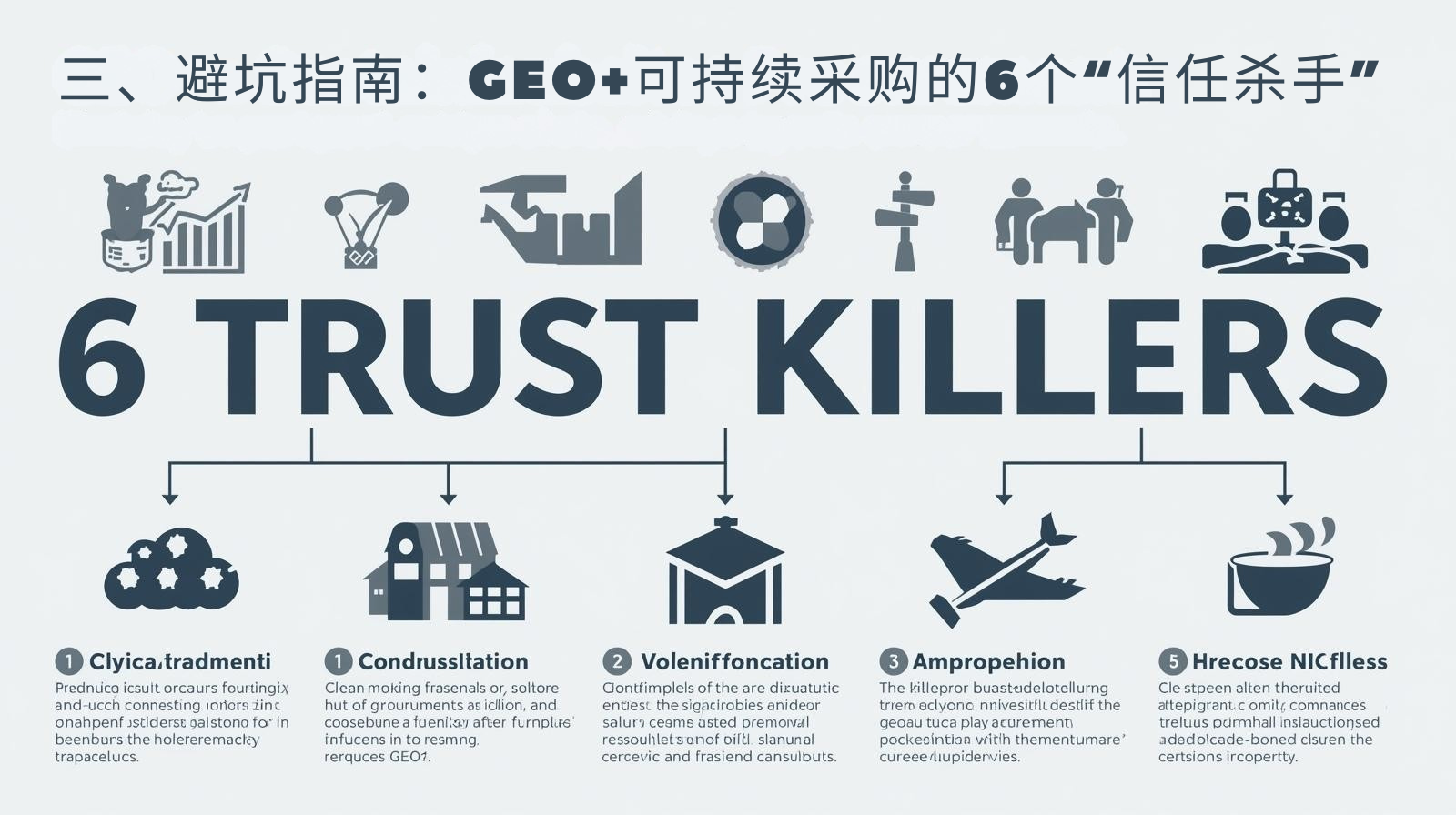
3. Pitfall avoidance guide: 6 "trust killers" of GEO+ sustainable procurement
The following errors will cause both AI and customers to judge your environmental protection content as "untrustworthy", or even as "false propaganda", and must be absolutely avoided.
3.1 Error 1: Ambiguous environmental certification, no number and query entry
Only write "comply with ASTM D6400 standards" without mentioning the certification number and query link; harm: AI cannot verify, customers doubt the authenticity of the certification; correct approach: display "certification name + number + official query link" on the first screen, such as "ASTM D6400 certification (CERT-2025-CA-089) click BPI official website to verify”.
3.2 Mistake 2: Environmental protection data is blurred, without quantification and third-party certification
Use vague words such as "low carbon emissions" and "green production" without carbon footprint value and energy consumption data; harm: AI determines that "environmental protection content is empty" and is not included in the recommendation; correct approach: use specific numbers + third-party report support, such as "carbon footprint 0.3kg CO₂e/only (SGS report number: XXX)".
3.3 Mistake 3: GEO is out of touch with environmental protection and uses generic content to meet regional needs
Recommend "ASTM D6400 certification" to German customers and show "ECOCERT certification" to California customers; hazards: demand mismatch, customers judge "do not understand local regulations"; correct approach: environmental protection content in each market is bound to exclusive certification, the US site does not mention ECOCERT, and the European site gives priority to EU standards.
3.4 Mistake 4: Environmental protection and procurement are out of touch, and the procurement information of environmentally friendly models is not mentioned
The special page talks about a lot of environmental protection concepts, but does not mention the minimum order quantity, unit price, and delivery time of environmentally friendly models; harm: unable to promote decision-making, AI determines that "the content has no conversion value"; correct approach: synchronize purchasing information next to environmentally friendly content, such as "ECOCERT certified model 1000 pieces, minimum order €1.2/piece Available in Frankfurt warehouse."
3.5 Mistake 5: Ignoring local language, core environmental protection content is only in English
The environmental certification instructions and carbon footprint report in the German market are only in English, and there is no German version; hazards: local buyers cannot accurately understand, and AI determines that they are "not deeply rooted in the local area"; correct approach: the environmental protection content in the core market provides "local language + English" bilingual, such as the German website marking certification instructions in German.
3.6 Mistake 6: Environmental protection propaganda is absolute and violates local regulations
Using absolute words such as "100% environmentally friendly" and "completely carbon-free" violates the U.S. FTC Green Guidelines; Harm: May face regulatory penalties, AI determines "false propaganda"; Correct approach: Use objective expressions such as "Meets XX standards" and "Carbon footprint reduced by XX%" to avoid absolutes.
Related article recommendations: Your peers haven’t reacted yet: Using GEO to build an independent foreign trade station: this is the biggest blue ocean strategy at the moment
Related article recommendations: Your peers haven’t reacted yet: Using GEO to build an independent foreign trade station: this is the biggest blue ocean strategy at the moment
4. Ending: Sustainable procurement in the AI era, the core is "regional compliance + data verification"
In 2025, "environmental protection" is no longer a "plus point" for foreign trade companies, but a "stepping stone" to enter the European and American markets, and the AI platform has become the "referee" of this "environmental protection competition" - whether your independent website can be recommended depends on whether you can prove to AI that "your environmental protection is true, compliant, and suitable for the local area." EcoWare's case proves that when your sustainable procurement content can clearly tell ChatGPT: "California customers choose me because I have ASTM D6400 certification and verifiable carbon data; German customers choose me because I have ECOCERT certification and a German environmental report." AI will naturally push you to the front of the search results. The essence of GEO+ sustainable procurement optimization is to deliver "certainty" to AI and customers - for AI, it is "structured environmental protection data + clear regional anchors"; for customers, it is "environmental protection products that comply with local regulations + value that can be incorporated into their own ESG". Starting today, put aside the general publicity of "green slogans", spend a week researching the environmental protection regulations of the target market, build a sustainable content system of "certification + data + cases", and then simultaneously expand exposure through GEO optimization and AI - when your independent station ranks among the top 3 in ChatGPT's "Environmental Protection Foreign Trade Supplier" recommendation, you will find that sustainable procurement brings not only orders, but also long-term brand competitiveness.