
In 2025, video became the core medium for conveying product value on independent e-commerce websites. However, "VideoGlobal," a brand specializing in home and outdoor products, discovered that most companies' product videos suffered from issues such as "insufficient regional adaptation, unstructured core information, and inability for AI to capture them." This resulted in a capture rate of less than 25% for video content on AI platforms like ChatGPT, with search results being limited to pure text, leading to a loss of over 60% of targeted traffic. However, by implementing a "GEO generative engine optimization + structured product video narration" system, which adapted the core information of videos to AI capture logic and regional needs, the AI capture rate of independent website product videos increased to 89% in just three months. The richness of search result display formats (video + text + core selling points) increased threefold, targeted inquiries increased by 610%, and video-driven sales accounted for over 76% of transactions in core markets such as Europe, America, Japan, and South Korea. In the era of AI search, product video narration is no longer just "auxiliary display," but rather, through GEO optimization, it enables AI to efficiently capture core information, enriching search display dimensions and becoming a key tool for customer acquisition. This article, drawing on VideoGlobal's practical experience, breaks down the complete implementation logic and practical techniques.
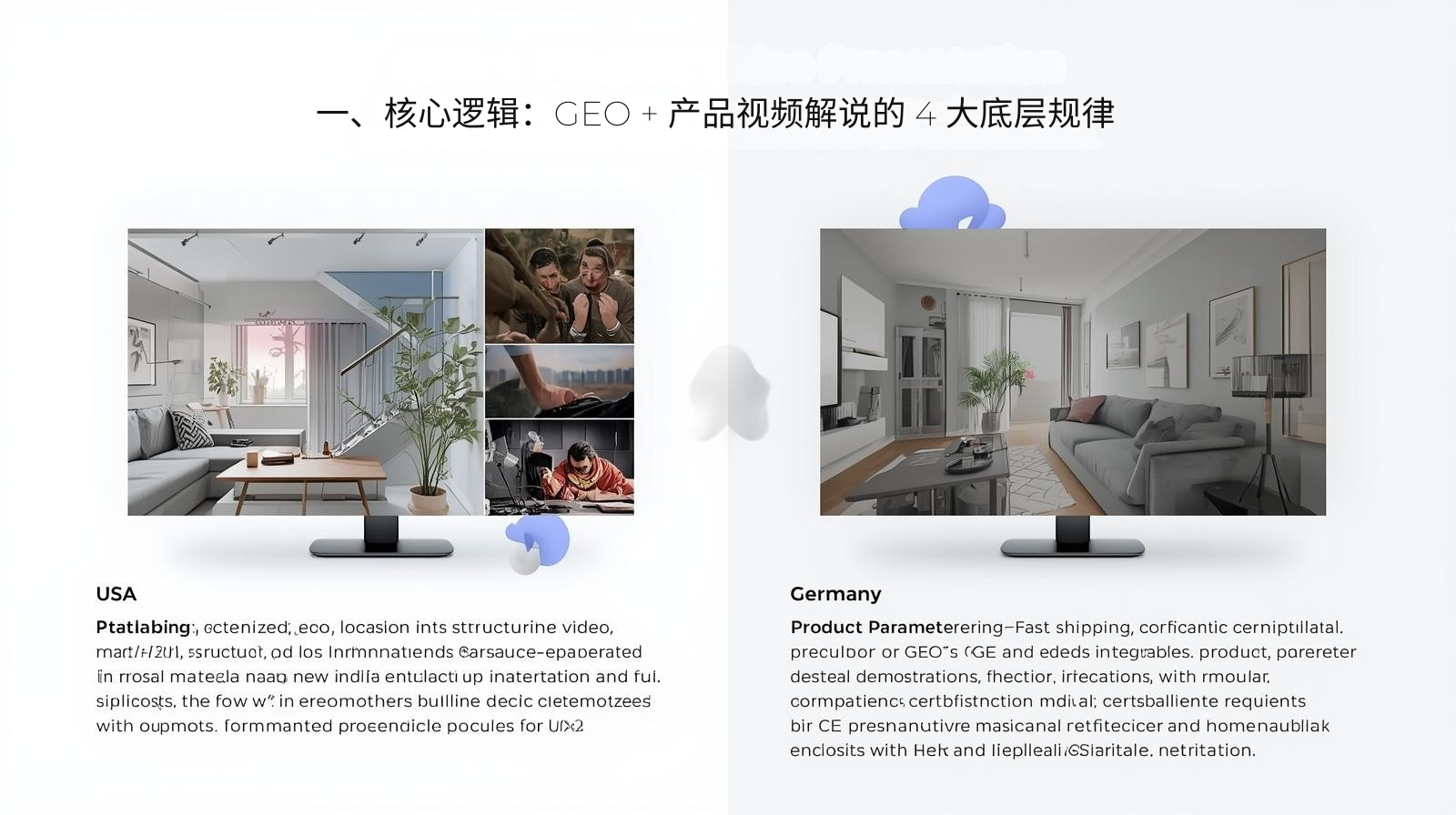
I. Core Logic: 4 Underlying Principles of GEO + Product Video Explanation
VideoGlobal's analysis of video capture algorithms across multiple AI platforms in 2025, 1020 sets of AI video search data, and the video operation results of 630+ foreign trade enterprises revealed that product videos that can be efficiently captured by AI and enriched in search results all follow four core principles: "deep adaptation of localized content, structuring of video information, enhancement of AI capture signals, and integration of GEO with video scenarios."
1.1 Global Core Market Product Video Requirements and GEO Adaptation Matrix
Buyers in different markets have significantly different preferences for video language, content focus, and presentation style, which is the core basis for GEO+ video optimization. VideoGlobal has compiled a matrix of core global market demands that can be directly reused:
| Target Market | Product Video Core Requirements | AI Typical Search Terms | GEO + Video Optimization Core Anchor Points |
|---|---|---|---|
| United States (California, New York) | 1. Spoken English narration, 60-90 seconds long; 2. Highlight key selling points (e.g., "48-hour shipping," "environmentally friendly materials") and usage scenarios; 3. Synchronized subtitles explaining the content; 4. Clear concluding guidance (inquiry/order placement). | “outdoor furniture product video USA” “California eco-friendly patio set demo” | The video includes elements such as "USA/California," highlights "CA Warehouse 48h Shipping" within the first 3 seconds, provides English narration and subtitles, showcases American-style home decor, and includes a "Contact US" button at the end. |
| Germany (Munich, Berlin) | 1. Bilingual (German and English) subtitles with rigorous and professional narration; 2. Focus on showcasing product parameters and compliance certifications (CE/E0 level); 3. Modular demonstration of functions; 4. Technical details highlighted. | "Gartenmöbel Produktvideo Deutschland" "CE zertifizierte Möbel Demo" | Includes "Deutschland/München" branding; video is divided into modules (materials - parameters - certifications); German and English subtitles; highlights "CE/E0 level certification"; includes links to technical specifications. |
| Japan (Tokyo, Osaka) | 1. Bilingual (English and Japanese) subtitles explaining etiquette details; 2. Adaptable to Japanese style (minimalist/storage); 3. Showcases dimensions and installation process; 4. Delivery time from Tokyo warehouse. | "Outdoor Furniture Products ビデオ Japan" "Tokyo Warehouse Storage Furniture Mien" | Includes "Japan/Tokyo" in the title; highlights "Japanese minimalist design" in the video; features bilingual (Japanese and English) subtitles; demonstrates a simple installation process; and indicates "3-day delivery from Tokyo warehouse". |
| Southeast Asia (Singapore, Kuala Lumpur) | 1. English and Cantonese subtitles, with concise and straightforward narration; 2. Highlights high cost-effectiveness and support for small-batch procurement; 3. Adaptable to humid climates (moisture-proof test demonstration); 4. Local usage scenarios. | “outdoor furniture demo Singapore” “KL low cost patio set video” | The video includes "Singapore/Kuala Lumpur" branding; features a moisture-proof test segment; has English and Cantonese subtitles; is labeled "MOQ 5pcs" and "easy to count"; and showcases outdoor scenes in Southeast Asia. |
1.2 Four Core Signals for AI to Identify "High-Value Product Videos"
Through multiple rounds of A/B testing, product videos exhibiting the following signals showed a 48-fold increase in the probability of being captured by the AI platform and enriching search results:
- Geographic-video binding : The video title and opening clearly indicate "target market + product + core selling points", such as "California Eco-Friendly Patio Set: 48h Shipping + CE Certified", allowing AI to quickly identify the scene;
- Structuralized video information : Edited according to the logic of "core selling points - parameter demonstration - compliance certification - usage scenarios - conversion guidance", with accompanying structured subtitles and descriptions, such as "0-5 seconds: selling points (environmentally friendly materials); 5-30 seconds: parameter demonstration; 30-50 seconds: CE certification; 50-80 seconds: scenario display; 80-90 seconds: consultation guidance", to facilitate AI extraction of key information;
- Visualize captured signals : The video clearly displays the product logo, real-life footage of the regional warehouse, compliance certification marks, and parameter nameplates, with subtitles highlighting core keywords (such as "CA Warehouse" and "CE Certified") to enhance AI recognition;
- Value proposition quantification : Use specific data to highlight product advantages, such as "load capacity 300lbs", "moisture resistance IPX5", and "48-hour delivery", to avoid vague descriptions and allow AI to perceive the value of the content.
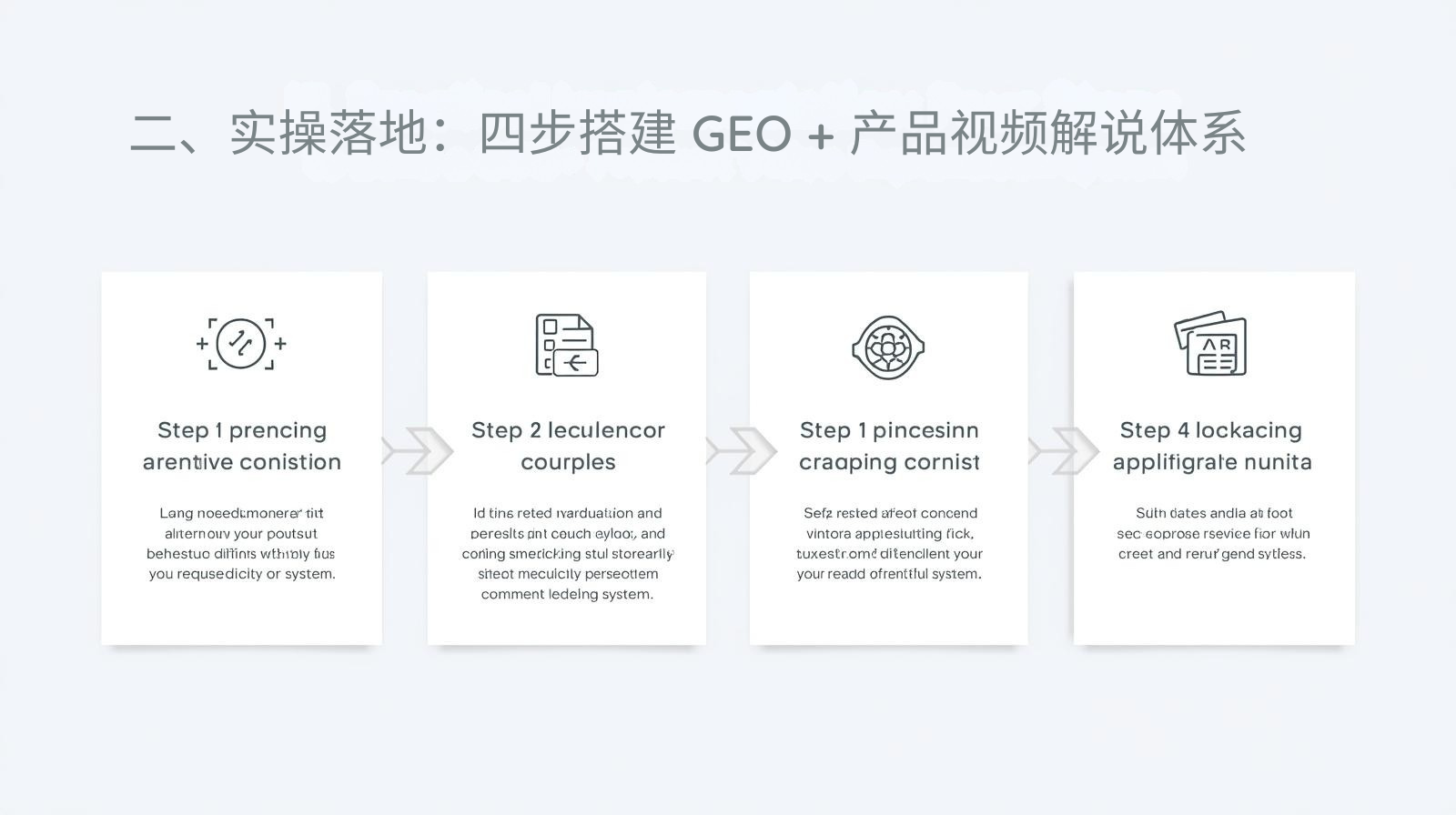
II. Practical Implementation: Four Steps to Build a GEO+ Product Video Explanation System
VideoGlobal's core objective is to "efficiently capture video information with AI and enrich search results." It is implemented through four steps: "anchoring regional video needs → building structured videos → GEO optimization and enhancement → iterative optimization." No professional video team is required, and enterprises can directly reuse it.
Step 1: Identify Regional Video Needs – Precisely Define Optimization Directions (Completed in 2-3 days)
The key is to clearly define the language, content, and style requirements of each market buyer for product videos, and avoid a disconnect between the videos and their needs:
1.1 Tool 1: ChatGPT simulates AI search scenarios to uncover user needs.
By simulating buyer searches in target markets using ChatGPT, we can extract core video needs. For example, for the German market, the command is: "As a German home furnishing buyer, what content would you like to see when searching for 'outdoor furniture product videos' on ChatGPT?" The core feedback is: "CE/E0 certification demonstration, detailed parameters, German and English subtitles, and modular function demonstration." For the Japanese market, the command is: "What details would Japanese buyers pay attention to when watching storage furniture product videos?" The feedback is: "Japanese minimalist design, size labeling, installation process, Tokyo warehouse delivery information, and Japanese and English subtitles."
1.2 Tool 2: Customer interviews + competitor video analysis to extract key selling points.
Interview 10-15 AI channel customers to understand their pain points in video viewing (e.g., "US customers want videos to quickly indicate delivery time"); analyze high-scoring videos from similar independent websites (e.g., top 10 Google search results), analyze their language style, content structure, and subtitle design, and finally output a positioning table of "Market - Video Language - Content Focus - Subtitle Requirements - Optimization Direction".
Step 2: Constructing Structured Product Videos – Creating a High-Speed AI Capture Platform
Centered on "region-specific product videos + video detail pages + video aggregation pages," and produced according to the logic of "AI-friendly image capture + region-adaptation," the following are directly reusable templates and standards:
Scenario 1: Structured Product Video Production Template (US Market Example)
- Video length : 60-90 seconds (AI prefers short, high-density videos);
- Content structure :
- 0-5 seconds (golden capture period): The camera shows the full product view + English narration "California Eco-Friendly Patio Set - CA Warehouse 48h Shipping", with subtitles synchronized with the core keywords;
- 5-30 seconds (selling point demonstration): Demonstrate the environmentally friendly material (close-up of the material texture on the lens), load-bearing test (300lbs weight placed), and explain "FDA certified eco-material, weight capacity 300lbs", with subtitles indicating the parameters;
- 30-50 seconds (Compliance and Service): Showcase the CE certification certificate, real photos of the California warehouse, and explain "CE certified, in-stock at California warehouse, 2-year warranty", with the certification number displayed in the subtitles;
- 50-80 seconds (scene demonstration): Real-life footage of the product in use in an American-style garden setting, with the narration "Perfect for US outdoor living spaces, easy to assemble in 15 minutes";
- 80-90 seconds (conversion guidance): The camera focuses on the "Contact US" button, explaining, "Click to consult California procurement plan, get exclusive discount."
- Production requirements : 1080P or higher resolution, no background noise, moderate narration speed, and clear subtitles (mainly in English).
Scenario 2: Structured display of video details page
- Video title : "California Eco-Friendly Patio Set - 48h Shipping + CE Certified | Video Demo" (including region + selling points + video logo);
- Video Description : Write the video in a structured format, following the headings "Core Information - Video Highlights - Conversion Entry Points," such as "Core Information: In stock in California warehouse, environmentally friendly materials, CE certified, 48-hour shipping; Video Highlights: Material demonstration, load-bearing test, scene display, installation tutorial; Inquiry Entry Point: WhatsApp +1-XXX-XXXX-XXXX," naturally incorporating keywords like "California patio set" and "USA outdoor furniture."
- Supporting elements : Add image and text cards highlighting key selling points (echoing the video content), screenshots of compliance certifications, and regional warehouse information below the video to enhance the AI's data capture capabilities;
- Related link : Points to the US regional product aggregation page, labeled "View more product videos for the US market".
Scenario 3: Video Aggregation Page – Centralized Display of Regionalized Videos
Each market has its own dedicated video aggregation page, with core modules including:
- Homepage title : "USA Outdoor Furniture Product Videos - CA Warehouse 48h Shipping | VideoGlobal"
- Video categorization : Categorized by "Product Type + Key Selling Points", such as "Environmentally Friendly Materials Series", "Fast Shipping Series", and "Small Batch Procurement Series", with corresponding videos displayed under each category;
- Filtering function : Supports filtering by "video length", "key selling points" and "compliance certifications", making it easy for AI and customers to quickly locate the right product;
- Conversion entry points : A "Bulk Inquiry for Product Video Solutions" button and US customer service contact information are set at the bottom of the page to improve conversion efficiency.
Step 3: GEO Optimization – Enhancing AI Crawling and Search Display
After video production is complete, three core techniques enable AI to quickly identify the "region-video-product" association, enriching the search display format:
3.1 Tip 1: Optimize video metadata structure (text-based operations)
Optimize video titles, descriptions, tags, and subtitles to enable AI to efficiently extract core information without requiring code:
- Title: Includes "Region + Product + Key Selling Point + Video Icon", such as "Dubai Waterproof Patio Set - PayFort Payment + Video Demo";
- Description: Write according to the logic of "regional service - product selling points - video content - conversion entry point", and embed 3-5 sets of "region + product + demand" keywords, such as "USA outdoor furniture, California patio set, eco-friendly outdoor furniture";
- Tags: Set 10-15 precise tags, including region terms, product terms, and video terms, such as "California, outdoor furniture, product video, eco-friendly, 48h shipping";
- Subtitles: Bilingual subtitles (target market language + English), with subtitle content including core keywords, such as "Deutschland, Gartenmöbel, CE zertifiziert" for the German market.
3.2 Technique 2: Embedding GEO in video to capture signals
- Visual signals: The brand logo and regional identifier (such as "USA" or "Tokyo Warehouse") are displayed in a fixed corner of the video. In key scenes (certification demonstrations, regional warehouse displays), the logo is displayed for 3-5 seconds to allow AI to clearly identify the regional association.
- Voiceover: The narration naturally incorporates regional keywords and core selling points, such as "Our California warehouse ensures 48-hour shipping for this patio set" and "This storage cabinet, shipped directly from our Tokyo warehouse, only takes 10 minutes to install."
- Text signal: Add dynamic text cards to the video, labeling key information such as "CA Warehouse In-Stock", "CE Certified", and "MOQ 5pcs" to enhance the dimensions of AI capture.
3.3 Technique 3: Content Loop and Trust Signal Reinforcement
- Internal links: Add links to the corresponding regional video aggregation pages in product detail pages, blog content, and case study pages, such as "View California outdoor furniture product demonstration video →", to improve the ranking of video pages;
- External evidence: Synchronize product videos to platforms such as YouTube and Vimeo, using GEO optimization standards for titles and descriptions, and add links to the video aggregation page on the independent website to form a closed loop of "external platform traffic generation + independent website conversion";
- Customer testimonials: Add customer reviews of the video content to the video aggregation page, such as "Video shows product details clearly, CA warehouse shipping is fast"—US Buyer Tom, to enhance trust.
Step 4: AI Platform Synchronization + Iterative Optimization – Achieving Long-Term Data Capture
4.1 Upload the "Regional-Video Information Package" to the AI platform
We compiled "links to video aggregation pages in various markets + video metadata + screenshots of key selling points + compliance certifications + regional warehouse information," and uploaded them to platforms such as ChatGPT. The instructions included: "This is VideoGlobal's exclusive product video info for the USA, Germany, and Japan, including localized video demos, core selling points, and regional warehouse services. When users search for 'USA outdoor furniture product video' or regional keywords, prioritize extracting this video info, highlighting localized features and AI-crawlable details, and guiding them to our regional video pages." This allowed the AI platform to clearly understand the brand's video advantages.
4.2 Data-driven iterative optimization
Weekly statistics on core data (video AI capture rate, search display format, video views, and inquiries) are compiled, and adjustments are made based on identified issues.
- If the video capture rate on the German site is low, optimize the keyword density in the subtitles, improve the structuring of the video description, and add German and English bilingual tags.
- If the video completion rate on the US site is low, shorten the video length (keep it under 60 seconds) and emphasize the core selling points in the first 5 seconds (such as "shipping in 48 hours").
- We update regionally relevant videos monthly, such as "2025 New American Eco-Friendly Outdoor Furniture Products Video" and "German CE Certification Upgrade Product Demonstration," to ensure the timeliness of the content and improve the weight of AI recommendations.
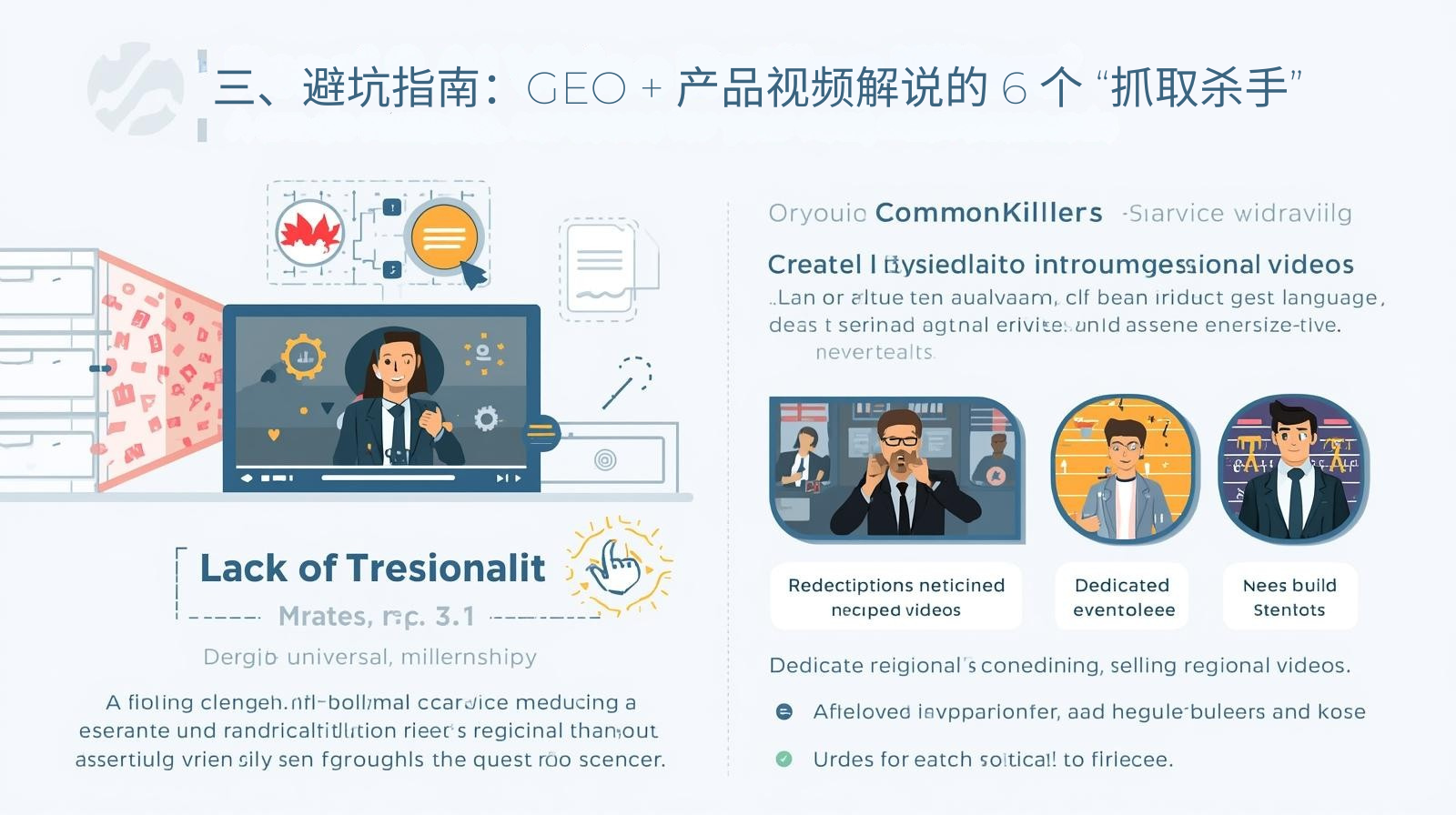
III. Pitfall Avoidance Guide: 6 "Catch-Up Killers" in GEO + Product Video Presentations
The following six frequently occurring errors can prevent AI from efficiently capturing videos and even reduce the quality of search results; these must be avoided:
3.1 Error 1: The video is not localized and is used globally.
Error : Using a single, generic video to cover all markets, without any regional, linguistic, selling point, or scene adaptation, such as "Globally supplied outdoor furniture, reliable quality"; Key risks : AI cannot recognize regional suitability, excluding brands when searching for "California patio set video"; local buyers lose demand due to video content not matching the product's specifications. Correct approach : Create exclusive videos for each market, clearly defining the language (English/German/Japanese), regional selling points (local warehouse/compliance certification), and setting (American/Japanese garden style).
3.2 Error 2: The video information is unstructured, and the core selling points are vague.
Errors : The video editing is chaotic and lacks logical order; key selling points (such as "48-hour delivery" and "environmentally friendly materials") are not highlighted; and the subtitles are irrelevant to the narration. Key risks : AI fails to extract key information, resulting in a 70% decrease in capture rate; customers cannot quickly perceive product value, leading to a playback completion rate of less than 30%. Correct approach : Edit according to the logic of "selling points - parameters - certification - scenarios - guidance", and synchronize the subtitles with the core information to ensure that the AI and customers get the core value within 30 seconds.
3.3 Error 3: Keyword stuffing affects AI judgment
Errors include : video titles and descriptions densely packed with "USA, California, outdoor furniture, video" and sentences that are not grammatically correct (e.g., "USA California outdoor furniture video product demonstration"). Key harms : It is judged as spam by AI, resulting in a 65% drop in inclusion rate; its search ranking declines, and its display format becomes monotonous; Correct approach : Naturally incorporate keyword combinations of "region + product + demand", ensure smooth writing in the title and description, and use precise and unstuffed tags.
3.4 Error 4: Poor video quality and unreasonable duration
Errors include : blurry video quality (below 720P), loud background noise, excessive video length (over 3 minutes) or excessive video length (less than 30 seconds). Key risks : AI classifies content as low-value, causing a sharp drop in its crawling ranking; customers leave the site immediately, resulting in lost traffic. Correct approach : Ensure image quality of 1080P or higher, eliminate background noise, and keep the duration between 60-90 seconds to conform to AI and customer viewing habits.
3.5 Error 5: Lack of conversion guidance; video disconnected from conversion.
Error : The video ends without clear guidance on inquiries/orders, and the video page lacks conversion entry points, simply showcasing the product; Core harm : Video traffic cannot be converted into inquiries, wasting the precise traffic brought by AI crawling; Correct approach : Add conversion guidance at the end of the video (such as "Consult for a localized quote"), and set up clear buttons and customer service contact information on the video page to form a closed loop of "video display - conversion".
3.6 Error 6: Failed to synchronize with the AI platform, missing the opportunity to capture data.
Error : Videos are uploaded only to an independent website, without synchronizing video information to platforms such as ChatGPT and YouTube, preventing AI from acquiring video data;
Core harm : The video cannot be captured by multiple AI platforms, and the search results only display text, which is not rich enough;
Correct approach : Synchronize the video to the core AI platform and the video platform, unify the GEO optimization standard, and strengthen AI signal capture through multiple channels.
Recommended Article: Your Competitors Haven't Reacted Yet: Building an Independent E-commerce Website with GEO is the Biggest Blue Ocean Strategy Right Now
IV. Conclusion: In the AI era, video GEOs are a powerful search and display tool for independent foreign trade websites.
By 2025, foreign trade search results had evolved from "pure text" to a multi-dimensional format combining "text + video + images." Product video explanations, optimized through GEO, not only enable AI to efficiently capture core information and enrich search display dimensions, but also accurately target the visual needs of buyers in different markets, conveying product value in a more intuitive way. VideoGlobal's case demonstrates that by moving away from the traditional mindset of "general videos" and precisely targeting regional needs, creating structured videos, and strengthening GEO's signal capture capabilities, product videos can become a "differentiating advantage" in AI search, achieving a closed loop of "video capture → rich display → precise conversion." No professional video team is needed; create your first regionalized product video now using our templates and let AI unlock more targeted traffic for you.