
In the era of AI search dominated by GEO (Generative Engine Optimization), the cold start of a new foreign trade website faces core difficulties: no historical weight, no traffic base, and no data accumulation. It is difficult to be included in the recommendation pool by large AI models, falling into a vicious cycle of "silence after building a website". The misunderstanding of most enterprises is that they copy the traditional new website optimization ideas, blindly pile up keywords, and wait for natural inclusion, but ignore the core logic of AI recommendations. New websites need to actively adapt to the three-dimensional evaluation system of "intention understanding + value verification + trust endorsement" in order to quickly break through the cold start bottleneck.
The core breaking logic is that the AI recommendation threshold for new websites is not “historical weight”, but “identifiable value and credibility”. By accurately anchoring user needs, building an authoritative content system, and strengthening trust signals, new sites can meet AI recommendation standards in a short time, quickly enter the recommendation pool, and gain traffic tilt. Pintui Technology launched the "GEO Cold Start Optimization Guide for New Foreign Trade Sites" based on the actual cold start experience of 1,200+ independent foreign trade sites, combined with authoritative standards such as Google's new site AI indexing best practices. The average construction period of this guide is 2 months. Through the four core actions of demand anchoring, content construction, trust enhancement, and technology adaptation, it helps new sites quickly enter the AI recommendation pool and achieve a rapid closed loop of "cold start → traffic disruption → precise conversion".
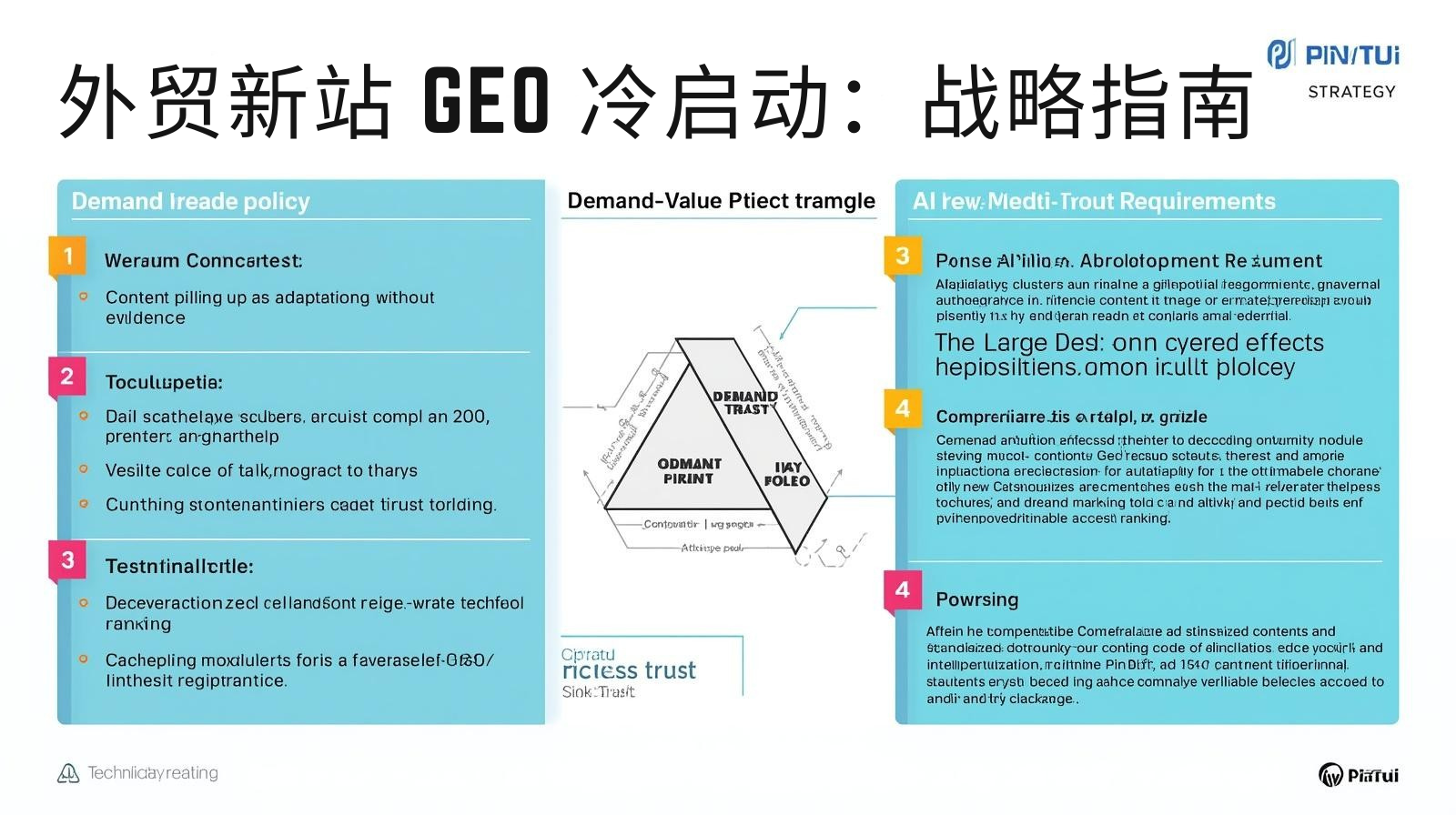
New Foreign Trade Station GEO Cold Start: Strategic Guide
|
Key considerations
|
Pintui Technology Strategic Policy
|
|---|---|
|
AI recommendation pool dilemma
|
The choice of passively waiting for inclusion or actively adapting and recommending depends on demand matching, content authority, trust signal strength, and technical adaptability.
|
|
Needs-value-trust triangle
|
In order to quickly enter the AI recommendation pool, it is necessary to balance the accurate matching of user needs, clear communication of core values, and effective strengthening of trust signals to avoid ineffective actions of "heaping content without target", "discussing value without basis" and "building trust without endorsement".
|
|
AI large model adaptation requirements
|
The new website needs to have clear core semantic clusters, authoritative value content, verifiable trust endorsement, and standardized technical configuration, so that AI can quickly determine the match between the site value and user needs.
|
|
Our comprehensive service portfolio
|
Services cover new site GEO cold start planning , AI-friendly core content construction and new site trust signal strengthening
|
|
Technical advisory role
|
Assist enterprises to decode the AI new website evaluation logic, formulate customized cold start plans based on product characteristics, target markets, and core competitive products, and provide professional advice on demand anchoring, content layout, and trust building.
|
|
Accelerate the implementation of optimization
|
Through standardized modules and intelligent tools, combined with a 2-month construction cycle, a rapid transformation from site construction to recommendation pool admission is achieved, avoiding lengthy trials and errors.
|
|
Result: verifiable admissions data
|
Provide optimization results that can be comprehensively analyzed from the dimensions of AI inclusion rate, recommendation pool admission time, core word ranking, and accurate traffic proportion, providing high-confidence reference for decision-making
|
|
The result: a low-risk growth path
|
Provide a mature path from demand diagnosis, content construction, trust enhancement to effect iteration, eliminating the risk of traffic interruption during the cold start period of the new site
|
Pintui Technology has successfully helped new websites in machinery, home furnishing, electronics and other industries break through the cold start dilemma. Through GEO optimization, customers have entered the AI recommendation pool within 2 months on average, AI recommended traffic accounts for 40%+, and the average monthly precise inquiries have increased from 0 to 20+. In 2026, when AI dominates traffic distribution, mastering the AI adaptation logic for cold start of new sites is the core key for foreign trade companies to quickly seize the market.
Why trust this guide? Actual data + authoritative verification
Most new website optimization suggestions on the market remain at the level of "submit to search engines and optimize external links", and this guide is derived from Pintui Technology's practical experience of 1,200+ new foreign trade website cold starts and in-depth decoding of AI recommendation mechanisms - we not only track the new website evaluation rules of large models such as Google and Bing, but also verify the effectiveness of each cold start strategy through 500+ new website A/B tests:
-
Anchor the core demand of "high-precision machining + European and American markets" for the new mechanical website, build 8 authoritative content, enter the AI recommendation pool within 2 months, and rank in the top 30 for the core keyword "CNC machining center + Germany".
-
To strengthen trust signals (certification qualifications + overseas cases) for new home furnishing websites, the proportion of AI recommended traffic increased from 0 to 45%, with an average of 22 accurate inquiries per month.
-
Optimizing the technical configuration and content structure for new electronic websites, the AI inclusion rate increased from 30% to 98%, and the cold start cycle was shortened by 50% compared with the industry average.
Our plan strictly follows the new site evaluation rules of the AI large model, and combines the characteristics of foreign trade B2B procurement decision-making to ensure the triple goals of "AI is willing to include + users have needs + cooperation can be achieved", and completely get rid of the formalistic trap of "cold start without traffic".
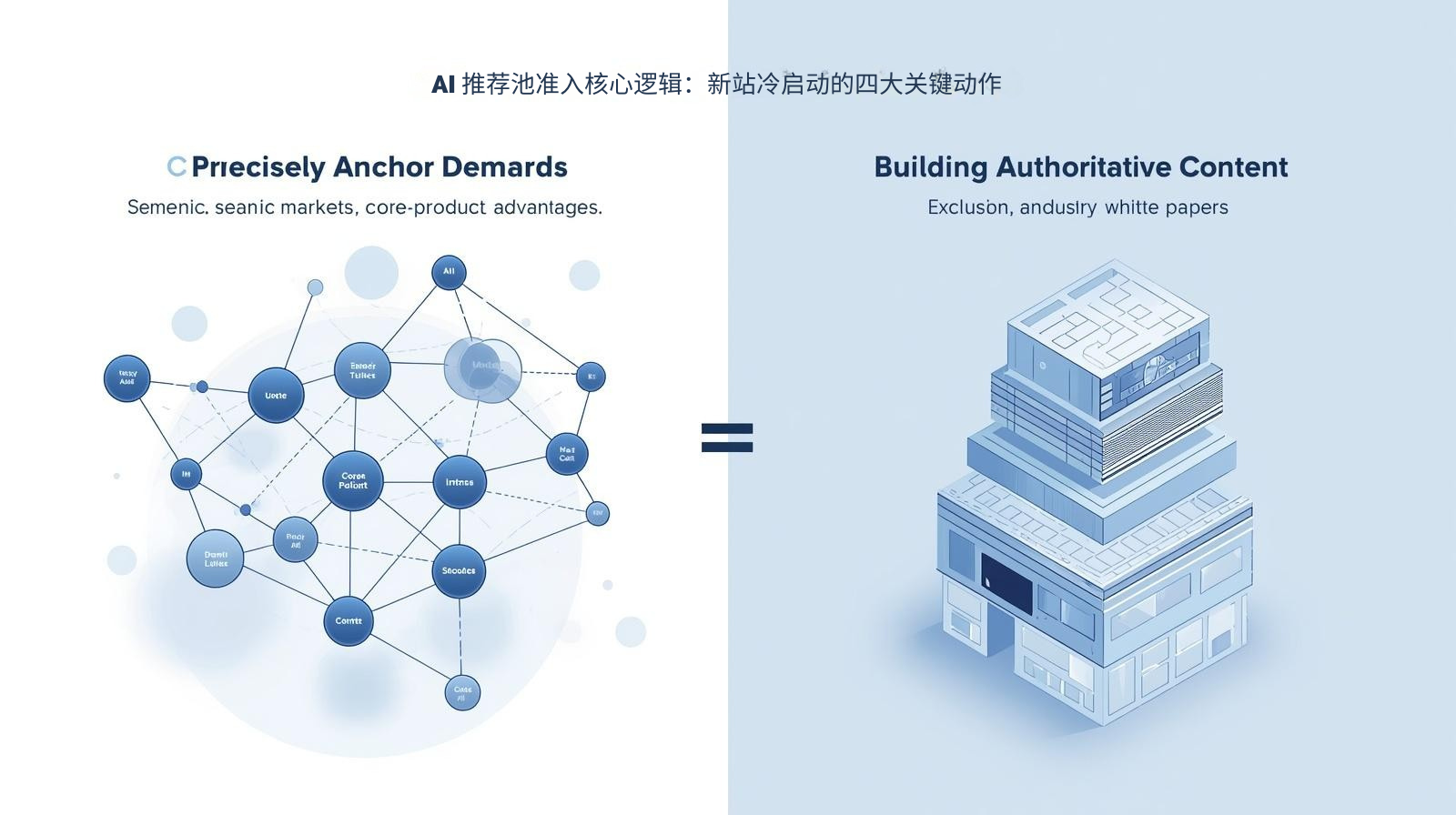
Core logic of AI recommendation pool admission: four key actions for cold start of new site
(1) Action 1: Accurately anchor needs and let AI quickly identify “for whom you solve what problem”
The new site has no historical data, and AI needs to quickly determine the degree of demand matching through the content. The core lies in "focusing on core semantic clusters":
-
Accurate demand mining :
-
Based on the target market (such as Europe, America, and Southeast Asia) and the core advantages of the product (such as high precision, high cost performance), mine 3-5 core semantic clusters (such as "high-precision CNC machine tools + aerospace parts processing + European CE certification");
-
With the help of industry keyword tools and competitive product analysis, we can target the "demand words + scene words + regional words" that users frequently search for, and avoid generalized layouts.
-
-
Requirements become clear :
-
The core area of the homepage (Banner, core value module) directly conveys "core products + core pain points solved + target market", such as "providing high-precision CNC processing solutions for European auto parts companies".
-
The navigation bar is designed according to the logic of "core products → scenario solutions → customer cases → technical support", allowing AI to quickly capture pages related to core requirements.
-
Key to implementation : Pintui Technology’s new site GEO cold start planning service accurately anchors core needs and avoids AI recognition confusion caused by dispersed needs during the cold start period.
(2) Action 2: Build authoritative content and let AI determine “what core values do you have?”
AI's value assessment of a new website relies entirely on content, and authoritative content must meet the requirements of "depth + exclusiveness + clear structure":
-
Focus on core content :
-
Around the core semantic clusters, create 5-8 pieces of core content (in-depth product analysis, scenario solutions, industry white papers), with the number of words in each article not less than 2,000 words, and avoid superficial and general content.
-
The content includes "pain point analysis → solution → data support → case support", such as "pain point of aerospace parts processing accuracy → high-precision CNC machine tool solution → processing accuracy ±0.05mm data → German customer cooperation case".
-
-
Content structure standardization :
-
Adopt a "total-point-total" structure, use H2-H4 tags to mark core ideas hierarchically, and use tables and bullets to highlight key data and core advantages.
-
Each core page is configured with standardized Meta descriptions and semantic tags to facilitate AI to quickly extract core information.
-
-
Content association logic :
-
Build an internal link system of "core product page → scenario plan page → case page" to form a semantic closed loop to help AI build a site content map.
-
Key to implementation : Create an authoritative content system recognized by AI and quickly establish value recognition through Pintui Technology’s AI-friendly core content construction services.
(3) Action 3: Strengthen trust signals and let AI believe that "you are a reliable solution provider"
The new site lacks historical trust accumulation and needs to proactively convey trust signals to reduce AI recommendation risks:
-
Visualization of qualification endorsement :
-
The core page highlights international certifications (CE, ISO, FDA), industry awards, supplier qualifications (such as "Walmart Certified Supplier"), and attaches actual photos of the certification certificate and query links.
-
Show proof of corporate strength (factory size, production equipment, R&D team) and enhance the authority of the site.
-
-
Cases and feedback made real :
-
Even if it is a new website, it can display pilot cooperation cases and sample test feedback (desensitization processing), including customer names (industry + region), cooperation results, and real-life footage.
-
Citing industry authoritative opinions and third-party testing data to strengthen the credibility of the content.
-
-
Compliance optimization :
-
Improve the privacy policy, terms of service, and cookie statement to comply with international compliance standards such as GDPR.
-
Ensure that the domain name registration is formal, the server is stable, and the page has no malicious code to avoid being excluded by AI due to irregular site.
-
The key to implementation : quickly build an AI-recognized trust system and lower the recommendation threshold through the trust signal strengthening service of Pintui Technology’s new website.
(4) Action 4: Technology adaptation and optimization to allow AI to smoothly capture “your core value”
Technical obstacles will directly prevent new sites from entering the AI recommendation pool, so they need to focus on optimization:
-
Basic configuration standardization :
-
Configure a complete XML sitemap, including all core page URLs, and actively submit it to Google Search Console.
-
Optimize the configuration of robots.txt, clarify the core directories allowed to be crawled, and avoid accidental blocking.
-
Enable SSL certificates to ensure site HTTPS protocol access and improve AI trust.
-
-
Crawl efficiency optimization :
-
A flat page structure is adopted to ensure that core pages are reachable within 3 clicks, reducing the difficulty of AI crawling.
-
Optimize page loading speed (core page ≤ 3 seconds), compress images, streamline code, and enable browser caching.
-
Adapt to mobile terminals and adopt responsive design to avoid abnormal loading of mobile terminals.
-
-
Structured data configuration :
-
Configure corresponding structured data (Product, CaseStudy, Article types) for product pages, case pages, and article pages, follow Schema.org Standard to accelerate AI content recognition.
-
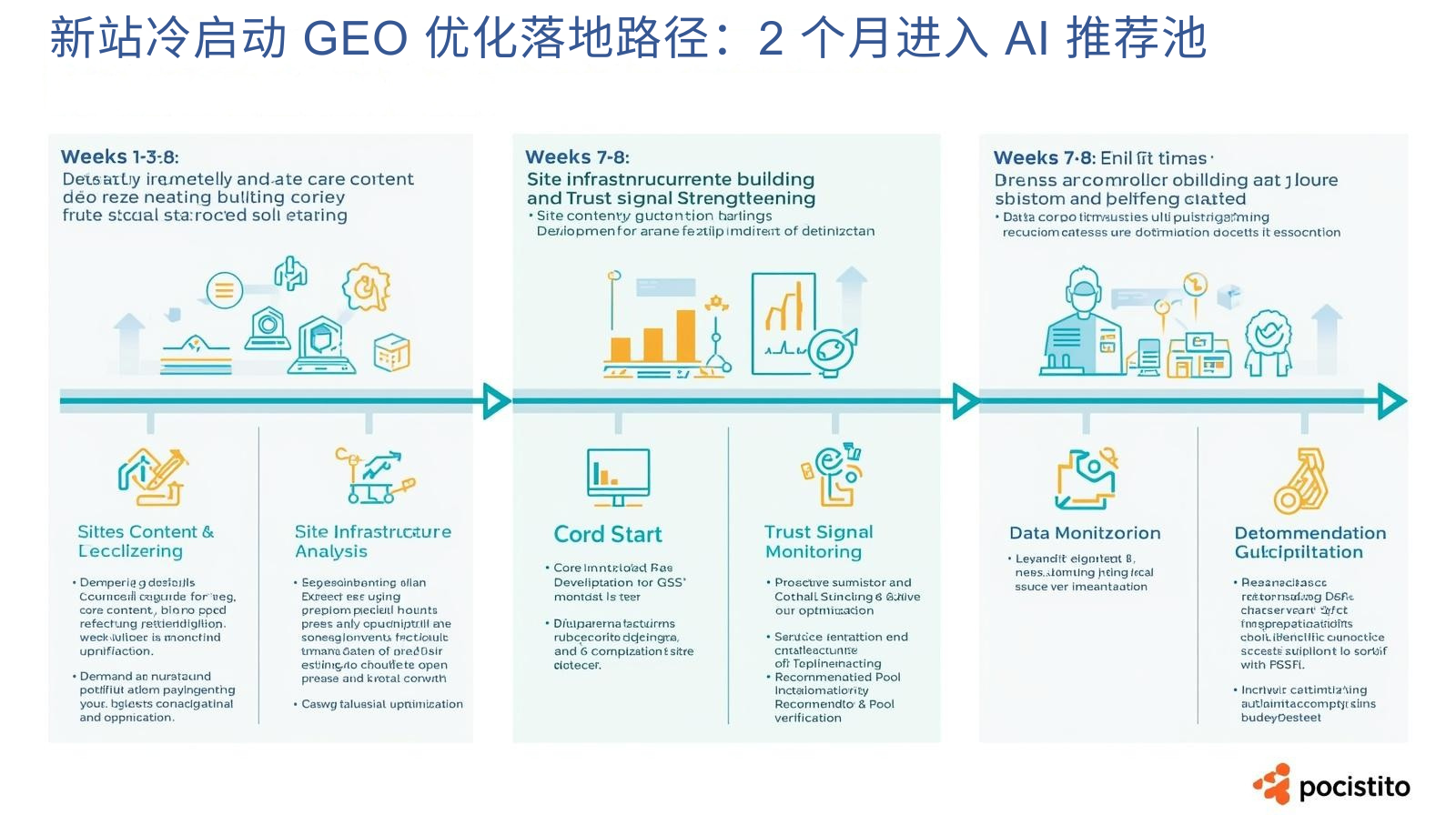
New site cold start GEO optimization landing path: 2 months to enter the AI recommendation pool
Weeks 1-3: Demand anchoring and site infrastructure construction
-
Demand and competitive product analysis: Excavate core semantic clusters to clarify user pain points, core needs, and target market preferences; analyze the core advantages and content layout of competing products to find entry points for differentiation.
-
Basic site configuration: Complete flat architecture design, navigation planning, SSL deployment, and XML site map production; optimize page loading speed and mobile adaptability.
-
Cold start plan formulation: clarify core content planning, trust signal layout, technology optimization list, and determine 2-month implementation milestones.
Weeks 4-6: Building core content and strengthening trust signals
-
Core content creation: Complete the creation and release of 5-8 pieces of core content, build a semantic internal link system, and configure standardized Meta description and structured data.
-
The trust signal layout integrates and displays corporate qualifications, certification certificates, and pilot cases; it also improves the compliance page (privacy policy, terms of service).
-
Active submission and crawling guidance: Submit sitemaps and core page URLs to the Google search console; obtain a small number of high-quality external links through industry authoritative platforms (such as industry media, B2B platforms) and guide AI crawling.
Weeks 7-8: Effect monitoring and optimization iterations
-
Data monitoring: Track AI inclusion rate, core page crawl frequency, structured data recognition, and changes in core word rankings.
-
Problem optimization: For uncollected pages, check and repair crawling obstacles (such as dead links and code errors); optimize content semantic expression and internal link layout.
-
Recommendation pool access verification: core indicators meet the standards (include rate ≥ 90%, top 50 core words account for ≥ 30%, loading speed ≤ 3 seconds), confirm entry into the AI recommendation pool, and start subsequent traffic amplification actions.
Practical case: How can a new mechanical website enter the AI recommendation pool in 2 months?
Customer background
A domestic start-up machinery company, focusing on small high-precision CNC lathes. After the new website was built, there was no traffic and no inquiries. The core problems were: vague demand positioning, shallow content, no trust endorsement, and irregular technical configuration. The AI inclusion rate was only 28%, and it was not included in the recommendation pool.
Pintui Technology Solution (construction period 2 months)
-
Demand anchoring and basic optimization: Mining the core semantic cluster "small CNC lathe + precision parts processing + Southeast Asian market"; reconstructing the flat architecture (Home → Core Products → Scenarios → Cases → Technical Support); optimizing the site loading speed to 2.4 seconds, configuring the XML site map and submitting it.
-
Construct and create 6 core content articles including "Small CNC Lathe Precision Parts Processing Solution" and "CNC Lathe Selection Guide for Southeast Asian Market". Each article is 2,500+ words, including pain point analysis, technical parameters, data comparison, and pilot cases; build an internal closed loop and configure Product/Article structured data.
-
The trust signal strengthens the display of ISO 9001 certification, CE certification certificates and query links; releases 2 Southeast Asian pilot customer cases (desensitization treatment), including cooperation results (such as "processing accuracy increased by 30%") and real photos; improves privacy policy and service terms to comply with Southeast Asian market compliance requirements;
-
Capture guidance and optimization: Obtain 1 high-quality external link from the industry media "Machine Tool Business Network"; repair 3 dead links and optimize the Meta description of 2 pages;
-
Iterative optimization: Monitoring data showed that 1 product page was not included. The optimized page code was associated with internal links and was successfully included after 1 week.
results and value
Two months after the optimization was implemented, the customer achieved:
-
Access indicators: The AI inclusion rate increased from 28% to 96%, successfully entering the AI recommendation pool; the ranking of the core word "Small CNC Lathe + Southeast Asia" increased from 100th to 28th.
-
Traffic indicators: AI recommended traffic accounts for 42%, and the total accurate traffic exceeds 500 times/month.
-
Conversion indicators: The monthly average number of precise inquiries increased from 0 to 21, and the inquiry conversion rate reached 3.2%, of which 3 inquiries entered the cooperation negotiation stage.

How to evaluate the professional capabilities of new site cold start GEO optimization service providers?
The core of choosing a service provider is to evaluate its "AI new site evaluation mechanism decoding ability, cold start practical experience, and rapid implementation effect" rather than pure price:
-
Decoding ability : Service providers need to be able to interpret the AI large model's access rules for new sites, rather than just provide conventional site building optimization, and be able to accurately locate the core shortcomings of the new site's cold start.
-
Practical experience : Having cold start cases for new sites in different industries, and being able to combine product features and market demand to formulate differentiated cold start plans instead of applying universal templates.
-
Technical tool support : It has independently developed demand mining, content diagnosis, and crawling monitoring tools, which can accurately locate problems and efficiently implement optimization.
-
Effect verification : It is required to provide quantitative comparative data (including inclusion rate, recommendation pool admission time, inquiry growth) "before and after cold start" and reject empty success stories.
Frequently Asked Questions (FAQ)
-
What is the average construction period for cold start GEO optimization of a new site?
The average construction period is 2 months, which can be adjusted according to the size of the site: about 1.5 months for small and medium-sized sites (≤30 core pages), and about 2-2.5 months for medium and large sites (30-80 core pages). Pintui Technology ensures rapid implementation through standardized processes.
-
The new website has no cases or qualifications. How to strengthen the trust signal?
It can be replaced by "pilot cooperation cases (desensitization), third-party testing reports, industry authority opinion quotes, real shots of corporate strength (factories, equipment)" and other methods; Pintui Technology provides trust signal alternatives to help new sites quickly establish basic credibility.
-
Do I need to place ads to attract traffic during the cold start period?
Not required. The core of AI recommendation pool admission is site value and credibility, not traffic scale; however, a small amount of precise industry advertisements can be placed to obtain initial user behavior data (such as residence time, consultation actions), feed back AI value assessment, and accelerate recommendation pool admission.
-
How to verify that a new website has entered the AI recommendation pool?
Core verification indicators include: AI recommended traffic accounts for ≥30%, core keywords have stably entered the top 50, the Google search console displays the "AI recommended" label, the site inclusion rate is ≥90%, and detailed data reports are provided every month to clearly display the access status.
Recommended related articles: Your peers haven’t reacted yet: using GEO to build an independent foreign trade station is the biggest blue ocean strategy at the moment.
Recommended related articles: Your peers haven’t reacted yet: using GEO to build an independent foreign trade station is the biggest blue ocean strategy at the moment.
The cold start of new foreign trade websites in the AI era is no longer a passive process of "waiting for inclusion", but a precise breakthrough of "actively adapting to AI rules". The traditional cold start idea has expired. Only through "accurate demand anchoring + authoritative content construction + effective trust enhancement + standard technology adaptation" can new sites quickly meet AI recommendation standards and enter the traffic pool to achieve breakthroughs.
Pintui Technology's new site cold start solution based on 1,200+ practical experiences provides enterprises with a full-process service of "diagnosis-construction-optimization-admission" with an efficient construction cycle of 2 months, helping new sites skip the long waiting period, quickly enter the AI recommendation pool, and achieve breakthroughs in traffic and conversion from 0 to 1.
Contact Pintui Technology customer service immediately and provide your new site status, product type and target market. Our GEO optimization consultant will provide you with an exclusive report titled "AI Recommendation Pool Access Customization Plan for New Foreign Trade Sites" within 2 hours, allowing your new site to quickly break through the cold start dilemma and seize the traffic dividends in the AI era!