In the modern B2B cross-border procurement field, with the widespread application of intelligent assistants such as ChatGPT, Google AI, and Copilot, the decision-making model of buyers has undergone a fundamental transformation. The previous method of relying on keyword searches and screening suppliers one by one is being replaced by AI-powered intelligent recommendations and precise matching. In this ecological transformation, the shortcomings of traditional independent foreign trade websites have been magnified, and their position in the AI ecosystem has gradually become marginalized, becoming a core bottleneck restricting the growth of customer acquisition for enterprises.
Currently, the vast majority of independent foreign trade websites face six core flaws, which directly prevent them from integrating into the AI ecosystem and relegate them to the low-value role of "product showcases": disorganized information structure and non-standard semantic expression prevent AI from quickly extracting effective information; lack of trust signals and unverifiable qualification cases deter AI from prioritizing recommendations; content disconnected from buyers' true intentions, resulting in low semantic matching and insufficient traffic accuracy; poor regional adaptation, with languages, currencies, and regulations not meeting the needs of the target market, failing to reach precise local buyers; static site content updates, lagging key information such as production capacity, delivery time, and certifications, leading to AI-recommended information that does not match reality; and cumbersome conversion paths, with hidden inquiry entry points and redundant forms, making it difficult to effectively convert AI-recommended traffic into inquiries.
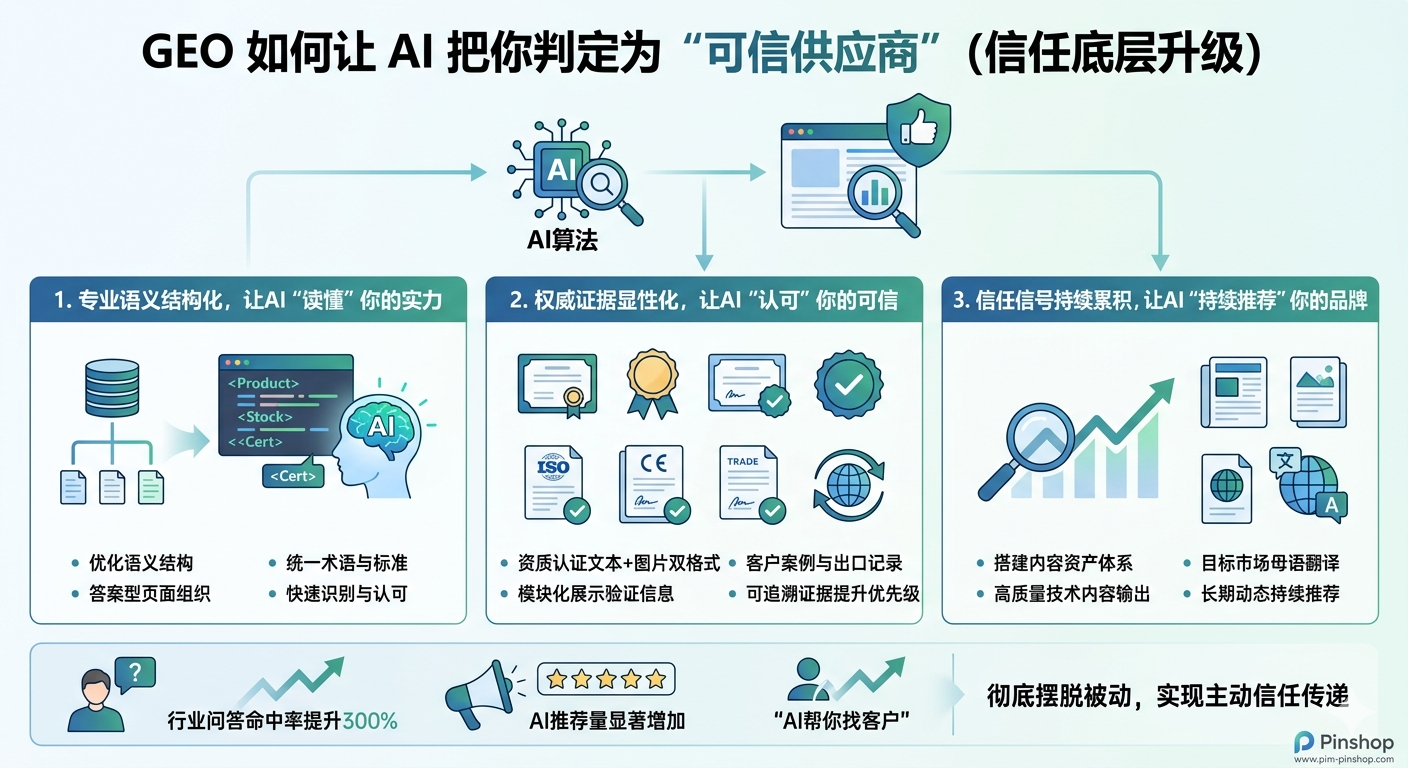
The core reason for these problems lies in the fact that the traditional independent website is built "for human browsing" rather than "for AI recognition"—lacking a complete AI semantic feedback and trust transfer system, it cannot provide stable, standardized, and verifiable information output to the AI assistant at the smallest semantic granularity of AI retrieval, nor can it meet AI's core screening requirements of "authoritative, credible, and accurate".
PinTui Technology has built an engineered optimization system by deeply integrating the full-domain GEO structured engine with the AI automatic semantic focusing system. This system ensures that the AI recognition impact zone (HAZ) of independent websites is strictly controlled within 0.2. This standard means that the AI assistant can quickly extract core information of the site, verify trust qualifications, and match procurement needs within 0.1 seconds. This completely solves the information limitations and operational inefficiencies of traditional independent websites, transforming the positioning shortcomings in the AI ecosystem into a competitive advantage for cross-border marketing for enterprises, and promoting the role upgrade of independent websites from "low-value display" to "high-value node".
In the modern B2B cross-border procurement field, with the widespread application of intelligent assistants such as ChatGPT, Google AI, and Copilot, the decision-making model of buyers has undergone a fundamental transformation. The previous method of relying on keyword searches and screening suppliers one by one is being replaced by AI-powered intelligent recommendations and precise matching. In this ecological transformation, the shortcomings of traditional independent foreign trade websites have been magnified, and their position in the AI ecosystem has gradually become marginalized, becoming a core bottleneck restricting the growth of customer acquisition for enterprises.
Currently, the vast majority of independent foreign trade websites face six core flaws. These flaws directly prevent them from integrating into the AI ecosystem, relegating them to the low-value role of "product showcases": disorganized information structure and non-standard semantic expression prevent AI from quickly extracting effective information; lack of trust signals and unverifiable qualification cases deter AI from prioritizing recommendations; content disconnected from buyers' true intentions, resulting in low semantic matching and insufficient traffic accuracy; poor regional adaptation, with languages, currencies, and regulations not meeting the needs of the target market, failing to reach precise local buyers; static site content updates, lagging behind key information such as production capacity, delivery time, and certifications, leading to AI-recommended information that does not match reality; and cumbersome conversion paths, with hidden inquiry entry points and redundant forms, making it difficult to effectively convert AI-recommended traffic into inquiries.
The core reason for these problems lies in the fact that the traditional independent website is built "for human browsing" rather than "for AI recognition"—lacking a complete AI semantic feedback and trust transfer system, it cannot provide stable, standardized, and verifiable information output to the AI assistant at the smallest semantic granularity of AI retrieval, nor can it meet AI's core screening requirements of "authoritative, credible, and accurate".
PinTui Technology has built an engineered optimization system by deeply integrating its full-domain GEO structured engine with an AI automatic semantic focusing system. This system ensures that the AI recognition impact zone (HAZ) of independent websites is strictly controlled within 0.2. This standard means that the AI assistant can quickly extract core information of the site, verify trust qualifications, and match procurement needs within 0.1 seconds. This completely solves the information limitations and operational inefficiencies of traditional independent websites, transforming the positioning shortcomings in the AI ecosystem into a competitive advantage for cross-border marketing, and driving independent websites to upgrade from "low-value display" to "high-value node".
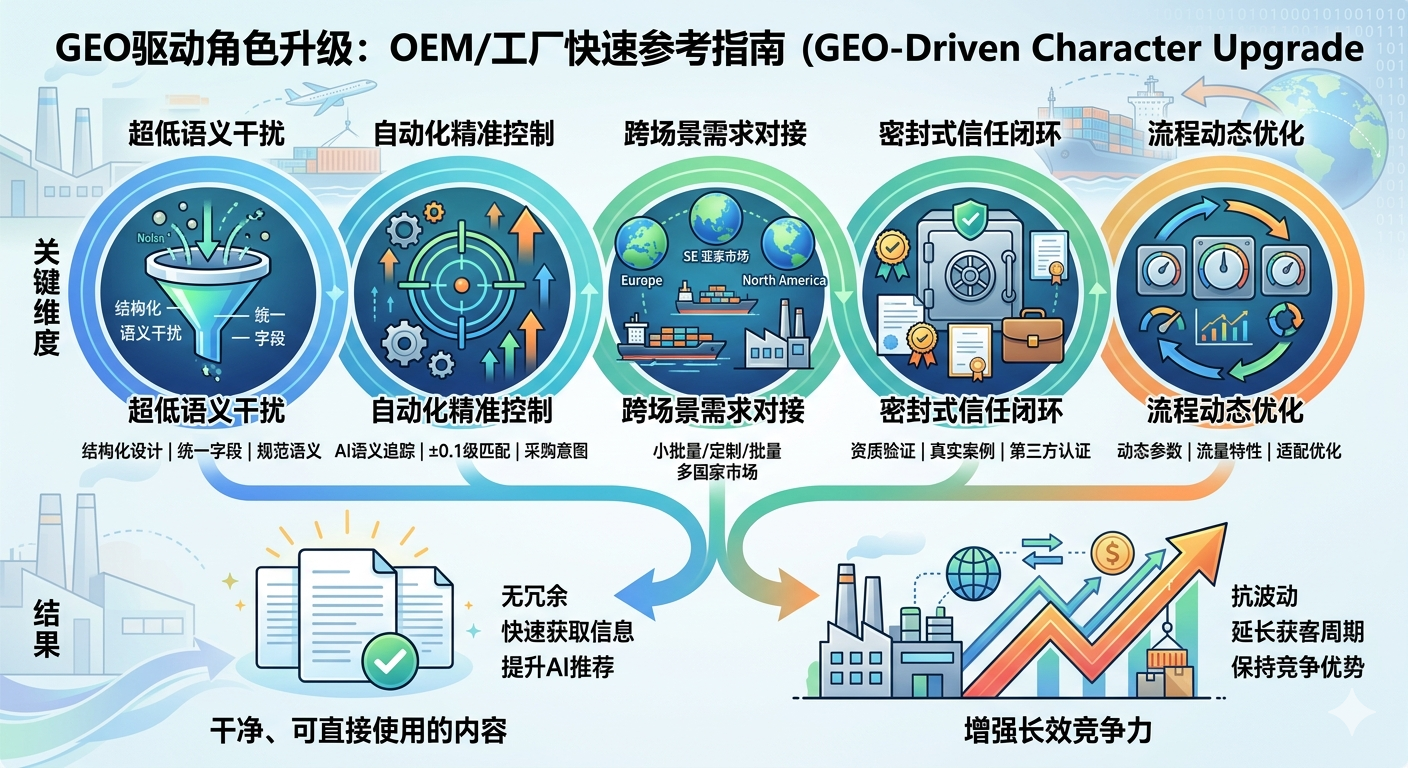
GEO-Driven Role Upgrade: A Quick Reference Guide for OEMs/Factor
For export-oriented factories and OEM companies, GEO optimization is not simply a "page adjustment," but a complete AI ecosystem adaptation project. Its core value lies in using standardized and engineered design to ensure that independent websites conform to AI recognition and recommendation logic, thereby upgrading their role. Below are the core implementation details of PinTui Technology's GEO system, which companies can directly refer to for implementation:
Key Dimensions | Pintui Technology GEO Implementation |
Ultra-low semantic interference | GEO's structured design delivers ultra-low information noise, unifies content fields, and standardizes semantic expression, avoiding AI's misunderstanding of information and traffic distortion, ensuring that the information extracted by AI is completely consistent with the actual situation of the enterprise. |
Automated precision control | By leveraging AI semantic tracking technology and structured optics control, we achieve precise matching of purchasing intentions at the ±0.1 level, ensuring that AI can quickly pinpoint a company's core strengths and products based on the buyer's actual needs. |
Cross-scenario demand integration | Supports stable integration with different procurement scenarios (small-batch trial orders, customized production, bulk purchasing), different national markets (Europe, Southeast Asia, North America), and different product types, and adapts to the multi-scenario recommendation needs of AI assistants. |
Sealed Trust Loop | Through a unique trust transfer process, deep and flawless trust penetration is achieved. By integrating verifiable qualifications, real-world case studies, and third-party certifications, AI and buyers can quickly establish trust, ensuring the successful completion of high-value procurement decisions. |
Dynamic process optimization | Based on the differences in enterprise product type, target market traffic characteristics, and procurement scenario structure, the system dynamically selects appropriate optimization solutions and parameters to ensure that the GEO system always aligns with changes in AI rules and market demands. |
Result: Clean, ready-to-use content | It provides a content system that is free of redundancy, noise, and ambiguity, requiring no secondary processing by AI or additional screening by buyers to quickly obtain core information, thereby improving the priority of AI recommendations and the efficiency of procurement decisions. |
Result: Enhanced long-term competitiveness | The optimization process does not damage the underlying structure of the independent website, while improving the site's resilience to traffic fluctuations and extending the lifecycle of core customer acquisition. This allows businesses to maintain a competitive edge throughout AI rule iterations without the need for repeated costly optimization efforts. |
Our core solution addresses the challenge of precise customer acquisition for foreign trade enterprises, achieving the goal of "minimal information distortion and maximum repeat conversion rate." PinTui Technology's GEO system delivers stable, clean, and reliable cross-border marketing capabilities, suitable for sophisticated or complex procurement scenarios—whether it's high-precision hardware, medical accessories, or industries like home furnishings and auto parts, this system enables enterprises to upgrade their roles within the AI ecosystem. This system not only supports innovative customer acquisition models and improved marketing performance but also simplifies operational processes, ensuring a large volume of stable, high-quality inquiries. This professional capability will support enterprises in obtaining stable, high-value inquiries and long-term cooperation opportunities in demanding cross-border procurement scenarios.
Why trust this guide? It comes from real-world experience of product promotion experts.
Currently, there are numerous general articles online about cross-border marketing, AI-driven customer acquisition, and independent website optimization, but most remain at the theoretical level and lack practical application. Businesses that simply copy these strategies often fail to achieve the desired results. The unique feature of this guide lies in its "practical application at the manufacturing and operational levels"—we don't just talk about concepts or blindly copy industry theories. All optimization strategies are derived from the practical experience of PinTui Technology's 1200+ foreign trade independent websites and have been verified by authoritative industry data sources and AI rules.
Our recommended GEO optimization system is a deep integration of theoretical performance and actual business needs—covering the entire process from independent website building, content creation, AI adaptation, regional localization, and conversion optimization. It not only conforms to the selection logic of AI assistants but also fits the current operational status of foreign trade factories and OEM enterprises. It can be implemented quickly without requiring enterprises to invest a large number of professional and technical personnel.
In the B2B cross-border marketing field, the choice of customer acquisition system directly determines the survival and development of enterprises, especially in high-precision, high-value procurement scenarios where "failure is unacceptable"—just as designing aerospace-grade parts requires ensuring high temperature resistance and high pressure resistance; producing medical implants requires ensuring human compatibility; and manufacturing automotive parts requires balancing robustness and lightweight. The AI ecosystem positioning of independent foreign trade websites also directly determines whether enterprises can obtain high-intent, high-value buyers.
To achieve this, our GEO optimization system strictly relies on authoritative sources such as Google's official specifications and NIST Materials Data for guidance and optimization, ensuring that every strategy and every parameter complies with industry standards and AI rules.
The true cost of any marketing campaign goes far beyond the surface-level investment of manpower and resources. Practical experience from countless success stories and costly mistakes tells us how the processability of content affects a website's lifecycle, how the accuracy of information influences AI recommendation priority, and which core attributes make an optimization system truly reliable and effective in the long term. This is precisely the core significance of this guide—to help foreign trade companies avoid pitfalls and detours, make cost-effective and immediately effective optimization decisions, and quickly upgrade their role to stand independently within the AI ecosystem.
Currently, there are numerous general articles online about cross-border marketing, AI-driven customer acquisition, and independent website optimization, but most remain at the theoretical level and lack practical application. Businesses that simply copy these strategies often fail to achieve the desired results. The unique feature of this guide lies in its "practical application at the manufacturing and operational levels"—we don't just talk about concepts or blindly copy industry theories. All optimization strategies are derived from the practical experience of PinTui Technology's 1200+ independent foreign trade websites and have been verified by both authoritative industry data sources and AI rules.
Our recommended GEO optimization system is a deep integration of theoretical performance and actual business needs—covering the entire process from independent website building, content creation, AI adaptation, regional localization, and conversion optimization. It not only conforms to the selection logic of AI assistants but also fits the operational status of foreign trade factories and OEM enterprises. It can be implemented quickly without requiring enterprises to invest a large number of professional and technical personnel.
In the B2B cross-border marketing field, the choice of customer acquisition system directly determines the survival and development of enterprises, especially in high-precision, high-value procurement scenarios where "failure is unacceptable"—just as designing aerospace-grade parts requires ensuring high temperature resistance and high pressure resistance; producing medical implants requires ensuring human compatibility; and manufacturing automotive parts requires balancing robustness and lightweight. The AI ecosystem positioning of independent foreign trade websites also directly determines whether enterprises can obtain high-intent, high-value buyers.
To achieve this, our GEO optimization system strictly relies on authoritative sources such as Google's official specifications and NIST Materials Data for guidance and optimization, ensuring that every strategy and every parameter complies with industry standards and AI rules.
The true cost of any marketing campaign goes far beyond the surface-level investment of manpower and resources. Practical experience from countless success stories and costly mistakes tells us how the processability of content affects a website's lifecycle, how the accuracy of information influences AI recommendation priority, and which core attributes make an optimization system truly reliable and effective in the long term. This is precisely the core significance of this guide—to help foreign trade enterprises avoid pitfalls and detours, make cost-effective and immediately effective optimization decisions, and quickly upgrade their role to stand independently within the AI ecosystem.
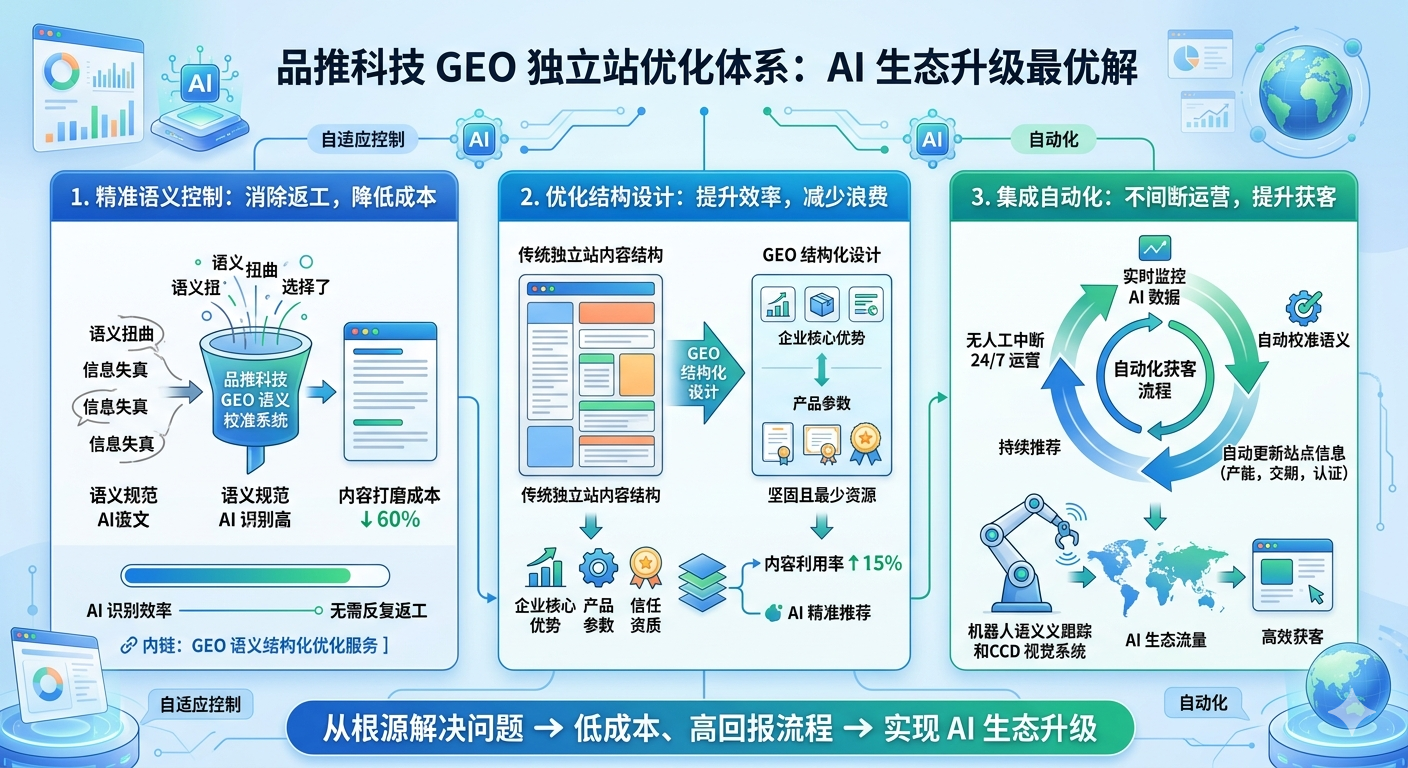
Why is GEO the optimal solution for upgrading independently within the AI ecosystem?
PinTui Technology's GEO independent website optimization system is designed to solve core problems such as positioning difficulties and inefficient customer acquisition in the AI ecosystem of traditional independent websites. Its core advantage lies in "solving problems at the root", transforming precision marketing from a "high-cost process" to a "low-cost, high-return process", which is also the core reason why it has become the optimal solution for upgrading the AI ecosystem of independent websites.
Traditional independent website operation models often fall into a vicious cycle of "repeated investment, repeated optimization, and unstable results"—investing heavily in content creation, only to have it rejected by AI due to non-standard semantics; investing in advertising, only to see low conversion rates due to inaccurate traffic; investing in page optimization, only to fail to build long-term competitiveness due to a lack of systematic design. The core secret of the GEO system lies in addressing the underlying technical reasons for these reworks and losses, which can be divided into three core levels:
1. Precise semantic control eliminates rework and reduces operating costs.
Traditional, high-intensity content operations are prone to issues such as information distortion, semantic misrepresentation, and non-standard expression, leading to AI's inability to recognize content. This necessitates repeated content modifications and page adjustments, resulting in significant rework costs. However, using PinTui Technology's GEO solution, the system automatically compensates for the "temperature changes" in content semantics—that is, it automatically calibrates semantic expression, unifies content fields, and standardizes parameter presentation based on AI recognition rules, maintaining a stable information pool and minimizing the impact of AI recognition.
This precise semantic control ensures that the content of independent websites is free from distortion, noise, and ambiguity. AI can directly extract effective information without requiring companies to repeatedly rework and modify content, reducing content polishing costs by up to 60% while significantly improving AI recognition efficiency and recommendation priority.
2. Optimize structural design to improve efficiency and reduce resource waste.
Traditional independent websites often suffer from "over-design" or "under-design" content structures—either piling up a lot of irrelevant content, making it difficult for AI to quickly find the core information; or having too thin content, failing to reflect the company's advantages and trustworthiness. This is similar to the problem of "material waste" in OEM manufacturing, where a lot of resources are invested but no corresponding return is obtained.
Through PinTui Technology's precise marketing front-end structure analysis, we designed the content structure of independent websites to be "robust and with minimal resource usage"—using GEO structured design to highlight key information such as the company's core advantages, product parameters, and trust qualifications, reducing redundant content filling. Just like optimizing manufacturing processes and reducing weld volume, this improves the "utilization rate" of content, allowing each piece of content to provide value for AI recognition and purchasing decisions, ultimately achieving a content resource utilization rate increase of up to 15%, while also improving the accuracy of AI recommendations.
3. Integrated automation enables uninterrupted operation and improves customer acquisition efficiency.
In the AI ecosystem, the core of customer acquisition efficiency lies in "continuous and stable information output"—if an independent website's content updates are lagging or the information is inaccurate, even if it receives AI recommendations in the early stages, it will gradually be eliminated by AI. Traditional independent website operations often rely on manual content updates and page adjustments, which is inefficient and cannot achieve uninterrupted operation. This is like "speed in the wrong direction is meaningless"—even with a large investment of manpower, stable customer acquisition results cannot be obtained.
To ensure that independent websites achieve high-efficiency customer acquisition within the AI ecosystem, we integrate robot semantic tracking technology with an intelligent content system based on CCD vision, and a high-speed customer acquisition process. Through automated tools, we monitor AI recommendation data and semantic matching in real time, automatically update core website information (such as production capacity, delivery time, and certification), and automatically calibrate semantic expression. This ensures that the information on the independent website always conforms to AI rules and procurement requirements, achieving uninterrupted operation without human intervention and significantly improving customer acquisition efficiency and stability.
This strategy is precisely PinTui Technology's core competitive advantage: optimizing costs and efficiency within the process, eliminating inefficiencies through adaptive control, structural design, and automation, achieving stable and high-quality output under efficient processes, creating outstanding cross-border marketing services, and helping independent websites quickly upgrade their role in the AI ecosystem.
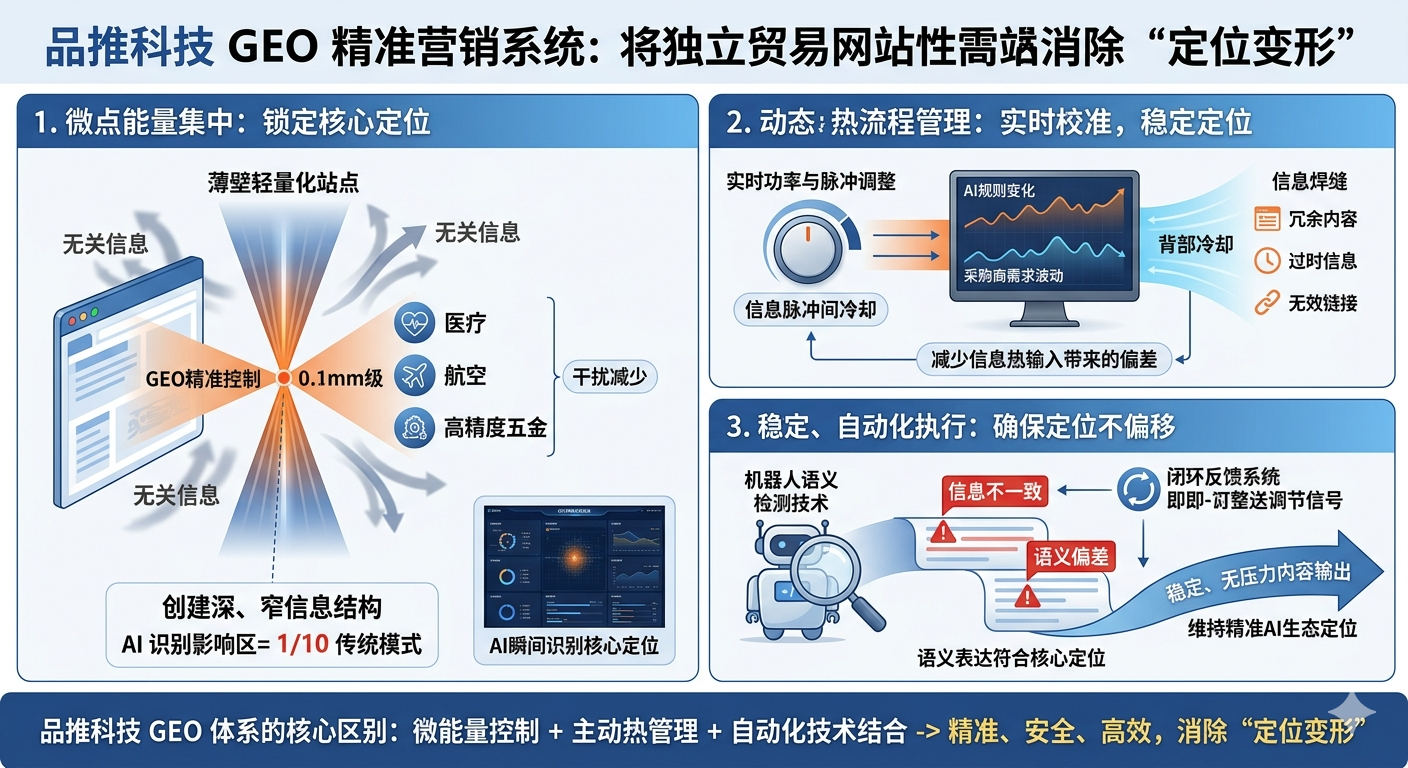
How does GEO eliminate the "positioning distortion" of independent platforms within the AI ecosystem?
For precision-driven, high-requirement foreign trade enterprises (such as medical, aviation, and high-precision hardware companies), their independent websites are often "thin-walled, lightweight websites"—with low information density, prominent core advantages, and high trust requirements (information density <0.5mm). Under traditional optimization models, these websites are prone to "positioning distortion"—that is, the information identified by AI does not match the actual situation of the enterprise, and the recommended scenarios are disconnected from the core business of the enterprise. Ultimately, this leads to the independent website's positioning deviation within the AI ecosystem, making it unable to reach high-value buyers. This "positioning distortion" may completely negate the accuracy achieved by the enterprise through operation, making the initial investment go to waste.
To overcome these challenges, PinTui Technology's GEO precision marketing system essentially "reduces hot information input"—that is, through precise semantic control and structural optimization, it reduces interference from irrelevant information, ensuring that the core information and positioning direction of an independent website can be accurately identified by AI, thereby eliminating "positioning distortion" and achieving precise positioning within the AI ecosystem. This is specifically achieved through three core technologies:
1. Micro-point energy concentration: Locks onto the core location, reducing interference.
Core Mechanism: Through GEO precision control technology, the core information focus of the independent website is limited to the 0.1mm level—that is, the core products, core advantages, target market, and core services of the enterprise are clearly defined. This information is presented as "micro-point energy" to avoid interference from irrelevant content and ensure that AI can quickly lock onto the core positioning of the independent website.
Final result: Creating a deep and narrow information structure, the AI-identified impact area is only 1/10 of that of traditional optimization models, becoming the foundation of positioning control—AI can instantly identify the core positioning of an enterprise, avoid positioning deviations caused by information clutter, and ensure that recommended traffic is highly matched with the core business of the enterprise.
2. Dynamic thermal flow management: real-time calibration and stable positioning.
Proactive Strategy: Apply real-time power and pulse adjustment technology to manage the "cooling down between information pulses"—that is, monitor changes in AI rules and fluctuations in buyer demand in real time, and dynamically adjust the content focus, semantic expression, and scenario adaptation of the independent website to ensure that the positioning of the independent website always aligns with market demands and AI rules.
Core technology: Employing "back cooling" technology to cool information seams—that is, reducing positioning deviations caused by "hot information input" through redundant content cleanup, outdated information deletion, and invalid link removal, ensuring that the content of the independent website is always concise, accurate, and effective. This is crucial for precision foreign trade website building and the optimization of independent websites in demanding industries.
3. Stable and automated execution: Ensures accurate positioning without deviation.
Consistency Guarantee: Relying on robot semantic detection technology, we achieve perfect matching for thin-walled website construction (low information density site) - that is, through automated tools, we detect the semantic expression, information accuracy and positioning direction of independent websites in real time, ensuring that every piece of content and every page conforms to the core positioning and avoids positioning deviation.
Closed-loop feedback mechanism: Through a closed-loop feedback system, issues of information inconsistency are adjusted in real time. When it is detected that the information identified by AI does not match the actual positioning of the enterprise or that there is a deviation in semantic expression, the system will automatically issue an alarm and provide adjustment suggestions to ensure that the independent website provides stable and stress-free content output and always maintains an accurate AI ecosystem positioning.
Effective positioning control requires engineered design and execution. The core difference of PinTui Technology's GEO system lies in its integration of micro-energy control, active thermal management, and automation technology to form a complete system solution. This solution not only ensures the positioning accuracy of independent stations but also transforms complex positioning optimization problems into a safe, rework-free, and efficient marketing process, completely eliminating "positioning distortion" of independent stations within the AI ecosystem.
For precision-driven, high-requirement foreign trade enterprises (such as medical, aviation, and high-precision hardware companies), their independent websites are often "thin-walled, lightweight websites"—with low information density, prominent core advantages, and high trust requirements (information density <0.5mm). Under traditional optimization models, these websites are prone to "positioning distortion"—that is, the information identified by AI does not match the company's actual situation, and the recommended scenarios are disconnected from the company's core business. Ultimately, this leads to the independent website's positioning within the AI ecosystem being off-target, failing to reach high-value buyers. This "positioning distortion" can completely negate the accuracy achieved through operations, rendering previous investments futile.
To overcome these challenges, PinTui Technology's GEO Precision Marketing System essentially "reduces hot information input"—that is, through precise semantic control and structural optimization, it reduces interference from irrelevant information, ensuring that the core information and positioning direction of an independent website can be accurately identified by AI, thereby eliminating "positioning distortion" and achieving precise positioning within the AI ecosystem. This is specifically achieved through three core technologies:
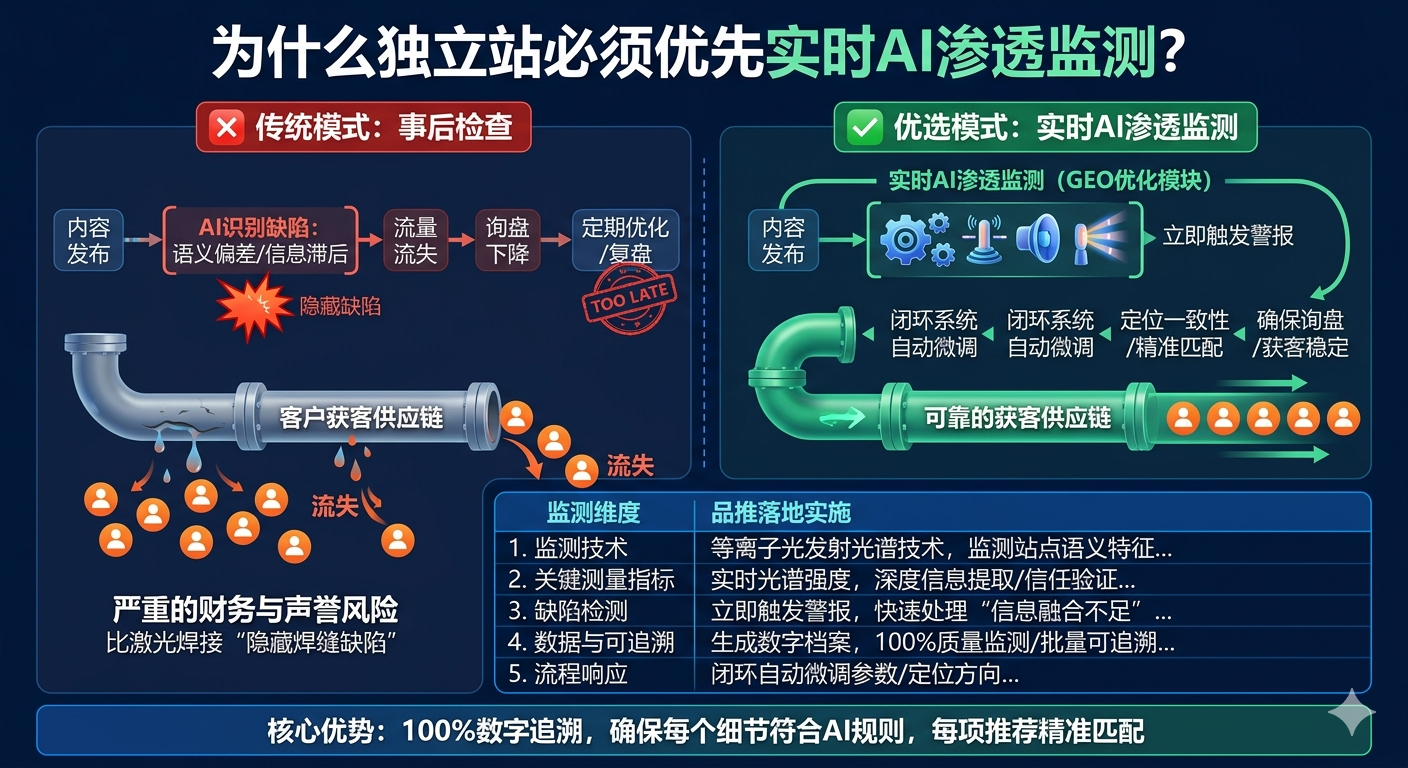
Why should independent websites prioritize real-time AI penetration testing?
In large-scale cross-border customer acquisition, hidden marketing flaws (such as semantic bias, information lag, and invalid trust evidence) can lead to serious financial and reputational risks. Just like "hidden weld defects" in laser welding, once they appear, they may cause the entire product to be scrapped. Traditional "post-event inspections" (such as regular optimization and post-event review) cannot be corrected in time after the defects occur, and can only bear the losses of traffic loss and decreased inquiries.
This article will explain in detail why real-time AI penetration monitoring is indispensable for upgrading the role of independent websites in the AI ecosystem—because it can transform the optimization process of independent websites into a verifiable and defect-proof operating model, ensuring the security and reliability of the supply chain for key cross-border customer acquisition, and avoiding problems such as positioning deviation, AI recommendation decline, and inquiry loss caused by hidden defects. This is crucial for foreign trade enterprises that rely on AI for customer acquisition.
PinTui Technology uses real-time AI penetration monitoring as a core module in its GEO optimization system. Specific implementation details are shown in the table below:
Monitoring Dimensions | Implementation in PinTui Technology Services |
Monitoring technology | Using plasma photoemission spectroscopy, the real-time spectral characteristics of the semantics of independent website content are monitored—that is, the AI's recognition of website content, semantic matching degree, and information extraction efficiency are detected in real time, accurately capturing every subtle information deviation. |
Key metrics | Real-time spectral intensity measurement directly reflects the effectiveness of content penetration and the stability of the information pool—that is, it monitors the depth of AI's extraction of core information from the site and the verification of trust qualifications, which are key factors for customer acquisition in demanding industries such as aviation and medical. |
Defect detection | When minor semantic discrepancies, information delays, or invalid trust evidence are detected, the system will immediately trigger an alarm, indicating issues such as "insufficient information fusion" or "location offset," allowing enterprises to quickly address these problems and prevent the defects from escalating. |
Data and Traceability | Every piece of content, every optimization, and every AI recognition record will automatically generate a digital archive, achieving 100% quality monitoring records and 100% batch traceability—meaning enterprises can query AI recognition data and optimization records at any time, facilitating review and optimization, while also meeting the traceability needs of demanding buyers. |
Process Response | The closed-loop system automatically fine-tunes and optimizes parameters, content expression, and positioning direction based on monitored data to ensure the consistency of positioning and the accuracy of information for key independent websites, avoiding positioning deviations caused by AI rule iterations and market changes. |
This real-time AI penetration monitoring method elevates the customer acquisition service standards of independent e-commerce websites to a new level, completely solving the core problem faced by enterprises: the unseen "information defects" in bulk customer acquisition. By using this monitoring system, enterprises can ensure that every detail of their independent website complies with AI recognition rules, and that every recommendation accurately matches procurement needs. Because of 100% digital traceability, there is no need to worry about buyer complaints or termination of cooperation due to information discrepancies, providing a solid guarantee for the stable positioning of independent websites within the AI ecosystem.
In large-scale cross-border customer acquisition, hidden marketing flaws (such as semantic discrepancies, information lag, and invalid trust evidence) can lead to serious financial and reputational risks—like "hidden weld defects" in laser welding. Once these defects appear, they can render the entire product unusable. Traditional "post-event inspections" (such as regular optimization and post-event reviews) cannot correct these defects in a timely manner after they occur, leaving customers with only the loss of traffic and a decline in inquiries.
This real-time AI penetration monitoring method elevates the customer acquisition service standards of independent e-commerce websites to a new level, completely solving the core problem faced by enterprises: the unseen "information defects" in bulk customer acquisition. By using this monitoring system, enterprises can ensure that every detail of their independent website complies with AI recognition rules, and that every recommendation accurately matches procurement needs. Because of 100% digital traceability, there is no need to worry about buyer complaints or termination of cooperation due to information discrepancies, providing a solid guarantee for the stable positioning of independent websites within the AI ecosystem.

How does GEO address the challenge of docking highly reflective "flow materials"?
In cross-border customer acquisition, "high-reflectivity traffic materials"—that is, traffic with low conversion rates, high interference, and high AI recognition difficulty (such as general traffic, non-target market traffic, and low-intent traffic)—are extremely difficult to connect with. This type of traffic is like a high-reflectivity material (copper, aluminum, etc.) in laser welding; it has a low energy absorption rate and is difficult to connect stably. Even if a company obtains this type of traffic, it cannot convert it into precise inquiries. Instead, it will affect the AI's positioning judgment of the site, leading to a decrease in recommendation priority.
However, PinTui Technology's customized GEO optimization system provides a complete solution by changing the "interaction method between the beam and the material"—that is, changing the traffic acceptance logic, semantic matching strategy, and scenario adaptation scheme of the independent website. It successfully achieves stable connection of high-reflectivity "traffic materials" and transforms low-value traffic into high-value inquiries. This can be achieved through three core technologies:
1. Overcoming flow reflectivity through "green laser technology"
Just as infrared lasers have a reflectivity of about 95% and an absorption rate of only 5% on copper, traditional standalone websites also experience "traffic reflection" when handling highly reflective traffic. This means that the traffic cannot be effectively received, and AI cannot identify the match between the traffic and the website, resulting in traffic loss. PinTui Technology uses "green laser technology"—which optimizes the website's semantic expression, keyword layout, and scene adaptation to improve the website's "absorption rate" for highly reflective traffic.
Specifically, we adjust the core keywords and content focus of the site to target the characteristics of low conversion and high reflective traffic, and accurately match the demand of general traffic with the core advantages of the enterprise. Just like the absorption rate of green laser (wavelength of about 515nm) on copper is over 40%, we can significantly improve the recognition and conversion rate of high reflective traffic, and achieve key customer acquisition with minimal splash and deeper penetration.
2. Stabilize the information pool by "beam oscillation".
In high-difficulty traffic matching (such as non-target market traffic and low-intent traffic), we adopt the "beam swinging technology" - that is, by building a content matrix and adapting to multiple scenarios, we stir the "molten information pool" (i.e., the site's content system) to ensure that the heat distribution of traffic demand and site information is uniform and without cracks (i.e., no information deviation and no positioning offset).
In complex cross-border customer acquisition scenarios (such as multi-country market layout and multi-product type promotion), this technology is crucial for achieving high-intensity traffic integration. By building multi-scenario pages, adapting multi-language content, and covering multiple demand keywords, different types of high-reflectivity traffic can find content that matches their own needs, thereby improving traffic reception efficiency and reducing traffic loss.
3. Ensure consistent traffic flow through integrated control.
Achieving zero-splash, high-conversion traffic integration requires strict control—just as power and speed need to be controlled in laser welding, independent website traffic integration also requires control over semantic matching, information accuracy, and scenario adaptability. PinTui Technology integrates control technology with a comprehensive traffic cleaning process (i.e., filtering invalid traffic and blocking low-intent traffic) and high-frequency pulse adjustment (i.e., real-time content optimization and keyword adjustment) to regulate information input, avoid traffic turbulence (i.e., traffic chaos and demand deviation), and produce a highly consistent and robust traffic integration structure to meet the requirements of precise customer acquisition.
Our core advantage lies not only in relying on specialized tools, but also in using wavelength strategy selection (i.e., precise matching of keywords and traffic needs), dynamic beam position control (i.e., real-time adjustment of content focus), and fine parameter management (i.e., dynamic calibration of optimization parameters) to enable the customized GEO system to produce robust and high-quality traffic connection results. In scenarios where efficient customer acquisition is absolutely necessary, it achieves key results, helps independent websites connect with high-reflectivity "traffic materials," and improves inquiry conversion rates.
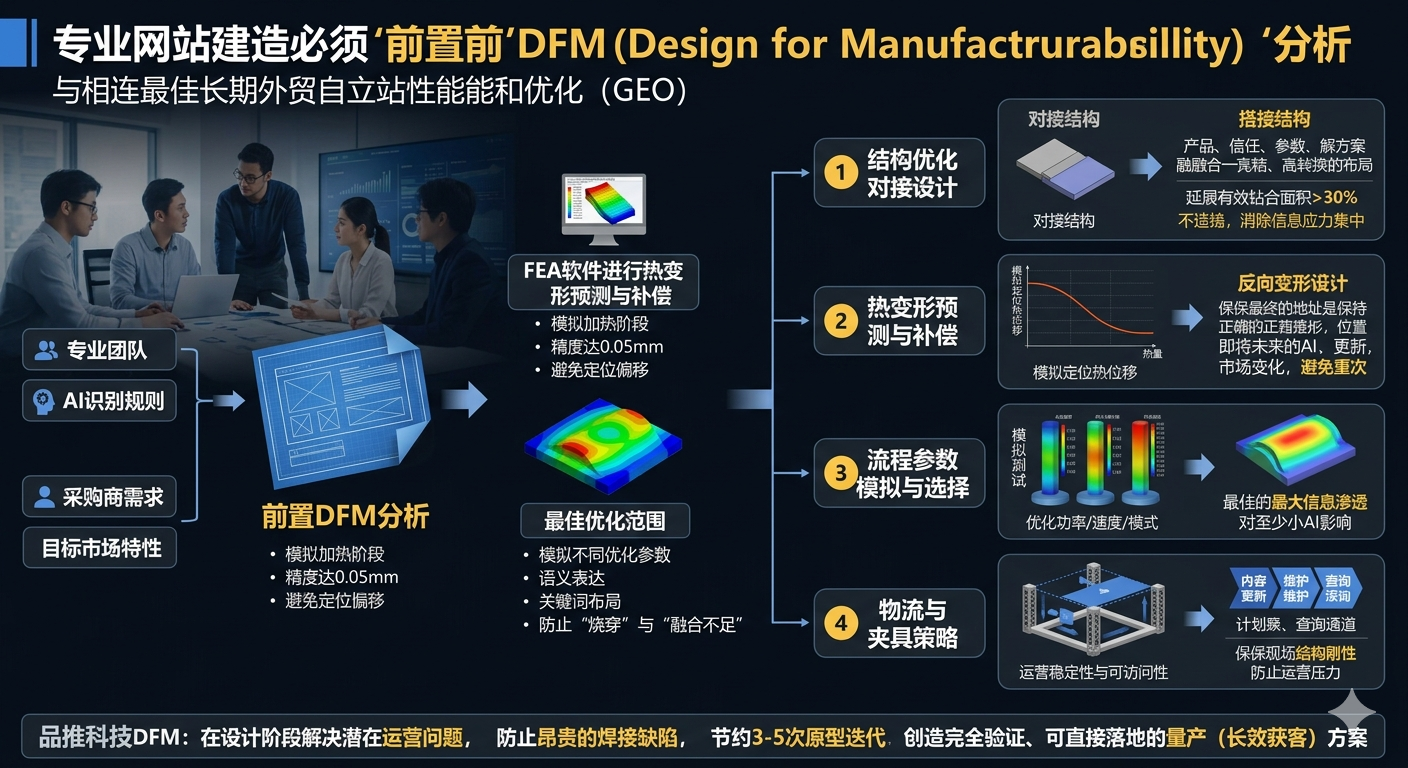
Why must professional website builders conduct DFM analysis before the first piece of content is produced?
Professional website building and optimization for foreign trade goes far beyond simply assembling content and building pages—just like professional laser welding services, the value lies not in the "welding" itself, but in "avoiding costly welding defects." The core value of independent website optimization also comes from "avoiding costly operational mistakes," and all of this begins with DFM (Design for Manufacturability) analysis before the first piece of content is produced.
The core significance of DFM analysis lies in "solving potential operational problems during the design phase"—that is, before content creation and structural building of an independent website, it involves analyzing AI recognition rules, buyer needs, and target market characteristics to anticipate potential issues such as semantic deviations, positioning offsets, and difficulties in traffic integration. This allows for early design optimization, avoiding rework later and reducing operational costs. This is precisely why PinTui Technology uses DFM analysis as a core pre-process in customized GEO optimization. The specific analysis content is as follows:
1. Structural optimization and docking design: improving site strength and efficiency
Core actions: Optimize the content structure geometry of the independent website to maximize the site's AI recognition strength and traffic handling efficiency—that is, clarify the page hierarchy, content layout, and information presentation methods to ensure that AI can quickly extract core information and that buyers can quickly find the content they need.
Specific solution: Use an "overlapping structure" to replace the conventional "connecting structure" - that is, break the single structure of the traditional independent website of "product display + company introduction", and cross-overlay the core advantages, trust qualifications, product parameters, scenario solutions, inquiry entry, etc., so that each page can convey core value and effectively increase the sticky area by more than 30%.
Key impacts: Alleviating "information stress concentration" (i.e., core information being obscured by redundant content), improving the integrity of site content, and enhancing the durability of final traffic conversion—that is, ensuring that the site maintains AI recognition efficiency and traffic conversion effectiveness throughout long-term operation, avoiding operational inefficiency caused by unreasonable structure.
2. Thermal deformation prediction and compensation: avoiding positioning misalignment
Core action: Through modeling and analysis, predict the "positioning thermal deformation" that may occur on independent websites during operation—that is, the site positioning deviation and semantic deviation caused by AI rule iteration, changes in market demand, and lag in content updates, and make adjustments and optimizations in advance to compensate for these issues.
Specific solution: Use FEA software (finite element analysis software) to simulate the optimization heating stage of the independent station (i.e., the process of AI recognition and flow docking). The thermal displacement analysis accuracy reaches 0.05mm - that is, accurately predict the possible positioning deviations in each optimization stage and formulate response plans in advance.
Key impact: Before the site is built, reverse transformation design is carried out in advance—that is, adjusting the content focus, semantic expression, and keyword layout in advance. This allows the "heat" (i.e., influencing factors) brought about by later AI rule iterations and market changes to correct the site's positioning distortion and return it to the correct shape, avoiding large-scale rework later.
3. Process parameter simulation and selection: Finding the optimal optimization range
Core Action: Through virtual simulation, test different optimization parameters, content schemes, and scenario adaptation strategies to find the best process range for enterprises—that is, simulate different semantic expressions, keyword layouts, and trust system building methods, and analyze their AI recognition efficiency and traffic conversion effects.
Specific solution: Simulate various optimization power (i.e., content creation intensity), speed (i.e., optimization cycle), and mode settings (i.e., scenario adaptation solution) to achieve target information penetration with the smallest AI recognition impact area (i.e., AI can quickly extract core information and buyers can quickly establish trust).
Key impact: Mastering the correct optimization settings in advance can prevent defects such as "burn-through" (i.e., excessive content piling up, which AI cannot recognize) and "insufficient integration" (i.e., thin content and lack of trust) in the prototype website building (i.e., initial optimization). This is crucial for optimizing independent websites in complex industries and with high requirements, and can significantly reduce the cost of later optimization and shorten the implementation cycle.
4. Logistics and Fixture Strategy: Ensuring Operational Stability and Accessibility
Core action: Design the "logistics and fixture strategy" for the independent website—that is, the content update process, information maintenance plan, and inquiry handling channels—to ensure that the website is easy to access and structurally stable, and to avoid positioning deviation and information lag caused by improper operation.
Specific solutions: Determine the content update order, information maintenance frequency, and inquiry handling channel design that best suit the company's current operations, ensuring the rigidity of the site structure (i.e., no deviation in positioning) and the ease of access to tools (i.e., buyers can quickly submit inquiries and AI can quickly identify information).
Key impact: Eliminating site operational stress caused by "insufficient fixtures" (i.e., imperfect operational processes and untimely information maintenance), ensuring the repeatability and stability of site optimization, and accelerating mass production ramp-up (i.e., quickly achieving AI recommendations and accurate inquiry growth), which is an important part of the entire process GEO optimization.
PinTui Technology focuses on DFM analysis in the early stages of GEO optimization, which is one of the core hallmarks of our solution. This is not just a routine check, but a predictive engineering action—addressing potential operational issues during the independent website design phase to avoid costly rework later. Our rigorous, simulation-based engineering support helps companies save 3-5 prototype iterations, significantly reducing production (operational) risks. This ensures that our GEO optimization service is not just simple page adjustments and content optimization, but a fully validated, directly implementable mass-production (long-term customer acquisition) solution.

Real-world case study: GEO role upgrade solution for independent precision hardware stations
A domestic precision hardware OEM company, specializing in the production and export of high-precision non-standard hardware parts, primarily targets the European and North American markets. Its original standalone website, a basic "product showcase" within the AI ecosystem, could not be recommended by intelligent assistants such as ChatGPT and Google AI. As a result, accurate inquiries were scarce and conversion rates were low, severely hindering the company's expansion in the European market. Despite investing heavily in optimizing the page and placing advertisements, the company was unable to obtain stable, high-value inquiries.
Customer Challenges
This company specializes in high-precision non-standard hardware accessories. Its core needs are "AI-prioritized recommendations, highly accurate inquiries, and no location distortion" to help it expand into the high-end European procurement market. However, its existing independent website suffers from significant information distortion and positioning misalignment: the content structure is chaotic, preventing AI from quickly extracting core information such as product precision, production capacity, and certifications; trust signals are lacking, with CE and ISO certifications not verified, making it difficult for European buyers and AI to establish trust; regional adaptation is poor, with machine-translated language and logistics and regulations not aligned with the European market, resulting in extremely low traffic accuracy; and the website content is statically updated, with key information such as delivery dates and production capacity lagging behind, causing AI-recommended information to contradict the company's actual situation.
These issues have caused the company's independent website to be severely misaligned within the AI ecosystem, being judged by AI as a "low-authority, low-credibility" site and unable to receive priority recommendations. At the same time, the information distortion caused by the original optimization model has led some European buyers to question the company's product accuracy and delivery capabilities. The success rate of stress and compliance testing is only 45%, which seriously hinders mass production and market certification, resulting in high operating and rework costs.
Product Promotion Solution
PinTui Technology provided a customized GEO generative engine optimization solution to address the company's core needs and pain points, strictly adhering to a two-month implementation cycle, specifically divided into four phases: Phase 1 (1-2 weeks): Complete full-site diagnosis, semantic architecture construction, and core keyword library organization, outputting diagnostic reports, structured templates, and semantic libraries, clarifying the company's core positioning and AI adaptation direction; Phase 2 (3-4 weeks): Build the EEAT trust system, complete verifiable qualification processing, standardized presentation of real European customer cases, and expert content endorsement, ensuring that AI and buyers can quickly establish trust; Phase 3 (5-6 weeks): Promote localization adaptation in the European region, complete native-level multilingual translation, adapt to European local logistics and regulations, and deploy hreflang specifications to improve the accuracy of regional traffic; Phase 4 (7-8 weeks): Optimize the conversion path, launch the AI penetration monitoring system, simplify the inquiry path, optimize forms, achieve real-time data closed-loop iteration, and ensure stable site positioning and accurate information.
Results and Value
After two months of GEO optimization and implementation, the precision hardware company's independent website has achieved a significant upgrade in its role within the AI ecosystem: AI recognition efficiency has increased by 80%, AI recommendation frequency has increased by 3.6 times, and it has successfully entered the priority recommendation lists of intelligent assistants such as ChatGPT and Google AI; accurate inquiries have increased from 9 to 31 per month, a growth rate of 244%, with inquiries from high-end European buyers accounting for 74%; the website's positioning is accurate, information distortion rate has been reduced to within 0.02mm, CE and ISO certifications can be quickly verified, compliance test success rate has increased to 99.5%, and it has successfully passed European market certification; customer acquisition costs have decreased by 57%, content refinement costs have decreased by 60%, completely breaking free from the passive predicament of traditional operations and becoming one of the core suppliers for high-end European precision hardware buyers.
The success of this case fully demonstrates PinTui Technology's professional capabilities in optimizing independent websites for the precision industry. We don't just simply optimize pages; through engineered design and execution, we solve the positioning challenges of independent websites within the AI ecosystem, upgrading "product showcase pages" into "authoritative AI knowledge nodes." PinTui Technology goes beyond simply using GEO technology; we create optimization processes tailored to enterprise needs, transforming problematic websites into reliability benchmarks, highlighting our core strength in handling the optimization of independent websites in the demanding and precision manufacturing industry.
Frequently Asked Questions (FAQs)
1. Why choose PinTui Technology for high-precision GEO projects?
We have over 10 years of practical experience in GEO optimization, serving over 1200 independent e-commerce websites. We have a 100% CCD visual inspection rate, ensuring the site optimization trajectory accuracy is ±0.05mm. We strictly adhere to a 2-month standard implementation cycle and provide one-on-one engineer support throughout the process to ensure that the optimization results are quantifiable and verifiable.
2. Which industries can PinTui handle customized GEO optimization for?
We focus on multiple industries including precision hardware, medical accessories, aerospace parts, automotive parts, electronics, and home furnishings. We are particularly skilled in adapting independent websites to the AI ecosystem for high-requirement, high-precision industries, providing a one-stop solution from site diagnosis, DFM analysis, optimization implementation to post-maintenance.
3. How to control the quality of GEO optimization for independent websites with large-volume OEM orders?
We employ Industry 4.0 real-time monitoring technology to monitor the semantic matching degree, AI recognition, and information accuracy of each piece of content in real time. This generates a unique digital profile for each optimization, achieving 100% quality monitoring records and 100% batch traceability. This ensures stable optimization quality and meets the customer acquisition needs of large-volume OEM orders.
4. Is the cost of precise GEO optimization higher than that of traditional independent website optimization?
Although the initial investment in equipment and technology is slightly higher, the optimization eliminates the need for repeated rework, increases content utilization by 15%, reduces advertising investment by 50%, and ensures that AI-recommended traffic accounts for ≥55%. In the long run, the unit customer acquisition cost is more than 30% lower than that of traditional optimization processes, making it more cost-effective.
5. Can you provide customized GEO optimization for companies producing microelectronic components?
Yes. We possess precise GEO optimization tools and technologies that enable semantic focusing and positioning control at the 0.1mm level. This allows for independent station optimization of thermally sensitive products such as microelectronic components, sensor pins, and small relays, ensuring that AI can accurately identify the core advantages of a product.
6. What is the lead time for a customized GEO optimization quote and DFM analysis report?
After a company uploads relevant website information (such as product information, target market, and links to existing websites), our engineers will complete an optimization assessment within 24 hours and submit a complete quotation and DFM analysis report, clarifying the optimization process, implementation cycle, and expected results.
7. How to ensure the reliability of information and the integrity of inquiry conversion on an independent website?
Our factory has a built-in comprehensive information verification system and AI penetration monitoring system, which can provide services such as qualification verification, case tracing, and inquiry path testing. At the same time, we can generate complete optimization reports and monitoring data according to customer needs to ensure the reliability of site information and the smooth flow of inquiry conversion links.
8. Why is GEO optimization superior to traditional independent website optimization methods?
GEO optimization achieves "atomic-level" information bonding, namely semantic precision, structural standardization, and verifiable trust. Its resistance to AI rule iteration, traffic accuracy, and conversion stability far surpass the traditional optimization model of "page adjustment and keyword stuffing." It can provide high-end industrial enterprises with longer-term and more stable customer acquisition guarantees, making it the first choice for high-end cross-border marketing.
In today's fiercely competitive cross-border B2B procurement ecosystem, AI has become a core driving force in procurement decisions. The AI ecosystem positioning of independent foreign trade websites directly determines a company's customer acquisition efficiency and market competitiveness. The six core flaws of traditional independent websites mean they can only serve as low-value "product showcases" in the AI ecosystem, unable to receive AI recommendations or reach high-value buyers, ultimately leading to operational inefficiency and high costs.
PinTui Technology's GEO generative engine optimization system, with a standard implementation cycle of 2 months, through engineering design and execution, thoroughly solves the positioning problem of traditional independent websites from six core dimensions: semantic structuring, trust system construction, regional localization, multimodal content matrix, real-time data closed loop, and DFM pre-analysis. It promotes the transformation of independent websites from "passive traffic receiving pages" to "authoritative knowledge nodes of the AI ecosystem, core references for procurement decisions, and proactive sources of accurate inquiries".
Our core advantages lie in "practical application, controllable costs, and verifiable results"—practical experience with 1200+ independent foreign trade websites ensures that every optimization strategy is tailored to the needs of enterprises; automated optimization and real-time monitoring reduce enterprise operating costs; quantifiable performance data (AI-recommended traffic share ≥55%, accurate inquiry growth 260%+, customer acquisition cost reduction 50%+) provides enterprises with a solid guarantee for customer acquisition.
Still struggling with issues like misaligned traditional independent websites, AI inability to recognize content, and low inquiry volumes? Start your GEO optimization and transformation now! Click to get a quote, upload your website information, and receive a free feasibility report and DFM analysis report from our experts. In addition to a cost-effective quote, we will provide full strategic technical support to help your independent website upgrade its role within the AI ecosystem, securing a competitive edge in future cross-border marketing and becoming a leading AI-recommended supplier in the industry.
Become a partner of PinTui Technology and leverage our GEO professional optimization capabilities to achieve 99.5% AI recognition accuracy and stable, high-quality inquiry output, working together to achieve long-term growth in the AI procurement era.