
Today, the procurement decision-making process of more and more foreign trade clients is changing. They no longer rely solely on traditional search engines like Google to find suppliers, but instead turn to generative AI tools like ChatGPT. By asking questions in natural language, they can obtain more direct and targeted procurement advice, such as "Which outdoor furniture suppliers in the European market will be compliant by 2025?" or "Which suppliers can provide FDA certification documents when sourcing plastic packaging from China to the US?" Under this trend, traditional SEO can no longer cover the new traffic pool brought by generative AI, and GEO (Generative Engine Optimization) has become the key to breaking through for independent foreign trade websites. By optimizing site content, structure, and authority, it allows ChatGPT to proactively reference or recommend your brand and products when answering user search questions, helping you gain a foothold in the blue ocean of AI search traffic. This article will comprehensively break down how independent foreign trade websites can leverage GEO to capture ChatGPT search traffic, from its core definition, practical prerequisites, implementation strategies to long-term maintenance. Each step provides directly implementable methods to help you convert AI traffic into actual procurement inquiries.
I. What is GEO (Generative Engine Optimization) for independent foreign trade websites?
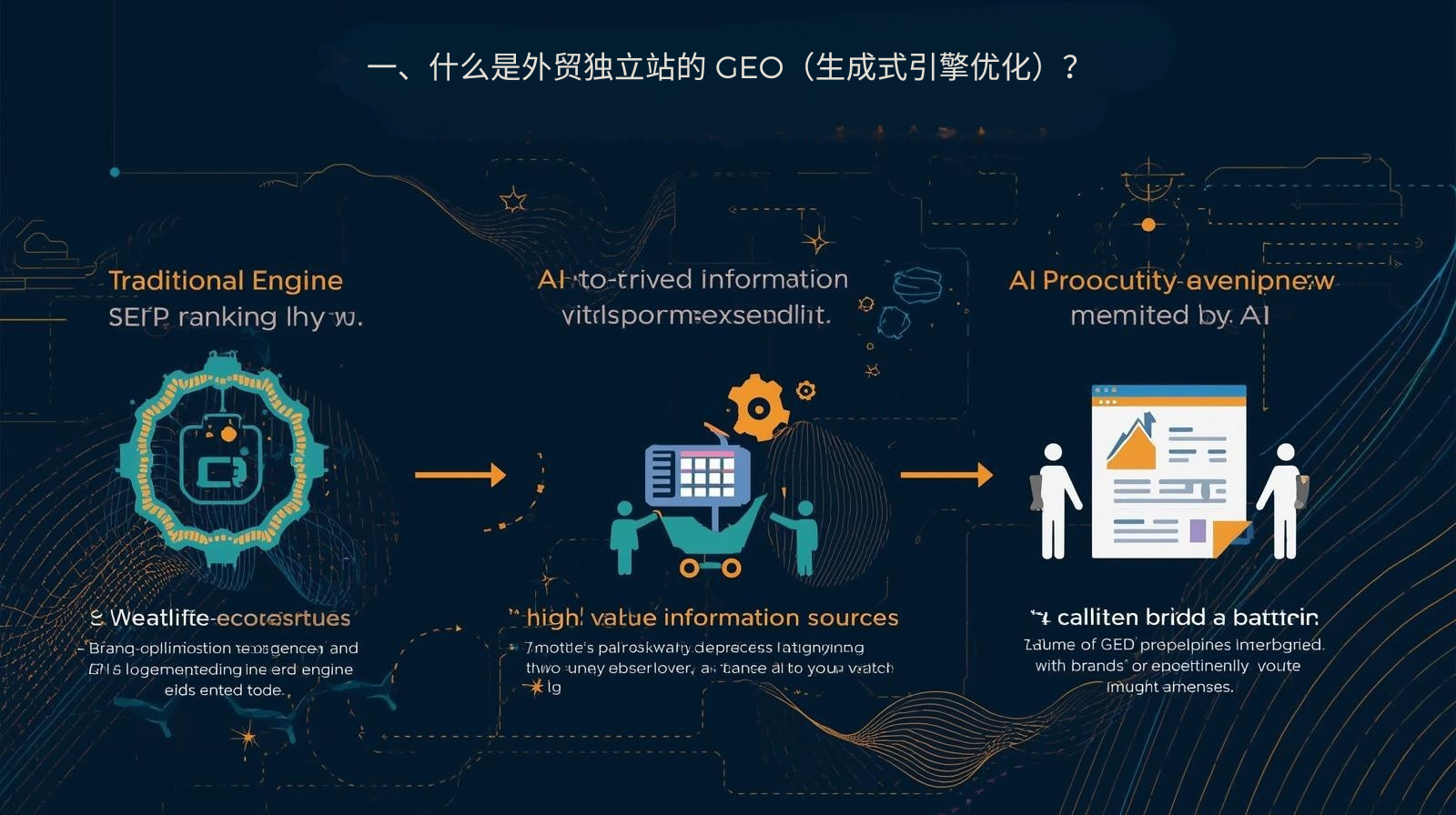
First, it's important to clarify that GEO, as discussed in this article, is not traditional geolocation, but rather Generative Engine Optimization . Its core is optimizing the "response generation logic" of generative AI tools like ChatGPT. By adjusting the content format, information density, and authority attributes of independent foreign trade websites, the AI, when analyzing user purchasing needs, will regard your site as a "high-value information source," proactively mentioning brand names, product advantages, or purchasing links in its responses, ultimately guiding users to visit your independent website.
Essentially, GEO differs from traditional SEO in several ways: Traditional SEO focuses on "Search Engine Results Page (SERP) ranking," optimizing metrics such as keyword density, number of backlinks, and page load speed to achieve a place on the first page of Google search results; while GEO focuses on "AI information filtering and recommendation logic," with the core objective being "being mentioned by AI" rather than "page ranking." This is because when users obtain information in ChatGPT, they see AI-integrated natural language responses, not traditional webpage lists. Only when your brand is explicitly mentioned by AI is it likely to appear on a user's purchasing shortlist.
For independent e-commerce websites, implementing GEO (Google Ads) is even more urgent for three reasons: First, its untapped traffic potential – currently, over 80% of e-commerce companies still focus their efforts on Google SEO/SEM, paying very little attention to generated AI traffic. Entering this market now means less competition and a greater chance of quickly capturing the AI search mindshare of target customers. Second, precise matching of procurement needs – B2B customers' questions on ChatGPT are often more specific, such as "What is the MOQ requirement for German automotive parts?" or "What is the delivery cycle for European CE certified lighting fixtures?" GEO allows your site to precisely match these high-intent needs, avoiding the problem of "inaccurate broad keyword traffic" in traditional SEO. Third, rapid establishment of brand trust – for unfamiliar overseas customers, brands mentioned on ChatGPT are implicitly considered "AI-filtered authoritative options." Compared to proactive promotion, this "third-party recommendation" fosters stronger trust and significantly reduces customer decision-making costs.
II. The core premise of GEO: Enabling ChatGPT to "effectively crawl" your independent website content
To get ChatGPT to mention your brand in their answers, the first step is to ensure that AI can "see" and "understand" the core information of your independent website—after all, if AI can't crawl the site's content, all subsequent optimizations are meaningless. This step requires consideration of three dimensions: "content readability," "technical accessibility," and "scenario suitability," each with clear practical standards:
1. Optimize the "AI readability" structure of the content.
ChatGPT has extremely low tolerance for disorganized content, preferring to crawl content with a clear structure, coherent logic, and well-defined information hierarchy. For independent e-commerce websites, whether product pages or blog pages, a structure of "core information first + hierarchical expansion" should be adopted, avoiding large blocks of illogical text. For example, the recommended structure for an outdoor furniture product page is as follows: The page title (H1 tag) must directly include "Brand + Product + Core Advantages + Compliance Attributes", such as "ABC Outdoor Furniture - 2025 European Campsite 100-Set Table and Chair Wholesale (ECOCERT Environmental Certification Compliant)". The first paragraph of the page should directly address the core questions of customers, such as "ABC Outdoor Furniture provides outdoor tables and chairs with a minimum order quantity of 50 sets for European campsite procurement needs, supports delivery throughout the EU, and delivers within 3-5 days after customs clearance. All products have passed ECOCERT environmental certification and EN 12521 safety standards". The following sections are divided into three H2 sections: "Core Advantages", "Application Scenarios", and "Procurement Process". Each section should be supplemented with details using coherent text. For example, the "Core Advantages" section should be specific, such as "Resistant to high and low temperatures -40℃ to 80℃, suitable for the Nordic winter climate; made of HDPE environmentally friendly material with a recyclability rate of up to 90%; 1000-hour salt spray test, service life of over 5 years", rather than simply stating "good quality, environmentally friendly". This structure allows AI to quickly locate key information, reducing the difficulty of data capture.
2. Ensure the site is accessible to AI crawlers.
ChatGPT (especially the online version GPT-4) primarily crawls public web pages, so it's necessary to overcome technical obstacles to allow the AI crawler to successfully access your core pages. The specific steps are as follows: First, check and modify the robots.txt file—locate robots.txt in the site's root directory and add "User-agent: GPTBot Allow: /" (allowing the ChatGPT crawler to access the entire site). To restrict non-core pages (such as the admin page), add "Disallow: /admin/" to prevent irrelevant information from being crawled. Second, simultaneously optimize traditional SEO fundamentals—submit a sitemap through Google Search Console to ensure that core pages (such as featured product pages and industry blogs) are indexed by Google. This is because ChatGPT refers to Google's index results to judge page credibility during crawling, and unindexed pages are almost impossible for AI to crawl. Finally, handle "member-only content"—if your independent website sets wholesale prices, purchase contract templates, etc., to "login-only," it is recommended to create a separate "public version of the purchase guide" page, including non-sensitive information such as "wholesale price range (e.g., $80 per unit for 50-100 sets, $75 per unit for over 100 sets)," "minimum order quantity," and "normal delivery cycle," to ensure AI accessibility. It can capture key procurement information.
3. Build a "question-answering content library" to match AI search scenarios.
Users' search behavior on ChatGPT is primarily based on "asking questions" rather than traditional "keyword searches." Therefore, the content of independent websites must directly address common questions from the target customers in order to be recommended by AI. The specific implementation method involves two steps: The first step is to collect core questions from the target market. This involves using tools like Semrush and Ahrefs to filter for "questionable keywords." For example, for an independent website targeting the US market for plastic packaging, you could collect questions like, "What are the US FDA requirements for food contact plastic packaging?", "How are tariffs calculated when purchasing plastic packaging from China and shipping it to Los Angeles?", and "How do I apply for ASTM D6400 compostable certification for plastic packaging?". Simultaneously, based on customer inquiry records, compile a list of "frequently asked questions," such as, "Do you support customized brand logo printing?" and "How many days does it take to ship samples?". The second step is to create an "AI Q&A" section—open a "Procurement Q&A" column on the independent website blog page, with each question corresponding to an independent article. Each article should begin with a clear answer, followed by detailed explanations. For example, when answering "FDA requirements," the article should list "materials must comply with FDA 21 CFR 177.1520 standards," "BPA is prohibited," and "a third-party testing report is required," and add, "All food contact products from ABC plastic packaging comply with FDA 21 CFR 177.1520 standards, SGS testing reports are available, and customer factory inspections are supported," naturally integrating brand information. This type of Q&A content highly matches ChatGPT's search scenario, increasing the probability of being cited by AI by more than 30%.
III. Practical Strategies for Independent Foreign Trade Websites (GEO): From "Being Cited" to "Being Prioritized for Recommendation"
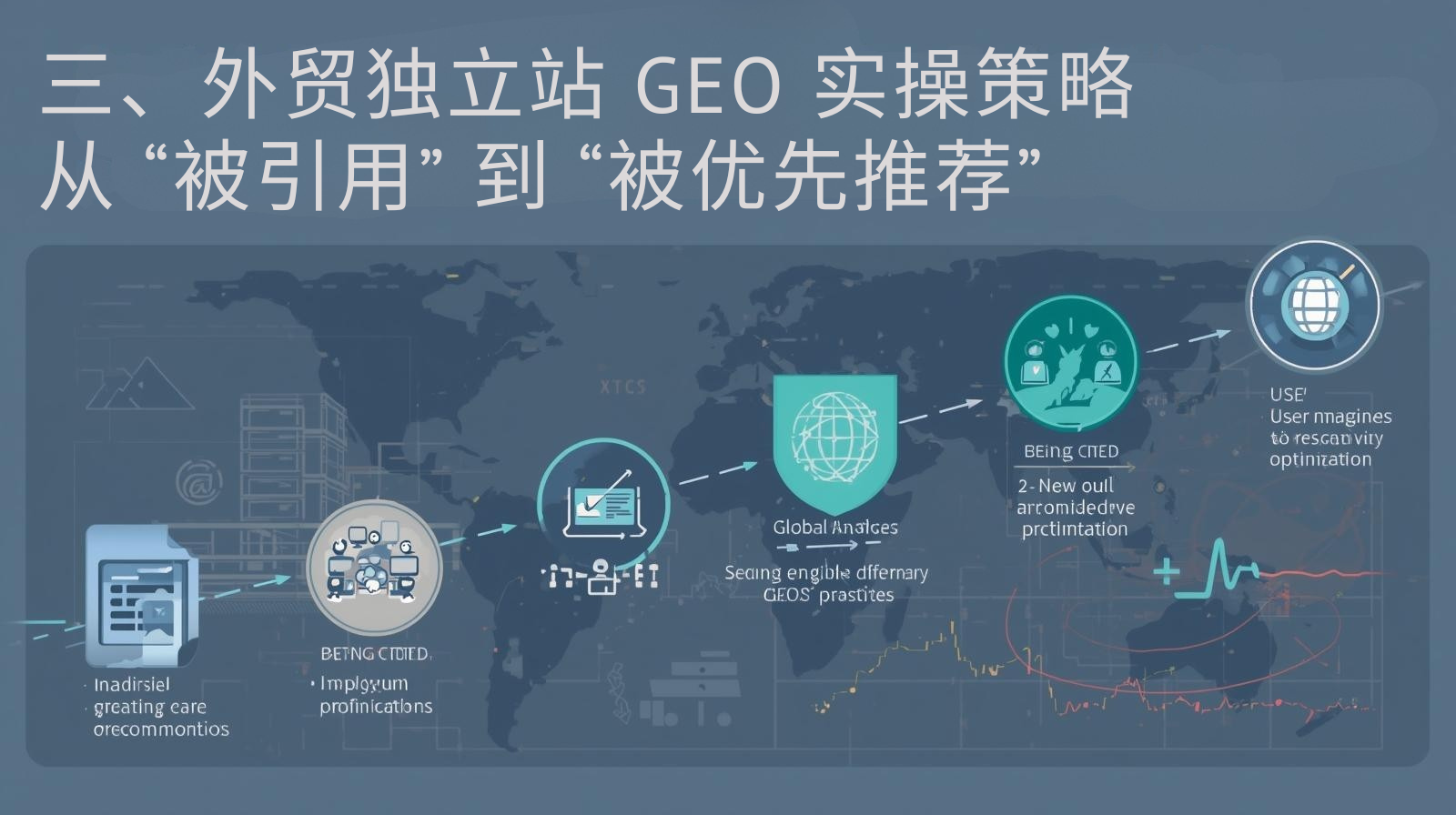
Enabling ChatGPT to capture content is just the beginning; the real GEO optimization goal is to make your brand "rank higher" and "provide more accurate information" in AI responses, even becoming the "first choice recommendation" after a user asks a question. To achieve this, you must deeply understand ChatGPT's "information prioritization logic"—AI will prioritize citing "authoritative, up-to-date, and specific" information, while also tending to continuously associate high-value content in contextual recommendations. Here are four practical strategies that can be implemented directly:
1. Anchoring AI's "Authoritative Information" Judgment Standards
Generative AI exhibits a clear bias in judging "authoritative information": first, it must be endorsed by a third party; second, the information must be verifiable; and third, the details must be sufficiently specific. In response to these three points, independent foreign trade websites need to strengthen the "authoritative attribute" of their content.
- Strengthen third-party endorsement : Display industry certification marks (such as ISO9001, CE, FDA, ASTM) in prominent positions on product pages and blog pages, along with certification verification links, such as "ABC Plastic Packaging's ASTM D6400 certification verification link: XXX"; at the same time, cite industry reports or authoritative data, such as "According to the 2025 report by the Plastic Packaging Institute (SPI), the market demand for compostable plastic packaging is growing by 45% year-on-year, and ABC's compostable packaging product line accounts for 60%, with production capacity meeting 5 million orders per month." The data source must be clearly marked to enhance credibility.
- Information timeliness labeling : AI will actively avoid "outdated information", so all core pages need to be labeled with the "last update time", such as "updated June 10, 2025", and the content should be updated regularly (once a month) - such as product compliance information ("In June 2025, the EU REACH regulation added restrictions on phthalates. ABC products have completed formula adjustments to meet the latest requirements"), price and delivery cycle ("In June 2025, ocean freight costs were adjusted. Customs clearance fees at US West Coast ports are included in the wholesale price, and the delivery cycle has been shortened to 15-20 days").
- Make details concrete : Avoid vague descriptions and transform abstract terms like "discount" and "high quality" into specific data. For example, change "wholesale price discount" to "15% off for purchases of 1000 pieces or more, including inland transportation costs from the Port of Los Angeles to Chicago"; change "fast delivery" to "samples shipped within 3 days, production completed within 7 days after payment for bulk orders, and sea freight to the Port of Hamburg in Europe in 25-30 days"; change "good after-sales service" to "free returns and exchanges for product quality issues within 30 days, a 1-year warranty, and local after-sales team support for European customers." Specific information is not only easier for AI to use, but it also directly impacts key decision-makers in the purchasing process.
2. The "Contextual Recommendation" Mechanism of ChatGPT
Users on ChatGPT often use a "sequential follow-up question" approach, such as first asking "US suppliers of compostable plastic packaging," then "the supplier's sample policy," and finally "payment methods for bulk orders." The AI recommends information based on "contextual relevance," therefore, independent websites need to establish strong links between pages to ensure the AI continuously references your brand.
- Internal Links : Add a "Related Procurement Information" section at the bottom of the product page, linking to pages such as "Sample Request," "Payment Methods," "Logistics Solutions," and "Customer Cases." For example, on the plastic packaging product page, add "Request ABC Compostable Packaging Samples (Click to fill out the form, shipped within 3 days)" and "Learn about ABC's L/C payment process for US customers." Simultaneously, insert "scenario-based links" into blog articles, such as adding "Want to purchase packaging that meets ASTM D6400 certification? Click to view ABC compostable packaging specifications and pricing" to the article "Understanding US Compostable Packaging Certification."
- Building a closed loop between pages : Ensure that core pages form a closed loop of association: "Product → Sample → Payment → Logistics → After-sales → Case Studies". For example, the "Sample Application" page should be linked back to the corresponding product page, the "Logistics Solution" page should be linked to "Customer Case Studies" (such as "ABC provided 500,000 packages for Company X in the United States, which were delivered to the customer's warehouse 5 days after customs clearance at the Port of Los Angeles"), and the "Customer Case Studies" page should then be linked to the product page. This allows AI to continuously "jump" to your site's content when answering follow-up questions, increasing the frequency of brand exposure.
3. Strengthen the content association between "brand keywords + scenario keywords"
When answering contextualized questions, ChatGPT prioritizes matching information containing "brand name + contextual term"—for example, if a user asks, "A US food factory needs to purchase compostable packaging, which supplier is suitable?", the AI will proactively search for content containing "[brand name] + US food factory + compostable packaging". Therefore, independent e-commerce websites need to naturally incorporate this combination into their content.
- Scenario keyword analysis : First, identify the core procurement scenarios of the target customers, such as "food factory packaging", "e-commerce express packaging", and "supermarket fresh food packaging" in the US market, and "organic farm product packaging" and "hotel disposable supplies packaging" in the European market; then, for each scenario, extract the combination of "scenario + demand", such as "US food factory - high temperature sterilization packaging temperature resistance requirements" and "European organic farm - compostable + environmentally friendly printing ink requirements".
- Seamlessly integrate the brand name into the content : Include "brand name + scenario name" in page titles, H1 tags, image alt text, and product descriptions. For example, a product page title could be "ABC Compostable Packaging - High-Temperature Sterilization Film for US Food Factories (FDA Compliant)," image alt text could be "ABC Compostable Packaging - Packaging Bags for European Organic Farm Vegetables," and the product description could include "ABC Compostable Packaging is designed specifically for US e-commerce companies, supports customized sizes, and adapts to the pressure-resistant requirements of express delivery." This strong association allows AI to quickly link your brand with your customers' specific purchasing scenarios, improving recommendation priority.
4. Test the AI's responses and iteratively optimize them.
GEO optimization is not a "one-and-done" process, because ChatGPT's algorithm is updated regularly, and customer questioning methods also change with market shifts. Therefore, a closed loop of "testing-analysis-optimization" needs to be established.
- Regular testing : Select 10-15 core questions each week (such as "compostable packaging supplier for US food factories" or "European CE certified lighting wholesale"), search in ChatGPT online mode, and record three key data: whether your brand is mentioned, whether the information mentioned is accurate, and the ranking of your brand in the AI response (whether it is the first or subsequent mention).
- Problem Analysis and Optimization : If not mentioned, first check "whether it has been crawled"—enter "[your brand name] + [core product]" in ChatGPT to check for citation sources. If not, recheck robots.txt or Google indexing. If crawled but not mentioned, optimize the content's "authority" or "scenario relevance," such as adding third-party certifications or refining the scenario description. If the mentioned information is inaccurate (e.g., incorrect pricing, expired certification), immediately update the site content and provide feedback in ChatGPT stating "This information is incorrect; the correct information is XXX (link to your site page)" to help AI correct its understanding.
IV. Long-term maintenance and performance monitoring of GEO: Ensuring continued dominance in AI traffic.
Generative AI algorithms iterate much faster than traditional search engines. To maintain a long-term advantage in ChatGPT search traffic, a "long-term maintenance + performance monitoring" mechanism must be established to prevent traffic loss due to algorithm updates or outdated content.
1. Establish an AI response monitoring system
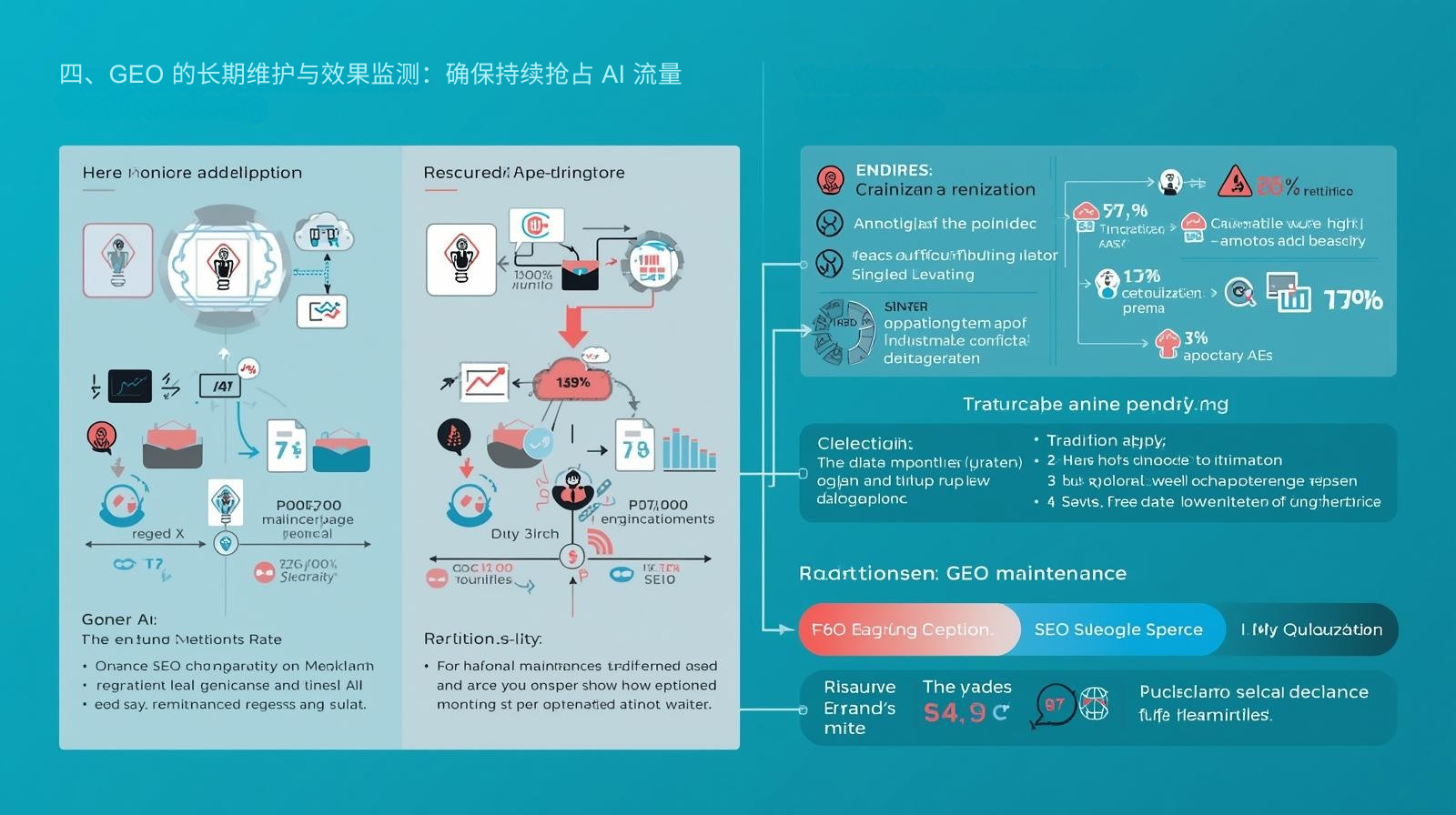
For 1-2 days each month, conduct searches on mainstream generative AI platforms such as ChatGPT, Claude, and Bing AI, targeting 20-30 core questions (covering dimensions such as product, certification, procurement process, and after-sales service), and fill out the "GEO Performance Monitoring Form." The core monitoring dimensions are:
- Brand mention rate : Calculate "number of questions mentioning the brand / total number of test questions". If the mention rate drops by more than 10%, it is necessary to analyze whether it is due to AI algorithm updates (such as strengthening the use of real-time data) or content not being updated in a timely manner.
- Information accuracy : Check whether the brand information (price, certification, delivery time) mentioned by AI is consistent with the website. If an error is found, update the website content within 24 hours and try to correct it through the AI feedback channel.
- Ranking position : Record the order in which the brand appears in the AI response (e.g., "first mention", "third mention"). If the ranking drops, the "authority" of the content (e.g., supplementing with the latest industry report citations) or "scenario relevance" needs to be optimized.
2. Simultaneously implement traditional SEO and GEO optimization.
When judging a website's authority, AI refers to the performance of traditional search engines—for example, websites ranking high on Google are more likely to be considered "reliable sources of information" by ChatGPT. Therefore, focusing on GEO should not neglect traditional SEO; both need to be optimized simultaneously.
- Basic SEO maintenance : Regularly check page loading speed (optimize using Google PageSpeed Insights to ensure overseas access speed is <3 seconds), build high-quality backlinks (exchange links with industry associations and B2B platforms in target markets), and ensure mobile adaptation (overseas customers often search for suppliers via mobile phones, so ensure a smooth mobile experience).
- Supplementing with content in less commonly spoken languages : If your target market is a multilingual region (such as Europe or Southeast Asia), supplement with content in less commonly spoken languages such as German, Spanish, and Japanese. Since 2025, ChatGPT has strengthened its use of content in less commonly spoken languages. Pages in less commonly spoken languages can help you reach more niche traffic, such as questions like "German organic farm compostable packaging supplier", which face less competitive pressure.
3. Tracking algorithm updates in generative AI
Companies like OpenAI and Anthropic regularly release algorithm update announcements (such as "GPT-4 enhances the use of real-time data" and "Claude optimizes the accuracy of responses in B2B procurement scenarios"). These updates directly affect GEO performance, therefore an "algorithm update tracking mechanism" needs to be established.
- Information channel subscription : Follow the updates and notifications on the OpenAI Blog and Anthropic official website, join the AI optimization community in the foreign trade industry, and get the latest information on algorithm changes;
- Rapid strategy adjustments : If AI enhances "real-time data referencing," an "Industry News" section needs to be added to the site, updating daily with real-time information such as "US plastic packaging tariff adjustments in June 2025" and "new European CE certification regulations." If AI optimizes "B2B procurement scenario accuracy," professional content such as "procurement process breakdown" and "factory audit standards" needs to be added, for example, "ABC's factory audit process for European clients: 7-day advance appointment → provision of ISO certification documents → on-site inspection of the production workshop → issuance of a factory audit report," making the content more aligned with the needs of B-end procurement decisions.
Recommended article: Pintui Technology's Viewpoint: The Best Independent E-commerce Website of the Future Will Be the One That Is "Most Instructive"
End
As foreign trade customers shift their search habits from "Google listings" to "ChatGPT conversations," GEO (Generative Engine Optimization) is no longer an "optional optimization," but a "must-answer question" for independent foreign trade websites to seize future traffic. Compared to traditional SEO, GEO focuses more on "direct matching of customer needs" and "proactive delivery of brand authority." It doesn't require you to compete with thousands of peers for page rankings; instead, it optimizes the alignment between content and AI logic, making your brand a "priority recommendation" after customers ask questions in ChatGPT.
The core logic of implementing GEO is actually quite simple: optimize content from an AI perspective (making it crawlable and understandable), design information based on customer needs (making content valuable and convertible), and then ensure continuous exposure of your brand in AI-generated answers through ongoing testing and maintenance. Starting today, you can begin by "analyzing 10 core questions from your target customers," creating your first Q&A-style content page, and gradually building a complete GEO optimization system—believe me, it won't be long before you see your brand in ChatGPT's answers, making AI traffic a new growth engine for your independent e-commerce website.