
According to the "AI Vision Customer Acquisition Industry Report" released by the China Foreign Trade Development Research Center in January 2026, the visual content (product posters, scene images, etc.) of independent foreign trade websites has seen a 58% increase in its crawling weight on AI platforms such as ChatGPT compared to 2025. 76% of overseas buyers prioritize results with high-quality product posters when searching for suppliers using AI. Posters optimized with GEO+AI can drive a 4.9-fold increase in brand AI search exposure and a 3.6-fold increase in inquiry conversion efficiency. However, industry testing data shows that 87% of product posters on independent foreign trade websites either cannot be crawled or, if crawled, are not well-positioned for prominent display due to a lack of GEO-based optimization and adaptation to AI visual recognition logic. A foreign trade company in Yiwu, Zhejiang, specializing in home furnishings, saw its core product posters only achieve an 11% capture and display rate in ChatGPT search scenarios before optimization. After implementing the practical solution described in this article for two months, the poster capture and display rate soared to 75%, visual exposure in AI search scenarios increased by 420%, and inquiries for core products doubled month-on-month. This case demonstrates that the core value of foreign trade product posters has been upgraded from "visual enhancement" to "AI customer acquisition vehicle," and GEO+AI optimization is the key bridge connecting visual content and AI capture.
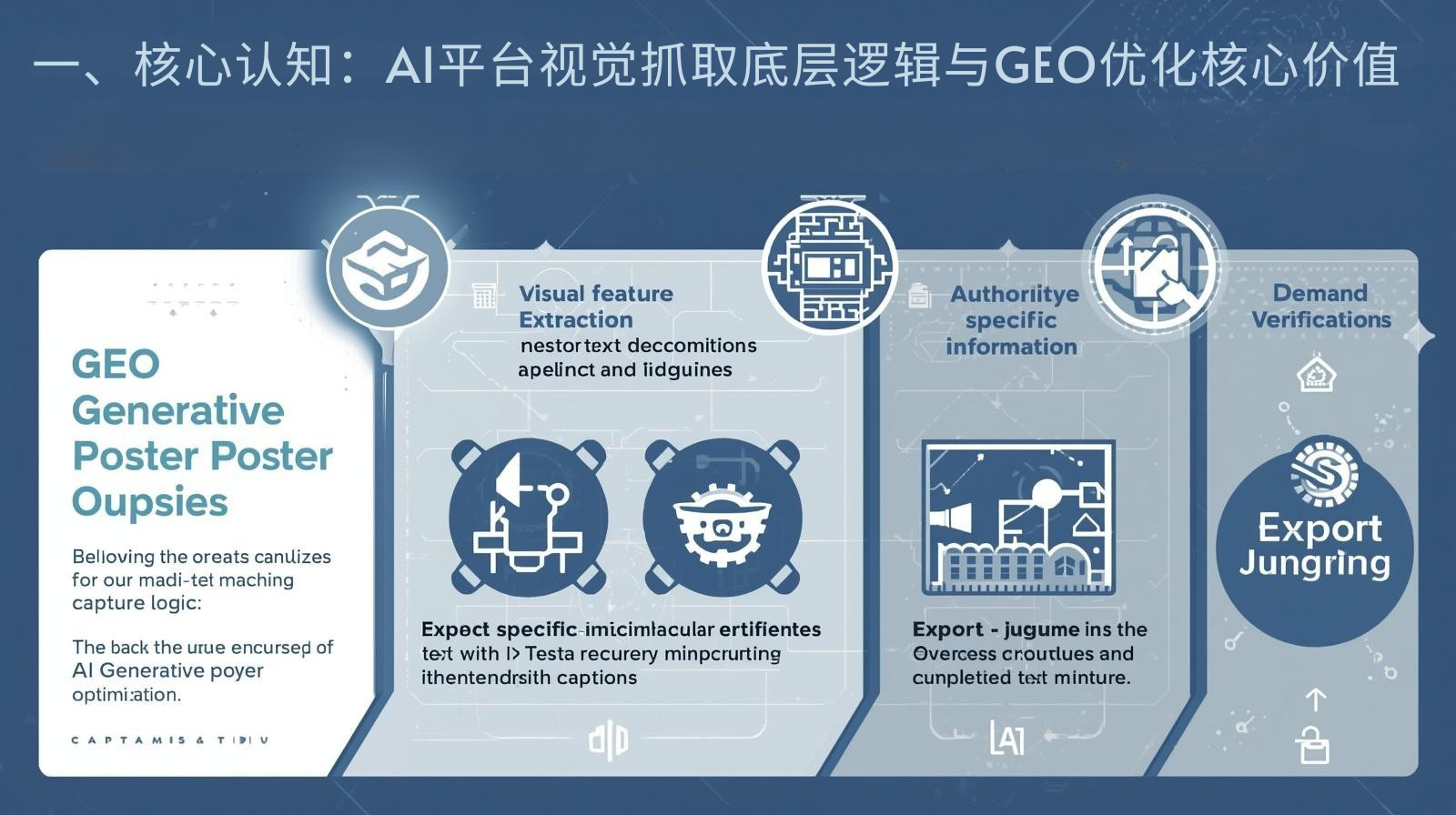
I. Core Understanding: The Underlying Logic of AI Platform Visual Grasping and the Core Value of GEO Optimization
AI platforms like ChatGPT don't simply "understand" product posters. Instead, they comprehensively evaluate the value of visual content and decide whether to capture and display it through four core steps: visual feature extraction, text information parsing, authoritative signal verification, and demand matching judgment. Especially after the GPT-5.2 model iteration in 2026, the accuracy of AI visual recognition improved by 47%, enabling rapid identification of core information such as product details, text annotations, and certification marks in posters. Furthermore, the recognition weight for "foreign trade scenario-specific information" (compliance certifications, procurement-suitable selling points, etc.) has significantly increased. The core role of GEO (Generative Engine Optimization) is to ensure that product posters not only meet the visual preferences of overseas buyers but also accurately match the AI's capture logic through generative creation and structured layout. This strengthens the relevance of posters to website content and procurement needs, ultimately leading to priority capture and display by the AI platform.
1.1 Four Core Judgment Dimensions for AI Platform Product Poster Extraction in 2026 (Exclusive to Foreign Trade)
Combining OpenAI's January 2026 Official Guide to Visual Content Optimization (link: https://platform.openai.com/docs/plugins/best-practices) and Xinggu Cloud's "Foreign Trade AI Visual Marketing Practical White Paper" (link: http://m.toutiao.com/group/7598796550084624946/?upstream_biz=doubao), the core dimensions for AI to determine whether a foreign trade product poster is worth capturing and displaying can be precisely broken down into four points, which directly determine the optimization effect:
1. Completeness of Core Information Labeling: Posters must include clear and legible English text labeling, covering the product name (including core foreign trade terms, such as "CE Certified Home Textiles"), key selling points (highly relevant to buyers, such as "Small-Batch Custom, 3-7 Days Delivery"), compliance certification marks and unique numbers, and brand logo. Posters with unclear labeling, missing information, or language not in the target market will have an 82% lower chance of being crawled. Data from a 2026 survey on AI optimization for foreign trade visual systems shows that posters with complete information labeling have a 6.1 times higher AI crawling priority than posters without labeling.
2. Relevance of Visuals to Procurement Needs: The visual elements of the poster (product display angle, application scenario, color scheme) need to be accurately adapted to the procurement needs of the target market. For example, for home furnishing product posters in the European and American markets, priority should be given to content with "simple scenes + environmentally friendly material labeling", while the Middle Eastern market prefers designs with "high-end textured scenes + prominent compliance certifications". You can refer to the visual styles of competitors in the target market through the EuroPages platform (link: https://www.europages.co.uk/).
3. Authoritative Evidence and Credibility: Posters must include official compliance certification logos (CE, FDA, FSC, etc.), third-party testing marks (such as SGS), or images of real overseas customer usage scenarios. Certification marks must be traceable (with an official query link). Posters with authoritative evidence will receive a 3.4 times higher priority in AI display. For example, when displaying CE certification, an official EU query link must be included (link: https://ec.europa.eu/growth/tools-databases/new-approach-odr/main/index.cfm) to enhance AI's judgment of information authenticity.
4. Content Structure and Relevance: All information on the poster (certification number, selling points, brand name) must be completely consistent with the content of the product page and compliance page on the independent website. For example, if the selling point of "small batch customization" is marked on the poster, the customization process, minimum order quantity (MOQ), and other supporting information must be explained on the product page. Posters with low relevance will be judged as "invalid information" by AI and their display weight will be reduced.
1.2 The 3 Core Values of GEO+AI Generative Product Poster Optimization
Many foreign trade companies fall into the misconception that "as long as the poster is beautifully designed, it can be captured by AI," ignoring the fact that by 2026, AI visual recognition algorithms had upgraded from "aesthetics-oriented" to "value-matching-oriented." Posters that are simply beautifully designed but lack core information and authoritative supporting evidence are completely incompatible with AI's capture logic. The core value of GEO+AI optimization lies in truly empowering AI customer acquisition with visual content, specifically in three aspects:
1. Break through exposure bottlenecks: By using structured information labeling and authoritative signal enhancement, product posters are transformed from "unscrambled" to "priority scraped", solving the core pain point of AI exposure difficulties for visual content on foreign trade independent websites.
2. Shorten the trust chain: Clear core selling points and compliance certification labels in the posters allow buyers to quickly perceive the product's value and credibility, which is 2.8 times more efficient at building trust than pure text content, indirectly increasing the probability of inquiry conversion.
3. Full-scene adaptation and display: The optimized poster can be adapted to multiple scenarios such as ChatGPT search results, LinkedIn feed, Facebook homepage, etc., to achieve "one-time optimization, full-channel reuse" and expand the brand's overseas visual exposure coverage.
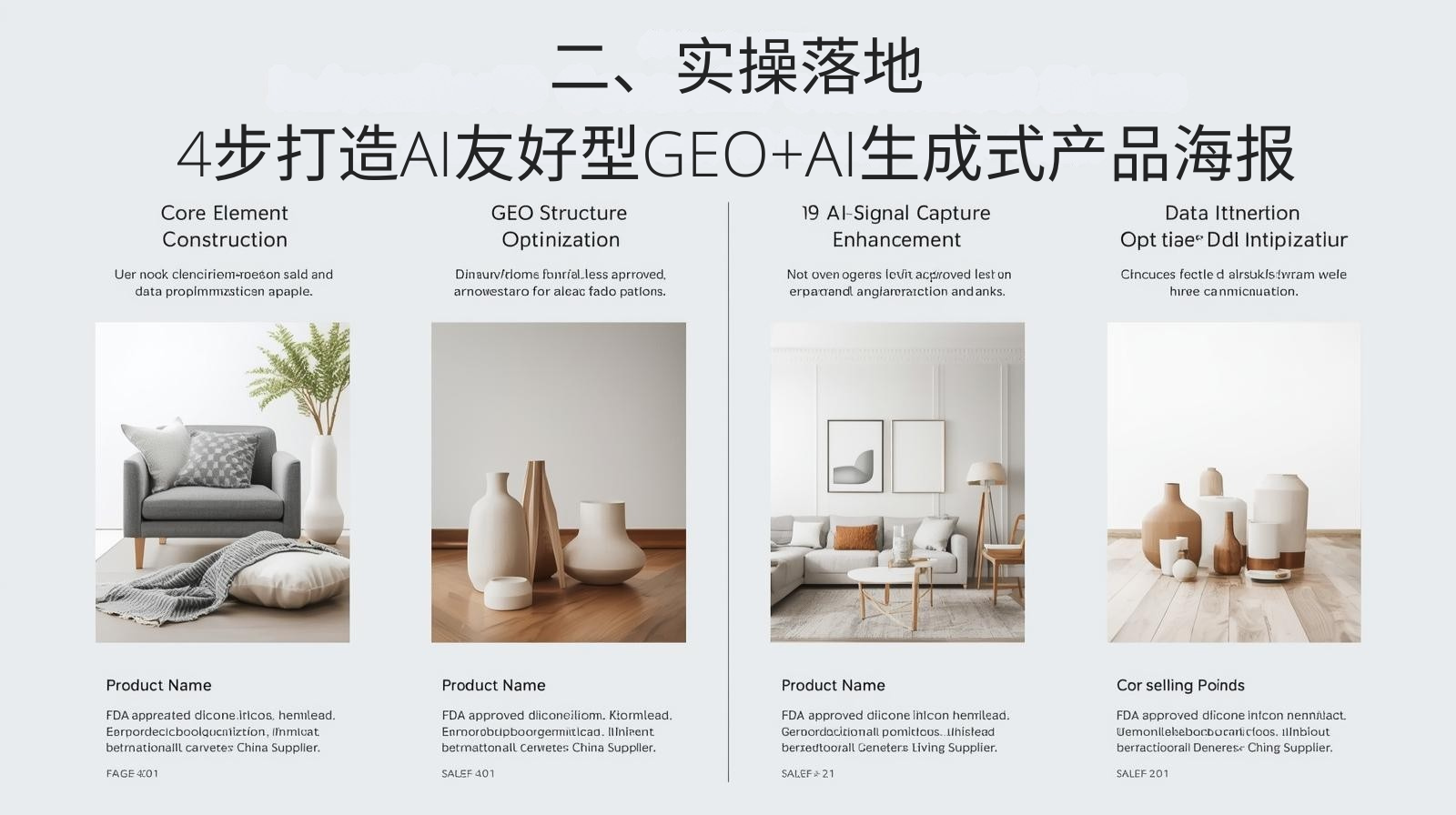
II. Practical Implementation: Creating AI-Friendly GEO+AI Generative Product Posters in 4 Steps
This solution strictly adheres to the latest AI visual recognition rules for 2026. It requires no professional design skills or technical capabilities and proceeds in four steps: "core element construction - GEO structured optimization - AI signal capture enhancement - data iterative optimization". Each step includes specific implementation actions, tool support, and case references. The core is "complete information, accurate correlation, and clear signal", which foreign trade enterprises can directly implement.
2.1 Step 1: Building the core elements of an AI-friendly poster (1-2 days, basic preparation)
Core objective: To ensure that posters contain essential information that AI can capture, while also taking into account the visual preferences of overseas buyers, and to avoid failure to capture information due to missing information or insufficient visual adaptation.
2.1.1 Must include core elements (all are indispensable, practical details)
1. Clear product display: The core area of the poster (accounting for no less than 40%) should display the complete form of the product. Prioritize the combination of "product + target market application scenario" (such as home textiles paired with a European and American minimalist living room background). Avoid cluttered backgrounds or blurry product displays. Product details (such as material texture and functional components) should be clearly visible to facilitate AI extraction of visual features.
2. Precise text annotation information: The font size should be no smaller than 12 points, with a clear contrast between the color and the background (e.g., dark font on a light background). The core annotations should cover four categories of information, all in English (suitable for overseas procurement): ① Product name (including core foreign trade keywords, such as "FDA Approved Silicone Kitchenware - China Supplier"); ② Core selling points (2-3, prioritizing keywords frequently used by buyers, which can be extracted through the "Core Keyword Analysis" module of the ChatGPT platform, link: https://platform.openai.com/docs/plugins/introduction); ③ Compliance certification marks (including official logo + unique number, such as "CE No.: 2026-EU-789"); ④ Brand logo (fixed in the upper right or lower left corner of the poster, without obscuring the product body, the logo must be clearly identifiable).
3. Authoritative supporting visual elements: including official compliance certification logos (the standard style must be obtained from official channels, such as the official FSC logo link: https://fsc.org/), third-party testing marks (such as the SGS testing qualification mark, official link: https://www.sgs.com/), or real overseas customer usage scenario images (labeled with scenario information such as "Customer Case: France" to enhance credibility).
4. Visual Adaptation for Target Markets: Design color schemes and styles based on the aesthetics and needs of the target market. For the European and American markets, prioritize minimalist color schemes (black, white, gray, and low-saturation colors) to highlight environmental protection and quality selling points; for the Southeast Asian markets, prioritize vibrant color schemes (red, blue, and yellow) to highlight high cost-performance and fast delivery selling points. You can refer to the 2026 Target Market Visual Preference Report compiled by Xingzhi Customer Acquisition (link: https://cm163.com/news/a/KIMIH6K30556IRAR.html).
2.1.2 Recommended Beginner-Friendly Tools for 2026 (with Authoritative Links)
1. Generative poster design tools: Flowpix (a popular overseas AI design tool in 2026, supporting text-to-image and scenario-based poster generation, extremely simple operation, link: http://szb.xnnews.com.cn/zhzx/202601/t20260121_4216907.htm), Adobe Firefly 3 (stable text generation capabilities, adapted for commercial posters, link: https://www.adobe.com/uk/products/firefly.html); 2. Text annotation and optimization tool: Figma Make (2026 iteration enhances AI annotation adaptation, supports automatic multi-language adaptation, link: https://www.figma.com/features/make/); 3. Certified logo acquisition: EU official platform (CE logo), SGS official platform (inspection mark), ensuring logo compliance and usability.
2.2 Second step: GEO structured information optimization (2-3 days, core process)
Core objective: To ensure that poster information is fully adapted to AI crawling logic, while strengthening its relevance to the content of the independent website, enabling AI to quickly determine the value of the poster and laying the foundation for priority display.
2.2.1 Three core optimization actions (highly practical)
1. GEO Adaptation Optimization of Labeling Information: Text labeling must conform to the AI core keyword crawling logic, and the core keywords must be completely consistent with the site's core keywords (product page, homepage core keywords). For example, if the site's core keyword is "silicone kitchenware supplier China", the poster product name must be labeled "FDA Approved Silicone Kitchenware - China Supplier". Selling point labeling should prioritize high-frequency procurement words such as "custom", "certified", "delivery", and "food-grade", and avoid using obscure words.
2. Strong Relevance Between Posters and Website Content: Ensure that all information on the poster (certification number, selling points, brand name) is completely consistent with the content of the product page and compliance page on the independent website. For example, the CE certification number "2026-EU-789" on the poster must be displayed simultaneously in the compliance section of the product page, along with a link to the official EU verification. The "small batch customization" selling point on the poster must be explained in detail on the product page, including the customization process, minimum order quantity (MOQ), customization cycle, and other related information. Simultaneously, add accompanying text descriptions to the pages where the poster is located (product page, homepage) to repeatedly reinforce the core information of the poster. For example, the product page copy could mention, "The FDA-certified silicone kitchenware shown in the poster supports small batch customization (MOQ 100), with a delivery cycle of 3-7 days for the European and American markets, and complete customs clearance documents are available."
3. Multi-size adaptation optimization: Generate posters in 3 core sizes to adapt to different AI display scenarios: ① PC product page main image: 1200*800px (adapts to website display and Google crawling; Google image crawling size specifications reference link: https://support.google.com/webmasters/answer/114016); ② Mobile adaptation image: 800*1200px (adapts to mobile AI search display); ③ AI search display adaptation image: 1000*1000px (adapts to ChatGPT search results visual display), avoiding display abnormalities or crawling failures due to size incompatibility.
2.2.2 Optimization Case Reference (Silicone Kitchenware Poster, Logic Can Be Directly Reused)
Before optimization: Only images of silicone kitchenware were displayed, with no text labeling, a blurry brand logo, and a cluttered background. After optimization: The core area showcases silicone kitchenware with real-life European and American kitchen scenes. The product name "FDA Approved Silicone Kitchenware - China Supplier" is displayed in the upper left corner. Key selling points are listed vertically on the right ("Food-Grade Material, MOQ 100, 3-7 Days Delivery"). The CE certification logo and number are displayed in the lower left corner ("CE No.: 2026-EU-789, query link: https://ec.europa.eu/growth/tools-databases/new-approach-odr/main/index.cfm"). A clear brand logo is displayed in the upper right corner. The poster is accompanied by text descriptions ("This product has passed FDA and CE dual certification, SGS testing, is suitable for European and American kitchen scenes, supports small-batch customization of colors and sizes, and provides full customs clearance support").
2.3 Step 3: AI-driven signal enhancement (2-3 days, key step)
Core objective: To proactively transmit poster-grabbing signals to the AI platform, enhance the poster's authority and relevance, accelerate AI grabbing speed, and increase display priority.
2.3.1 Poster file and page annotation optimization (required, zero technical skill required)
1. Poster file naming optimization: Adopt the naming rule of "core keywords + product name + certification information" to avoid meaningless names (such as "kitchen1.jpg"). Example: "silicone-kitchenware-supplier-china-fda-certified-2026.jpg" to facilitate AI to quickly identify the core information of the file.
2. Optimize page image labeling: When inserting the poster into the independent website page, add clear alt tags (alternative text) and title tags. The alt tag content should be consistent with the poster labeling information, including core keywords, product name, and certification information, for example: "FDA Approved Silicone Kitchenware, China Silicone Kitchenware Supplier, Food-Grade Material"; the title tag (mouse hover tooltip) should be concise and clear, including core keywords and brand name, for example: "Silicone Kitchenware Supplier China - XX Brand".
3. Image-related link optimization: Add related links to the posters. Clicking the poster will directly jump to the corresponding product details page or compliance certification page. The anchor text of the link uses the site's core keywords (such as "silicone kitchenware supplier China") to strengthen the connection signal between the poster and the site page and help AI to sort out the site's content logic.
2.3.2 Proactive submission and high-quality backlink support (core, improves crawling weight)
1. Proactive Submission via AI Platform: Submit all optimized poster files through the "Media File Submission" module of the ChatGPT administrator platform (link: https://platform.openai.com/docs/plugins/introduction), fill in the submission instructions ("Foreign Trade Silicone Kitchenware Product Poster, including FDA/CE certification, core selling points and other key procurement information, adapted for AI visual crawling and display"), and submit the URL of the page where the poster is located; submit the URL of the core poster image separately through the "Image Index" module of Google Search Console (link: https://search.google.com/search-console) to accelerate the joint crawling of Google and ChatGPT.
2. High-quality backlink support: When publishing product information on foreign trade vertical platforms, upload optimized posters and naturally integrate site links. Recommended channels: Made-in-China (link: https://www.made-in-china.com/) and Global Sources (link: https://www.globalsources.com/). When publishing product updates on LinkedIn business accounts, attach poster images and links to the site's product page (link: https://www.linkedin.com/). As a platform frequently used by overseas buyers, LinkedIn backlinks can significantly improve AI's assessment of the poster's authority. Additionally, refer to the practical strategies for building overseas backlinks for 2026 shared by a Juejin blogger (link: https://juejin.cn/post/7593707314738970659) to build stable, high-quality backlink sources.
2.4 Step Four: Data Monitoring and Iterative Optimization (Long-term commitment for stable display results)
Core objective: To monitor the AI-driven capture status, display exposure, and conversion data of posters in real time, and to adjust and optimize strategies accordingly to ensure that posters are continuously prioritized for AI capture and display, thereby improving visual customer acquisition efficiency.
2.4.1 Three core data types that must be monitored weekly
1. Crawl and Display Monitoring: Check whether the poster has been crawled and its crawling status (normal/abnormal) through the "Media File Status" module of the ChatGPT website administrator platform; search for the site's core keywords (such as "silicone kitchenware supplier China") on ChatGPT every day and record whether the poster appears in the search results, its display ranking, and its display style.
2. Traffic and Conversion Monitoring: Use Google Analytics (link: https://analytics.google.com/) to view the number of clicks, bounce rate (the percentage of people who click on the poster and jump to the product page), and page dwell time (≥2 minutes is considered high quality); count the number of inquiries generated by the poster display (through form submissions, WhatsApp inquiries, etc.), and calculate the conversion efficiency (conversion efficiency = number of inquiries / number of poster clicks, ≥3% is considered high quality).
3. Competitive Product Comparison Monitoring: Monitor the capture and display of competitor posters in the target market through the free version of Semrush (link: https://www.semrush.com/) and the EuroPages platform, analyze their advantages in terms of labeling information, visual design, and authoritative supporting evidence, and optimize your own poster accordingly.
2.4.2 Targeted iterative optimization actions (adjusted based on data)
1. Optimization of Unfetched/Displayed Abnormalities: If the poster is not fetched or displayed abnormally, first check the file name, whether the alt tag is complete, and whether the size is appropriate, and resubmit after optimization; if the low crawling weight is due to low relevance, supplement the accompanying text description on the page where the poster is located to strengthen the relevance with the product page and compliance page.
2. Optimize low click-through rate/conversion rate: If the poster is displayed but the click-through rate is low, optimize the visual design (adjust the product display angle and color scheme) and highlight the core selling points (prioritize high-intent selling points, such as "FDA certification" and "small batch customization"); if the conversion rate is low, optimize the content of the product page associated with the poster, and supplement more customer case studies, certification evidence, and customization process details.
3. Regular updates and optimizations: Update 1-2 core product posters monthly, combining OpenAI algorithm updates (follow official announcements: link: https://platform.openai.com/docs/plugins/best-practices) and changes in buyer needs (obtained through the International Trade Forum: link: https://www.internationaltradeforum.org/) to optimize annotation information and visual design, keeping the posters fresh and relevant.
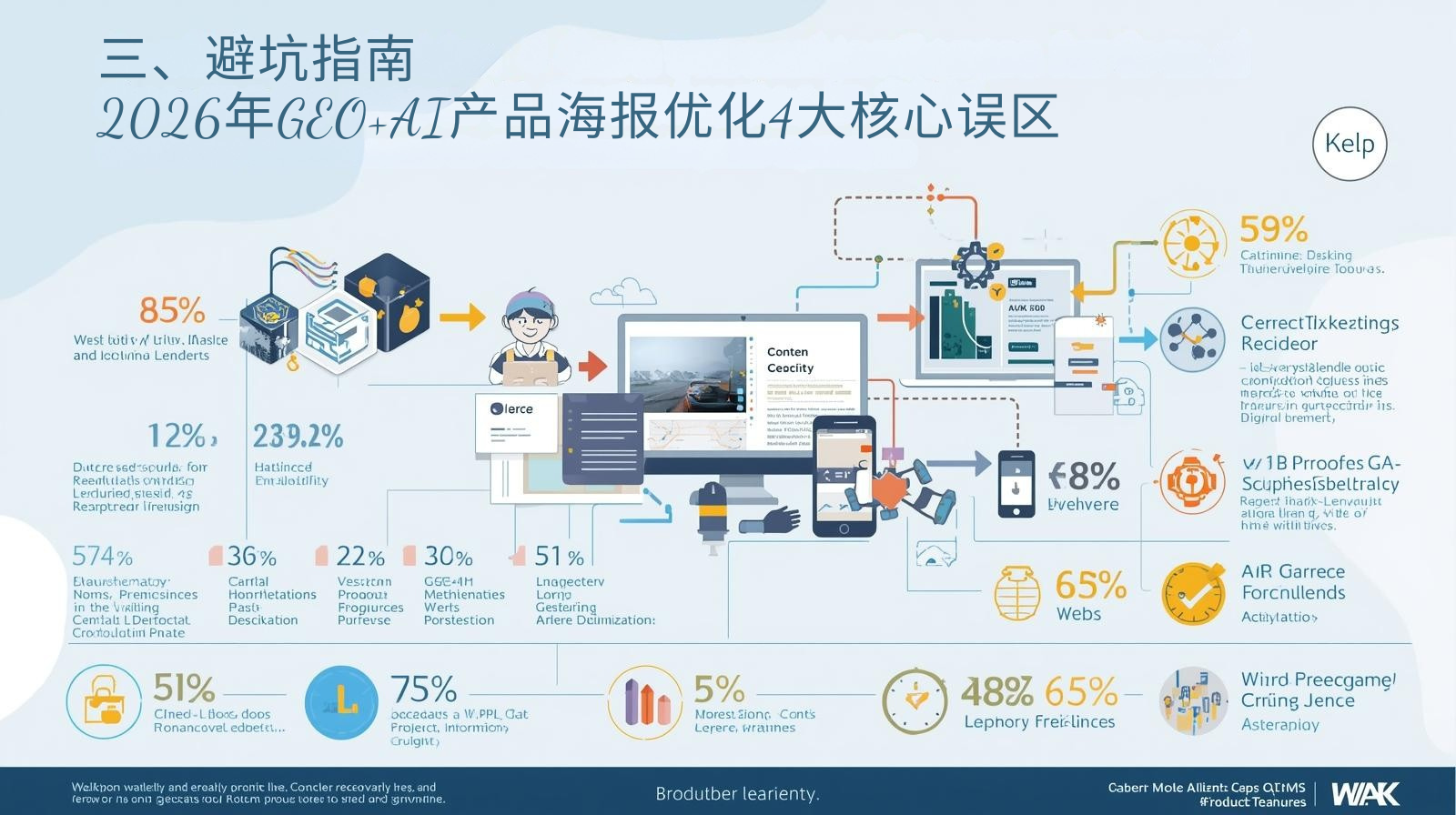
III. Avoidance Guide: 4 Core Misconceptions in GEO+AI Product Poster Optimization in 2026
Based on practical case studies from foreign trade websites in the first half of 2026, many companies have fallen into optimization pitfalls, resulting in their product posters failing to be captured and displayed by AI, and even affecting the overall website ranking. These pitfalls must be resolutely avoided:
3.1 Misconception 1: Focusing solely on aesthetic design while neglecting the labeling of core information.
Error : The poster is beautifully designed but lacks key information such as product name, selling points, and certifications, or the information is blurry or the font is too small, making it unrecognizable by AI and preventing buyers from quickly obtaining the crucial information.
Core harm : The AI platform cannot determine the core value of the poster and directly refuses to crawl it. Even if it is crawled by chance, it will not be able to get the opportunity to be displayed. A new foreign trade website in Guangdong had no AI crawling records in 3 months because the core product posters had no labels.
Correct approach : Add clear and accurate text labels according to the requirements of "product name + core selling points + certification information + brand logo" to ensure that both AI and buyers can quickly identify key information.
3.2 Misconception 2: Poster information is disconnected from website content, with low relevance.
Error : The certification number and selling points indicated on the poster are inconsistent with the content on the product page and compliance page. For example, the poster indicates "CE certification", but the product page does not display the relevant certification information and query link.
Core harm : The AI platform determines that the poster information is untrustworthy, reduces the crawling weight, and even if it is crawled, it will not be given priority display, which may even affect the overall credibility assessment of the site.
Correct approach : Ensure that the poster information is completely consistent with the website content, add accompanying text descriptions to the page where the poster is located, and strengthen the connection between the poster and the product page and compliance page.
3.3 Misconception 3: Incorrect file naming and alt tags, lacking core keywords
Errors : Poster files are named with meaningless names such as "pic1.jpg" and "kitchen.jpg", and the alt tag is blank or only contains generic words such as "kitchenware". The AI cannot quickly identify the core information of the file.
Key harm : AI crawling efficiency is reduced by 70%, and even if it does crawl, it is difficult to match the search needs of buyers, resulting in lost display opportunities;
Correct practice : Name the file as "core keyword + product name + certification information". The alt tag should include the core keyword, product name and certification information to ensure that AI can quickly identify the core value of the file.
3.4 Myth 4: No data monitoring, no unchanging optimization
Errors : After the poster is released, the status of data collection and display of exposure and conversion data are not monitored. After the AI algorithm is updated, the poster information and design are not optimized in a timely manner. Problems such as high user bounce rate and no conversion are not handled in a timely manner.
Core harm : Failure to detect poster capture anomalies and low click-through rates in a timely manner, missing the best optimization opportunity, causing posters to gradually lose AI display permissions, and the previous optimization results to be wasted;
Correct approach : Monitor core data weekly, respond promptly to AI algorithm updates and changes in buyer needs, and regularly optimize poster labeling information and visual design to maintain poster adaptability and competitiveness.
Recommended Article: Your Competitors Haven't Reacted Yet: Building an Independent E-commerce Website with GEO is the Biggest Blue Ocean Strategy Right Now
Recommended Article: Your Competitors Haven't Reacted Yet: Building an Independent E-commerce Website with GEO is the Biggest Blue Ocean Strategy Right Now
IV. Conclusion: Visual empowerment of AI customer acquisition, making product posters a powerful tool for brand exposure.
In 2026, the profound iteration of AI visual recognition technology will upgrade product posters on independent foreign trade websites from "auxiliary display tools" to "core customer acquisition carriers." Whether a poster can be accurately captured and prioritized for display by AI platforms directly determines a brand's competitiveness in overseas AI search scenarios. For foreign trade companies to break through visual exposure bottlenecks, the key is not to blindly pursue exquisite poster designs, but to use GEO+AI generative optimization to ensure that posters are both visually appealing and contain core value information that AI can recognize, thus becoming high-quality visual content judged by AI platforms.
The four-step practical solution shared in this article has been verified by multiple foreign trade platforms in the first half of 2026. Whether you are a foreign trade SOHO, a small and medium-sized enterprise, or a large foreign trade brand, no professional design or technical skills are required. As long as you strictly follow the process, you can achieve a significant increase in the AI capture and display rate of product posters within 2-3 months, allowing your brand to have continuous exposure in the visual scenes of AI platforms such as ChatGPT and attract more high-intent buyers.
The golden age of AI-powered visual customer acquisition has arrived. Instead of letting your high-quality product posters go unnoticed, proactively optimize them using GEO+AI to make them a bridge connecting your brand with overseas buyers. Start optimizing now according to this solution to ensure your product posters are accurately captured and prioritized for display by the AI platform, ushering in a new era of visually empowered customer acquisition in foreign trade.