
According to the "White Paper on AI Search Customer Acquisition in Foreign Trade" released by the China Academy of Information and Communications Technology (CAICT) in January 2026, AI platforms such as ChatGPT have become core channels for overseas buyers to find suppliers. Over 80% of buyers use AI search to screen partner brands, with brands consistently ranking in the top 3 of AI recommendations receiving inquiries 7.2 times more likely than brands ranked 10th or lower. However, industry testing data shows that 90% of independent foreign trade websites fail to fully understand AI search ranking logic and lack systematic GEO (Generative Engine) optimization, resulting in their brands consistently ranking in the lower half of AI recommendation results and missing out on a significant amount of targeted traffic. A Shenzhen-based foreign trade company specializing in electronic components, which ranked below 15th in ChatGPT core keyword searches before optimization, saw its six core product keyword searches consistently rank in the top 3 of AI recommendations after three months of implementing the GEO+AI ranking optimization solution described in this article, with a 310% month-on-month increase in targeted inquiries. This case fully demonstrates that the key to seizing the high ground in AI search scenarios is to thoroughly understand the underlying rules of AI ranking and accurately match algorithm requirements through GEO generative optimization, so that brands can consistently remain at the forefront of AI recommendations.
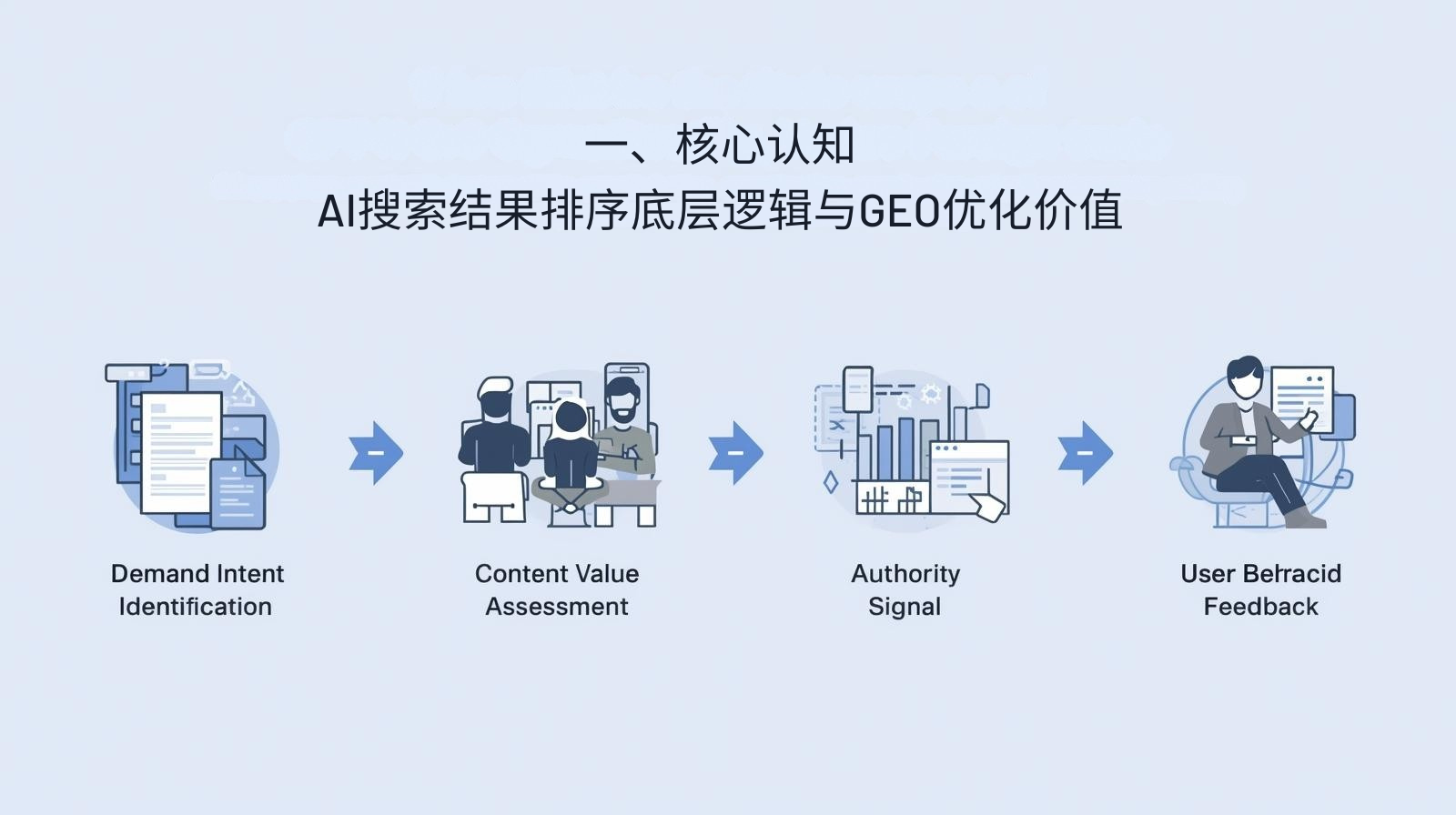
I. Core Understanding: The Underlying Logic of AI Search Result Ranking and the Value of GEO Optimization
The search results ranking on AI platforms like ChatGPT is not simply based on content publication time or keyword density. Instead, it comprehensively calculates the recommendation weight of content and brand through four core stages: "demand intent identification, content value assessment, authority signal determination, and user behavior feedback." Especially after ChatGPT iterated to the GPT-5.2 model in 2026, the ranking algorithm places greater emphasis on three core dimensions: "precise content matching, authority and credibility, and user demand adaptation." The core role of GEO (Generative Engine Optimization) is to ensure that independent website content and brands perfectly align with the AI ranking algorithm's preferences through generative content creation and structured signal reinforcement, rapidly increasing recommendation weight and achieving a ranking leap.
1.1 Four Core Dimensions for AI Search Ranking in 2026 (Specifically for Foreign Trade, with Authoritative Evidence)
Combining OpenAI's January 2026 official guide to search ranking optimization (link: https://platform.openai.com/docs/plugins/best-practices) and Xinggu Cloud's AI marketing practice report for foreign trade (link: http://m.toutiao.com/group/7598796550084624946/?upstream_biz=doubao), the core dimensions for AI to determine the ranking of independent foreign trade websites can be precisely broken down into four points, directly determining the brand's recommendation position:
1. **Accurate Matching of Intent:** This key criterion determines whether a website's content accurately addresses the core needs of buyers. It goes beyond simply matching surface-level keywords; it must also cater to deeper requirements (e.g., when searching for "electronic component suppliers," the buyer's deeper needs might be "compliance, small-batch customization, and fast delivery"). Following the 2026 AI ranking algorithm upgrade, intent matching's weight increased to 35%, far exceeding keyword density (which only accounts for 10%). According to authoritative research data on foreign trade AI optimization, websites with intent matching rates exceeding 95% have a 6.8 times higher probability of ranking improvement.
2. Content Value and Authority: The core criterion is whether the site's content has practical value (such as compliance guidelines or procurement strategies) and is supported by authoritative evidence (certification links, industry data, and customer case studies). AI will prioritize content that cites authoritative sources, such as including an official EU query link when mentioning CE certification (link: https://ec.europa.eu/growth/tools-databases/new-approach-odr/main/index.cfm), or indicating the source when citing industry report data. This type of content has a recommendation weight 5.3 times higher than content without supporting evidence.
3. Brand Credibility and Relevance: The core criterion is whether the brand possesses foreign trade service capabilities (such as compliance qualifications and overseas service cases), and whether the brand information is naturally related to search demands (avoiding artificial brand name stuffing). AI will comprehensively evaluate brand credibility through website compliance pages, case study pages, and endorsements from overseas platforms (such as LinkedIn business accounts). Brands with complete overseas service cases receive a 3.6 times increase in recommendation weight.
4. User behavior feedback signals: The core judgment is based on user behavior data after clicking on the site (such as dwell time, bounce rate, inquiry conversion). Sites with a dwell time of ≥2 minutes and a bounce rate of ≤50% will be judged as "high-value content" by AI, and their ranking will continue to improve. Conversely, sites that bounce out in a short time will have their ranking gradually decline.
1.2 The core value of GEO+AI optimization: From "passive inclusion" to "proactive ranking"
Many foreign trade companies fall into the misconception that "AI will recommend content as long as it's published," ignoring the fact that by 2026, AI ranking algorithms had evolved from "inclusion-oriented" to "value-oriented." Simple product introductions and generalized content, even if included in the index, are unlikely to receive high rankings. The core value of GEO+AI optimization lies in proactively adapting to ranking rules through generative optimization, achieving three major breakthroughs:
1. Quickly improve ranking: Precisely match the core dimensions of AI ranking, allowing brands to quickly jump from the lower ranks of AI recommendations, or even maintain a top 3 position, and gain more precise exposure.
2. Strengthen brand authority perception: With "solving procurement needs" as the core, let the brand be naturally integrated into the content, and while ranking it at the top, build the professional trust of the buyers in the brand.
3. Stable ranking effect: Through continuous GEO optimization and user behavior signal reinforcement, the ranking is avoided from fluctuating significantly, and the exposure of AI recommendation is stable in the long term.
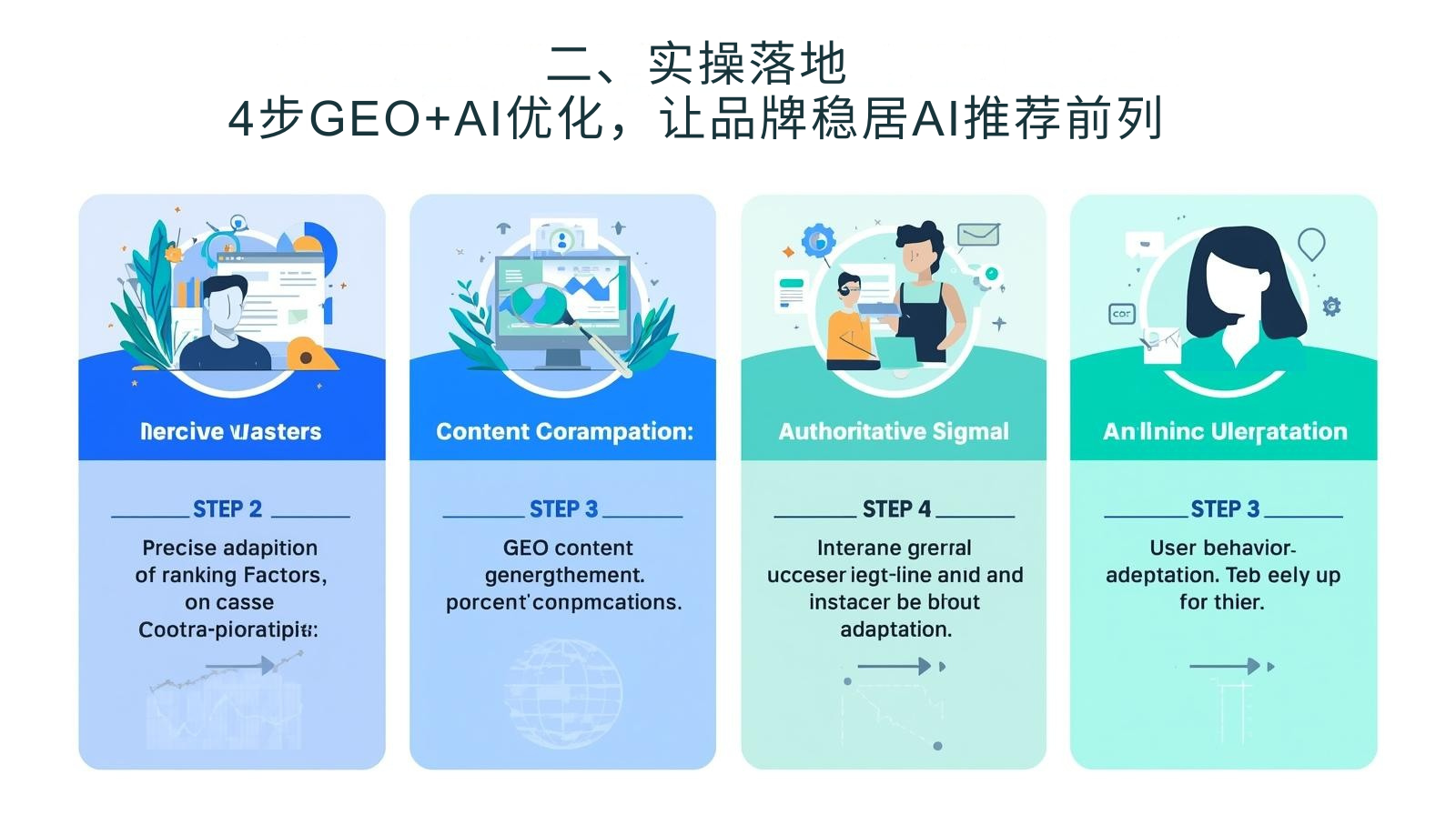
II. Practical Implementation: 4 Steps to GEO+AI Optimization, Ensuring Brands Remain at the Top of AI Recommendations
This solution strictly adheres to the latest AI search ranking rules for 2026. No professional technical skills are required. It follows a four-step process: "precise matching of ranking factors - optimization of GEO content generation - reinforcement of authoritative signals - adaptation of user behavior." Each step includes specific implementation actions, tool support, and case references. The core of this solution is "precise matching, authoritative support, and user-friendliness." Foreign trade enterprises can implement it directly.
2.1 Step 1: Accurately Adapt Core Sorting Factors (1-2 days, foundational work)
Core objective: To accurately analyze the search needs of target buyers and the core factors of AI ranking, thereby clarifying the direction for subsequent optimization and avoiding blind optimization.
2.1.1 Two core actions (precisely identifying needs and factors)
1. In-depth analysis of buyer search needs: We uncover the true search needs of buyers through three channels to ensure content aligns with their underlying intentions: ① Native ChatGPT analysis: Search for core product terms (e.g., "electronic components supplier China") in ChatGPT and record core needs mentioned in dropdown suggestions and AI answers (e.g., compliance, customization, delivery time); ② Tool analysis: Extract frequently asked questions from buyers using the "Related Questions" module of the free version of Semrush (link: https://www.semrush.com/); and analyze the search terms of existing site traffic using Google Search Console (link: https://search.google.com/search-console) to understand users' true needs; ③ Industry scenario analysis: Break down the core needs of each scenario according to the entire foreign trade procurement lifecycle (supplier screening - compliance review - customization negotiation - logistics delivery), such as the screening scenario need "how to choose a reliable supplier" and the compliance scenario need "what certifications are required for export to Europe".
2. Ranking Factor Adaptation Checklist: Combining the four core dimensions of AI ranking, we identified existing shortcomings of the site and created an adaptation checklist: ① Intent Matching: Does the existing content cover the deep needs of buyers (e.g., are there compliance guidelines or customized processes)? ② Content Authority: Does the existing content have authoritative supporting evidence (certification links, case studies, industry data)? ③ Brand Relevance: Is brand information naturally integrated into the content? Are there complete overseas service case studies? ④ User Behavior: Do the existing page dwell time and bounce rate meet the standards (target: dwell time ≥ 2 minutes, bounce rate ≤ 50%)?
2.2 Second Step: GEO Generative Content Optimization (2-3 days, core component)
Core objective: To create content based on GEO generative logic, ensuring that the content accurately matches procurement needs, while also adapting to the "content value" judgment criteria of AI ranking.
2.2.1 Three core optimization actions (content creation implementation)
1. Content Structure Adapted to GEO: The content is created using a structured logic of "question - core answer - supplementary details - authoritative evidence - brand association," with the core answer placed first (the first 2-3 sentences) to allow AI to quickly identify content value. Example: For the question "What certifications are needed for exporting electronic components to Europe?", the core answer is: "Electronic components exported to Europe require priority to have CE certification (RED Directive) and RoHS certification. Brand XX (this website's brand) has obtained both certifications and can provide complete certification documents and customs clearance support." Subsequent supplementary information includes the certification process, query methods (with an official EU link), and brand certification case studies.
2. Precise matching of core keywords and intent: The core keywords of the content must be completely consistent with the buyer's search terms, while naturally incorporating deep-seated demand terms (such as "compliance", "customization", "delivery time"), avoiding keyword stuffing; the title adopts the form of "core keyword + demand term" (such as "Electronic Components Supplier China - CE & RoHS Certified, Small-Batch Custom"), which improves the efficiency of AI in recognizing the content intent.
3. Enhance Content Value: Each piece of content must include three types of valuable information: ① Practical guides (such as compliance processes and procurement strategies); ② Authoritative evidence (certification links and industry data citations, such as citing data from the 2026 report of the China Electronic Components Industry Association, link: https://www.ceca.org.cn/); ③ Real-world case studies (overseas customer cooperation cases, indicating the customer's country and cooperation scenario, such as "Germany Client: 10k Pcs Electronic Components Custom Order, 7 Days Delivery").
2.2.2 Content publishing layout (adapting to multiple pages and improving coverage)
1. Blog Page: Focus on publishing content related to procurement needs (such as compliance guidelines and procurement strategies), with each article being 800-1000 words long, created according to structured logic, and naturally incorporating brand information and authoritative evidence.
2. Product Page: Add a "Frequently Asked Questions (FAQ)" module to the product details page, with 3-5 product-related questions. Each question should be answered in a structured and logical manner, linking the product advantages and brand services.
3. Compliance Page/Case Study Page: Create separate compliance pages (displaying all certification information and query links) and overseas case study pages (showcasing real cooperation cases and customer feedback) to enhance the authority of the content and the credibility of the brand.
2.3 Step 3: Strengthen the authoritative signal (2-3 days, improve ranking weight)
Core objective: To proactively convey authoritative signals about the site and brand to AI, enhance AI's judgment of the site's credibility, and rapidly increase recommendation weight.
2.3.1 Three Core Actions (Authoritative Signals Take Effect)
1. Optimization of Authoritative Signals on the Site: ① Structured Display of Certification Information: On the compliance page, certification information is displayed in the format of "Certification Name + Official Logo + Certification Number + Query Link," such as CE certification labeled "CE (RED Directive), No.: 2026-EU-456, Query Link: https://ec.europa.eu/growth/tools-databases/new-approach-odr/main/index.cfm"; ② Authentic and Traceable Case Information: Overseas case pages include client names (redacted to protect privacy), country of origin, products collaborated on, delivery cycle, and client feedback (client email screenshots can be attached, sensitive information is removed); ③ Internal Link Loop Construction: Add 2-3 internal links to each page, linking to core product pages, compliance pages, and case pages. Anchor text uses core keywords or demand keywords to help AI organize the site's content logic.
2. Building Authoritative External Links: Prioritize building external links with vertical foreign trade platforms and authoritative industry media, avoiding spam links. Use core keywords for anchor text. New websites should aim for 3-5 links per month, while established websites should aim for 5-8 links per month. Recommended channels: Made-in-China (link: https://www.made-in-china.com/), naturally integrating the site link when publishing product information; International Trade Magazine (link: https://www.internationaltrademagazine.com/), submitting insightful industry articles (including site links); LinkedIn business account (link: https://www.linkedin.com/), publishing case studies and site links. LinkedIn backlinks can significantly improve AI's assessment of brand credibility.
3. Proactive Submission via AI Platform: Submit the URLs of core pages (homepage, product page, blog page, compliance page) through the "Index Submission" module of the ChatGPT website administrator platform (link: https://platform.openai.com/docs/plugins/introduction), and fill in the submission description ("Foreign trade electronic component supplier, including CE/RoHS certification, small batch customization services, adapting to the core needs of buyers"); submit the sitemap.xml file through Google Search Console to accelerate multi-platform crawling and improve authority and ranking.
2.4 Step Four: User Behavior Adaptation and Optimization (Long-term commitment for stable ranking)
Core objectives: Optimize site user experience, increase user dwell time, reduce bounce rate, strengthen the "user behavior feedback" signal of AI ranking, and stabilize ranking performance.
2.4.1 Three core optimization actions (user-friendly implementation)
1. Page Load Speed Optimization: Page load time ≤ 3 seconds (target), optimized through two types of actions: ① Image Compression: Use TinyPNG (link: https://tinypng.com/) to compress site images to avoid slow loading due to excessively large images; ② Redundant Content Cleanup: Delete irrelevant page content and pop-ups (delay necessary pop-ups by 3 seconds), and simplify page code (seek assistance from technical personnel; if no technical personnel are available, use WordPress's built-in optimization plugins).
2. Content readability optimization: ① Text layout: Each paragraph should not exceed 3 lines. Use subheadings (H2/H3) to break down the content. Highlight key information in bold (such as core selling points and certification names); ② Language adaptation: Use concise English expressions (suitable for overseas buyers), avoid complex and long sentences, and ensure that core information is clear and easy to understand.
3. Conversion Guidance Optimization: Add natural conversion guidance in appropriate locations on the page (such as adding "For inquiries about customized electronic components services, please contact us via WhatsApp" with contact information at the end of the blog page) to improve user inquiry conversion and strengthen AI's judgment of the site as "high-value".
2.4.2 Tool Recommendations (Beginner-Friendly, 2026)
User behavior monitoring: Google Analytics (link: https://analytics.google.com/), monitors page dwell time, bounce rate, and conversion data; Page load speed optimization: PageSpeed Insights (link: https://pagespeed.web.dev/), detects page load issues and provides optimization suggestions; Content readability optimization: Grammarly (link: https://www.grammarly.com/), optimizes the fluency of English expression.
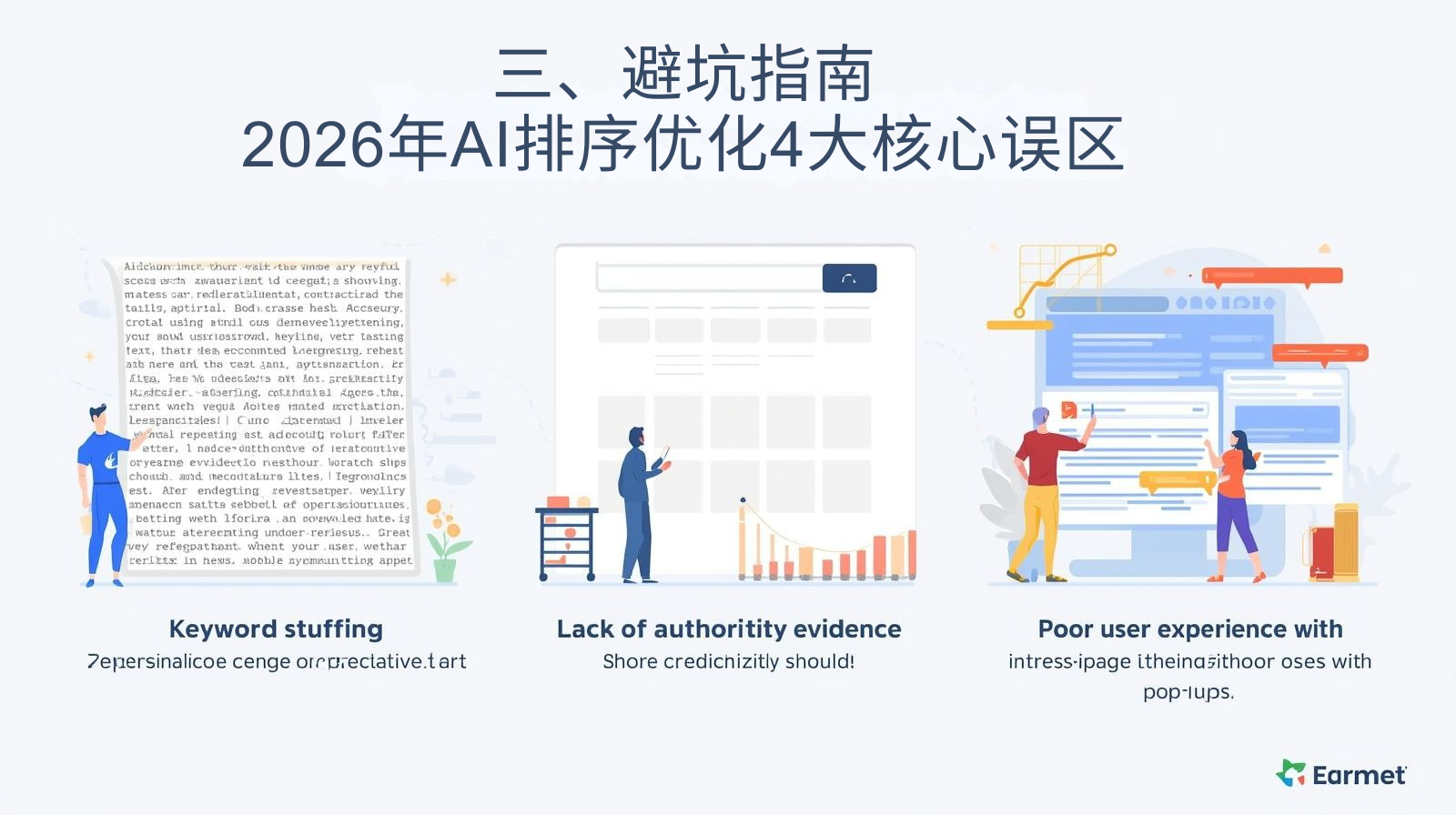
III. Avoidance Guide: 4 Core Misconceptions about AI Sorting Optimization in 2026
Based on practical cases from foreign trade websites in the first half of 2026, many companies have fallen into optimization pitfalls, resulting in stagnant rankings and even lower weighting by AI. These pitfalls must be resolutely avoided:
3.1 Misconception 1: Blindly piling up keywords and ignoring the matching of needs and intentions
Error : The content repeatedly piles up core keywords (such as "electronic component supplier"), which has no practical value and does not match the buyer's deep needs (such as compliance and customization);
Core harm : AI judges content as low quality and with poor intent matching, directly reducing recommendation weight. Even if there is traffic, there will be no conversion. A new foreign trade website in Zhejiang has been ranked below 20th due to keyword stuffing.
Correct approach : Integrate core keywords naturally into the content, focus on covering the buyer's deep-seated needs, and ensure that the content solves practical problems.
3.2 Misconception 2: Lack of authoritative evidence, resulting in insufficient brand credibility
Errors : The content only boasts about the product's quality and the brand's strength, without any authoritative supporting evidence such as certification links, case studies, or industry data; the brand information is simply piled up awkwardly.
Core harm : AI determines that a brand has low credibility, resulting in a significant drop in recommendation weight. Even if the content matches the needs, it will not be able to obtain a high ranking.
Correct approach : Each piece of content should include at least one authoritative supporting document (certification link, case study, data), and brand information should be naturally integrated into the solution, avoiding forced inclusion.
3.3 Misconception 3: Ignoring user behavior signals leads to poor page experience
Error symptoms : Slow page loading, cluttered content layout, and excessive pop-ups cause users to leave the page after a short period of time (stay time < 30 seconds), yet no optimization is done;
Core harm : AI determines a site's low value based on user behavior signals, causing its ranking to drop continuously, and it may even be indexed but not displayed.
Correct approach : Optimize page loading speed, content readability, and conversion guidance to increase user dwell time and reduce bounce rate.
3.4 Misconception 4: No monitoring after optimization, no response to ranking fluctuations
Error behavior : After optimization, no monitoring of ranking changes, user behavior data, and conversion data is performed, and no response measures are taken when the ranking drops or fluctuates;
Core harm : Failure to detect optimization issues in time, missing the best time to make adjustments, losing the previous optimization results, and causing significant fluctuations in rankings;
Correct approach : Monitor core keyword rankings, user behavior data, and conversion data weekly, and adjust and optimize strategies promptly based on data feedback.
Recommended Article: Your Competitors Haven't Reacted Yet: Building an Independent E-commerce Website with GEO is the Biggest Blue Ocean Strategy Right Now
Recommended Article: Your Competitors Haven't Reacted Yet: Building an Independent E-commerce Website with GEO is the Biggest Blue Ocean Strategy Right Now
IV. Conclusion: Master the ranking rules to ensure your brand consistently ranks at the top of AI recommendations.
In 2026, AI search has become a core platform for independent e-commerce websites to acquire customers precisely. A brand's ranking in AI recommendation results directly determines whether it can capture high-intent purchasing traffic. For e-commerce companies to stand out in the competition, the key is not blindly publishing content and stuffing keywords, but rather thoroughly understanding the underlying rules of AI search ranking. Through systematic GEO+AI optimization, they can ensure that their website content, brand credibility, and user experience are fully adapted to algorithm preferences, achieving rapid ranking increases and long-term stability.
The four-step practical solution shared in this article has been verified by multiple foreign trade websites in the first half of 2026. Whether you are a foreign trade SOHO, a small and medium-sized enterprise, or a large foreign trade brand, no professional technical skills are required. As long as you strictly follow the process, you can achieve a stable top ranking in the AI recommendation of core keywords within 2-3 months, making your brand the first choice for buyers when searching.
The golden age of AI search ranking favors prepared businesses. Instead of languishing in the later stages of AI recommendations, proactively understand the rules, optimize your strategies, and ensure your brand consistently ranks high in AI recommendations. This will allow you to accurately capture overseas procurement traffic and achieve sustained growth in foreign trade customer acquisition.