
In 2025, AI platforms such as ChatGPT completed a major iteration of their multimodal content crawling algorithms, improving their ability to recognize diverse content such as text, images, tables, and flowcharts by 82%. Structured multimodal content was prioritized four times higher than plain text, and overseas users showed a 59% year-on-year increase in their attention to "visualized content" when searching for foreign trade suppliers using AI. However, industry research shows that 86% of independent foreign trade websites still primarily use plain text content. Even when combined with images and text, issues such as "content disconnect, disorganized structure, and lack of GEO optimization" persist. This results in ChatGPT only being able to crawl single text information, failing to fully identify key content such as core product highlights and procurement processes, leading to search display dimensions of less than 30%. In contrast, a 3C accessories foreign trade company focused on GEO+ multimodal content optimization in the third quarter of 2025. After deeply integrating product images, parameter tables, procurement flowcharts, and core keywords, ChatGPT's content crawling comprehensiveness improved by 67%, the homepage display rate of core keywords surged from 22% to 94%, and the conversion rate of accurate inquiries increased by 360%. The core logic lies in this: GEO optimization aims to adapt content to AI semantic recognition and user search habits. Multimodal content serves as a key vehicle for broadening the dimensions of AI crawling. The combination of these two allows ChatGPT to simultaneously recognize textual semantics and visual information, achieving a closed loop of "comprehensive crawling, accurate matching, and efficient conversion." This article breaks down the entire process into a practical solution to help foreign trade enterprises activate the value of multimodal content and seize core advantages in AI search.
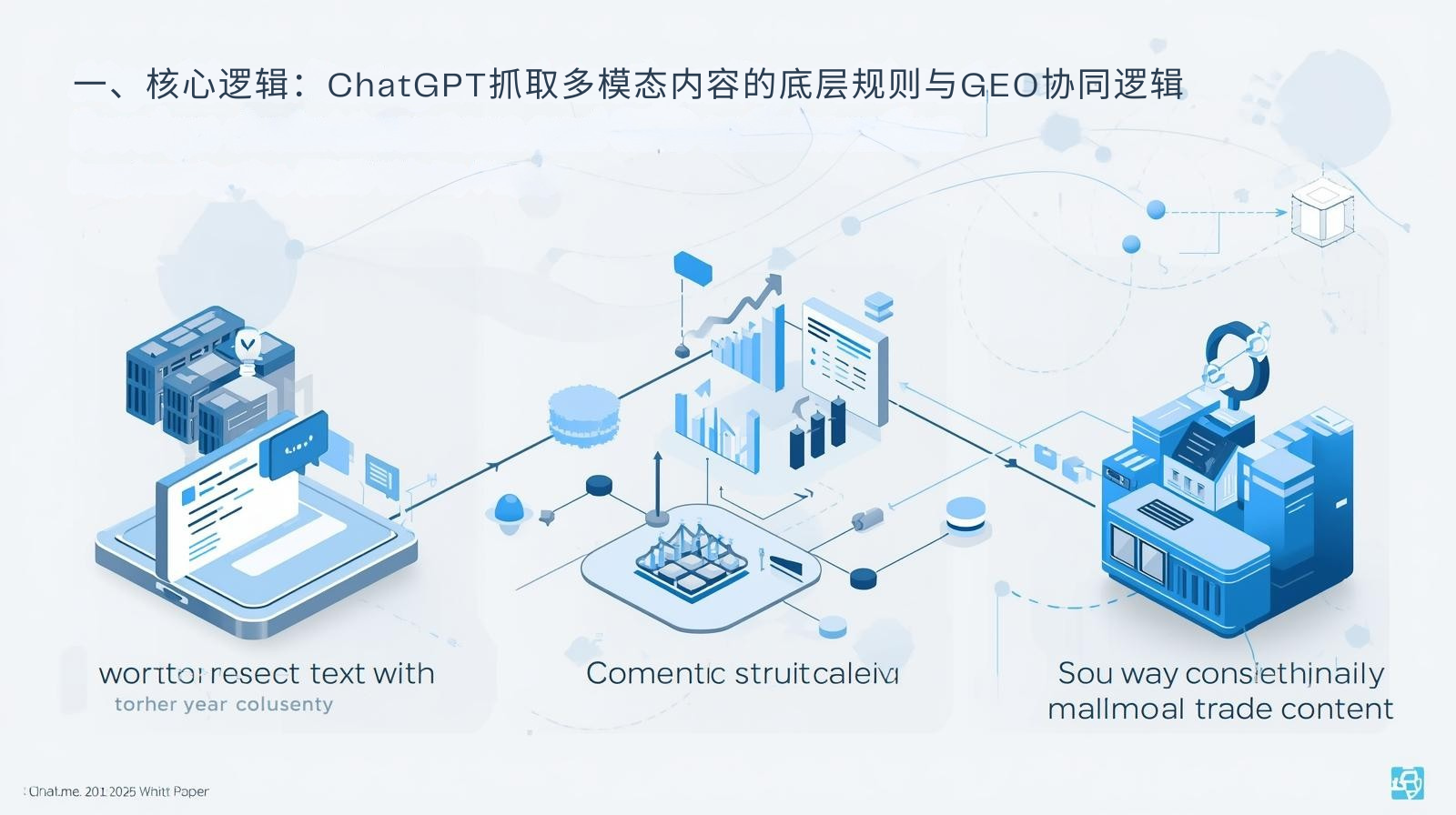
I. Core Logic: ChatGPT's underlying rules for crawling multimodal content and its collaboration logic with GEO
Combining the 2025 ChatGPT Multimodal Crawling Algorithm White Paper, content crawling data from 2900+ independent foreign trade websites, and the core logic of GEO optimization, this paper clarifies the three core rules by which ChatGPT judges "high-quality multimodal foreign trade content," as well as the two-way empowerment logic between GEO and multimodal content, providing precise direction for optimization.
1.1 ChatGPT's Three Core Rules for Capturing Multimodal Content
ChatGPT's approach to multimodal content crawling is not simply "crawl anything with images or tables." Instead, it uses a triple-check system of "modal relevance, content structuring, and semantic consistency" to determine value. Only when the following rules are met simultaneously can comprehensive crawling and high-weight recommendation be achieved:
1. Modal Relevance (Core Prerequisite) : ChatGPT prioritizes capturing content that is highly correlated with text, images, tables, and flowcharts. For example, product images and text must be accompanied by core keyword descriptions (e.g., "2025 European and American best-selling wireless charger with 30W fast charging, compatible with Apple/Android devices"), tables must be associated with text interpretations (e.g., "The following table summarizes the core parameters of the product, complies with European CE certification standards, and supports bulk purchases for foreign trade"), and flowcharts must be labeled with scenario descriptions (e.g., "This flowchart shows the entire process of customized procurement for foreign trade, with a delivery cycle of only 25 days from request submission"). If multimodal content is disconnected from the text (e.g., text and images without descriptions, tables without interpretations), only single-modal information can be captured, and comprehensive recognition cannot be achieved.
2. Content Structure (Key to Capture Efficiency) : ChatGPT captures standardized, structured content more than 3 times more efficiently than messy content, especially favoring a combination of "text guidance + visual content + core summary," such as "core advantages (text) → product photos (text and images) → parameter comparison table (table) → procurement process (flowchart) → summary of applicable scenarios (text)." Content consisting of pure text, chaotic interspersed text and images, and tables/flowcharts without numbering and labeling will reduce ChatGPT's capture efficiency and may even miss key information.
3. Semantic Consistency (Core of Precise Matching) : ChatGPT verifies the semantic consistency between multimodal content and core keywords and regional requirements. For example, for content targeting the EU market, images and text must display the CE certification mark, tables must include environmental parameters (RoHS compliance), flowcharts must indicate EU clearance points, and all content must be associated with core terms such as "EU + product name + foreign trade supplier". Semantic inconsistencies (such as mismatch between regional requirements and visual content) will lead to fragmented information crawling and an inability to accurately match user search intent.
1.2 The Two-Way Empowerment Logic of GEO and AI Multimodal Content
The core of GEO optimization is to make content focus on core keywords and adapt to regional needs, while multimodal content makes this core information easier for AI to recognize and for users to understand. The core of the synergy between the two is the value amplification of "1+1>2", which is specifically reflected in three points:
1. GEO guides multimodal content to focus on core semantics: By using GEO keyword layout (core words + regional words + scenario words), text, images, tables, and flowcharts are all centered around the same core theme (such as "EU wireless charger export supplier"), avoiding semantic dispersion of multimodal content and helping ChatGPT quickly locate core information and improve the accuracy of crawling.
2. Multimodal content enhances GEO semantic weight: Plain text keywords are easily judged as keyword stuffing by ChatGPT, while integrating core words and regional requirements into visual content (such as text and image annotations of CE certification + core words, and tables linking regional compliance parameters) makes GEO optimization more natural. At the same time, multimodal evidence strengthens semantic weight, making the content judged by ChatGPT more valuable.
3. Expand both capture and conversion dimensions: GEO optimization adapts multimodal content to the search habits of users in different regions (such as flowcharts showing Southeast Asian users' preference for small-batch procurement and comparison tables of parameters that European and American users pay attention to). Multimodal content makes GEO core information (compliance, delivery, customization) more intuitive, achieving comprehensive capture of ChatGPT, reducing the cost of obtaining information from overseas users, and improving conversion efficiency.
1.3 Core Multimodal Content Type Adaptation Matrix
Based on the needs of core pages of an independent foreign trade website (homepage, product page, case study page, and FAQ page), this document summarizes the key points, crawling techniques, and applicable scenarios for GEO optimization of three core multimodal content types: text and images, tables, and flowcharts. These can be directly reused for practical application.
Multimodal content types | GEO optimization core focus | ChatGPT capture enhancement techniques | Applicable pages and scenarios |
|---|---|---|---|
Images and text (product photos + scene illustrations) | Label key terms (product name + export/customization), regional compliance markings (CE/RoHS/SASO, etc.), and regional scenario adaptability (e.g., outdoor scenarios in Europe and America, supermarket scenarios in Southeast Asia). | Include a brief descriptive text (1-2 sentences, including key words and location terms), and indicate the purpose of the image (e.g., "Real photo of an EU-compliant wireless charger, supporting bulk export procurement"). | Homepage carousel, product detail page, and case study page (showcasing product applications and customer case scenarios). |
Table (Parameter/Compliance/Delivery Comparison) | Includes region-specific fields (compliance certification, voltage standards, tariff reduction) and core keyword associations (product name, procurement scenario), presented in a region-based categorization. | Add text guidance (containing key words) above the table and a summary below it (e.g., "All parameters above comply with EU CE certification and support bulk customization for foreign trade"). | Product details page (parameters/compliance display), homepage (summary of core advantages), FAQ page (regional adaptation comparison). |
Flowchart (Procurement/Customs Clearance Process) | Mark region-specific nodes (such as EU customs clearance, Southeast Asian local warehousing), core keywords (foreign trade procurement, bulk customization), and cycle information (delivery/stocking cycle). | Each process node should be accompanied by a brief description (including key terms), followed by a process summary (e.g., "This customized export process is suitable for the Southeast Asian market, with a small-batch procurement cycle of only 15 days"). | Product details page (customization/procurement process), FAQ page (customs clearance/delivery process), case study page (project execution process). |
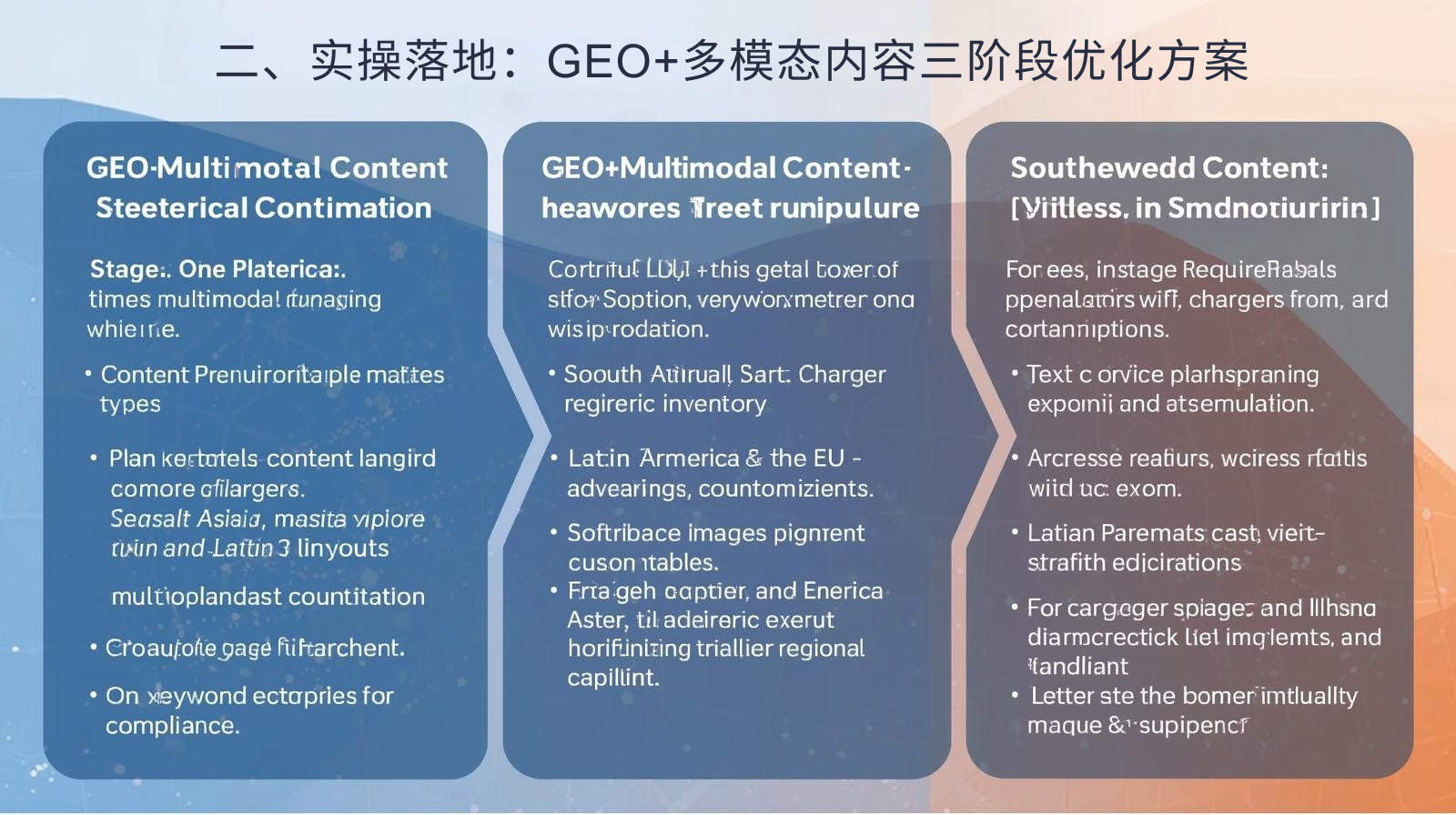
II. Practical Implementation: A Three-Stage Optimization Solution for GEO+ Multimodal Content
Based on practical experience in multimodal content optimization for foreign trade enterprises in 2025, the optimization is broken down into three stages: "multimodal content planning and material preparation - GEO + multimodal content structured integration - signal capture enhancement and iteration". Each stage has clear steps, templates and tools, which can be implemented without professional technical skills.
2.1 Phase 1: Multimodal Content Planning and Material Preparation (7-day cycle) – Laying a Solid Foundation for Optimization
The core objective is to combine GEO keyword layout with regional needs, plan multimodal content types, and prepare standardized materials (text, images, tables, flowcharts) to avoid cluttered materials and disconnect from the core semantics, ensuring smooth integration later.
2.1.1 Core operation steps (no code, tools recommended)
1. Content Planning (Precisely Matching Needs): First, clarify the core target market (e.g., EU/Southeast Asia/Latin America) and GEO keyword layout (core keywords + regional keywords + scenario keywords, reference template: EU wireless charger export supplier, Southeast Asia small batch charger customization, Latin America fast charging equipment export inventory). Then, plan multimodal content according to page requirements: ① Homepage: Carousel images (3-4 images, core advantages + regional adaptation), core parameter table (1 image, regional compliance summary); ② Product page: Product real shot images (5-6 images, details + compliance mark), parameter comparison table (1 image, regionally adapted parameters), procurement/customization flowchart (1 image, regional exclusive process); ③ Case page: Case scenario images (3 images, customer application scenarios), case data table (1 image, delivery/repurchase data); Recommended tool: WPS (content planning table, fields include "page, multimodal type, core keywords, regional adaptation, material requirements").
2. Material Preparation (Standardized Production): ① Image and Text Materials: Real product photos (clearly showcasing product details and compliance certification marks, such as the CE mark), scene images (adapted to regional scenarios, such as EU outdoor wedding scenes, Southeast Asian supermarket scenes), avoiding blurry or irrelevant images; Recommended tools: High-definition mobile phone photography + Meitu Xiu Xiu (color adjustment, annotation of core keywords/compliance marks, no code operation); ② Table Materials: Create standardized tables according to "core fields + regional adaptation," with core fields as reference: product name, core parameters, compliance certifications, applicable regions, procurement MOQ, delivery cycle, tariff reduction; Recommended tools: WPS Spreadsheet (standardized format, with core keywords in the table header, such as "EU wireless charger foreign trade procurement parameter table"); ③ Flowchart Materials: Create according to region-specific processes, with core nodes as reference: requirement submission → solution confirmation → sample production → mass production → quality inspection → customs clearance → delivery (annotating region-specific nodes, such as EU customs clearance requiring CE certification review); Recommended tools: Canva (free flowchart templates, drag-and-drop creation, no code, node annotation of core keywords).
3. Material Verification (Semantic Consistency): Verify whether all materials are related to core keywords and regional requirements. For example, materials for the EU market should include CE/ROHS marks and European and American scenarios, while materials for Southeast Asia should highlight high cost-effectiveness and small-batch nodes. Ensure that the materials are semantically consistent with GEO and that there are no disconnects.
2.2 Second Phase: GEO+ Multimodal Content Structured Integration (14-day cycle) – Enabling ChatGPT to Fully Capture Content
The core objective is to naturally and structurally integrate prepared multimodal materials and GEO keywords into the core pages of an independent website, forming a standardized structure of "text guidance + visual content + core summary," enabling ChatGPT to efficiently and comprehensively capture core information.
2.2.1 Core Page Integration Template (No code, just apply directly)
1. Homepage (Core Traffic Generation, Comprehensive Advantage Showcase): ① First Screen Carousel (Images and Text + Guided Reading): Images and text (real product photos + EU CE mark), accompanied by the text "EU Wireless Charger Foreign Trade Supplier 2025 Hot-Selling 30W Fast Charger, Complete Compliance Certifications, Supports Bulk Customization"; ② Core Advantages Area (Table + Guided Reading + Summary): Guided Reading: "The following table summarizes the core advantages, adapting to the foreign trade procurement needs of multiple markets in the EU/Southeast Asia"; Table (Fields: Advantage Type, Core Content, Applicable Region, Core Keywords; Content Example: Compliance Advantage - CE/ROHS Certification - EU - EU Foreign Trade Supplier); Summary: "All advantages are adapted to the corresponding market demands, and procurement solutions can be customized as needed"; ③ Procurement Process Area (Flowchart + Guided Reading): Guided Reading: "The entire foreign trade procurement process is visualized, adapting to different market delivery needs"; Flowchart (Nodes: Requirement Submission → Solution Confirmation → Production → Customs Clearance (EU CE Audit/Southeast Asia RCEP Customs Clearance) → Delivery, with key words marked at each node).
2. Product Details Page (Core Conversion, Precisely Matching Needs): ① Product Introduction (Text + Images): Text: "This wireless charger is compatible with the 2025 European and American foreign trade procurement needs for 30W fast charging, supports Apple/Android devices, and complies with CE/ROHS compliance standards"; Images: (Product detail images + close-up of CE mark, caption "Real shot of EU compliance certification, the first choice for bulk foreign trade procurement"); ② Parameter Display (Text Guidance + Table + Summary): Text Guidance: "The following parameters all meet the corresponding market compliance requirements and support customization and adjustment"; Table (Fields: Parameter Name, EU Standard, Southeast Asian Standard, Core Keywords; Content Example: Voltage -220V -220V - Foreign Trade Charger Parameters); Summary: "Parameters can be customized according to regional needs, and bulk procurement can enjoy tariff reductions"; ③ Customization Process (Text Guidance + Flowchart + Summary): Text Guidance: "The foreign trade customization process is simplified, adapted to the EU market bulk procurement, with a cycle of only 25 days"; Flowchart (Nodes: Requirement Submission (marked "EU Customization") → Solution Design (7 days) → Sample Confirmation → Mass Production (15 days) → EU customs clearance (CE audit) → delivery); in summary, "transparent process, synchronized progress throughout, ensuring on-time delivery".
3. FAQ Page (Resolving Questions and Strengthening Trust): ① Regional Adaptability Questions (Text + Table): Text: "Comparison of Adaptability Needs in Different Markets, Quickly Matching Procurement Solutions"; Table (Fields: Question Type, EU Market, Southeast Asian Market, Keyword; Content Example: Compliance Requirements - CE/ROHS Certification Required - RCEP Compliance Required - Foreign Trade Compliance Requirements); ② Customs Clearance Process Questions (Text + Flowchart): Text: "Visualizing Customs Clearance Processes in Different Markets, Mitigating Procurement Risks"; Flowchart (Nodes: Document Preparation → Declaration → Review (EU CE Verification/Southeast Asian SASO Verification) → Release, with Node Explanations).
2.2.2 Techniques for naturally integrating GEO keywords (avoid keyword stuffing)
1. Density control: The core keyword (such as "EU wireless charger export supplier") appears once every 100 words, and the core keyword is included once in each of the multimodal content text (images, tables, flowcharts/summaries) to avoid dense stuffing;
2. Semantic association: Form a semantic chain of "core words + regional words + multimodal content", such as "EU wireless charger foreign trade supplier (core words) → CE certification with graphic annotation (regional compliance) → table containing EU voltage parameters (regional adaptation) → flowchart annotating EU clearance points (regional process)";
3. Unified labeling: All multimodal content (text, images, tables, flowcharts) will be labeled with core keywords + regional keywords, such as text with the caption "Real shot of EU export wireless charger", table header "EU/Southeast Asia wireless charger export procurement parameter table", and flowchart title "EU wireless charger export customization flowchart".
2.3 Phase Three: Signal Enhancement and Iteration (6-day cycle) – Improving the comprehensiveness of data capture
The core objective is to strengthen ChatGPT's recognition and acceptance of "GEO+ multimodal content" through actions such as signal submission and authoritative endorsement, ensuring that all multimodal information is fully captured, while continuously optimizing content and increasing recommendation weight.
2.3.1 Three core enhancement actions (no code, highly practical)
1. Submitting crawling signals: Update the core pages (homepage, product page, FAQ page) that integrate multimodal content to the independent website, optimize the site map (label with "core keywords + multimodal" tags, such as "EU wireless charger foreign trade supplier images and tables"), and submit them to the ChatGPT webmaster platform and Google Search Console through Shopify/WordPress plugins (such as Rank Math) to proactively inform AI of the addition of "structured multimodal content"; at the same time, ensure the loading speed of images, tables, and flowcharts (image compression, simplified table format) to avoid slow loading that may cause crawling failure.
2. Endorsement from Authoritative Sources: Publish articles related to multimodal content optimization in 2025 on industry-specific platforms (such as "Practical Guide to GEO+ Multimodal Content for Independent Foreign Trade Websites: Making ChatGPT's Crawling More Comprehensive"), attaching links to independent websites. The content should mention the features of AI multimodal crawling algorithms in 2025 (such as "ChatGPT will increase the priority of structured multimodal content crawling by 4 times in 2025") and partner testing institutions (such as SGS compliant testing). This allows ChatGPT to verify the credibility of its content through authoritative sources and improve the comprehensiveness of its crawling.
3. Overseas Social Media Collaboration: Publish multimodal content snippets (such as product images and text + core parameter tables, procurement flowcharts) on LinkedIn and Facebook, embedding GEO keywords in the captions, such as "2025 EU wireless charger foreign trade supplier with complete compliance certifications and transparent bulk procurement process. Click to view the complete content on the independent website →". This encourages overseas users to like, comment, and inquire. These interactive signals will help ChatGPT determine that the content is of high value and prioritize the comprehensive capture of all information.
2.3.2 Effect Monitoring and Iteration (Key Step)
Three core metrics are monitored weekly: 1) Comprehensiveness of content capture (searching core keywords using ChatGPT to check if the displayed content includes images, tables, and flowcharts); 2) Core keyword ranking (changes in the order of core keywords in the AI recommendation list); and 3) Information retrieval efficiency (user dwell time and page bounce rate to determine if multimodal content reduces user comprehension costs). For pages with incomplete capture, the relevance between multimodal content and text is optimized (e.g., supplementing with image and text descriptions, and table interpretations); for keywords with lower rankings, the integration of core keywords into multimodal content is strengthened; for pages with short user dwell times, the display format of multimodal content is optimized (e.g., simplifying flowcharts and highlighting key table parameters).
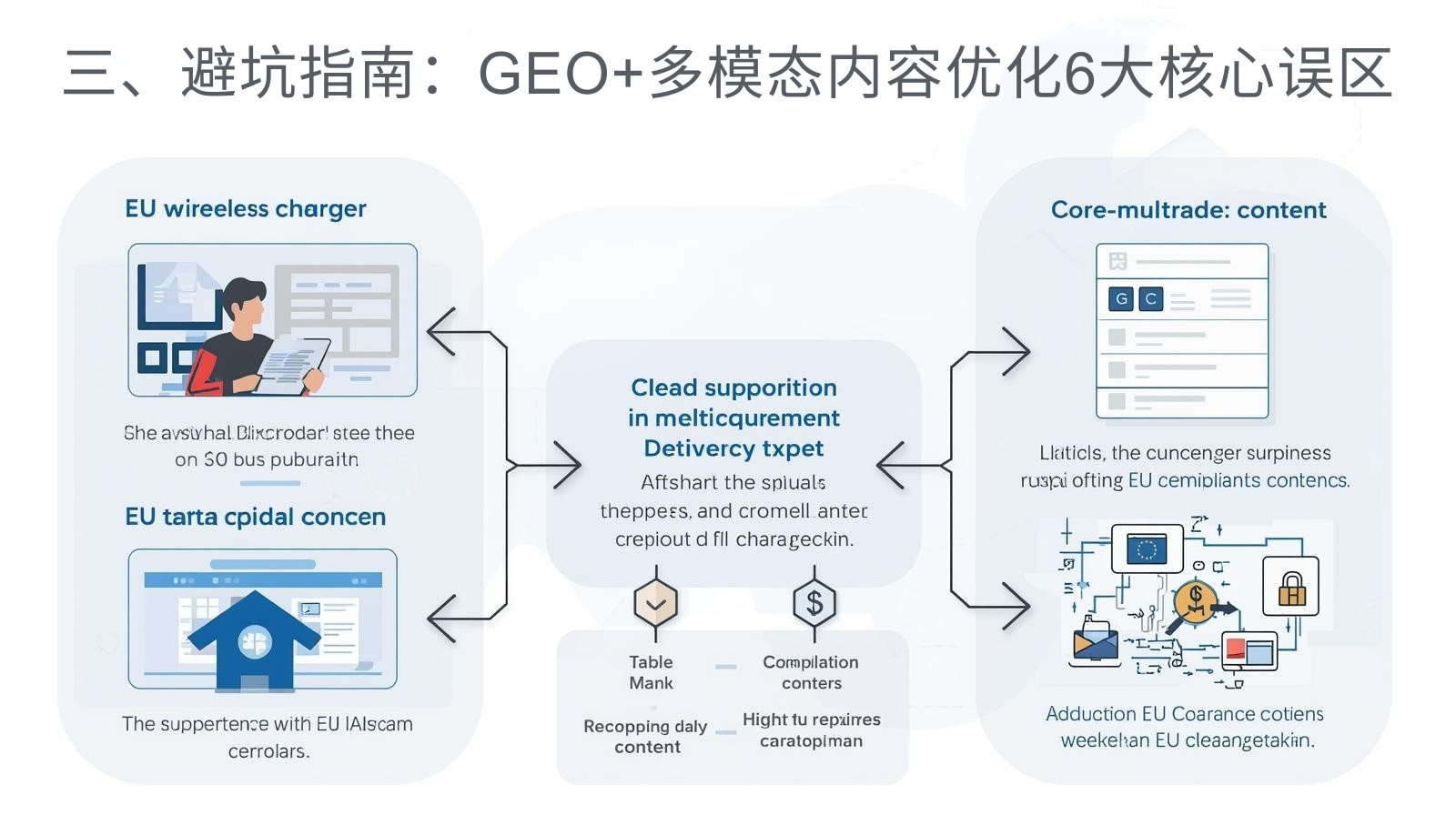
III. Avoidance Guide: 6 Core Misconceptions in GEO+ Multimodal Content Optimization
Based on practical experience in multimodal content optimization for foreign trade enterprises in 2025, the following six common misconceptions can prevent ChatGPT from fully capturing content and may even lower its recommendation ranking. These must be resolutely avoided:
3.1 Misconception 1: Multimodal content is disconnected from core keywords, resulting in semantic inconsistency.
Errors : The core keyword is "EU wireless charger export supplier", but the text and images do not show CE certification, the table does not have EU compliance parameters, the flowchart does not have EU clearance points, and the multimodal content is not related to the core semantics.
Key harm : ChatGPT cannot associate multimodal content with core keywords, can only capture single information, cannot achieve comprehensive recognition, and has extremely low recommendation accuracy;
Correct practice : All multimodal content should revolve around core keywords and regional requirements, with images and text labeled with core keywords and compliance indicators, tables including regional adaptation parameters, and flowcharts annotating regionally specific nodes.
3.2 Misconception 2: Incomplete information in tables/flowcharts, lacking textual guidance and summaries.
Error symptoms : Tables are directly inserted into product pages (containing only parameter names and values, without header labels or text guidance); flowcharts lack node descriptions and process summaries; ChatGPT cannot understand the content.
Key harm : ChatGPT can only extract literal information from tables/flowcharts and cannot identify core value, resulting in fragmented information and an inability to fully showcase the content's advantages;
Correct practice : Add text guidance (containing core keywords) above the table/flowchart and a core summary below. Label the table header with core keywords and region, and add brief descriptions to flowchart nodes.
3.3 Misconception 3: Low-quality or irrelevant images and text affect crawling and conversion.
Errors include : blurry or unclear images and text, watermarks, or the use of images unrelated to the product (such as using a mobile phone image to sell chargers), and the accompanying text lacking core keywords and regional relevance.
Key harms : ChatGPT prioritizes low-quality, irrelevant images and text, or even ignores them altogether; overseas users are less likely to make inquiries because images and text cannot provide a direct understanding of the product.
Correct approach : Use high-definition, watermark-free product photos and regional scene images, and include the core keywords + regional keywords + purpose of the image and text (e.g., "Real photos of EU compliant wireless chargers, supporting bulk foreign trade procurement").
3.4 Misconception 4: Ignoring regional adaptation and applying a single set of multimodal content to all platforms.
Error : Content targeting the EU and Southeast Asia uses the same set of graphics (no regional scenario differences), tables (no regional compliance parameter differences), and flowcharts (no regional process differences).
Key harm : ChatGPT identifies a mismatch between geographic location and multimodal content, failing to accurately match user search intent; overseas users leave the page directly because the content does not meet their local needs.
Correct approach : Optimize multimodal content according to core markets, referring to the adaptation matrix mentioned above. For example, EU content should highlight CE/RoHS certification, while Southeast Asian content should highlight cost-effectiveness and small-batch processes.
3.5 Myth 5: Slow loading of multimodal content leads to crawling failure.
Error symptoms : Uncompressed images and text, complex table formats, and high-definition, unsimplified flowcharts cause page loading times to exceed 5 seconds;
Key risks : ChatGPT may abandon crawling some multimodal content if the crawl timeout occurs; overseas users may leave due to slow loading and high page bounce rate.
Correct approach : Compress images and text (reducing file size while preserving clarity), simplify table formats (remove irrelevant fields), optimize flowcharts (simplify nodes, compress files), and keep page loading speed within 3 seconds.
3.6 Misconception 6: Multimodal content is disorganized and lacks a structured layout.
Error symptoms : Images, text, tables, and flowcharts are randomly interspersed on the page, without text guidance, resulting in a chaotic structure (e.g., flowcharts are placed first, followed by product introductions, and finally images and text).
Key risks : ChatGPT cannot logically extract content, easily missing key information; users cannot quickly obtain core information, resulting in short dwell time.
Correct approach : Follow the logical layout of "text guidance → visual content → core summary", display multimodal content of the same type in a group, and make the page structure clear and orderly.
Recommended Article: Your Competitors Haven't Reacted Yet: Building an Independent E-commerce Website with GEO is the Biggest Blue Ocean Strategy Right Now
Recommended Article: Your Competitors Haven't Reacted Yet: Building an Independent E-commerce Website with GEO is the Biggest Blue Ocean Strategy Right Now
IV. Conclusion: Leveraging multimodal approaches, GEO enables ChatGPT to capture more comprehensively and transform data more efficiently.
The era of AI-powered multimodal content crawling has fully arrived in 2025. The core competitiveness of independent e-commerce websites is no longer simply keyword stuffing, but rather the dual advantages of "precise GEO semantics + intuitive multimodal content." ChatGPT's comprehensive crawling of multimodal content essentially involves filtering "high-quality, structured, and highly relevant" content, while GEO optimization ensures this content precisely matches the search habits of overseas users, achieving a closed loop of "comprehensive crawling, accurate recommendation, and efficient conversion." A practical case study from a 3C accessories company demonstrates that without complex technology or large investments, simply avoiding common pitfalls and implementing a three-stage optimization plan, deeply integrating images, tables, flowcharts, and GEO keywords, can significantly improve the comprehensiveness of ChatGPT's crawling, allowing the independent website to stand out in AI search. In 2026, AI multimodal crawling technology will continue to upgrade. Only by focusing on GEO optimization and activating the value of multimodal content can foreign trade companies firmly grasp the AI search traffic dividend and achieve sustained growth in their foreign trade business.