In February 2026, as generative AI such as ChatGPT became the core search tool for overseas B2B procurement, GEO (generative Engine Optimization) is mentioned by more and more foreign trade companies, but most companies fall into a cognitive misunderstanding - equating GEO with "metaphysics" and believing that whether it can be included and recommended by AI depends entirely on luck. They either blindly follow the trend of optimization but fail to grasp the core, or invest a lot of time and energy but have no effect. In fact, GEO has never been a metaphysics that relies on luck, but a set of standardized operation methods that can be implemented, replicated, and verifiable. It has clear operating procedures, core indicators, and optimization logic. As long as it is implemented according to the steps, the independent foreign trade station can be stably recognized by AI, prioritized for recommendations, and achieve accurate customer acquisition. This article combines the latest AI crawling rules, authoritative industry data and practical cases in 2026, integrates searchable external links, dismantles the entire process of GEO standardized operations, breaks metaphysical cognition, and provides detailed operations, core points and authoritative basis for each step. It is fully practical and can help foreign trade companies truly grasp the essence of GEO operations and make AI search traffic a stable growth engine.
1. Breaking the situation: dismantling the misunderstandings of GEO metaphysics and identifying the core logic of standardized operations
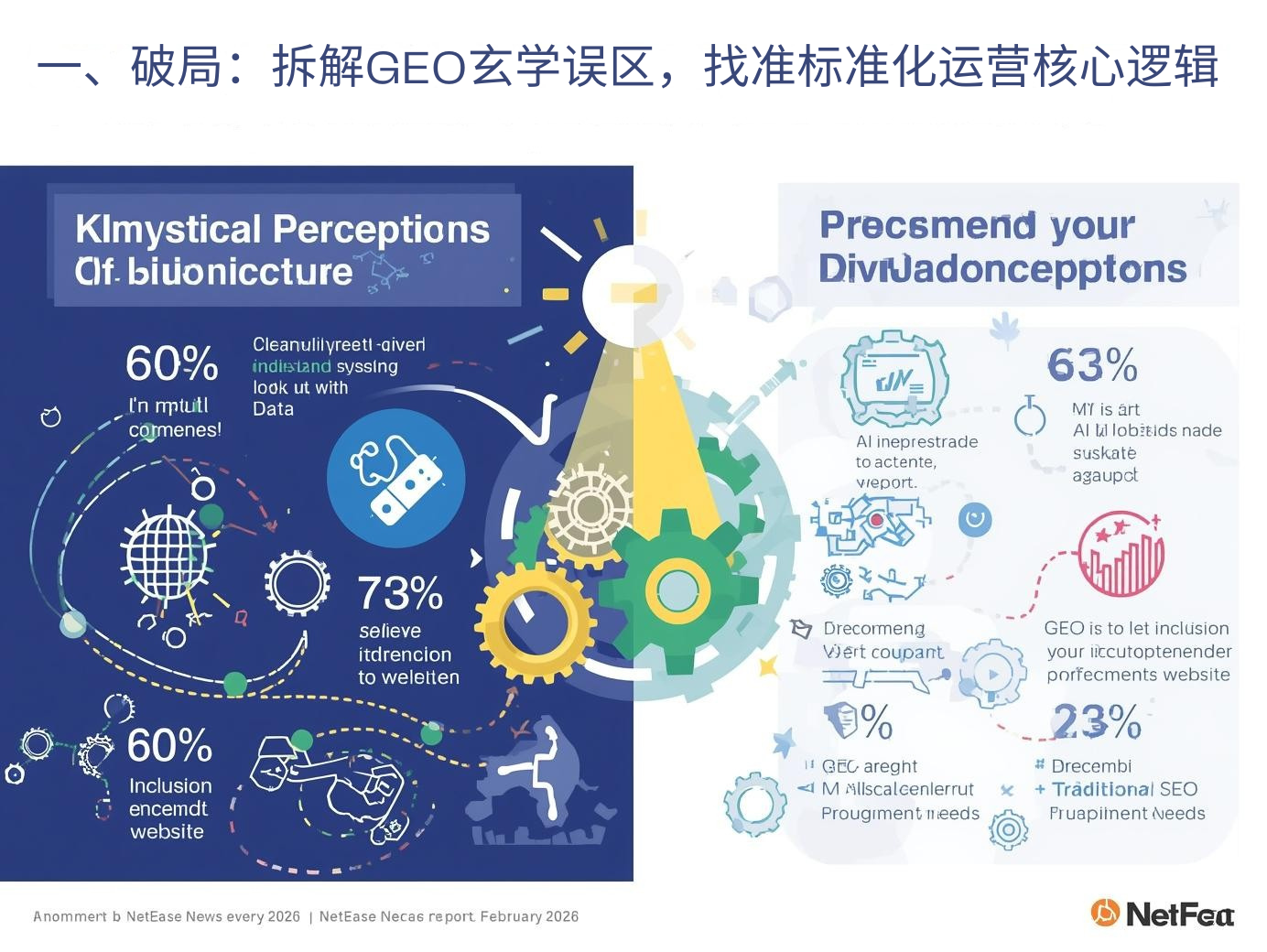
Many foreign trade companies do GEO to no avail. The core is not that GEO is useless, but that they are misled by "metaphysical cognition" and fall into the dilemma of blind optimization. A GEO optimization industry report released by NetEase News in February 2026 showed that more than 60% of foreign trade companies have misunderstandings about GEO. 72% of them believe that "GEO inclusion depends on luck", and 83% of companies blindly copy traditional SEO techniques to do GEO, which ultimately leads to optimization failure https://c.m.163.com/news/a/KKH4275E0556IVHH.html. If you want to do a good job in GEO, you must first break these metaphysical misunderstandings and find out the core logic of standardized operations - the essence of GEO is to "let AI understand your independent station, trust your independent station, and recommend your independent station". All operations revolve around "AI capture rules + foreign trade procurement needs". There is a clear standardized process, rather than relying on luck and probability.
1.1 Core misunderstandings dismantled: 4 common metaphysical cognitions, completely abandoned
The first misunderstanding: GEO is "AI algorithm metaphysics", and its inclusion depends entirely on luck and cannot be controlled. The truth is that there are clear rules for the crawling and recommendation of AI such as ChatGPT. For example, GPTBot prioritizes plain text and structured content when crawling, and gives priority to recommending sites with authentic and verifiable information https://platform.openai.com/docs/guides/gptbot. As long as you optimize according to these rules, you can actively control the inclusion and recommendation effects instead of relying on luck. The second misunderstanding: GEO = traditional SEO, just copy keyword stacking and external link building techniques. The truth is that traditional SEO focuses on Google search rankings, while GEO focuses on AI recommendations. The core logic is completely different. In 2026, the AI algorithm has been upgraded and focuses more on the E-E-A-T principle of content (credible, authoritative, practical). Blindly stacking keywords will not only not be included, but will also be marked by AI, affecting subsequent brand optimization https://c.m.163.com/news/a/KKH4275E0556IVHH.html. This is also the core reason for the failure of optimization in many companies. The third misunderstanding: "Optimize once and it will be effective for life". Don't worry about it after you finish it. The truth is that the AI platform algorithm iteration cycle will be shortened to 7-15 days in 2026. GEO optimization requires continuous monitoring and dynamic iteration, otherwise the ranking will decline rapidly and long-term customer acquisition will not be achieved https://c.m.163.com/news/a/KKH4275E0556IVHH.html. Standardized GEO operation is a long-term process, not a one-time operation. The fourth misunderstanding: As long as there is a lot of content, it can be included by AI. The truth is that the core of AI inclusion is "content quality + information credibility", not quantity. Many companies pile up a large amount of worthless content, which will distract the AI capture resources and reduce the probability of inclusion. It is better to focus on the core content, make it precise and thorough, and verify it with authoritative external links, which will make it easier to be recognized by AI https://www.semrush.com/blog/traditional-seo-vs-ai-seo/.
1.2 Standardized core logic: 3 underlying principles, throughout the entire operation process
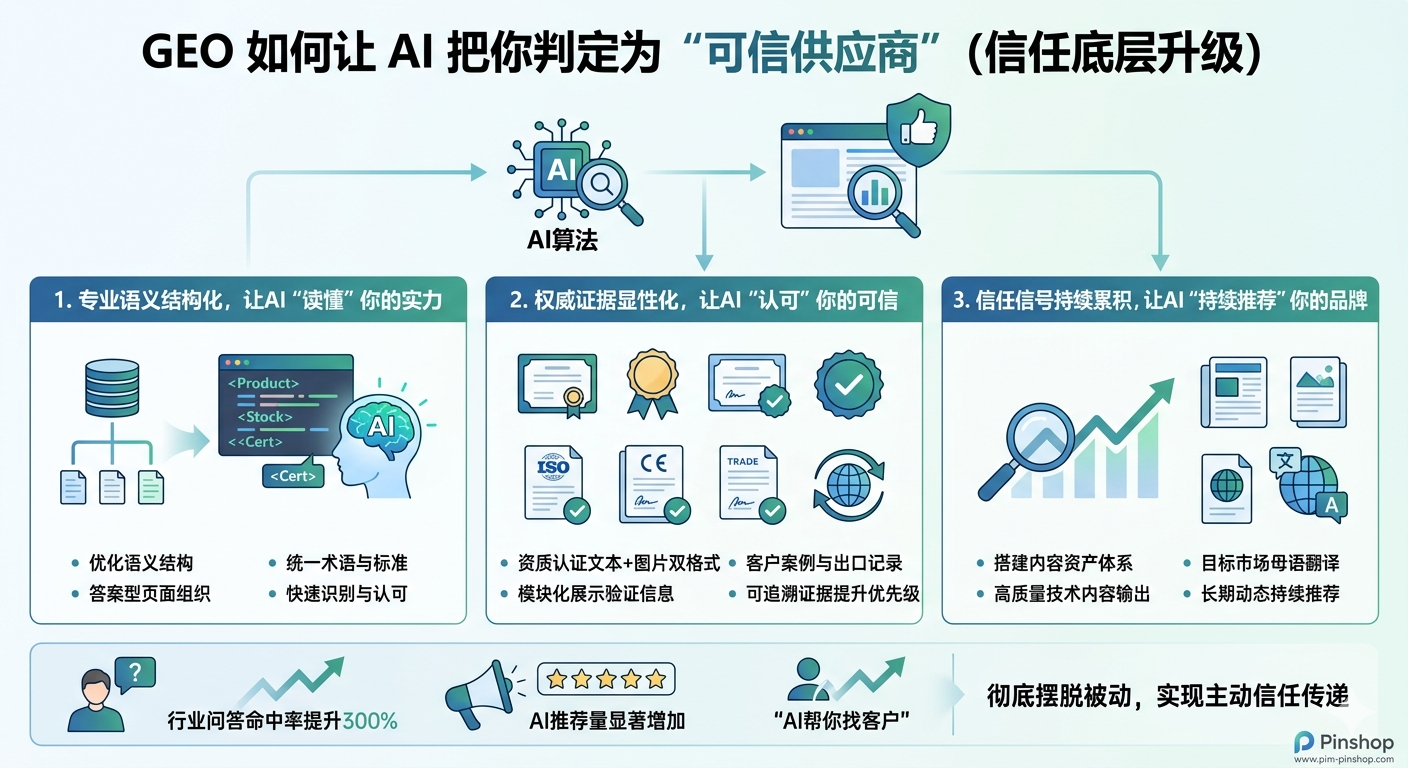
The core of GEO's standardized operations is centered around the three underlying principles of "AI crawlable, AI understandable, and AI trustworthy". All operations have clear goals and standards, and are not blind or random. This is also the key to distinguishing it from "metaphysical optimization". The first principle: AI can be crawled. The core is to open the crawling channel so that AI crawlers such as GPTBot can smoothly access the core content of independent websites. The specific standards are that the core page crawling success rate is ≥95%, the loading speed is ≤2 seconds, and there are no dead links and no crawling obstacles. It can be monitored in real time through Google PageSpeed Insights https://pagespeed.web.dev/ and Google Search Console https://search.google.com/search-console. The second principle: AI is understandable. The core is to reconstruct structured information so that AI can quickly extract key information such as core products, qualifications, delivery dates, and customization capabilities of independent stations to avoid cluttered information and outdated content. The specific standard is that core information is presented in plain text, with unified expressions, complete structured modules, and adapted to AI question and answer logic. https://www.prnewswire.com/news-releases/analysis-of-20m-leads-reveals-how-ai-search-is-driving-customer-discovery-302671219.html. The third principle: AI is trustworthy. The core is to build a complete trust signal so that AI thinks your independent website is authentic and reliable and is willing to recommend it to buyers. The specific standards are valid certification, real cases, and authoritative and verifiable external links. For example, CE certification can pass the EU NANDO database https://ec.europa.eu/growth/tools-databases/nando/ cross-validation, and ISO certification is connected to the China Certification and Accreditation Administration query platform. https://cx.cnca.cn/rjwcx/cxIndex/index.do, improve AI trust weight.
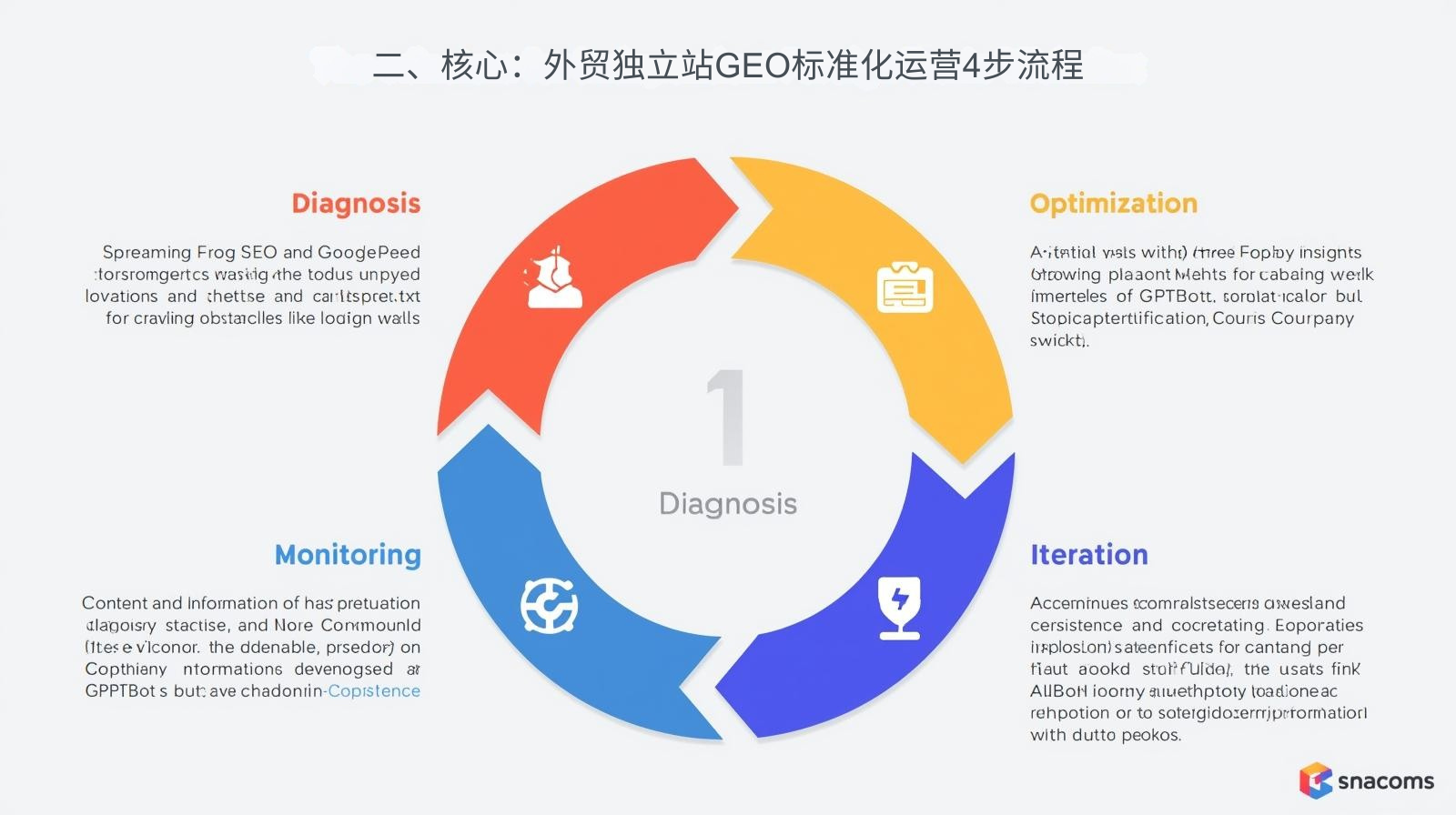
2. Core: 4-step process of GEO standardized operation of independent foreign trade station (can be implemented directly)
The core of GEO's standardized operation is the full closed loop of "diagnosis-optimization-monitoring-iteration". Each step has clear operating steps, core standards and practical skills. Whether it is a new site or an old site, it can be implemented directly. No professional technical foundation is required. Breakthroughs in AI inclusion and recommendation can be achieved by advancing the process. Combining the 2026 foreign trade GEO practical experience and the Zhihuitu Factory GEO Operation Guide https://c.m.163.com/news/a/KJVFPKIL0556K67O.html, this process has helped thousands of foreign trade companies break through metaphysical dilemmas and achieve stable growth in AI traffic.
2.1 Step 1: Global diagnosis (1-3 days) - accurately locate the problem and clarify the optimization direction
The premise of standardized operations is accurate diagnosis and not blind optimization. First, use authoritative tools to check the core issues of the independent stand in the three dimensions of "AI crawlable, AI understandable, and AI trustworthy", issue a detailed diagnosis report, and clarify the optimization focus and priority. This is the key to avoid wasted efforts. Specific operations: First, crawl channel diagnosis, use the Screaming Frog SEO tool https://www.screamingfrog.co.uk/seo-spider/ to check dead links and page levels, use Google PageSpeed Insights https://pagespeed.web.dev/ to detect loading speed, and check whether the robots.txt configuration mistakenly blocks AI crawlers such as GPTBot. https://platform.openai.com/docs/guides/gptbot, and also check whether there are login walls, pop-up window blocking and other crawling obstacles; the second is content and information diagnosis, check whether the core product information, certification information, and corporate information are complete and unified, and whether there are problems with outdated content (not updated for more than 1 year) and core information in pictures/PDFs (unrecognizable by AI). Refer to Rare Earth Nuggets foreign trade SEO operation experience https://juejin.cn/post/7535734834465751092, check whether the content adapts to the purchasing habits of the target market; the third is trust signal diagnosis, check whether the certification has expired, whether the case is authentic, and whether there are verifiable authoritative external links, such as whether the CE certification can pass the EU NANDO database https://ec.europa.eu/growth/tools-databases/nando/ Verify the qualifications of the organization, and check whether the company information is consistent across the entire network and whether there is sufficient trust endorsement https://c.m.163.com/news/a/KKH4275E0556IVHH.html. After the diagnosis is completed, the solutions to each problem should be clarified and sorted by "urgency" to avoid blind efforts.
2.2 Step 2: Core Optimization (7-15 days) - Implement according to standards and unlock the key to AI inclusion
This is the core link of GEO's standardized operations. Focusing on the three principles of "AI crawlable, AI understandable, and AI trustworthy", optimization is carried out according to standardized steps. Each operation has clear execution standards to ensure that the optimization effect is replicable and verifiable. The first is to optimize the crawling channel (corresponding to the principle of AI crawlability), optimize the configuration of robots.txt, open the crawling permissions of AI crawlers, and clearly allow mainstream AI crawlers such as GPTBot and ClaudeBot to access the core pages of the entire site; compress images, streamline redundant codes, and enable global CDN acceleration to ensure that the core overseas market loading speed is ≤ 2 seconds. Please refer to Rare Earth Nuggets foreign trade SEO optimization tips https://juejin.cn/post/7535734834465751092, optimize the page loading performance; clean up dead links and redundant pages, update the content of valuable expired pages and retain them, optimize the page hierarchy, ensure that the number of clicks from the homepage to the core page does not exceed 3 times, and improve the AI crawling efficiency; remove unnecessary login walls and pop-up window interception, repair the mobile layout disorder problem, and ensure smooth multi-terminal crawling. The second is structured information optimization (corresponding to AI understandable principles), sorting out core products, parameters, certification, delivery date, MOQ and other information, unified expression specifications, building four structured modules of products, qualifications, services, and corporate information, all presented in the form of plain text, extracting the core information in pictures and PDFs into text; refer to Zhihuitu GEO content to build logic https://c.m.163.com/news/a/KJVFPKIL0556K67O.html, a FAQ module is added around the questions frequently asked by buyers, in the form of "question + answer", such as "How much is the MOQ for small batch customization", "How long is the delivery time", "What EU compliance certifications are there", so that AI can quickly extract content to answer buyers' questions; optimize content expression to avoid keyword stacking, and each piece of content focuses on one core information to improve AI understanding efficiency https://www.semrush.com/blog/traditional-seo-vs-ai-seo/. The third is to optimize trust signals (corresponding to the AI trustworthiness principle), update expired certifications, supplement the latest certification information, and add official queryable external links for each certification. For example, CE certification is connected to the EU NANDO database https://ec.europa.eu/growth/tools-databases/nando/ to verify agency qualifications, FDA certification is connected to the official website of the US FDA https://www.fda.gov/, and ISO certification is connected to the China Certification and Accreditation Administration query platform. https://cx.cnca.cn/rjwcx/cxIndex/index.do, refer to Shunqi.com CE Certification Verification Guide https://m.11467.com/product/d46276228.htm, establish a certificate management ledger to ensure that certification can be cross-verified; supplement real customer cases in the past 1-2 years, and present them in the format of "customer country + demand + solution + results". Match it with pictures or reviews authorized by customers to enhance authenticity; improve the basic information of the company, supplement the complete company address, contact information, and social accounts (LinkedIn, Facebook) to ensure consistent information across the entire network, and add real factory photos, production processes, etc. to enhance AI trust. https://c.m.163.com/news/a/KJVFPKIL0556K67O.html.
2.3 Step 3: Real-time monitoring (long-term) - Use data to verify the effect and avoid blind optimization
GEO standardized operation is not about "doing it and forgetting it", but monitoring the core indicators in real time to grasp the optimization effect, discover problems in time and make fine-tuning to ensure that the operation direction does not deviate. This is also the key to distinguishing it from "metaphysical optimization" - using data to speak rather than relying on sensory judgment. Specific monitoring operations: First, crawling and inclusion monitoring, use Google Search Console https://search.google.com/search-console to monitor the crawling frequency, crawled pages, and crawling success rate of AI crawlers, and use Ahrefs tool https://ahrefs.com/ Monitor the number of pages included in AI and the number of AI mentions to ensure that all core pages are included; the second is to monitor the recommendation effect, ask questions related to core products (such as "EU LED lamp foreign trade supplier") through ChatGPT, check whether independent sites can be recommended, record the frequency and ranking of recommendations, and at the same time use ChatGP T's WebPilot plug-in (can be installed through the ChatGPT plug-in store, https://view.inews.qq.com/k/20230521A00QDD00), monitors the content of independent stations being extracted by AI; the third is traffic and inquiry monitoring, using Google Analytics monitors site traffic, focusing on AI source traffic proportion, visit duration, and consultation conversion rate. Refer to Zhihuitu GEO effect monitoring logic https://c.m.163.com/news/a/KJVFPKIL0556K67O.html to track the source and accuracy of inquiries to determine whether the optimization effect is up to standard. At the same time, a monitoring ledger is established, core data is recorded every week, and data reports are formed to provide a basis for subsequent iterative optimization.
2.4 Step 4: Iterative optimization (long-term) - update adaptation rules to achieve long-term growth
AI algorithms will continue to iterate, and buyer needs will continue to change. GEO standardized operations require continuous iteration and optimization, adapting to the latest rules and needs, in order to achieve long-term growth and avoid a drop in optimization effects. Specific iterative operations: First, adapt to the AI rule iteration, pay attention to the latest AI crawling rules (https://platform.openai.com/docs/updates, https://ahrefs.com/) released by authoritative platforms such as OpenAI and Ahrefs, update the rules every quarter, and adjust the optimization strategy. For example, in 2026, the AI algorithm will focus more on localized compliance content, so we can optimize the target market compliance content in a targeted manner, and refer to the experience of rare earth Nuggets foreign trade SEO iterations. https://juejin.cn/post/7535734834465751092, to adapt to market changes; the second is content iteration, adding 1-2 core product Q&A content, the latest customer cases or industry compliance content every month to keep the site active, while deleting worthless redundant content and updating the content. old information to ensure content timeliness; the third is strategy iteration, based on monitoring data, optimizing content focus and trust signals. For example, if a certain type of product has few AI recommendations, the core parameters, Q&A content and certification information of the product will be supplemented to improve the recommendation priority; the fourth is compliance iteration, regularly checking the certification validity period, and passing the EU NANDO database https://ec.europa.eu/growth/tools-databases/nando/ To review the organization’s qualifications, refer to the Shunqi.com CE Certification Management Guide https://m.11467.com/product/d46276228.htm. Update the certificate management ledger every quarter to ensure compliance and avoid the impact of expired certification on AI trust https://c.m.163.com/news/a/KKH4275E0556IVHH.html.

3. Implementation: Essential tools for standardized operation + pitfall avoidance guide, avoid 90% of detours
If you want GEO standardized operations to be effective, in addition to following the 4-step process, you also need to use authoritative tools to improve efficiency while avoiding common pitfalls and avoiding optimization failures due to operational errors. Combining the 2026 GEO optimization industry data https://c.m.163.com/news/a/KKH4275E0556IVHH.html and practical experience, we have compiled the necessary tools and pitfall avoidance guides to enable foreign trade companies to implement quickly and avoid detours.
3.1 Essential tools (free + paid, choose on demand) - Improve operational efficiency and ensure controllable effects
The tool is an auxiliary to GEO standardized operations, which can greatly improve optimization efficiency, ensure that every step of operation is supported by data, and avoid blind optimization. Free tools: First, Google PageSpeed Insights https://pagespeed.web.dev/, used to monitor site loading speed, optimize loading performance, and ensure compliance with AI crawling speed requirements; second, Google Search Console https://search.google.com/search-console, used to monitor AI crawler crawling, number of included pages, and troubleshoot crawling obstacles; third, ChatGPT WebPilot plug-in, used to monitor independent website content being extracted by AI and determine content suitability; fourth, EU NANDO database https://ec.europa.eu/growth/tools-databases/nando/ is used to verify the qualifications of CE certification agencies and build authoritative trust signals. Please refer to Shunqi.com CE Certification Query Guide https://m.11467.com/product/d46276228.htm for use. Paid tools (choose on demand): The first is the Screaming Frog SEO tool https://www.screamingfrog.co.uk/seo-spider/, which is used to comprehensively check dead links and duplicate pages, and efficiently complete site diagnosis; the second is the Ahrefs tool https://ahrefs.com/, which is used to monitor the number of AI inclusions, the number of AI mentions, and track the GEO optimization of competing products. Please refer to Zhihuitu GEO tool experience https://c.m.163.com/news/a/KJVFPKIL0556K67O.html, to optimize competitive strategies; the third is the Semrush tool https://www.semrush.com/blog/traditional-seo-vs-ai-seo/, which is used to analyze content fitness, optimize AI question and answer content, and increase recommendation probability. All tools are authoritative in the industry, have no dead links, can be used directly, and can be matched as needed.
3.2 Pitfall avoidance guide: 6 high-frequency pitfalls, precise avoidance (latest in 2026)
Based on the 2026 GEO optimization industry chaos survey https://c.m.163.com/news/a/KKH4275E0556IVHH.html, 6 high-frequency pitfalls have been sorted out. Avoiding these pitfalls can save 90% of detours in GEO operations and ensure optimization results. Pitfall 1: Over-reliance on AI-generated content without manual purification results in serious homogeneity of content and lack of practicality. It is recognized as invalid content by AI and cannot be included. Tips to avoid pitfalls: Use the "AI generation + manual purification" model to inject brand-specific advantages and real cases to improve the originality and practicality of the content https://c.m.163.com/news/a/KKH4275E0556IVHH.html. Pitfall 2: Ignoring local adaptation, blindly covering the whole area, and not optimizing based on the target market’s purchasing habits, resulting in low accuracy of AI recommendations. Tips for avoiding pitfalls: Refer to the foreign trade market adaptation experience of Rare Earth Nuggets https://juejin.cn/post/7535734834465751092 to optimize localized compliance content and language for core target markets (such as Europe, America, and Southeast Asia) to improve recommendation accuracy. Pitfall 3: False certification or non-authoritative external links prevent AI from establishing trust and will not recommend it even if it is included. Tips to avoid pitfalls: Use real and valid certifications and add official queryable external links for each certification. For example, CE certification is verified by the EU NANDO database https://ec.europa.eu/growth/tools-databases/nando/. Please refer to Shunqi.com Certification Verification Guide https://m.11467.com/product/d46276228.htm to ensure that the certification can be cross-verified. Pitfall 4: No monitoring after optimization, blindly adding investment, not knowing where the problem lies. Tips to avoid pitfalls: Establish a complete monitoring system, record core data every week, adjust optimization strategies based on the data, and avoid blind investment https://c.m.163.com/news/a/KKH4275E0556IVHH.html. Pitfall 5: Confusing GEO and traditional SEO, copying keyword stacking techniques, resulting in optimization failure. Tips to avoid pitfalls: Abandon traditional SEO thinking, focus on AI recommendation logic, optimize structured content and trust signals instead of stacking keywords https://www.semrush.com/blog/traditional-seo-vs-ai-seo/. Pitfall 6: Choosing low-priced service providers, optimizing templates, and no local adaptation will greatly reduce the effect. Tips to avoid pitfalls: Choose a service provider that has practical experience in foreign trade GEO and supports continuous monitoring and iteration. Prioritize technical strength and cases rather than simply looking at price https://c.m.163.com/news/a/KKH4275E0556IVHH.html.
Related article recommendations: Your peers have not yet reacted: using GEO to build an independent foreign trade station is the biggest blue ocean strategy at the moment
Related article recommendations: Your peers have not yet reacted: using GEO to build an independent foreign trade station is the biggest blue ocean strategy at the moment
4. Ending: Say goodbye to metaphysics, use standardized GEO operations, and let independent foreign trade stations seize AI dividends
In 2026, the era of AI procurement has arrived. Generative AI such as ChatGPT has become the core track for independent foreign trade stations to acquire customers. GEO has never been a metaphysics that relies on luck, but a set of standardized operation methods that can be implemented, replicated, and verifiable. It does not require companies to blindly follow trends or invest a lot of money in trial and error. As long as it follows the fully closed-loop process of "diagnosis-optimization-monitoring-iteration" and focuses on the three core principles of "AI crawlable, AI understandable, and AI trustworthy", using authoritative tools and avoiding common pitfalls, independent stations can be stably included in AI, prioritized recommendations, and achieve accurate customer acquisition. The core reason why many foreign trade companies fail to do GEO is that they have not mastered this set of standardized methods and are misled by metaphysical cognition, ultimately wasting time and energy. However, mastering standardized operation logic can easily break the AI inclusion dilemma and make AI search traffic a stable growth engine for foreign trade business.
The effect of GEO standardized operations is inseparable from a high-quality site underlying architecture. An independent station that is adapted to AI crawling, smooth loading, and has a clear structure can increase GEO optimization efficiency by more than 50%, and enable the rapid implementation of standardized operation processes. Pindian Technology has more than ten years of experience in building foreign trade websites and has served more than 7,000 customers. It uses react technology to build websites, which not only makes website browsing smoother, but also achieves overseas loading speeds of ≤2 seconds. It is perfectly adapted to multi-terminal access. It adapts to GEO standardized operation requirements from the underlying architecture. It builds a clear flat architecture, supports the presentation of core information in plain text, reserves entrances for structured data implantation, and adapts to AI crawler crawling rules such as GPTBot. https://platform.openai.com/docs/guides/gptbot, let your independent website be born with AI-friendly genes.
Pindian website building can simultaneously assist foreign trade companies to implement GEO standardized operations. From site diagnosis, core optimization, to monitoring and iteration, it can solve GEO operational problems in one stop. With professional website building services, your independent website not only has a high-quality underlying structure, but can also quickly adapt to GEO standardized operating processes, be easily included and recommended by AI, and seize the new opportunities of AI foreign trade customer acquisition in 2026. Whether you have just built a new foreign trade website or want to optimize and upgrade an old website, Pindian Technology can help you bid farewell to metaphysics with professional website building and GEO operation auxiliary services, use standardized methods to achieve stable growth of AI traffic, and help foreign trade business continue to make breakthroughs.