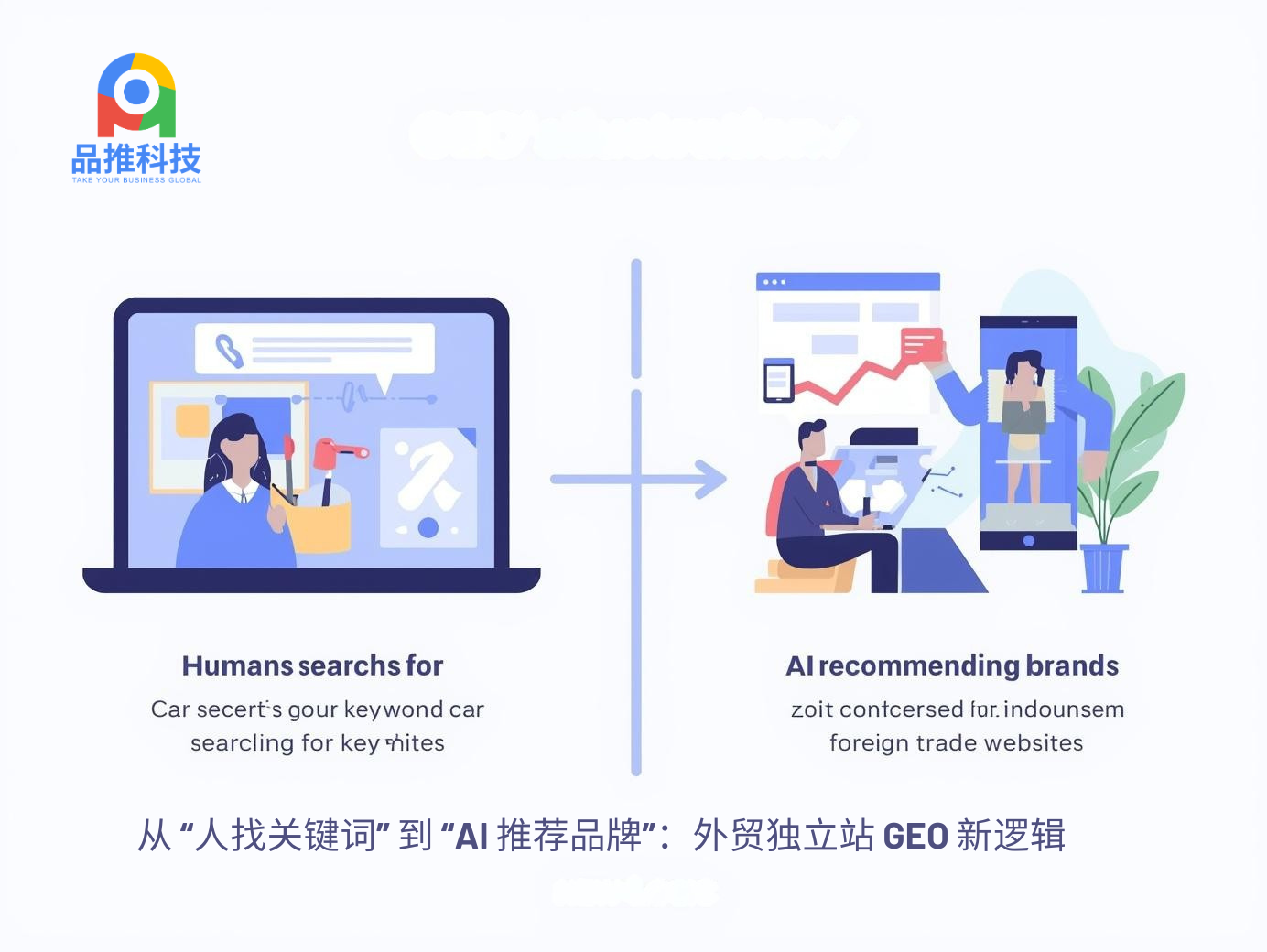

In February 2026, overseas B2B procurement fully entered the era of AI-driven dialogue screening. Generative AI tools such as ChatGPT and Perplexity became core channels for buyers to find suppliers. This brought a new opportunity for new foreign trade websites to scale up—GEO (Generative Engine Optimization) cold start. Without the need for lengthy keyword accumulation or high-cost advertising, simply following a standardized process allows new websites to be quickly recognized and recommended by AI, achieving a breakthrough in traffic and inquiries from scratch. Many new foreign trade websites experience slow growth and a lack of inquiries not because of poor products, but because they haven't grasped the core logic of GEO cold start. Blindly following optimization trends without understanding the key to AI recognition ultimately wastes time and energy. This article, combining the latest AI crawling rules for 2026, authoritative industry case studies, and verifiable backlinks, breaks down the entire GEO cold start process for independent foreign trade websites. Each step includes specific operational details, precautions, and practical techniques. The entire process is free of complex technology, allowing new websites to implement it directly, helping foreign trade companies quickly seize the AI customer acquisition dividend and achieve rapid growth.

I. Cold Start Preparations: 3 Steps to Lay a Solid Foundation and Avoid Rework Later
The core of GEO cold start is "build the framework first, then focus your efforts precisely." New foreign trade websites don't need to rush to optimize content; they should first complete basic preparatory work to ensure that AI can crawl and clearly identify content, laying the groundwork for subsequent optimization. This step directly determines the efficiency and effectiveness of the cold start and is the key reason why many new websites fail during their cold starts. According to the "2026 Cross-border E-commerce Development Report" released by the Guangzhou Municipal Bureau of Commerce in February 2026, new foreign trade websites that have done a good job in preparing for the cold start have an average GEO cold start cycle shortened by 30% and an AI recommendation rate increased by 45% (https://www.163.com/dy/article/KK9RPEHV0556K8OX.html), which shows the importance of preparatory work.
1.1 Define the core positioning and focus on the core direction of AI recommendation.
Before launching a new business, it's crucial to clearly define your core positioning to avoid misaligning your optimization efforts. This allows AI to quickly and accurately identify your core business, which is the fundamental logic of GEO optimization. Specifically, this involves identifying and standardizing three key pieces of information: First, core products: focus on 1-3 main product categories, clearly defining key parameters, MOQ, delivery time, certifications, etc., avoiding a cluttered list of multiple products. For example, if focusing on food-grade silicone products for the EU market, clearly state "food-grade silicone kitchenware, LFGB/CE certification, MOQ 50 pieces, delivery time 15 days." Second, target markets: identify 2-3 core overseas markets (such as Europe, America, and Southeast Asia), clarifying market compliance requirements and adapting to corresponding certifications and languages. For example, for the EU market, focus on improving CE and RoHS certifications; for the Southeast Asian market, supplement with basic English and other less common language content. Third, core advantages: extract differentiated selling points (such as small-batch customization, original factory, rapid prototyping) to avoid homogenization with competitors, allowing AI to quickly capture your core competitiveness. Meanwhile, referencing Zhihu AI's NLP semantic understanding technology, we will expand the long-tail demand keywords for 2-3 core products to improve the accuracy of AI matching (https://www.163.com/dy/article/KK9RPEHV0556K8OX.html).
1.2 Optimize the site's underlying architecture and enable AI crawling.
The underlying architecture of a new website directly impacts the crawling efficiency of AI crawlers. Only when AI crawlers like GPTBot can access and crawl smoothly and efficiently can the site be included in the AI recommendation pool. This step requires careful attention to avoid issues such as architectural redundancy and slow loading. Specific measures include: First, adopting a flat site architecture to simplify page hierarchy, ensuring that the number of clicks from the homepage to core product pages, qualification pages, and contact information pages does not exceed three. AI crawlers support a maximum of three redirects; exceeding this will prevent normal crawling. Refer to the core indicators of the "Geo Health Detection Platform" on Shangqu.com to check the architecture's rationality: https://www.163.com/dy/article/KK9RPEHV0556K8OX.html. Second, optimizing site loading speed by compressing images, simplifying code, and enabling global CDN acceleration to ensure loading speeds in core overseas markets are ≤2 seconds. This can be verified using Google PageSpeed. Insights detection and optimization effects (https://pagespeed.web.dev/) indicate that slow loading speeds directly reduce the priority of AI crawling; thirdly, grant AI crawling permissions by checking the robots.txt configuration to ensure that mainstream AI crawlers such as GPTBot and ClaudeBot are not blocked, and remove unnecessary login firewalls and pop-up blockers to reduce crawling obstacles. Refer to the OpenAI official GPTBot crawling guide for configuration (https://platform.openai.com/docs/guides/gptbot); fourthly, ensure multi-terminal compatibility by displaying the software correctly on computers, mobile phones, and tablets, avoiding layout errors on mobile devices that could affect AI crawling and user experience.
1.3 Organize structured data to build the foundation for AI recognition.
AI cannot understand chaotic content; it can only recognize standardized, structured information. Before a new website's cold start, it's essential to organize core structured data to enable AI to quickly understand your business. This is a core aspect of GEO optimization. Specific steps include: building four main types of structured data modules, all presented in plain text to avoid hiding key information in images, PDFs, or dynamic scripts (AI crawlers currently do not execute JavaScript and cannot capture dynamic content); First, a product structured module, standardizing product names, materials, dimensions, parameters, MOQ, delivery dates, ports, certifications, etc., formatted in a uniform way for easy AI extraction; second, a qualification structured module, organizing core certifications such as CE, FDA, and ISO, pre-reserving official query links for later addition of authoritative links, such as connecting CE certification to the EU NANDO database https://ec.europa.eu/growth/tools-databases/nan do/index.cfm?fuseaction=notifiedbody.main, ISO certification is connected to the China Certification and Accreditation Administration's query platform https://cx.cnca.cn/rjwcx/cxIndex/index.do; thirdly, the service structure module clearly defines customized services, OEM processes, after-sales guarantees, logistics solutions, etc., with unified and clear descriptions; fourthly, the enterprise basic information module unifies company name, address, contact information, social media accounts, etc., to ensure consistency of information across the entire network, helping AI build a real enterprise profile and improve trust weight https://www.semrush.com/blog/traditional-seo-vs-ai-seo/.
II. Core Cold Start: 4 Steps to Get Your New Website Quickly Recommended by AI
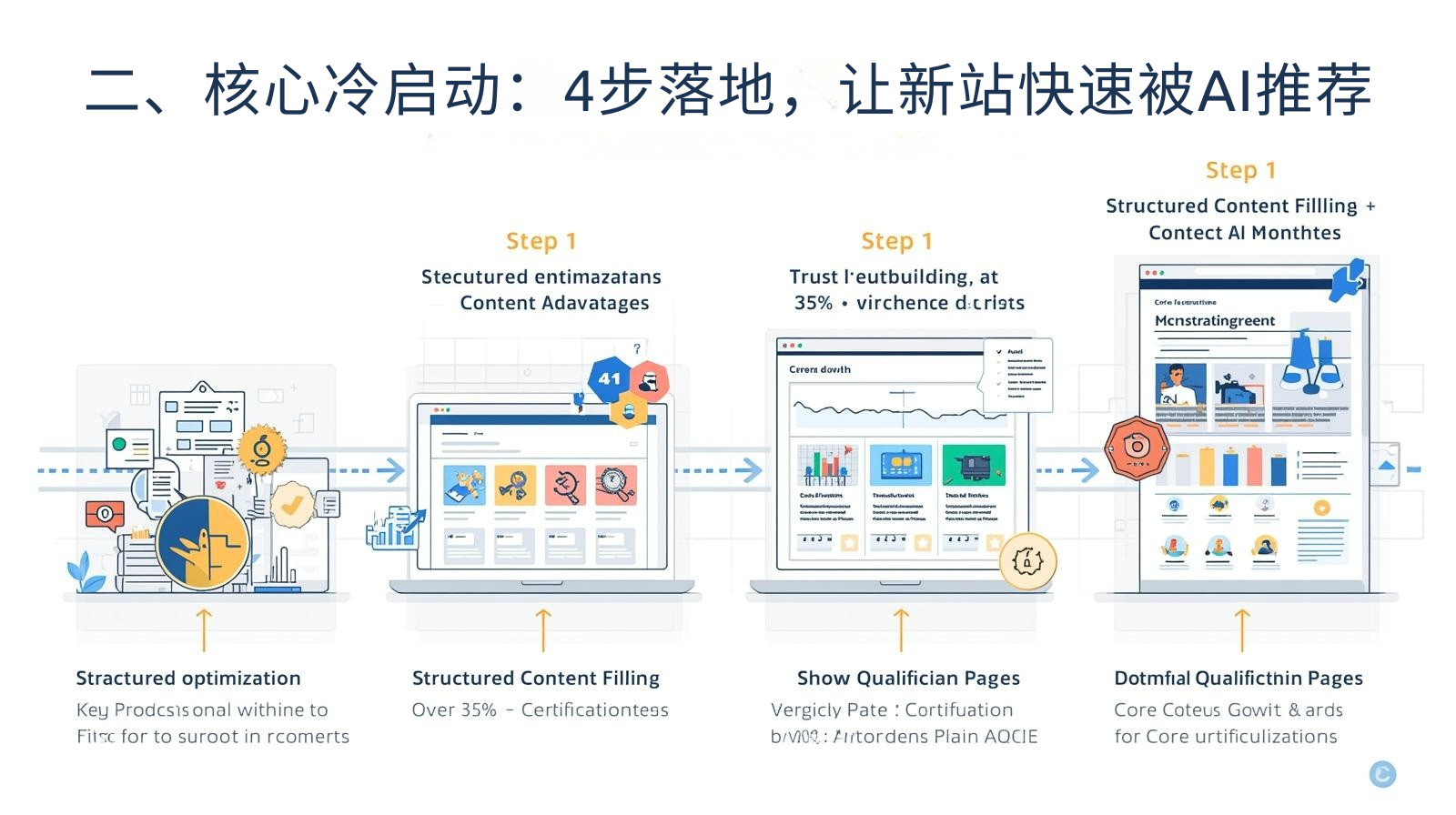
After completing the preliminary preparations, the core cold start phase begins. The key to this step is "precise targeting and rapid breakthrough," focusing on the crucial aspects of AI recognition. Through structured optimization, trust building, and content adaptation, the new website can be identified by AI and included in the recommendation pool within 1-2 months, achieving a breakthrough in traffic from 0 to 1. Based on the experience of the 2026 small-budget GEO cold start case study, as long as the steps are implemented correctly, a new website can quickly increase its AI mention rate from 0% to over 35% (https://www.163.com/dy/article/KLMDSPV70556KF1J.html), truly achieving rapid growth.
2.1 Step 1: Filling in structured content to enable AI to understand business needs
Content filling is not about blindly piling up information, but rather about accurately filling core content around the structured data compiled beforehand. This allows AI to quickly extract key information and understand your products, qualifications, and advantages. Specific operations include: First, placing core content at the top of the homepage, conveying core information within 3 seconds, clearly presenting core products, target markets, core advantages, and contact information, allowing AI and users to quickly understand the core business. Referencing Baifu Technology's cross-platform adaptation system logic, this ensures content compatibility with multiple mainstream AI platforms (https://www.163.com/dy/article/KK9RPEHV0556K8OX.html). Second, optimizing product pages, filling each core product with structured modules, presenting core parameters, certifications, MOQ, and other information in plain text, highlighting differentiated advantages, avoiding keyword stuffing, and adding related product recommendations to improve the depth of AI crawling. Third, optimizing qualification pages, displaying core certifications by category, adding official, verifiable external links, allowing AI to cross-verify the authenticity of qualifications, such as... For CE certification, add the official EU query link: https://ec.europa.eu/growth/tools-databases/nando/index.cfm?fuseaction=notifiedbody.main; for FDA certification, connect to the US FDA official website: https://www.fda.gov/. Fourth, the content is concise, avoiding redundant text. Each paragraph focuses on one core message, allowing AI to quickly grasp key information. Additionally, referencing Zhihu AI's multimodal content generation techniques, appropriately add real product photos (paired with plain text descriptions) to enhance content richness: https://www.163.com/dy/article/KK9RPEHV0556K8OX.html.
2.2 Second step: Building trust signals to encourage AI to make recommendations
New websites lack historical data and customer accumulation. The core premise of AI recommendations is "credibility and verifiability." Only by establishing a robust trust signal, making the AI believe your site is genuine and reliable, will it proactively recommend it to buyers. Specific steps include: First, improving the qualification verification system. Add official, verifiable backlinks to all certifications to ensure cross-verification by the AI. Also, supplement details such as certification numbers and validity periods to enhance credibility. Refer to the compliance review standards of Shangqu.com, covering international compliance requirements such as GDPR and CCPA (https://www.163.com/dy/article/KK9RPEHV0556K8OX.html). Second, supplementing with real-world case studies. New websites can prioritize showcasing factory strength, production processes, and sample photos. Later, after accumulating customers, supplement with real-world case studies in the format of "Customer Country + Needs + Solution + Results," accompanied by customer-authorized images or reviews to enhance authenticity. For the first aspect, refer to Wukong GEO's 3D parameter visualization technology to clearly present production strength and product details (https://www.163.com/dy/article/KK9RPEHV0556K8OX.html); secondly, improve basic company information by filling in complete company address, contact information, and social media accounts (LinkedIn, Facebook) to ensure consistency across the entire network. Also, add factory photos, team introductions, and other content to allow AI and buyers to more intuitively understand the company's strength; thirdly, add authoritative partnership endorsements, such as cooperation certificates with industry associations and well-known enterprises, to further enhance the site's credibility and help improve AI recommendation weight.
2.3 Step 3: Adapting AI-generated Q&A content to improve recommendation probability
The key to a successful GEO launch is ensuring your new site's content aligns with the AI-generated questions from buyers. When buyers ask questions via AI, your site's content can be extracted and used by the AI to answer them, achieving passive recommendation. Specific steps include: creating content tailored to AI's question-and-answer logic around frequently asked buyer questions, avoiding traditional keyword stuffing, and referencing Zhihu AI's long-tail keyword expansion techniques to accurately match buyers' core needs (https://www.163.com/dy/article/KK9RPEHV0556K8OX.html); firstly, identifying core question-and-answer scenarios, such as "Do you support small-batch customization?", "How long is the delivery time?", "What EU certifications do you have?", "Can you export to the US?", etc., with clear plain text answers for each question, placed on product pages or FAQ pages; secondly, adapting content to AI's understanding logic, using a "question + answer" format, with concise language and clear facts, allowing AI to quickly extract and use it to answer buyer questions. For example, when answering "small-batch customization," clearly state "MOQ is supported." "Small-batch customization starting from 50 pieces, sampling cycle 3-5 days, bulk delivery time 15-20 days"; Thirdly, focus on core long-tail needs, combine with the purchasing habits of target markets, expand relevant long-tail demand content, such as for the EU market, supplement with "EU food-grade silicone certification requirements" and "EU cross-border logistics solutions" to improve the accuracy of AI matching. Referring to the 2026 B2B purchasing behavior report, the AI questions from buyers mostly revolve around core needs such as compliance, delivery time, and customization. https://www.163.com/dy/article/KKRPFCCP05388F4M.html
2.4 Fourth step: Capture, monitor, and fine-tune to accelerate the effectiveness of cold start.
During the cold start of a new website, it is necessary to monitor the AI crawling status in real time, promptly identify problems, and make fine-tuning optimizations to ensure efficient progress and avoid wasted effort. Specific operations include: First, using Google Search Console (https://search.google.com/search-console) and the ChatGPT WebPilot plugin (which can be installed through the ChatGPT plugin store, https://view.inews.qq.com/k/20230521A00QDD00) to monitor the crawling status of AI crawlers such as GPTBot, checking the crawling frequency, crawled pages, and reasons for crawling failures, and promptly fixing pages that failed to crawl (such as dead links or slow-loading pages); Second, monitoring the structured data recognition status through Semrush AI... SEO testing tools (https://www.semrush.com/blog/traditional-seo-vs-ai-seo/) are used to check whether core information is correctly recognized by AI. If incomplete recognition occurs, the content description and layout should be optimized to ensure plain text presentation. Thirdly, fine-tuning optimization involves adjusting the content focus based on monitoring results. For example, if the AI crawling frequency for a certain type of product is low, core parameters and Q&A content for that product can be added to increase crawling priority. Fourthly, regular updates are crucial. Adding 1-2 core Q&A articles or product detail content weekly maintains site activity and increases AI crawling frequency. Referencing Baifu Technology's dynamic weight algorithm, the content update rhythm should be adjusted according to the target market time period (https://www.163.com/dy/article/KK9RPEHV0556K8OX.html).
III. Cold Start and Final Stages: Performance Evaluation + Long-Term Optimization to Achieve Continuous Growth
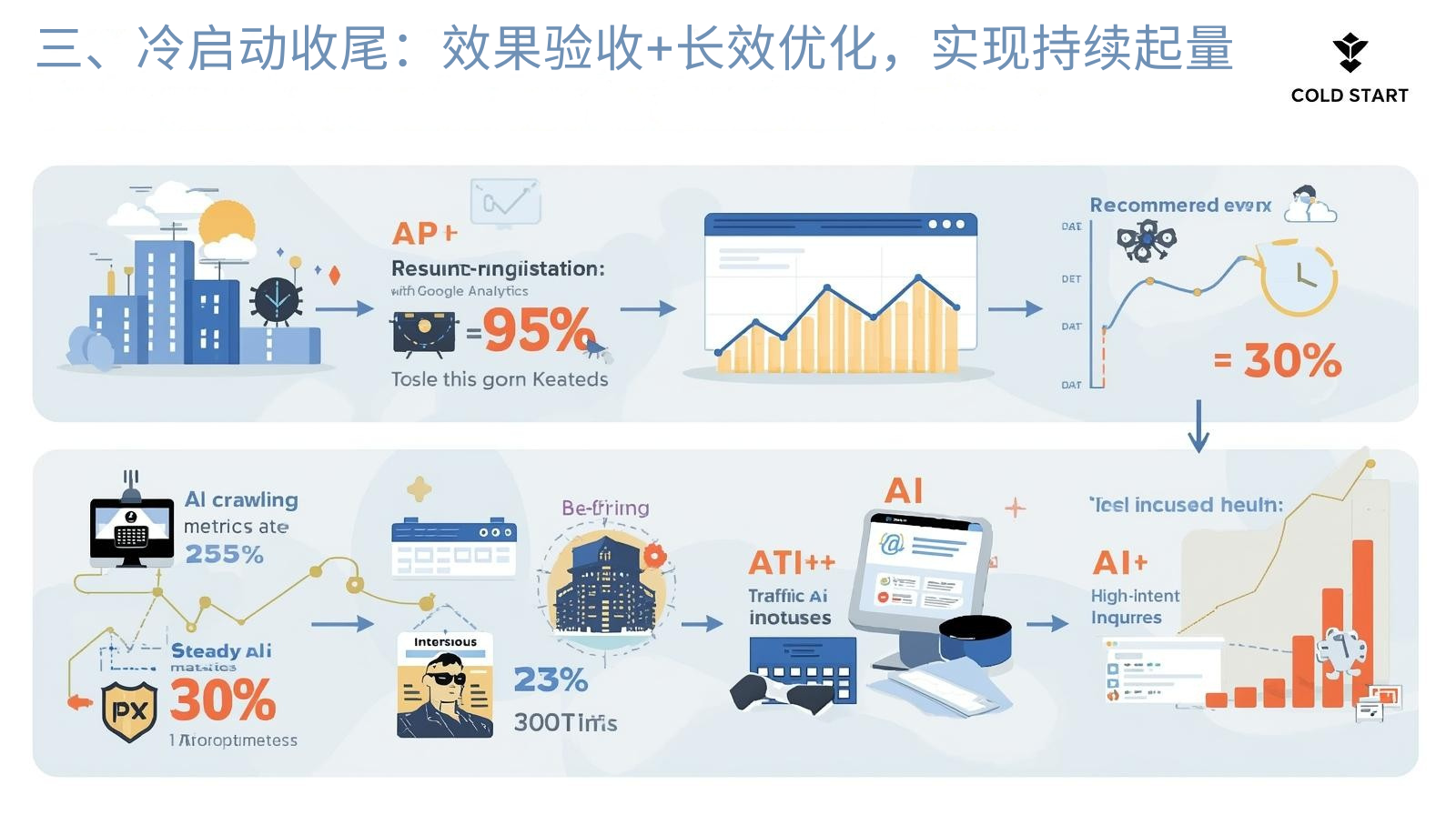
GEO cold start is not a one-time operation. After completing core optimizations, it's necessary to verify the results and confirm that the new website has been recognized and recommended by AI. Simultaneously, a long-term optimization system needs to be built to achieve the transition from "rapid scaling" to "sustainable growth," preventing a drop in traffic after the cold start. According to 2026 data from GEO cold start cases for new foreign trade websites, sites that performed well in the final optimizations achieved an 82% AI traffic retention rate and a 65% increase in long-term inquiry stability. https://www.growthhk.cn/cgo/geo/152578.html
3.1 Cold start effectiveness acceptance (1-2 months after cold start)
The core of performance evaluation is to confirm three key metrics to ensure the cold start achieves the expected goals and lays the foundation for subsequent long-term optimization. Specific evaluation criteria are: 1. AI crawling metric: Confirm via Google Search Console that the AI crawler is crawling normally, with a core page crawling success rate ≥95% and no obvious crawling obstacles; 2. AI recommendation metric: Ask questions related to core products via ChatGPT (e.g., "EU food-grade silicone kitchenware manufacturers") to see if your own site's brand or information appears, and monitor AI mentions using Ahrefs (https://ahrefs.com/) to ensure a steady monthly increase in mentions; 3. Traffic and inquiry metric: Monitor site traffic via Google Analytics, with AI-driven traffic accounting for ≥30%, and stable high-intent inquiries (focusing on core needs such as product, delivery time, and certifications). Refer to the AI Customer Acquisition Rabbit performance verification methodology and compare traffic and inquiry data before and after optimization (https://www.163.com/dy/article/KK9RPEHV0556K8OX.html). If the acceptance criteria are not met, targeted optimizations should be made. For example, if the crawling success rate is low, optimize the site loading speed and architecture; if the AI is mentioned infrequently, supplement the Q&A content and trust signals.
3.2 Long-term optimization strategy to lock in AI traffic growth
After the cold start, continuous optimization is necessary to adapt to AI rule iterations, consolidate the cold start results, and achieve sustained growth. Specific actions include: 1. Regularly updating content, adding 2-3 core product Q&A articles, customer case studies, or industry compliance content monthly to maintain site activity. Simultaneously, refer to Zhihu AI's weather-sensitive word system and localized copywriting techniques to adjust content based on changes in target market needs (https://www.163.com/dy/article/KK9RPEHV0556K8OX.html); 2. Optimizing trust signals, promptly adding new customer case studies, updating certification validity periods, and adding new authoritative partnership endorsements to continuously improve site credibility; 3. Adapting to AI rule iterations, paying attention to the latest AI crawling rules released by authoritative platforms such as OpenAI and Ahrefs (https://platform.com/). (rm.openai.com/docs/updates, https://ahrefs.com/), adjust and optimize strategies in a timely manner to ensure that the site always adapts to AI recognition rules; fourth, monitor competitor dynamics, track the GEO optimization of peers in real time through the competitive intelligence monitoring tool of Shangqu.com, learn from their advantageous optimization strategies, and create differentiated competitiveness (https://www.163.com/dy/article/KK9RPEHV0556K8OX.html); fifth, optimize inquiry conversion, place multiple contact methods (email, WhatsApp, form) on core pages, and place the FAQ module in advance to dispel customer doubts and convert AI recommended traffic into effective inquiries.
Recommended Article: Your Competitors Haven't Reacted Yet: Building an Independent E-commerce Website with GEO is the Biggest Blue Ocean Strategy Right Now
Recommended Article: Your Competitors Haven't Reacted Yet: Building an Independent E-commerce Website with GEO is the Biggest Blue Ocean Strategy Right Now
IV. Conclusion: When starting a new website, choosing the right GEO cold start process can save you 90% of the trouble.
In 2026, the growth logic for new foreign trade websites has completely changed. It's no longer about "doing SEO first and then waiting for traffic," but rather "doing a GEO cold start first to quickly seize AI traffic." A GEO cold start doesn't require lengthy accumulation or high investment. Simply follow the process of "preparation → core optimization → long-term follow-up" to quickly get your new website recognized and recommended by AI tools like ChatGPT, achieving a breakthrough in traffic and inquiries from zero to one. Many new foreign trade websites experience slow growth because they haven't found the right practical methods. They blindly optimize without grasping the key to AI recognition, ultimately wasting time and energy. A standardized GEO cold start process can help you avoid detours and quickly seize the AI customer acquisition opportunities.
The effectiveness of GEO cold start relies heavily on a high-quality underlying website architecture. A standalone website that is compatible with AI crawling, loads smoothly, and has a clear structure can improve cold start efficiency by over 50%. PinDian Technology boasts over ten years of experience in building websites for foreign trade, serving more than 7,000 clients. Utilizing React technology, our websites not only offer a smoother browsing experience but also achieve overseas loading speeds of ≤2 seconds, perfectly adapting to multi-device access. From the underlying architecture, we adapt to GEO cold start requirements, building a clear, flat architecture that supports plain text core information presentation, reserves entry points for structured data embedding, and adapts to AI crawling rules, giving your new website an inherently AI-friendly nature.
PinDian website building can simultaneously assist new websites in completing the entire GEO cold start optimization process, from pre-construction preparation and structured content filling to trust signal building, monitoring and fine-tuning. It provides a one-stop solution to the cold start challenges of new websites, allowing your new site to be quickly recognized and recommended by AI, rapidly scaling up traffic and seizing the new AI-driven foreign trade customer acquisition opportunities of 2026. Whether you have a newly built foreign trade website or want to relaunch your site, PinDian Technology can help you quickly break through traffic bottlenecks and achieve rapid scaling and sustained growth with professional website building and GEO optimization services.