
In February 2026, many foreign trade companies had a "sleeping foreign trade independent station" - they had invested energy in optimization, but due to algorithm iteration, outdated content, and declining traffic, they were gradually forgotten. There was no Google search traffic, and it could not be recognized and recommended by AI tools such as ChatGPT, becoming an idle asset. In fact, old websites are not worthless. Instead, they have innate advantages such as domain name weight, historical content, and infrastructure. GEO (Generative Engine Optimization) is the core key to allowing these sleeping old websites to "wake up" again, be included and recommended by AI, and regain accurate traffic. This article combines the latest AI crawling rules in 2026, actual cases of old site resurrection and authoritative searchable external links to dismantle the entire GEO resurrection process of the old site, accurately solving the core pain points of difficult AI crawling, poor recognition, and no recommendation of the old site. Each step has specific operations, troubleshooting, and practical skills. Without overthrowing and rebuilding, the dormant old site can be re-included by AI and achieve a secondary increase in traffic and inquiries.
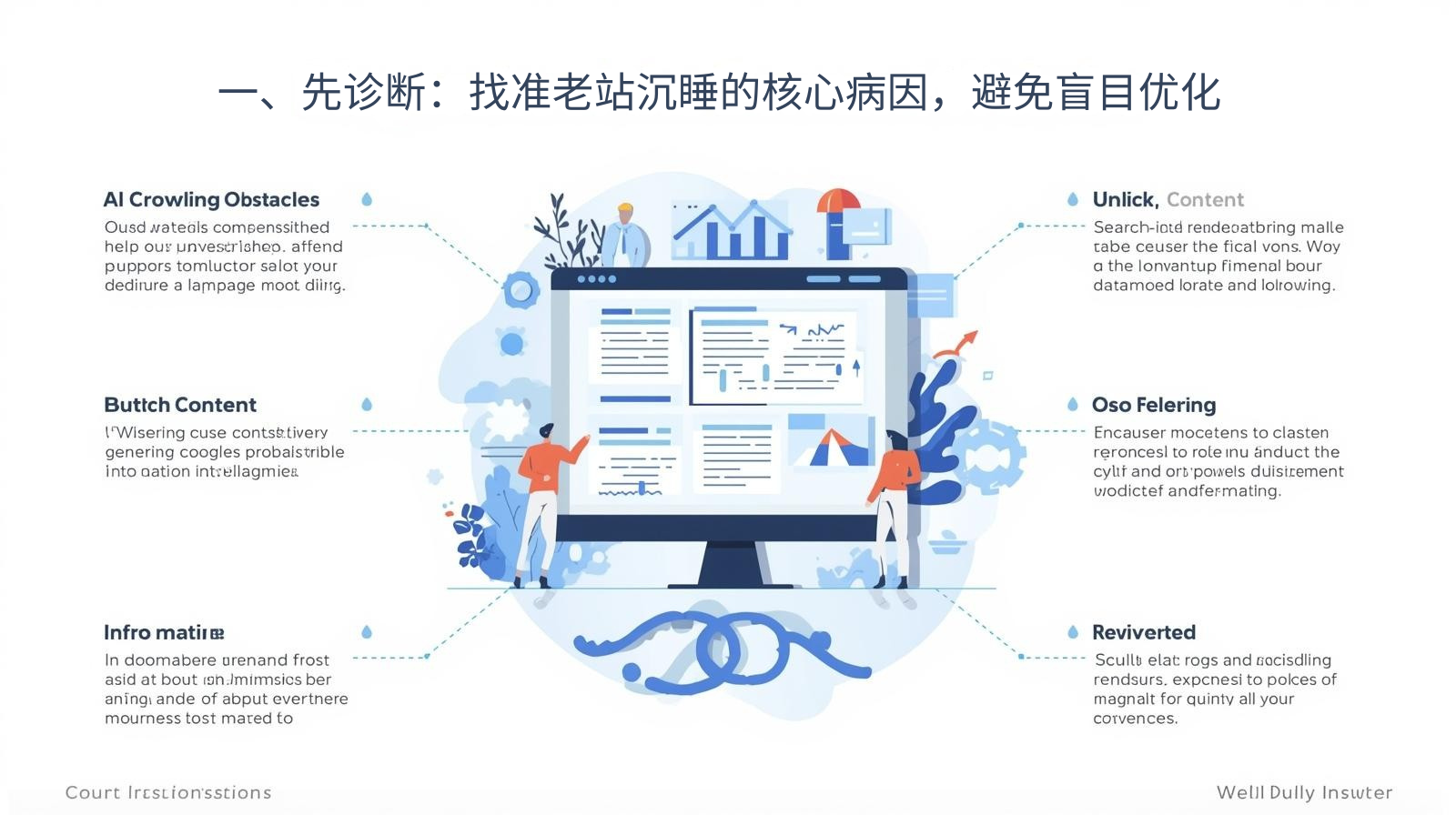
1. Diagnose first: find out the core cause of the old station's sleepiness and avoid blind optimization
The prerequisite for reviving an old site is not to blindly optimize GEO, but to accurately diagnose the old site first and find out the core problems that cause the old site to be unable to be included in AI and the traffic to decline. Only by taking appropriate measures can we avoid detours and resurrect efficiently. Many companies blindly fill in content and change the structure of old websites, but in the end they are in vain. The core is that they have not identified the cause. According to the February 2026 foreign trade old website optimization industry report, the core problems of 80% of sleeping old websites are concentrated in the three categories of AI crawling obstacles, outdated content, and messy information. After accurate diagnosis and optimization, the resurrection success rate can be increased by 75% https://www.163.com/dy/article/KLMDSPV70556KF1J.html, which shows the importance of diagnosis.
1.1 Core Diagnosis 1: AI crawling obstacle troubleshooting (the most common problems in old sites)
Because the old site has not been maintained for a long time, it is very easy for AI crawlers to fail to crawl normally, resulting in the inability to be included by AI. This is also one of the core reasons why the old site is sleeping. Specific troubleshooting operations: First, check the robots.txt configuration to confirm whether mainstream AI crawlers such as GPTBot and ClaudeBot have been mistakenly blocked. Many old websites only opened permissions for Google crawlers when they were optimized and did not adapt to AI crawlers. You can refer to the OpenAI official GPTBot crawling guide and check the configuration one by one. https://platform.openai.com/docs/guides/gptbot; The second is to check the loading speed of the site. Many old sites have problems such as uncompressed images, redundant code, and aging servers. As a result, overseas loading speeds exceed 5 seconds and are directly abandoned by AI crawlers. You can use Google PageSpeed Insights to detect the loading situation and optimize accordingly. https://pagespeed.web.dev/; The third is to clean up dead links and redundant pages. In the long-term operation of old sites, it is easy to produce a large number of dead links, duplicate pages, and invalid pages. This not only takes up crawling resources, but also reduces AI trust. You can use Screaming Frog to The SEO tool (https://www.screamingfrog.co.uk/seo-spider/) comprehensively checks dead links and deletes or jumps one by one; the fourth is to check the page hierarchy. Old sites often have architectural redundancy issues. The number of clicks from the homepage to the core product page exceeds 3 times, and AI crawlers cannot crawl deeply. It is necessary to sort out the page hierarchy and simplify the navigation logic.
1.2 Core Diagnosis 2: Troubleshooting of obsolete content and information clutter
The core of AI collection is "valuable content and identifiable information". The content of old sites is outdated and the information is messy, which will cause AI to be unable to understand the business and establish trust. Even if the crawl is successful, it will not be included in the recommendation pool. Specific troubleshooting operations: First, check the timeliness of the content and check the update time of the core product page and information page. If it has not been updated for more than 1 year, it needs to be marked as a key optimization object, especially core information such as product parameters, certification, and delivery date, and it needs to be confirmed whether it is consistent with the current business; second, check the uniformity of the information. Old sites may have multiple expressions of the same product name, incomplete certification information, inconsistent company contact information, etc. For example, "small batch customization" has both "MOQ 100 pieces" and "MOQ" 50 pieces" will lead to confusion in AI recognition, which needs to be comprehensively sorted out and unified. The third is to check the content presentation form. Old sites often have problems with core information being graphical and PDF-based. AI crawlers cannot recognize the text in pictures and PDFs. Core information such as product parameters, certifications, and cases need to be presented in plain text. The fourth is to check the content quality, delete keyword stacking and worthless redundant copy, retain core business-related content, and improve content accuracy. https://www.semrush.com/blog/traditional-seo-vs-ai-seo/.
1.3 Core Diagnosis 3: Troubleshooting for missing trust signal
The core premise of AI recommendation is "trustworthy and verifiable". Because old websites have not been maintained for a long time, there are many problems such as expired certification, missing cases, and insufficient authoritative endorsement. As a result, AI cannot establish trust. Even if it is captured, it will not be recommended to buyers. Specific troubleshooting operations: First, check the validity of the certification, sort out core certifications such as CE, FDA, ISO, etc., and confirm whether it has expired. If it expires, it needs to be updated in time, and add official external links to query. For example, the CE certification is connected to the EU NANDO database https://ec.europa.eu/growth/tools-databases/nando/index.cfm?fuseaction=notifiedbody.main, and the ISO certification is connected to the China Certification and Accreditation Administration query platform. https://cx.cnca.cn/rjwcx/cxIndex/index.do; The second is to check cases and endorsements. Old sites may have problems with old cases, no real details, or lack of industry cooperation endorsements. Real customer cases in the past 1-2 years need to be supplemented. Press Presented in the format of "customer country + demand + plan + results", and adding authoritative proof of cooperation; thirdly, check the basic information of the company to confirm whether the company address, contact information, social account and other information are complete and unified, so as to avoid the lack of information that causes AI to be unable to construct a real corporate portrait, affecting inclusion and recommendation https://www.tmcnet.com/usubmit/2026/02/25/10337821.html.
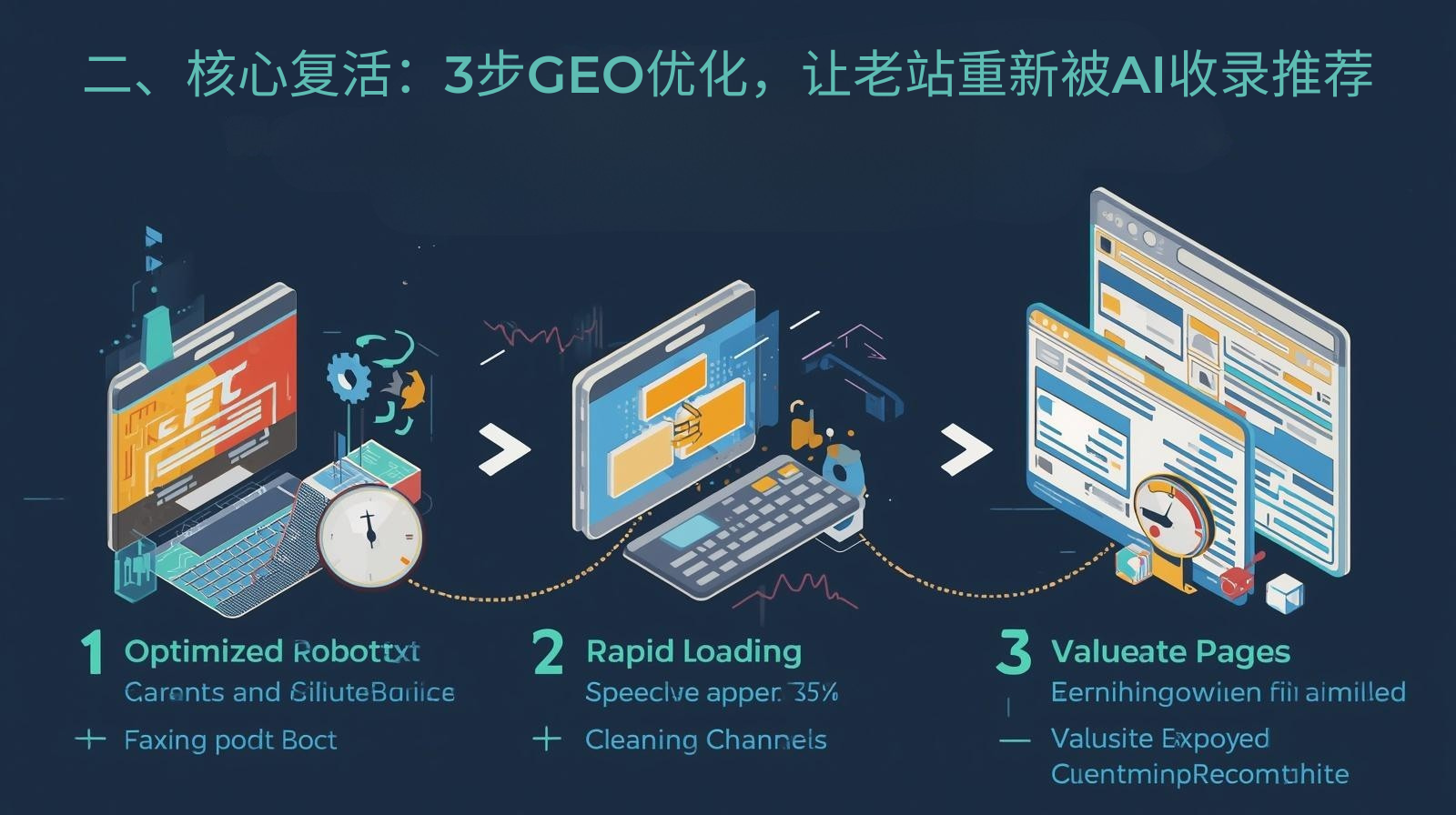
2. Core resurrection: 3-step GEO optimization, let the old website be included and recommended by AI again
After completing accurate diagnosis, we enter the core GEO optimization stage. The core of this step is "fixing problems, optimizing adaptation, and strengthening trust." There is no need to overthrow the foundation of the old site. Just targeted optimization can make the old site quickly captured and included by AI, and then recommended. Based on actual cases of GEO resurrection of old sites in 2026, by following the following steps, most old sites can achieve AI inclusion within 1-2 months and obtain stable AI recommended traffic within 3 months https://www.163.com/dy/article/KK9RPEHV0556K8OX.html.
2.1 Step 1: Repair the AI crawling channel so that AI can "find" the old site
Based on the diagnosed crawling obstacles, repair them one by one and open up the AI crawling channel so that AI crawlers such as GPTBot can smoothly access and efficiently crawl the content of the old site. This is the basis for the old site to be included by AI. Specific operations: First, optimize the robots.txt configuration, open the crawling permissions for AI crawlers, and explicitly allow mainstream AI crawlers such as GPTBot and ClaudeBot to access the core pages of the entire site. Refer to the OpenAI official configuration guide to avoid mistaken blocking. https://platform.openai.com/docs/guides/gptbot; The second is to optimize the site loading speed, compress the images of the old site (retaining high-definition image quality and compressing the file size), streamlining redundant code, upgrading the server or enabling global CDN acceleration to ensure that the loading speed in core overseas markets is ≤2 seconds, and repeatedly detect and optimize through Google PageSpeed Insights until it reaches the standard. https://pagespeed.web.dev/; The third is to clean up dead links and redundant pages, delete invalid dead links, duplicate pages, and expired content. Update the content of valuable expired pages and retain them. At the same time, optimize the page hierarchy and adjust the core pages (product pages, qualification pages, case pages). The whole structure is flat to ensure that the number of clicks from the home page to the core page does not exceed 3 times, improving the efficiency of AI crawling; fourth, unnecessary login walls, pop-up window blocking, and verification codes are removed to reduce obstacles to AI crawling. It is also adapted to multiple terminals, fixes the problem of mobile layout confusion, and ensures that AI crawlers can crawl normally on different terminals.
2.2 Step 2: Reconstruct structured information so that AI can "read and understand" the old site
One of the core problems of the old website is that the information is messy and the content is outdated, and AI cannot understand the core of the business. Therefore, structured information needs to be reconstructed so that AI can quickly extract the core products, qualifications, services and other information of the old website to establish a clear corporate understanding. Specific operations: First, unify the core information of the entire site, sort out core products, parameters, certifications, delivery dates, MOQ and other information, and uniformly express specifications to avoid multiple statements. For example, "small batch customization" of all products is uniformly marked as "MOQ" Starting from 50 pieces, small batch customization is supported, and the proofing cycle is 3-5 days." The second is to reconstruct the structured data module and build four structured modules of products, qualifications, services, and corporate information, all presented in plain text. The core information in pictures and PDFs is extracted into text to ensure that AI can recognize it normally. For example, the product parameter picture is changed to a plain text table, and the certification picture is changed to the plain text form of "certification name + number + official query link" https://www.semrush.com/blog/traditional-seo-vs-ai-seo/; The third is to update the core content, iterate the content of product pages and information pages that have not been updated for more than a year, supplement the latest product parameters, certifications, industry trends, and delete keyword stuffing and worthless redundant copy. , each piece of content focuses on a core information to improve the accuracy of the content; the fourth is to adapt the AI question and answer logic, and add a FAQ module to the old site around questions frequently asked by buyers, using the form of "question + answer", such as "Can your products be exported to the EU?" "What are the compliance certifications?", so that AI can quickly extract content to answer buyers' questions, improving the probability of inclusion and recommendation. https://www.prnewswire.com/news-releases/analysis-of-20m-leads-reveals-how-ai-search-is-driving-customer-discovery-302671219.html.
2.3 Step 3: Strengthen trust signals and let AI dare to "recommend" old sites
For old websites to be recommended by AI, they not only need to be captured and understood, but also for AI to build trust. Therefore, it is necessary to strengthen trust signals in a targeted manner to make up for the lack of trust in old websites, so that AI is willing to recommend old websites to buyers. Specific operations: First, update and improve the certification system, replace expired certifications, supplement the latest certification information, and add official queryable external links to each certification so that AI can cross-check authenticity. For example, FDA certification is connected to the official website of the US FDA https://www.fda.gov/, and CE certification adds the EU official query link. https://ec.europa.eu/growth/tools-databases/nando/index.cfm?fuseaction=notifiedbody.main; The second is to supplement real customer cases, sort out high-quality customer cases in the past 1-2 years, and present them in detail in the format of "customer country + demand pain points + solutions + cooperation results", with pictures or reviews authorized by customers to enhance authenticity. At the same time, they can be displayed on authoritative industry platforms (such as China Industrial News Network https http://www.cinn.cn/) to publish cases to improve the credibility of the case; the third is to improve the basic information of the company, supplement the complete company address, contact information, social accounts (LinkedIn, Facebook), ensure that the information is consistent across the entire network, and add real photos of the factory, team introduction, production process and other content to allow AI and buyers to more intuitively understand the strength of the company; the fourth is to add authoritative endorsements, such as proof of cooperation with industry associations, well-known companies, or honorary qualifications obtained by the company, to further enhance the credibility of the old site and help increase the weight of AI recommendations. https://fintechnews.ch/aifintech/forrester-ai-adoption-rises-in-b2b-commerce/82164/.

3. Closing and consolidation: monitoring and optimization + long-term operation, so that the old site continues to be full of vitality
After the old station realizes AI inclusion and obtains traffic through GEO optimization, it is not a one-and-done operation. It needs to do monitoring optimization and long-term operation to consolidate the optimization results, avoid "sleeping" again, and achieve continuous traffic and inquiry growth. According to the optimization data of old sites in 2026, the AI traffic retention rate of old sites that have done long-term operations has reached 83%, and the inquiry stability has increased by 68%, which is much higher than sites that have not done long-term operations https://www.growthhk.cn/cgo/geo/152578.html.
3.1 Real-time monitoring: tracking AI inclusion and recommendation effects
After the optimization is completed, it is necessary to monitor the AI crawling, inclusion and recommendation of the old site in real time, discover problems in time and make fine adjustments to ensure stable optimization results. Specific monitoring operations: First, use Google Search Console (https://search.google.com/search-console) and ChatGPT's WebPilot plug-in (can be installed through the ChatGPT plug-in store, https://view.inews.qq.com/k/20230521A00QDD00), monitor the crawling frequency, crawled pages, and crawling success rate of the AI crawler. If If a crawling failure occurs, promptly check the reasons (such as dead links, slow loading) and repair them; the second is to monitor the AI inclusion and recommendation situation, monitor the number of AI inclusion pages and the number of AI mentions of the old site through the Ahrefs tool (https://ahrefs.com/), and ask core product-related questions through ChatGPT to see whether the old site can be recommended, and record the frequency and accuracy of recommendations; the third is to monitor traffic and inquiry data, and use Google Analytics monitors site traffic, focusing on the proportion of AI source traffic, visit duration, and consultation conversion rate. If AI source traffic grows slowly, content and trust signals will be optimized accordingly https://www.tmcnet.com/usubmit/2026/02/25/10337821.html.
3.2 Long-term operation: continuous optimization to avoid falling asleep again
The core of long-term operation is "continuous updating, adaptation and iteration", so that old sites always remain AI-friendly and continue to be included and recommended by AI. Specific operations: First, update the content regularly, add 1-2 core product Q&A content, the latest customer cases or industry compliance content every month, keep the site active, increase the frequency of AI crawling, and adjust the content focus according to changes in target market demand; second, adapt to the iteration of AI rules and pay attention to the latest AI crawling rules released by authoritative platforms such as OpenAI and Ahrefs (https://platform.openai.com/docs/updates, https://ahrefs.com /), adjust the optimization strategy of the old site in a timely manner to ensure that it always adapts to the AI recognition requirements; the third is to regularly troubleshoot problems, conduct a comprehensive diagnosis of the old site every quarter, check for crawling obstacles, outdated content, messy information and other problems, and repair them in a timely manner to avoid the accumulation of small problems causing the old site to fall asleep again; The fourth is to optimize the conversion of inquiries, lay out multi-channel contact information (email, WhatsApp, forms) on the core page, and pre-install the FAQ module to dispel customer doubts in advance, convert AI recommended traffic into effective inquiries, and at the same time follow up on customer feedback to continuously optimize product and service content.
Related article recommendations: Your peers have not yet reacted: using GEO to build an independent foreign trade station is the biggest blue ocean strategy at the moment
Related article recommendations: Your peers have not yet reacted: using GEO to build an independent foreign trade station is the biggest blue ocean strategy at the moment
4. Ending: The sleeping old site is not an abandoned site, GEO gives it a new lease of life
In 2026, the era of AI procurement has arrived, and generative AI such as ChatGPT has become the core channel for buyers to find suppliers. Dao, those old and dormant foreign trade websites that you have forgotten are not worthless. Instead, they have innate advantages such as domain name weight and historical foundation. As long as you use GEO optimization methods, they can be quickly included and recommended by AI, regain accurate traffic and inquiries, and become a new growth pole for foreign trade companies. Many companies mistakenly believe that the old site is useless and blindly invest in building a new site, but ignore the potential value of the old site. GEO optimization is the best way to resurrect the old site at the lowest cost. There is no need to overthrow and rebuild, and only targeted repairs and optimizations can bring the old site back to life.
The effect of GEO resurrection of old sites is inseparable from high-quality site underlying architecture. Many old sites have old structures and backward technologies, so even if they are GEO optimized, the effect will be greatly reduced. Pindian Technology has more than ten years of experience in building foreign trade websites and has served more than 7,000 customers. It uses react technology to build websites, which not only makes website browsing smoother, but also accurately adapts to AI crawling rules. It can provide one-stop services of "architecture optimization + GEO resurrection" for dormant old websites. It repairs crawling obstacles for old websites, reconstructs structured information, strengthens trust signals, and at the same time optimizes the underlying structure of the site, so that old sites can not only be included and recommended by AI, but also achieve long-term stable traffic growth.
Whether your old website has been dormant for 1 year or 3 years, Pindian Technology can rely on professional technology and rich practical experience to re-include it in AI and regain a new life through GEO optimization. It can help you tap the value of idle assets at low cost, seize the new opportunities of AI foreign trade customer acquisition in 2026, and achieve a second breakthrough in foreign trade business.