
Data released by the China Academy of Information and Communications Technology (CAICT) in 2026 shows that the global foreign trade GEO optimization market is expected to exceed 32 billion yuan, with an annual growth rate of 72%. Over 60% of leading foreign trade companies have increased their GEO optimization budgets to more than 45% of their total marketing budgets. Meanwhile, ChatGPT, Wenxin Yiyan, and Tongyi Qianwen, three core AI platforms, have all completed 2-3 major algorithm updates since 2026, focusing on four key optimization areas: foreign trade compliance identification, multilingual semantic adaptation, structured content capture, and scenario-based demand matching. However, industry testing data shows that 71% of foreign trade companies' GEO optimization results did not meet expectations. The core issue lies in a lack of awareness of adapting to multiple AI algorithms, focusing only on optimization for a single platform, and failing to keep up with the update pace of multiple platforms, leading to a continuous decline in search visibility on some AI platforms. A Zhejiang-based foreign trade company specializing in cross-border machinery previously only optimized its ChatGPT search engine optimization. After the Wenxin Yiyan and Tongyi Qianwen algorithms were updated in January 2026, inquiries on these platforms plummeted by 40%. However, by implementing the core solution outlined in this article and adapting to multiple AI algorithms (GEO), the company's search results on all three major platforms reached the top three pages within a month, with total inquiries increasing by 190% month-on-month. This case demonstrates that for independent foreign trade websites to achieve omnichannel customer acquisition across multiple AI platforms, the key is to use GEO generative optimization to accurately adapt to different AI algorithm logics, keep up with their update cycles, and achieve "one-stop optimization, multiple platform benefits."
I. Core Understanding: The Core Differences in Algorithms of the Three Major AI Platforms and the Value of GEO Adaptation
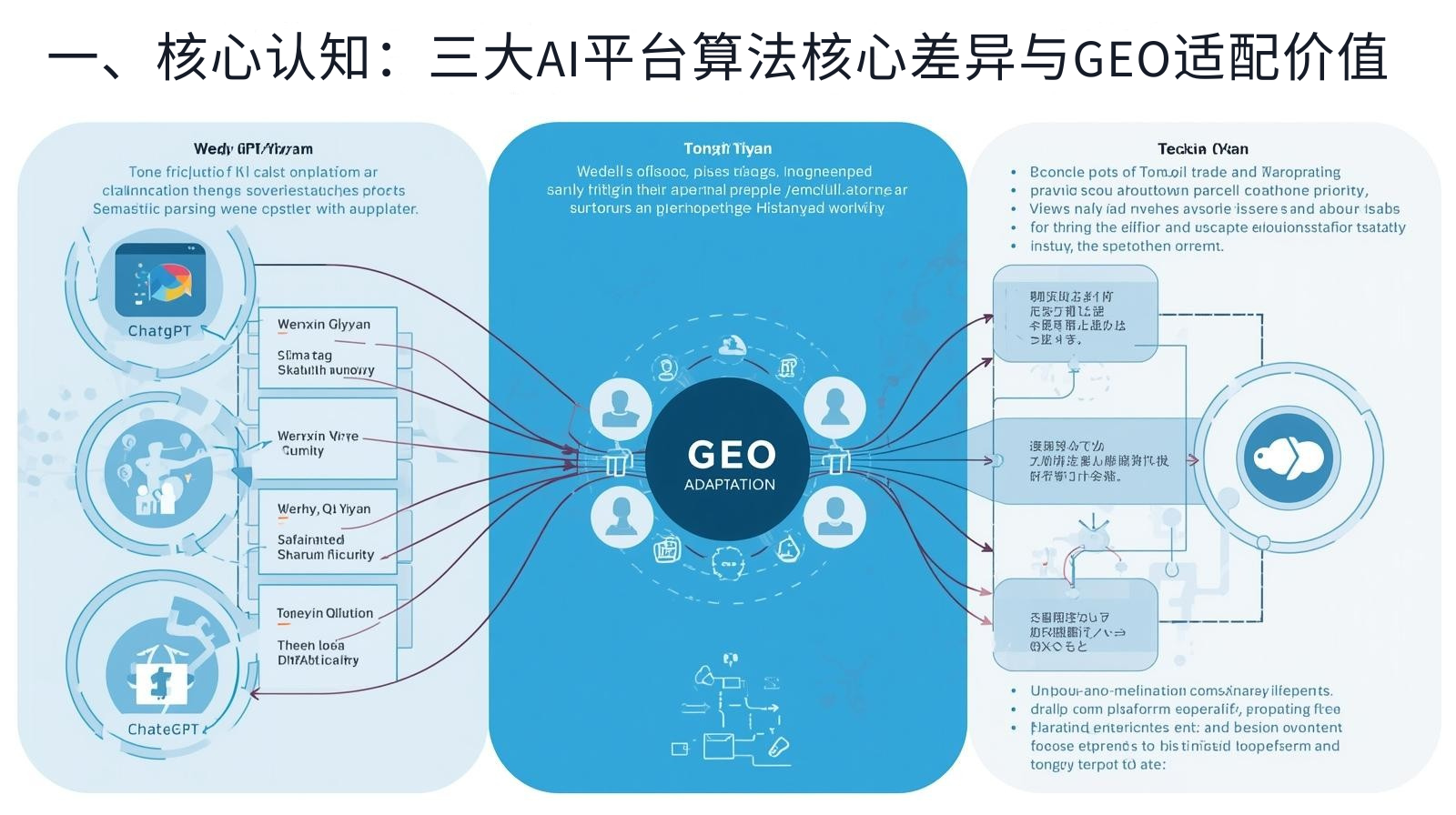
ChatGPT, Wenxin Yiyan, and Tongyi Qianwen, as core customer acquisition AI platforms for independent foreign trade websites, all emphasize the extraction of "valuable, structured, and compliant" content. However, due to differences in technical architecture, ecosystem positioning, and target audience, their algorithm judgment logic varies significantly, and their update rhythms differ. The core function of GEO's multi-AI algorithm adaptation is to build a "generally adaptable + platform-specific" content system through generative engine optimization. This satisfies the common extraction requirements of the three major platforms while accurately matching the algorithm characteristics of each platform. At the same time, it establishes an update rhythm tracking mechanism to ensure that the site always keeps up with the latest algorithm rules and avoids traffic loss due to algorithm iterations.
1.1 Core Differences in Algorithms of the Three Major AI Platforms in 2026 (Exclusive to Foreign Trade Websites)
Based on the latest algorithm update announcements and authoritative evaluation reports from the three major platforms in 2026 (link: https://www.163.com/dy/article/KJ3U8PC90556HG0C.html), the core differences in their foreign trade-related algorithms can be broken down into four points, which directly determine the focus of GEO adaptation:
1. Core Crawling Priority Differences: ChatGPT (updated January 2026) prioritizes crawling content with "accurate English semantics, complete foreign trade compliance, and third-party verification," especially emphasizing the verifiability of international certifications such as EU CE and US FDA. It also improves the semantic parsing ability of foreign trade content in less common languages (such as German and Spanish) by 30%. Wenxin Yiyan (updated late January 2026) leverages the advantages of the Baidu ecosystem to prioritize crawling content with "bilingual adaptation of Chinese and English names, qualifications of Chinese companies going global, and clear cross-border logistics solutions." It also gives higher weight to crawling domestic supply chain advantages (such as factory strength and production capacity). Tongyi Qianwen (previewed February 2026 update) focuses on "e-commerce foreign trade scenarios, supply chain resilience information, and ESG compliance content." It prioritizes crawling practical information such as product price ranges, minimum order quantities, and delivery cycles. It also increases the recommendation priority of content adapted to emerging markets such as Southeast Asia and Latin America.
2. Differences in Compliance Judgment Standards: ChatGPT focuses on verifying international compliance requirements such as EU GDPR data compliance and Carbon Border Tax (CBAM) adaptation. Foreign trade websites without compliance declarations will have their crawling priority reduced by 50%. Wenxin Yiyan verifies both domestic export qualifications (such as import and export operating rights) and target market compliance certifications. Websites with incomplete compliance information will not be able to enter core search positions. Tongyi Qianwen adds an ESG compliance judgment dimension, focusing on crawling information such as corporate carbon emission data and environmentally friendly production qualifications, adapting to the new global foreign trade ESG access regulations in 2026.
3. Differences in Content Structure Requirements: ChatGPT prefers structured content in the form of short sentences and lists, with each sentence being 15-25 words (in English). Content with core information at the beginning is 4 times more efficient at capturing than paragraph-based content. Wenxin Yiyan is suited to a modular, image-text combined structured layout. Sites that display product core selling points and factory strength modules separately have higher capture weight. Tongyi Qianwen focuses on structured content in the form of scenarios and solutions, such as solution-type content like "a certain product + a certain market + a certain scenario," which is easier to capture than simple product introductions.
4. Differences in update rhythm: ChatGPT updates its algorithm on average once a month, focusing on optimizing its international trade semantic parsing and compliance identification capabilities; Wenxin Yiyan updates it approximately every 45 days, focusing on optimizing scenarios suitable for Chinese companies going global; Tongyi Qianwen updates it every two months, keeping pace with policy and algorithm logic adjustments in emerging foreign trade markets.
1.2 The core value of GEO's multi-AI algorithm adaptation: Stable customer acquisition across all domains
Many foreign trade companies mistakenly believe that "optimizing one AI platform is enough to cover all traffic," but they overlook the fact that by 2026, the three major AI platforms already accounted for 82% of foreign trade search traffic. Optimizing a single platform will result in missing out on nearly half of potential customers. The core value of GEO's multi-AI algorithm adaptation lies in breaking the dependence on a single platform and achieving simultaneous adaptation across multiple platforms through structured optimization. Its core advantages are reflected in three points:
1. Keep up with algorithm updates and avoid traffic fluctuations: Establish a GEO adaptation and update mechanism to predict or quickly respond to algorithm iterations of the three major AI platforms, avoiding a decline in search display positions due to algorithm adjustments. Traffic stability is 75% higher than that of single-platform optimization.
2. Covering all AI traffic channels and increasing customer acquisition reach: Simultaneously compatible with ChatGPT (mainstream markets in Europe and America), Wenxin Yiyan (Chinese markets in China, Japan, South Korea and Southeast Asia), and Tongyi Qianwen (emerging e-commerce and foreign trade markets), covering overseas buyers of different regions and types, increasing customer acquisition reach by 2.3 times.
3. Enhance brand authority and improve conversion efficiency: The site's core advantages can be stably displayed on multiple AI platforms, which can enhance overseas buyers' perception of the brand's authority. The inquiry conversion rate is 1.8 times higher than that of single-platform optimization, and the quality of customers is also better.
II. Practical Implementation: GEO Multi-AI Algorithm Adaptation Throughout the Entire Process, Keeping Pace with Updates
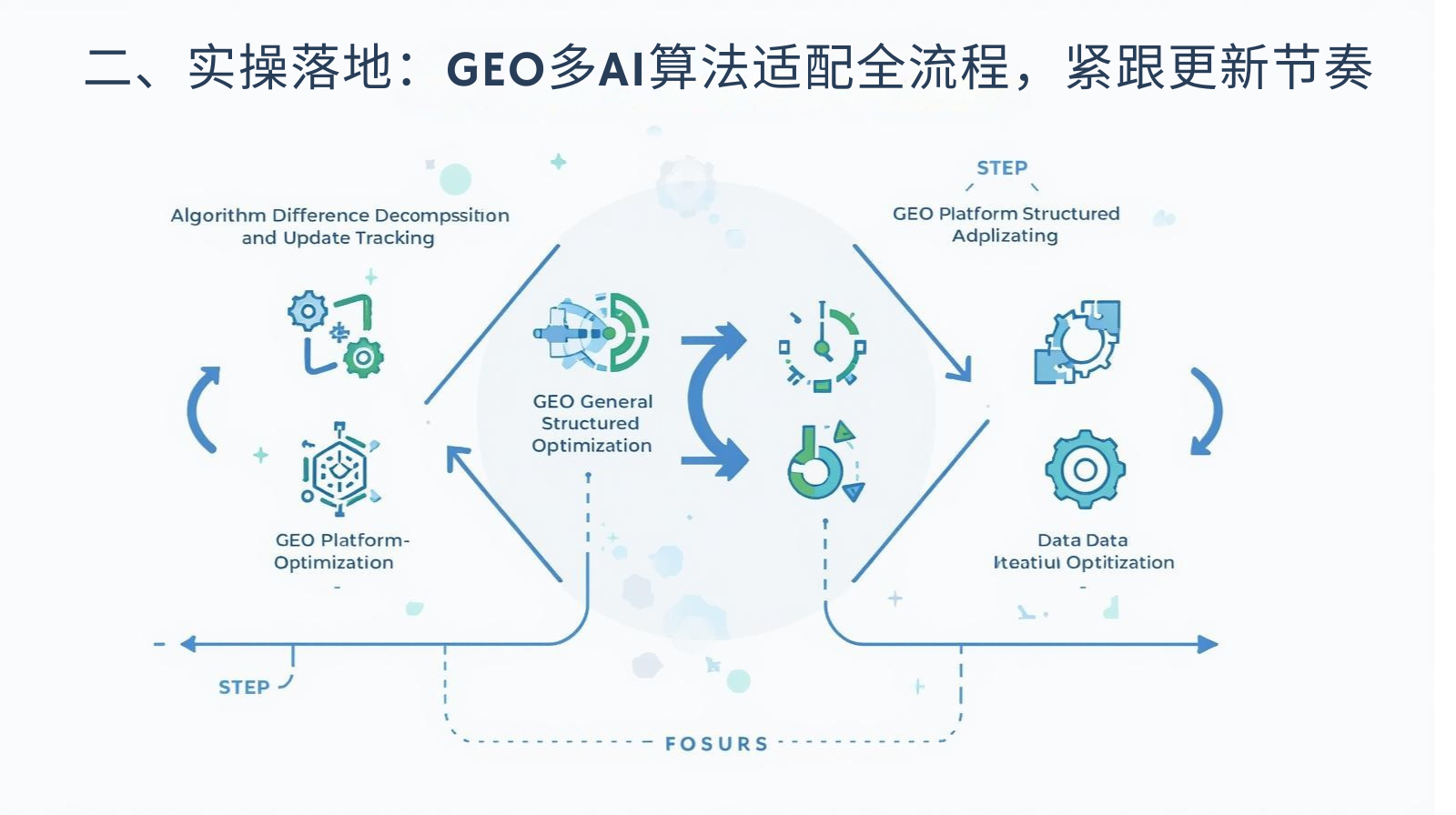
This solution strictly follows the latest algorithm rules of the three major AI platforms in 2026, and proceeds in four steps: "algorithm difference decomposition and update tracking - GEO general structured adaptation - GEO platform-specific optimization - data iteration optimization". Each step has clear goals, specific actions, tool support and case references. No complicated code operation is required and it can be directly implemented. The core is "general adaptation to lay the foundation, specific optimization to focus on key points, and rhythm tracking to ensure stability".
2.1 Step 1: Algorithm Difference Analysis and Update Rhythm Tracking (Long-Term Commitment) – Accurate Adaptation Without Deviation
Core objective: To track the algorithm updates of the three major AI platforms in real time, analyze the differences in foreign trade-related algorithms across platforms, establish an update early warning mechanism, and ensure that GEO optimization always aligns with the latest rules.
2.1.1 Core tracking tools and channels (essential, 15-20 minutes daily)
1. Official Channel Tracking: Follow the official site administrator guidelines and update announcements of the three major AI platforms. ChatGPT uses the OpenAI Site Administrator Platform (link: https://platform.openai.com/docs/plugins/introduction), Wenxin Yiyan uses the Baidu Smart Cloud Foreign Trade GEO Optimization Platform (link: http://m.toutiao.com/group/7594327764484833833/?upstream_biz=doubao), and Tongyi Qianwen uses the Alibaba Cloud Tongyi Developer Platform (link: https://developer.aliyun.com/product/tongyi). Enable update notifications to ensure you receive algorithm iteration information as soon as possible. 2. Authoritative Industry Channel Tracking: Subscribe to industry reports from organizations such as the Global Foreign Trade Digitalization Association (link: https://www.163.com/dy/article/KJ3U8PC90556HG0C.html) and Chenfeng Technology to receive monthly interpretations of the foreign trade algorithm adaptations of the three major AI platforms, avoiding biased interpretations. 3. Tool Tracking: Using the free version of Semrush (link: https://www.semrush.com/), enter the site domain name and view the "Impact of Algorithm Updates" module, which can automatically identify the degree to which the site is affected by the algorithm updates of the three major AI platforms; through Hangzhou Jiusanlu Digital Media's "Tianshu-Foreign Trade GEO Algorithm Adaptation Engine" (an authoritative industry tool, link: https://www.163.com/dy/article/KJ3U8PC90556HG0C.html), the direction of algorithm fine-tuning can be predicted 72 hours in advance with an accuracy rate of up to 94%.
2.1.2 Difference Decomposition and Update Response Mechanism (Required)
1. Difference Analysis: Establish a "Comparison Table of Foreign Trade Algorithms of the Three Major AI Platforms," recording the latest rules of each platform according to four dimensions: "capture priority, compliance standards, structured requirements, and core adaptation points." Update this table monthly. Examples of core adaptation points include: ChatGPT adaptation points (accurate English semantics, verifiable international certifications), Wenxin Yiyan adaptation points (bilingual adaptation, domestic export qualifications), and Tongyi Qianwen adaptation points (ESG compliance, scenario-based solutions). 2. Update Response: Establish a "24-hour rapid response mechanism." Upon receiving an algorithm update announcement, complete the core rule analysis within 24 hours to determine the direction of GEO optimization adjustments (e.g., after Tongyi Qianwen adds ESG compliance judgments, immediately supplement the site with carbon emission data and environmental qualification content); hold a weekly adaptation review meeting to adjust optimization strategies based on data feedback.
2.2 Second Step: GEO General Structure Adaptation (3-5 days) – Laying a solid foundation for multi-platform adaptation
Core objective: To optimize the site's GEO structure in accordance with the common requirements of the algorithms of the three major AI platforms, ensuring that the site meets the basic crawling conditions of "compliance and integrity, high-quality content, and clear structure", and achieving universal adaptability across multiple platforms.
2.2.1 General Adaptation Core Actions (Required, Covering the Entire Page)
1. Compliance Information Structure Optimization: We have streamlined the core compliance information of the website, including international certifications (CE, FDA, ISO, etc., with identification numbers and official query links), domestic export qualifications (import and export rights, customs registration number), ESG compliance information (carbon emission data, environmental certifications), and data compliance statements (GDPR compliance, etc.). We have established "Compliance Qualification Zones" on the homepage, product pages, and about us page, displaying them in a structured list format, such as "CE Certification (Number: CE-2026-EU098, query link: https://ec.europa.eu/growth/tools-databases/new-approach-odr/main/index.cfm); ISO9001 Quality Management System Certification (certificate verification available)". 2. Content Structuring Optimization: All page content is optimized according to the principles of "core information first, concise expression, and clear module distinction." Product pages are laid out logically as "core selling points → parameter descriptions → compliance certifications → foreign trade services → suitable scenarios." Core selling points are presented as short sentence lists (15-25 words/sentence in English, 8-12 characters/sentence in Chinese) to avoid lengthy paragraphs. The homepage features four modular areas: "core advantages, product categories, customer cases, and compliance qualifications," with structured content presented in each area. 3. Multilingual Basic Adaptation: At least bilingual (Chinese and English) content optimization is completed. English content conforms to the language habits of overseas buyers (avoiding literal translation), and core keywords and product selling points are consistent in both languages. For sites focusing on less common language markets, supplementary content in those languages (such as German and Spanish) is added, with semantic accuracy adapted to the target market's purchasing terminology.
2.3 Step 3: GEO Platform Dedicated Optimization (5-7 days) – Focus on Key Areas to Improve Display Priority
Core objective: Based on the differences in algorithms across the three major AI platforms, optimize exclusive content and signal transmission to improve the search display priority on each platform and achieve a dual adaptation effect of "general foundation + exclusive enhancement".
2.3.1 ChatGPT-Specific Optimizations (Focus on the European and American Markets)
1. Content Enhancement: Emphasize the semantic accuracy and international compliance information of English content. Product pages should include detailed international certification documentation (such as screenshots of test reports and steps to look up certification numbers). Case study pages should highlight client cases from the European and American markets (indicating the client's country, purchase volume, and cooperation period), such as "A US electronics company (monthly supply of 10,000+ units, 3-year cooperation, compliant with FDA certification requirements)." 2. Signal Transmission: Submit the website and core page URLs through the ChatGPT website administrator platform, indicating "European and American foreign trade supplier, complete CE/FDA certifications, supports small-batch customization"; publish English content on foreign trade vertical platforms such as Made-in-China and EuroPages (links: https://www.made-in-china.com/, https://www.europages.co.uk/), incorporating core keywords and anchor text links to the website to strengthen ChatGPT's crawling signal.
2.3.2 Exclusive optimizations for Wenxin Yiyan (focusing on the Chinese, Japanese, Korean, and Southeast Asian Chinese markets)
1. Content Enhancement: Emphasis will be placed on enhancing the bilingual adaptation of the Chinese and English names. Bilingual switching entry points will be provided on both the homepage and product pages. Chinese content will highlight the advantages of the Chinese supply chain (e.g., factory strength, production capacity, cross-border logistics efficiency), and will include information on domestic export qualifications (import and export operating rights number, customs registration information). Case studies for adaptation to the Chinese, Japanese, Korean, and Southeast Asian markets will be added, such as "A Korean supermarket (bulk purchase of XX product, delivery cycle 7 days)". 2. Signal Transmission: The site will be submitted through the Baidu Smart Cloud GEO optimization platform and linked to the Baidu Search Resource Platform (link: https://ziyuan.baidu.com/) to complete site verification. Core site information will be added to Baidu International Edition and Baidu Encyclopedia (enterprise entry) to strengthen the Wenxin Yiyan (文心一言) crawling signal. The mobile experience will be optimized (loading speed ≤ 2 seconds, optimized through Google PageSpeed Insights: link: https://pagespeed.web.dev/) to improve the mobile crawling priority of Wenxin Yiyan.
2.3.3 Tongyi Qianwen Exclusive Optimization (Key Focus for Emerging E-commerce and Foreign Trade Markets)
1. Content Enhancement: Emphasize ESG compliance information and scenario-based solutions. Supplement product pages with ESG content such as carbon emission data and environmentally friendly production processes. Construct solution modules according to the "product + market + scenario" logic, such as "XX product (food-grade material) + Southeast Asian market + food cold chain scenario → adapted to the high-temperature environment of Southeast Asia, meets local food hygiene standards, delivery cycle 3-5 days". Clearly indicate product price range, minimum order quantity, and cross-border logistics solutions (such as DDP delivery, 3-7 days delivery to Southeast Asia). 2. Signal Transmission: Submit the website and sitemap.xml file through the Alibaba Cloud Tongyi Developer Platform, indicating "Emerging market foreign trade supplier, ESG compliant, supports small-batch e-commerce procurement"; publish scenario-based product content on platforms such as Global Sources and Shopee (link: https://www.globalsources.com/), incorporating core keywords, and anchor text links to the website; optimize the website's e-commerce conversion entry points (such as inquiry buttons and sample application entry points), and increase the weight of Tongyi's 1000 Questions conversion signal judgment.
2.4 Step Four: Data Iteration and Optimization (once a week) – Keep up with the pace to ensure stability
Core objective: Monitor the search display performance, traffic, and conversion data of the three major AI platforms, and adjust and optimize strategies accordingly based on the algorithm update schedule to ensure that the site always conforms to the latest algorithm rules and stably occupies a core search position.
2.4.1 Core data monitoring (mandatory, once a week)
1. **Display Performance Monitoring:** Search for core foreign trade keywords (e.g., "XX product supplier China") on ChatGPT, Wenxin Yiyan, and Tongyi Qianwen, recording site search rankings and display types (summary area, featured area). Count the number of core keywords appearing on the first 3 pages of search results for each platform (≥80% is considered high-quality). 2. **Traffic Data Monitoring:** Use Google Analytics (link: https://analytics.google.com/) and Baidu Analytics to analyze traffic (visits, dwell time, bounce rate) from the three AI platforms, focusing on dwell time (≥2 minutes is considered high-quality) and bounce rate (≤50% is considered high-quality). 3. **Conversion Data Monitoring:** Analyze the number of inquiries, sample requests, and orders generated by traffic from each platform, calculating the conversion rate (conversions/visits). A core keyword conversion rate ≥3% is considered high-quality. Use the CRM system to mark customer sources on each platform and analyze the purchasing preferences of customers on different platforms (e.g., ChatGPT customers are more concerned with international certifications, while Tongyi Qianwen customers are more concerned with price and delivery time).
2.4.2 Iterative optimization actions (mandatory, adjusted according to data and update rhythm)
1. Algorithm Update Adaptation and Adjustment: Upon receiving an algorithm update announcement, adjust core content within 24 hours. For example, ChatGPT strengthens compliance evidence, Wenxin Yiyan adds supply chain advantages, and Tongyi Qianwen improves ESG content. After adjustment, resubmit to the official tools of each platform to accelerate crawling. 2. Data-Driven Optimization: If traffic or ranking drops on a platform, analyze whether it's due to algorithm updates or insufficient content adaptation. If bounce rate is high, optimize content structuring and core selling point display; if ranking drops, strengthen platform-specific signals. Optimize platform-specific content based on customer preferences (e.g., for Tongyi Qianwen customers who focus on price, highlight price ranges and preferential policies). 3. Regular Content Updates: Update core site content monthly based on algorithm update rules and market demand changes (e.g., add compliance certifications, customer cases, ESG data) to ensure content is always "fresh, compliant, and valuable," improving crawling priority across multiple platforms.
III. Avoidance Guide: 3 Core Misconceptions in GEO Multi-AI Algorithm Adaptation (Latest 2026 Version)
Based on practical case studies from foreign trade websites in the first half of 2026, many companies have fallen into three major pitfalls by ignoring the differences and update cycles of various AI algorithms. These pitfalls result in poor adaptation, large traffic fluctuations, and even damage to the overall authority of the website, which must be resolutely avoided:
3.1 Misconception 1: Adapting content uniformly to all AI, ignoring algorithm differences
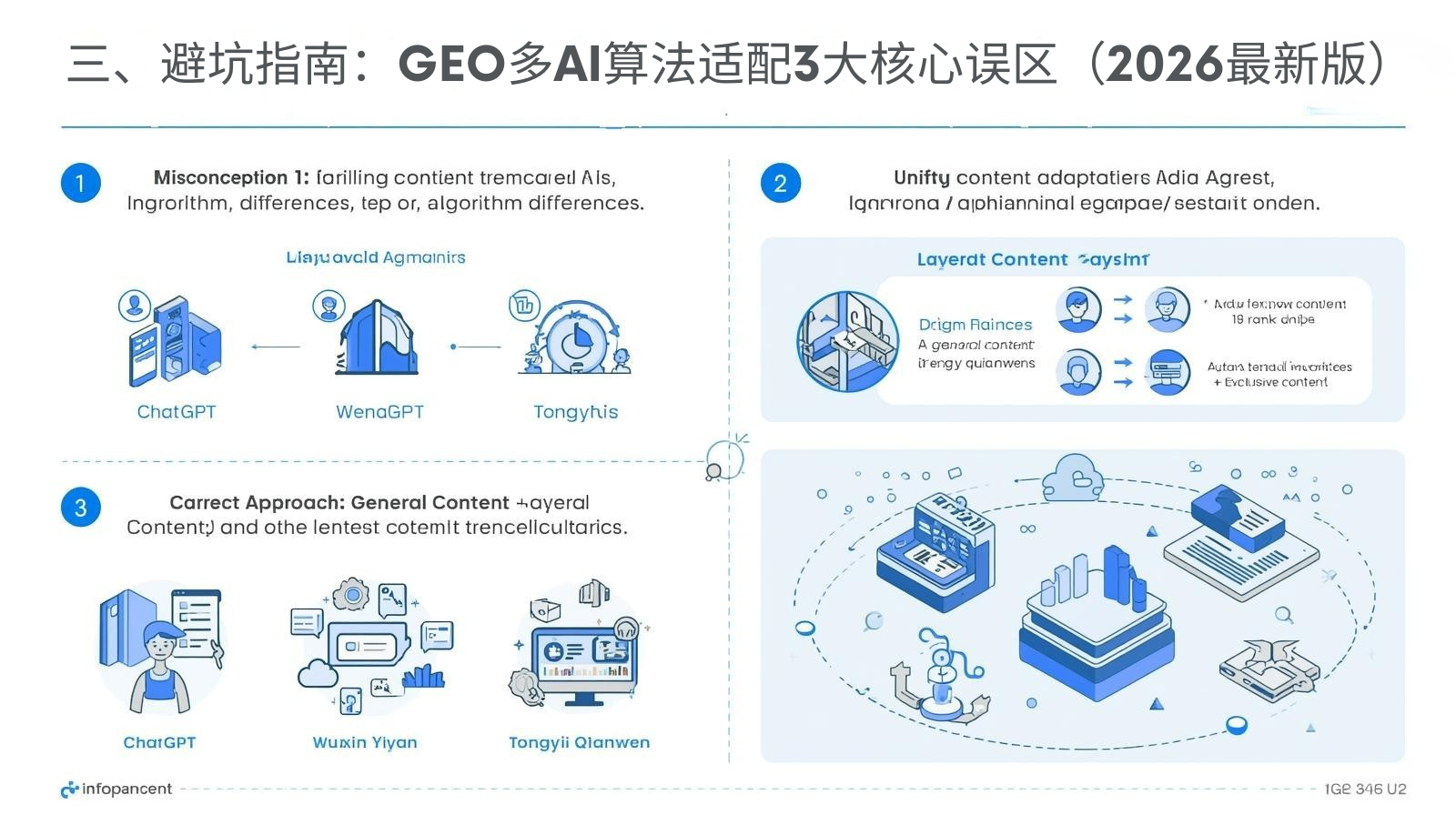
Errors include : using the same set of content to adapt to the three major AI platforms without distinguishing the crawling priority and compliance standards of each platform. For example, only optimizing English content to adapt to ChatGPT without supplementing bilingual content and domestic qualifications to adapt to Wenxin Yiyan; only displaying product information without supplementing ESG content to adapt to Tongyi Qianwen.
Core harms : The site can only achieve good display on a single platform. Due to insufficient adaptation on other platforms, its search ranking continues to decline, making it impossible to acquire customers across all channels. Some platforms directly reduce the site's crawling priority or even include it in the list of low-quality sites due to non-compliant content (such as the lack of ESG information in Tongyi Qianwen). For example, a Guangdong foreign trade site, due to uniform content adaptation, saw its ranking drop from page 2 to beyond page 10 after the Wenxin Yiyan algorithm update in January 2026, and traffic on related platforms plummeted by 60%.
The correct approach is to build a content system of "general content + exclusive content" based on the differences in algorithms of the three major AI platforms. General content forms the foundation, while exclusive content focuses on key points, ensuring that each platform can accurately match the algorithm requirements.
3.2 Misconception 2: Ignoring the algorithm update rhythm and keeping optimization unchanged.
Error manifestations : After completing GEO optimization in one go, the algorithm updates of the three major AI platforms were no longer tracked, and the optimization strategy remained unchanged for a long time; after the algorithm was updated, the content and signal transmission were not adjusted in time, causing the site to gradually deviate from the latest rules;
Key risks : As algorithms iterate, website content gradually becomes disconnected from crawling rules, leading to a continuous decline in search rankings and a gradual loss of traffic. After some major algorithm updates (such as adjustments to compliance standards), websites may be restricted from crawling due to non-compliance, rendering previous optimization efforts futile. According to data from the China Academy of Information and Communications Technology (CAICT) in 2026, foreign trade websites that ignored algorithm update cycles experienced an average traffic decline of 72% within six months.
Correct approach : Establish a routine algorithm tracking mechanism, respond promptly to algorithm updates, and regularly adjust GEO optimization strategies to ensure the site always conforms to the latest rules and avoids traffic fluctuations.
3.3 Misconception 3: Lack of or false compliance information affects trust across multiple platforms
Errors include : the site lacking core compliance information such as international compliance certifications and ESG information; or falsely labeling certification information (such as forging CE certification numbers), exaggerating supply chain strength, and failing to provide supporting evidence;
Key harms : In 2026, all three major AI platforms strengthened their compliance verification. Websites lacking compliance or providing false information will have their crawling priority reduced by all platforms, and may even be blacklisted. Overseas buyers who discover false compliance information will completely lose trust, damaging their brand image. A 2026 case study by Zheyu Lingfeng (Hangzhou) Technology shows that foreign trade websites with false compliance information had an inquiry conversion rate of less than 1% across multiple platforms, far lower than the 4.5% of compliant websites.
Correct approach : Compile complete compliance information to ensure all certifications, qualifications, and data are authentic and verifiable, and provide official query links; regularly update compliance information (such as adding new certifications and updating ESG data) to enhance trust in the site across multiple platforms.
Recommended Article: Your Competitors Haven't Reacted Yet: Building an Independent E-commerce Website with GEO is the Biggest Blue Ocean Strategy Right Now
Recommended Article: Your Competitors Haven't Reacted Yet: Building an Independent E-commerce Website with GEO is the Biggest Blue Ocean Strategy Right Now
IV. Conclusion: Multi-AI Adaptation + Closely Following the Pace, Building a Strong Moat for Customer Acquisition in Foreign Trade
In 2026, foreign trade customer acquisition entered an era of "competition across multiple AI platforms." Optimization on a single platform is no longer sufficient to meet the needs of enterprises going global. Keeping up with the algorithm update rhythms of ChatGPT, Wenxin Yiyan, and Tongyi Qianwen, and ensuring proper adaptation to GEO's multi-AI algorithms, has become the core competitiveness for stable customer acquisition on independent foreign trade websites. The algorithm iterations of the three major AI platforms are essentially a screening of content that is "more compliant, higher quality, and more suited to needs." For foreign trade enterprises to stand out in the competition, the core is not blind optimization, but precise adaptation to the algorithm logic of each platform. This involves using GEO's structured optimization to build a content system and consistently tracking and keeping up with the update rhythm to achieve stable customer acquisition across multiple platforms.
The core logic of this solution is "differentiated adaptation + rhythm control + data iteration." It lays a foundation through general adaptation, focuses on key areas through customized optimization, and ensures stability through rhythm tracking. This allows independent foreign trade websites to meet the common crawling requirements of the three major AI platforms while accurately matching the algorithm characteristics of each platform, and keeping pace with update schedules to avoid traffic fluctuations. Whether you are a foreign trade SOHO, a small business, or a large foreign trade brand, as long as you strictly follow the optimization process, you can achieve stable improvements in search display positions across multiple AI platforms, covering high-quality foreign trade traffic across the entire domain.
The ultimate competitive advantage of GEO optimization in foreign trade in 2026 lies in "multi-platform adaptability" and "algorithm pace control." Immediately implement this solution to adapt GEO to multiple AI algorithms, keep up with the update pace of the three major AI platforms, and ensure your independent foreign trade presence is accurately displayed in the global AI search, attracting more high-intent inquiries, building a strong moat for overseas customer acquisition, and achieving continuous growth in foreign trade business.