
In March 2026, overseas B2B procurement behavior underwent a fundamental shift: buyers no longer relied on page-flipping searches, but instead directly asked AI-generated questions to find suppliers. The search era is coming to an end, and the dialogue era has arrived, redefining the customer acquisition logic, traffic structure, and conversion path of independent foreign trade websites. GEO (Generative Engine Optimization) is the core bridge connecting businesses with AI, helping brands gain a competitive edge in this new customer acquisition paradigm.
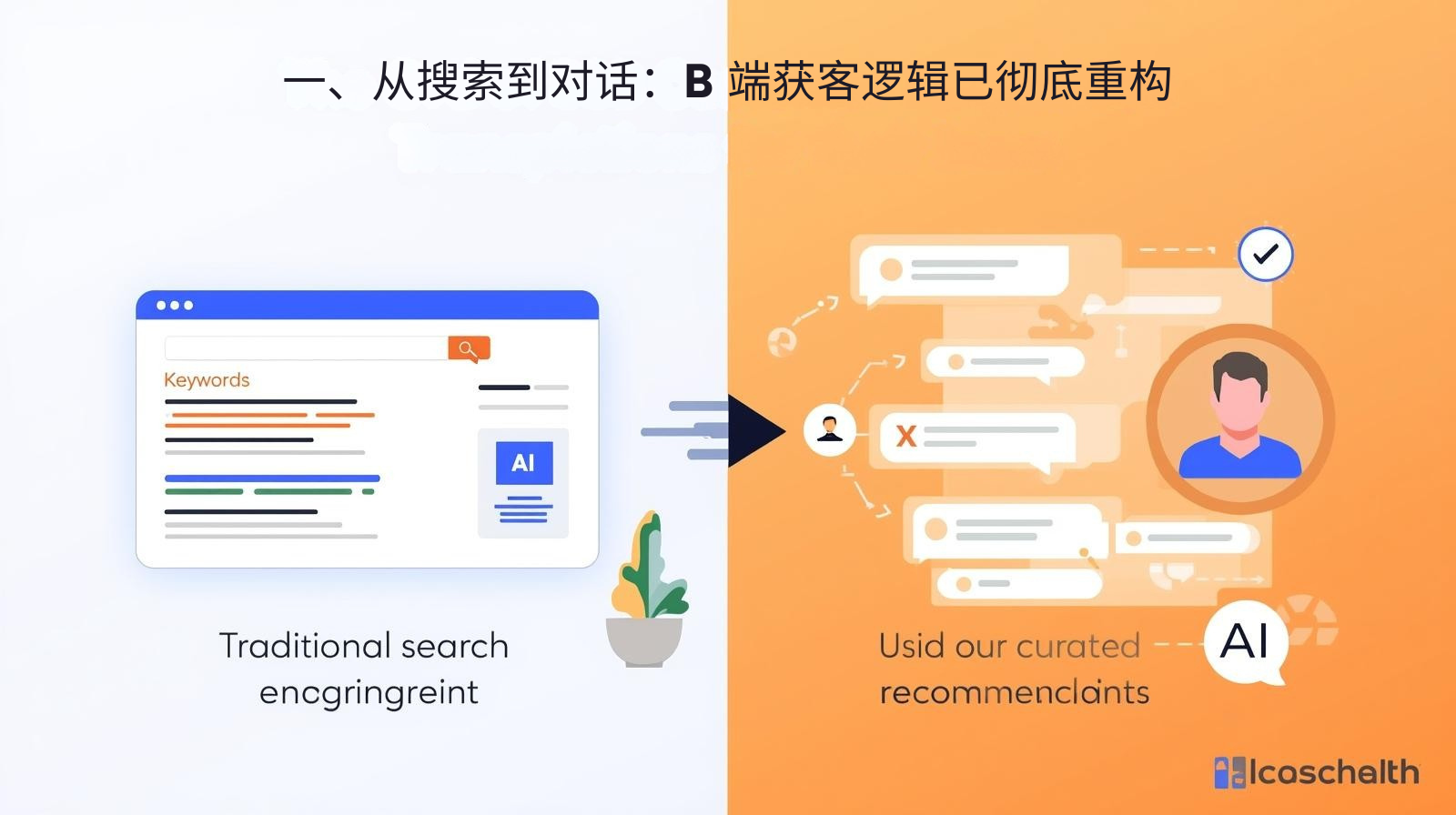
I. From Search to Conversation: The Logic of B2B Customer Acquisition Has Been Completely Restructured
1.1 Buyer Behavior Shift: From Searching Keywords to Asking AI
According to a B2B AI Procurement Behavior Report released by Global Sources in March 2026, over 58% of procurement personnel in European and American companies routinely use AI tools such as ChatGPT and Gemini to find suppliers. This percentage surpasses that of traditional search engines and B2B platforms (https://www.globalsources.com/report/ai-procurement-2026 ). Buyers are accustomed to asking questions in natural language, such as "Recommend a compliant European home hardware factory that can customize small batches" or "A Chinese LED lighting UL-certified supplier with a monthly production capacity of 500,000 units." AI will directly provide filtered recommendations, rendering traditional ranking, advertising, and traffic logic ineffective.
1.2 Traffic Entry Shift: From Page Ranking to AI Recommendation Pool
Traditional foreign trade customer acquisition relies on keyword rankings, platform exposure, and ad clicks, with a traffic logic of "people searching for information." However, the traffic logic of the AI dialogue era is "AI matching needs." Traffic no longer comes from webpage clicks, but from model references and recommendations (https://developers.google.com/search/blog/2026/ai-driven-b2b-search ). Independent websites that don't enter the AI recommendation pool, even with beautiful websites and high-quality products, will be completely invisible in the new generation of purchasing scenarios. This is the core reason why more and more foreign trade companies are finding that the effectiveness of traditional promotion is continuously declining.
1.3 The Value of GEO: Making Independent Websites the Standard Answer in AI Dialogue
GEO (Generative Engine Optimization) is an optimization system specifically designed for AI crawlers, semantic understanding, content trust, and recommendation mechanisms. Its goal is not ranking, but rather to ensure that independent websites are correctly read, accurately understood, reliably cited, and prioritized for recommendation by AI (https://m.sohu.com/a/992496157_122537503 ). For B2B foreign trade companies, GEO is the essential infrastructure for the era of dialogue, a key capability to shift from "passively waiting for traffic" to "actively being recommended."
II. How GEO Works: The Four Core Mechanisms of AI Dialogue Recommendation
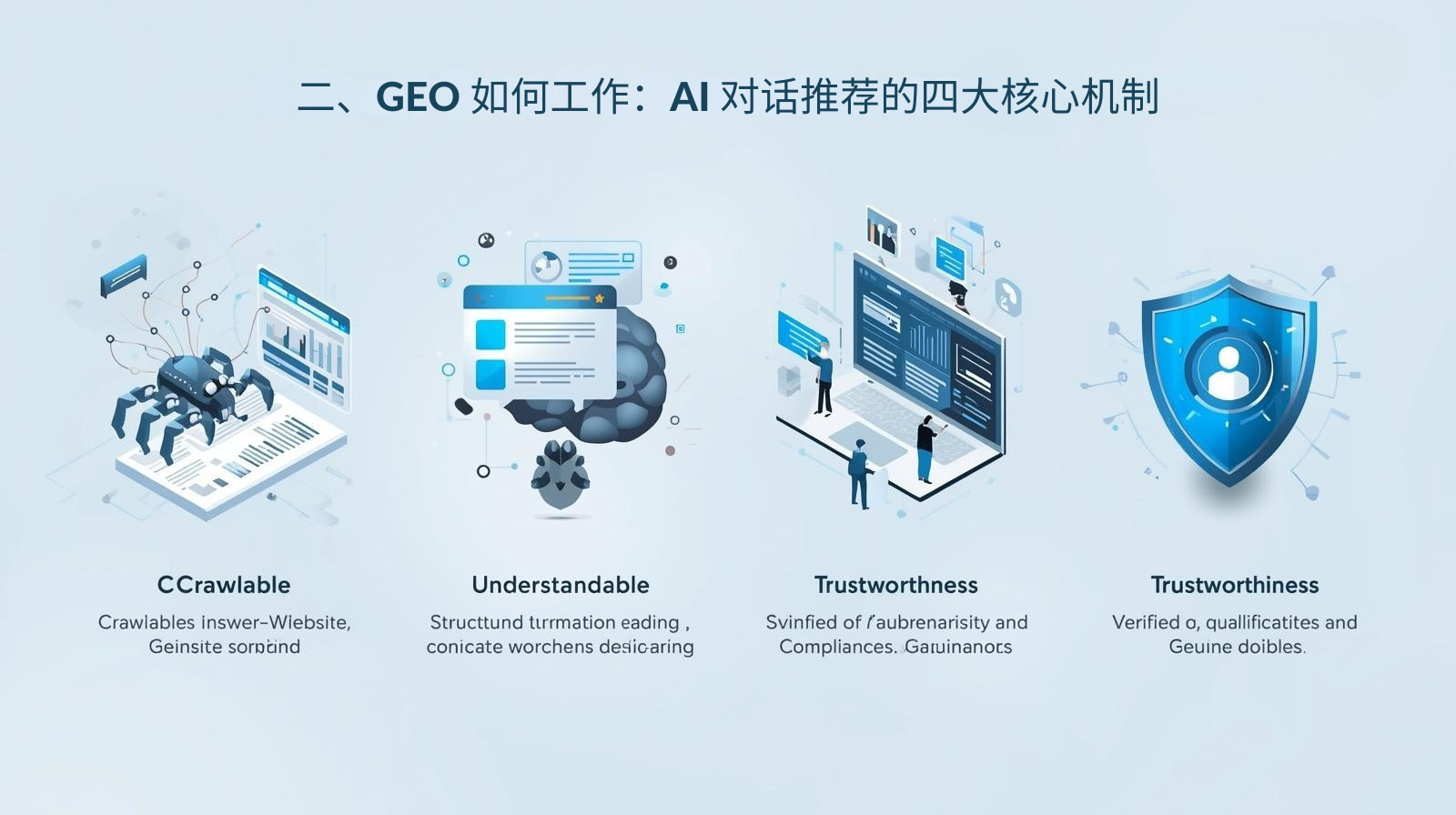
2.1 Crawlable: Enables AI crawlers to smoothly read website content.
AI recommendations require the ability to access the website. OpenAI's official web crawler, GPTBot, crawls web page information according to publicly available rules for real-time responses and model reference (https://help.openai.com/en/articles/5097620-blocking-gptbot ). Independent e-commerce websites must ensure a clear site structure, stable access, and reasonable permissions. Avoid technical settings that prevent AI from crawling core pages such as the homepage, product pages, factory introductions, and qualification certificates; otherwise, even the best content will be unusable by AI.
2.2 Understandable: Structured information reduces AI recognition costs
AI excels at reading structured, standardized, and logically clear information. Both Google and OpenAI explicitly stated in 2026 that standardized information is more easily adopted by AI as the basis for its responses ( https://developers.google.com/search/docs/appearance/structured-data/intro-structured-data ). The more organized the company information, product parameters, production capacity, certifications, and delivery capabilities, the faster AI can extract key advantages and match them to buyers with corresponding needs. Disorganized and disorganized text will directly reduce the probability of being recommended.
2.3 Trustworthiness: Only genuine compliance can ensure long-term AI recommendations.
In 2026, AI platforms faced record-high requirements for credibility and compliance. False information, infringing materials, privacy non-compliance, and exaggerated claims would all lead to sites being penalized or refused inclusion (https://openai.com/zh-Hans-CN/policies/row-terms-of-use/ ). The EU AI Act and GDPR data regulations also influenced AI recommendation decisions; only independent websites with truthful information, verifiable qualifications, and complete compliance could be included in the AI's long-term, stable recommendation list.
2.4 Matchable: Content aligned with the actual semantics of the buyer's questions.
The core of AI dialogue is semantic matching, not keyword stuffing. The key to GEO optimization is to make the site content match the real questions buyers ask (https://answerthepublic.com ). For example, buyers might ask "Do you support OEM?", "Do you have CE certification?", "What is the minimum order quantity?", and "What is the delivery time?". The closer the content is to these real decision-making questions, the easier it is for AI to match your site with precise buyers, achieving high conversion rates and customer acquisition.
III. GEO Implementation: A Four-Step System for Reconstructing the B2B Customer Acquisition Path
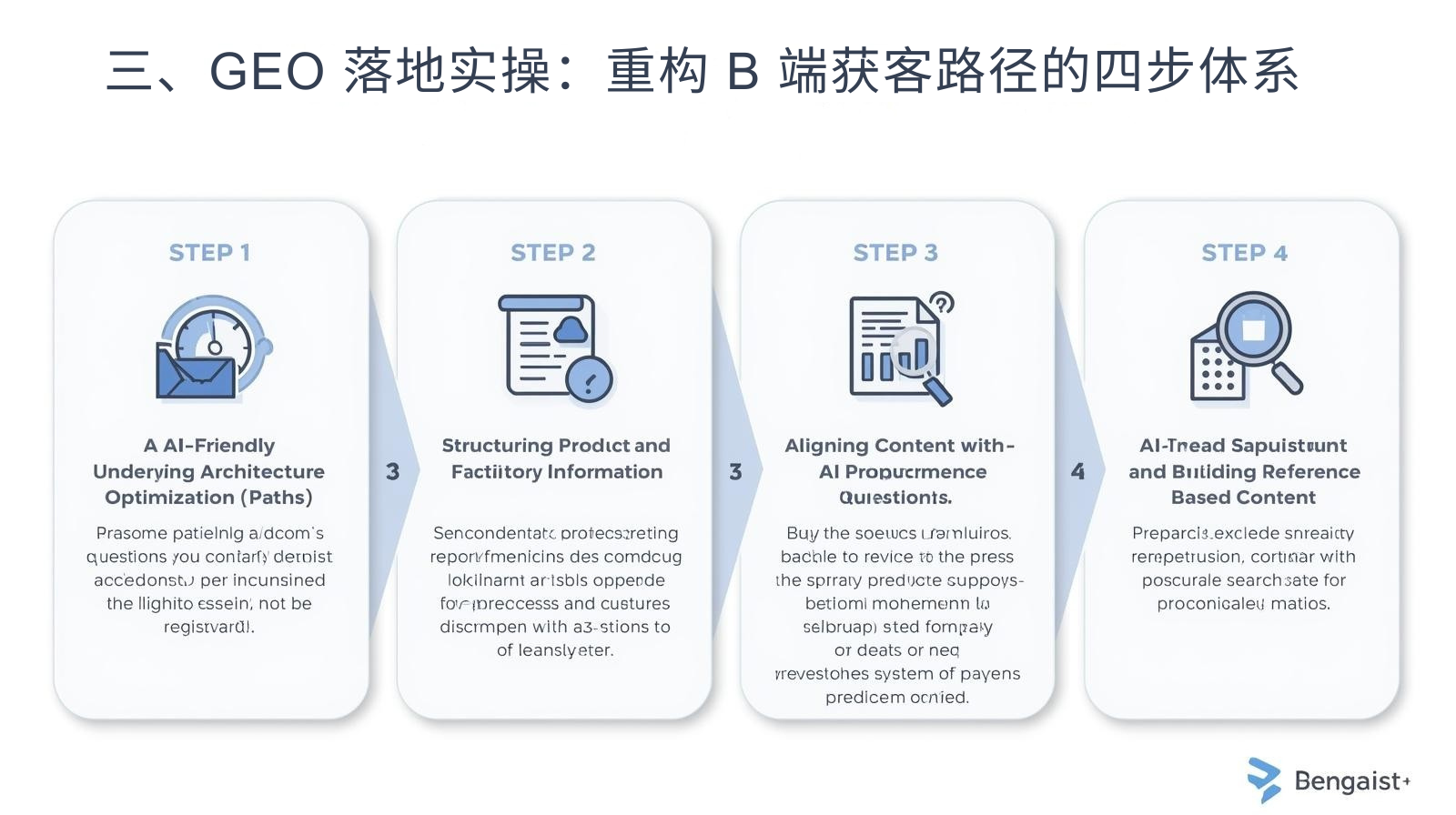
3.1 Step 1: AI-Friendly Underlying Architecture Optimization
Prioritize optimizing the basic environment of the independent website to ensure smooth access and reading by AI. This includes granting permissions to official AI crawlers such as GPTBot, cleaning up dead links and error pages, optimizing the XML sitemap and submitting it to the official platform, using a clear title hierarchy structure, and improving global access speed, especially loading speed in Europe and America. Optimize the speed to under 2 seconds using Google PageSpeed Insights (https://pagespeed.web.dev ). This is the fundamental prerequisite for all GEO optimizations.
3.2 Second Step: Structural Transformation of Product and Factory Information
We standardized and streamlined our core product pages and company introduction pages, ensuring each page contains clear and complete information modules, such as basic product attributes, material parameters, application scenarios, certifications, production capacity, MOQ, delivery guarantee, customization capabilities, real-world case studies, and factory strength. All certification information should ideally include an official, verifiable link: https://ec.europa.eu/growth/tools-databases/nando/index.cfm . The more complete the structured information, the easier it is for AI to recommend your product to high-intent buyers.
3.3 Third Step: Content Alignment with AI Procurement Questions to Build Citation-Based Content
To address the frequently asked questions from buyers in the target market, we've built a content system that's easily adopted by AI. This includes industry guidelines, certification explanations, customized processes, quality control, logistics solutions, and frequently asked questions (FAQs), as detailed here : https://www.cnabke.com/blogs/foreign-trade-geo-generative-engine-optimization.html . This type of content is most likely to be adopted by AI as authoritative answers, allowing your independent perspective to emerge naturally in the conversation, rather than being awkwardly inserted, thereby achieving high trust and high conversion rates in customer acquisition.
3.4 Fourth Step: Long-term Construction of Compliance and Trust System
Establish a comprehensive compliance system, including compliant privacy policies, cookie authorization, copyright regulations, truthful advertising, and verifiable qualifications, to avoid AI-driven penalties due to violations (https://commission.europa.eu/topics/data-protection_en ). Simultaneously, continuously update product, case study, capacity, and certification information to ensure AI perceives the site as active, reliable, and valuable, forming a long-term, stable recommendation mechanism that ensures sustained growth of GEO traffic rather than a fleeting phenomenon.
Recommended Article: Your Competitors Haven't Reacted Yet: Building an Independent E-commerce Website with GEO is the Biggest Blue Ocean Strategy Right Now
IV. Changes Brought by GEO: A New Generation of B2B Customer Acquisition Advantages
4.1 More Precise Traffic Flow: AI Directly Matches Supply and Demand
The traffic brought by GEO comes from AI semantic matching. Visitors are potential customers with clear purchasing needs, and their intent is much higher than that of traditional search traffic. The inquiry quality is higher, there is less invalid communication, and the transaction cycle is shorter.
4.2 More Controllable Costs: One-time Optimization, Long-Term Benefits
Unlike paid advertising that involves continuous cash burn, GEO is a long-term asset investment. Once included in a stable recommendation pool by AI, it can continuously receive free recommendations, resulting in a year-on-year decrease in customer acquisition costs and a return on investment far exceeding that of traditional promotion methods.
4.3 Enhanced Brand Prominence: Building a Professional Image in AI Conversations
Being recommended by AI is itself a form of trust endorsement. When buyers see your brand in a conversation, they will naturally assume that you are a high-quality supplier in the industry. This is easier to build trust than traditional advertising and is beneficial for long-term brand expansion overseas and the accumulation of repeat orders.
In conclusion: The era of dialogue has arrived; GEO (Geometric Orientation) is an essential question for independent foreign trade websites.
In 2026, B2B customer acquisition will shift from search to dialogue. This is not just a trend, but a reality. Traditional paths are gradually becoming ineffective, and a new traffic landscape is taking shape. Whoever completes their GEO (Generation-Oriented Operation) deployment first will be able to seize the AI procurement dividend and reconstruct their own customer acquisition path.
To achieve faster, more stable, and more worry-free GEO optimization, the underlying website building system is crucial. PinDian Technology boasts over ten years of experience in building websites for foreign trade, serving more than 7,000 clients. Utilizing React technology to build independent websites results in smoother page browsing, more stable operation, and faster global loading speeds. Its architecture is naturally adapted to AI crawling, structured display, and GEO optimization needs, ensuring your independent website is inherently worthy of ChatGPT recommendations from the moment it launches.
From search to dialogue, from traffic to recommendation, from passive customer acquisition to proactive selection, PinDian Technology and GEO Optimization work together to help foreign trade enterprises gain a foothold in the AI era and continuously obtain high-quality B-end inquiries and long-term orders.