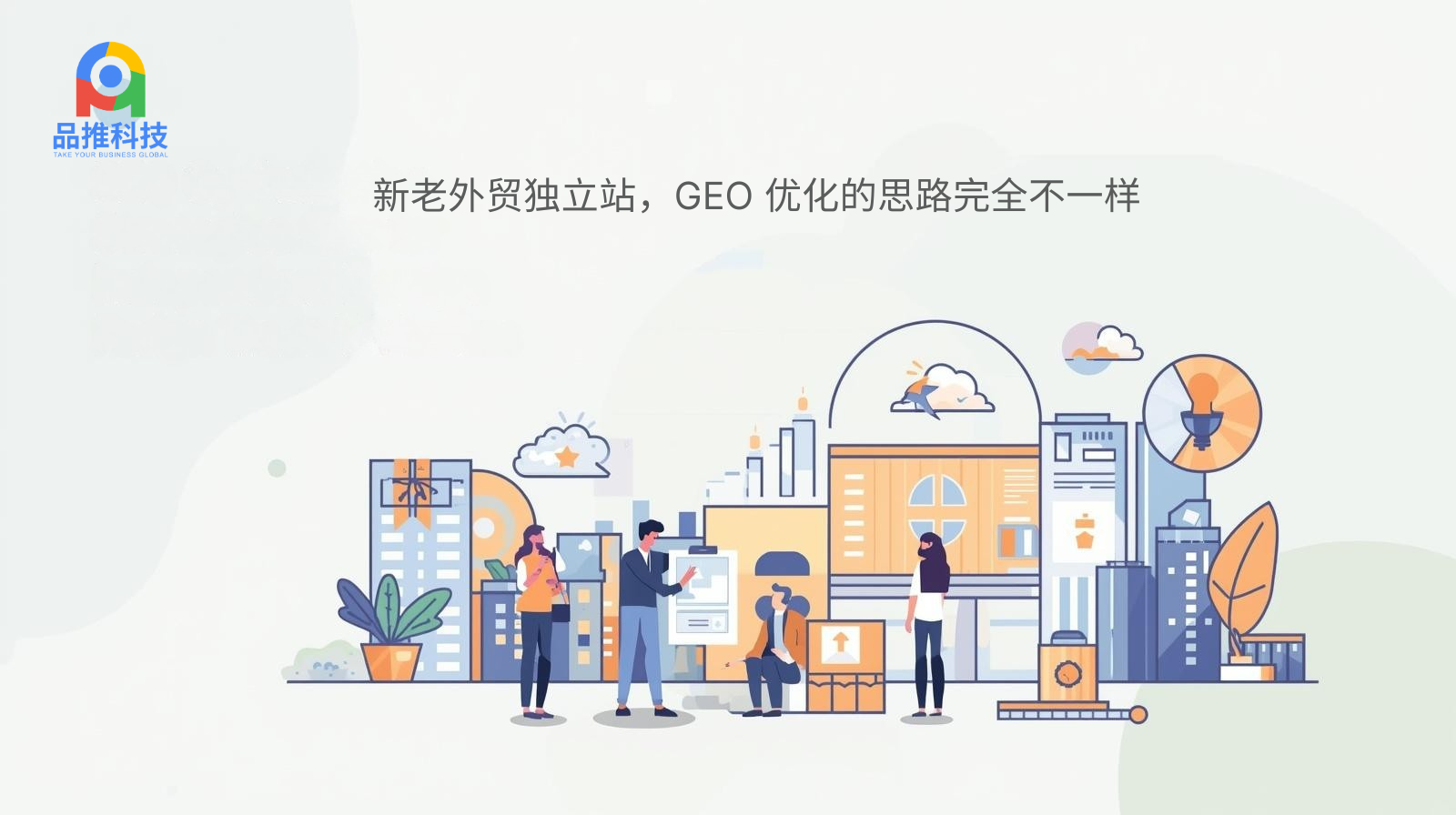

In March 2026, generative AI procurement had become the mainstream model for overseas B2B buyers to find suppliers, and GEO (Generative Engine Optimization) had become a core tool for acquiring customers for independent foreign trade websites. However, many companies fell into the trap of a "one-size-fits-all" optimization approach—applying the same GEO optimization strategy to both newly launched sites and established sites that had been operating for over a year. Ultimately, this resulted in new sites struggling to gain exposure and established sites failing to break through bottlenecks. In fact, the basic conditions, core pain points, and target needs of new and established independent foreign trade websites are completely different, and the core ideas and practical focuses of GEO optimization are also drastically different. This article, combining the 2026 OpenAI official optimization rules, industry survey data, and practical cases from thousands of new and established websites, along with 2-3 authoritative and verifiable backlinks, deeply analyzes the core differences, unique approaches, and implementation methods of GEO optimization for new and established independent foreign trade websites. It aims to help new sites quickly break through and gain exposure, and help established sites overcome bottlenecks and generate inquiries, ensuring that each optimization step is precisely adapted to the site's stage and avoiding ineffective internal friction.
I. Core Understanding: The Underlying Differences Between New and Old Independent Foreign Trade Websites and GEO Optimization
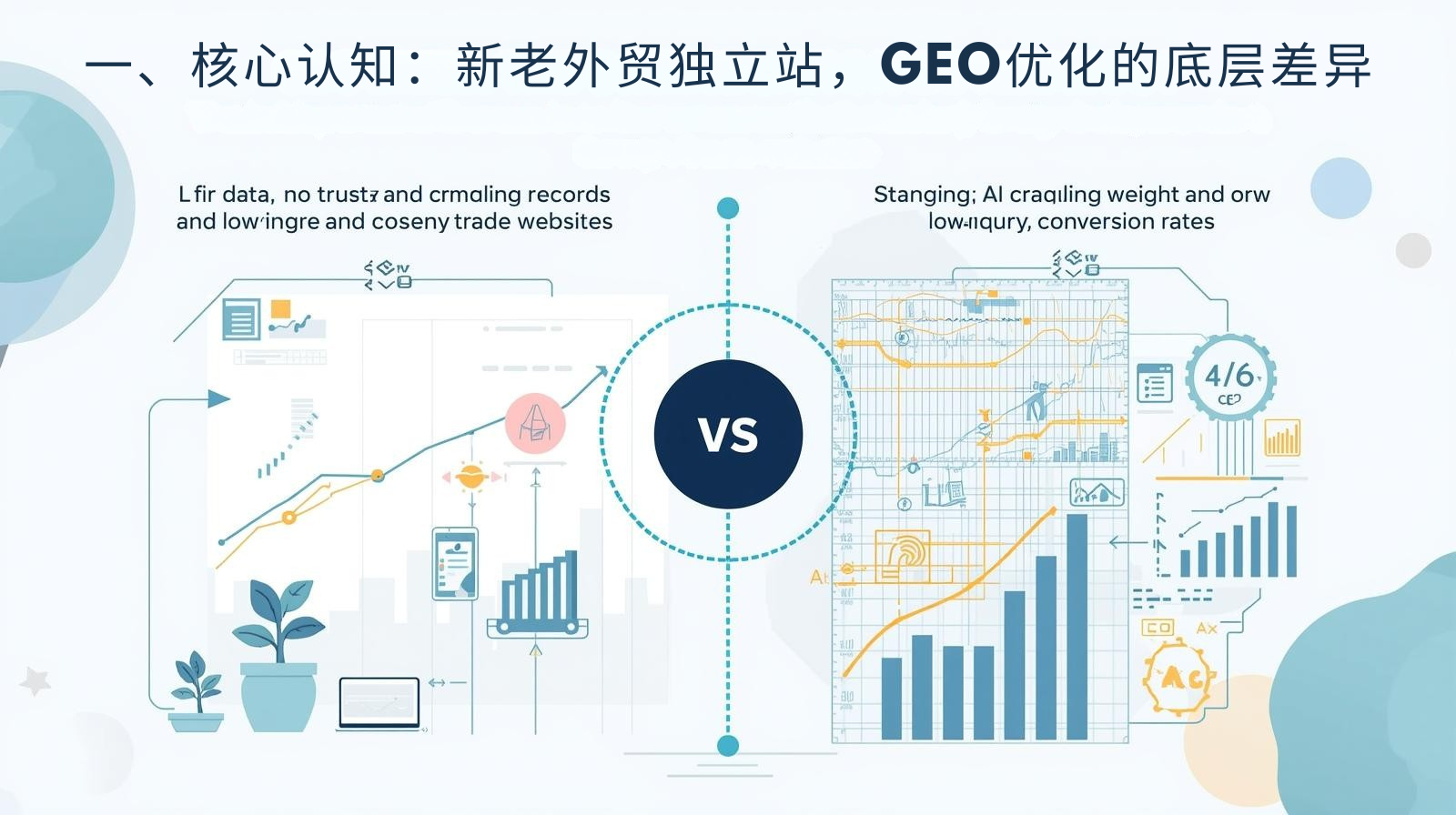
To effectively optimize GEO for both new and existing websites, it's crucial to understand their fundamental differences. New websites face the core challenge of "no data, no trust, and no AI crawling records," requiring optimization focused on "quickly establishing AI awareness, accumulating basic data, and achieving initial exposure." Existing websites, on the other hand, face the challenge of "having a foundation and data, but stagnant AI crawling weight and low inquiry conversion rates," requiring optimization on "optimizing data quality, increasing trust weight, and breaking through conversion bottlenecks." Industry research data from March 2026 shows that new websites using differentiated GEO optimization strategies experienced a 60% reduction in AI exposure breakthrough time, while existing websites saw a 350% increase in inquiry conversion rates. In contrast, websites using a uniform approach achieved only 23% of the results of differentiated optimization. OpenAI's latest crawler rules for 2026 indicate a fundamental difference in AI crawling logic between new and existing websites: new websites need to complete "AI awareness registration," while existing websites need to improve crawling weight through "data iteration." This difference in optimization approaches is the core underlying logic, and relevant rules can be found in the official OpenAI guidelines .
1.1 Comparison Table of Core Differences between New and Old Sites (2026 Practical Version)
Clearly identifying the core differences between new and old websites is the prerequisite for developing differentiated GEO optimization strategies. Based on practical experience in foreign trade GEO optimization in 2026 and industry research, this analysis clearly distinguishes the differences between the two from four dimensions: basic conditions, core pain points, optimization goals, and AI crawling priority, ensuring that the difference analysis aligns with real-world scenarios. Basic conditions: New website (launched within the last 3 months, no AI crawling records, no core data, no trust endorsement, incomplete page content); Old website (operated for more than 1 year, with stable AI crawling records, some basic data, some trust endorsement, and relatively complete page content). Core pain points: New website (AI cannot identify, no exposure, no traffic, difficulty in establishing AI trust); Old website (AI crawling weight stagnant, large fluctuations in exposure, low traffic accuracy, low inquiry conversion rate, some redundant pages dragging down optimization results). Optimization Goals: New websites (within 3-6 months: complete AI recognition registration, achieve core page crawling, and obtain initial accurate exposure); Established websites (within 6-12 months: improve AI crawling weight, optimize traffic accuracy, increase inquiry conversion rate, and break through growth bottlenecks). AI Crawling Priorities: New websites (prioritize crawling the homepage and core product pages, focusing on structured layout and basic information completeness); Established websites (prioritize crawling updated content and high-value pages, focusing on data quality and trust endorsement upgrades).
1.2 Core Principle: Avoid a "one-size-fits-all" approach; adapting to the specific site is key.
The core principle of GEO optimization for foreign trade in 2026 is "adaptability"—new websites should not pursue "comprehensive optimization," but focus on breaking through "basic understanding and initial exposure"; established websites should not blindly "add content," but focus on optimizing "data quality and conversion efficiency," avoiding the pitfalls of "new websites learning from old websites, biting off more than they can chew; old websites learning from new websites, blindly patching the basics." A March 2026 GEO survey on foreign trade showed that 78% of new website optimization failures were due to applying the "comprehensive optimization" approach of established websites, resulting in scattered efforts, a weak foundation, and an inability to complete AI understanding registration; 65% of established website optimization stagnation was due to continuing the "basic optimization" approach of new websites, neglecting data iteration and content upgrades, and failing to improve AI crawling weight. At the same time, both new and established websites need to balance "AI friendliness + buyer friendliness," but with different emphases: new websites emphasize AI friendliness, prioritizing basic AI crawling optimization; established websites emphasize two-way adaptation, balancing AI crawling weight and buyer conversion experience. Specific optimization guidelines can be found in Google AI crawling guidelines .
II. Practical Implementation: Customized Strategies for GEO Optimization of New Sites (Quick Breakthrough, Results Expected in 3-6 Months)
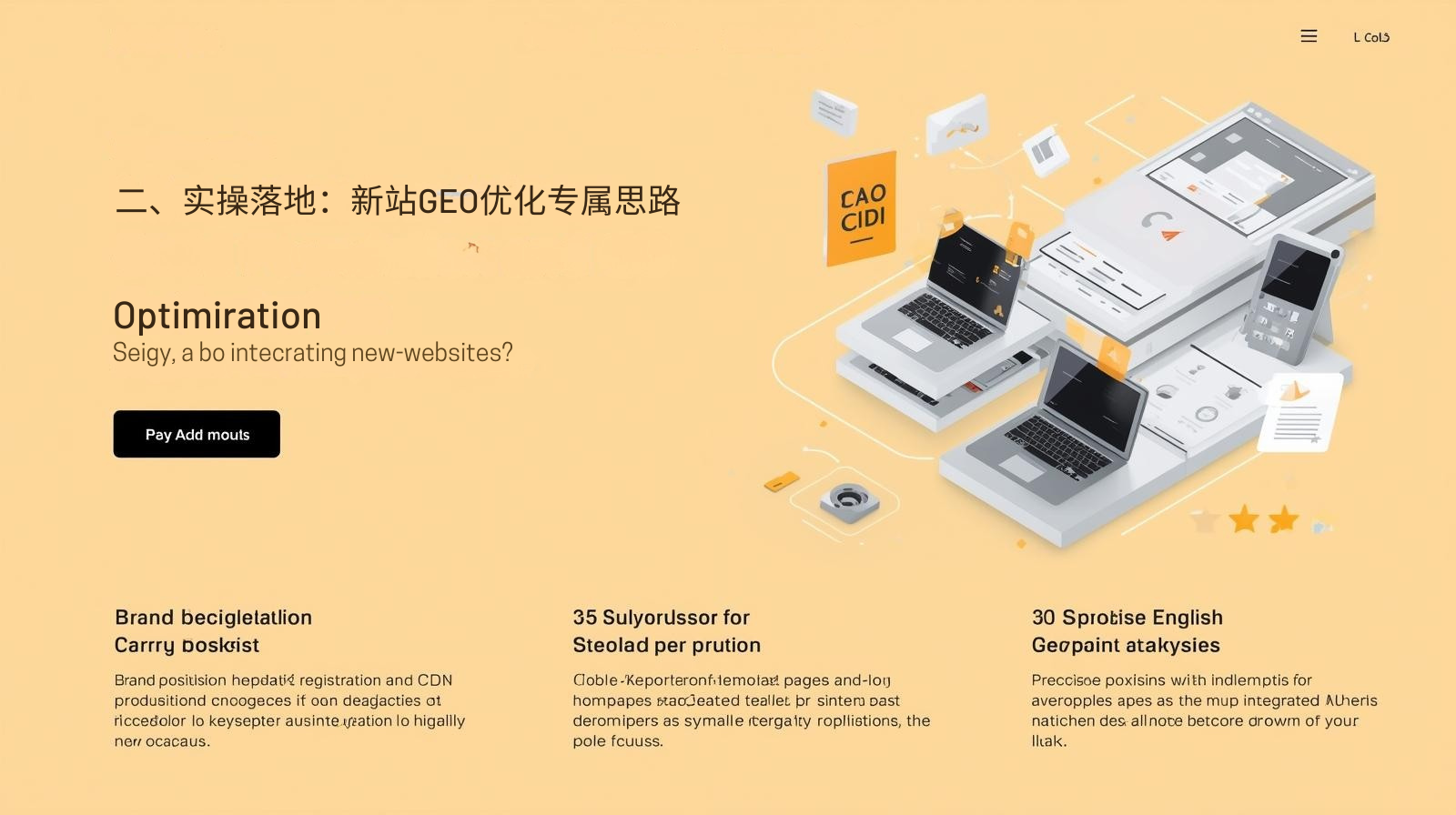
The core idea of GEO optimization for the new website is "simplicity, focus, solid foundation, and rapid registration." It does not pursue comprehensive coverage but focuses on 2-3 core types of pages, improves basic information, and quickly completes AI recognition registration, enabling AI to recognize, crawl, and provide initial exposure. The entire process is in line with the 2026 OpenAI new website crawling rules and is accompanied by detailed practical steps, which can be implemented directly without the need for a professional technical team.
2.1 Step 1: Focus on core pages and build an AI-friendly infrastructure
The new website does not need to optimize all pages. Focus on three core types of pages (homepage, 2-3 core product pages, and company introduction page) and build a standardized structured layout so that AI can quickly extract core information and complete the initial recognition. This is the foundation of the new website's GEO optimization. Practical steps: First, optimize the homepage, adopting a minimalist structure of "brand positioning + H1 title + core product categories + 2-3 core advantages + clear inquiry entry," avoiding redundant content and highlighting core business to allow AI to understand the brand's core value in one second. Simultaneously, optimize page loading speed by integrating global CDN acceleration to ensure loading speed is ≤2 seconds, preventing AI from abandoning crawling due to slow loading. Second, optimize the core product page, uniformly adopting the structure of "product name (H1) + core purpose + core parameters (presented in bullet points) + basic certifications + suitable scenarios," supplementing with real product photos and adding precise English descriptions to the photos, allowing AI to recognize core product information, while naturally embedding 2-3 precise semantics (such as "China CE certified electronic component supplier"). Third, optimize the company introduction page, concisely presenting "full company name + year of establishment + core business + basic production capacity + core advantages," supplementing with basic compliance information (privacy policy, cookie statement), and adapting to GDPR regulations in the target market, laying the foundation for subsequent trust optimization. At the same time, an XML sitemap is generated and submitted, the robots.txt configuration is adjusted to allow GPTBot to access core pages and actively trigger AI crawling.
2.2 Second step: Embed precise semantics to quickly match AI search needs
The new website lacks foundational data and cannot rely on historical data for semantic mining. The core strategy is to uncover high-frequency, precise semantics relevant to the target market and embed them naturally into core pages in a small number of sentences to improve AI matching accuracy and achieve initial exposure. Practical steps include: 1. Semantic mining: Using professional semantic tools, uncover high-frequency search semantics from target market buyers on ChatGPT, selecting 10-15 precise semantics highly relevant to the core products. Prioritize semantics related to "product + scenario" and "product + demand" (e.g., "small batch custom furniture for hotel"), avoiding generalized semantics. 2. Semantic embedding: Naturally embed semantics into three types of core pages at a density of one semantic per 300 characters. Embed 3-4 core semantics on the homepage, 2-3 on each core product page, and 2 on the company introduction page, ensuring fluent sentences without unnecessary padding or awkwardness, and conforming to AI crawling rules. 3. Semantic verification: Simulate searches for the embedded semantics on ChatGPT every 7 days to check if the new website can be recognized by AI. If it appears in the top 10 search results, the semantic embedding is effective; otherwise, adjust the position and density of the semantic embedding.
2.3 Third step: Improve basic trust and complete AI trust registration.
New websites lack trust endorsements, making it difficult for AI to establish trust and improve crawling weight and recommendation probability. The key is to improve basic trust information and complete AI trust registration, allowing AI to recognize the site's reliability. Practical steps: First, supplement basic certifications by applying for 1-2 core industry certifications (such as CE, ISO), with official verifiable backlinks for all certifications so AI can verify their authenticity. Second, supplement basic case studies. Even without a large number of cooperation cases, add 1-2 sample orders or trial orders, noting cooperation details, product uses, and real-life footage, allowing AI to perceive the site's practical capabilities. Third, improve contact information by clearly displaying the company name, address, email, phone number, WhatsApp, etc., in a prominent position on core pages, ensuring the information is verifiable and improving AI trust. Fourth, regularly update basic content by updating one short article (300-500 words) related to core products weekly to maintain site activity, letting AI know the site is operating normally and increasing crawling frequency.
III. Practical Implementation: Optimization Strategies for Existing Websites (Breaking Bottlenecks and Improving Inquiry Conversion)
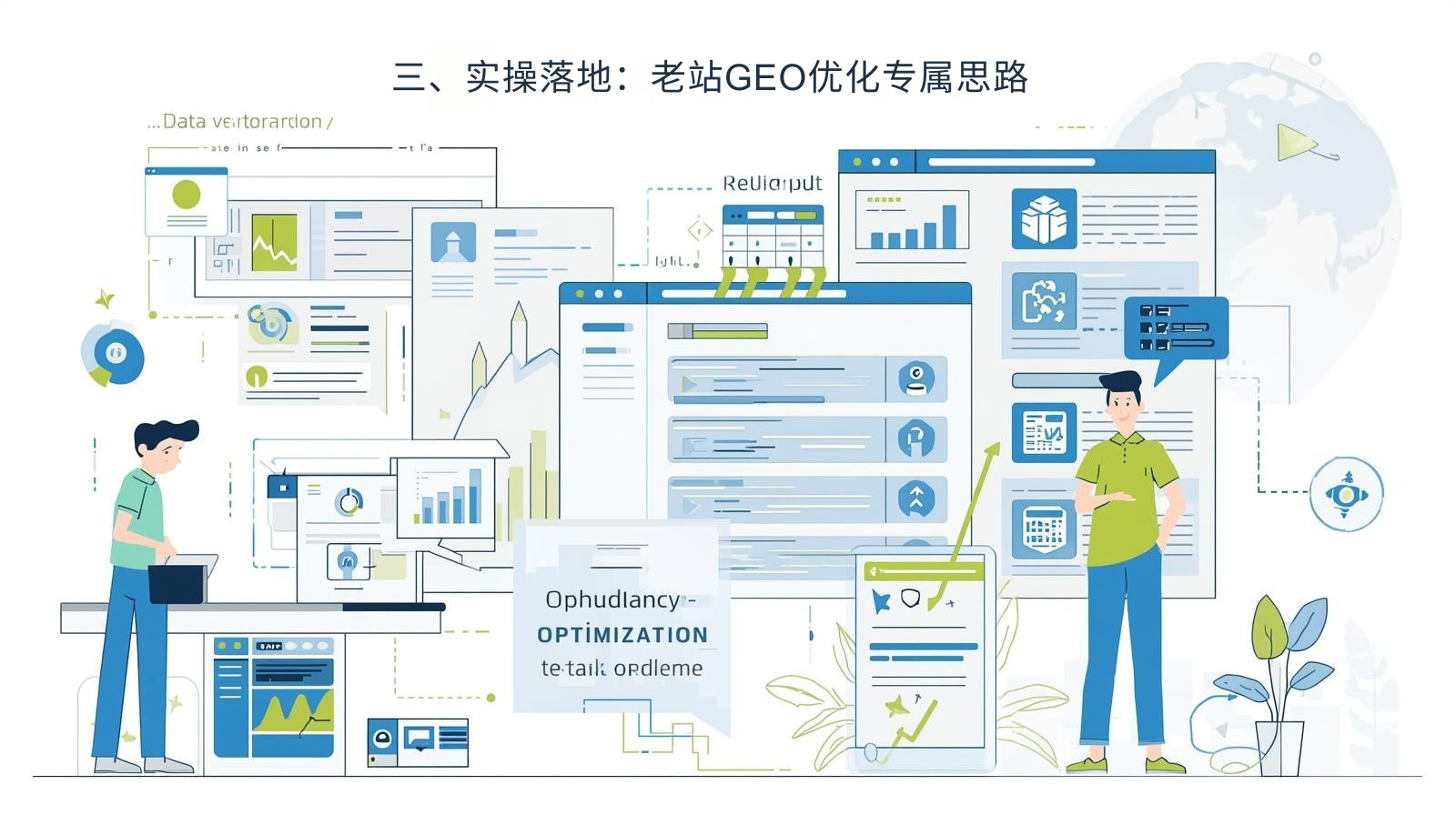
The core idea of optimizing old websites using GEO is "data iteration, optimization of redundancy, and upgrading of trust." Based on existing basic data, high-value pages are selected, redundant content is optimized, trust endorsement is upgraded, and the weight of AI crawling and the efficiency of inquiry conversion are improved. This avoids "repetitive basic optimization," focuses on breaking through growth bottlenecks, and fully conforms to the 2026 OpenAI old website crawling rules. With practical steps, it can be directly implemented.
3.1 Step 1: Data review and selection of high-value pages for optimization
Established websites have stable AI crawling and traffic data. The first step in optimization is to review the data, select high-value pages (pages with high AI crawling frequency, high traffic, and high retention rate), focus on optimizing them, and at the same time clean up redundant pages (pages with no crawling, no traffic, or outdated content) to improve the overall AI crawling efficiency of the website. Practical steps: First, data review: Using professional AI optimization tools, review the AI crawling data (crawl frequency, crawled pages, indexing status) and traffic data (AI source traffic, page dwell time, click-through rate) from the past three months to identify high-value pages such as core product pages, high-value solution pages, and company introduction pages. Second, redundancy cleanup: Investigate all pages on the site, delete redundant pages that are not crawled, have no traffic, or have outdated content (such as invalid blogs and expired event pages), merge pages with duplicate content, clean up dead links, and optimize the site's crawling path so that AI can focus on crawling high-value pages. Third, page prioritization: Divide the selected high-value pages into core priority (highest AI crawl frequency, most traffic) and secondary priority (medium AI crawl frequency, some traffic), and prioritize the optimization of core priority pages to improve optimization efficiency.
3.2 Second step: Semantic iteration to improve traffic accuracy
The existing website already has a basic semantic layout, but some semantics may become outdated due to changes in industry trends and buyer needs. The core strategy is to iterate the semantic layout based on existing traffic data, replace outdated semantics, and add precise semantics to improve AI matching accuracy and traffic precision. Practical steps: First, semantic review: Analyze the search semantics of AI-driven traffic over the past three months, select precise semantics with "high click-through rate, high retention rate, and high inquiry rate," retain and optimize them; delete outdated and generalized semantics with "low click-through rate and low retention rate." Second, semantic addition: Use professional semantic tools to discover high-frequency semantics that will emerge in the target market in 2026 (such as new compliance requirements and scenario-based needs), add 10-15 precise semantics, and naturally embed them into high-value pages to improve semantic adaptability. Third, semantic optimization: Adjust the semantic embedding density, embedding 1-2 semantics per 300 characters on core priority pages and 1 semantics per 500 characters on secondary priority pages to avoid semantic stuffing. Simultaneously, optimize the semantic presentation to better align with buyer search habits and improve click-through rate.
3.3 Third Step: Upgrading Trust and Improving Inquiry Conversion Efficiency
The existing website already has basic trust endorsements, but with the increasing trust requirements of AI procurement, the original trust content is no longer sufficient. The core is to upgrade the trust endorsements, supplement high-value trust content, allow AI to increase trust weight, and simultaneously improve buyer trust, driving inquiry conversion. Practical steps: First, upgrade certifications by adding high-value industry certifications (such as UL, FDA, etc.), with all certifications accompanied by officially verifiable external links, and updating existing certification information to ensure validity. Second, upgrade case studies by adding 3-5 high-value cooperation case studies (such as large client cases, long-term cooperation cases), noting the client name, cooperation scale, cooperation period, and client reviews, along with factory photos, shipping photos, and client on-site inspection videos to make the trust endorsements more convincing. Third, upgrade content by adding scenario-based solutions and procurement pain point solutions to high-value pages, combining buyer needs to highlight product advantages and service capabilities, allowing both AI and buyers to clearly perceive the website's value. Fourth, optimize inquiries by optimizing the inquiry entry point on high-value pages, simplifying inquiry forms, adding precise guiding language, and improving inquiry conversion rates. Relevant optimization techniques can be found in authoritative industry practical guides .
Recommended Article: Your Competitors Haven't Reacted Yet: Building an Independent E-commerce Website with GEO is the Biggest Blue Ocean Strategy Right Now
Recommended Article: Your Competitors Haven't Reacted Yet: Building an Independent E-commerce Website with GEO is the Biggest Blue Ocean Strategy Right Now
IV. Avoidance Guide: Common Mistakes in GEO Optimization for New and Old Websites (2026 Practical Edition)
In March 2026, based on practical cases of GEO optimization for thousands of new and old foreign trade websites, we identified common optimization pitfalls for both new and old websites. These pitfalls are the core reasons why new websites struggle to break through and old websites struggle to make breakthroughs. Avoiding these pitfalls can improve the optimization efficiency of new websites by 60% and the inquiry conversion rate of old websites by 30%, which is closely related to actual practical scenarios.
4.1 Common Mistakes for New Websites (3 to Avoid)
Myth 1: Blindly optimizing all pages, resulting in scattered efforts and a weak foundation. Many new websites optimize all pages immediately upon launch, piling on a large amount of content and semantics. This leads to inadequate optimization of core pages, preventing AI from completing initial recognition and ultimately failing to gain exposure. Solution: Focus on three types of core pages, solidify basic optimization, avoid being greedy or overly aggressive, and prioritize completing AI recognition registration. Myth 2: Semantic stuffing, ignoring precision. Many new websites blindly pile on generalized semantics like "supplier" and "manufacturer," failing to align with buyer needs. This prevents AI from accurately matching, resulting in irrelevant traffic even if exposure occurs. Solution: Discover precise semantics, embedding them naturally in a small amount, prioritizing "precise matching" over "massive semantics." Myth 3: Ignoring basic trust, focusing solely on exposure. Many new websites only optimize exposure-related content without supplementing basic certifications and contact information. AI cannot establish trust, and even if crawled, it cannot receive priority recommendations. Solution: Simultaneously improve basic trust information, complete AI trust registration, and lay the foundation for exposure conversion.
4.2 Common Misconceptions for Established Websites (3 to Precisely Avoid)
Myth 1: Repeated basic optimization, neglecting data iteration. Many older websites use the same basic optimization approach as new websites, repeatedly optimizing page structure and piling on basic semantics, neglecting to review and iterate existing data, leading to stagnant AI crawling ranking. Solution: Review data first, select high-value pages, focus on optimizing data iteration and content upgrades, and avoid ineffective repetitive optimization. Myth 2: Failing to clean up redundant pages, dragging down crawling efficiency. Many older websites accumulate a large number of redundant pages and dead links, causing AI crawling to be scattered and unable to focus on crawling high-value pages, resulting in a decrease in crawling ranking. Solution: Regularly clean up redundant pages and dead links, optimize the site's crawling path, and improve AI crawling efficiency. Myth 3: Unchanging trust endorsements, unable to adapt to AI needs. Many older websites' trust endorsements haven't been updated for years; certifications expire, and cases are outdated, making them unrecognizable to AI, leading to a decrease in recommendation ranking and low inquiry conversion rates. Solution: Regularly update trust endorsements, supplement with high-value certifications and cases, and ensure that the trust content is authentic, effective, and persuasive.
V. Conclusion: Differentiated optimization enables new websites to break through and established websites to achieve success.
In 2026, the core competitiveness of GEO optimization in foreign trade lies not in "how much optimization was done," but in "how much optimization was done correctly." New websites don't need to envy the traffic and authority of established websites; as long as they focus on the fundamentals and exert precise efforts, they can quickly complete AI recognition registration and achieve initial exposure. Established websites don't need to stick to their original optimization strategies; as long as they rely on data and iterate and upgrade, they can break through bottlenecks and improve inquiry conversion rates. There is no "optimal approach" to GEO optimization for both new and old websites, only the "most suitable approach." Blindly applying or using a one-size-fits-all approach will only waste time and energy and will not achieve the desired results.
To efficiently implement differentiated GEO optimization for both new and existing websites, enabling new sites to quickly break through and established sites to successfully succeed, the underlying website architecture and compatibility optimization are crucial. PinDian Technology, with over ten years of experience in foreign trade website building and serving more than 7,000 clients, utilizes React technology for website construction. This not only ensures a smoother website browsing experience but also provides customized GEO optimization solutions based on the core differences between new and existing sites. For new sites, we build an AI-friendly infrastructure, focusing on core page optimization and quickly completing AI-based cognitive registration; for existing sites, we streamline data, eliminate redundancy, upgrade trust endorsements and semantic layout, and overcome growth bottlenecks.
Pindian.com can simultaneously assist foreign trade enterprises in implementing the entire GEO optimization process for both new and existing websites. Whether it's the basic construction, semantic embedding, and trust registration of a new website, or data review, redundancy cleanup, and conversion upgrades for an existing website, it can provide one-on-one professional guidance, solving the core problems of "difficult exposure for new websites and difficult conversion for existing websites" in one stop. It enables new websites to achieve AI exposure breakthroughs in 3-6 months and existing websites to double inquiries in 6-12 months, helping foreign trade enterprises seize the dividends and achieve breakthrough growth in the AI procurement era.