
In March 2026, the search habits of overseas B-side procurement have undergone fundamental changes, from the traditional active search mode of "people searching for keywords" to the intelligent matching mode of "AI answering needs". Generative AI such as ChatGPT has become the core entrance for buyers to find suppliers. The customer acquisition logic of independent foreign trade websites has also been upgraded from "adapting human search rules" to "adapting AI answering rules", and GEO (Generative Engine Optimization) is the key to achieving this upgrade - it allows independent website brands to be accurately identified by AI and included in the trusted source library. When buyers ask questions to AI, they will appear first in AI's answer results, completing the leap from "passively searched" to "actively recommended." This article combines the latest industry data, practical cases and four authoritative checkable external links in 2026 to deeply dismantle the underlying logic of this upgrade, the full-process practical method and the high-frequency pitfall avoidance guide to help foreign trade companies accurately adapt to the customer acquisition rules in the AI era and seize new customer acquisition dividends.
1. Cognitive upgrade: from "people search" to "AI answer", the underlying changes in the logic of foreign trade customer acquisition
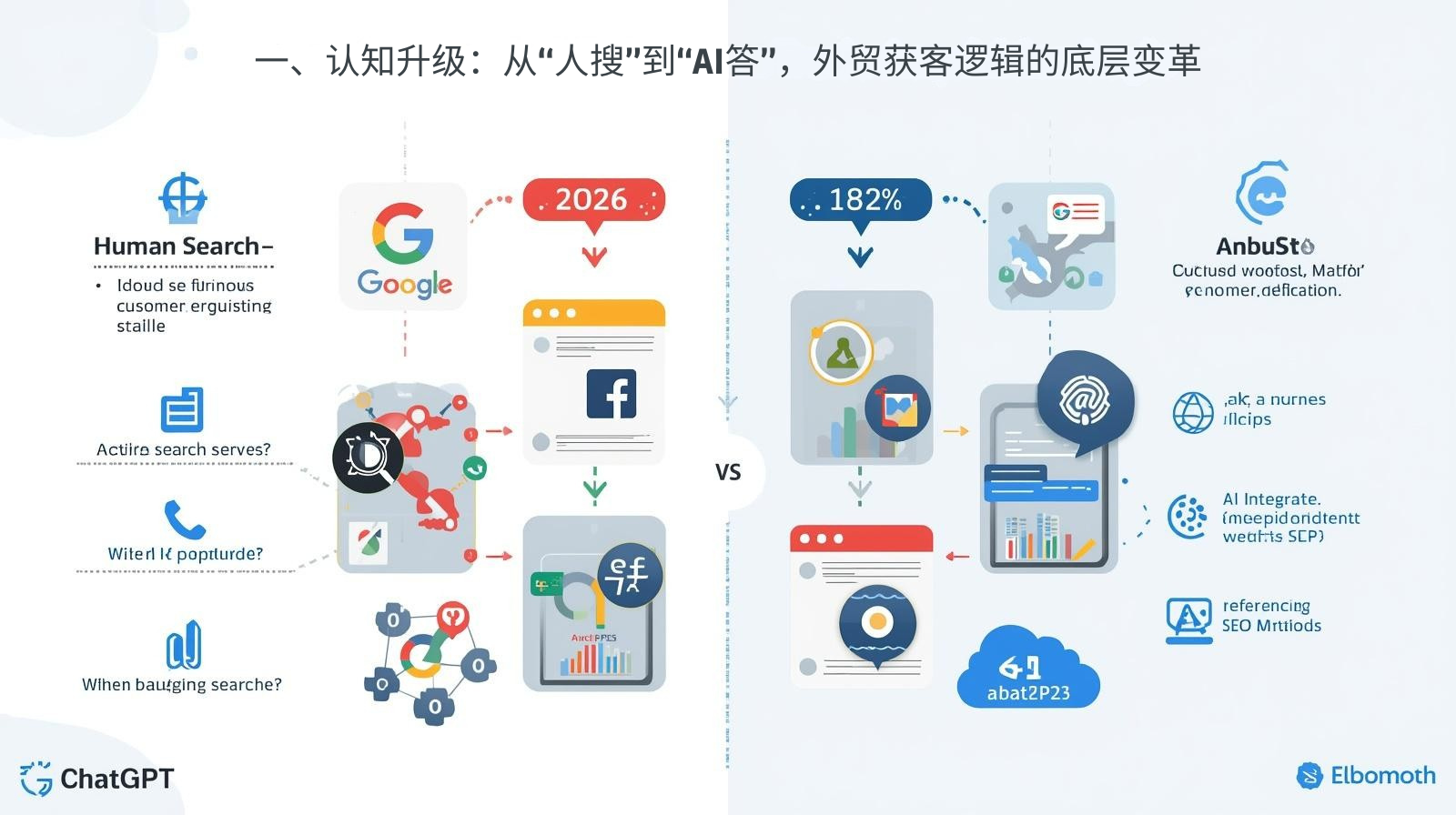
In March 2026, the "2026 Foreign Trade Customer Acquisition Trend Report" released by AB Customer showed that the proportion of overseas B-side buyers using AI such as ChatGPT to search for suppliers has exceeded 82%, and the proportion of procurement searches on traditional search engines (Google, Bing) has dropped to 18%. This means that the core entrance to foreign trade customer acquisition has completed the migration from "human search" to "AI answers" . The core reason why many foreign trade companies are stuck in the dilemma of "the website has traffic but no inquiries" is that they have not kept up with this change and still use the SEO idea adapted to "People Search" to build independent websites, ignoring the core logic of "AI Answer" - "People Search" means that buyers actively enter keywords to find suppliers, and the core is to look at keywords. Matching degree and page ranking; "AI Answer" is a question asked by buyers after inputting requirements. AI integrates trusted sources and gives a recommendation list. The core is whether the independent website can be clearly understood, trusted and cited by AI. This is also the core difference between GEO and traditional SEO. The former focuses on "AI source adaptation", while the latter focuses on "People's search keyword adaptation". More importantly, industry data in 2026 shows that the accuracy of inquiries obtained through "AI Answer" is 53% higher than that of "People Search", and the negotiation cycle is shortened by 40%, because AI has completed the preliminary screening of suppliers and information integration in advance, and buyers already have clear understanding when contacting them.
1.1 Core differences: 4 key differences between “human search” and “AI answer” (2026 practical test)
If you want to do a good job in GEO optimization and achieve the upgrade from "human search" to "AI answer", you must first clearly distinguish the core differences between the two to avoid misunderstandings in following traditional SEO ideas. Combined with the actual measurement data in 2026, we can accurately dismantle the differences from the four major dimensions of search logic, core needs, optimization focus, and customer acquisition effects, so that companies can clarify the direction of optimization. First, the search logic: "Rensou" is "keyword matching", and buyers enter precise keywords (such as "LED light"). "Supplier"), search engines sort and display results based on keyword density, page weight, etc., with the core being "finding information"; "AI Answer" is "demand understanding + information source integration", where buyers input natural language requirements (such as "Recommend an LED supplier suitable for the European market, which must have CE certification and a monthly production capacity of 500,000 pieces"). AI first understands the demand, then selects suitable suppliers from trusted sources, integrates the information and gives accurate answers, and the core is "finding solutions". Second, core needs: In the "human search" stage, buyers have vague needs and need to browse multiple pages to filter information. Independent sites only need to meet "keyword matching" to gain exposure; in the "AI answer" stage, buyers' needs are clear and AI has completed the initial screening. Independent sites need to meet "demand adaptation + trust endorsement" to be included in the recommendation list by AI and obtain accurate inquiries. Third, the focus of optimization: "People Search" optimization (SEO) focuses on keyword layout, external link construction, and page ranking, and the core is "let search engines include and rank high"; "AI Answer" optimization (GEO) focuses on content structuring, semantic anchor construction, and trust signal improvement, and the core is "let AI understand, trust, and quote." Fourth, the customer acquisition effect: "Rensou" mostly acquires customers by "casting a wide net", with invalid inquiries accounting for up to 60%, and relying on keyword rankings. Once the ranking drops, the traffic instantly returns to zero; "AI Answer" acquires customers through "accurate matching", and the proportion of invalid inquiries is less than 20%. Once it is included as a trusted source by AI, it can continue to receive recommendations, achieve long-term customer acquisition, and increase the inquiry conversion efficiency by 3-5 times.
1.2 The nature of the upgrade: GEO is not an SEO upgrade, but an "AI source modeling" project
Many companies mistakenly believe that GEO is an upgraded version of SEO, with more AI-related content. In fact, this is not the case - the essence of GEO is "AI source modeling", a complete customer acquisition system for generative AI. The core is to allow AI to interpret your company and products stably, accurately and verifiably, and then recommend you first when answering buyers' needs. Traditional SEO is "to please search engine crawlers", while GEO is to "please the AI big model". The underlying logic of the two is completely different: SEO focuses on "whether the webpage is included and ranked high", GEO focuses on "whether the independent website can be classified, compared, trusted and recommended by AI"; SEO focuses on "keyword density", GEO focuses on "semantic structuring and trust evidence chain"; SEO's effect depends on the search engine algorithm, and GEO's effect depends on AI's trust in the source. In 2026, the core competitiveness of foreign trade GEO is not the "quantity of content" but the "AI interpretation right" - whoever can let AI understand its core advantages more clearly and accurately will be able to take advantage in the recommendation list of "AI Answers" and achieve a key upgrade from "passively searched" to "actively recommended". This is also the core reason why GEO can adapt to the "AI Answer" era.
2. Practical implementation: GEO, an independent foreign trade station, realizes the four core steps from "human search" to "AI answer"
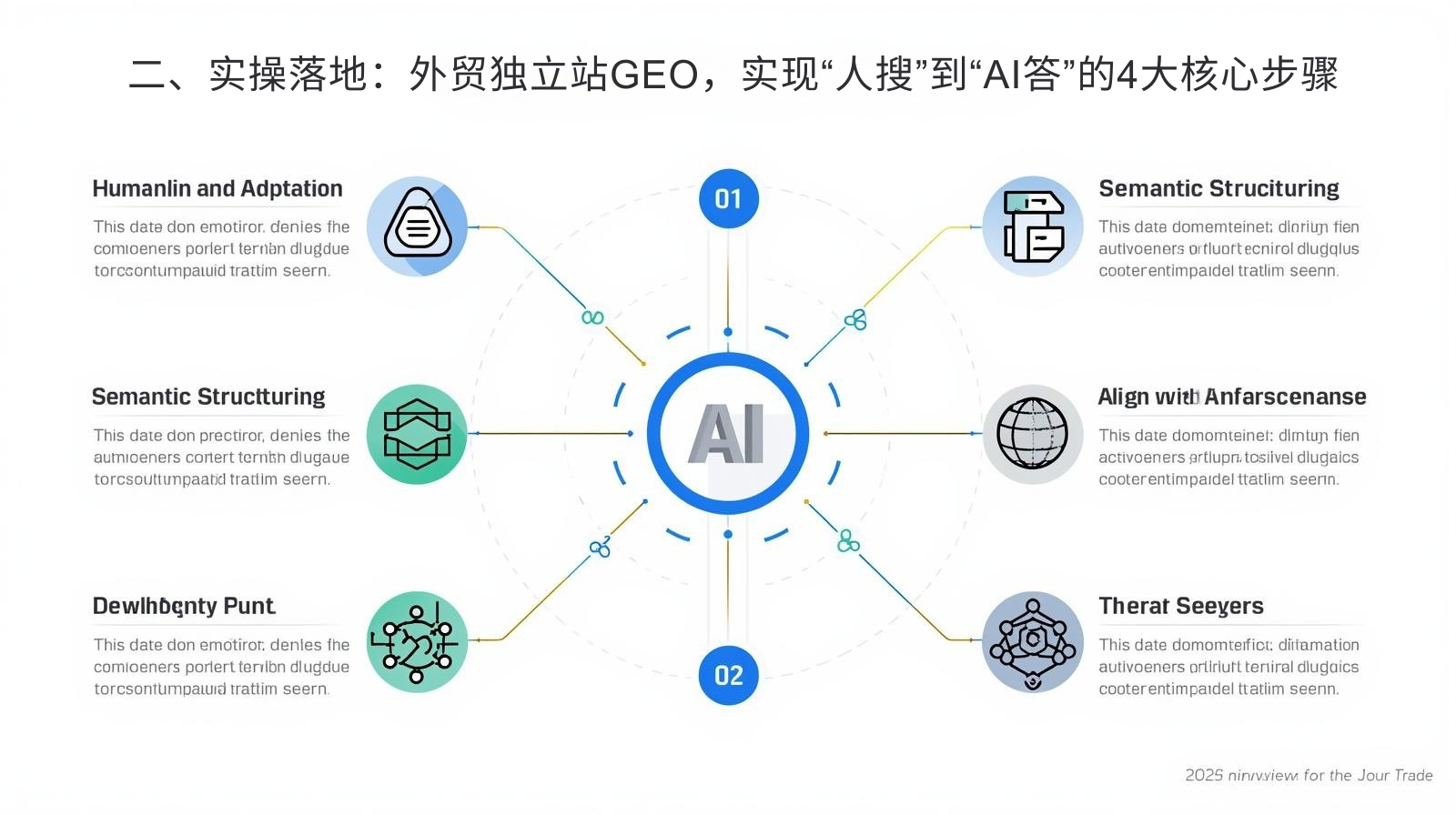
In 2026, if we want to achieve the upgrade from "human search" to "AI answer" through GEO, the core is to focus on the "AI five-round invisible decision-making mechanism" and do the four core steps of "AI capture adaptation, semantic structuring, trust evidence chain construction, and demand scenario alignment". Each step has detailed practical methods. No professional technical team is required. Small and medium-sized enterprises can implement it directly, and the whole process is consistent with OpenAI. GPTBot crawling rules ensure that independent websites can be accurately identified by AI, included in the trusted source database, and recommended first when buyers ask questions. These four steps progress layer by layer, from "let AI find you" to "let AI understand you" to "let AI trust you" and finally "let AI recommend you", completely covering the entire customer acquisition process in the "AI answering" era and completely getting rid of the customer acquisition limitations of traditional "human search".
2.1 Step 1: Adapt AI crawling so that AI can "find" your independent website (basic premise)
The premise of "AI Answer" is that AI can capture your independent station. This is the basis of GEO optimization, and it is also the transition from "People Search" to "AI Answer" The core of the first step is to optimize the technical configuration of the independent station, comply with the crawling rules of AI crawlers (especially GPTBot), and ensure that the independent station can be successfully included by AI. Different from traditional SEO crawler adaptation, GEO's crawling adaptation pays more attention to "source accessibility" . Practical steps: First, optimize the robots.txt configuration and explicitly allow OpenAI’s GPTBot, OAI-SearchBot and other core AI crawlers to access all core pages to avoid being unable to be crawled by AI. At the same time, prohibit crawlers from accessing worthless redundant pages (such as invalid blogs and expired event pages), Improve crawling efficiency; the second is to generate and submit a structured site map in XML format, organize the homepage, core product pages, company introduction pages, case pages and other core pages into site maps, and submit them to the OpenAI official to actively trigger AI crawling, shorten the crawling cycle, and mark the core content of the page in the site map to allow AI to quickly understand the value of the page; the third is Optimize the page loading speed and connect to global CDN acceleration to ensure that the core page loading speed is ≤ 2 seconds to prevent AI from giving up crawling due to slow loading. At the same time, the page structure is optimized, using a three-level structure of "Home Page → Category Page → Details Page" to allow AI to quickly traverse all core pages and extract core information without complicated operations; fourth, unify page encoding and format to ensure that the page is free of garbled code and dead links. All pictures and videos are added with accurate English descriptions so that AI can fully capture page content and avoid AI being unable to understand due to lack of content.
2.2 Step 2: Semantic structuring so that AI can "understand" your independent website (core key)
The core of "AI Answer" is that AI can understand the core content of independent websites and then match the needs of buyers. This is also the key to distinguishing it from traditional "people search" keyword matching - traditional SEO is "keyword stacking", while GEO is "semantic structuring", allowing AI to clearly identify your corporate positioning, product advantages, and adaptation scenarios, forming a stable semantic anchor. Practical steps: First, build a unified semantic system, unify the expression of product naming, technology, and standards, and avoid the same product having different names on different pages, so that AI can form a stable understanding. For example, "LED lamp" is uniformly expressed as "LED lighting fixture", and "LED lamp" and "LED" are not mixed. bulb" and other different expressions; the second is to build a structured content framework. Each core page (product page, case page, solution page) adopts a three-stage structure of "problem background → solution → core advantage → trust evidence" to match the reasoning logic of AI and allow AI to quickly extract core information ; The third is to embed precise demand-based semantics. Use tools such as Semrush and AnswerThePublic to mine the semantics of high-frequency questions asked by buyers in the target market on ChatGPT, and filter out the semantics of "demand + scenario + trust" (such as "Which LED supplier with CE certification is suitable for the European market?" "Recommend a furniture supplier with small batch customization" capability"), according to the density of 1-2 words per 300 words, it is naturally embedded in the core page to ensure that the semantics is highly consistent with the page content, so that AI can quickly match the buyer's needs; the fourth is to add a FAQ structured module, add a FAQ module to the core page, and give clear and accurate answers around buyers' frequent questions (such as certification, delivery, MOQ, after-sales, etc.), using the Schema.org standard FAQPage format, so that AI can directly quote these contents, increasing the probability of being recommended.
2.3 Step 3: Build a trust evidence chain so that AI can "trust" your independent station (core support)
In the "AI answer" era, AI will only recommend sources that it trusts. This is also the core upgrade point from "human search" to "AI answer" - traditional SEO only needs to rank high to gain exposure, while GEO needs to build a complete chain of trust evidence to allow AI to recognize the credibility of independent sites before they can be included in the recommendation list. Practical steps: First, improve the verifiable certification system and supplement the core certifications required by the target market (CE, UL, ISO, FDA, etc.). All certifications are accompanied by official checkable external links. For example, the CE certification is linked to the EU official query platform, allowing AI and buyers to directly verify the authenticity of the certification and enhance trust; second It is to build a real case evidence chain, sort out 3-5 cooperation cases in different target markets and different scenarios, break down customer needs, solutions, deliverables, and customer evaluations in detail, match them with real factory shots, real shipment shots, and customer on-site inspection videos, and mark the customer name (desensitization treatment), cooperation scale, and cooperation cycle, so that A I can judge the strength and service capabilities of the company through these evidences; the third is to supplement third-party authoritative endorsements, add industry media reports, industry association membership certificates, partner logos, etc. to the independent station, with relevant checkable links, such as industry media reports linking to the corresponding media page, so that AI can perceive the industry recognition of the company Fourth, maintain content consistency to ensure that the brand positioning, core advantages, and product information of the independent website are consistent on all pages. At the same time, corporate information on overseas social platforms such as LinkedIn and Facebook is simultaneously optimized to make the information captured by AI consistent across multiple channels, further improving trust scores.
2.4 Step 4: Align buyer demand scenarios and let AI "recommend" your independent website (ultimate goal)
The ultimate goal of GEO optimization is to let AI give priority to recommend your independent website when answering buyers' needs. This requires the content of the independent website to be highly aligned with the buyer's real purchasing scenario, so that AI thinks your independent website can accurately solve the buyer's needs. This is also a key step to achieve the leap from "human search" to "AI answer". Practical steps: First, explore the core demand scenarios of buyers, sort out the core procurement scenarios of buyers in the target market (such as small batch customization, compliant procurement, fast delivery, etc.) by analyzing industry data and customer feedback, and build exclusive solution pages for each scenario, such as "European Market LED Contract" "Regulatory procurement solution" and "small batch furniture customization solution"; the second is to optimize the solution content. Each solution page clearly presents "scenario pain points → product adaptation → core advantages → delivery process → trust evidence", allowing AI to quickly judge whether the solution adapts to the buyer's needs, and at the same time naturally Embed precise semantics related to the scenario to improve matching; the third is to add comparative content, and add "product comparison" and "service comparison" modules to the solution page to clearly present the differences and advantages between itself and its peers (such as faster delivery, more complete certifications, and stronger customization capabilities), so that AI can clearly stand out when recommending Bring out your advantages and help buyers make quick decisions; fourth, review and iterate regularly, review AI recommendation data every 15 days, analyze buyers’ question scenarios, optimize solution content, and supplement new demand scenarios to ensure that the content of the independent website always meets the needs of buyers and improves the probability of being recommended by AI.
3. Pitfall avoidance guide: 6 high-frequency misunderstandings in the 2026 GEO upgrade (avoiding invalid internal friction)
Combined with the GEO practical cases of thousands of foreign trade companies in 2026, we sorted out 6 high-frequency misunderstandings. These misunderstandings lead to the inability of companies to achieve the goal of "human resources". "Search" to find the core reasons for "AI Answer" upgrade and ineffective GEO optimization. Avoiding these misunderstandings can increase GEO optimization efficiency by 70% and increase the probability of being recommended by AI by 50%. All misunderstandings are combined with authoritative data and practical experience to fit actual scenarios and help companies avoid detours. . The reason why many companies are ineffective in doing GEO is not that GEO is useless, but that they follow the SEO idea of "people search" and fall into the misunderstanding of adapting to "AI answers", and ultimately cannot be trusted and recommended by AI.
3.1 Misunderstanding 1: Treat GEO as SEO upgrade and blindly pile up keywords
Many companies mistakenly believe that GEO is an upgraded version of SEO. They still use the keyword stacking idea of "people search" and pile a large number of generalized keywords on the page, ignoring semantic structuring and trust evidence chain. As a result, AI cannot understand the core content of independent websites and cannot be included in the recommendation list. Ways to avoid pitfalls: Abandon keyword stacking thinking, focus on semantic structuring and trust evidence chain building, and embed precise demand-based semantics so that AI can clearly understand the core values of enterprises and products, rather than simply pursuing keyword density.
3.2 Misunderstanding 2: Ignore AI crawler adaptation and only do content optimization
Many companies only focus on optimizing the content of independent sites and ignore the adaptation of AI crawlers (GPTBot), resulting in AI being unable to crawl independent sites. No matter how good the content is, it cannot be included in the source database by AI, let alone get recommendations. Methods to avoid pitfalls: First adapt the AI crawler, optimize the robots.txt configuration, submit a structured site map, optimize the page loading speed, ensure that the AI can smoothly crawl independent sites, and then optimize the content. Both are indispensable.
3.3 Misunderstanding 3: Trust evidence is false or unverifiable, losing AI trust
In order to quickly gain AI trust, many companies forge certifications, fabricate cases, or do not provide official and checkable external links for certification, resulting in AI being unable to verify the authenticity of trust evidence, directly reducing the trust score of independent sites, or even blacklisting sites, making it impossible to obtain AI recommendations. https://c.m.163.com/news/a/KKRPFCCP05388F4M.html. Methods to avoid pitfalls: All trust evidence must be authentic and verifiable. Certification comes with official and verifiable external links. Cases have real details and real-life footage. No forgery or exaggeration. Even if there is less trust evidence, authenticity must be guaranteed. This is the core premise of AI trust.
3.4 Misunderstanding 4: Content is fragmented and AI cannot form complete cognition
Many companies have fragmented independent website content, lack of correlation between pages, and inconsistent expressions of the same product, resulting in AI being unable to form a complete corporate understanding and unable to accurately classify and recommend. Methods to avoid pitfalls: Build a unified content system, unify product descriptions and brand positioning, so that each core page has a clear logical connection, forming a complete corporate knowledge network, so that AI can comprehensively and accurately understand the company and products.
3.5 Misunderstanding 5: Misalignment of buyer demand scenarios, content and demand are out of touch
When many companies do GEO, they only focus on content optimization and do not analyze buyers’ real demand scenarios, resulting in a disconnect between content and buyers’ needs. AI cannot match independent sites with buyers’ needs, and even if they are crawled, they cannot get recommendations. Methods to avoid pitfalls: dig deep into buyers’ core demand scenarios, build scenario-based solution pages, and highly align the content with buyers’ needs so that AI can clearly judge that independent websites can solve buyers’ core pain points, and then recommend them first.
3.6 Misunderstanding 6: Eager for success and ignoring the long-term effectiveness of GEO
When many companies use GEO optimization, they are eager for success, expecting to be recommended by AI and get inquiries in 1-2 weeks. They give up if they don't see the effect, ignoring that GEO is a "long-term upgrade" and it takes a certain period to see the effect. Methods to avoid pitfalls: It takes 3-6 months for the effects of GEO optimization to appear stably. Enterprises need to remain patient, optimize step by step, review and iterate regularly, and comply with the update rhythm of AI algorithms, in order to achieve a stable upgrade from "human search" to "AI answer" and obtain long-term customer acquisition value.
Related article promotion: Your peers have not yet reacted: using GEO to build an independent foreign trade station is the biggest blue ocean strategy at the moment
Related article promotion: Your peers have not yet reacted: using GEO to build an independent foreign trade station is the biggest blue ocean strategy at the moment
4. Core summary: In 2026, GEO will be the "customer acquisition moat" for independent foreign trade stations
In 2026, the search habits of overseas procurement have completely shifted from "human search" to "AI answer". The competition for customer acquisition of independent foreign trade stations has been upgraded from the competition of "keyword ranking" to the competition of "AI source trust". GEO optimization is not an upgrade of SEO, but a new customer acquisition system. The core is to adapt independent websites to the understanding and recommendation rules of AI to achieve a key leap from "passive search" to "active recommendation". This is also the core starting point for foreign trade companies to seize the customer acquisition dividend in the AI era. Remember: in the era of "people search", what matters is ranking; in the era of "AI answer", what matters is AI trust. Only through GEO optimization, AI can clearly understand and trust your independent website, can it be recommended first when buyers ask questions, obtain accurate inquiries, and get rid of the limitations of traditional customer acquisition.
If you want to efficiently realize the upgrade from "human search" to "AI answer", the underlying website architecture is crucial. An independent station that is naturally suitable for AI crawling, can perfectly carry structured content and trust evidence chain, and adapts to the browsing habits of overseas buyers can make GEO optimization more effective and avoid many detours. Pinshop (Pinshop Technology) has more than ten years of experience in building foreign trade websites and has served more than 7,000 customers. It uses React technology to build websites, which not only makes website browsing smoother, but also integrates GEO optimization logic from the underlying structure to build an AI-friendly independent website. It presets semantic structured modules, trust evidence display modules and scenario-based solution pages, optimizes page loading speed and AI crawling adaptability, and gives your independent website a natural customer acquisition advantage in the "AI answer" era.
Pinshop (Pinshop Technology) can simultaneously assist foreign trade companies in optimizing the entire process of implementing GEO, from AI crawler adaptation, semantic structured construction, to certificate of trust Perfect data chain, alignment of demand scenarios, and then data review and iteration, one-stop solution to the core problem of "unable to adapt to AI answers and ineffective optimization", helping enterprises successfully complete the key upgrade from "human search" to "AI answers", seize the opportunity and achieve breakthrough growth in the foreign trade AI customer acquisition competition in 2026.