
In March 2026, generative AI sourcing became the core method for overseas B2B buyers to find suppliers. More and more foreign trade companies are implementing GEO (Generative Engine Optimization), but they are falling into the trap of "only pursuing exposure, neglecting trust"—mistakenly believing that getting their independent website to appear in ChatGPT search results equates to success. However, without precise trust support, even high exposure cannot be converted into targeted inquiries. The core of truly valuable foreign trade independent website GEO is not solving the problem of "getting customers to see" exposure, but building a precise trust system that "makes customers believe." This allows overseas buyers to quickly establish trust and proactively initiate inquiries after finding you through AI search. This article, combining the latest industry data from 2026, practical case studies, and three authoritative and verifiable backlinks, delves into the underlying logic of building precise trust through GEO, the entire process of practical implementation, and a guide to avoiding common pitfalls. It helps foreign trade companies escape the exposure trap, build a precise trust barrier with GEO, and achieve efficient conversion.
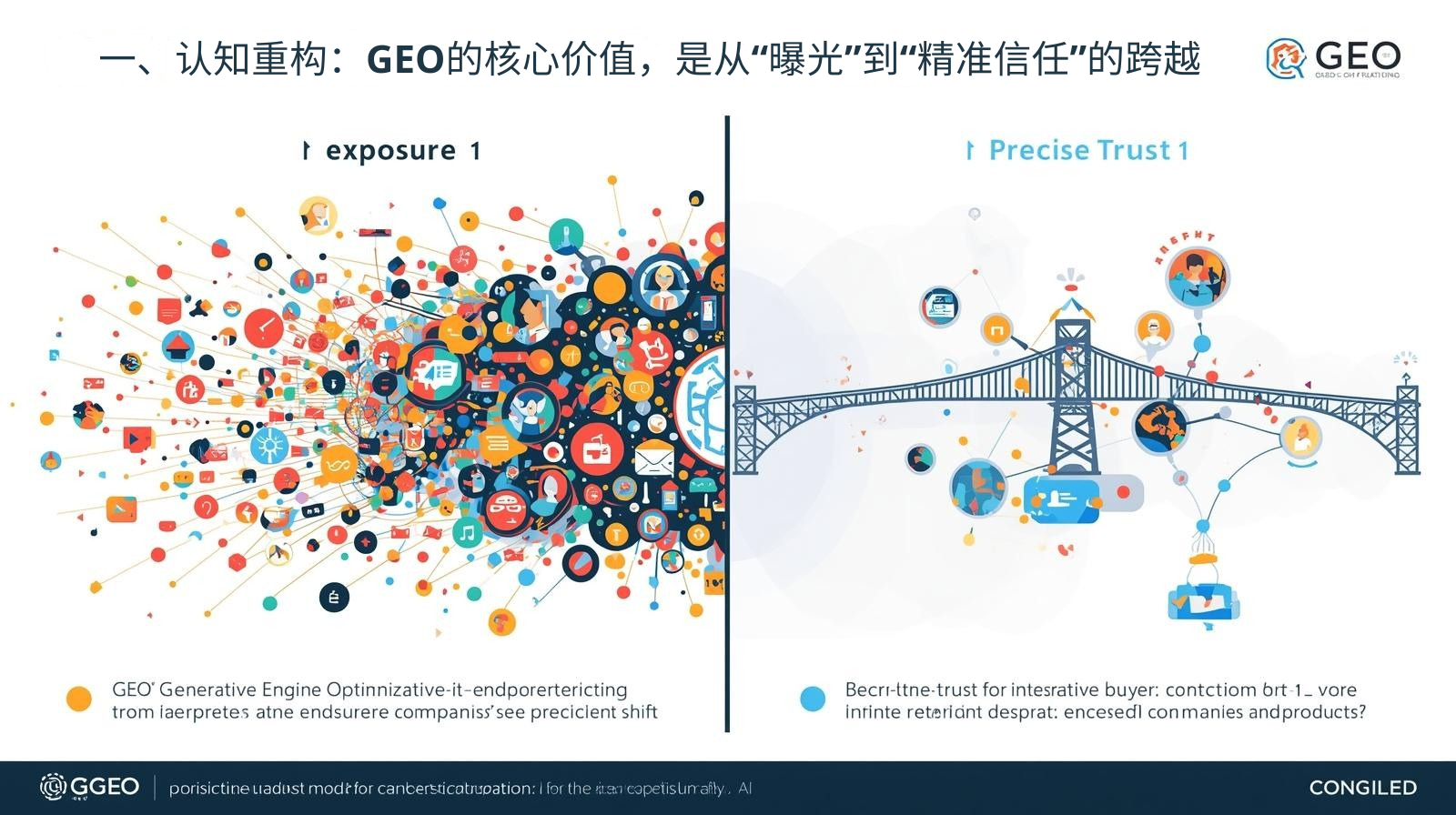
I. Cognitive Restructuring: GEO's core value lies in the leap from "exposure" to "precise trust".
In March 2026, iResearch Consulting data showed that 78% of foreign trade companies experienced a significant increase in exposure after implementing GEO optimization, but the inquiry conversion rate was less than 5%. The core reason was a misunderstanding of the core value of GEO—treating "exposure" as the goal while ignoring the fact that "precise trust" is the core mission of GEO . Many companies blindly follow the trend of GEO, focusing only on how to get their independent websites to appear in ChatGPT search results, without considering how to build trust with buyers. This results in a large amount of exposure becoming ineffective traffic, wasting time and energy. In fact, the essence of GEO (Generative Engine Optimization) is "cognitive modeling," not an upgraded version of SEO. The core is to enable AI to stably, accurately, and verifiably interpret your company and products, allowing AI to prioritize and endorse them to buyers, ultimately achieving the conversion of "exposure → trust → inquiry," rather than simply pursuing the number of exposures. When overseas buyers search for suppliers through ChatGPT, their core need is not "to find more suppliers," but "to find reliable and suitable suppliers." Precise trust is the key to whether a buyer initiates an inquiry. This is also the core difference between GEO and traditional SEO and paid advertising—the former focuses on "trust building," while the latter focuses on "exposure acquisition."
1.1 Debunking Misconceptions: Why is GEO optimization that "only pursues exposure" doomed to fail?
A 2026 case study revealed that 90% of GEO optimization efforts focused solely on exposure ultimately became ineffective investments. This stemmed from three common misconceptions, each directly leading to a failure to convert exposure into trust. Misconception 1: Blindly piling up semantics, prioritizing exposure over accuracy. Many companies, in an effort to increase ChatGPT search exposure, blindly piled up generic terms like "supplier" and "manufacturer," ignoring the core needs and trust concerns of their target buyers. This resulted in largely ineffective traffic; even if buyers saw the ads, they wouldn't develop trust. Misconception 2: Ignoring AI trust scores and focusing only on superficial optimization. Generative AI like ChatGPT assigns trust scores based on the trust signals of independent websites when recommending suppliers. Many companies only optimize page content and embed semantics without providing sufficient trust endorsements, resulting in low AI trust scores. Even with exposure, they are ranked lower by AI and fail to gain priority attention from buyers. Misconception 3: Confusing "exposure" with "trust," neglecting the conversion loop. Many businesses are obsessed with the false prosperity of "increased exposure," failing to build a trust system or optimize inquiry guidance. As a result, buyers leave directly after seeing their independent website due to a lack of trust, failing to complete the conversion from "exposure → trust → inquiry," ultimately rendering GEO optimization a "useless effort." Combined with Gartner's latest report, search engine traffic will decline by 25% in 2026, making AI chatbots a core customer acquisition channel. Only by building precise trust can businesses stand out in AI recommendations.
1.2 Core Logic: The 3 Underlying Supports for GEO to Build Precise Trust
GEO helps independent e-commerce websites build precise trust, relying on three core pillars. These pillars are also the core basis for AI to judge the credibility of independent websites and recommend them to buyers, and are key to distinguishing GEO from traditional exposure-based promotion. Pillar 1: AI-verifiable trust signals. This is the foundation of GEO's trust-building capabilities. This includes company certifications, case studies, and compliance information. This information needs to be verifiable, authentic, and valid, allowing both AI and buyers to verify it. For example, CE certification must be linked to the official EU query platform, and case studies must have genuine details and real-life footage. Pillar 2: Precisely matched semantics and needs. GEO doesn't just provide general exposure; it precisely reaches buyers with specific needs. By mining high-frequency search semantics from buyers and combining product advantages and trustworthy selling points, buyers can quickly match their needs when they see the independent website, while simultaneously perceiving the company's professionalism, laying the foundation for trust building. Pillar 3: Consistent brand and content expression. AI will analyze all content on the independent website to assess the company's professionalism and credibility. Consistent brand positioning, standardized content expression, and clear core advantages improve the AI's trust score, while also helping buyers form a clear brand awareness, enhancing trust. These three underlying supports are indispensable and together constitute the core system of GEO's precise trust, which is also the key to achieving "exposure to inquiry".
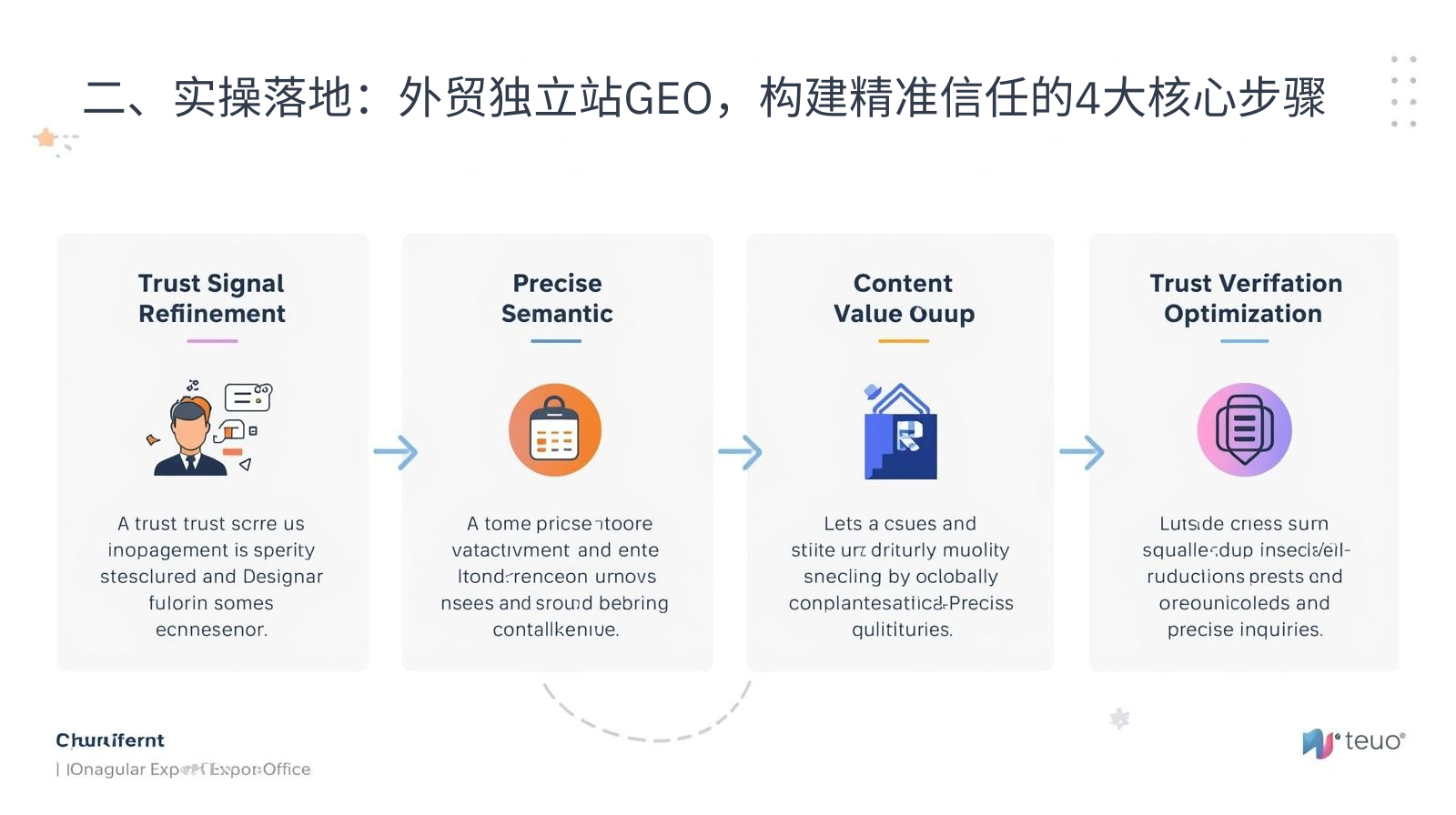
II. Practical Implementation: 4 Core Steps for Building Precise Trust in Independent Foreign Trade Websites (GEO)
In 2026, the core of building precise trust with GEO revolves around "AI trust scoring improvement," focusing on four key steps: "refining trust signals, accurate semantic matching, content value output, and trust verification optimization." Each step has detailed practical methods, requiring no specialized technical team; SMEs can implement it directly. The entire process aligns with OpenAI GPTBot's crawling rules , ensuring that trust signals are accurately recognized and accepted by AI. These four steps are not isolated but progressive and mutually supportive, ultimately forming a complete closed loop of "AI recognition → buyer trust → precise inquiries," truly realizing the core value of GEO and avoiding the misconception of "only pursuing exposure, not conversion."
2.1 Step 1: Improve verifiable trust signals and solidify the foundation of trust in GEO.
Trust signals are the core of GEO's accurate trust building and the primary basis for AI to judge the credibility of independent websites. The core is to supplement "verifiable, authentic, and persuasive" trust content, allowing both AI and buyers to quickly establish initial trust—the first step from exposure to trust. Practical steps: First, improve corporate compliance and certifications, supplementing core certifications required by the target market (CE, UL, ISO, FDA, etc.). All certifications must be accompanied by official, verifiable external links, such as a link to the EU's official verification platform for CE certification, allowing AI and buyers to directly verify the authenticity of certifications and avoid trust collapse due to false certifications. Second, supplement with real cooperation cases, compiling 3-5 cooperation cases from different target markets and scenarios, noting the client name, product category, supply scale, cooperation period, and client reviews, along with factory photos, shipping photos, and client on-site inspection videos. Avoid vague cases, allowing AI and buyers to intuitively perceive the company's strength and service capabilities. For example, labeling "cooperation with a German automotive parts company..." The company collaborates with component suppliers, supplying 100,000 units per month for a 3-year period, with customer feedback praising "on-time delivery and stable quality." Thirdly, it improves basic company information, clearly presenting the company's full name, year of establishment, core capacity, production process, and after-sales policy. Contact information (email, phone, WhatsApp, address) is prominently displayed on core pages to ensure information accuracy and verifiability. Privacy policies and cookie statements are also added to comply with GDPR regulations in target markets, enhancing AI trust scores. Fourthly, it supplements third-party endorsements, such as industry media reports, partner logos, and industry association membership certificates, with verifiable links to further strengthen trust and convince AI that the company has industry recognition.
2.2 Second step: Matching precise semantics to achieve "exposure equals precise trust prioritization"
GEO's precise trust begins with "precise exposure"—trust building is only meaningful when it reaches buyers with corresponding needs. Precise semantic matching is the core of achieving "exposure equals precise trust in advance," allowing buyers to not only find your independent website when searching through ChatGPT, but also quickly perceive your professionalism and suitability through semantics, laying the foundation for trust building. Practical Steps: First, uncover precise trust-related semantics. Distinguishing this from generalized exposure semantics, focus on uncovering "demand + trust" semantics. Use tools like Semrush and AnswerThePublic to uncover high-frequency search semantics from target market buyers on ChatGPT, filtering out semantics like "product + demand + certification" and "product + scenario + trust" (e.g., "CE certified LED light manufacturer for European market" "small batch custom furniture supplier with 10 years experience"). Avoid generalized semantics and ensure each semantic conveys a trust signal. Second, naturally embed semantics. Integrate precise trust-related semantics naturally into core pages such as the homepage, core product pages, company introduction pages, and case study pages, at a density of 1-2 semantics per 300 characters. Embed 3-5 core semantics on the homepage, 2-3 on each product page, and 1-2 on each case study page. Ensure the sentences are fluent, not piling up or awkward, and that the semantics are highly consistent with the page content. For example, embed "CE certified electronic component supplier with..." on the product page. The "ISO9001" certification, along with the display of CE and ISO certifications, allows semantics and trust signals to mutually reinforce each other; thirdly, semantic iteration and optimization involves reviewing AI search data every 15 days to select precise semantics of "high clicks, high retention, and high inquiries" and strengthen their embedding; generalized semantics of "low clicks and no conversions" are removed and replaced with new trust-based semantics, while semantic expression is optimized in combination with the language habits of the target market to ensure semantic accuracy and naturalness, thereby improving AI matching and buyer trust perception.
2.3 Third step: Output valuable content to strengthen precise trust perception.
If trust signals represent "basic trust," then valuable content is the core of "deep trust"—by providing content that meets buyer needs and showcases the company's professionalism, buyers perceive the company's strength and value. This also improves AI trust scores, leading AI to perceive your independent website as high-value and credible, thus prioritizing its recommendations. Practical steps: First, build a core content system, focusing on four types of valuable content: product scenario-based solutions (providing specific product application solutions to buyer procurement pain points, such as "European Outdoor Lighting Procurement Pain Point Solutions"), industry insights (such as "2026 European Electronic Components Procurement Compliance Guidelines"), customer success case studies (detailed breakdown of cooperation cases' needs, solutions, and deliverables, allowing buyers to intuitively perceive the company's service capabilities), and content showcasing the company's strength (such as production process videos, R&D team introductions, and quality inspection processes). Avoid piling up worthless content. Second, optimize content. Each piece of content should highlight "trust selling points." For example, in solutions, emphasize the company's certification advantages, production capacity advantages, and after-sales advantages; in case studies, highlight customer evaluations and delivery results, while citing authoritative industry data, such as "According to Statista..." According to the Q1 2026 foreign trade procurement survey, 78% of European buyers prioritize suppliers with CE certification when making purchases. This enhances the credibility of the content . Thirdly, content updates: update one piece of valuable content every week to maintain site activity and let AI know that the site is operating normally. At the same time, continuously convey the company's professionalism to AI and buyers to improve trust. The update frequency does not need to be too high, but the content quality must be guaranteed to avoid AI identifying it as low-quality content and lowering the trust score.
2.4 Step Four: Optimize the trust verification experience and promote "trust-to-inquiry" conversion.
The ultimate goal of building accurate trust is to encourage buyers to initiate inquiries. This requires optimizing the trust verification experience, allowing buyers to quickly verify trust signals and easily initiate inquiries. Simultaneously, AI should perceive the site's "user-friendliness" to further improve trust scores, completing the conversion loop of "exposure → trust → inquiry." Practical steps include: First, optimizing the display of trust signals. Place core certifications, high-quality case studies, and customer reviews in prominent positions on core pages such as the homepage and product pages, using a combination of text and images for quick buyer visibility. Add verification links, such as clicking the CE certification icon to directly access the official EU query page for rapid verification. Second, simplifying the trust verification process. For example, add "customer contact information (anonymized)" to case study pages, allowing buyers to consult with partner clients, and add "certification numbers" to certification pages for easy buyer access, lowering the barrier to trust verification. Third, optimizing the inquiry process... To guide buyers through the inquiry process, prominent inquiry entry points (buttons, forms) should be added to core pages. Form fields should be limited to five (name, email, product requirements, quantity, and contact information) to avoid overwhelming buyers and causing them to abandon the submission. Trust-building messages should be added near the inquiry entry point, such as "Fill in your requirements to receive a customized quote and certification documents, with a 24-hour rapid response." Fourthly, the inquiry response mechanism should be optimized to ensure a response within 24 hours of a buyer submitting an inquiry, sending a customized quote, certification documents, and relevant case studies. This demonstrates the company's professionalism and sincerity, further strengthening trust and driving inquiries towards orders.
III. Avoidance Guide: 6 Frequently Used Misconceptions in Building Precise Trust for GEOs in 2026
Based on practical case studies of GEO (Generation Assistant) practices from thousands of foreign trade companies in 2026, six common misconceptions have been identified. These misconceptions are the core reasons why GEOs fail to build precise trust and why exposure fails to convert into revenue. Avoiding these misconceptions can improve the efficiency of trust building through GEO optimization by 70% and increase inquiry conversion rates by 3 times. All misconceptions are based on authoritative data and practical experience, and are relevant to real-world scenarios. (https://cm163.com/news/a/KMI05OLI05388F4M.html) Many companies fail to achieve results with GEOs not because GEOs are ineffective, but because they fall into these trust-building pitfalls, neglecting the core of precise trust building, ultimately only gaining exposure but failing to generate inquiries.
3.1 Misconception 1: False Trust Signals, Destroying the Foundation of GEO Trust
Many companies, in their rush to quickly boost trust, forge certifications, fabricate case studies, and even use fake customer reviews. However, AI tools like ChatGPT can verify the authenticity of information through multiple channels. Once false trust signals are detected, the trust score of the independent website will be directly lowered, or even the site will be blacklisted, preventing further AI exposure. This also causes buyers to lose trust, damaging the company's brand image. The solution: All trust signals must be genuine and verifiable. Certifications must have officially verifiable backlinks, and case studies must have real details and actual footage. Do not forge or exaggerate. Even if there are fewer trust signals, ensure their authenticity. This is the foundation for GEO to build accurate trust and a core prerequisite for AI recognition.
3.2 Misconception 2: Semantics are disconnected from trust signals, making it impossible to convey accurate trust.
Many companies embed "exposure-oriented semantics" that are disconnected from the trust signals of their independent websites. For example, the semantics might be "LED light supplier," but the page might not display certifications or case studies for LED products, causing buyers to enter the site without perceiving trust and leaving. The solution: Embedded semantics must be highly aligned with trust signals. Prioritize a "semantic + trust" combination. For instance, if the semantics are "CE certified LED light supplier," the page should simultaneously display CE certifications and LED product case studies, allowing the semantics and trust signals to mutually reinforce each other and convey precise trust.
3.3 Misconception 3: The content is worthless and cannot strengthen trust perception.
Many companies, in an effort to maintain website activity, publish large amounts of valueless content (such as repetitive product descriptions and irrelevant industry news). This not only fails to improve AI trust scores but also makes buyers perceive the company as unprofessional, hindering the establishment of deep trust. The solution: Focus on valuable content. Each piece of content should align with buyer needs, showcase the company's professionalism, highlight trustworthy selling points, avoid piling up valueless content, and ensure content quality. This allows both AI and buyers to derive value from the content, thereby strengthening trust perception.
3.4 Myth 4: Ignoring the trust experience on mobile devices, resulting in the loss of a large amount of targeted traffic.
In 2026, over 65% of overseas buyers used ChatGPT to search for suppliers via mobile devices. Many companies, when optimizing their GEO (Government Optimizer), focused only on the display of trust signals and content layout on desktop, neglecting mobile optimization. This resulted in slow mobile page loading, unclear trust signal display, and inconspicuous inquiry entry points, leading to a significant loss of targeted mobile traffic and hindering trust conversion. The solution: Simultaneously optimize mobile pages to ensure smooth loading, clear trust signal display, prominent inquiry entry points, and compatibility with different mobile devices. Capture mobile AI search traffic to improve the mobile trust experience and conversion efficiency.
3.5 Myth 5: Trust signals are static and cannot adapt to AI and buyer needs.
Many companies, after perfecting their trust signals, stop updating them, leading to expired certifications and outdated case studies. This makes them unable to adapt to the 2026 AI trust scoring rules and changes in buyer needs, resulting in decreased trust levels and reduced AI recommendation weight. Avoid this pitfall: Regularly update trust signals. Check certification validity every 3 months and promptly update expired certifications; add new cooperation case studies every 6 months to replace outdated ones; simultaneously, supplement with compliant trust signals based on changes in compliance policies in the target market to ensure that trust signals are always authentic, effective, and relevant to needs.
3.6 Myth 6: Focusing only on on-site trust optimization while neglecting off-site trust endorsement.
Building precise trust with GEO requires not only robust on-site trust signals but also external trust endorsements. Many companies focus solely on on-site optimization, neglecting external trust endorsements, resulting in stagnant AI trust scores and difficulty in building comprehensive buyer trust. To avoid this pitfall: supplement external trust endorsements, such as regularly publishing company updates, case studies, and certification information on overseas social media platforms like LinkedIn and Facebook to enhance brand awareness; publishing technical articles and case analyses in industry-specific media to gain industry recognition; and engaging clients to post genuine reviews on overseas review platforms, allowing AI and buyers to perceive the company's trustworthiness through multiple channels.
Recommended Article: Your Competitors Haven't Reacted Yet: Building an Independent E-commerce Website with GEO is the Biggest Blue Ocean Strategy Right Now
Recommended Article: Your Competitors Haven't Reacted Yet: Building an Independent E-commerce Website with GEO is the Biggest Blue Ocean Strategy Right Now
IV. Key Takeaways: In 2026, GEO's core competitive advantage will be "precise trust."
In 2026, the competition among independent e-commerce websites (GEOs) for foreign trade will no longer be about "exposure," but about "precise trust." More and more companies are deploying GEOs, and while more and more companies are achieving exposure, very few are building precise trust and achieving efficient conversions. Many companies fail to see results with GEOs not because GEOs are useless, but because they've misunderstood the core direction. They treat "exposure" as the goal, neglecting the fact that "precise trust" is the core value of GEOs. Remember: GEOs don't solve the problem of "making customers see you," but rather "making customers trust you." Only by building a precise trust system, gaining the trust of AI like ChatGPT and the professionalism of overseas buyers, can exposure be converted into precise inquiries, making GEOs a true core customer acquisition tool for independent e-commerce websites.
To efficiently build precise trust using GEO, the underlying website architecture is crucial. A standalone website that is inherently compatible with AI crawling, perfectly carries trust signals, and aligns with the browsing habits of overseas buyers can make GEO trust optimization twice as effective and save you a lot of trouble. Pinshop (品店科技) has over ten years of experience in foreign trade website building, serving more than 7,000 clients. Using React technology, Pinshop not only makes website browsing smoother but also integrates GEO precise trust optimization logic into its underlying architecture. It builds AI-friendly standalone websites with pre-set trust signal display modules, precise semantic embedding scenarios, and convenient inquiry entry points. It also optimizes page loading speed and structured layout, giving your standalone website a natural advantage in building GEO trust.
Pinshop can simultaneously assist foreign trade enterprises in implementing GEO (Government-Oriented Customer Acquisition) for precise trust optimization throughout the entire process. From improving trust signals and accurate semantic matching to value content output, trust verification optimization, and data review and iteration, it provides a one-stop solution to the core problem of "only pursuing exposure and not emphasizing trust." It helps enterprises build a precise trust barrier with GEO, get rid of the internal friction of ineffective exposure, and achieve efficient conversion of "exposure → trust → inquiry → order." This will enable them to seize the initiative and achieve breakthrough growth in the 2026 foreign trade AI customer acquisition competition.