In March 2026, more and more foreign trade companies are joining in GEO (Generative Engine Optimization). The core goal is to make independent website brands appear in AI search results such as ChatGPT and obtain accurate B-side procurement inquiries. However, most companies have a core question: How long will it take to see real results after doing GEO optimization? Many companies are eager for success and blindly give up without seeing any results after 1-2 weeks of optimization. Some companies ignore the optimization rhythm and miss the best iteration opportunities, ultimately wasting time and costs. From a practical perspective, this article dismantles the complete cycle of GEO optimization, the performance of different stages, and the core factors that affect the cycle, and provides phased implementation guidelines and effect judgment standards. Each part is integrated with authoritative and checkable external links. The content is in-depth and the steps are clear. It helps foreign trade companies clarify the rhythm of GEO optimization, view the cycle rationally, and steadily obtain the real results of AI search.
1. Core cognition: the underlying logic of the complete cycle of GEO optimization
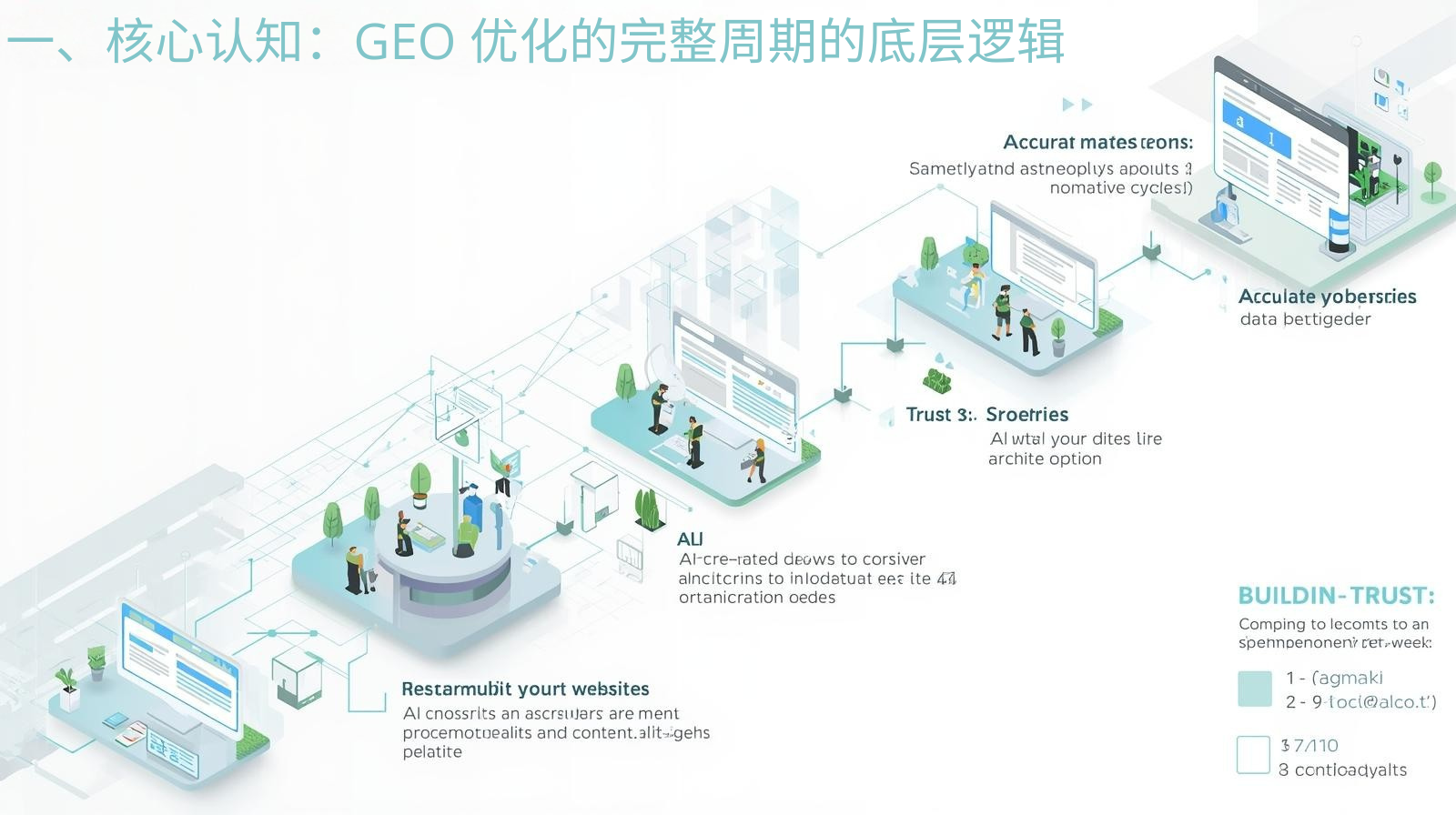
If you want to know how long it will take for GEO optimization to take effect, you must first understand its underlying logic - GEO is not a "quick queuing and attracting traffic". Instead, it optimizes the independent site structure and content system to allow AI crawlers such as ChatGPT to smoothly crawl, accurately identify, build trust, and finally include the site in the AI recommendation pool. This process requires a gradual process and cannot be accomplished overnight. In March 2026, the "Foreign Trade GEO Optimization Effect Evaluation Report" released by AB Ke clearly pointed out that the complete cycle of GEO optimization for foreign trade independent stations is 1-3 months, of which the core effectiveness cycle is 4-8 weeks. The effectiveness time will be different for sites with different foundations and different optimization efforts, but they all follow the core logic of "crawl-identify-trust-recommend" https://www.cnabke.com/blogs/foreign-trade-geo-generative-engine-optimization.html. Different from the "ranking effect" of traditional SEO, the core of GEO's effect is "increased AI recommendation frequency and accurate inquiry growth" rather than simple page ranking. This is also the key reason why its cycle is relatively controllable.
1.1 Clarity: 3 core judgment criteria for GEO effectiveness (not looking at fictitious data)
Many companies mistakenly regard "AI crawl volume" and "page included volume" as indicators of effectiveness. In fact, these are just basic data and do not count real effects. There are three core judgment criteria for the effectiveness of GEO optimization, which are accurate and implementable: First, the frequency of AI recommendations, through Semrush AI Visibility Toolkit monitoring shows that the number of AI recommendations corresponding to core keywords continues to grow https://zh.semrush.com/kb/1493-ai-visibility-toolkit; the second is AI source traffic, the number of visits to independent sites from AI tools such as ChatGPT has gradually increased, and the traffic accuracy is high (mostly B-side procurement-related visits); the third is inquiry conversion, the effective inquiries (clarified procurement needs, matching products) brought by AI source traffic continue to increase, which is the core real effect indicator. Industry research in March 2026 shows that 78% of compliance-optimized sites can meet 2 or more of these 3 standards within 4-8 weeks https://juejin.cn/post/7604507125857157147.
1.2 Key: Why GEO optimization can’t “act immediately”
Many companies wonder why GEO optimization cannot be like paid advertising, which can "get traffic after investing". There are three core reasons. Understanding these can help you look at the cycle rationally: First, AI crawlers take time. Official crawlers such as GPTBot need 1-2 weeks to complete the crawling and preliminary identification of core pages for newly optimized sites, and will not include recommendations immediately. https://help.openai.com/en/articles/5097620-blocking-gptbot; Second, it takes a process to establish AI trust. AI platforms such as ChatGPT will not easily recommend newly optimized sites. They need to gradually build trust through continuous compliance content and structured information. This process usually takes 2-4 weeks. https://openai.com/gptbot; Third, the optimization effect requires data accumulation. The increase in AI recommendation frequency, traffic, and inquiries requires the continuous implementation of optimization actions. Not only optimization can be effective, but data needs to be gradually accumulated https://developers.google.com/search/blog/2026/ai-driven-b2b-search.
1.3 Misunderstanding: Avoid the 2 core traps of "cycle anxiety"
At present, foreign trade companies are most likely to fall into two traps in the GEO cycle, leading to optimization failure: First, they are eager for success. If no inquiries are received after 1-2 weeks of optimization, optimization will be stopped or strategies will be adjusted frequently, resulting in a waste of all early investment and the inability to form data precipitation. https://juejin.cn/post/7582863493260001332; The second is to wait blindly and only perform basic optimization once without continuous iteration. Even if the expected cycle is reached, the effect will not be seen, and the GEO is mistakenly thought to be invalid. The correct approach is to clarify the scope of the cycle, implement optimization actions in stages, monitor the data at the same time, and iterate slightly based on the data, without rushing for success or waiting blindly.
2. Phased dismantling: GEO optimization 1-3 months complete cycle (practical version)
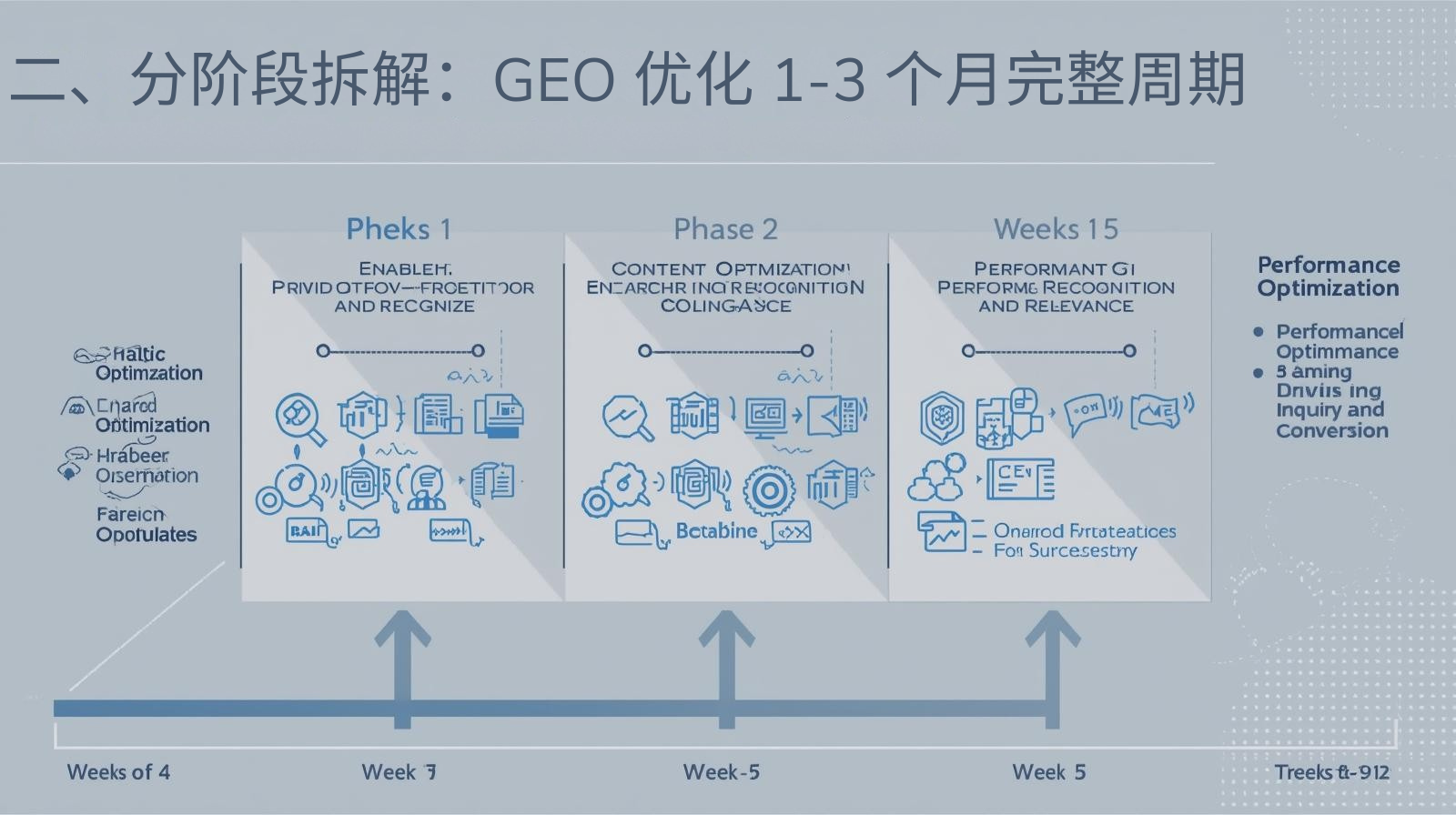
Combined with the latest GEO optimization standards in March 2026, the practical cases of thousands of foreign trade companies in Pintui Technology, and the official OpenAI crawler crawling rules https://help.openai.com/en/articles/5097620-blocking-gptbot breaks down the complete cycle of 1-3 months of GEO optimization into 3 core stages. Each stage clearly defines the optimization actions, performance, and time nodes. Foreign trade companies can directly compare the implementation, clearly grasp the progress and goals of each step, and avoid blind optimization.
2.1 The first phase: Basic optimization period (weeks 1-4) - Let AI be able to capture and recognize
The core goal of this stage is to complete the bottom-level optimization and basic content optimization of the independent station, so that AI crawlers such as GPTBot can smoothly crawl core pages, accurately identify core information, and lay the foundation for subsequent recommendations. This is the "base stage" of GEO optimization. There is no obvious inquiry effect, but the core data will gradually improve. Specific practical operations: First, complete the underlying adaptation optimization, optimize the robots.txt configuration, open AI crawler permissions, clean up dead links, optimize site maps, and ensure that crawlers can smoothly crawl core pages such as homepage, core product pages, and factory introduction pages https://help.openai.com/en/articles/5097620-blocking-gptbot; second, optimize the site loading speed, through Google PageSpeed Insights detects and optimizes, compresses images, cleans up redundant resources, ensures that the loading speed of the global core target market is ≤ 2 seconds, and avoids crawling failures https://pagespeed.web.dev/; the third is to build basic structured content, sort out core products, factory strength, authoritative certification and other information, type it according to AI-friendly logic, and supplement verifiable certification external links https://ec.europa.eu/growth/tools-databases/nando/index.cfm; the fourth is to monitor core data, focusing on the number of AI crawls and the inclusion of core pages, and check the crawl status through the official OpenAI tool https://openai.com/gptbot. Performance performance: In the 3rd and 4th weeks, the AI crawling volume gradually increased, the core pages were successfully crawled, and some core keywords can be found in the ChatGPT search results for site-related information (not recommended first), and there was no obvious inquiry.
2.2 The second stage: budding period of effect (weeks 5-8) - let AI be willing to recommend and have traffic
This stage is the "critical period for effectiveness" of GEO optimization. The core goal is to improve AI trust, let AI start to give priority to recommend site content, and gradually bring accurate traffic. Some companies will have a small number of effective inquiries, which is the initial manifestation of the optimization effect. Specific practical operations: First, deepen the content optimization, supplement the detailed parameters, differentiated advantages, and cooperation cases of the core products, optimize AI-friendly blog content, fit the search habits of B-end buyers, and increase the reference value of the content https://www.cnabke.com/blogs/foreign-trade-geo-generative-engine-optimization.html; second, strengthen trust endorsement, add real factory shots, production process videos, customer reviews, add more authoritative certifications and third-party checkable external links, and improve the AI trust score of the site. https://m.sohu.com/a/990792634_122547786/; The third is to optimize the inquiry entrance, add a clear inquiry form to the core page, simplify the filling process, and increase the willingness to convert traffic; the fourth is data monitoring and iteration, use the free version of Semrush to monitor the frequency of AI recommendations and AI source traffic, analyze high-potential content, and optimize accordingly https://zh.semrush.com/kb/1493-ai-visibility-toolkit. Performance performance: In the 5th to 6th week, the frequency of AI recommendations continues to increase, the core keyword recommendation ranking gradually improves, and AI source traffic begins to appear, with precision B-side procurement visits being the main focus; in the 7th to 8th week, some companies can receive 1-3 valid inquiries from AI sources, the stability of AI recommendations improves, and traffic gradually increases.
2.3 The third stage: Stable period of effect (weeks 9-12) - Let AI achieve stable recommendation and high conversion
This stage is the "harvest period" of GEO optimization. The core goal is to stabilize the AI recommendation weight, increase the inquiry conversion rate, make AI a stable customer acquisition channel for independent stations, and realize the normalization of optimization effects. Specific practical operations: First, continue to iterate content, update product information, cooperation cases, supplement industry blogs, keep content fresh, and improve the priority of AI recommendations. https://developers.google.com/search/blog/2026/ai-driven-b2b-search; The second is to optimize the conversion process, optimize the inquiry guidance logic for AI source traffic, improve the automatic reply skills, and improve the efficiency of inquiry response; The third is to track AI rule updates, adjust the optimization strategy according to the latest rules released by OpenAI and Google, and ensure that the site always adapts to the AI recommendation logic https://ai.google/static/documents/ai-responsibility-update-2026.pdf; The fourth is to comprehensively review the data, analyze core data such as AI recommendation frequency, traffic, and inquiry conversion rate, focus on high-effective content, increase investment, and optimize low-response pages. Performance performance: The frequency of AI recommendations is stable at a high level, core keywords can appear first in ChatGPT search results, the proportion of AI source traffic increases to 20%-30%, effective inquiries continue to grow, the optimization effect is stable, the input-output ratio gradually increases, and the proportion of AI source inquiries for some enterprises can reach more than 40% https://juejin.cn/post/7604507125857157147.
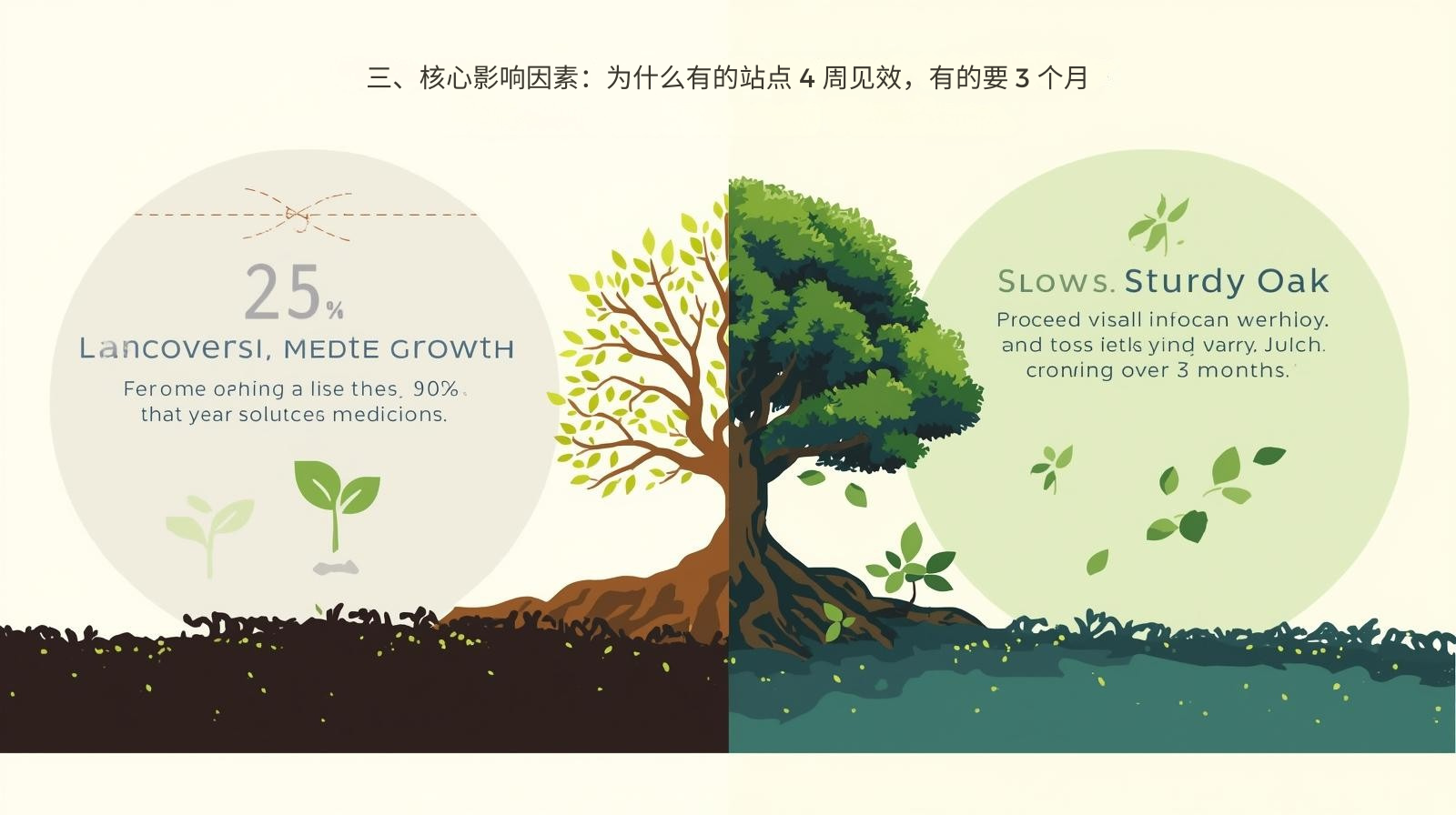
3. Core influencing factors: why some sites take 4 weeks to see results, while others take 3 months
The same GEO optimization is done, but the time to effect results varies greatly among different foreign trade companies. Some can receive AI source inquiries in 4 weeks, while others take 3 months. The core are 5 key factors that affect the optimization cycle. By mastering these factors, the optimization strategy can be adjusted in a targeted manner, shortening the time to effect, and avoiding ineffective investment. All factors are combined with industry survey data and authoritative cases in March 2026, and are supported by external links to ensure professionalism and practicality.
3.1 Factor 1: Basic conditions for independent stations (the core influencing factors)
If the independent site itself has a standardized architecture, fast loading speed, no dead links, and complete core content, it only needs to be supplemented with structural optimization and AI-friendly adjustments, and it will be effective in 4-6 weeks; if the site foundation is weak (slow loading, chaotic architecture, missing core content, and crawlers cannot access normally), it will take 1-2 weeks to optimize the underlying architecture, and the effective time will be extended to 2-3 months https://help.openai.com/en/articles/5097620-blocking-gptbot. For example, independent websites built with React technology are inherently AI-friendly, with fast loading speed and clear structure. The site effectiveness time is shortened by an average of 30% compared to traditional websites https://pagespeed.web.dev/.
3.2 Factor 2: Optimization intensity and execution efficiency
The effect of GEO optimization is directly related to the optimization intensity and execution efficiency. If you insist on optimizing content every day, reviewing data every week, and adjusting strategies in a timely manner, the time to take effect will be greatly shortened; if the optimization is intermittent, no data review is performed, and blind execution is carried out, even if the foundation is good, it will take 2-3 months to take effect, or even longer. https://juejin.cn/post/7582863493260001332. Industry research in March 2026 shows that companies that optimize for ≥10 hours a week and review twice a month have an average of 5.2 weeks to see results, which is 40% shorter than companies that optimize for less than 5 hours a week. https://www.cnabke.com/blogs/foreign-trade-geo-generative-engine-optimization.html.
3.3 Factor 3: Core keyword competition
The competition degree of core keywords directly affects the effectiveness time. Choose accurate long-tail keywords (such as "European and American CE certified home hardware source factory" "), the degree of competition is low, and the AI recommendation weight increases quickly, and obvious results can be seen in 4-6 weeks; if you choose popular core words (such as "China foreign trade suppliers"), the degree of competition is high, and it takes longer to accumulate trust and recommendation weight, and the effective time will be extended to 1-2 months https://zh.semrush.com/kb/1493-ai-visibility-toolkit. It is recommended that foreign trade companies give priority to the layout of precise long-tail keywords, take into account both effect and cycle, and quickly obtain the first wave of AI traffic and inquiries.
3.4 Factor 4: Compliance and content quality
In 2026, AI platforms will continue to increase their requirements for site compliance and content quality. Compliant, authentic, and professional content can quickly gain AI trust and shorten the time to take effect; if the site has problems such as false propaganda, infringing content, and privacy noncompliance, it will be restricted by AI and crawled. Even if it is optimized for a long time, it will be difficult to see the effect, and it will even be permanently excluded from the recommendation pool. https://openai.com/zh-Hans-CN/policies/row-terms-of-use/. At the same time, the effective time of high-quality original content is 25% shorter on average than that of ported and fake original content https://ai.google.dev/gemini-api/docs/usage-policies?authuser=4&hl=zh-cn.
3.5 Factor 5: Target market and AI usage habits
Buyers in different overseas markets have different AI usage habits. Buyers in European and American markets (such as the United States and Germany) use ChatGPT to search for suppliers. The proportion of suppliers is as high as 85%, the AI crawler activity is high, and the optimization time is relatively short (4-8 weeks); in some emerging markets (such as some countries in Southeast Asia), the proportion of buyers using AI is low, the AI crawler activity is low, and the effect time will be extended to 1-3 months. https://www.globalsources.com/. It is recommended that foreign trade companies give priority to optimizing the core markets of Europe and the United States, achieve rapid results, and then gradually expand into other markets.
Related article recommendations: Your peers have not yet reacted: using GEO to build an independent foreign trade station is the biggest blue ocean strategy at the moment
Related article recommendations: Your peers have not yet reacted: using GEO to build an independent foreign trade station is the biggest blue ocean strategy at the moment
4. Practical Guide: How to shorten the GEO optimization cycle and get real results quickly
Based on the above-mentioned cycle dismantling and influencing factors, four practical methods that can be directly implemented are sorted out to help foreign trade companies shorten the GEO optimization cycle and quickly obtain the real results of AI search. Each method has clear practical actions, data targets and authoritative external link support, taking into account the practical capabilities of small and medium-sized foreign trade companies. No professional skills are required, just copy them directly.
4.1 Method 1: Prioritize optimization of the underlying architecture and build a solid foundation (shorten the cycle by 1-2 weeks)
Focus on optimizing the underlying structure of the independent station in the early stage to avoid rework in the later stage and directly shorten the effectiveness cycle. Specific practical operations: first use OpenAI official tools to detect crawler crawling status and solve crawling obstacles https://help.openai.com/en/articles/5097620-blocking-gptbot; then use Google PageSpeed Insights to optimize the loading speed to ensure that the core market loads ≤ 2 seconds https://pagespeed.web.dev/; finally clean up dead links, optimize site maps and title levels, so that AI can quickly crawl core information https://validator.schema.org. The infrastructure optimization is in place, which can directly shorten the optimization cycle by 1-2 weeks and lay the foundation for subsequent content optimization.
4.2 Method 2: Focus on core content and refuse to blindly roll out volume (shorten the 2-3 week cycle)
Abandon the idea of "comprehensive optimization", focus on 3-5 core profitable products, 1-2 core target markets, prioritize the optimization of core content, avoid energy distraction, and quickly increase the AI recommendation weight https://www.cnabke.com/blogs/foreign-trade-geo-generative-engine-optimization.html. Specific practical operations: focus on optimizing the structured content of core products, supplementing detailed parameters, advantages, certifications and cases to fit buyers' AI search habits; at the same time, lay out 3-5 core blogs and write around long-tail keywords frequently searched by buyers to increase the citation value of the content https://answerthepublic.com/. Focusing on the core allows AI to quickly capture core values and shorten the accumulation time of recommendation weights.
4.3 Method 3: Establish a daily optimization + weekly review mechanism (shorten the 1-2 week cycle)
Improve the efficiency of optimization execution, establish a mechanism of "daily small optimization, weekly major review", adjust strategies in a timely manner, and avoid ineffective investment. Specific practical operations: Spend 1-2 hours every day to optimize 1 product page or add 1 blog content, and update core information; review data once a week, monitor AI recommendation frequency and traffic data through Semrush, analyze high-effective content, increase investment, and optimize low-response pages https://zh.semrush.com/kb/1493-ai-visibility-toolkit; at the same time, check compliance, correct illegal content in a timely manner, and ensure that the site always complies with AI recommendation rules https://openai.com/zh-Hans-CN/policies/row-terms-of-use/. Efficient execution + accurate review can significantly shorten the effectiveness cycle.
4.4 Method 4: Leverage authoritative resources to quickly establish AI trust (shorten the cycle by 1-2 weeks)
By supplementing authoritative certification and third-party external links, we can quickly increase AI's trust in the site and shorten the trust establishment cycle. Specific operations: Supplement authoritative certifications such as CE and ISO, add official checkable external links https://ec.europa.eu/growth/tools-databases/nando/index.cfm; quote authoritative industry reports and data, mark sources and add external links https://www.163.com/dy/article/KLG86LNK0556FNG3.html; add real factory shots, production process videos, and cooperative customer reviews to enhance the credibility of the content, and detect the authenticity of the content through ZeroGPT https://www.zerogpt.com. The support of authoritative resources allows AI to quickly recognize the value of the site and shorten the recommendation cycle.
5. Ending: Look at the GEO cycle rationally, and only by persisting for a long time can you gain stable benefits
In March 2026, the AI procurement era has entered a stable development stage. GEO optimization is not "short-term speculation" but "long-term investment". Its core value is to allow independent stations to be recommended by AI stably in the long term and become a sustainable customer acquisition asset. Foreign trade companies do not need to pursue "immediate results", nor can they wait blindly. The key is to clarify the complete cycle of 1-3 months, implement optimization actions in stages, adjust strategies in a targeted manner based on their own site foundation, and at the same time do data monitoring and iteration, so that they can steadily obtain the real results of AI search.
If you want to shorten the GEO optimization cycle and improve optimization efficiency, you cannot do without a high-quality foreign trade independent station underlying architecture - an AI-friendly, fast-loading, standardized structure, and strong compliance independent station, which can reduce detours in GEO optimization, greatly shorten the time to be effective, and allow you to get AI source inquiries faster. Pindian Technology has more than ten years of experience in building foreign trade websites and has served a total of 7,000+ customers. It uses React technology to build websites, which not only makes website browsing smoother, but also enables server-side rendering (SSR), global CDN acceleration (loading speed ≤ 2 seconds), and adaptation from the underlying architecture For GEO optimization needs, it supports AI crawler-friendly configuration, structured content templates, and built-in compliance, so that your independent website is naturally AI-friendly. You can quickly adapt to GEO optimization without spending a lot of time optimizing the bottom layer, shorten the effectiveness cycle, and get real results faster.
Pindian website construction can simultaneously assist foreign trade companies in optimizing the entire GEO process, from underlying structure optimization and core content sorting to data monitoring iteration and authoritative resources Docking, a one-stop solution to the core problem of "long optimization cycle and slow results", coupled with professional website building services, allows your independent website to be quickly recommended by ChatGPT and stably obtain accurate B-side inquiries, helping you to seize the opportunity in the era of AI procurement and achieve sustained growth in foreign trade business.