
In March 2026, over 65% of overseas B2B buyers had prioritized ChatGPT and Google Gemini for procurement, no longer scrolling through Google search results page by page. Traditional independent foreign trade websites are still focused on keyword rankings and click-through rates, while leading companies have already used GEO (Generative Engine Optimization) to transform their sites into AI trust sources, appearing directly in AI-generated answers. Traffic-driven thinking seeks to "be seen," while AI-driven thinking seeks to "be trusted." This is precisely the core logic of GEO—upgrading independent websites from traffic nodes to AI knowledge nodes, achieving long-term, precise, and low-cost cross-border customer acquisition.
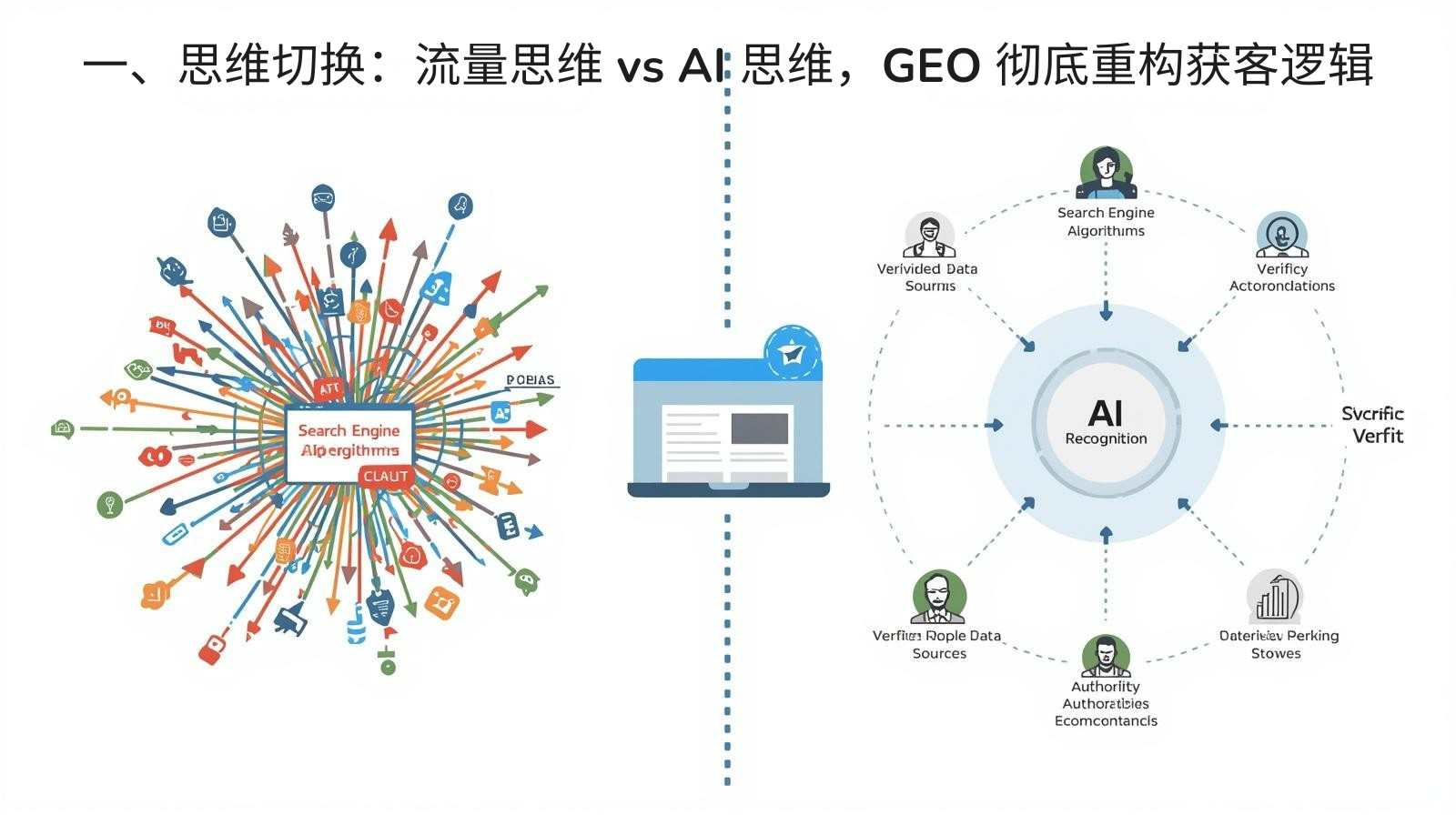
I. Mindset Shift: Traffic-Driven Thinking vs. AI-Driven Thinking – GEO Completely Reconstructs Customer Acquisition Logic
Traditional traffic-driven thinking revolves around "click → visit → conversion," with the core objective of pleasing search engine algorithms, improving rankings, and gaining exposure. In contrast, AI-driven thinking revolves around "understanding → verification → recommendation," with the core objective of getting AI to recognize the authority and authenticity of your information. The customer acquisition efficiency and long-term value brought by the two are completely different. In a traffic-driven mindset, independent websites serve as showcases, with operational goals focused on boosting keyword rankings and purchasing advertising traffic. Once investment ceases, traffic and inquiries plummet. In an AI-driven mindset, however, independent websites become trusted data sources. Operational goals prioritize structured facts, authoritative endorsements, and consistent entity representation. The more frequently a website is cited by AI, the higher its trust weight, allowing it to continue receiving recommendations even without advertising. OpenAI's updated GPTBot crawling rules in March 2026 explicitly state that AI prioritizes crawling pages with clear facts, standardized structures, and verifiable enterprise information, rather than keyword-dense pages ( https://help.openai.com/en/articles/5097620-blocking-gptbot ). Google's 2026 AI Search report also mentioned that AI Overview prioritizes sites with complete entity information and structured data, with these pages being recommended 3.6 times more likely than ordinary pages ( https://developers.google.com/search/blog/2026/ai-overviews ). For foreign trade enterprises, abandoning the obsession with traffic and shifting to an AI-driven mindset is a prerequisite for capturing the next generation of procurement traffic.
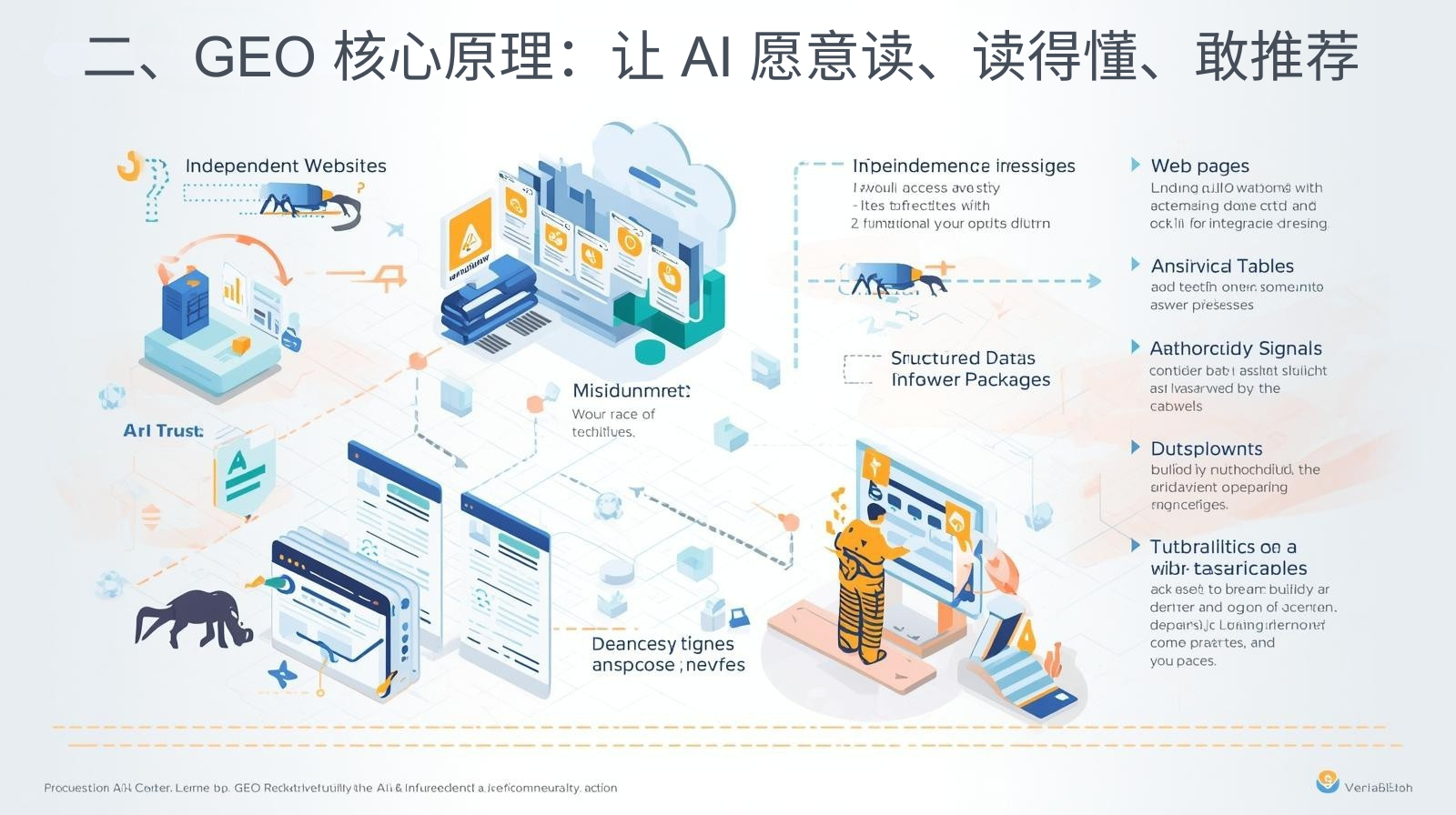
II. GEO Core Principle: To make AI willing to read, understand, and confident in recommending.
The essence of GEO is to package independent websites into "trustworthy answer packages" in an AI-understandable way, fully covering the four key aspects of "crawling, parsing, verification, and citation". This is also the core principle behind ChatGPT's ability to include your brand in recommendation results.
1. Crawlable: Enables access channels for AI web crawlers.
AI cannot recommend content it cannot read. GEO must first ensure that GPTBot and GeminiBot can smoothly access the core pages of the site. In practice, the site loading speed should be kept stable within 2 seconds in European and American markets to avoid a large amount of dynamic JS rendering that could cause content to be unreadable. At the same time, the site configuration should grant the AI crawler permission to crawl core pages such as product, qualification, case, and FAQ pages without blocking or interfering with them, thus removing technical obstacles for AI reading ( https://pagespeed.web.dev/ ).
2. Parsable: Reducing the AI's understanding cost with structured content.
AI is not good at interpreting vague text, purely image-based information, or long blocks of unstructured text. GEOs require that information such as company strength, product parameters, certifications, and delivery capabilities be organized into standardized, tabular, and plain text structured content so that AI can extract key facts at a glance. For example, product pages should consistently display model number, material, precision, MOQ, delivery date, and certification number; About Us pages should clearly state factory area, annual production capacity, service markets, and number of patents; and FAQs should be presented directly in the format of "question + answer + basis." These are the content formats that AI can most easily recognize and reference ( https://schema.org/ ).
3. Verifiable: Establishing trust in AI using authoritative signals.
AI only recommends suppliers it trusts, and GEO enhances credibility through verifiable authoritative signals. Key actions include displaying CE, ISO, FDA, and other certification numbers on certification pages and linking to official verification portals; ensuring consistency between company names and addresses across independent websites, Google Merchants, LinkedIn, and customs data; and publishing real, traceable overseas customer case studies and third-party evaluations. This information allows AI to cross-validate across platforms, significantly increasing recommendation priority ( https://ec.europa.eu/growth/tools-databases/nando/ ).
4. Quotable: Outputs answers that the AI can directly use.
GEO's ultimate goal is to make your information the standard answer that AI uses. The content should be relevant to the high-frequency questions buyers ask on ChatGPT, such as "Recommend a reliable factory in China for XX product", "CE certified supplier for XX product", "Manufacturer with strong customization capabilities in XX industry". The page content should directly provide clear, specific, and data-supported answers, reducing the secondary processing cost for AI and making your site the preferred source for AI to generate answers ( https://answerthepublic.com/ ).
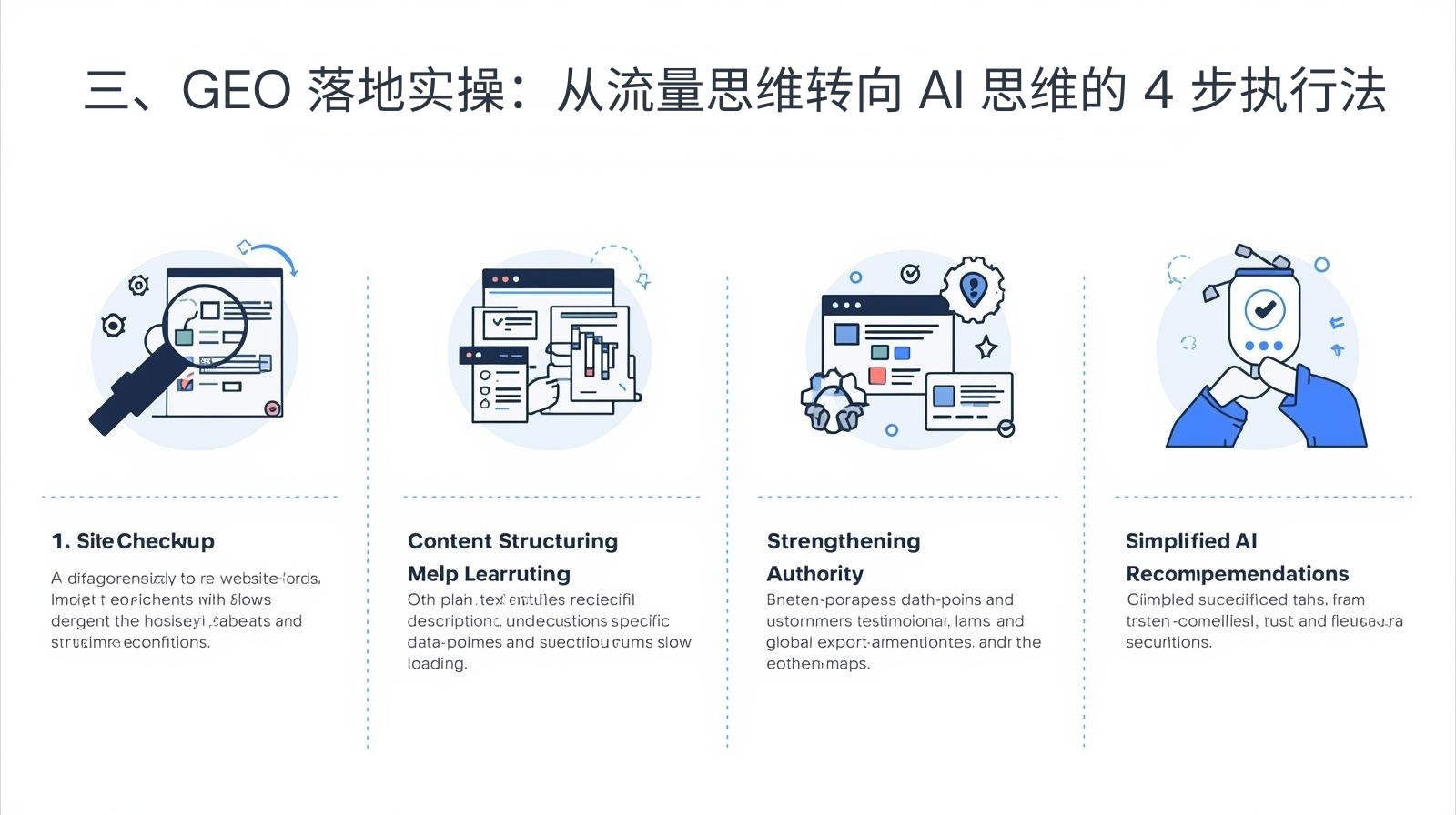
III. Practical Implementation of GEO: A 4-Step Execution Method for Shifting from a Traffic-Driven Mindset to an AI-Driven Mindset
Transitioning from traditional operations to GEO doesn't require rebuilding the website from scratch or using complex code. Just follow these 4 steps, and the core transformation can be completed in 20–30 days, allowing your site to quickly adapt to AI recommendation logic.
1. Site Checkup: Clearing Obstacles Left by the Traffic-Driven Mindset
A comprehensive investigation was conducted to identify any issues hindering AI reading from the site, including core information rendered as images or PDFs and thus unextractable, empty content relying solely on adjectives, excessive JS rendering preventing crawlers from reading the content, robots.txt settings mistakenly blocking AI crawlers, slow page loading, and too many dead links. These issues were addressed one by one before formal optimization could begin ( https://support.google.com/webmasters/answer/6062608 ).
2. Content structuring: Convert the website to an AI-friendly format.
The content structure of product pages, factory pages, qualification pages, and FAQ pages has been restructured, with all information presented in plain text and standard tables. Vague descriptions such as "high quality, leading, reliable" have been replaced with verifiable data such as "accuracy 0.01mm, defect rate 0.3%, delivery time 7–12 days, CE certification number XXXX". Standardized structural annotations have also been deployed on key pages to help AI quickly locate core information ( https://developers.google.com/search/docs/appearance/structured-data/intro-structured-data ).
3. Enhanced Authority and Trust: Enabling AI to Recommend Your Brand
Improve the certification verification links, customer case details, third-party endorsements, and unified entity information across the entire network. Focus on strengthening the trust points that both overseas buyers and AI value, such as the country of export, service industry, major customer cases, test reports, and after-sales guarantees, so that AI can confirm the authenticity and reliability of your information during cross-validation ( https://www.trustpilot.com/ ).
4. Continuous Iteration: Transforming the Site into a Long-Term Trust Asset for AI
We update product parameters, add case studies, supplement certifications, and optimize FAQs monthly to maintain site activity and information freshness. At the same time, we observe changes in AI recommendations and continuously strengthen frequently cited content modules to accumulate trust weight and form an AI customer acquisition barrier that is difficult for competitors to surpass ( https://www.semrush.com/blog/ai-seo-2026/ ).
Recommended Article: Your Competitors Haven't Reacted Yet: Building an Independent E-commerce Website with GEO is the Biggest Blue Ocean Strategy Right Now
Recommended Article: Your Competitors Haven't Reacted Yet: Building an Independent E-commerce Website with GEO is the Biggest Blue Ocean Strategy Right Now
IV. Conclusion: Using AI thinking to build the next generation of independent foreign trade websites
In 2026, the competition among independent e-commerce websites will no longer be about who has more traffic or a more visually appealing page, but rather who can be prioritized and recommended by AI. GEO doesn't just bring a short-term increase in traffic; it represents a fundamental upgrade in logic, moving from "grabbing traffic" to "building trust assets." This allows your brand to consistently appear in the purchasing recommendations of AI tools like ChatGPT, resulting in more accurate, higher-converting, and more sustainable overseas inquiries.
Shifting from a traffic-driven mindset to an AI-driven mindset requires a foundational architecture for independent websites that is inherently compatible with GEO. PinDian Technology boasts over a decade of experience in building websites for international trade, serving more than 7,000 clients. Built with React technology, featuring server-side rendering and global CDN acceleration, our websites offer smooth, fluid browsing and consistently fast loading speeds. The underlying architecture natively supports AI crawler reading, structured content deployment, and the output of authoritative trust signals, ensuring your independent website is AI-friendly from day one. Pindian.com offers a one-stop solution for GEO optimization and implementation, helping you quickly complete content structuring, AI crawling and adaptation, and trust system building. This allows you to focus on the growth dividends of the AI procurement era without getting bogged down in technical details, and to seize the next generation of customer acquisition opportunities in foreign trade with the right mindset and tools.