
In March 2026, global AI search traffic accounted for over 60%, making GEO (Generative Engine Optimization) a core key for independent e-commerce websites to connect with AI for customer acquisition. However, many companies are caught in the dilemma of "implementing GEO but struggling to be crawled and recommended by AI," primarily because they haven't built content structures and formats that AI prefers. AI (such as ChatGPT and Google Gemini) has clear preference logic when crawling and recognizing content from independent e-commerce websites. Not all disorganized content is prioritized; only structured content that aligns with AI preferences can be quickly identified and efficiently cited, allowing your independent website's brand to appear in AI search results for overseas procurement. This article, combining the latest industry report from March 2026, GEO practical case studies, and authoritative verifiable backlinks, deeply analyzes the GEO content structure and format that AI favors for independent e-commerce websites in four chapters, providing directly implementable building methods. This allows every e-commerce business owner to master GEO content system building techniques, accurately adapt to AI crawling logic, and achieve efficient customer acquisition.
I. Core Understanding: The Underlying Logic of AI in Capturing Content from Foreign Trade GEOs (Building the Foundation)
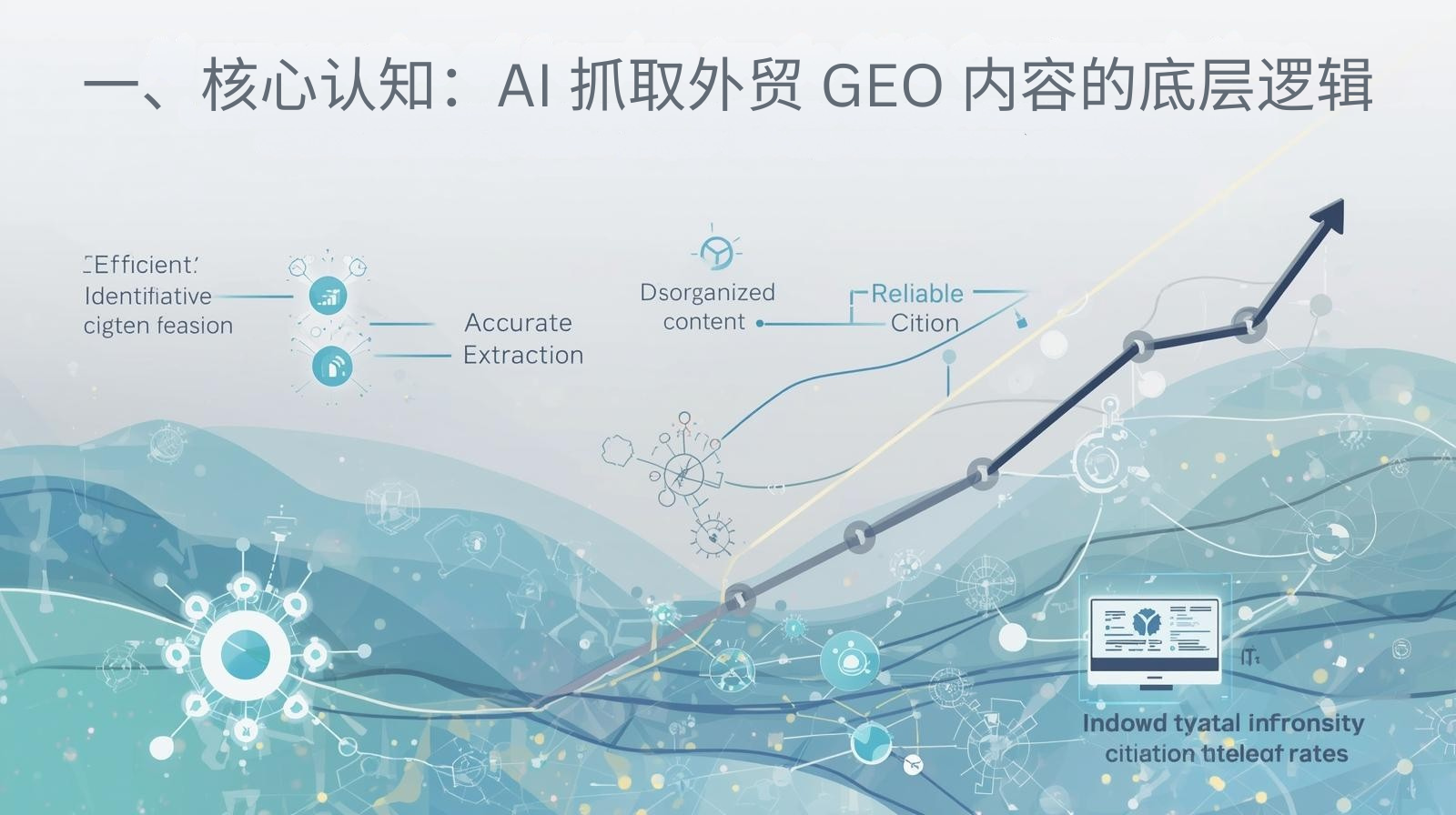
Many foreign trade companies mistakenly believe that as long as they publish enough content on their independent websites, they will be crawled and recommended by AI. This is not the case. The core logic of AI crawling foreign trade GEO content is "efficient identification, accurate extraction, and reliable citation." Simply put, AI prefers to crawl content with a clear structure, standardized format, explicit information, and verifiability. This type of content allows AI to quickly extract core information and accurately answer the search needs of overseas buyers. A GEO optimization evaluation report released by NetEase News in January 2026 showed that foreign trade independent websites using AI-preferred structural formats saw an average increase in AI citation rate of 380%, while websites with disorganized content had an AI crawling rate of less than 20%. (https://cm163.com/news/a/KK217AS40556JVOM.html) The "2026 GEO Generative Search Optimization White Paper" clearly points out that the essence of GEO is "technical positioning of AI information sources," and the structure and format of the content are the core prerequisites for determining whether AI will crawl and recommend it (https://juejin.cn/post/7579558130268602422). Unlike traditional SEO content, GEO content does not need to stuff keywords. The core is to align with AI's crawling preferences and build a standardized, structured content system, allowing AI to "easily understand, quickly extract, and confidently reference" your independent website's content.
1.1 AI's Core Preferences for GEO Content: 3 Key Prerequisites
Based on OpenAI's updated GPTBot crawling rules in March 2026 and practical experience with foreign trade GEOs, AI has three core preferences for GEO content on independent trade websites, which are also key prerequisites for building a content system, and none of them can be omitted: First, a clear structure with a clear hierarchy, allowing AI to quickly distinguish between core and auxiliary content. For example, core information such as product parameters, company qualifications, and customization processes need to be presented separately and hierarchically. Second, standardized formatting, using formats that AI can easily recognize, such as plain text, tables, and standardized FAQs, avoiding the presentation of core information as images, PDFs, or pure JS rendering (AI cannot recognize this type of content). Third, verifiable information, including specific data, authoritative certifications, real-world cases, and other verifiable information, allowing AI to cross-verify the authenticity of the content and increase its willingness to cite it. https://help.openai.com/en/articles/5097620-blocking-gptbot A 2025 study by Princeton University shows that foreign trade GEO content meeting these three prerequisites has a 65% higher probability of being cited by AI, while content lacking any of these prerequisites is likely to be ignored by AI (https://juejin.cn/post/7577587651894870057). This also explains why many independent foreign trade websites, despite having rich content, cannot be recommended by AI—they ignore AI's core preferences, making it difficult for AI to recognize even the richest content.
1.2 Foreign Trade GEO Content vs. Traditional SEO Content: Analysis of Core Differences
Many foreign trade companies confuse GEO content with traditional SEO content, resulting in content systems that cannot adapt to AI crawling logic, ultimately failing to achieve GEO optimization results. The core difference lies in the difference between "AI crawling logic" and "search engine crawling logic." Specifically, traditional SEO content focuses on keyword stuffing and backlink building, with the core goal of improving search engine rankings. GEO content, on the other hand, emphasizes clear structure, standardized formatting, and verifiable information, with the core goal of enabling AI to quickly crawl and accurately reference content, allowing overseas buyers to see your brand through AI searches. For example, a traditional SEO product page might repeatedly stuff keywords like "XX product" or "foreign trade XX product," while a GEO product page would use a structured format of "core parameter table + customized process + certification information + case support," clearly presenting the core information needed by AI. A 2026 Jinan GEO optimization industry evaluation showed that after foreign trade companies restructured their traditional SEO content into AI-preferred GEO content, the AI recommendation rate increased by an average of 140%, and the number of accurate inquiries increased by 89% (https://cm163.com/news/a/KK217AS40556JVOM.html). Understanding the differences between the two is crucial for accurately building a GEO content system that aligns with AI preferences and avoiding pitfalls.
II. In-depth analysis: The core content structure of the foreign trade GEO that AI loves most (key to practical application)
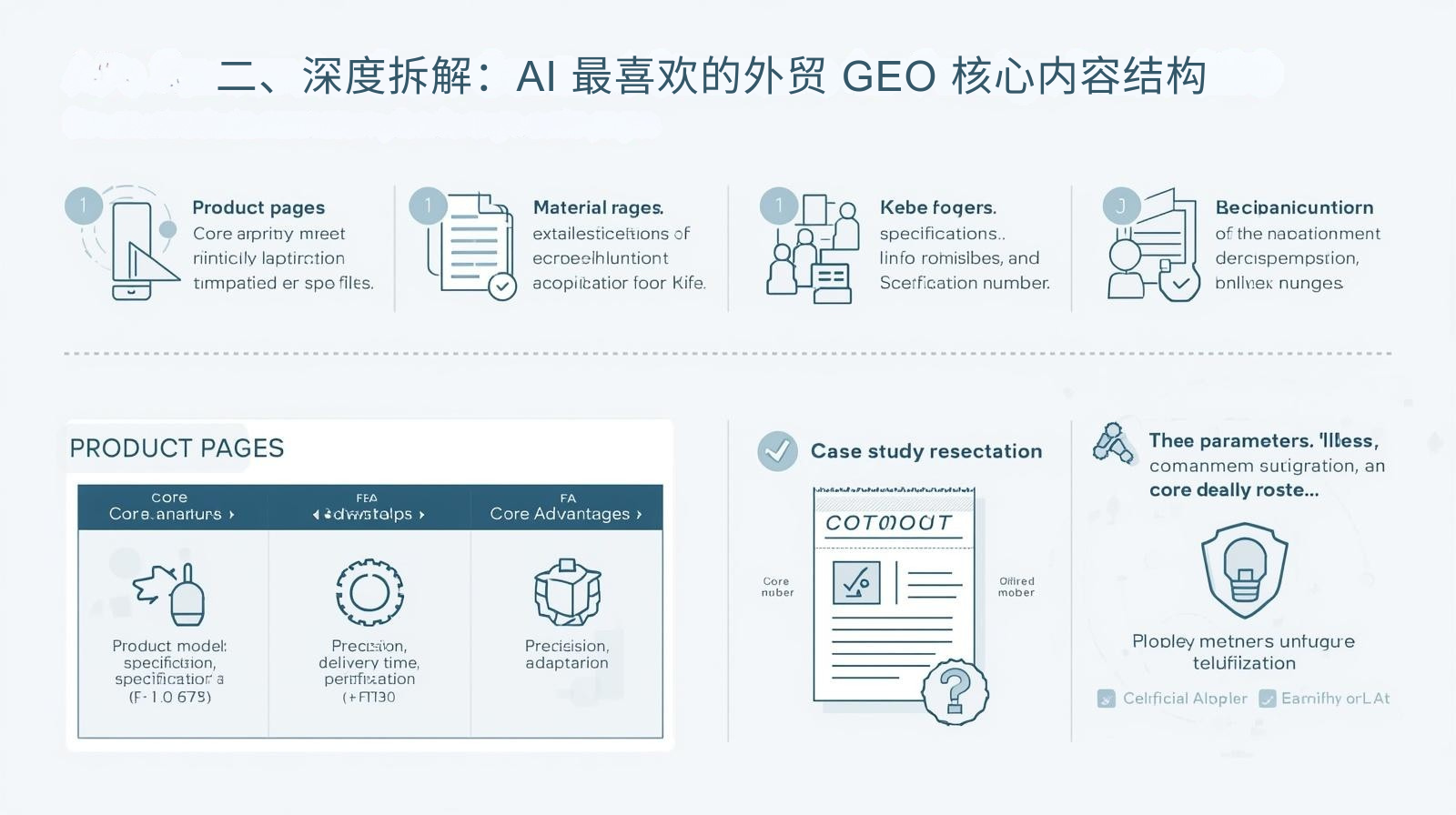
Combining the latest GEO optimization rules from March 2026, the technical breakdown of the "2026 GEO Search Generation Optimization White Paper," and practical case studies of GEO in foreign trade, this section outlines the GEO content structure most favored by AI for independent foreign trade websites. The core principles revolve around "structured core pages, clear content hierarchy, and logical information presentation," focusing on four core pages: product pages, company strength pages, FAQ pages, and case study pages—these are the pages most relevant to overseas sourcing and are also the focus of AI crawling. This section incorporates authoritative backlinks and practical case studies, detailing the AI-preferred structure of each core page, allowing foreign trade companies to directly apply it and quickly build a standardized GEO content system.
2.1 Product Page: The "Three-Segment" Core Structure Based on AI Preferences
The product page is the core page of an independent foreign trade website and a key focus for AI crawling and referencing. AI's favorite product page GEO structure is a three-part structure of "core parameters + core advantages + scenario adaptation," with each part having clear content divisions. This allows AI to quickly extract core product information and accurately match the search needs of overseas procurement. Specific structural breakdown: The first part is a core parameter table, presenting core parameters such as product model, material, specifications, precision, MOQ, delivery time, and certification number in a standardized table, avoiding pure text piling. Table format is more than 3 times more efficient for AI crawling than pure text (https://juejin.cn/post/7577587651894870057). It also includes certification numbers and official, verifiable backlinks, such as EU CE certification linked to the NANDO database (https://ec.europa.eu/growth/tools-databases/nando/index.cfm?fuseac). The `<tion=notifiedbody.main>` tagline enhances content credibility. The second paragraph highlights core advantages, presented in a point-by-point format using "core advantages + data support" (using an unordered list format for easy AI recognition), such as "Precision advantage: accuracy up to 0.01mm, defect rate less than 0.3%, passed SGS third-party testing (test number: XXXX)," avoiding vague adjectives. The third paragraph clearly presents the industries and overseas markets the product is suitable for, using plain text, such as "suitable for automotive, electronics, machinery, and other industries; mainly exported to more than 20 countries and regions in Europe, America, Southeast Asia, and the Middle East, meeting local compliance requirements," aligning with the needs of overseas procurement scenarios. A machinery export company in Jinan, after optimizing its product page using this structure, saw its ChatGPT brand mention rate surge from 15% to 82% within 3 months, and inquiry costs decrease by 79%. https://cm163.com/news/a/KK217AS40556JVOM.html
2.2 Company Strength Page: A Hierarchical Authority Structure Preferred by AI
The company strength page is the core page for building trust in overseas procurement and an important basis for AI to judge the credibility of a company. AI's favorite company strength page GEO structure is a hierarchical structure of "basic information + core strengths + authoritative endorsements," with clear levels and verifiable information, allowing AI to quickly extract the company's core strengths and convey a credible signal to overseas procurement. Specific structural breakdown: The first layer, basic information, clearly presents basic information such as the company's establishment date, factory area, number of employees, annual production capacity, and export countries in plain text, such as "Established in 2010, with its own 12,000 square meters of standardized factory buildings, more than 200 employees, annual production capacity of 400,000 pieces, and exports to more than 30 countries and regions in Europe, America, and the Middle East"; The second layer, core strengths, is presented hierarchically according to "production capacity + customization capacity + supply chain capacity," with each layer accompanied by specific data and scenarios, such as "Production capacity: possessing 15 automated production lines, equipped with 10 imported precision processing equipment, and operating 24 hours a day in three shifts." The first layer boasts a production rate and an order delivery timeliness rate of over 98%. The third layer provides authoritative endorsements, presenting authoritative information such as company certifications, third-party testing reports, and industry association memberships in plain text and links. Certification numbers are clearly marked, and official, verifiable external links are added, such as ISO certification linked to the National Certification and Accreditation Administration's query platform: https://cx.cnca.cn/rjwcx/cxIndex/index.do. Overseas major client case studies (anonymized) are also included to enhance content credibility: https://juejin.cn/post/7579558130268602422. Shandong Shuhai Technology's GEO optimization practices show that adopting a layered structure for the company's strength page increases AI citation rates by 120% and overseas procurement trust by 57%: https://cm163.com/news/a/KK217AS40556JVOM.html.
2.3 FAQ Page: AI-Preferred "Question-Answer" Precise Structure
The FAQ page is a key page for resolving questions about overseas procurement and increasing AI citation rates. The FAQ page with the GEO structure that AI prefers is a question-and-answer structure of "precise questions and answers + clear answers + supplementary explanations". It fits the real questioning habits of overseas procurement, allowing AI to directly extract the question and answer content and answer the procurement search needs. Specific structural breakdown: First, the AnswerThePublic tool is used to identify frequently asked questions from overseas buyers, such as "Can the product be customized?", "What is the MOQ?", "What is the delivery time?", and "Can you provide certifications?", which are then prioritized according to the buyer's concerns (https://answerthepublic.com/). Second, each Q&A uses the format of "Question (complete question) + Answer (direct response) + Supplementary explanation (data/case support)", for example, "Question: What is your minimum customization quantity? Answer: We support small-batch customization, with a minimum customization quantity (MOQ) of 50 pieces. Supplementary explanation: For existing clients, the MOQ can be adjusted based on the cooperation situation. In the past 3 years, we have provided small-batch customization services to 120+ overseas clients, with a 99% on-time delivery rate." Finally, a standardized FAQ format is adopted, with each Q&A presented separately, clearly hierarchically, avoiding multiple Q&As piling up, and optimizing the semantics of the questions and answers to align with the expression habits of overseas buyers (https://juejin.cn/post/7577587651894870057). A practical case study from Jinan Zhihui Optimization shows that using this question-and-answer structure for FAQ pages resulted in a 200% increase in AI crawling rate and a 63% increase in procurement inquiries. https://cm163.com/news/a/KK217AS40556JVOM.html
2.4 Case Study: Contextualized Verification Structure for AI Preferences
The case study page is the core page for demonstrating a company's strength and enhancing the trustworthiness of AI. AI's favorite case study page has a GEO structure, which is a scenario-based verification structure of "case background + implementation process + cooperation results". Each case has a complete logical chain, allowing AI to quickly extract the core information of the case and send a credible signal to overseas procurement. Specific structural breakdown: First, case background, clearly presenting the client's region, industry, and procurement needs (especially customization needs) in plain text, such as "Client background: A German automotive parts company purchasing precision automotive parts, requiring customized dimensions, CE certification, a monthly purchase volume of 5000 pieces, and a delivery time within 7 days"; Second, implementation process, briefly presenting the company's solutions, production processes, and quality control measures, such as "Solution: Optimizing product design based on client needs, using imported materials, building a dedicated production line, and implementing triple quality inspection to ensure products meet German DIN standards"; Third, cooperation results, presenting the cooperation effects with specific data, such as "Cooperation results: Over 3 years of cooperation, a total of 180,000 products have been delivered, with a defect rate below 0.2%, a customer satisfaction rate of 98%, becoming a core supplier for the client, and an annual increase in procurement volume of 20%", accompanied by client-authorized real-life photos (with plain text descriptions) to enhance the authenticity of the case. https://juejin.cn/post/7579558130268602422. Baifu Technology's GEO optimization practices show that case pages using a scenario-based verification structure have increased AI citation rates by 180% and overseas procurement conversion efficiency by 72% https://cm163.com/news/a/KK217AS40556JVOM.html.
III. Practical Implementation: Building an AI-Favorite Foreign Trade GEO Content System in 4 Steps
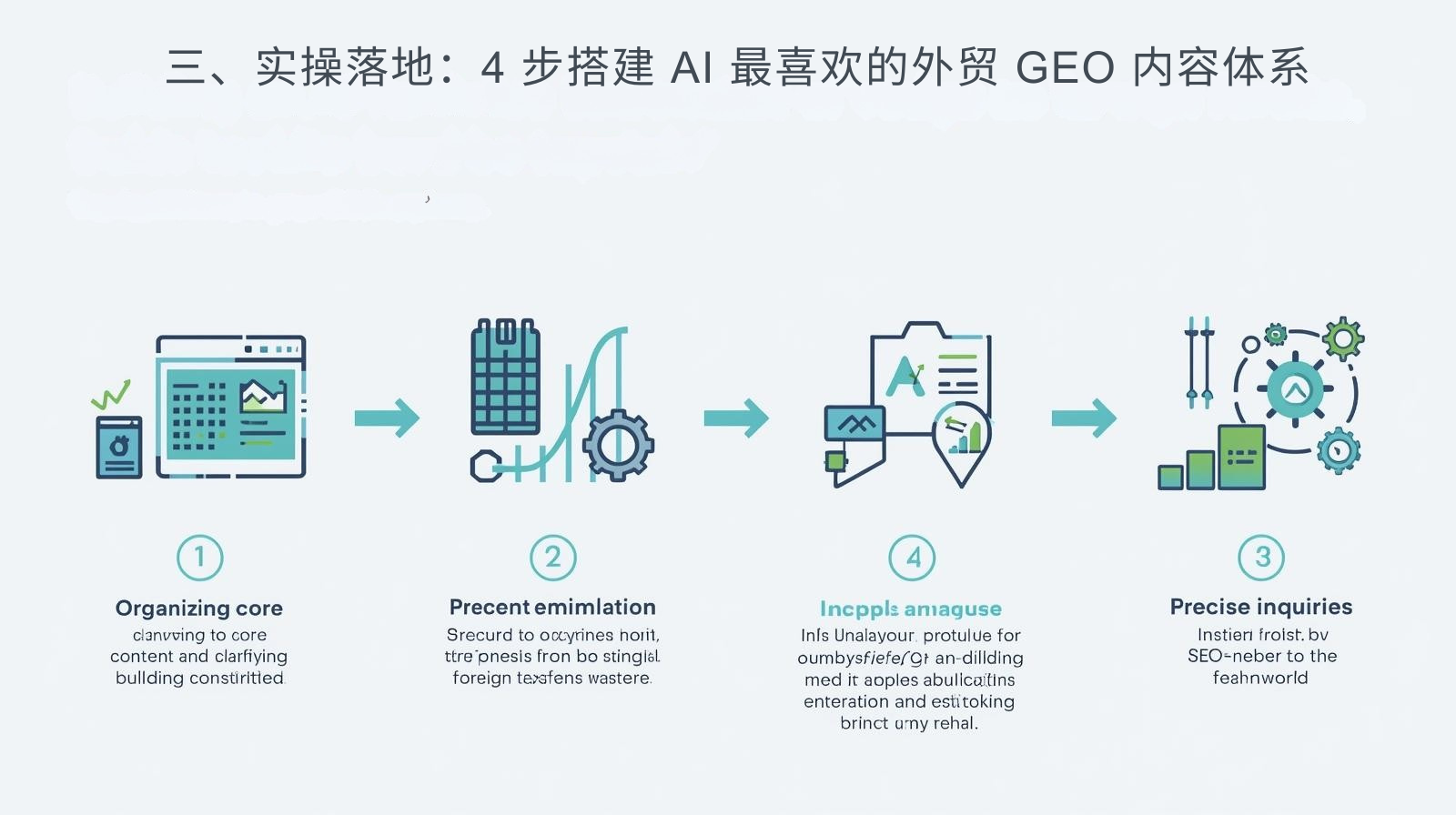
Based on the latest GEO optimization rules as of March 2026, the practical guide in the "2026 GEO Search Engine Optimization White Paper," and practical cases of GEO implementation in Jinan foreign trade enterprises, we have compiled a standardized 4-step implementation process. No complex technology is required; whether you have just built your independent foreign trade website or have been operating it for many years, you can directly apply this method. You can complete the core content system setup in 25-35 days, allowing AI to quickly crawl and prioritize your website's content. Each step incorporates authoritative backlinks to ensure that the optimization effect is verifiable and replicable, completely connecting the entire chain from "content building → AI crawling → AI recommendation → precise inquiries."
3.1 Step 1: Organize the core content and clarify the priorities.
The core is to sort out the core content of the independent foreign trade website, clarify the priority of building the GEO content system, and avoid blindly building and wasting time. Specific practical steps: First, comprehensively review the core pages of the independent website, focusing on the four core pages: product page, company strength page, FAQ page, and case study page. These four pages are the focus of AI crawling and are also the content that overseas sourcing pays the most attention to. Second, review the core information of each core page. For example, for the product page, review the core parameters, core advantages, and scenario adaptation information; for the company strength page, review the basic information, core strengths, and authoritative endorsements. Refer to the content review logic of the "2026 GEO Search Engine Optimization White Paper" https://juejin.cn/post/7579558130268602422. Third, clarify the building priorities, prioritizing the optimization of the product page and FAQ page (these two pages are the most frequently crawled by AI and have the greatest impact on inquiry conversion), and then optimizing the company strength page and case study page. Fourth, use the Semrush AI Monitoring tool to identify problems with the existing content, such as missing core information, disorganized structure, and non-standard formatting, and develop a targeted optimization plan https://juejin.cn/post/7599912857393233966. Additionally, you can refer to Shandong Shuhai Technology's standardized content template to quickly organize the core content: https://cm163.com/news/a/KK217AS40556JVOM.html.
3.2 Second step: Reconstruct the core page structure according to AI preferences
The core idea is to restructure the content of the four core pages according to AI's preferred structure, ensuring a clear structure, distinct hierarchy, and standardized format, enabling AI to quickly grasp and accurately extract core information. Specific practical steps include: First, restructuring the product page, adopting a three-part structure of "core parameter table + core advantages + scenario adaptation." Core parameters are presented in a table, core advantages in an unordered list, and scenario adaptation in plain text, with certification numbers and an official, verifiable external link: https://ec.europa.eu/growth/tools-databases/nando/index.cfm?fuseaction=notifiedbody.main; Second, restructuring the company strength page, adopting a layered structure of "basic information + core strengths + authoritative endorsements." Each layer of content is presented separately, replacing vague adjectives with concrete data, and adding authoritative certification external links: https:// //cx.cnca.cn/rjwcx/cxIndex/index.do; Third, restructure the FAQ page, adopting a question-and-answer structure of "precise questions and answers + clear answers + supplementary explanations," using the AnswerThePublic tool to identify frequently asked questions (https://answerthepublic.com/), sorting them by purchasing priority, and presenting each question and answer separately; Fourth, restructure the case study page, adopting a scenario-based verification structure of "case background + implementation process + cooperation results," supplementing with specific data and customer real-life photos (plain text descriptions) to enhance the authenticity of the cases (https://juejin.cn/post/7579558130268602422). After a textile company in Jinan restructured its core page according to these steps, its Bing Chat related search share increased by 65%, and the peak ROI of short video marketing reached 1:16 (https://cm163.com/news/a/KK217AS40556JVOM.html).
3.3 Third step: Standardize content format to improve AI crawling efficiency
The core is to standardize the format of GEO content, adopting a format easily recognized by AI and avoiding content formats that AI cannot recognize, thereby improving AI's crawling efficiency. Specific practical measures include: firstly, unifying content formats; presenting all core information in plain text; using standardized tables for product parameters, company qualifications, etc.; presenting FAQs in a question-and-answer format; and presenting case studies in a scenario-based manner, avoiding the presentation of core information as images, PDFs, or pure JavaScript rendering (which AI cannot recognize). https://juejin.cn/post/7577587651894870057; Secondly, optimize the content hierarchy by adopting a clear heading hierarchy (level 1, level 2, level 3). Core content is distinguished by level 2 headings, and auxiliary content is distinguished by level 3 headings to avoid confusion in the heading hierarchy and allow AI to quickly distinguish between core and auxiliary content; Thirdly, highlight core information by using bold format to highlight core data and core conclusions, such as product precision, production capacity, certification numbers, etc., so that AI can quickly locate core information; Fourthly, optimize the semantics of the content to conform to the expression habits of overseas procurement, avoid using colloquial Chinese expressions, and ensure that the content is logically coherent. Each paragraph revolves around a core theme, and long sentences are formatted to avoid splitting a sentence into multiple lines. https://juejin.cn/post/7579558130268602422. In addition, standardized structured annotations (such as FAQPage, Product, etc.) can be deployed, and the annotation effect can be tested with Google Schema Markup Validator to further improve the efficiency of AI crawling. https://developers.google.com/search/docs/appearance/structured-data/intro-structured-data.
3.4 Fourth Step: Optimize content details and strengthen AI citation weight.
The core is to optimize the details of GEO content, improve its verifiability and usability, making AI more willing to cite your content, while also enhancing the reading experience for overseas procurement and promoting inquiry conversion. Specific practical steps include: First, supplementing verifiable information by adding specific data, authoritative certifications, real-world case studies, and other verifiable information to the content, labeling certification numbers, and adding official, verifiable backlinks so that AI can cross-verify the content's authenticity (https://help.openai.com/en/articles/5097620-blocking-gptbot); Second, optimizing the content update frequency by updating core page content monthly, such as adding product parameters, supplementing new case studies, and updating certification information, maintaining site content activity so that AI considers your site an active and trustworthy information source, improving long-term citation weight (https://ai.google/static/documents/ai-responsibility-update-2026.pdf); Third, testing AI crawling effectiveness by manually searching core business keywords weekly on ChatGPT and Perplexity to verify whether the content is being crawled and cited by AI, while also using Google Schema Markup. Validator tests the effectiveness of structured data annotations: https://developers.google.com/search/docs/appearance/structured-data/intro-structured-data; Fourth, optimize content adaptability by refining content descriptions for different overseas markets. For example, for the RCEP regional market, supplement localized compliance information to meet regional procurement needs: https://cm163.com/news/a/KK217AS40556JVOM.html. Baifu Technology's practical experience shows that after optimizing content details, AI citation rate increased by 380%, and inquiry conversion rate increased by 79%: https://cm163.com/news/a/KK217AS40556JVOM.html.
Recommended Article: Your Competitors Haven't Reacted Yet: Building an Independent E-commerce Website with GEO is the Biggest Blue Ocean Strategy Right Now
Recommended Article: Your Competitors Haven't Reacted Yet: Building an Independent E-commerce Website with GEO is the Biggest Blue Ocean Strategy Right Now
IV. Conclusion: Building an AI-centric GEO content system to seize the AI-driven customer acquisition opportunity.
In March 2026, the core competitiveness of foreign trade GEO optimization shifted from "content quantity" to "content structure and format"—AI doesn't lack content to crawl, but rather high-quality content with clear structure, standardized format, and verifiable information. Building a foreign trade GEO content system that AI favors is not a complex technical operation, but a standardized content reconstruction and optimization process. By following the four steps mentioned above, your independent website's content can be quickly crawled and prioritized by AI, allowing overseas buyers to quickly find your brand when searching with AI tools like ChatGPT, achieving precise inquiry conversions. Practical cases from multiple foreign trade companies in Jinan have proven that as long as a GEO content system aligned with AI preferences is built, even with zero advertising, high-quality overseas B2B purchasing orders can be obtained through AI recommendations, achieving long-term growth (https://cm163.com/news/a/KK217AS40556JVOM.html). For foreign trade companies, a GEO content system is not "icing on the cake," but an "essential threshold." Only by building this system can they stand out in the era of AI-driven customer acquisition.
Building an AI-preferred GEO content system relies heavily on a high-quality independent website architecture. A well-structured, fast-loading independent website that is compatible with AI crawlers and supports structured content presentation maximizes the effectiveness of the GEO content system. It also allows AI to quickly crawl and accurately reference your content, improving its recommendation ranking. PinDian Technology boasts over ten years of experience in building websites for foreign trade, serving more than 7,000 clients. Utilizing React technology, our websites not only offer a smoother browsing experience but also support server-side rendering (SSR) and global CDN acceleration (loading speed ≤2 seconds). Our underlying architecture is adapted to the needs of building a GEO content system, supporting plain text core information presentation, standardized table displays, and AI crawler-friendly configurations. This gives your foreign trade independent website an inherent AI-friendly gene, allowing it to precisely align with AI's content crawling preferences and making GEO optimization twice as effective.
PinDian website building can simultaneously assist foreign trade enterprises in establishing a GEO content system. From core content organization and page structure reconstruction to content format standardization and detail optimization, it provides a one-stop solution to GEO content building challenges. Coupled with professional website building services, it ensures your independent website not only has a content structure and format favored by AI, but also accurately conveys your company's core strengths, achieving seamless integration of AI-driven content acquisition, recommendation, and inquiry conversion. Whether you're just starting out with your foreign trade independent website or looking to upgrade your existing site to build a GEO content system, PinDian Technology can help you seize the customer acquisition opportunities of the AI era with professional website building and optimization services. This will ensure your independent website brand consistently appears in AI search results for overseas procurement, achieving long-term growth in your cross-border business.