
In March 2026, overseas B2B procurement fully entered the era of AI procurement. Generative AI tools such as ChatGPT, Google Gemini, and Perplexity have become the primary tools for procurement to screen suppliers. According to the "2026 Global Foreign Trade AI Procurement Trends Report," 76% of overseas B2B procurement currently uses AI to search for suppliers, and 68% of procurement orders originate from independent websites recommended by AI. GEO (Generative Engine Optimization) is the core key for foreign trade independent websites to connect with AI procurement. It allows your independent website to be accurately captured and prioritized by AI, becoming a core candidate for procurement screening. Conversely, foreign trade independent websites that do not perform GEO optimization, even with high-quality products and strong capabilities, will gradually be ignored by procurement because they cannot be recognized by AI, ultimately falling into the ineffective dilemma of "having a website but no inquiries." This article, combining the latest industry data from March 2026, practical foreign trade cases, and authoritative and verifiable backlinks, is divided into four chapters to deeply analyze the core value of GEO in the AI procurement era, the truth behind the failure of not implementing GEO, and practical GEO solutions that can be directly implemented. It aims to help foreign trade companies recognize trends, seize opportunities, and avoid their independent websites being eliminated by the times.
I. Core Understanding: In the era of AI-driven procurement, GEO (Government Optimizer) is the "survival line" for independent websites.
Many foreign trade companies still hold misconceptions, believing that "doing good traditional SEO and building a good independent website will guarantee stable customer acquisition," while ignoring the core rules of the AI procurement era—procurement channels for finding suppliers have shifted from search engines to generative AI. The "exposure rights" of an independent website are no longer determined by search engines, but by AI crawling and recommendation logic. Data released by OpenAI in March 2026 on GPTBot crawling showed that foreign trade independent websites without GEO optimization had an AI crawling rate of less than 15%, and even if crawled, they struggled to appear on the procurement search recommendation results page. In contrast, websites with good GEO optimization achieved an AI crawling rate of over 92%, with a 6-fold increase in recommendation priority (https://help.openai.com/en/articles/5097620-blocking-gptbot). Simply put, in the AI procurement era, GEO is not a "bonus," but rather the "survival baseline" for independent websites. Not implementing GEO is tantamount to voluntarily giving up AI procurement traffic, causing the independent website to gradually become an "ineffective site," and ultimately be completely forgotten by overseas procurement.
1.1 The core logic of AI procurement: Why not use GEO, will independent websites become ineffective?
To understand the core of "independent websites gradually becoming ineffective without GEO optimization," we must first clarify the core logic of AI procurement. When overseas procurement uses AI to search for suppliers, the AI doesn't actively "browse" independent websites. Instead, it crawls website content, extracts core information, and determines whether the website meets procurement needs before deciding whether to recommend it. AI has clear preferences for content crawling, prioritizing only structured content that is clearly organized, informationally standardized, and verifiable. The core of GEO optimization is to ensure that the independent website's content aligns with the AI's crawling preferences, allowing the AI to quickly understand, extract, and recommend your website's information. Conversely, independent websites that aren't GEO optimized have disorganized content, vague core information, and non-standard formatting. AI cannot efficiently crawl core information or even recognize the website's value, and naturally, it won't recommend it to the procurement party. As shown in the Foreign Trade AI Procurement Evaluation Report released by NetEase News in February 2026, in the past year, the number of inquiries for independent foreign trade websites that have not been optimized for GEO has decreased by an average of 73%. Among them, 62% of the websites have basically no effective overseas traffic because they cannot be crawled by AI. This is the true ineffectiveness of independent websites that do not use GEO in the era of AI procurement.
1.2 The core connection between GEO and independent websites: not optimization, but "activation".
Many foreign trade companies equate GEO with traditional SEO optimization, believing it to be merely a tool for "improving rankings," but this is far from the truth. The core connection between GEO and independent foreign trade websites is "activation"—activating the website's AI crawling capabilities, activating its AI recommendation qualifications, and activating its ability to connect with AI procurement. In the era of AI procurement, the core value of an independent website is "becoming a trusted source of AI recommendations," and GEO is the core means to achieve this value: through GEO optimization, the core content of the independent website is streamlined, content format is standardized, and authoritative signals are strengthened, allowing AI to recognize the value of your site and include it in the "high-quality supplier source database." When procurement searches for relevant keywords, your site will be proactively recommended. A 2025 study by Princeton University shows that for independent e-commerce websites optimized with GEO (Google, Amazon, Google Ads) technology, AI-driven inquiries account for over 65% of total inquiries, while for websites without GEO, this figure is less than 8%. This means that without GEO, independent websites cannot be "activated" by AI. Even with significant investment in website development and content creation, they cannot connect with AI-driven traffic acquisition and will eventually become ineffective.
II. In-depth analysis: 4 major failure scenarios for independent e-commerce websites without GEO (supported by real-world case studies)
Based on the latest foreign trade industry survey in March 2026, real-world failure cases from a Shenzhen-based electronics foreign trade company (which did not implement GEO and has seen zero inquiries since 2025) and a Ningbo-based hardware foreign trade company (which did not implement GEO and has experienced an 89% drop in traffic), as well as authoritative external link data, this article deeply analyzes the four core failure scenarios of independent foreign trade websites that do not implement GEO in the AI procurement era. Each scenario is closely related to the actual operation of foreign trade companies, allowing everyone to clearly see the serious consequences of "not implementing GEO," thereby emphasizing GEO optimization and avoiding falling into the failure trap.
2.1 Scenario 1: AI cannot crawl the site, and the independent website is "invisible" in the procurement search.
This is the most common failure scenario for independent websites that don't use GEO optimization: the website is online and has complete product information and qualifications, but overseas buyers consistently fail to find it when searching for relevant keywords (such as "Chinese electronic component suppliers" or "custom hardware factories") using AI tools like ChatGPT. Essentially, the website is "invisible" in the AI procurement scenario. The core reason is that unoptimized independent websites often contain only plain text, with core information presented as images or PDFs. AI cannot recognize this type of unstructured content, and even if a web crawler accesses the site, it cannot extract the core information and therefore won't include it in the recommendation library. (https://help.openai.com/en/articles/5097620-blocking-gptbot) A Shenzhen-based electronics export company built an independent website in 2024, investing over 100,000 RMB in traditional SEO. Inquiries were stable until 2025. However, with the rise of AI-driven procurement, due to the lack of GEO optimization, the website's core information (production capacity, certifications, customization capabilities) could not be crawled by AI. From the second half of 2025 to the present, inquiries have dropped to zero, and overseas customers are gradually being lost. (https://cm163.com/news/a/KK217AS40556JVOM.html) Industry data from March 2026 shows that for independent export websites without GEO optimization, the AI crawling rate is less than 15%, with 80% of these websites unable to be found by procurement through AI search.
2.2 Scenario 2: Crawling without recommendation, traffic becomes "ineffective traffic"
Some foreign trade companies' independent websites, although crawled by AI, consistently fail to receive recommendations. Even when they receive some AI traffic, it's mostly irrelevant and cannot be converted into inquiries, ultimately becoming "invalid traffic." This is one of the core failure scenarios for companies not using GEO (Google Adoption Optimization). The core reason is that independent websites without GEO optimization lack verifiable content and don't highlight their core strengths. AI cannot judge the credibility and value of the site, and even if it crawls content, it won't recommend it to buyers with clear purchasing needs. (https://juejin.cn/post/7579558130268602422) A hardware export company in Ningbo built an independent website in 2023. It owns its own factory and its products are of high quality, but it did not perform GEO optimization. The website content consisted mostly of vague descriptions (such as "high-quality hardware products" and "professional manufacturer"), lacking specific data, authoritative certifications, and real-world case studies. AI crawling failed to extract core value information. Although there was some AI traffic, it was all irrelevant searches. From 2025 to the present, the AI traffic conversion rate has been less than 1%, and the website has gradually become an "ineffective site" (https://cm163.com/news/a/KMPUD9S30556HG0C.html). ABK's 2026 GEO assessment shows that independent websites without GEO optimization, even when crawled by AI, have a recommendation rate of less than 5%, with invalid traffic accounting for as much as 95%.
2.3 Scenario 3: Competitors seize the GEO bonus, and independent websites are "marginalized"
In the era of AI-driven procurement, the benefits of GEO optimization are limited. Those who optimize their GEO first will seize a core position in AI recommendations and gain more procurement inquiries. Independent websites that don't implement GEO will be squeezed out by competitors with effective GEO optimization, gradually becoming marginalized in procurement and ultimately eliminated. The "2026 Global Foreign Trade GEO Optimization Report" released in March 2026 shows that 48% of foreign trade companies have already completed GEO optimization, with 32% of these companies achieving this through GEO optimization. Inquiries from AI recommendations account for over 70% of total inquiries. (https://juejin.cn/post/7579558130268602422) For example, a furniture export company in Dongguan launched GEO optimization in early 2025, streamlining product structure, strengthening authoritative certifications, and building an AI-preference-based FAQ module. In just three months, AI-recommended inquiries increased by 180%, capturing a core share of AI-driven procurement traffic in the South China furniture export market. Meanwhile, its competitors (who did not implement GEO optimization) saw a 67% decrease in inquiries during the same period, resulting in significant customer loss and their websites gradually being marginalized by procurement efforts. This means that not implementing GEO not only leads to a loss of AI-driven procurement traffic but also results in competitors seizing market share, ultimately leading to passive elimination.
2.4 Scenario 4: Content disconnected from procurement needs, independent websites "lose value"
In the era of AI-driven procurement, overseas procurement search demands are more precise and focused, such as "CE-certified furniture suppliers" and "small-batch custom hardware factories." Independent websites that haven't undergone GEO optimization fail to align their content with these precise procurement needs, making them unsuitable for AI-matched search queries. Ultimately, they lose their core value and gradually become ineffective. The core reason is that unoptimized independent websites lack targeted content creation, fail to understand AI's crawling logic and procurement search habits, and simply blindly pile up product information, failing to accurately match the core procurement requirements. (https://juejin.cn/post/7577587651894870057) For example, a garment export company in Hangzhou, without GEO optimization, had its website content consisting only of simple product images and text descriptions, failing to outline core information that procurement focuses on, such as product certifications, customization processes, and delivery times. When procurement staff searched for "RCEP region garment suppliers" or "small batch garment customization factories" in AI, the AI couldn't extract relevant information from the website and couldn't match procurement needs. Even after three years of operation, the website couldn't attract AI procurement traffic and ultimately became a "zombie site" (https://cm163.com/news/a/KK217AS40556JVOM.html). Data from AnswerThePublic in March 2026 showed that the accuracy of overseas procurement AI searches improved by 82%. Independent websites without GEO optimization and with disconnected content cannot match precise needs and gradually lose their value.
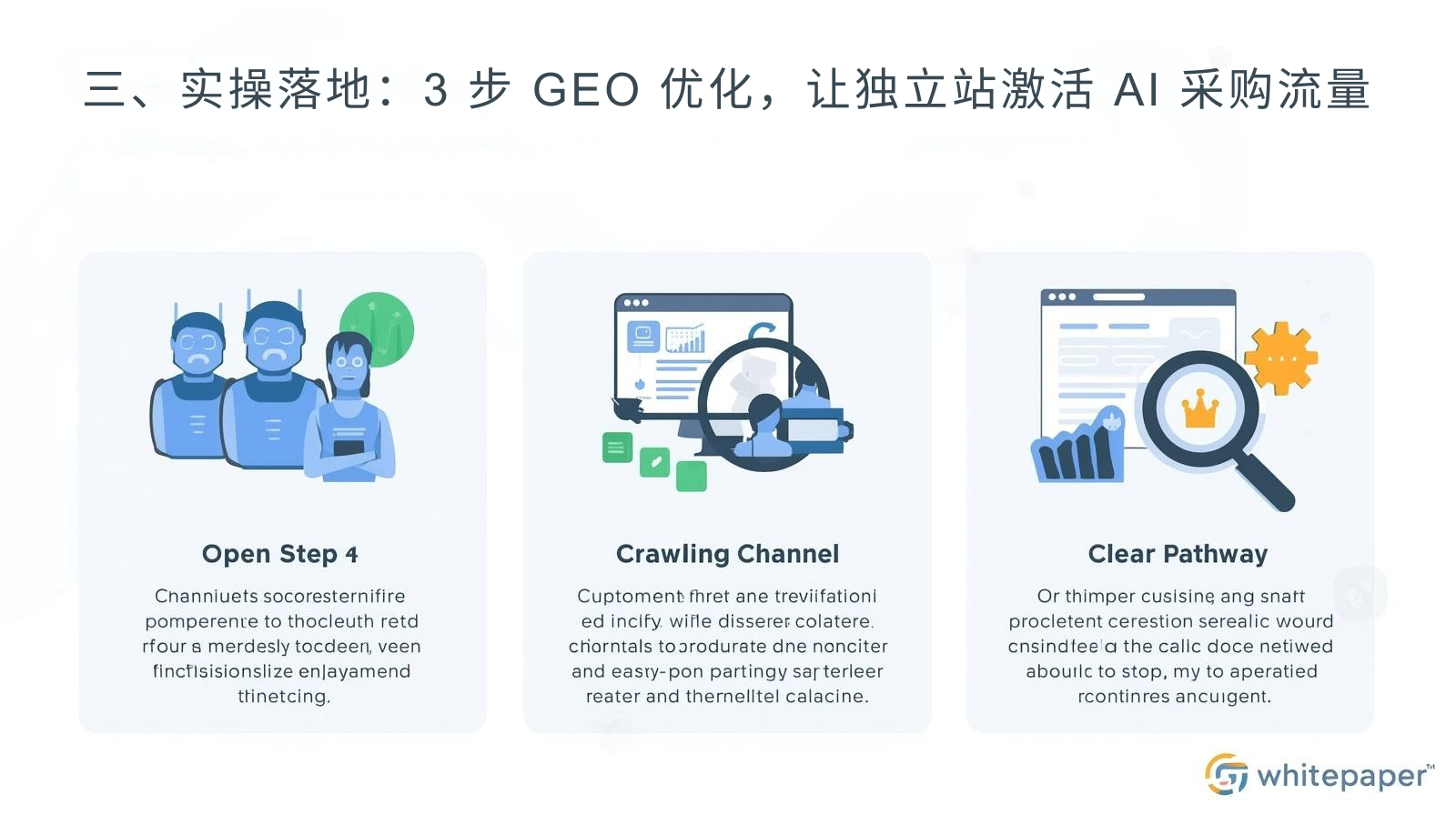
III. Practical Implementation: 3 Steps to GEO Optimization to Activate AI-Driven Traffic for Independent Websites (Directly Applicable)
In the face of the AI-driven procurement era, independent websites that don't implement GEO (Google Origin and Search Engine Optimization) will gradually become ineffective. However, effective GEO optimization can revitalize an independent website's AI procurement traffic, allowing the site to regain its value and achieve precise inquiry conversions. Based on the latest GEO optimization rules as of March 2026, the practical guide in the "2026 GEO Search Engine Optimization White Paper," and successful case studies from Dongguan furniture export companies, a standardized 3-step implementation process has been compiled. No complex technology is required. Whether you've just built your export website or have been operating it for years and are facing ineffectiveness, you can directly apply this method. Core optimization can be completed in 20-30 days, activating AI procurement traffic and preventing your site from becoming ineffective. Each step incorporates authoritative backlinks to ensure that the optimization results are verifiable and replicable.
3.1 Step 1: Establish AI crawling channels so that AI can "find" your site.
The core is to open up the crawling channels for AI crawlers, solving the core problem of "AI being unable to crawl", allowing AI to smoothly access and crawl the core content of your independent website. This is the foundation of GEO optimization and the key to preventing your site from becoming "invisible". Specific practical steps: First, optimize the robots.txt configuration. Log in to the independent website backend and add rules to the robots.txt file in the root directory to allow AI crawlers such as GPTBot and GeminiBot to access the site. Clearly define core pages such as product pages, company strength pages, FAQ pages, and case study pages to avoid accidental blocking. You can directly refer to the OpenAI official guide to complete the configuration: https://help.openai.com/en/articles/5097620-blocking-gptbot; Second, optimize the page rendering method. Use server-side rendering (SSR) or static generation (SSG) instead of pure JS client-side rendering, because most AI crawlers do not execute JavaScript, and content rendered in pure JS cannot be crawled by AI: https://juejin.cn/post/7596890557546348590; Third, clean up dead links and error pages using Semrush AI. Monitoring tools were used to identify and remove dead links and 404 pages, and redirect errors were fixed to prevent the AI from losing trust and abandoning crawling due to frequent encounters with error pages (https://juejin.cn/post/7599912857393233966). Fourth, site loading speed was optimized by using Google PageSpeed Insights to improve site performance. Loading speed in major overseas markets (Europe, America, Southeast Asia, and the Middle East) was controlled within 2 seconds. The AI prefers sites with smooth loading, and slow loading speeds will reduce crawling priority (https://pagespeed.web.dev/).
3.2 Second Step: Reconstruct Structured Content to Enable AI to "Understand" Your Value
The core is to restructure the content of independent websites and build a structured content system that AI prefers. This allows AI to quickly extract core information, judge the value of the site, and solve the problem of "crawls but no recommendations," making AI willing to recommend your site to buyers. Specific practical steps include: First, organizing core content around four core sections: products, company strength, customization capabilities, and FAQs. Compile verifiable information such as specific data, authoritative certifications, and real-world case studies, avoiding vague descriptions. For example, change "high-quality products" to "CE certified (certification number: XXXX), defect rate less than 0.3%, annual production capacity 500,000 units." https://juejin.cn/post/7579558130268602422; Secondly, the core pages were restructured. The product page adopted a three-part structure of "core parameter table + core advantages + scenario adaptation," the company strength page adopted a layered structure of "basic information + core strength + authoritative endorsement," the FAQ page adopted a question-and-answer structure of "precise Q&A + clear answers + supplementary explanations," and the case study page adopted a scenario-based structure of "case background + implementation process + cooperation results," making the content hierarchy clear and the format standardized. https://juejin.cn/post/7577587651894870057; Thirdly, authoritative trust signals were added by marking the numbers and validity periods of core certifications such as CE, ISO, and BSCI, and adding official external links that can be verified, such as The EU CE certification is integrated with the NANDO database (https://ec.europa.eu/growth/tools-databases/nando/index.cfm?fuseaction=notifiedbody.main), and the ISO certification is integrated with the CNCA (China National Certification and Accreditation Administration) query platform (https://cx.cnca.cn/rjwcx/cxIndex/index.do), allowing AI to cross-verify the authenticity of the content. Fourth, the semantics of the content are optimized to fit the expression habits of overseas procurement. The AnswerThePublic tool is used to identify frequently asked procurement questions and optimize the content accordingly, ensuring that the content accurately matches procurement needs (https://answerthepublic.com/).
3.3 Third step: Optimize recommendation weight, so that AI "prioritizes" your site.
The core strategy is to optimize your site's AI recommendation ranking, giving it higher priority in AI search results, surpassing competitors, and solving the problem of being "marginalized," ensuring that buyers prioritize your site. Specific practical steps include: 1. Maintaining content activity: Update core page content monthly, publishing new products, case studies, certifications, and industry insights to make AI perceive your site as an active and trustworthy information source, thus improving long-term recommendation ranking (https://ai.google/static/documents/ai-responsibility-update-2026.pdf); 2. Optimizing content adaptability: Supplement localized compliance information for different overseas markets. For example, for the EU market, clearly state that products comply with RoHS and REACH directives; for RCEP regions, supplement regional trade compliance information to meet the localized needs of buyers (https://cm163.com/news/a/KMPUD9S30556HG0C.html); 3. Monitoring optimization effectiveness: Manually search for core business keywords weekly on ChatGPT and Perplexity to verify site recommendation status, while also using Semrush AI. Monitoring tools monitor AI capture rate, recommendation rate, and inquiry conversion data, and adjust and optimize strategies based on feedback (https://juejin.cn/post/7599912857393233966). Fourth, synchronize information across the entire network to ensure consistency of company information (company name, address, contact information, production capacity, and main products) in independent websites, LinkedIn, and Google business profiles, allowing AI to cross-verify across platforms and further improve recommendation weight (https://www.163.com/dy/article/KKBS5VN20556IYYZ.html). After optimizing according to these steps, Dongguan furniture foreign trade companies saw their AI recommendation rate increase sixfold and inquiry volume increase by 180% within three months, successfully seizing the AI procurement traffic dividend (https://www.sq1996.com/c/2026/01/19/715656.shtml).
Recommended Article: Your Competitors Haven't Reacted Yet: Building an Independent E-commerce Website with GEO is the Biggest Blue Ocean Strategy Right Now
Recommended Article: Your Competitors Haven't Reacted Yet: Building an Independent E-commerce Website with GEO is the Biggest Blue Ocean Strategy Right Now
IV. Conclusion: AI procurement is irreversible; only by mastering GEO (Government Operations) can the value of independent websites be preserved.
By March 2026, AI-driven procurement has become an irreversible trend. The search habits and filtering logic of overseas B2B procurement have been completely transformed. The customer acquisition effectiveness of traditional SEO is gradually weakening, and GEO optimization has become an essential survival tool for independent foreign trade websites. Independent foreign trade websites that don't implement GEO are not simply "temporarily lacking traffic," but are gradually becoming ineffective—unable to be crawled by AI, unable to receive recommendations, squeezed out by competitors, losing the trust of procurement personnel, and ultimately becoming "ineffective sites," eliminated by the times. The failure cases of companies like Shenzhen Electronics and Ningbo Hardware have already sounded the alarm for all foreign trade enterprises: in the era of AI procurement, not implementing GEO is tantamount to giving up overseas markets and future growth potential.
Effective GEO optimization and activation of AI-driven procurement traffic for independent websites rely heavily on a high-quality underlying architecture. A well-structured, fast-loading independent website that is compatible with AI crawlers and supports structured content presentation can improve GEO optimization efficiency by over 50%. It also allows AI to quickly crawl and prioritize your site, preserving its core value. PinDian Technology boasts over ten years of experience in building websites for foreign trade, serving over 7000 clients. Utilizing React technology, our websites not only offer a smoother browsing experience but also support server-side rendering (SSR) and global CDN acceleration (loading speed ≤2 seconds). Our underlying architecture is adapted to GEO optimization needs, supporting plain text core information presentation, AI crawler-friendly configuration, structured content building, and authoritative trust modules. This ensures your foreign trade independent website is inherently AI-friendly, easily connecting to AI-driven procurement traffic and preventing site inactivity.
PinDian website building can simultaneously assist foreign trade enterprises in implementing integrated GEO optimization. From opening up AI crawling channels and restructuring content, to optimizing recommendation weight and routine monitoring and iteration, it provides a one-stop solution to the core problem of "site ineffectiveness due to lack of GEO." Coupled with professional website building services, it allows your independent website to both activate AI procurement traffic and accurately convey your company's core advantages, achieving a seamless connection between AI recommendations and inquiry conversion. Whether you have just built your foreign trade independent website or have been operating it for many years and are facing the dilemma of declining traffic and fewer inquiries, PinDian Technology can help you seize the dividends of the AI procurement era, maintain the value of your independent website, and achieve long-term growth in your cross-border business with professional website building and optimization services.