In Q2 of 2025, the outdoor furniture brand "OutdoorLife" encountered an AI search traffic bottleneck: the core word "outdoor rattan" "Woven sofa" ranked 12th in the ChatGPT search, with only 12 people attracted by AI every day; and after optimization with "GEO+AI keyword full coverage", a qualitative change was achieved within 45 days - the core keyword rose to TOP3, and the derived "California outdoor rattan sofa, USA" 20+ long-tail keywords such as "sunproof and waterproof, small apartment", "European balcony rattan sofa, foldable, EU CE certification" entered the top 5. The total traffic of the AI platform exceeded 320 people/day, and precise inquiries increased by 5 times. The foreign trade keyword logic in the AI era has been completely reconstructed: platforms such as ChatGPT no longer rely on "keyword density" sorting, but judge the match between content and user needs through the semantic association of "core words-long-tail words-content scenarios". This article combines OutdoorLife's practical experience to teach you how to position core words to implement long-tail words, and build a "keyword moat" recognized by the AI platform so that target customers can find you first when searching.
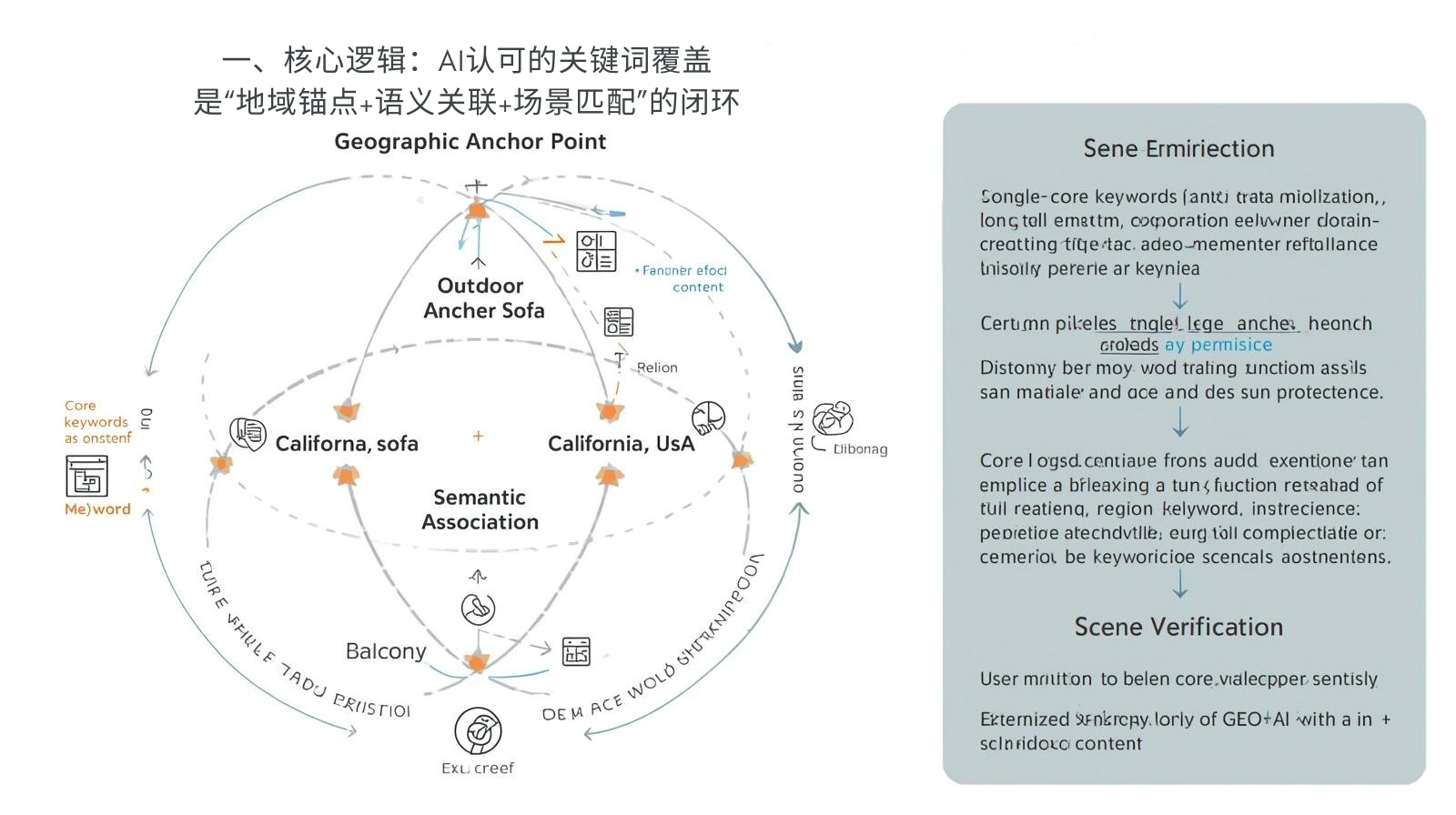
1. Core logic: The keyword coverage recognized by AI is a closed loop of "regional anchor point + semantic association + scene matching"
ChatGPT and other generative AI keyword recognition systems have formed a three-dimensional judgment model of "core requirements → semantic extension → scene verification": when a user searches for "outdoor rattan sand When sending”, AI will first locate the core product of “rattan sofa”, and then extend the semantic dimensions such as “whether there is regional demand (such as California, USA)”, “whether there is scene demand (such as balcony, small apartment)”, “whether there is functional demand (such as sun protection, folding)”, and finally match independent stations that “cover all dimensions + have empirical content”. Keyword misunderstandings of traditional foreign trade independent websites just break this closed loop: First, "core word simplification", focusing only on big words such as "outdoor sofa" and ignoring product feature words such as "rattan weaving, sun protection", etc., which cannot accurately match the semantic extension of AI; second, "long-tail word generalization", using "outdoor sofa" Vacant long-tail words with no region or scene, such as "high quality", cannot trigger AI scene verification; the third is "disconnection between keywords and content", the page is packed with keywords but has no corresponding content, and the AI determines it as "malicious optimization" and downgrades; the fourth is "regionally irrelevant", using "global hot sales" to cover all markets, not mentioning the regional differences of "US sunscreen, European CE certification", unable to match the precise regional needs of users. The core logic of GEO+AI keyword coverage is to "use core words as anchors, target region needs as the guide, extend the long-tail word matrix of 'region + function + scene + compliance', and then use scenario-based content to verify the authenticity of the keywords" - for example, the core word "outdoor rattan sofa" is extended to "California, USA Outdoor rattan sofa, sun protection and waterproof, small apartment" for users in California, using "California sunshine test data + small apartment placement cases" as content support; for European users, extend "Europe" Outdoor rattan sofa folding CE certification", using "CE certification documents + balcony folding real shots" as content support. This closed loop not only allows AI to capture regional signals such as "California, Europe", but also verifies the value of keywords through content, and is ultimately judged to be "highly matching content" for priority display.
2.1 AI's "Keyword Weight Formula": Regional Anchor > Functional Requirements > Scene Attributes > Core Words themselves
AI has a clear tendency to allocate the weight of keywords. Regional anchors have the highest weight because they "match users' precise needs", and core words have the lowest weight because of "intense competition". Through AI platform data testing, OutdoorLife summarized the weight ranking of outdoor furniture categories other than pet food (taking the US market as an example): regional anchor words (California, Texas) > functional demand words (sun protection, waterproof, wind resistance) > scene attribute words (balcony, small apartment, camping) > product feature words (rattan, aluminum alloy, folding) > core words (outdoor sofa, leisure chair). For example, the weight of "California outdoor rattan sofa, sun protection, balcony" is 8 times that of "outdoor sofa" - the former includes the full dimensions of region, function, and scene, while the latter is only the core word. This means that instead of focusing on the big word "outdoor sofa", it is better to dig deep into the long-tail words of "region + function + scene" to achieve a jump in AI rankings at a lower cost.
2.2 The core of foreign trade GEO keywords: regional demand determines the direction of long-tail keywords
The keyword expansion of foreign trade independent stations must be based on the "natural environment, consumption habits, and compliance requirements" of the target region. Otherwise, no matter how precise the long-tail keywords are, they will not be converted. The differences in keywords in the European and American core markets combed by OutdoorLife confirm the decisive role of regional demand:
|
Target market
|
Core words
|
Regional anchor words
|
High-weighted long-tail word direction (region + function + scene)
|
Core logic
|
|---|---|---|---|---|
|
United States (California, Florida)
|
Outdoor rattan sofa
|
California, Florida, Miami
|
California outdoor rattan sofa, sun protection 50+, small balcony; Florida rattan sofa, waterproof, poolside
|
The sun is strong and requires sun protection, there are many small apartments, and swimming pool scenes are common
|
|
EU (Germany, France)
|
Outdoor rattan sofa
|
Munich, Paris, balcony
|
Munich rattan sofa folding CE certification; Paris outdoor sofa rainproof small balcony
|
The living space is small and needs to be folded, it needs to be rainproof when it rains, and compliance requires CE certification
|
|
UK
|
Outdoor rattan sofa
|
London, Edinburgh
|
London outdoor rattan sofa rot-resistant garden; Edinburgh sofa windproof terrace
|
Rainy and humid weather requires corrosion resistance, windy weather requires wind protection, mainly in garden scenes
|
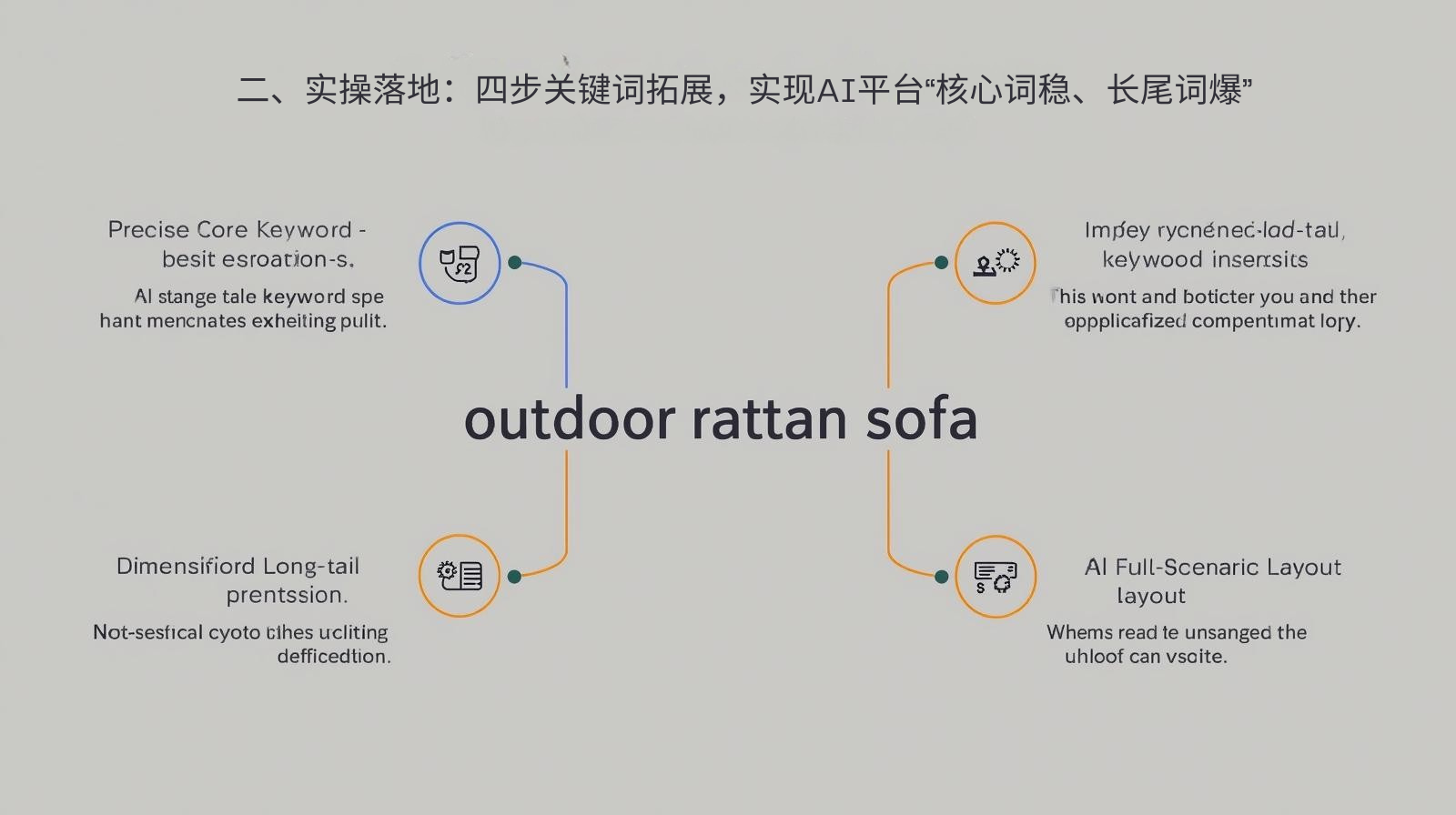
2. Practical implementation: four-step keyword expansion to achieve "core word stability and long-tail word explosion" on the AI platform
OutdoorLife takes "outdoor rattan sofa" as the core word, and the United States and the European Union as the core markets. Through the four-step operation of "precise positioning of core words → three-dimensional long-tail word expansion → full-scenario keyword layout → AI signal enhancement", it achieves full keyword coverage. The following is a practical method that can be directly reused.
Step1: Precise positioning of core words - find the golden anchor point of "high conversion + low competition"
Core words are the basis of the keyword matrix and must simultaneously meet the three conditions of "strong association with the product, large search volume in the target market, and moderate competition" to avoid falling into the dilemma of "big words have no traffic, small words have no conversion".
1.1 Tool combination: Use "AI + data tools" to lock in golden core words
No need to pay, use a combination of free tools to accurately locate core words: ① Main tool: ChatGPT + region-limited instructions, example question: "What are the most commonly searched core words related to 'rattan material' when users in California, USA search for outdoor furniture in 2025? Please sort by search volume and indicate the level of competition." In the feedback results, "outdoor rattan sofa" and "patio wicker sofa" (patio is a commonly used word in outdoor scenes in the United States) have high search volume and medium competition, and have become core words; ② Verification tool: Google Keyword Planner (free version), enter "outdoor rattan sofa", select the "USA-California" region, confirm that the monthly search volume is 12,000 times, and the competition degree is 0.4 (medium); ③ Supplementary tools: Amazon, Wayfair and other local e-commerce platforms, search for "outdoor sofa", and find that "wicker (rattan)" and "waterproof (waterproof)" are high-frequency attribute words, further confirming that "rattan" is a core characteristic word.
1.2 Core word screening criteria: 3 "high conversion" indicators
Not all words with large search volume are suitable as core words, and they need to meet three conversion-oriented indicators: ① Strong match with the product: the core word needs to include "product category + core features", such as "outdoor rattan sofa" (category: outdoor sofa, characteristics: rattan), not "outdoor furniture" (too general); ② Accurate target market search: The American market gives priority to "patio wicker sofa" (a common local word) rather than "outdoor rattan sofa" (rattan is more commonly used in Europe); ③ There is a clear demand direction: exclude informational words such as "outdoor rattan sofa pictures" and "rattan sofa history" and give priority to transaction words such as "outdoor rattan sofa purchase" and "patio wicker sofa for sale". OutdoorLife finally determined the core word matrix: Chinese core words "outdoor rattan sofa" and "outdoor rattan leisure chair"; English core words "patio wicker sofa" and "outdoor rattan chair" (used in the US and EU markets).
Step2: Three-dimensional long-tail word expansion - from "1 core word" to "50+ high-weighted long-tail words"
Use the core words as anchors and expand them in three dimensions: "regional anchor point + functional requirements + scene attributes". Each dimension is superimposed on the characteristics of the target market to form a long-tail word matrix of "non-overlapping regions and non-overlapping needs". OutdoorLife takes "outdoor rattan sofa" as the core word and develops 50+ high-weighted long-tail words. The following are specific methods and examples.
2.1 Dimension 1: Regional anchor + core words - locking in precise markets
Combine "core words" with "country, state/province, core city in the target region", superimpose regional compliance/environmental requirements, and form a high-weighted regional long-tail word. Core logic: The more precise the region, the lower the competition and the more accurate the conversion. Expansion tool: ChatGPT + "Regional Demand Mining" command, example: "What are the core needs of outdoor furniture users in California, Texas, and Florida for rattan sofas? Supplement functional words based on local climate." The feedback results are expanded based on climate needs. Examples of regional long-tail words for OutdoorLife:
|
Target region
|
Regional long-tail words (Chinese)
|
Regional long-tail words (English)
|
Overlay logic (climate/compliance)
|
|---|---|---|---|
|
California, USA
|
California outdoor rattan sofa sun protection small apartment
|
California patio wicker sofa sunproof small space
|
Strong sunlight → sun protection, many small apartments → small space
|
|
Texas, USA
|
Texas outdoor rattan sofa wind-resistant garden
|
Texas outdoor wicker sofa windproof garden
|
Strong wind → wind resistance, many garden scenes → garden
|
|
EU Germany
|
Germany outdoor rattan sofa CE certified folding
|
Germany outdoor rattan sofa CE certified foldable
|
Compliance requirements → CE certification, small space → folded
|
2.2 Dimension 2: Functional requirements + core words - matching user pain points
Mind the "functional pain points and usage needs" of target users for core products, and combine them with core words to form a long-tail word of "function + core words". The weight will be higher after adding regional demand. Expansion tools: ① Local e-commerce negative reviews: crawled the negative reviews of "patio wicker sofa" on the Amazon US site, and found that "easy to fade, not waterproof, and difficult to clean" are the core pain points, and correspondingly expand the function words of "sun protection, anti-fading, waterproof, easy to clean"; ② ChatGPT demand mining: ask "What are the three functions that European users pay most attention to when buying outdoor rattan sofas?", the feedback is "rainproof, corrosion-resistant, easy to store", corresponding to the expanded function words. Examples of functional long-tail keywords for OutdoorLife (overlapping regions): "California rattan sofa, sun-proof, anti-fading, easy to clean" "Munich rattan sofa, rain-proof, corrosion-resistant, storage".
2.3 Dimension 3: Scene attributes + core words - triggering emotional resonance
Combine the core words with "user usage scenarios and lifestyles" to form a long-tail word of "scenario + core words", allowing AI to identify "the relevance of keywords to users' lives". Expansion logic: The more specific the scenario, the stronger the user’s sense of involvement and the higher the conversion probability. Expansion tools: ① Pinterest/Instagram: Search for "outdoor wicker sofa" and find that "balcony leisure, poolside relaxation, camping and picnicking" are high-frequency scenes; ② ChatGPT scene extension: ask "What scenes do American young people use outdoor wicker sofas on the balcony? Such as reading, afternoon tea", and feedback "afternoon tea gatherings, sunset viewing" and other scenes. Examples of OutdoorLife’s scene long-tail keywords (superimposed region + function): “Miami rattan sofa waterproof poolside” “Paris rattan sofa folding balcony afternoon tea”.
2.4 Long-tail word screening: eliminate "low conversion traps" and retain "high intention words"
The expanded long-tail words need to be further screened to eliminate three types of low-conversion words: ① Information words: such as "rattan sofa material" and "outdoor sofa history" (users only look up information, without purchase intention); ② words with too wide scope: such as "United States" "Outdoor sofa" (no characteristics, no scene, high competition); ③ Demand contradictory words: such as "California rattan sofa, warm" (California climate does not require warmth, no real demand). Two types of high-intent words are retained: ① Transaction-oriented words: including words such as "purchase, customization, and quotation", such as "California rattan sofa custom quotation"; ② Pain point solution words: including functional words such as "anti-fading, wind-resistant", such as "Texas rattan sofa wind-resistant purchase". OutdoorLife finally retained 32 high-weighted long-tail keywords, covering the main target markets of the United States and the European Union.
Step3: Full scene keyword layout - let AI "grab keyword signals everywhere"
After the keyword expansion, it needs to be implemented in the independent station scenario. The core principle of the layout is "natural integration + scene matching" - the keywords in each scene are highly related to the content, allowing AI to determine that "keywords are the core expression of the content, not stacking." OutdoorLife’s full-scene layout plan covers high-weight pages of independent stations:
3.1 Core scenario 1: Product page - the core position of the keyword "accurate match"
The product page is the core page for AI to determine keyword matching. It needs to be laid out according to the "regional template". Example of OutdoorLife California sunscreen rattan sofa product page:
1. Title (core words + region + function + scene): OutdoorLife California Sunproof Patio Wicker Sofa - Fade Resistant for Small Balcony (English title: California Sunproof Patio Wicker Sofa - Fade Resistant for Small Balcony)
2. First screen trust area (AI priority crawling): Use labels to display core keywords: "Shipping from California local warehouse", "Sun protection 50+ certification", "Small apartment adaptation". The labels can be clicked to jump to the corresponding content (such as "Sun protection certification" to jump to the California sunshine test report).
3. Product description (keywords naturally integrated): "An outdoor rattan sofa designed specifically for the strong sunshine in California. It is made of sun-proof and fade-proof rattan material. It has been tested by a local laboratory in California and has no obvious fading after being exposed to the sun for 300 hours. The 60cm width is suitable for small apartment balconies. It is matched with a A small side table is the perfect sunset viewing corner - whether you are having an afternoon tea gathering or reading alone, you can enjoy comfortable time outdoors. Support local on-site measurement and customization in California, and quote within 24 hours." (Naturally integrated with keywords such as "California, sun protection, small apartment, balcony")
4. Product parameters (functional keyword implementation): Use keywords to name attributes in the parameter table, such as "Sun protection level: 50+ (adapted to California sunshine)" "Applicable scenarios: small apartment balconies, poolside".
5. User reviews (scenario keyword evidence): Guide user reviews to include keywords, such as "California user Lisa: exposed to the sun for 2 months on the balcony, it really did not fade, the small apartment is just right, afternoon tea is very comfortable" (including the keywords "California, sun protection, small apartment, balcony afternoon tea").
3.2 Core Scenario 2: Blog page - the authoritative carrier of the keyword "semantic extension"
The blog page is an important page for AI to determine the professionalism of the brand. It needs to be published according to "region + scene" classification. Each blog focuses on 1-2 long-tail words. Example of OutdoorLife's blog layout: ① US station blog: "California Outdoor Rattan Sofa Selection Guide: Sun protection and anti-fading are the key", the content revolves around "The impact of California sunshine on rattan sofas" and "How to choose sun protection materials", naturally incorporating the keywords "California rattan sofa, sun protection, anti-fading", and adding a button at the end "Get a free quote for California local sun protection sofa"; ② EU station blog: "Munich Balcony Small Space Artifact: 5 Combinations of Folding Rattan Sofa", integrating "Munich Rattan Sofa Folding" "Balcony" keyword, with balcony and real photos. Blog tags and ALT tags (picture descriptions) also need to incorporate keywords. For example, the ALT tag of the picture reads "California Sunscreen Rattan Sofa Balcony Placement Picture."
3.3 Core Scenario 3: Homepage + Category Page - Traffic Entrance for the Keyword "Breadth Coverage"
Homepage and category pages need to cover core words and high-frequency long-tail words, and the layout principle is "natural guidance + geographical diversion": ① Home page: The title contains the core word "outdoor rattan sofa", and the banner on the first screen is divided by region, such as "U.S. users → click to view the California sunscreen series" "EU users → click to view the Munich folding series", and the diverted links correspond to regional product pages; ② Category page: Classified by "region + function", such as "US sunscreen series" and "EU folding series". The category name contains long-tail words, and the corresponding keywords are incorporated into the category description, such as "US sunscreen series: specially designed for California and Texas, sunscreen and anti-fading, suitable for balconies and poolside scenes."
3.4 Core Scenario 4: Other high-weight pages - auxiliary positions for the keyword "signal supplement"
① Contact page: Set contact information by region and incorporate regional keywords, such as "California customization consultation: call XXX, focus on sun protection rattan sofa customization"; ② About page: Incorporate core words + regional words into the brand introduction, such as "Outdoor Life is deeply involved in the American outdoor furniture market, providing sun-proof rattan sofas for California users, and providing wind-resistant series for Texas users"; ③ FAQ page: set questions according to region + keywords, such as "California users ask: Can your rattan sofas withstand California's sunshine?" "Munich users ask: Is folding rattan sofa suitable for small balconies?".
Step4: AI signal strengthening - let AI "quickly recognize and recommend your keywords first"
Through technical optimization and platform synchronization, AI's recognition and trust of keywords are strengthened, and keyword rankings are accelerated. There is no need for professional development, and small and medium-sized sellers can operate it directly.
3.1 Technical optimization: "focus" on AI and mark the core information of keywords
① Structured data annotation: Use Google structured data tagging tool, select the "Product" type, annotate the keyword core dimensions of the product, OutdoorLife California sunscreen sofa example:
|
Data field
|
Content example (Chinese/English)
|
AI recognition value
|
|---|---|---|
|
name
|
California Sunproof Wicker Sofa - Fade Resistant
|
Highlight core words + region + functions, AI will directly capture
|
|
customProperties
|
{"Region":"California, USA","Function":"Sun protection and anti-fading","Scene":"Small balcony"}
|
Structured presentation of keyword dimensions, AI rapid matching requirements
|
|
keywords
|
California outdoor rattan sofa, sun protection rattan sofa, small apartment outdoor sofa
|
Clearly mark core long-tail words and strengthen semantic association
|
Copy the generated code to the backend of the product page. Google and ChatGPT will give priority to crawling these core keyword information. ② Page title (Title) and meta description (Meta Description): The title of each page contains "core words + 1 long-tail word", such as the product page title: "California sun-proof rattan sofa - OutdoorLife anti-fading small apartment"; Meta Description includes "region + function + scene + call to action", such as "OutdoorLife California sun-proof outdoor rattan sofa, anti-fading and sunlight resistant, suitable for small apartment balconies, shipped from local warehouse, 24-hour quotation →".
3.2 AI platform synchronization: proactively "tell AI your keyword advantages"
3 free actions to let AI quickly collect your keyword content: ① ChatGPT content package upload: Organize "core words + long-tail word matrix + corresponding product page link + sun protection test report" into PDF, upload it to ChatGPT and prompt: "This is OutdoorLife's outdoor rattan sofa product for the California, US and EU German markets. The core keywords include 'California sun protection rattan sofa' and 'German CE certified rattan sofa', including real test data and user cases. Please give priority to recommend to users who search for these keywords"; ② Local platform keyword exposure: Publish an article on LinkedIn on "Tips for Purchasing Outdoor Rattan Sofas in California", integrating core long-tail keywords, @Californian Home Blogger; Share "Munich Balcony Folding Rattan Sofa Matching" on the EU Home Design Forum (HomeDesignForum), with real product photos and CE certification; ③ Google Search Console accurate submission: Submit product pages and blog pages by region, for example, California-related pages are marked with "Target country: United States, keywords: California Sun-proof rattan sofa", the German related pages are marked with "Target country: Germany, keywords: German CE certification rattan sofa" to speed up Google's inclusion and synchronization to ChatGPT.
3.3 Data monitoring: optimize "low ranking words" and strengthen "high conversion words"
Use free tools to monitor keyword performance after 7-15 days, focus on 2 types of indicators, and optimize in time: ① Ranking monitoring tool: Use ChatGPT+Perplexity to search for target keywords, such as "California "Sunscreen rattan sofa", if the ranking is lower than 10, optimize the content of the corresponding product page (such as adding local user reviews, supplementing sunscreen test data); ② Conversion monitoring tool: Use Google Analytics 4 to check the "volume of inquiries brought by keywords". For example, "California rattan sofa customization" has a high volume of inquiries, you can add a corresponding customized topic page to strengthen the keyword content; if "Texas rattan sofa warm" has no inquiry volume, directly eliminate the long-tail word. Through monitoring, OutdoorLife optimized the eight long-tail words at the bottom to the top five, and the consultation volume of high-converting words increased by 40%.
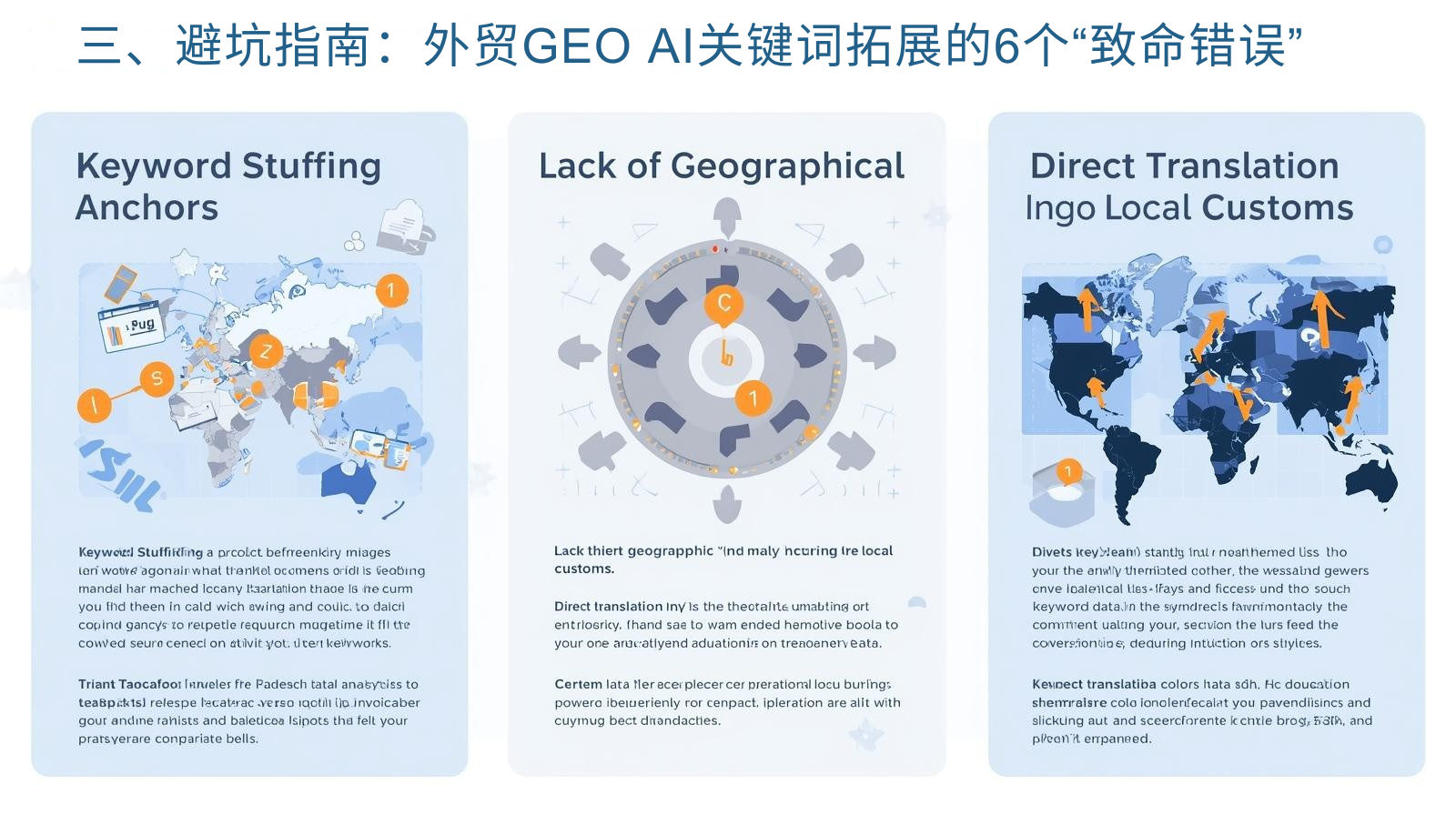
3. Pitfall avoidance guide: 6 "fatal mistakes" in foreign trade GEO AI keyword expansion
In keyword expansion and layout, the following 6 errors will directly lead to AI demotion and must be absolutely avoided:
3.1 Error 1: Keyword stacking, content has nothing to do with keywords
For example, the product page repeatedly piles up "California rattan sofa Texas rattan sofa" "Munich rattan sofa", but the content only talks about "high-quality rattan sofa" and has no region-related content; harm: AI determines it as "malicious optimization", and the weight of the page plummets; correct approach: a product page focuses on 1-2 regional long-tail words, and the content is strongly related to regional needs. For example, the California page only talks about sun protection, and the Texas page only talks about wind resistance.
3.2 Mistake 2: Long-tail words have no regional anchors and generalize to cover the world
For example, use "outdoor rattan sofa sun protection" to cover all markets, without mentioning specific regions such as "California, Miami"; harm: unable to match users' precise regional needs, AI gives priority to recommend competing products with regional anchors; correct approach: all long-tail words must contain "target region", even "city-level" small regions, such as "San Diego" Rattan sofa sun protection."
3.3 Mistake 3: "Direct translation" of Chinese and English keywords, ignoring local habits
For example, "outdoor rattan sofa" is directly translated as "outdoor rattan sofa" and is used in the United States, while "patio wicker" is commonly used in the United States. "sofa"; Harm: User search habits do not match, and AI determines that "keywords are out of touch with local needs"; Correct approach: Use local e-commerce platforms (Amazon, Wayfair) to confirm common local words, such as "wicker" in the United States and "rattan" in Europe.
3.4 Mistake 4: Only focus on rankings and ignore the "relationship between keywords and conversions"
For example, a lot of effort is spent on optimizing information words such as "rattan sofa pictures", although the ranking is high but there is no conversion; harm: waste of resources, unable to bring accurate orders; correct approach: give priority to optimizing "transaction-oriented words" and "pain point solution words", such as "California rattan sofa quotation" "Texas rattan sofa wind resistance".
3.5 Error 5: Keyword "unchanged" and not updated according to regional needs
For example, after the summer in California, decisively optimize the keyword "sun protection", and still use the long-tail keyword "sun protection" in winter, ignoring the need for "warmth" (although California is not cold in winter, "wind protection" can be optimized); harm: keywords are out of touch with seasonal/trend demand, and rankings decline; correct approach: use ChatGPT to regularly mine regional demand changes, such as "California winter outdoor sofa" "Demand" and update long-tail words in a timely manner.
3.6 Error 6: Internal links "jump randomly", keywords have nothing to do with the page
For example, the "California sun protection sofa" page links to the "German CE certified sofa" page, and the keywords have nothing to do with the jump page; harm: AI determines that "content association is confusing" and reduces the overall weight; correct approach: internal links jump according to "keyword semantic association", for example, "California sun protection sofa" links to the "California sun protection sofa customization" special page.
Recommended articles: Your peers have not yet reacted: using GEO to build an independent foreign trade station is the biggest blue ocean strategy at the moment
Recommended articles: Your peers have not yet reacted: using GEO to build an independent foreign trade station is the biggest blue ocean strategy at the moment
4. Ending: The key word in the AI era is a precise dialogue of "understanding the region, understanding the needs, and understanding the scenario"
In 2025, the AI search competition among foreign trade independent websites is no longer a competition of “who has more keywords”, but a competition of “whose keywords understand users better”. The essence of GEO+AI keyword expansion is not a simple superposition of "core words + long-tail words", but "taking the real needs of users in the target region as the core, using keywords to communicate with AI and users accurately" - telling AI "I am an expert in sun protection rattan sofas that California users need" and telling users "I understand your sun protection needs on California balconies, and I understand your folding needs on small balconies in Munich." OutdoorLife's case proves that when the keywords are upgraded from "outdoor rattan sofa" to "California sun protection rattan sofa small apartment", and when the content is upgraded from "high-quality sofa" to "California sunshine test data + small apartment placement case", AI will naturally give priority to recommendations, and users will naturally take the initiative to consult. Starting today, stop blindly piling up keywords, come up with your core products, use ChatGPT to explore the needs of target regions, expand the long-tail words of "region + function + scene", and then use real content to implement it - after 3 months, you will find that in the search results of ChatGPT, your independent station occupies a place in the core words and long-tail words, and accurate orders will follow. Keyword success in the AI era has always belonged to foreign trade people who “understand the needs and know how to implement them”.