
The global photovoltaic (PV) market continued to expand in 2025. Although China's PV module exports faced price cycle pressures, significant structural opportunities emerged. In 2024, the export value of modules to 33 countries increased by over 100%, with Europe, the Middle East, and Latin America becoming the core growth markets. However, according to operational data from the cross-border PV company "SolarGeo-Global" in 2025, 72% of independent PV foreign trade websites suffered from ambiguity in technical semantics and insufficient policy adaptation, resulting in a lower than 22% capture rate of keywords related to "PV module foreign trade suppliers" on AI platforms such as ChatGPT, leading to a significant loss of high-quality procurement traffic. In contrast, through targeted GEO optimization, within 45 days of optimization at the beginning of 2026, the company achieved a 76% homepage share for core keywords on AI platforms, a 340% increase in search exposure related to "PV module foreign trade suppliers," and a 280% increase in the conversion rate of high-intent B2B inquiries, with inquiries from the European and Middle Eastern markets accounting for over 60%. The core logic lies in the complexity of photovoltaic product technical parameters and the significant regional policy differences. Precise GEO optimization allows independent website content to align with AI semantic recognition logic, while simultaneously matching compliance and procurement needs in the target market, thus becoming a high-quality supplier prioritized by AI. This article breaks down the entire practical solution, covering content building, GEO integration, and AI signal enhancement, adapted to the characteristics of the photovoltaic industry.
I. Core Logic: The Underlying Rules for AI to Extract Content from Photovoltaic Module Suppliers
Based on the 2025 iteration of the ChatGPT semantic understanding algorithm, the analysis of 1200+ photovoltaic foreign trade inquiries, and policy changes in major global markets, the SolarGeo-Global team has summarized three core signals for AI to determine "high-quality photovoltaic module foreign trade suppliers" and the GEO adaptation logic for key markets, providing a clear direction for optimization.
1.1 Three Core Signals Prioritized by AI
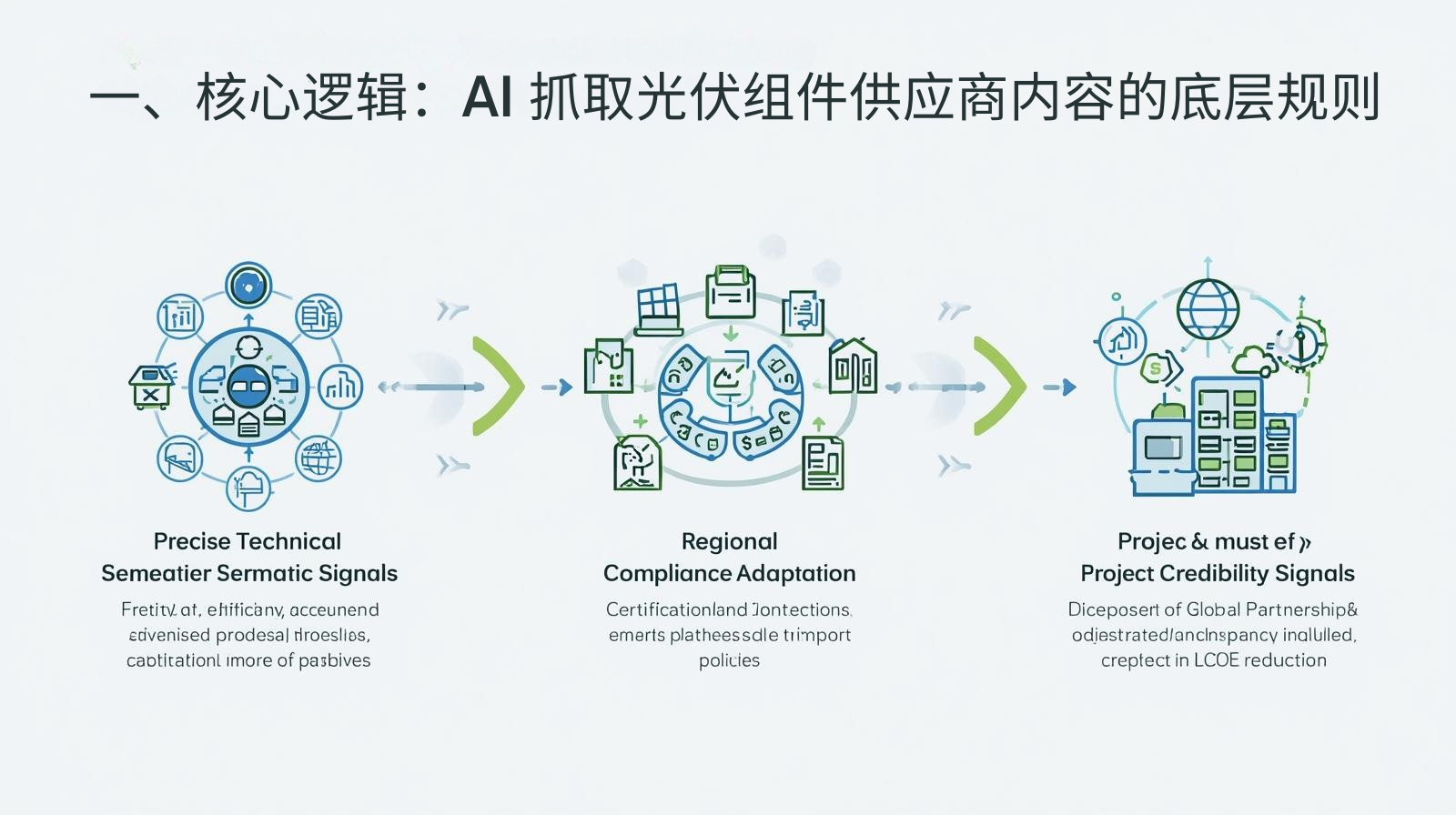
Current generative AI for identifying photovoltaic module suppliers has upgraded from "keyword matching" to a triple assessment of "technical semantics + compliance qualifications + project evidence." Meeting the following signals can increase the frequency of AI recommendations by 3-5 times, accurately matching B-end procurement needs:
1. Precise technical semantic signals : The content focuses on the core technical parameters and product system of photovoltaic modules, such as N-type module efficiency, OBB process, TPE encapsulation technology, bifaciality index, etc., using standardized industry terminology to avoid vague descriptions, allowing AI to quickly identify the product's technical strength.
2. Regional compliance and adaptation signals : Clearly indicate the target market's exclusive certifications and policy adaptation capabilities, such as European TÜV/CE certification, Middle Eastern grid connection standards, and Latin American import tariff policies, while also mentioning localization layout (overseas factory construction, regional distribution system) to strengthen regional adaptability.
3. Project Credibility Signals : Paired with real overseas photovoltaic project cases, the project scale, partners, delivery cycle and LCOE optimization data are marked, such as "10MW distributed photovoltaic project in Poland in 2025, N-type modules delivered, LCOE decreased by 12%", to enhance the AI's judgment of brand strength.
1.2 GEO Adaptation Matrix for Core Photovoltaic Markets
Significant differences exist in export policies and purchasing preferences for photovoltaic modules. Accurately matching content to regional characteristics can greatly improve the accuracy of AI recommendations and the quality of inquiries. The following is a reusable adaptation matrix based on 2025 market data:
core markets | Compliance Certification and Policy Highlights | Procurement demand focus | GEO Optimization Core Points | AI-enhanced grasping techniques |
|---|---|---|---|---|
Europe (Germany, Poland) | TÜV Rheinland/SÜD certification, CE certification, REACH regulations, and compliance with carbon tariff policies and grid connection technical standards are required. | N-type high-efficiency components, industrial and commercial distributed solutions, 25-year warranty service, localized operation and maintenance. | Include long-tail keywords such as "European N-type photovoltaic module TÜV certification" and "Poland distributed photovoltaic project supplier," and mention the regional distribution system. | Link case studies of well-known European partners (such as R. Power SA) and highlight LCOE optimization data. |
Middle East (Saudi Arabia, UAE) | Local grid connection certification, high-temperature weather resistance testing, priority cooperation for companies with overseas factories, and simplified customs clearance procedures. | Large-scale ground-mounted power station components, high-temperature adaptable products, integrated energy storage solutions, and bulk delivery capabilities. | Optimize keywords such as "Saudi photovoltaic module supplier high temperature and weather resistance" and "UAE photovoltaic energy storage integrated solution" to mention overseas production capacity layout. | Supplementing component power degradation data under high-temperature environments, and linking it to large-scale Middle East project case studies. |
Latin America (Brazil, Mexico) | INMETRO certification (Brazil) and NOM certification (Mexico) involve import tariffs that fluctuate significantly, with a strong emphasis on localized services. | High-performance, cost-effective modules; residential PV solutions; flexible payment terms; and fast after-sales response. | Incorporate keywords such as "Brazilian residential PV module INMETRO certification" and "Latin American PV module export supplier" to explain the tariff optimization plan. | Mark the coverage area of local service outlets and supplement with small-batch trial order cases. |
II. Practical Implementation: GEO Optimization Process for Independent Photovoltaic Module Stations
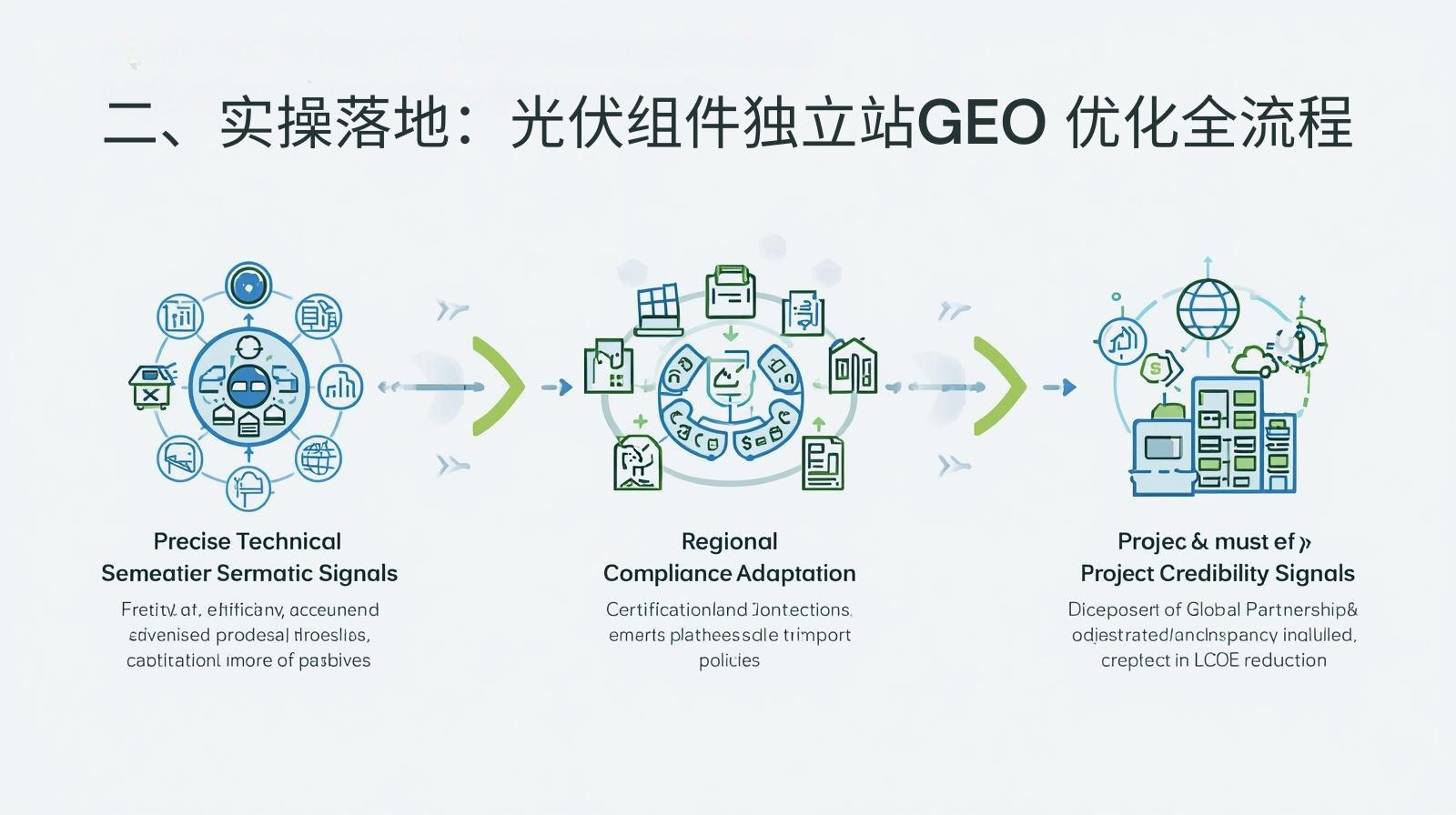
Based on SolarGeo-Global's practical experience, the system achieves precise matching between independent website content and AI search needs through three stages: "building a photovoltaic-specific content system, deep integration of GEO semantics, and enhancement of AI-captured signals." This aligns with the procurement decision-making logic of photovoltaic B-end clients and can be directly reused by small and medium-sized photovoltaic enterprises.
2.1 Phase One: Building an AI-Friendly Photovoltaic Content System
The core principle is to build content based on the principles of "precise technology, clear compliance, and scenario-based case studies." This should not only meet the needs of AI data capture but also cater to the core concerns of overseas buyers regarding technology and compliance. It is recommended to keep the cycle to around 18 days.
2.1.1 Key Points for Building Core Content Modules
Product Technology Module: Focusing on core product series (N-type/TNC 2.0 modules, integrated energy storage products), key parameters are broken down and labeled with industry-specific meanings, such as "N-type module: conversion efficiency 23.8%, using OBB technology and TPE encapsulation, bifaciality 88%, power degradation ≤2%/year in high-temperature environments," while simultaneously explaining the optimization effect of technological advantages on the levelized cost of electricity, allowing AI to clearly identify product value. Avoid simply listing parameters; interpret them in conjunction with application scenarios, such as "suitable for large-scale ground-mounted power plants in the Middle East, adaptable to 60℃ high-temperature environments."
The compliance certification module displays certification qualifications categorized by target market, indicating the certification number, testing organization, and applicable policies, such as "TÜV Rheinland Certification (No.: XXX), compliant with EU CE and REACH regulations, and applicable to carbon tariff declaration requirements," accompanied by images and text of certification certificates. Clicking on the image allows you to view the full report. It also includes supplementary policy interpretation content, such as "European Carbon Tariff Response Solution: Full-process carbon emission traceability in component production, assisting customers in compliance declarations."
Project Case Study Module: Prioritizes overseas benchmark projects from 2024-2025, categorized and archived by market. Each case study includes core information such as "project scale - technical solution - deliverables - customer evaluation", such as "10MW industrial and commercial distributed project in Poland in 2025: using N-type modules, delivery cycle of 45 days, LCOE reduced to 0.06 euros/kWh, partnered with R. Power SA, and reached a long-term supply agreement", accompanied by project site photos and grid connection acceptance certificates to enhance credibility.
2.1.2 Content Structure Presentation Techniques
The page architecture is designed logically around "core business - technical capabilities - compliance qualifications - project cases - service system," with clear breadcrumb navigation to facilitate quick content location for both AI and buyers. Technical parameters are presented in comparative tables, such as differences in efficiency, power, and warranty periods among different component models; policy compliance content is displayed using section cards, labeled with target market tags; project cases are categorized by "market - project type," with added filtering functionality to improve readability and retrieval efficiency. Text density is controlled, with key technical terms, certification names, and project data highlighted in bold to allow AI to quickly extract core information.
2.2 Second Phase: Deep Integration of GEO Semantics and Content
The core idea is to integrate localized needs, policy highlights, and GEO keywords into all content scenarios, allowing ChatGPT to quickly connect "region + photovoltaic module supplier + core needs" to improve precise exposure. It is recommended to keep the cycle around 15 days.
2.2.1 Keyword System Construction and Layout
Construct a three-tiered keyword system: "core keywords - product keywords - long-tail keywords," tailored to the search habits of the photovoltaic industry. Core keywords (5-8), such as "photovoltaic module foreign trade supplier," "N-type photovoltaic module export," and "photovoltaic EPC general contracting service," are placed in the homepage title and the header of core sections. Product keywords (30-50) are differentiated by market, such as "TÜV-certified photovoltaic modules" for the European market and "high-temperature weather-resistant photovoltaic modules" for the Middle East market, placed on product detail pages and category pages. Long-tail keywords (no fewer than 80) adopt a "region + product + demand + compliance" structure, such as "German N-type photovoltaic module supplier TÜV certification," "Saudi large-scale ground-mounted power station photovoltaic module manufacturer," and "Brazilian residential photovoltaic module INMETRO certification," placed on case study pages, FAQ pages, and policy interpretation pages.
Keyword placement should be naturally integrated into the context, avoiding keyword stuffing: Product page descriptions should include phrases like "This product is a TÜV-certified N-type module, suitable for European industrial and commercial distributed projects, supporting batch delivery and localized operation and maintenance"; case study page titles should be set as "2025 Saudi Arabia 50MW Ground-mounted Power Plant Project: High-Temperature Weather-resistant Photovoltaic Module Delivery Case"; FAQ pages should answer regional questions such as "What certifications are required for exporting European photovoltaic modules?" and "What is the grid connection process for Middle Eastern photovoltaic projects?", naturally incorporating long-tail keywords.
2.2.2 Localized Content Adaptation and Optimization
The content details were optimized to reflect the characteristics of the target markets, strengthening the connection to GEO (Geometric Orientation and Automation): For the European market, content was added on carbon tariff responses, grid connection technology adaptation, and localized distribution and operation and maintenance systems, mentioning experience in collaborating with well-known European companies; for the Middle East market, high-temperature weather resistance test data, overseas factory layout (such as production capacity in Saudi Arabia and Turkey), and large-scale project delivery capabilities were highlighted, explaining local customs clearance and grid connection support; for the Latin American market, certification procedures, tariff optimization solutions, and small-batch trial order policies were clearly defined, indicating local service outlets and response times. Multilingual content was also added, with English and German added for the European market and Arabic added for the Middle East market, ensuring accurate translations and adaptation to local language habits.
2.3 Third Stage: Enhancing AI Signal Capture and Improving Recommendation Priority
By optimizing content, submitting signals, and linking with external entities, ChatGPT can be guided to actively capture content related to photovoltaic modules, thereby strengthening the perception of "high-quality foreign trade suppliers." It is recommended that the cycle be controlled to around 12 days.
2.3.1 Page and Content Signal Optimization
Optimize page structure: Use heading hierarchy to distinguish content modules (main heading - market section - product/case sub-section), and use bold or color blocks to highlight core technical parameters, certification information, and project data for easy AI extraction; add internal links, linking product pages to corresponding market case pages and compliance pages to relevant policy interpretation pages, and annotate with anchor text such as "European Compatibility Case" and "Middle East Compliance Key Points" to improve page ranking. Additionally, add a "Photovoltaic Module Technology Semantic Library" section to the independent website, compiling core technical terms, compliance terms, and regional expressions, and synchronizing them to the site map to guide AI in deeper crawling.
2.3.2 External Endorsement and Capture Signal Submission
Proactively enhance content credibility and crawlability: First, update the site map, incorporating product pages, case study pages, compliance pages, and technical semantic libraries, labeling them with the "PV module export supplier" tag, and submitting them to the ChatGPT website management platform and Google search console to inform AI of the added high-quality content; Second, publish core content on industry-specific vertical platforms (such as PV Headlines AI and Energy AI Think Tank), attaching links to the independent website, linking compliance certifications and overseas project cooperation certificates, strengthening AI's trust in the brand's strength; Third, share overseas project updates and technical interpretations on LinkedIn, embedding GEO keywords in the captions, mentioning partner names, guiding external traffic interaction, and enhancing the assessment of content value. Simultaneously, set up AI-guided dialogue, clearly stating core advantages in the site backend, such as "This site is a global PV module export supplier, providing N-type high-efficiency modules, adaptable to the compliance requirements of the European, Middle Eastern, and Latin American markets, with experience in 100+ overseas benchmark projects," guiding AI recommendations to associate with core content.
III. Avoiding Pitfalls: 6 Core Misconceptions about GEO Optimization of Photovoltaic Modules
The following six common misconceptions can prevent AI from accurately identifying the value of photovoltaic module suppliers, and may even reduce brand credibility and affect ChatGPT's recommendation priority. These should be avoided in light of the characteristics of the photovoltaic industry:
3.1 Misconception 1: Vague technical parameters and unprofessional semantic descriptions
Errors include : generalized descriptions of "high-efficiency components" and "high-quality products" without mentioning core technologies such as N-type/OBB; and inconsistent parameter labeling, such as mixing conversion efficiency and power indicators.
Core harm : AI cannot recognize the technical strength of products, and its priority is low when matching keywords such as "photovoltaic module foreign trade supplier", making it difficult for buyers to assess the value of products;
Correct approach : Use standardized industry terminology to label core parameters and interpret them in conjunction with technical processes and application scenarios, such as "N-type modules use OBB technology, have a conversion efficiency of 23.8%, and are suitable for high-temperature environments in the Middle East."
3.2 Misconception 2: Compliance certification is out of touch with the market, and labeling is incorrect.
Errors include : uniformly labeling products as "CE certification" without distinguishing between certifications specific to the target market, such as labeling exports to Brazil as TÜV certification, or having expired certification information or lacking supporting numbers;
Key risks : Insufficient compliance adaptability of AI judgments, reduced recommendation priority, buyers abandoning cooperation due to compliance risks, and even triggering trade disputes;
Correct practice : Label the certification with the specific target market, add the certification number and testing organization, and update the latest policy information for 2025-2026 to ensure that the compliance information is accurate and traceable.
3.3 Misconception 3: Ignoring policy updates and outdated content
Error manifestation : Failure to keep up with the latest policies in the target market, such as changes in European carbon tariffs and Middle Eastern grid connection standards, and still using compliance requirements from before 2023;
Core harm : AI-judged content is not timely enough, recommending it with lower priority than frequently updated competitors, misleading buyers into compliance declarations and affecting trust in cooperation;
Correct approach : Track policy changes in core markets every quarter, and in 2026 focus on updating the details of European carbon tariffs and preferential policies for overseas factory construction in the Middle East, while simultaneously optimizing content and keywords.
3.4 Misconception 4: Project case studies are vague and lack regional and data support.
Errors : The case only mentions "overseas photovoltaic projects" without specific market, scale, technical solutions, and results data, or it plagiarizes other people's project materials;
Key harms : AI determines that the credibility of the content is insufficient, so it is not included in high-priority recommendations, making it difficult for buyers to verify the brand's strength, resulting in low inquiry conversion rates;
Correct approach : Use real project cases from 2024-2025, clearly indicating the specific market, scale, technical solutions, delivery cycle, and LCOE optimization data, along with self-produced materials, and anonymize customer information.
3.5 Misconception 5: Keyword stuffing and semantic logic confusion
Errors include : forcibly piling up generic terms such as "photovoltaic modules, foreign trade, Europe, Middle East" in the content, resulting in sentences with nonsensical meanings, such as "photovoltaic module foreign trade supplier Europe and Middle East high-efficiency certification";
Key harm : AI identifies it as "keyword stuffing," which lowers the page's ranking, affects the buyer's reading experience, and weakens the brand's professionalism;
Correct approach : Focus on structured long-tail keywords, integrate them naturally into the context, control the keyword density at 2%-3%, prioritize semantic coherence and logical clarity, and cater to the reading habits of buyers.
3.6 Misconception 6: Ignoring B-end procurement needs and focusing content on C-end needs.
Error : Overemphasizing product appearance and retail price while neglecting core B-end concerns such as bulk delivery, warranty service, compliance certification, and localized operation and maintenance;
Key harm : AI cannot match the search demand of B-end "photovoltaic module foreign trade suppliers", resulting in insufficient traffic accuracy and low inquiry quality;
Correct approach : Focus content on B-end needs, highlighting technical strength, compliance capabilities, batch delivery, project cases, and after-sales service, and aligning with procurement decision-making logic.
Recommended Article: Your Competitors Haven't Reacted Yet: Building an Independent E-commerce Website with GEO is the Biggest Blue Ocean Strategy Right Now
Recommended Article: Your Competitors Haven't Reacted Yet: Building an Independent E-commerce Website with GEO is the Biggest Blue Ocean Strategy Right Now
IV. Conclusion: Focusing on GEO optimization, seizing the high ground in photovoltaic AI foreign trade traffic.
The global photovoltaic (PV) market has entered a phase of "precise customer acquisition," with AI platforms becoming a core channel for PV module export suppliers to connect with global buyers. GEO optimization is key to addressing pain points such as ambiguous technical semantics, insufficient policy adaptation, and low traffic accuracy. Essentially, it involves creating professional, localized, and scenario-based content that aligns with AI semantic recognition logic and target market procurement needs, enabling independent websites to be identified by AI as "high-quality PV module export suppliers," achieving precise exposure and efficient conversion. SolarGeo-Global's practical experience demonstrates that without complex technical investment, standardized content creation, deep GEO integration, and AI signal enhancement can significantly improve recommendation frequency and inquiry quality on platforms like ChatGPT. For PV companies, only by accurately grasping the policies and technological needs of various markets and dynamically adapting to AI algorithm iterations can they lock in the AI traffic dividend and build a differentiated competitive advantage in the wave of global expansion across the entire industry chain.