
In 2025, competition in the photovoltaic (PV) product foreign trade entered a phase of "precise content competition." Independent websites that simply pile up technical parameters and generalize compliance certifications are no longer suitable for the semantic recognition logic of AI platforms. According to full-year test data from the cross-border PV company "SolarAB-Lab" in 2025, PV content that had not undergone GEO A/B testing had an average capture rate of less than 23% on AI platforms such as ChatGPT. However, after systematic testing and optimization, the content capture rate increased to 81%, and the exposure of core keywords such as "PV module foreign trade supplier" and "N-type module export solution" increased by 360%. The conversion rate of precise inquiries in the European and Middle Eastern markets increased by 290%. The core logic is that PV products have high technical complexity and significant regional compliance differences. AI's preference for their content can be quantified through A/B testing with controlled variables, precisely identifying the optimal content solution that matches the target market and the AI algorithm. This article focuses on three high-value experiments, dissecting the entire process from variable design and data monitoring to result implementation, helping PV companies efficiently optimize their GEO content.
I. Core Logic: The Underlying Principles of Adapting GEO A/B Testing of Photovoltaic Products to AI Platforms
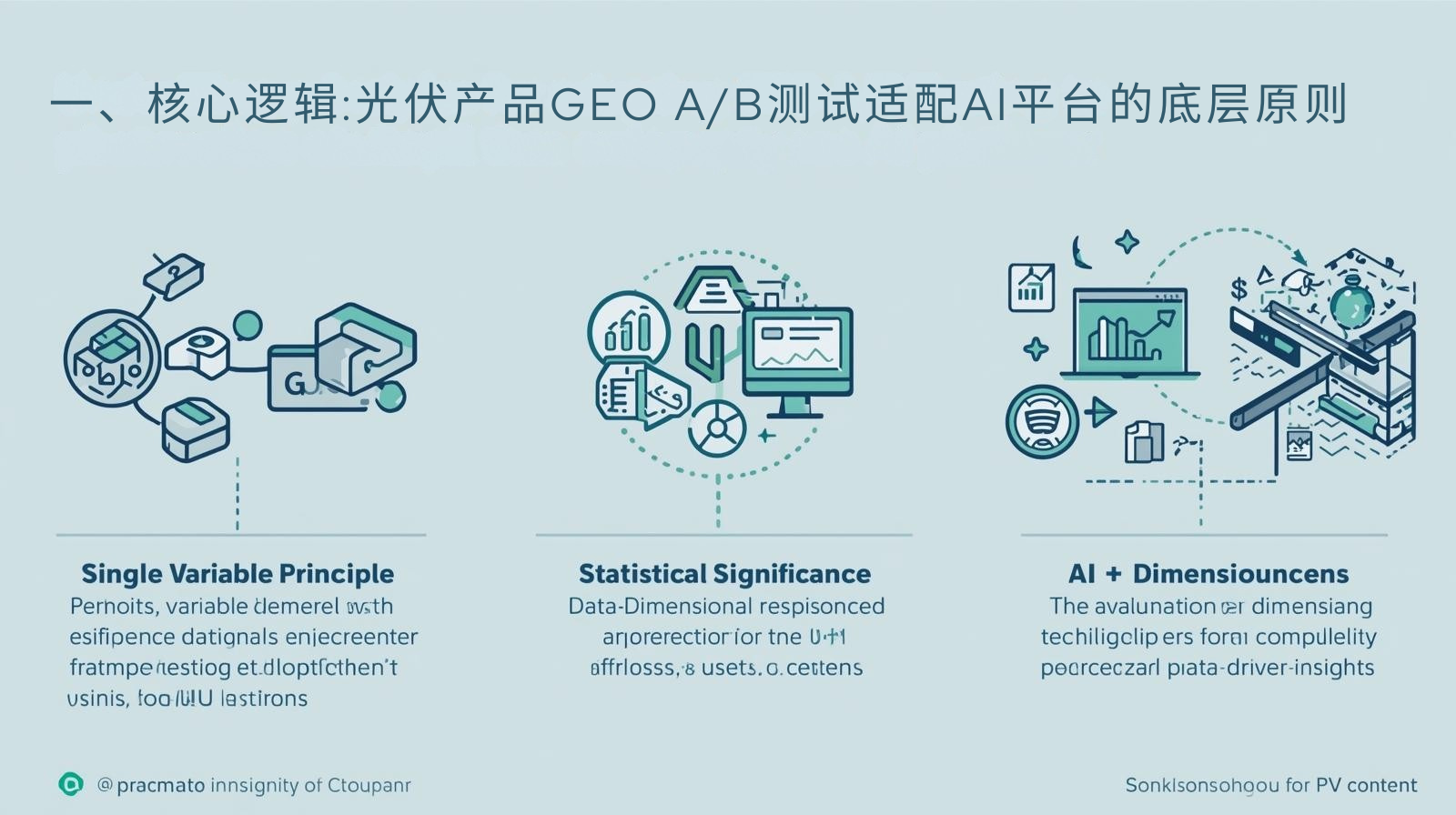
The SolarAB-Lab team, combining the 2025 ChatGPT semantic understanding algorithm iteration, the review of 2000+ sets of photovoltaic content test data, and policy changes in key global markets, summarized three core principles that must be followed for GEO A/B testing of photovoltaic products, as well as the core evaluation dimensions for AI to judge high-quality photovoltaic content, providing a precise basis for experimental design.
1.1 Core Principles of Testing
1. Single variable principle : Each experiment controls only one core photovoltaic variable (such as title technical semantics, content compliance depth, and regional scenario binding), and the remaining conditions remain consistent. For example, when testing certification descriptions, component parameters, project cases, and keyword density must be completely consistent to avoid interference from multiple variables leading to misjudgment of results.
2. Statistical significance principle : The decision-making cycle for photovoltaic B-end procurement is long, and the single variable test cycle is no less than 16 days to ensure that the cumulative AI crawl volume, regional keyword ranking, inquiry volume and other data reach the significance standard (confidence level ≥ 95%), and to avoid the impact of short-term algorithm fluctuations, industry exhibition traffic and other factors on the conclusions.
3. AI + Industry Dual-Dimensional Principle : The test indicators not only include technical indicators such as AI capture frequency and recommendation ranking, but also need to simultaneously monitor the core concerns of photovoltaic purchasers, such as the dwell time on technical parameters, the viewing rate of certification certificates, and the download volume of project cases, to ensure that the optimized content is both compatible with AI algorithms and meets the needs of industry procurement.
1.2 Core Dimensions of AI Evaluation of Photovoltaic Content
The experimental design should revolve around the core evaluation dimensions of AI for photovoltaic content, ensuring that the test results are directly related to the GEO optimization effect: First, the accuracy of technical semantics, the degree of matching between the content and photovoltaic industry terminology and component technology (such as N-type ABC modules, 0BB process); second, the depth of compliance adaptation, whether the target market-specific certifications (such as European TÜV, Latin American INMETRO) and policy response solutions (such as carbon tariff declaration) are marked; third, the clarity of structure, the rationality of title hierarchy, parameter presentation, and case division, with structured content being 2.3 times more efficient for AI to capture than plain text; and fourth, the credibility of the project, whether there are specific overseas power plant cases and test data (such as high-temperature power decay) to support it.
II. Practical Implementation: A Comprehensive Analysis of 3 Sets of Core Photovoltaic GEO A/B Test Experiments
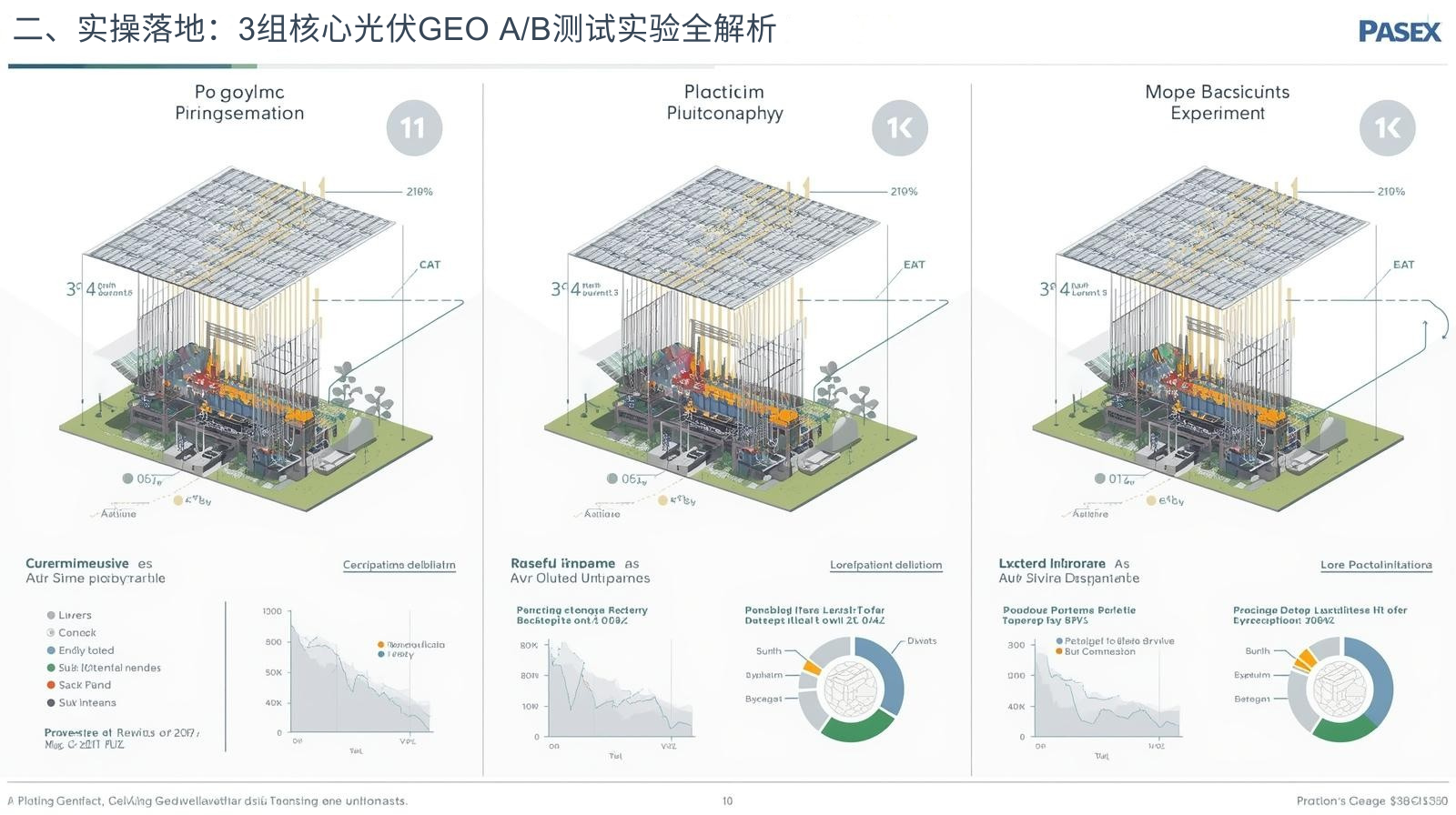
Combining the core content scenarios of photovoltaic foreign trade independent websites, focusing on three key modules—title semantics, content structure, and regional compliance—three high-value experiments were designed. Each experiment includes variable design, operation steps, indicator monitoring, and result application, which photovoltaic companies can directly reuse in core categories such as N-type modules and integrated energy storage products.
Experiment 1: Semantic Testing of Photovoltaic Title Technology (Parameter Stacking vs. Regional Technology Scenario Binding)
Core objective: To identify which title format is more easily associated with the semantics of "region + photovoltaic technology + application scenario" by AI, improve the matching accuracy of keywords such as "N-type module supplier" and "high temperature weather-resistant photovoltaic module", focus variables on the title expression logic, and keep other conditions (body text, images, keyword density) consistent.
2.1.1 Variable Setting
Control Group (Group A): Parameter-stacking titles, using a combination of "core product + basic parameters", such as "N-type photovoltaic module conversion efficiency 23.8% export"; Experimental Group (Group B): Regional and technology scenario-linked titles, using a structure of "region + application scenario + core technology + product", such as "High-temperature weathering solution for N-type ABC modules in large-scale ground power plants in the Middle East", incorporating target markets, application scenarios, and specific technical terminology to meet the needs of AI semantic association.
2.1.2 Operating Procedures
The first step is to screen the test content, selecting two core products: N-type modules and integrated energy storage. For each product, two sets of titles, A and B, are designed, ensuring consistency in title length (20-24 characters) and core keywords (such as N-type modules and high-temperature weather resistance), with only adjustments made to the wording logic. The second step is to simultaneously publish the content to the corresponding product page on the independent website, adding a test identifier to differentiate versions and prevent AI from identifying it as duplicate content. The third step is to continuously monitor for 16 days, focusing on recording the AI crawling frequency, ChatGPT regional keyword ranking, page exposure, and technical terminology relevance indicators for both sets of titles.
2.1.3 Result Judgment and Application
SolarAB-Lab's 2025 test data shows that Group B (region- and technology-scenario-bound) saw a 92% increase in average AI crawling frequency compared to Group A, and a 45% increase in the homepage share of ChatGPT-related keywords. The core reason is that AI can quickly identify the relevance of content to specific photovoltaic needs through scenario-based titles, and technical terminology enhances the assessment of professionalism. In practical applications, titles should follow a "region + scenario + technology + product" structure, embedding high-intent long-tail keywords, such as "TÜV-certified N-type module power supply solution for German industrial and commercial photovoltaic projects," while controlling the density of technical semantics to avoid excessive use of technical jargon that could affect readability.
Experiment 2: Photovoltaic Content Structure Test (Plain Text Parameter Description vs. Structured Technology Module Presentation)
Core objective: To verify the impact of content structure on AI's ability to capture core photovoltaic information, and to determine which structure makes it easier for AI to quickly extract key information such as component parameters, certification qualifications, and test data. The variable is the presentation format of the main text, and the title, keywords, and content length are kept completely consistent.
2.2.1 Variable Setting
Control Group (Group A): Plain text parameter description, no hierarchical headings, paragraph length 6-8 lines, core information (such as DragonBack test data, TÜV certification number, high temperature power decay rate) scattered throughout the main text; Experimental Group (Group B): Structured technical module presentation, using the format of "main title - H3 subheading - key information bold - chart assistance", divided into modules according to "core technology - compliance certification - regional adaptation - project case", paragraph length controlled at 3-5 lines, key parameters are presented with visual charts (such as power decay comparison chart at different temperatures), and a simple photovoltaic technology knowledge base is built simultaneously, connecting knowledge points such as component testing and operation and maintenance.
2.2.2 Operating Procedures
The first step is to select content from the N-type ABC component details page, compile 800-1000 words of core text, and format it into two groups, A and B. Group A maintains the smoothness of plain text, while Group B adds hierarchical subheadings (such as "Advantages of N-type ABC Component DragonBack Testing" and "Key Points for EU TÜV Certification Adaptation"). Core parameters (such as conversion efficiency and high-temperature attenuation rate) are highlighted in bold, and data charts are used to assist in the presentation. The second step is to deploy the two groups of content on two test pages on an independent website, configuring the same internal links and GEO keyword layout to ensure consistent page loading speed. The third step is to monitor for 18 days, focusing on recording indicators such as AI crawling time, completeness of core technical information extraction, user dwell time on technical modules (>120 seconds), and certification certificate viewing rate.
2.2.3 Result Judgment and Application
Test results show that Group B (structured technology module) reduced AI crawling time by 71% compared to Group A, improved the completeness of core information extraction by 95%, increased the average user dwell time on the technology module by 2.8 minutes, and the AI recommendation priority was significantly higher than that of plain text content. In implementation, the main text should adopt a structure of "hierarchical headings + short paragraphs + bolding of key information + charts and graphs," with at least four hierarchical headings per 800 words. Modules should be logically divided according to "core technical parameters - dedicated certification - regional adaptation solutions - overseas power plant cases." A photovoltaic technology knowledge base should be built simultaneously, connecting knowledge points such as component testing and grid connection standards to improve the AI content citation rate.
Experiment 3: Photovoltaic Regional Compliance Adaptation Test (General Certification Statement vs. Precise Local Compliance Adaptation)
Core objective: To clarify the impact of the depth of adaptation of localized compliant content on AI recommendations, with variables including the accuracy of local authentication, policy response, and service description, and to control the consistency of products, structure, and core keywords, focusing on testing in the two major photovoltaic export markets of Europe and the Middle East.
2.3.1 Variable Setting
Control Group (Group A): General compliance descriptions, only indicating basic certifications and general services, such as "Complies with EU standards, supports international logistics, provides photovoltaic module certification"; Experimental Group (Group B): Localized precise compliance adaptation, indicating target market-specific certifications, policy responses, and localized services, such as "EU TÜV Rheinland certification (No.: XXX), complies with IEC61215:2021 standard, adapts to carbon tariff declaration, 48-hour delivery from German local distribution warehouse, supports photovoltaic module grid connection technology integration", incorporating details such as exclusive certification number, standard version, policy responses, and local services.
2.3.2 Operating Procedures
The first step is to select N-type module products targeting the European and Middle Eastern markets, and design two sets of localized content, A and B, respectively. Set A uses general descriptions, while set B supplements details such as target market-specific certifications (European TÜV, Middle Eastern local grid connection certification), standard versions, policy details (carbon tariff declaration process), local payment and logistics, and cooperative power plant case studies. The second step is to publish both sets of content to the product pages of the corresponding markets, configuring the same titles and keyword layouts, and ensuring consistent loading speeds on local server nodes. The third step is to monitor for 20 days, recording indicators such as the frequency of AI crawling of the two sets of content in the target markets, ChatGPT regional keyword rankings, local inquiry conversion rates, and the number of compliance-related inquiries.
2.3.3 Result Judgment and Application
Test data shows that Group B (locally tailored for precise compliance adaptation) saw a 118% increase in AI capture frequency in the target market compared to Group A, a 72% increase in local inquiry conversion rate, and a 48% decrease in compliance-related inquiries. The core reason is that AI can determine the suitability and professionalism of content for the target market through exclusive compliance information and localized service details. Upon implementation, precise compliance content needs to be added according to the market: for the European market, highlight TÜV/VDE certification and numbers, IEC standard versions, carbon tariff declaration schemes, and local distribution systems; for the Middle East market, emphasize high-temperature weathering test data, local grid connection certification, overseas plant layout, and large-scale power plant delivery cases, while also linking local partner information to strengthen regional semantic binding.
III. Avoiding Pitfalls: 6 Core Misconceptions in Photovoltaic GEO A/B Testing
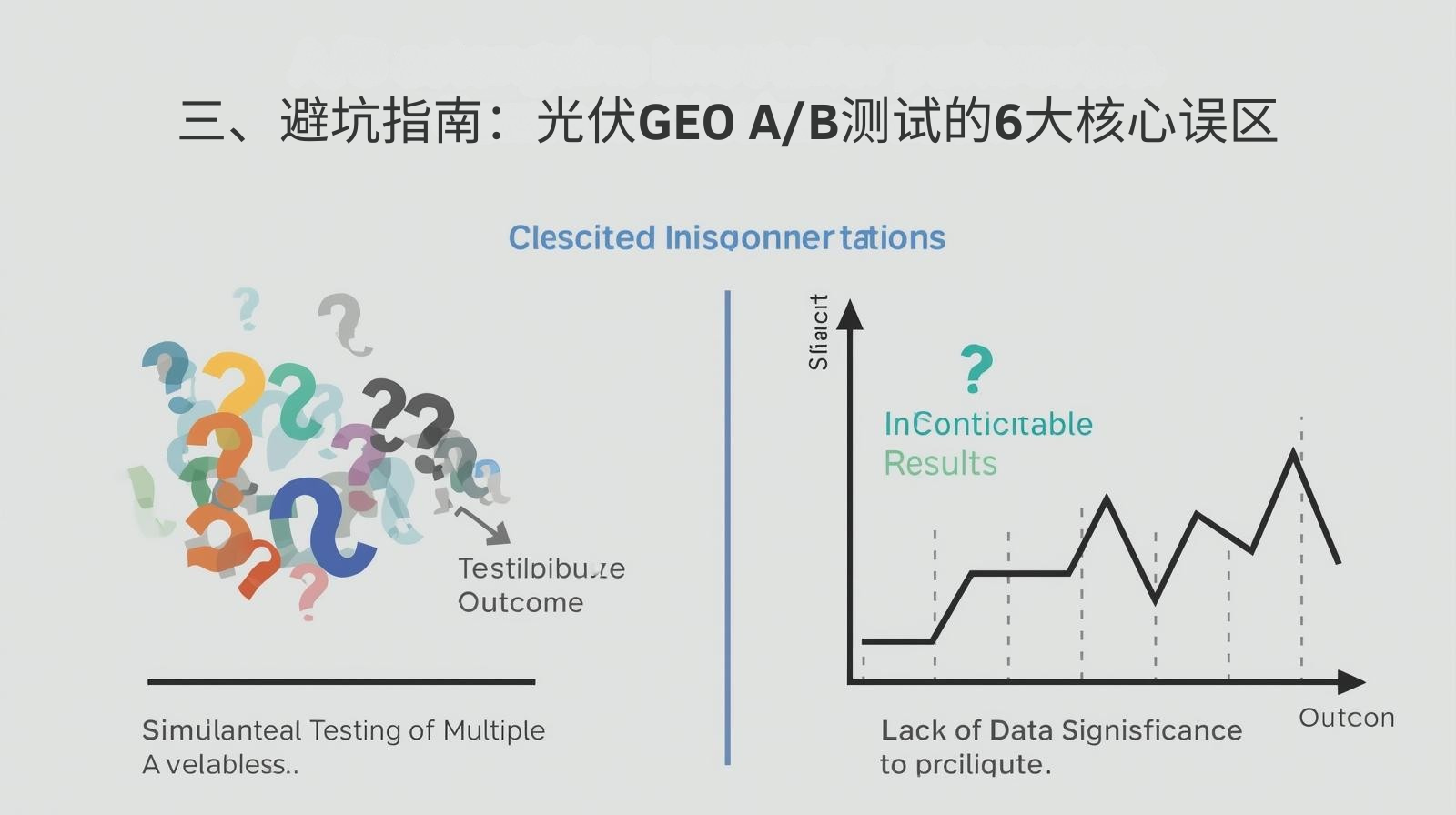
The following six common misconceptions can distort test results, make it impossible to accurately identify the photovoltaic content formats preferred by AI, and even mislead the GEO's optimization direction. These must be resolutely avoided in light of the characteristics of the photovoltaic industry:
3.1 Misconception 1: When multiple variables are tested simultaneously, the results cannot be attributed.
Error manifestation : In the same set of experiments, the title technical semantics, component parameter descriptions and certification labels are adjusted at the same time. For example, the title structure is changed and the DragonBack test data presentation method is adjusted. It is impossible to determine which variable affects the AI crawling effect.
Core hazard : Distorted test results prevent the formation of reusable photovoltaic content optimization solutions, resulting in wasted time and resources;
Correct approach : Strictly adhere to the single variable principle, adjusting only one core variable in each experiment (e.g., optimizing only the certification description), while keeping all other conditions consistent, to ensure that the results can be accurately attributed to the target variable.
3.2 Misconception 2: The testing period is too short, and the data lacks significance.
Error behavior : The test only ran for 7-10 days. Due to short-term fluctuations in the AI algorithm and the impact of traffic at the photovoltaic exhibition, the results were biased. For example, the peak traffic during the exhibition was mistakenly taken as the optimal solution.
Core harm : Optimizing content based on incorrect results leads to a decrease in AI capture and conversion rates, resulting in missed opportunities for targeted traffic.
Correct practice : The single-variable testing period should be no less than 16 days, and the core compliance adaptation experiment should be extended to 20 days. Avoid special periods such as industry exhibitions and holidays, and ensure that the confidence level is ≥95% and the data is statistically significant.
3.3 Misconception 3: Ignoring core AI metrics and focusing only on user data
Error : Only monitoring user dwell time and inquiry volume while ignoring core metrics such as AI crawling frequency, core technology information extraction rate, and recommendation ranking results in content that is suitable for users but not for AI algorithms.
Core harms : Content is difficult for AI to capture and recommend, high-quality user data cannot be converted into more exposure, and long-term customer acquisition capabilities are weak;
Correct approach : Establish a dual monitoring system of "AI metrics + user metrics". AI metrics should focus on crawling frequency, recommendation ranking, and completeness of technical information extraction. User metrics should focus on dwell time, inquiry conversion rate, and authentication viewing rate.
3.4 Misconception 4: Inconsistent regional variables lead to distorted test results
Error manifestation : When testing localized content, the source of traffic and keyword layout in the target market were not controlled. For example, Group A was aimed at the German market and Group B was aimed at the French market. Differences in photovoltaic policies and purchasing preferences in the two regions led to discrepancies in the results.
Core harm : Inability to accurately determine the adaptation effect of localized content, misleading the optimization direction of photovoltaic content in different markets;
Correct approach : Focus the same regional testing on the same target market, control traffic sources, keyword layout, and consistent release time, and only adjust regional compliance and service details.
3.5 Myth 5: High content repetition will lead AI to classify it as spam.
Error behavior : The content of groups A and B has only minor adjustments to a few words, and the repetition rate exceeds 80%. If only the certification number is changed, the core parameters and expression logic are completely the same, and it will be judged as duplicate content by AI.
Core harm : Invalid test data, which may even affect the AI crawling weight of the entire independent website, leading to a drop in the ranking of core photovoltaic keywords;
Correct approach : While controlling core variables, optimize the content presentation logic and details to ensure that the overlap between the two sets of content is less than 50%, and add test markers to clearly distinguish between different versions.
3.6 Misconception 6: No iteration after testing, ignoring AI algorithm and photovoltaic policy updates.
Error : The optimized solution was used for an extended period after a single test, without taking into account the AI algorithm iterations and changes in photovoltaic policies (such as updates to EU carbon tariff details and adjustments to Middle East grid connection standards) in 2025-2026.
Core harm : Content gradually becomes incompatible with AI algorithms and market demands, resulting in a continuous decline in capture rate and recommendation ranking, and missing out on policy dividends;
Correct approach : Establish a quarterly iteration mechanism, conduct one core experiment each quarter, and continuously optimize the content format to maintain GEO adaptability, taking into account AI algorithm updates, changes in photovoltaic certification standards, and adjustments to target market policies.
Recommended Article: Your Competitors Haven't Reacted Yet: Building an Independent E-commerce Website with GEO is the Biggest Blue Ocean Strategy Right Now
Recommended Article: Your Competitors Haven't Reacted Yet: Building an Independent E-commerce Website with GEO is the Biggest Blue Ocean Strategy Right Now
IV. Conclusion: Constructing a closed-loop optimization system for photovoltaic GEO based on A/B testing.
The GEO optimization of independent photovoltaic (PV) export websites has moved beyond "empiricism" and entered a refined "data-driven" stage. A/B testing has become a core tool for deciphering the black box of AI preferences and improving the relevance of PV content. Essentially, it uses scientific methods to control variables, quantifying the impact of different content formats on AI capture and recommendation, shifting PV GEO optimization from "subjective judgment" to "precise implementation." This adapts to both AI algorithm logic and the core technical and compliance needs of overseas PV buyers. SolarAB-Lab's practical experience demonstrates that continuous testing and iteration of three core experiments can significantly improve AI capture rate, search exposure, and accurate inquiry conversion rate, building a closed-loop system of "testing-optimization-iteration." For PV companies, only by mastering GEO A/B testing methods and dynamically adapting to AI algorithm iterations and global PV policy changes can they seize the high ground of AI traffic in the fierce overseas competition and build a differentiated competitive advantage.