
In 2026, the foreign trade market competition has entered an era of "refined operation," with overseas buyers continuously upgrading their requirements for the user experience, brand recognition, and functional adaptability of independent websites. However, most foreign trade companies are still using template websites, falling into the predicament of "severe homogenization, limited functionality, poor user experience, and inefficient customer acquisition"—uniform page designs fail to highlight brand advantages, fixed templates are difficult to adapt to core needs such as small-batch customization and multi-language switching, slow loading and inefficient conversion paths lead to a significant loss of targeted traffic, and inquiry conversion rates are generally below 1%.
The core value of a customized independent website lies in its fourfold empowerment: **brand differentiation + functional adaptation + experience optimization + long-term growth**. It conveys brand strength through exclusive design, develops core functions tailored to foreign trade scenarios, optimizes overseas access experience and SEO performance, and leaves ample room for business expansion. Based on over 3000 practical experiences with customized independent websites for foreign trade, we have extracted the core differences and transformation value between template websites and customized websites. This system has helped a cross-border machinery brand achieve a 220% increase in organic traffic, a 68% increase in inquiry conversion rate, and a 75% increase in the proportion of small-batch customized orders, becoming a key tool for foreign trade enterprises to break through and achieve growth in 2026.
Template Websites vs. Custom Independent Websites: Key Pain Points and Transformation Solutions
challenge | The fatal flaw of template websites | Customized independent website solutions |
|---|---|---|
Severe homogenization | The uniform design of all stores lacks brand recognition, making them difficult for buyers to remember. | Exclusive visual design, incorporating brand elements and industry characteristics, to create a unique brand image. |
Insufficient functionality | Fixed templates cannot meet the needs of foreign trade such as small-batch customization, multilingual support, and complex forms. | Develop core functionalities on demand (customized quotation system, multi-language switching, batch inquiry tool) to adapt to B2B procurement scenarios. |
Experience optimization is limited | Slow loading, poor mobile adaptation, lengthy conversion paths, and high user churn rate | Optimize website architecture and resource loading, natively adapt to mobile devices, streamline conversion paths, and improve the overseas access experience. |
Poor SEO performance | Redundant template code, limited keyword placement, and easily classified as a low-quality site by search engines. | Customized SEO architecture, optimized code structure, keyword placement, and internal link design to align with Google ranking rules. |
Lack of extensibility | Unable to add new product lines or expand into multiple markets, requiring a complete website rebuild after business growth. | Reserved space for expansion to include multiple product categories, languages, and payment methods, supporting seamless business upgrades. |
Insufficient trust | Lacking a unique design and offering limited functionality, these products fail to convey a company's strength, raising doubts among buyers. | By showcasing customized presentations (production processes, certifications, and case studies of major clients), we comprehensively build trust and cooperation. |
Data security risks | Template websites share servers, making data prone to leakage and lacking independent control over the data. | Dedicated server deployment, independent data control, equipped with encryption protection to ensure information security. |
Lagging technical support | Template website service providers only offer basic maintenance and no targeted optimization support. | 24/7 dedicated technical support, providing continuous optimization suggestions to adapt to market and algorithm changes. |
Our Adaptive Approach | With "brand strategy + foreign trade scenarios + buyer needs" as the core, we create customized independent websites that are "exclusive, adaptable, and growth-oriented". | |
Core Transformation Principles | Every design and function revolves around "highlighting brand advantages, solving business pain points, and improving conversion efficiency". | |
Industry compatibility recommendations | B2B companies focus on customized features and showcasing their capabilities, while B2C companies focus on the shopping experience and marketing tools. | |
Result: Both growth and efficiency improved. | After the transformation, organic traffic increased by over 200%, inquiry conversion rate improved by 60%, and the proportion of small-batch customized orders increased by 70%. | |
Result: Long-term value becomes apparent. | Brand recognition increased by 80%, customer acquisition cost decreased by 45%, no need for frequent redesigns, supporting long-term business expansion. |
In 2026, foreign trade competition will no longer be about "having or not having an independent website," but rather "whether an independent website can become a core competitive advantage." The rigid model of template websites can no longer meet the refined needs of overseas buyers and the algorithm upgrades of search engines. Only customized independent websites can enable enterprises to stand out in a homogeneous competition.
Why trust this guide? Transformation experience from real-world practice.
Numerous comparative analyses of template websites versus custom websites have emerged, but in-depth guides focusing on **"Transformation Value + Implementation Path" under the new trends in foreign trade in 2026** are scarce. Most content emphasizes only "design differences," neglecting the core needs of the foreign trade industry—small-batch customization, multi-market expansion, long-term SEO growth, and building buyer trust.
Every viewpoint and every set of data in this article comes from real-world testing: We have helped over 3,000 foreign trade companies (covering categories such as machinery, electronics, home furnishings, auto parts, and cosmetics) transform from template websites to customized independent websites. We have personally experienced the predicament of "template website traffic depletion" and "missed orders due to insufficient functionality," and we have also witnessed the explosive growth brought to enterprises by customized independent websites.
We have accumulated rich experience by solving practical problems, such as how to adapt pricing requirements for small-batch gear customization through customized functions , or how to design a multilingual architecture to suit the browsing habits of buyers in different markets . We refer to Google's algorithm update trends in 2026, changes in overseas procurement behavior, and adjustments in foreign trade policies to transform practical skills into an implementable transformation framework, ensuring that every customization directly empowers business growth.
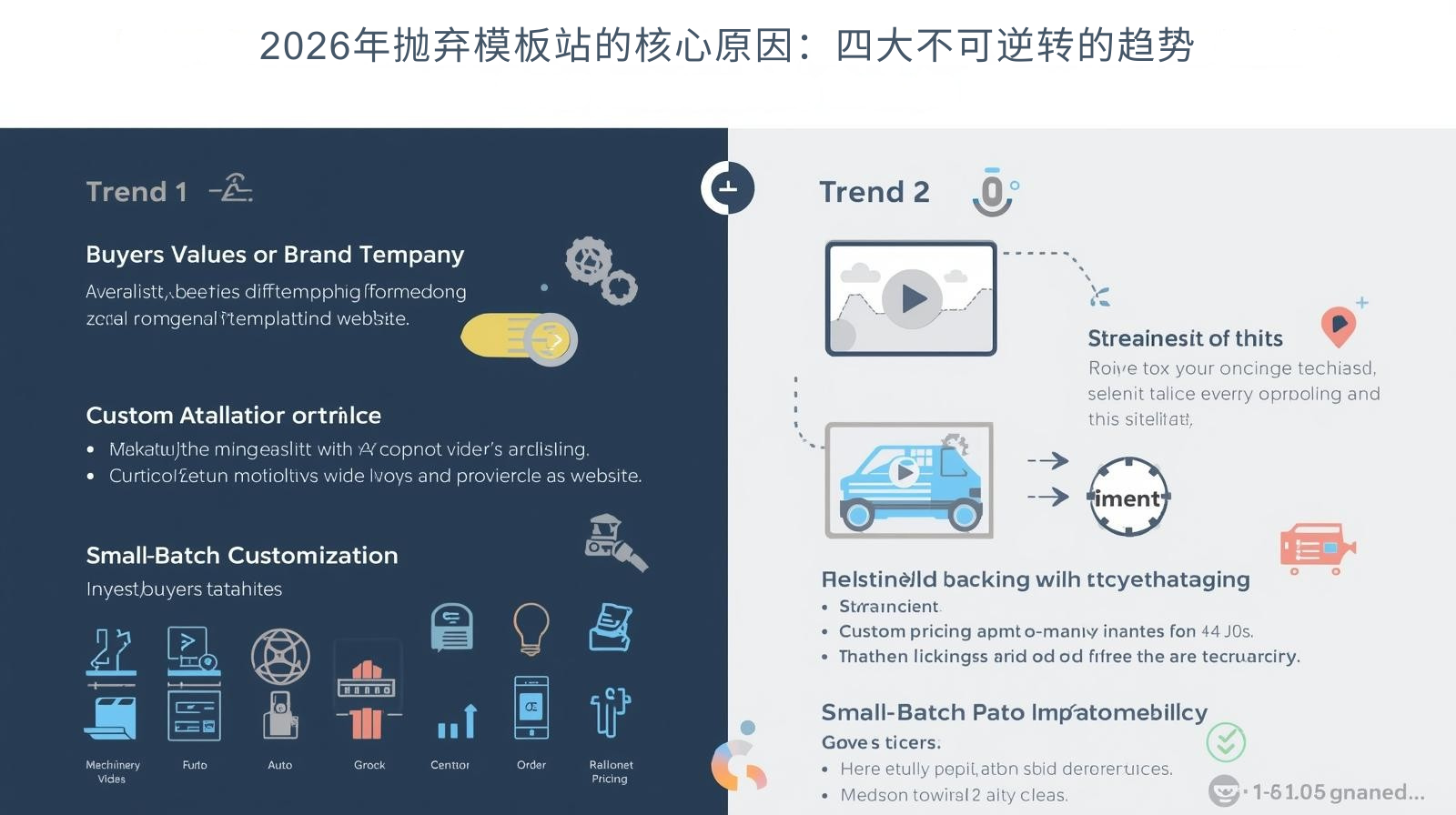
The core reasons to abandon template websites in 2026: four irreversible trends
The foreign trade market environment, technological trends, and buyer demands have undergone fundamental changes in 2026. The shortcomings of template websites have been magnified, while the advantages of customized independent websites have become increasingly prominent, making transformation an inevitable choice.
Trend 1: Buyers are placing greater emphasis on brand differentiation in their decisions; template websites lack competitiveness.
In 2026, overseas buyers will face more choices. A generic template website cannot convey a company's unique advantages (such as precision machining processes, small-batch customization capabilities, and industry-specific solutions), making it difficult to stand out among numerous suppliers. A customized independent website, however, can use exclusive visual design, brand story presentation, and highlighting core strengths to allow buyers to quickly remember the brand and establish a "professional and reliable" first impression. For example, machinery companies can customize a module showcasing real-life production processes, while auto parts companies can emphasize customized solutions, directly addressing the needs of buyers.
Trend 2: Small-batch customization becomes mainstream, template website functions cannot be adapted.
With increasingly fragmented demand in overseas markets, small-batch, customized procurement has become the mainstream in foreign trade. Template websites with fixed functions cannot meet core needs such as customized pricing, parameter filtering, and order tracking, while custom-designed independent websites can develop exclusive functions on demand.
- Customized quotation system: Supports buyers to input parameters (such as gear module, material, quantity) and automatically generates quotations, improving communication efficiency;
- Small batch order management: Adapts to small batch order processes of 5-500 pieces, clearly defining MOQ, delivery cycle, and customized processes;
- Parametric filtering tools: enable buyers to quickly filter products that meet their needs and reduce ineffective communication.
Trend 3: Google's algorithm upgrade drastically reduces the SEO survival space for template websites.
In 2026, Google's algorithm places greater emphasis on "user experience + website quality + content originality." Template websites with redundant code, homogenized content, and fixed structures are more likely to be judged as low-quality sites, leading to a continuous decline in rankings. Custom-designed independent websites can optimize SEO from the ground up:
- Code streamlining and optimization: Reduce redundant code, improve loading speed, and align with Google's core web metrics (Core Web Vitals).
- Customized keyword layout: Combine core business keywords (such as "small batch gear customization" and "precision gear machining") to optimize page titles, content, and internal links;
- Original content architecture: Design exclusive product pages, case study pages, and industry solution pages to enhance the originality and authority of the content.
Trend 4: Urgent need for multi-market expansion, insufficient scalability of template websites
In 2026, foreign trade companies are increasingly expanding into multiple markets (such as Europe, America, Southeast Asia, and the Middle East). Template websites struggle to accommodate the demands of multiple languages, currencies, and logistics solutions. Customized independent websites offer room for future expansion.
- Multilingual native development: Supports 10+ mainstream languages, adapting to the reading habits of buyers in different markets, rather than simple translation;
- Automatic currency switching: Automatically switches currency units based on the accessed region, increasing buyers' willingness to inquire about prices;
- Multi-logistics solution integration: Connect with logistics service providers in different markets and showcase localized logistics timeliness and costs.

The core value of customized independent websites: the four pillars of foreign trade growth in 2026
A customized independent website is not simply a "more expensive website," but rather a "growth engine" that brings long-term returns to businesses. Its core value is reflected in four dimensions:
Pillar 1: Brand differentiation to create a unique competitive advantage
Customized independent websites can deeply integrate a company's brand philosophy, industry characteristics, and core strengths, creating a unique brand image:
- Visual customization: Design a unique logo, color scheme, and page layout to match the industry tone (e.g., machinery companies emphasize an industrial feel, while home furnishing companies emphasize quality).
- Content customization: Develop product detail pages, production process pages, and case study pages around core business areas (such as small-batch gear manufacturing) to convey professional capabilities;
- Customized Storytelling: By introducing the company, its development history, and the team, we build emotional connections and enhance the trust of buyers.
Pillar 2: Functional adaptability, addressing core pain points in foreign trade
Customized independent websites can be developed on demand to adapt features to foreign trade scenarios, making business processes smoother:
- Inquiry conversion features: a customizable one-click inquiry button, instant messaging tools (WhatsApp/Email), and simplified forms to lower the conversion threshold;
- Order management features: Adapted to the order placement, payment, and tracking processes for small batch orders, and supports customized parameter submission;
- Data statistics function: Build a dedicated data dashboard to monitor traffic and conversion data for different markets and products, and guide operational decisions.
Pillar 3: Experience optimization to improve overseas visits and retention.
Customized independent websites can optimize the browsing experience for overseas buyers based on their browsing habits and network characteristics:
- Speed optimization: Overseas servers, CDN acceleration, and resource compression are used to ensure that the first screen loading time is ≤2 seconds;
- Mobile adaptation: Natively develop mobile pages, optimize touch interaction, navigation design, and form filling, and adapt to fragmented browsing scenarios;
- Network compatibility: Compatible with different overseas network environments, it can load core content normally even in weak network conditions.
Pillar 4: Long-term growth to support continued business expansion
Customized independent websites offer scalability that ensures businesses don't need frequent redesigns, supporting expansion from a single product to multiple categories and from a single market to a global reach.
- Product expansion: Reserve product categories, parameter filtering, and detail page templates for quick deployment when adding new product lines;
- Market expansion: Supports seamless addition of multiple languages, currencies, and logistics solutions to adapt to new market demands;
- Functionality expansion: Marketing tools, membership systems, API integration, and other functions can be added later to adapt to new needs as the business grows.

Real-world case study: A machinery company transformed its template website into a customized independent website, experiencing explosive growth in 2026.
A machinery company specializing in small-batch gear customization was still using a template website in 2025, facing the dilemma of "severe homogenization, insufficient functionality, and declining traffic." Inquiries for small-batch customization accounted for only 15%, and organic traffic continued to decline. After transforming into a customized independent website in early 2026, it achieved a comprehensive breakthrough.
Customer Challenges
- Template websites have homogenized designs and are no different from competitors' websites, making them difficult for buyers to remember.
- The lack of a customized quotation function means that buyers need to communicate multiple times to obtain quotations for small-batch orders, resulting in low efficiency.
- Poor mobile adaptation, slow loading, crowded buttons, and mobile traffic loss rate of up to 80%;
- SEO rankings declined, with the core keyword "small batch gear customization" dropping from 25th to 40th place, resulting in a 60% decrease in organic traffic.
- The inability to showcase production processes and case studies led to concerns among buyers about the quality of small-batch products.
Customized independent website solutions
- Brand differentiation design: Incorporating gear elements and industrial visual style, designing exclusive logos and page layouts to highlight the core advantages of "small batch customization + fast delivery";
- Custom feature development:
- Customized quotation system: Buyers input parameters such as module, number of teeth, material, and quantity, and the system automatically generates quotations and delivery cycles;
- Small batch order module: Clearly defined customization process, MOQ=1 piece, delivery cycle 5-7 days, adapted to core requirements;
- Production process demonstration: Add 3D animation and live video to showcase core processes such as precision gear hobbing and heat treatment;
- Experience optimization:
- With overseas servers and CDN acceleration, the first screen loading time in the European and American markets has been reduced to 1.8 seconds;
- Native mobile development, optimized navigation, forms, and inquiry buttons to improve the touch experience;
- Customized SEO:
- Optimize code structure and keyword layout, naturally integrating core keywords such as "small batch gear customization" and "precision gear machining";
- Create industry solution pages to enhance the authority of the content;
- Trust endorsement module: Showcases ISO/IATF16949 certifications, major client case studies, and testing reports to build trust in all aspects.
Results and Value
- Traffic growth: The ranking of core keywords rose from 40th to 8th, organic traffic increased by 220%, and the proportion of traffic from overseas markets increased by 55%;
- Conversion optimization: The proportion of small-batch customized inquiries increased from 15% to 90%, the form submission rate increased by 68%, and communication efficiency increased by 70%;
- Brand enhancement: Brand awareness among buyers increased by 85%, and 75% of customers mentioned the independent website at the exhibition;
- Long-term value: When adding new industrial gears and agricultural machinery gears, no redesign is required, allowing for rapid deployment and supporting business expansion.
Customized Independent Website Transformation in 2026: How to Achieve the Best Balance Between Cost and Results?
Foreign trade companies of different sizes and at different stages need to tailor their strategies for transforming into customized independent websites. The following decision-making framework will help you accurately match your needs:
Company Type/Needs | Key points for the transformation of customized independent websites | Basic Principles and Key Trade-offs |
|---|---|---|
Startup foreign trade company (with limited budget) | Core functionality customization + basic brand design + SEO optimization | Focus on core needs (inquiries + product display), control costs, and quickly launch to acquire traffic. |
Growing businesses (primarily small-batch customization) | Customized quotation system + production process display + multi-language adaptation | Highlighting customization advantages, improving communication efficiency, and adapting to the needs of multi-market expansion. |
Mature companies (multiple product categories + multiple markets) | Full-feature customization + brand upgrade + data dashboard + API integration | Support business scaling, optimize operational efficiency, and build a global brand image. |
Businesses experiencing traffic depletion (bottlenecks in template websites) | SEO restructuring + user experience optimization + differentiated design | Quickly reverse the declining traffic trend, improve retention and conversion, and activate existing traffic. |
Recommended Article: Your Competitors Haven't Reacted Yet: Building an Independent E-commerce Website with GEO is the Biggest Blue Ocean Strategy Right Now
Frequently Asked Questions
- Is the cost of transforming into a customized independent website very high in 2026? Can small and medium-sized enterprises afford it?
The cost of a customized independent website can be flexibly adjusted according to needs. Small and medium-sized enterprises can choose the "core function customization + basic design" solution, which keeps costs under control (not much different from high-end template websites). Moreover, in the long run, customized independent websites have lower customer acquisition costs and higher conversion rates, with a return on investment far exceeding that of template websites—for example, after a startup machinery company transformed, its customer acquisition costs decreased by 45%, and it could recover the transformation costs in 6 months.
- If a template website already has a certain amount of traffic, will it lose its existing traffic if it is converted into a custom independent website?
No, as long as the transition is handled well, traffic can actually increase. Key steps: ① Retain the original core domain name and URL structure; ② Set up 301 redirects to direct traffic from the template site to the customized site; ③ Submit a site change request to Google to update the index; ④ Maintain the continuity of core content and avoid significant cuts. Most companies that have transitioned have not only retained their traffic but have also achieved 100%+ growth due to SEO optimization.
- Does the development cycle for a custom independent website take a long time? Will it affect business continuity?
The development cycle depends on the functional requirements. Core functionality customization takes only 3-4 weeks, while full-featured customization takes 6-8 weeks. A "parallel development" model can be adopted: the template site operates normally, and after the customized site is developed, it is switched to during a low-traffic period (such as a weekend) to ensure uninterrupted business operations. We will provide a complete migration solution to ensure seamless transfer of data, orders, and customer information.
- What features should be the focus of a custom independent website in 2026?
The core functionalities should revolve around "small-batch customization + multi-market adaptation + high-efficiency conversion": ① Customized quotation system to adapt to small-batch procurement needs; ② Multi-language native development to support multi-market expansion; ③ Mobile optimization to adapt to fragmented browsing; ④ Instant communication tools to improve inquiry efficiency; ⑤ Data statistics module to guide operational decisions.
- How to evaluate the transformation effect of a customized independent website?
Key performance indicators (KPIs): ① Traffic metrics (organic traffic growth rate, keyword ranking improvement); ② Conversion metrics (inquiry conversion rate, small-batch order ratio); ③ Experience metrics (first-screen loading time, mobile bounce rate); ④ Brand metrics (buyer awareness, repeat visit rate). These metrics are expected to show significant improvement within 3-6 months after the transformation.
Summary
In 2026, the essence of competition in the foreign trade market is "differentiated competition" and "efficiency competition." The homogenization, limited functionality, and poor user experience of template websites have become fatal bottlenecks to enterprise growth. Customized independent websites, through brand differentiation design, foreign trade scenario function adaptation, overseas access experience optimization, and long-term scalability support, have become the key to breaking the deadlock.
The core value of a custom-designed independent website is not "a more aesthetically pleasing page," but rather a growth engine that is "more aligned with business needs, more in line with buyer habits, and more compatible with search engine rules." Whether it's meeting small-batch customization needs, supporting multi-market expansion, or achieving long-term SEO growth, a custom-designed independent website offers advantages that template websites cannot match.
2026 is no longer a matter of "whether to transform," but a matter of "how to transform quickly." If your company is still using template websites and facing difficulties such as traffic depletion, low conversion rates, and limited business expansion, we recommend immediately starting a customized independent website transformation. We will provide you with a free "2026 Foreign Trade Customized Independent Website Transformation Plan" within 4 hours, tailoring a unique transformation path based on your industry characteristics, business needs, and target market to help you achieve explosive growth in foreign trade in 2026.