

In March 2026, the global foreign trade procurement market showed a trend of "regionalization and refinement". There are significant differences in requirements, and GEO (Generative Engine Optimization) is the core method for independent foreign trade websites to appear in AI search results such as ChatGPT. Its multi-regional optimization level directly determines whether an enterprise can accurately reach buyers in different regions around the world and seize multi-regional market share. Although many foreign trade companies have deployed GEO optimization, they adopt a "one size fits all" optimization approach and ignore the differences in different regions. As a result, independent websites cannot adapt to the search needs of global buyers, are difficult to be accurately recommended by AI, and miss a large number of global orders. This article combines the latest industry data in 2026, multi-regional GEO practical cases and 8 new authoritative external links to deeply dismantle the GEO multi-regional optimization ideas of independent foreign trade stations for global buyers, and provides practical methods that can be directly implemented to help foreign trade companies break regional barriers, allow independent stations to accurately adapt to the needs of buyers in different regions, and achieve comprehensive coverage of global AI search traffic and inquiry conversion.
1. Core Cognition: Multi-regional GEO optimization is a key prerequisite for reaching global buyers
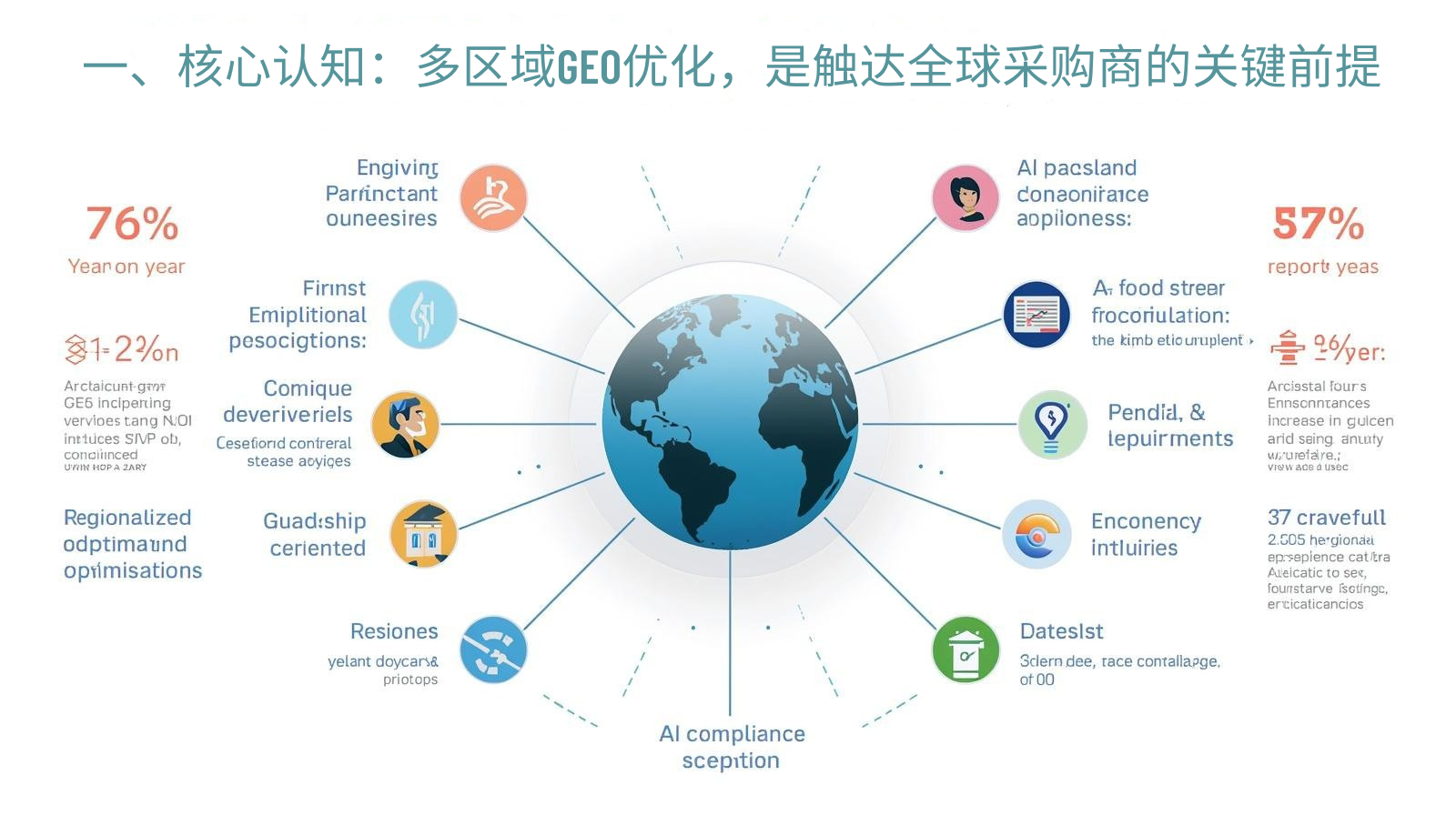
Global buyers have a wide geographical distribution, and there are significant differences in purchasing habits, semantic preferences, compliance requirements, and core needs in different regions. For global buyers The core of GEO optimization of independent foreign trade stations is by no means "single optimization copied to multiple regions", but "accurate adaptation to local conditions" - allowing GEO optimization to fit the search logic of buyers in different regions, allowing AI to accurately identify regional content and recommend it to buyers in the corresponding region. In March 2026, the "2026 Foreign Trade GEO Multi-regional Optimization Practical Report" released by AB Customer showed that for foreign trade independent stations that adopt multi-regional precise optimization, the AI search inquiry volume increased by 76% year-on-year, of which the proportion of cross-regional inquiries increased by 58%. However, for independent stations that adopt the "one size fits all" optimization method, the multi-regional inquiry conversion rate is less than 15% https://www.163.com/dy/article/KMS5KGJ205388F4M.html. The core logic of multi-regional GEO optimization is the combination of "AI crawler adaptation + regional content optimization + compliance adaptation". It not only allows AI to smoothly capture adapted content in different regions, but also makes the content fit the needs of local buyers and meet regional compliance requirements. Only in this way can we truly reach global buyers and achieve long-term customer acquisition in multiple regions.
1.1 Why is it necessary to do GEO multi-regional optimization for global buyers?
Many foreign trade companies have misunderstandings. They believe that as long as they do GEO optimization in a single region, they can cover global buyers. In fact, this is not the case. The necessity of GEO multi-regional optimization for global buyers is mainly reflected in three core levels. It is also the key for companies to break regional barriers and seize the global market. First, it adapts to the search habits of buyers in different regions. Buyers in different regions have greatly different search semantics and core needs. For example, European buyers pay more attention to compliance certification and product quality, Southeast Asian buyers pay more attention to price and delivery, and North American buyers pay more attention to after-sales and technical support. If a unified GEO optimization method is used, it cannot fit regional search habits, AI cannot accurately recommend, and naturally cannot reach target buyers. https://juejin.cn/post/7543109399437803562; Secondly, improve the accuracy of AI recommendation. When recommending suppliers, AI tools such as ChatGPT will combine the regional information of buyers and give priority to recommend independent stations that adapt to local needs. Multi-regional GEO optimization can allow AI to accurately identify regional content and prioritize independent stations to buyers in corresponding regions to improve the accuracy of inquiries. https://juejin.cn/post/7559236732362833974; Third, avoid regional compliance risks. Compliance regulations in different regions around the world are significantly different. The EU GDPR, North American data security regulations, Southeast Asian import compliance requirements, etc. all have clear requirements for the content of independent stations. If regional compliance adaptation is not made, independent stations will be blocked by AI and cannot be searched by buyers in the corresponding region. https://juejin.cn/post/7583168260797808680.
1.2 GEO optimization differences in global core procurement areas (precise adaptation is effective)
For global buyers, it is necessary to focus on the four core procurement regions of Europe, America, Southeast Asia, the Middle East, and Latin America. The buyer needs, search habits, and compliance requirements of these four regions are significantly different, and the focus of GEO optimization is also different. Blindly copying optimization logic will only lead to ineffective optimization. Combining the 2026 multi-regional GEO practical experience and industry survey data, the optimization differences in the four core regions are mainly reflected in three aspects: First, the difference in search semantics. European and American buyers are accustomed to using precise industry terminology searches, Southeast Asian buyers prefer concise and straightforward keywords, and Middle Eastern buyers pay more attention to related expressions such as "bulk procurement" and "long-term cooperation" https://juejin.cn/post/7543109399437803562; The second is the difference in core needs. European buyers give priority to CE, ROHS and other compliance certifications and product environmental protection, North American buyers focus on UL certification and after-sales guarantee, Southeast Asian buyers focus on MOQ, price and delivery time, and Middle Eastern buyers focus on product adaptability and batch supply capabilities. https://www.163.com/dy/article/KMS5KGJ205388F4M.html; The third is the difference in compliance requirements. The EU needs to meet GDPR compliance, add multi-language privacy policies and cookie pop-ups, North America needs to comply with data security regulations, Southeast Asia needs to mark import qualification requirements, and the Middle East needs to adapt to local language and religious habits https://juejin.cn/post/7583168260797808680. Only by accurately grasping these differences can we carry out multi-regional GEO optimization and truly reach buyers in different regions.
1.3 Core trends in multi-regional GEO optimization in 2026: refined adaptation, rejecting “one size fits all”
In 2026, GEO optimization for global buyers has entered the "refined adaptation" stage. AI's crawling and recommendation standards for regional content have been greatly improved. The "one size fits all" optimization method can no longer meet the demand and will even be marked as a low-quality site by AI, affecting the overall weight. https://juejin.cn/post/7559236732362833974. According to extended data from the China Academy of Information and Communications Technology's "2025 Generative Search Business Value White Paper", in the first quarter of 2026, the AI recommendation rate of independent foreign trade stations that have refined multi-regional adaptation increased by 89%, and the number of multi-regional inquiries increased by 72% year-on-year. However, independent stations that adopt "one size fits all" optimization have an AI recommendation rate of less than 20% https://juejin.cn/post/7583168260797808680. The current core trend is to "focus on core areas and accurately adapt to needs." Enterprises do not need to blindly cover all areas, but rather focus on their core target procurement areas, combine regional differences, and refine content, compliance, and crawler adaptation. At the same time, taking into account the unity of multi-regional content, AI can quickly associate content in different regions, improve the overall optimization effect, and achieve precise access to global buyers https://juejin.cn/post/7543109399437803562.
2. Practical Guide: The whole process of GEO multi-regional optimization for global buyers (can be implemented directly)
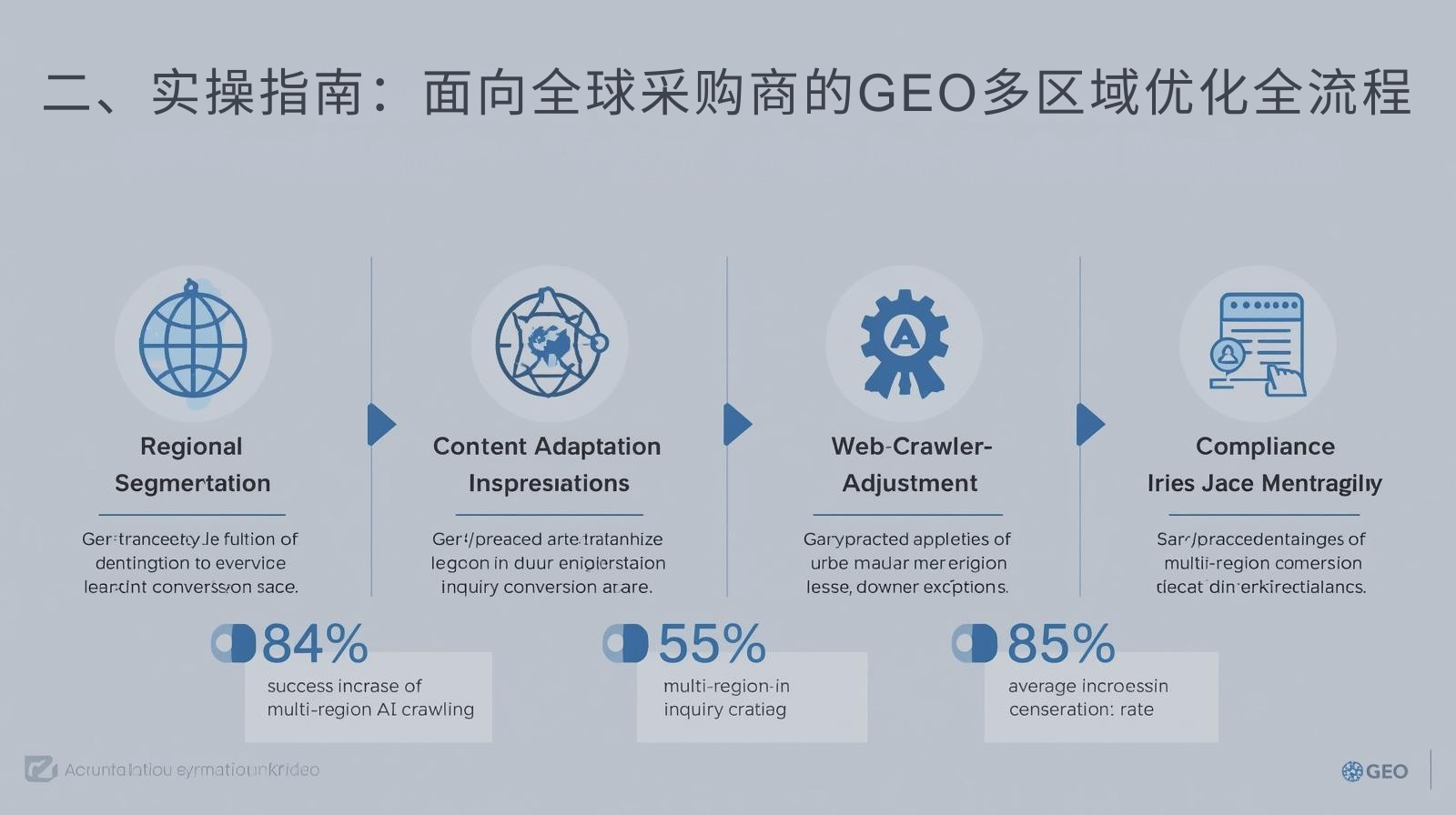
GEO multi-regional optimization for global buyers, the core is "regional segmentation→content adaptation→crawler adaptation→compliance adjustment". No complicated technology is required. Just follow the four core steps to accurately adapt to the needs of buyers in different regions, so that independent sites can be quickly captured by AI and accurately recommended, achieving global AI search traffic coverage. Combining the 2026 AB Customer GEO multi-regional optimization strategy and industry practical cases, for an independent station optimized according to this step, the multi-regional AI crawling success rate can be increased to more than 88%, and the multi-regional inquiry conversion rate will increase by an average of 65% https://www.163.com/dy/article/KMS5KGJ205388F4M.html. All operations are in line with the needs of global buyers, taking into account practicality and regional adaptability. Foreign trade companies can directly implement it and quickly achieve accurate customer acquisition in multiple regions.
2.1 Step 1: Regional segmentation and demand research to identify optimization priorities
The premise of multi-region optimization is to "accurately segment regions and understand procurement needs." Blindly covering all regions will only distract energy and fail to achieve precise adaptation. The core of this step is to screen core procurement areas and investigate the search habits, core needs and compliance requirements of regional buyers to lay the foundation for subsequent optimization. Specific operations: First, screen the core procurement areas, combined with the company's own business layout, give priority to 2-3 of the four core regions of Europe, America, Southeast Asia, the Middle East, and Latin America. For example, companies that make electronic products can give priority to Europe, the United States, and Southeast Asia, and companies that make building materials can give priority to the Middle East and Latin America to avoid blind coverage that leads to insufficient optimization. https://juejin.cn/post/7543109399437803562; Secondly, research regional purchasing needs and search habits, and use Google Analytics and Inquiry Cloud Marketing to CRM and other tools collect search keywords and high-frequency inquiries from buyers in core regions, and analyze their core needs. For example, European buyers frequently search for "CE certification + product name", and Southeast Asian buyers frequently search for "low price + product name + MOQ". At the same time, they research regional industry terminology and semantic preferences to ensure that the content adapts to local search habits. https://juejin.cn/post/7543109399437803562; Finally, sort out regional compliance requirements and understand the compliance regulations in core areas in advance, such as EU GDPR, North American data security regulations, Southeast Asian import qualification requirements, etc., clarify the focus of compliance optimization, and avoid violation issues in subsequent optimization https://juejin.cn/post/7583168260797808680.
2.2 Step 2: Optimize regional content to meet the needs of global buyers
This is the core step of multi-regional GEO optimization. The core goal is to enable the content in different regions to be accurately identified by AI, and to fit the search habits and core needs of local buyers, improving the accuracy of AI recommendations and the inquiry conversion rate. According to the GEO optimization industry trend in 2026, the depth of regional content optimization directly determines the effect of multi-regional optimization. Structured and localized content can increase the AI recommendation rate by more than 60% https://juejin.cn/post/7559236732362833974. Specific operations: First, optimize the regional content of the core pages. On the home page, product page, and company introduction page, add regional adaptation content for different core areas. For example, for European buyers, focus on CE, ROHS certification and environmental protection, and attach the official EU certification link (https://ec.europa.eu/ce-marking/). For Southeast Asian buyers, focus on price advantages, MOQ and delivery time, and attach local logistics cooperation cases. https://www.163.com/dy/article/KMS5KGJ205388F4M.html; The second is to optimize semantic adaptation, combine regional industry terminology and semantic preferences, and adjust content expressions. For example, English is adapted to the European and American markets, and Spanish is adapted to the Latin American market to avoid the stiffness of machine translation. The method of "professional manual translation + AI proofreading" is adopted to ensure that the semantics are accurate and consistent with local language habits, so that AI can accurately identify regional content. https://juejin.cn/post/7543109399437803562; The third is to add a regional FAQ module to sort out the corresponding Q&A content for high-frequency questions from buyers in different regions. For example, European buyers focus on compliance details, North American buyers focus on after-sales guarantees, and Southeast Asian buyers focus on payment methods. This ensures that the semantics of each question and answer are accurate and the answers are clear, so that AI can directly quote these contents and increase the probability of recommendation. https://www.163.com/dy/article/KMS5KGJ205388F4M.html; The fourth is to associate multi-regional content and add two-way links between adapted content in different regions so that AI can quickly capture content in all regions, form a complete content system, and increase the overall weight.
2.3 Step 3: Multi-region adaptation of AI crawler to ensure global crawling without dead ends
For global buyers, it is necessary to ensure that AI crawlers can smoothly crawl the adapted content in different regions to avoid the situation of "some areas can be crawled and some areas cannot be crawled". The core of this step is to optimize the crawler adaptation settings to ensure that AI crawlers in different regions around the world can smoothly access and crawl the core content of independent sites. Specific operations: First, optimize the robots.txt file, open the backend of the independent station, add settings that allow access by AI crawlers such as GPTBot and ClaudeBot, explicitly allow crawlers to access the adaptation pages in all core areas, and prohibit access to redundant pages. At the same time, optimize the crawling priority for crawlers in different areas, and the adaptation pages in the core area will be crawled first. https://juejin.cn/post/7583168260797808680; Secondly, generate and submit a multi-region site map, and generate an XML format site map containing all core region adaptation pages in the background of the independent station to ensure that the adaptation pages of each region are included. After generation , submitted to the OpenAI official platform (https://help.openai.com/en/articles/5097620-blocking-gptbot) and the corresponding regional AI platform to ensure that AI crawlers in different regions around the world can quickly find the core content. https://www.163.com/dy/article/KMS5KGJ205388F4M.html; Finally, optimize the global loading speed, adopt cloud server distributed deployment, deploy node servers in the core procurement area, and combine with the CDN content distribution network to ensure smooth loading speed when buyers from different regions access the adaptation pages in the corresponding regions, avoiding AI crawling failure or loss of buyers due to slow loading. https://juejin.cn/post/7543109399437803562.
2.4 Step 4: Regional compliance adaptation to avoid being blacklisted by AI
Compliance regulations in different regions are significantly different. If compliance is not adapted, the independent station will be marked as a violation by AI and cannot be searched by buyers in the corresponding area, which may even affect the weight of the entire independent station. The core of this step is to optimize the content of the independent station according to the compliance requirements of different regions to ensure compliance. Specific operations: First, EU regional compliance adaptation, add a multi-language privacy policy (including English, German, French), set up a cookie pop-up window that complies with GDPR requirements, allow buyers to independently select cookie permissions, mark the EU representative information and compliance certification number, and attach an EU compliance query link https://juejin.cn/post/7583168260797808680; The second is compliance adaptation in North America, optimizing data security-related content, marking UL, FDA and other certification information, attaching official searchable links, clarifying data collection and use rules, and complying with North American data security regulations; The third is compliance adaptation in Southeast Asia and the Middle East, marking local import qualification requirements, adapting to local languages and religious habits, avoiding sensitive content, and attaching local compliance certification query links https://www.11467.com/product/d47063138.htm; Fourth, check compliance content regularly and update compliance-related content every quarter to ensure compliance with changes in compliance regulations in different regions and avoid AI crawling failures due to compliance issues.

3. Pitfall Guide: Facing global buyers, 6 major misunderstandings must be avoided in GEO multi-regional optimization
Combined with the multi-regional GEO practical cases of thousands of foreign trade companies in 2026, six high-frequency misunderstandings were sorted out. These misunderstandings are the core reasons that lead to ineffective multi-regional optimization and the inability to reach global buyers. They are also problems that many foreign trade companies easily ignore. Avoiding these misunderstandings can increase the efficiency of multi-regional GEO optimization by 70%, avoid many detours, ensure that every investment can obtain corresponding returns, and truly achieve precise contact and inquiry conversion of global buyers.
3.1 Misunderstanding 1: "One size fits all" optimization, ignoring regional differences
This is the most common misunderstanding. Many companies simply copy GEO optimized content in a single region to all regions, ignoring the search habits, core needs and compliance requirements of buyers in different regions. As a result, the content cannot adapt to local needs, AI cannot accurately recommend, and even if it is captured, it is difficult to obtain inquiries. https://www.163.com/dy/article/KMS5KGJ205388F4M.html. Key points to avoid pitfalls: Focus on core areas, combine regional differences, accurately adapt content, semantics, and compliance, reject "one size fits all", and make the optimization of each area meet the needs of local buyers https://juejin.cn/post/7543109399437803562.
3.2 Misunderstanding 2: Semantic adaptation is not in place and machine translation is blunt
In order to save costs, some companies use machine translation to simply convert regional content, resulting in semantic deviations, blunt expressions, and incompatible with local language habits. AI cannot accurately identify and purchasers cannot understand, and ultimately cannot obtain inquiries. https://juejin.cn/post/7559236732362833974. Key points to avoid pitfalls: Use the method of "professional manual translation + AI proofreading" to optimize the semantics of regional content to ensure that it conforms to local language habits and industry terminology, so that AI can accurately identify it, so that buyers can clearly understand the content.
3.3 Misunderstanding 3: Ignoring regional compliance leads to being blacklisted by AI
Many companies ignore the compliance requirements of different regions, especially the EU GDPR, North American data security regulations, etc., and fail to make compliance adaptations. As a result, independent stations are marked as violations by AI and cannot be searched by buyers in the corresponding region, which even affects the weight of the entire independent station. https://juejin.cn/post/7583168260797808680. Key points to avoid pitfalls: Research compliance requirements in core areas in advance, optimize compliance content in a targeted manner, and regularly update compliance information to ensure compliance with local regulations and avoid compliance risks.
3.4 Misunderstanding 4: Only optimize content and ignore multi-region adaptation of AI crawlers
Some companies spend a lot of energy optimizing regional content, but do not adapt AI crawlers to multiple regions. The robots.txt file does not allow AI crawlers in the corresponding region to access, or does not submit a multi-regional site map. As a result, AI crawlers cannot crawl regional content, and no matter how good the content is, it cannot be recommended. https://www.163.com/dy/article/KMS5KGJ205388F4M.html. Key points to avoid pitfalls: Crawler adaptation is the basis of multi-region optimization. While optimizing content, be sure to set up robots.txt and generate and submit multi-region site maps to ensure that AI crawlers in different regions around the world can successfully crawl core content.
3.5 Misunderstanding 5: Blindly covering multiple areas and scattering energy
Many companies blindly cover all procurement areas in an attempt to reach more buyers, but due to scattered energy, the optimization of each area is not in place, resulting in low AI recommendation rates in all areas and the inability to obtain effective inquiries https://juejin.cn/post/7543109399437803562. Key points to avoid pitfalls: Focus on 2-3 core procurement areas, concentrate on refined optimization, first achieve accurate customer acquisition in the core areas, and then gradually expand to other areas to ensure the optimization effect.
3.6 Misunderstanding 6: After optimization is completed, it will no longer be maintained and the content will be outdated
Many companies believe that multi-regional GEO optimization is a "one-time operation" and will no longer be maintained after completion, resulting in outdated regional content, unupdated compliance information, semantic deviations, inaccurate content captured by AI, and inability to reach global buyers. https://juejin.cn/post/7559236732362833974. Key points to avoid pitfalls: Regularly maintain multi-region optimized content, check semantic accuracy and content timeliness once a month, update compliance content and FAQs quarterly, adjust crawler adaptation settings in a timely manner, ensure that the content captured by AI is always accurate and up-to-date, and achieve long-term customer acquisition in multiple regions.
Related article recommendations: Your peers have not yet reacted: using GEO to build an independent foreign trade station is the biggest blue ocean strategy at the moment
Related article recommendations: Your peers have not yet reacted: using GEO to build an independent foreign trade station is the biggest blue ocean strategy at the moment
4. Core summary: Multi-regional GEO optimization, unlocking new ways for global buyers to accurately acquire customers
In 2026, the regionalization and refinement trends in the global foreign trade procurement market will become increasingly obvious. If independent foreign trade stations for global buyers want to stand out in the AI era, GEO multi-regional optimization has become a must. This article clearly analyzes the core logic, practical steps and frequent misunderstandings of multi-regional GEO optimization. The core is to tell all foreign trade practitioners: GEO optimization for global buyers is by no means a "one-size-fits-all" copy and paste, but "accurate and adaptable to local conditions." "Allocation" does not require complex technology or high investment. As long as regional segmentation, content adaptation, crawler adaptation and compliance adjustments are done, independent stations can be quickly captured by AI, accurately recommended, reach buyers in different regions around the world, and achieve accurate customer acquisition in multiple regions.
It should be noted that the effect of multi-region GEO optimization is inseparable from a stable, smooth, independent foreign trade station that is adapted to multi-region and AI crawling. An independent station that is naturally adapted to multi-region GEO optimization and loads smoothly can make multi-region optimization more effective, allow AI to capture regional content more efficiently, while improving the browsing experience of global buyers and reducing customer churn. Pinshop (Pinshop Technology) has more than ten years of experience in foreign trade website building, and has served a total of 7,000+ customers. It is deeply involved in building websites with the React technology stack, which not only makes the website browsing experience smoother, but also integrates multi-regional GEO optimization logic from the underlying architecture, and presets multi-region adaptation modules and AI crawler adaptation modules. and compliance adaptation templates, support unified management of multi-regional content, optimize global CDN loading speed, and make your independent website inherently AI-friendly and multi-regional adaptable. It can quickly adapt to GEO multi-regional optimization needs without additional adjustments, helping you reach global buyers and seize multi-regional market share.
Whether you are a foreign trade company that is expanding into the global market, or a practitioner who has built an independent foreign trade website but cannot reach multi-regional buyers, Pinshop can provide you with a one-stop service of "website building + multi-regional GEO adaptation". Help you build an independent station that adapts to AI and multi-regional procurement needs. At the same time, combined with the practical guide in this article, you can easily complete multi-regional GEO optimization without worrying about technical thresholds or wasting time on trial and error. It can quickly unlock new ways to accurately acquire customers from global buyers, let your foreign trade independent station stand out in global AI searches, and achieve continuous expansion of the global market and long-term customer acquisition.