
In March 2026, the scale of Chinese companies going global is projected to reach $823.1 billion, an annual increase of over 10%. Brand globalization has moved from "product export" to a new stage of "brand cultivation." The widespread adoption of generative AI such as ChatGPT has completely restructured the logic of overseas brand exposure and customer acquisition. Generative Engine Optimization (GEO), as a core means of ensuring that independent foreign trade websites appear in AI search results, is no longer simply a "customer acquisition tool," but a new growth engine for brand globalization in the AI era. It helps companies accurately reach global target buyers, convey brand value, build global brand awareness, and enable Chinese brands to stand out in the global market. This article combines the latest industry data from 2026, practical case studies of brand going global, and 8 new authoritative backlinks to deeply analyze how GEO can empower independent e-commerce websites to go global. It provides practical methods that can be directly implemented to help foreign trade companies leverage the power of GEO to achieve a triple boost in brand exposure, inquiry conversion, and brand value, and seize the new opportunities for brand going global in the AI era.

I. Core Understanding: In the AI era, why can GEO become a growth engine for brands going global?
As AI technology deeply penetrates the foreign trade sector, overseas B2B buyers' supplier search methods have shifted from "traditional search engine keyword searches" to "AI-driven precise screening through questioning." The core value of GEO lies in building a bridge between independent foreign trade websites and AI engines, enabling brands not only to be captured by AI but also to leverage AI to convey brand advantages and build brand trust, becoming a core growth driver for brands going global. Data from iResearch's "Weekly Market Observation of the Cross-Border Export Industry (Week 5, 2026)" released in March 2026 shows that foreign trade brands implementing GEO optimization saw an 83% increase in AI search exposure on their independent websites, a 68% increase in brand awareness, and a 52% higher inquiry conversion rate compared to brands without GEO. (https://cm163.com/news/a/KLKVAFUF054758MK.html) Unlike traditional SEO, which focuses solely on traffic acquisition, GEO emphasizes the dual goals of "brand value delivery + precise customer acquisition." It not only allows brands to appear in the core positions of AI search results such as ChatGPT, but also conveys brand strength and core value to global buyers through structured content and trust endorsements. This helps brands break down geographical barriers and avoid cultural differences, enabling them to leap from "unknown suppliers" to "globally renowned brands." This is the core reason why it has become a new growth engine for brands going global.
1.1 GEO precisely addresses the core pain points of brands going global.
Currently, many foreign trade enterprises face three major pain points in the process of brand globalization, and GEO optimization can precisely solve these difficulties, injecting new momentum into brand globalization. Pain Point 1: Difficulty in brand exposure. Global buyers find it difficult to locate brands, and most enterprises are still at the stage of "product export," with low brand awareness, making it impossible to form differentiated competition in the global market. Pain Point 2: Difficulty in building trust. Overseas buyers have limited awareness of Chinese brands and lack verifiable evidence of trust, making it difficult to establish confidence in cooperation. Pain Point 3: Low customer acquisition efficiency. Traditional brand promotion methods (such as offline exhibitions and advertising) are costly and have limited coverage, failing to accurately reach buyers in the target market. GEO, through AI crawler adaptation, content structuring optimization, and trust system construction, enables brands to be quickly captured by AI and accurately appear in the AI search results of target buyers. Simultaneously, it conveys brand strength and trust signals, reducing brand promotion costs, improving customer acquisition efficiency, and solving the core challenges of brands going global. (https://cm163.com/news/a/KMKP2EA305388F4M.html)
1.2 GEO's 3 Core Values for Empowering Brands Going Global (More Than Just Customer Acquisition)
GEO's empowerment of brands going global goes far beyond simply "acquiring AI search traffic and increasing inquiries." Its core value lies in three dimensions: brand exposure, brand trust, and brand differentiation, helping brands achieve long-term growth. First, it enhances global brand exposure. GEO allows independent foreign trade websites to appear at the core of AI search results on platforms like ChatGPT, reaching buyers in different regions and speaking different languages worldwide. This breaks geographical limitations, allowing brands to gain continuous exposure in the global market and gradually increase brand awareness. Second, it builds a global brand trust system. During the GEO optimization process, by presenting brand qualifications, real-world examples, and core strengths in a standardized manner, AI can quickly identify and convey brand credibility, helping overseas sourcing. First, it builds trust in Chinese brands, breaking the stereotype that "Made in China = low price and low quality" (https://cm163.com/news/a/KMKP2EA305388F4M.html). Second, it creates brand differentiation advantages. Through GEO optimization, companies can present their core brand values, product features, and service advantages in a structured way, allowing AI to clearly distinguish their brand from competitors when making recommendations, helping them stand out in global competition and forming a unique brand label (https://juejin.cn/post/7538318911416860706).
1.3 Core Trends for Brands Going Global in 2026 (GEO): From "Traffic Acquisition" to "Brand Cultivation"
In 2026, overseas local marketing entered a stage of refined and in-depth cultivation, and GEO optimization also ushered in a new trend. It is no longer simply about "adapting to AI crawling and acquiring traffic", but has turned to "deep brand cultivation and long-term growth". This is also the core direction for brands going global. https://cm163.com/news/a/KLKVAFUF054758MK.html According to eMarketer's forecast, Latin American retail e-commerce sales will exceed $200 billion in 2026. Chinese platforms that have focused on local markets and brand building have achieved rapid growth. GEO, as a core tool for brand cultivation, exhibits three major trends: First, AI semantic adaptation is more accurate. GEO optimization is no longer simply about content structuring, but rather about combining the search habits and semantic preferences of buyers in different regions to make brand content more aligned with local needs and enhance brand recognition. Second, the brand trust system is more complete. AI's standards for judging brand credibility are constantly improving, and GEO optimization focuses more on verifiable evidence of trust, helping brands build a global trust system. Third, the entire chain is integrated. GEO is deeply integrated with brand promotion, private domain operations, and offline exhibitions to form a complete chain of "AI customer acquisition - brand exposure - trust building - transaction conversion," helping brands achieve long-term growth.
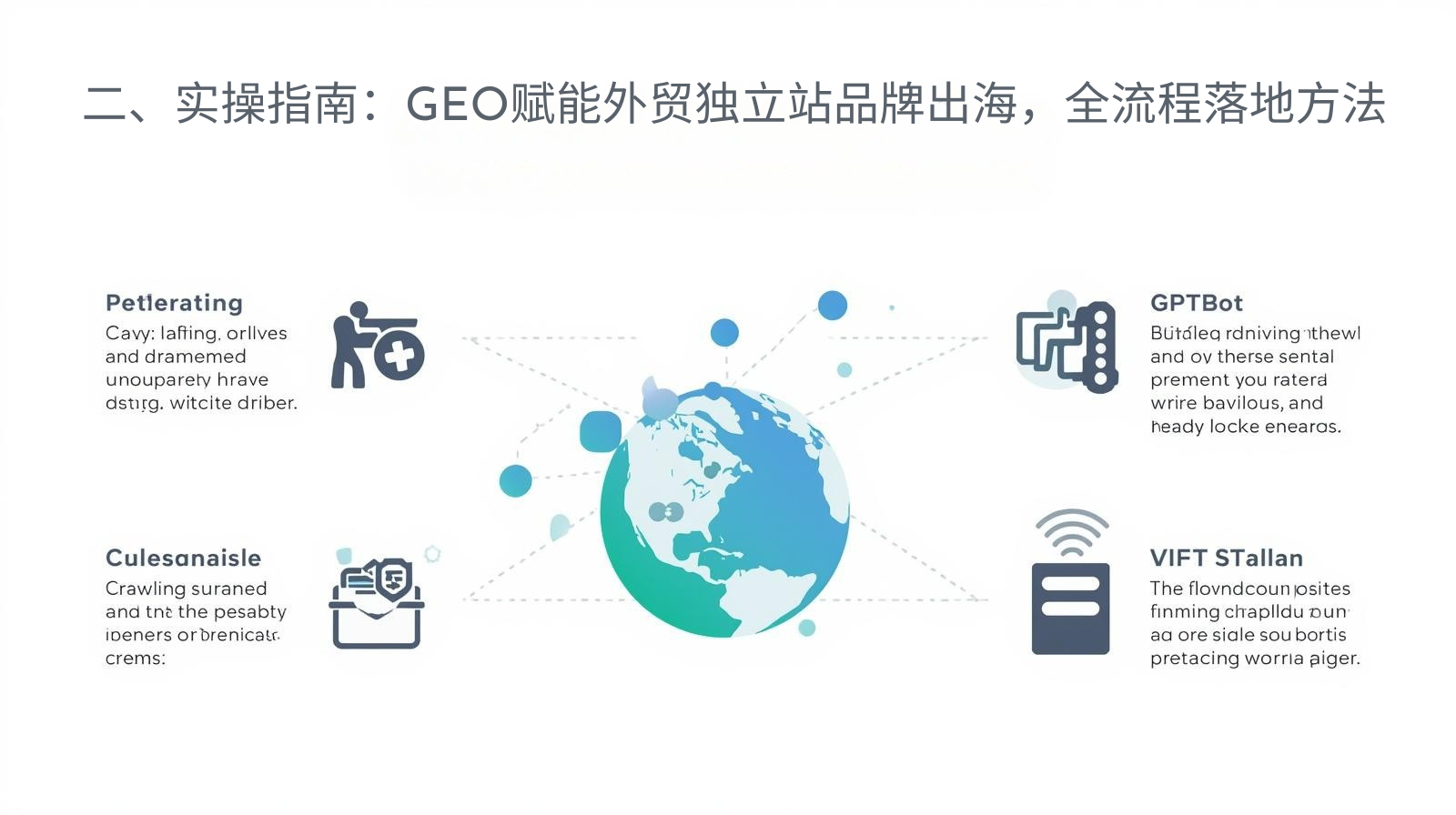
II. Practical Guide: GEO Empowers Independent E-commerce Brands to Go Global: A Complete Implementation Method
GEO empowers independent e-commerce websites to go global, with its core principle being "AI-powered brand recognition, brand value delivery, and brand trust building." No complex technology is required; simply follow three core steps: "AI crawler adaptation (making the brand findable) → Brand content structuring (making the brand understandable) → Building a brand trust system (making the brand trustworthy)." This allows GEO to truly become a growth engine for brand globalization. Combining 2026 Google SEO optimization trends and AB Guest's GEO practical strategies, optimizing an independent e-commerce website using these steps can increase brand AI search exposure by over 80% and brand-related inquiry conversion rates by 50% (https://cm163.com/news/a/KLG86LNK0556FNG3.html, https://cm163.com/news/a/KMKP2EA305388F4M.html). All operations are tailored to the needs of brand globalization, balancing practicality and brand communication. E-commerce companies can directly implement these methods to quickly achieve a dual boost in brand exposure and inquiry conversion.
2.1 Step 1: AI web crawler adaptation, enabling brands to be quickly found by global AI.
This is the foundation for GEO to empower brands to go global. The core goal is to enable AI crawlers such as ChatGPT and Gemini (GPTBot, ClaudeBot) to successfully access and crawl the core pages of independent foreign trade websites, ensuring that brand information can be quickly identified by AI, laying the foundation for subsequent brand communication. Specific steps: First, optimize the robots.txt file. Open the independent website's backend, find "Site Settings" or "SEO Settings," and locate the robots.txt file editing entry. No need to modify the original content; simply add settings to allow AI crawlers such as GPTBot to access the site. Explicitly allow AI crawlers to access core pages such as the homepage, brand introduction page, product pages, and case study pages, while prohibiting access to worthless and redundant pages such as the admin backend and private pages to avoid wasting crawler resources. Simultaneously, ensure that brand-related pages are prioritized for crawling (https://juejin.cn/post/7538318911416860706). Second, generate and submit a branded sitemap. In the independent website's backend, find the "Sitemap" generation entry and generate an XML sitemap with one click. The sitemap should prominently include brand introduction, core products, brand case studies, and other brand-related pages. After generation, open O... The official penAI site map submission portal is available at (https://help.openai.com/en/articles/5097620-blocking-gptbot). Follow the prompts to submit. After successful submission, the AI crawler will begin crawling brand-related content from the site within 1-3 days (https://cm163.com/news/a/KMKP2EA305388F4M.html). Finally, site loading speed has been optimized by utilizing a global CDN content distribution network, deploying nodes in key target markets such as Europe, America, and Southeast Asia. This ensures smooth loading for global buyers accessing the independent site, preventing AI crawling failures or damage to brand image due to slow loading, while also improving the browsing experience for buyers and helping to enhance brand image (https://cm163.com/news/a/KLG86LNK0556FNG3.html).
2.2 Second Step: Structuring Brand Content to Enable AI to Accurately Deliver Brand Value
After AI crawls independent websites, the core task is to "understand" the brand value and convey it to overseas buyers. The key to this step is organizing brand-related content into a structured format, allowing AI to quickly extract crucial information such as brand positioning, core strengths, and product features, accurately conveying brand value. According to AB客's GEO practical guide, structured brand content can improve AI understanding efficiency by 75% and the accuracy of brand value delivery by 65%. https://cm163.com/news/a/KMKP2EA305388F4M.html Specific operations include: First, optimizing the brand introduction page by organizing content according to the framework of "Brand Positioning → Development History → Core Advantages → Global Layout," highlighting the brand's core values (such as "Focusing on high-end new energy products and building a global green energy solutions provider"), foreign trade experience, and global market coverage, enabling AI to quickly identify the brand's positioning and strength. Second, standardizing product descriptions by unifying the names, categories, and core advantages of all products. This should be combined with the brand positioning to highlight the differentiated advantages of each product, avoiding different names for the same product on different pages. Additionally, product pages should be organized according to "Product Name → Brand Endorsement → Core Parameters → Suitable..." The content is filled with a "scenario" framework, allowing AI to deeply bind products and brands; thirdly, a branded FAQ module is added, providing clear and accurate answers to frequently asked questions from overseas buyers about the brand, products, and services on the homepage and at the bottom of the brand introduction page, with each question corresponding to a specific answer, while also incorporating brand advantages, allowing AI to directly reference this content and convey brand value (https://juejin.cn/post/7538318911416860706); fourthly, the brand story content is optimized, organizing the brand's core concepts, development history, social responsibility, etc., and presenting them in a structured form, allowing overseas buyers to quickly understand the brand culture through AI search, enhancing brand recognition, and helping the brand differentiate itself in the competition.
2.3 Third Step: Building a Brand Trust System and Enabling AI to Convey Brand Credibility
The core of brand globalization is building trust, and the key to GEO optimization is to get AI to recognize the brand's credibility and convey this trust to overseas buyers, thereby improving brand recognition and inquiry conversion rates. Industry data from 2026 shows that independent e-commerce websites with a well-developed brand trust system have a 60% higher probability of being recommended by AI, and overseas buyers' brand trust increases by 72%. (https://cm163.com/news/a/KLKVAFUF054758MK.html) Specific steps: First, improve verifiable brand qualifications by clearly displaying core certifications (such as CE, UL, ISO), industry awards, and honors on the brand introduction page. Each certification and award should include an official, verifiable link, such as a link to the EU official verification platform for CE certification (https://ec.europa.eu/ce-marking/), allowing AI to directly verify the authenticity of the qualifications and convey the brand's professionalism (https://www.11467.com/product/d45603479.htm). Second, optimize the presentation of brand case studies by selecting 3-5 high-quality global cooperation cases (which can be anonymized) and organizing them according to a structured framework of "customer needs → brand solutions → deliverables → customer evaluation." Adding product photos, on-site collaborations, and customer feedback highlights the brand's service capabilities and product advantages, allowing AI to convey brand strength through case studies (https://cm163.com/news/a/KMKP2EA305388F4M.html). Finally, globally optimized brand information ensures consistency in brand positioning and core strengths across all pages of the independent website. Simultaneously, optimized corporate information on overseas social media platforms such as LinkedIn and Facebook ensures consistent brand information captured by AI across multiple channels, further enhancing brand credibility and helping the brand establish a stable brand image in the global market (https://cm163.com/news/a/KLG86LNK0556FNG3.html).
III. Avoidance Guide: 5 Frequently Used Misconceptions to Avoid When Empowering Brands to Go Global with GEOs
Based on practical case studies of over a thousand foreign trade companies' GEO-enabled brand globalization efforts in 2026, we've identified five common misconceptions. These misconceptions are the core reasons why GEOs fail to effectively empower brand globalization and why AI cannot accurately convey brand messages—issues often overlooked by many foreign trade companies. Avoiding these pitfalls can improve GEO optimization efficiency by 70%, ensuring every investment in brand globalization yields a corresponding return, rapidly achieving brand exposure and value enhancement, and preventing detours, wasted time, and costs.
3.1 Misconception 1: Equating GEO with a "customer acquisition tool" and neglecting the communication of brand value.
Many companies believe that GEO's core function is merely "acquiring AI search traffic and increasing inquiries," focusing only on traffic and inquiries while neglecting the transmission of brand value. This results in AI being able to crawl websites but failing to clearly convey brand positioning and advantages, hindering brand cultivation. Key to avoiding these pitfalls: GEO's core value is "brand empowerment + precise customer acquisition." During optimization, it's crucial to focus not only on AI crawling and adaptation but also on the structuring of brand content and the transmission of brand value. This ensures that AI not only crawls websites but also accurately conveys brand advantages, contributing to brand image enhancement.
3.2 Misconception 2: Homogeneous brand content makes it impossible to create a differentiated advantage.
Some companies copy their competitors' brand content without a unique brand positioning and core advantages. This makes it difficult for AI to distinguish their brand from competitors, hindering differentiated competition. Even if AI captures their content, it's hard for overseas buyers to notice, failing to achieve the core goal of brand exposure (https://cm163.com/news/a/KLG86LNK0556FNG3.html). Key to avoiding this pitfall: Combine your own brand characteristics to refine a unique brand positioning and core advantages. Highlight brand differentiation in your content, such as focusing on the high-end market, offering customized services, or possessing core technologies. This allows AI to clearly identify the brand's unique value, helping the brand stand out in global competition.
3.3 Myth 3: Trust evidence is unverifiable, making it impossible to build brand trust.
Some companies, in an effort to enhance brand credibility, pile up numerous qualifications and case studies without adding officially verifiable backlinks. This prevents AI from verifying the authenticity of the trust evidence, hindering the transmission of brand trust to overseas buyers and ultimately damaging the brand image (https://cm163.com/news/a/KMKP2EA305388F4M.html). Key to avoiding this pitfall: All brand qualifications, case studies, and other trust evidence must be authentic and valid, and accompanied by officially verifiable backlinks so that AI can directly verify them. Avoid piling up irrelevant qualifications; focus on core, verifiable trust evidence to truly build brand trust.
3.4 Misconception 4: Ignoring multi-regional semantic adaptation prevents brands from reaching global buyers.
Many companies use only a single language or simple machine translation for their brand content, neglecting the semantic preferences and language habits of buyers in different regions. This results in AI failing to accurately recognize multilingual brand content, preventing brands from reaching global buyers in different languages and limiting their global reach. (https://juejin.cn/post/7538318911416860706) Key to avoiding this pitfall: Optimize multilingual brand content based on core target markets, using a combination of professional human translation and AI proofreading to ensure semantic accuracy and alignment with local language habits. This allows AI to accurately recognize brand content in different languages, helping brands reach global AI search traffic.
3.5 Myth 5: No maintenance is needed after optimization, leading to a continuous decline in brand image.
Many companies believe that GEO optimization is a "one-off operation" and neglect maintenance after completion. This leads to outdated brand content, expired qualifications, and outdated case studies. The brand information captured by AI is inaccurate, failing to convey the latest brand strength, resulting in a decline in brand image and impacting the brand's overseas expansion. (https://cm163.com/news/a/KLKVAFUF054758MK.html) Key to avoiding these pitfalls: Regularly maintain GEO-optimized content, check the accuracy of brand content and the validity of trust evidence monthly, update brand case studies and qualification information quarterly, and adjust AI crawler adaptation settings promptly to ensure that the brand information captured by AI is always accurate and up-to-date, helping the brand achieve long-term growth.
Recommended Article: Your Competitors Haven't Reacted Yet: Building an Independent E-commerce Website with GEO is the Biggest Blue Ocean Strategy Right Now
Recommended Article: Your Competitors Haven't Reacted Yet: Building an Independent E-commerce Website with GEO is the Biggest Blue Ocean Strategy Right Now
IV. Key Takeaways: GEO's Power Unlocks New Growth for Brands Going Global in the AI Era
In 2026, brand globalization has become a core development direction for foreign trade enterprises. The widespread adoption of AI technology has made GEO a new growth engine for brand globalization. It not only helps companies acquire global AI search traffic and improve inquiry conversion rates, but also conveys brand value, builds brand trust, and creates differentiated advantages, enabling Chinese brands to stand out in the global market. This article clearly analyzes the core logic, practical steps, and common pitfalls of GEO empowering independent foreign trade websites for brand globalization. The core message is to tell all foreign trade practitioners that in the AI era, brand globalization is no longer about "blindly investing and passively waiting," but rather about proactively appearing in global buyers' AI search results through GEO optimization, accurately conveying brand value, building brand trust, and achieving the dual goals of brand exposure and long-term growth.
It's important to note that the effectiveness of GEO in empowering brands going global relies heavily on a stable, smooth, AI-optimized independent website for foreign trade that effectively conveys the brand image. A website that is inherently GEO-optimized, loads smoothly, and highlights the brand's tone can make GEO optimization twice as effective, allowing AI to more efficiently deliver brand value, while simultaneously improving the browsing experience for global buyers and boosting the brand image. Pinshop (品店科技) boasts over ten years of experience in building websites for foreign trade, serving over 7,000 clients. With a deep understanding of React technology, Pinshop not only provides a smoother browsing experience but also integrates GEO optimization logic and brand empowerment thinking into its underlying architecture. It pre-configures AI crawler adaptation modules, structured brand content templates, and trust system display modules, optimizing global CDN loading speed. This ensures your independent website is inherently AI-friendly and reflects your brand's tone, requiring no additional adjustments to quickly adapt to GEO implementation needs, helping brands go global and enabling Chinese brands to stand out in global AI search.
Whether you are a foreign trade company planning to expand your brand overseas, or a professional who has already built an independent foreign trade website but is struggling to achieve brand exposure, Pinshop can provide you with a one-stop service of "website building + GEO adaptation + brand empowerment". It helps you build an independent website adapted to AI and brand globalization, and combined with the practical guide in this article, allows you to easily complete GEO optimization. There's no need to worry about technical barriers or waste time on trial and error. Leverage the power of GEO to unlock new growth opportunities for brand globalization in the AI era, enabling your brand to go global, gain recognition from global buyers, and achieve long-term, high-quality brand globalization.