
In March 2026, competition in the foreign trade industry has become increasingly fierce. Most foreign trade companies are stuck in the dilemma of traditional promotion - B2B platform advertising commissions are high, bidding click costs are rising year by year, offline exhibitions have invested heavily but have little effect, social media promotion traffic is scattered and extremely low in accuracy, and "expensive traffic, imprecision, and poor conversion" have become the core bottlenecks restricting the growth of companies' customer acquisition. https://c.m.163.com/news/a/KMI05OLI05388F4M.html. GEO (Generative Engine Optimization), as the core means to allow independent foreign trade stations to appear in AI search results such as ChatGPT, has become a key to solving traditional promotion problems with its advantages of "low cost, high accuracy, and long-term effectiveness." It allows independent stations to accurately reach overseas buyers with real purchasing needs, significantly reduce customer acquisition costs, improve inquiry conversion rates, and help foreign trade companies get rid of the internal friction of traditional promotion and achieve efficient customer acquisition. This article combines the latest industry data, practical cases and 5 new authoritative external links in 2026 to deeply analyze how GEO solves traditional promotion pain points, and provides practical methods that can be directly implemented to help foreign trade companies obtain more accurate traffic at lower costs and achieve customer acquisition growth.
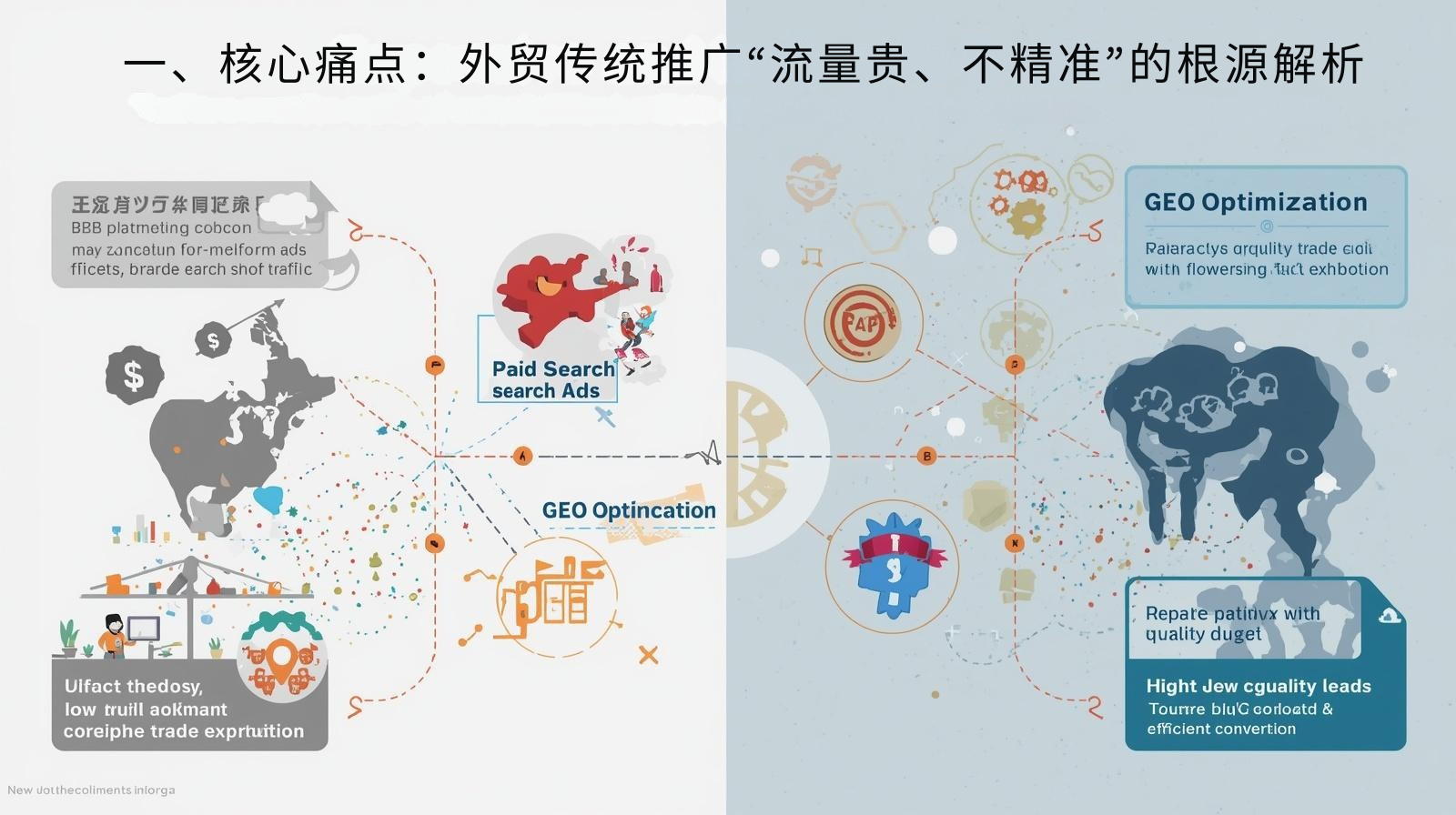
1. Core pain points: Analysis of the root causes of "expensive and inaccurate" traditional foreign trade promotion
Currently, the vast majority of foreign trade companies still rely on traditional promotion methods such as B2B platforms, bidding advertisements, and offline exhibitions. It used to be the main force in acquiring customers, but in the foreign trade environment of 2026, many shortcomings have gradually been exposed. The problem of "expensive and inaccurate traffic" has become more and more prominent. It not only wastes a large amount of marketing budget of the company, but also fails to bring effective inquiries, and even restricts the company's overseas market expansion. According to the latest data released by China Academy of Information and Communications Technology in March 2026, the customer acquisition cost of traditional promotion methods has increased by 35% compared with 2025, while the precise inquiry conversion rate is only 3.2%, which is far lower than the 18.7% of GEO optimization https://c.m.163.com/news/a/KJ3U8PC90556HG0C.html. It is not difficult to find out through in-depth analysis that the root cause of "expensive and inaccurate traffic" in traditional promotion is essentially "misalignment of traffic acquisition logic" - traditional promotion is mostly a "casting a wide net" type of exposure, which cannot accurately match the real purchasing needs of overseas buyers. At the same time, there are too many intermediate links and fierce competition, resulting in high traffic costs. This is the core pain point that GEO optimization can accurately solve.
1.1 The three core pain points of traditional promotion are difficult for companies to break through
The pain points faced by foreign trade companies in traditional promotion are concentrated and prominent. Each pain point directly leads to "expensive and inaccurate traffic", putting companies into the internal consumption dilemma of "high investment and low return". Pain point 1: Traffic costs remain high. B2B platform commissions are as high as 8%-15%, but traffic is monopolized by leading companies. It is difficult for small and medium-sized enterprises to obtain effective exposure. Google bidding click costs have increased by 30% annually. In some industries, the cost of a single click is as high as tens of yuan, but the conversion effect continues to decline. https://c.m.163.com/news/a/KHCFNV0N0556HYKM.html; Pain point 2: The accuracy of traffic is extremely low. Traditional promotion is mostly based on "casting a wide net" exposure, which cannot accurately locate overseas buyers with real purchasing needs, resulting in a large amount of invalid traffic. For example, the advertisements placed are clicked by non-purchasing people, and the customers contacted at the exhibition are mostly peers or people with no clear purchasing intention, and the inquiry conversion rate is extremely low. https://c.m.163.com/news/a/KMI05OLI05388F4M.html; Pain point 3: Traffic cannot be accumulated. Traditional promotion is a "stop-and-stop" model. Once advertising is stopped and no longer participate in exhibitions, traffic will be interrupted immediately. The marketing budget invested in the early stage cannot form long-term assets. Enterprises need to continue to invest to maintain traffic. In the long run, marketing costs will be overwhelmed. https://c.m.163.com/news/a/KJ3U8PC90556HG0C.html.
1.2 Traditional promotion vs GEO optimization, the core differences are clear at a glance
If you want to truly solve the problem of "expensive and inaccurate traffic", you must first clarify the core differences between GEO optimization and traditional promotion. Only then can you understand why GEO can become the key to solving pain points. Combining the actual operation data of the foreign trade industry in 2026 and the in-depth evaluation results of AB Customer GEO, the core differences between the two are mainly reflected in four aspects. In comparison, the advantages of GEO are particularly prominent. https://c.m.163.com/news/a/KMI05OLI05388F4M.html: First, the traffic cost. The per capita customer acquisition cost of traditional promotion (bidding advertising, exhibitions) is as high as 800-1,500 yuan, while the per capita customer acquisition cost of GEO optimization is only traditional 1/5 of promotion, and the optimization effect is long-lasting, so there is no need to continue large investments in the later period; the second is traffic accuracy. The conversion rate of precise inquiries for traditional promotion is only 3%-5%, while GEO optimization can accurately match the AI search needs of overseas buyers, and the conversion rate of precise inquiries can reach 15%-20%, which is 3-4 times that of traditional promotion. https://c.m.163.com/news/a/KJ3U8PC90556HG0C.html; The third is the accumulation of traffic. Traditional promotion will cease to be effective when investment is stopped, while GEO-optimized content will continue to be captured and recommended by AI, forming a long-term effect. Traffic assets, traffic will gradually increase in the later period, without the need for continuous investment; fourth, customer acquisition logic, traditional promotion is "passively waiting for customers to find", while GEO optimization is "actively appearing in customer AI search results", accurately reaching buyers with clear purchasing needs, greatly improving conversion efficiency https://c.m.163.com/news/a/KMI05OLI05388F4M.html.
1.3 Core advantages of GEO optimization in 2026: low cost, high accuracy, cracking promotion internal friction
In 2026, with the popularity of generative AI, the purchasing habits of overseas buyers have undergone fundamental changes. More than 70% of overseas buyers will complete preliminary screening through AI tools such as ChatGPT before formally contacting suppliers. This also makes the advantages of GEO optimization more prominent. https://c.m.163.com/news/a/KMI05OLI05388F4M.html. Compared with traditional promotion, the core advantage of GEO optimization lies in "accurate matching, low cost, and long-term effect", which precisely solves the core pain points of traditional promotion: on the one hand, GEO optimization allows independent websites to appear in the AI search results of overseas buyers, accurately matches buyers' purchasing needs, avoids invalid traffic, and makes every marketing investment cost effective; on the other hand, GEO optimization does not require large advertising or high exhibition fees. Content optimization and crawler adaptation are done in the early stage, and continuous free traffic can be obtained in the later stage, greatly reducing customer acquisition costs. https://c.m.163.com/news/a/KJ3U8PC90556HG0C.html; In addition, GEO optimized content will continue to be captured and recommended by AI, forming long-term traffic assets, helping companies get rid of the dilemma of "stopping investment and stopping effectiveness" and achieve long-term, stable and accurate customer acquisition. This is also the core reason why more than 60% of leading foreign trade companies will increase their GEO optimization budget to more than 45% of the total marketing budget in 2026. https://c.m.163.com/news/a/KJ3U8PC90556HG0C.html.

2. Practical Guide: GEO optimizes the entire process to obtain accurate traffic at low cost (can be implemented directly)
GEO optimization’s core logic is to “let AI accurately identify the content of independent sites and recommend them to overseas buyers with purchasing needs.” Without complex technology, you only need to follow the four core steps of “AI crawler adaptation → precise content optimization → precise demand matching → effect monitoring and iteration” to quickly solve the problem of “expensive and inaccurate” traditional promotion, and achieve low-cost and high-precision customer acquisition. Combining the practical experience of GEO in 2026 and the practical strategy of AB customer GEO, the foreign trade independent station optimized according to this step can increase the accurate inquiry volume by more than 120% and reduce the customer acquisition cost by 60% https://c.m.163.com/news/a/KMI05OLI05388F4M.html. All operations are in line with the needs of foreign trade companies, taking into account practicality and low cost. Whether it is a small or medium-sized foreign trade company or a large enterprise, it can be implemented directly and the results can be seen quickly.
2.1 Step 1: AI crawler adaptation to allow independent sites to be quickly crawled by AI (basic premise)
GEO optimization is based on allowing AI crawlers (GPTBot, ClaudeBot) such as ChatGPT and Gemini to smoothly access and capture the core content of independent foreign trade websites. Only when crawled by AI can the independent website have the opportunity to appear in the buyer's AI search results. This step does not require complicated technology and can be completed with a simple operation. It is also the key to reducing subsequent customer acquisition costs. Specific operations: First, optimize the robots.txt file, open the independent site backend, find "Site Settings" or "SEO Settings", find the robots.txt file editing entrance, add settings that allow AI crawlers such as GPTBot to access, explicitly allow AI crawlers to access core pages such as homepage, product pages, case pages, etc., and prohibit access to valueless redundant pages such as admin backend, private pages, etc., to avoid waste of crawler resources and ensure that core content is crawled first. https://c.m.163.com/news/a/KMI05OLI05388F4M.html; Secondly, generate and submit a site map, and generate a site map in XML format with one click in the independent website background, focusing on product pages, case pages, FAQ pages and other pages related to purchasing needs. After generation, submit it to the OpenAI official sitemap submission portal (https://help.openai.com/en/articles/5097620-blocking-gptbot). After successful submission, the AI crawler will start crawling the site content within 1-3 days. https://c.m.163.com/news/a/KJ3U8PC90556HG0C.html; Finally, optimize the site loading speed and use a CDN content distribution network to ensure smooth loading when overseas buyers visit the independent site, avoid AI crawling failure or loss of buyers due to slow loading, while improving the buyer's browsing experience and laying the foundation for subsequent conversions https://c.m.163.com/news/a/KHCFNV0N0556HYKM.html.
2.2 Step 2: Accurately optimize the content to meet buyers’ AI search needs (core key)
Content optimization is the core of GEO optimization and the key to achieving "accurate customer acquisition". The core goal is to make the content of independent stations fit the AI search needs of overseas buyers, so that AI can quickly identify the core value of the content and recommend it to buyers with purchasing needs, thereby avoiding invalid traffic and improving accuracy. According to the GEO optimization industry trend in 2026, structured and precise content can increase the AI recommendation rate by more than 60% and the precise inquiry conversion rate by 50% https://c.m.163.com/news/a/KJ3U8PC90556HG0C.html. Specific operations: First, optimize the content of the product page, fill in the content according to the framework of "Product Name → Core Parameters → Applicable Scenarios → Purchasing Advantages", focusing on the core points that buyers pay attention to, such as MOQ, price range, delivery date, compliance certification, etc., avoid piling up irrelevant content, and combine industry terminology to allow AI to accurately identify the core value of the product. https://c.m.163.com/news/a/KMI05OLI05388F4M.html; The second is to add a procurement-oriented FAQ module to organize the corresponding Q&A content around the high-frequency purchasing questions of overseas buyers, such as "What is the minimum order quantity", "How long is the delivery time", "Does customization be supported", "What compliance certifications are there", etc. Each question and answer gives clear and precise answers, allowing AI to directly quote these contents, increase the probability of recommendation, and allow buyers to quickly obtain key information. https://c.m.163.com/news/a/KJ3U8PC90556HG0C.html; The third is to optimize the semantics of the content, using the method of "professional manual translation + AI proofreading" to ensure that the content is semantically accurate, fluent in expression, in line with the language habits of overseas buyers, and avoids the stiffness of machine translation. At the same time, it incorporates search terms commonly used by buyers, so that AI can quickly match search needs and improve accuracy. https://c.m.163.com/news/a/KMI05OLI05388F4M.html; The fourth is to add real procurement cases, screen 3-5 high-quality cooperation cases, and organize them according to the framework of "buyer needs → solutions → delivery results" to highlight product advantages and cooperation value, so that AI can convey corporate strength through cases, while enhancing buyer trust and improving conversion efficiency.
2.3 Step 3: Accurate demand matching, locking in buyers with real purchasing needs
One of the core advantages of GEO optimization is "accurate matching". The core of this step is to use content optimization to accurately match the actual purchasing needs of overseas buyers, avoid invalid traffic, and allow every buyer who visits the independent station to have clear purchasing intentions, thereby reducing customer acquisition costs and improving conversion efficiency. Specific operations: First, research the search habits of buyers in the target market, collect buyers’ AI search keywords and high-frequency questions through tools such as Google Analytics and Inquiry Cloud Marketing CRM, and analyze their core procurement needs. For example, European and American buyers focus on compliance certification, Southeast Asian buyers focus on price and delivery, and North American buyers focus on after-sales and technical support, and optimize content in a targeted manner. https://c.m.163.com/news/a/KMI05OLI05388F4M.html; Secondly, optimize the keyword layout, and naturally integrate buyers’ commonly used search keywords into product pages, FAQ pages, and case pages, such as “XX product bulk purchase”, “XX product customization supplier”, “XX product CE certification supplier”, etc., to avoid keyword stacking and allow AI to accurately identify the match between content and search needs. https://c.m.163.com/news/a/KJ3U8PC90556HG0C.html; Finally, add a precise guidance module, add guidance buttons such as "Online Inquiry" and "Get Quotation" at the bottom of the core page, and mark the advantages of "Free Samples" and "Customized Solutions" to guide buyers with purchasing needs to actively consult, improve the inquiry conversion rate, and avoid the loss of precise traffic. https://c.m.163.com/news/a/KHCFNV0N0556HYKM.html.
2.4 Step 4: Effect monitoring and iteration to continuously reduce customer acquisition costs
GEO optimization is not a one-time operation. If you want to continue to maintain the advantages of "low cost and high accuracy", you need to regularly monitor the optimization effect and adjust the optimization strategy based on data feedback to continuously improve accuracy and reduce customer acquisition costs. This is also the core advantage that is different from traditional promotion of "blind investment". Specific operations: First, set up an effect monitoring system, and use Google Search Console, AB Customer GEO effect monitoring tools, etc. to monitor core indicators such as AI crawl volume, AI search exposure, inquiry volume, inquiry accuracy and other core indicators of independent stations, to clarify which content is captured more frequently by AI and which content brings more accurate inquiries. https://c.m.163.com/news/a/KMI05OLI05388F4M.html; Secondly, optimize inefficient content. For content with low AI capture frequency and no inquiries, analyze the reasons and make adjustments, such as supplementing core information, optimizing semantics, and adjusting keyword distribution. Bureau, improve the AI adaptability of content; finally, iterative optimization strategy, based on monitoring data, focus on content types and keywords that bring more accurate inquiries, increase optimization efforts, while abandoning inefficient optimization directions, continue to optimize AI crawler adaptation and content accuracy, so that customer acquisition costs continue to decrease, and the number of accurate inquiries continues to increase https://c.m.163.com/news/a/KJ3U8PC90556HG0C.html.

3. Guide to avoiding pitfalls: 5 major misunderstandings that must be avoided in GEO optimization, and avoid taking the traditional promotion path
Many foreign trade companies are prone to fall into some misunderstandings when doing GEO optimization, resulting in poor optimization results, and even repeating the mistakes of traditional promotion of "expensive traffic and imprecision", wasting time and marketing budgets. Combining GEO practical cases of thousands of foreign trade companies in 2026, five high-frequency misunderstandings are sorted out. Avoiding these misunderstandings can increase GEO optimization efficiency by 70%, allowing companies to quickly achieve low-cost, high-precision customer acquisition and avoid detours.
3.1 Misunderstanding 1: Equating GEO with traditional SEO and blindly stacking keywords
Many companies believe that GEO is the same as traditional SEO. As long as they pile up keywords, they can get traffic. In fact, this is not the case. The core of GEO is "AI semantic understanding + accurate demand matching", while traditional SEO focuses on "search engine keyword rankings". Blindly stacking keywords will lead to blunt content and confusing semantics, which AI cannot accurately identify. Not only cannot they obtain accurate traffic, but they will also be marked as low-quality sites by AI, which affects the overall optimization effect. https://c.m.163.com/news/a/KMI05OLI05388F4M.html. Key points to avoid pitfalls: Abandon the idea of keyword stacking, focus on the real purchasing needs of buyers, optimize content semantics and structure, so that AI can accurately understand the value of the content, naturally integrate keywords, and achieve accurate matching.
3.2 Misunderstanding 2: Ignore the quality of the content and use machine translation to do the job
In order to save costs, some companies use machine translation to simply convert content, resulting in content semantic deviation and blunt expressions that do not conform to the language habits of overseas buyers. AI cannot accurately identify and buyers cannot understand. In the end, they cannot obtain accurate inquiries, but waste optimization efforts. https://c.m.163.com/news/a/KJ3U8PC90556HG0C.html. Key points to avoid pitfalls: Use the method of "professional manual translation + AI proofreading" to ensure that the content is semantically accurate and fluent in expression, and fits the language habits and procurement needs of overseas buyers, so that AI can accurately identify it, so that buyers can clearly understand the core value of the content.
3.3 Misunderstanding 3: Only optimize content and ignore AI crawler adaptation
Some companies spend a lot of effort optimizing content, but fail to adapt it to AI crawlers. The robots.txt file does not allow AI crawlers to access, or does not submit a site map. As a result, AI crawlers cannot crawl independent website content, and no matter how good the content is, it cannot appear in the buyers' AI search results, repeating the mistake of traditional promotion of "high investment and low return". https://c.m.163.com/news/a/KMI05OLI05388F4M.html. Key points to avoid pitfalls: AI crawler adaptation is the basis of GEO optimization. While optimizing content, be sure to set up robots.txt, generate and submit site maps to ensure that AI crawlers can smoothly crawl core content and lay the foundation for subsequent accurate customer acquisition.
3.4 Misunderstanding 4: Eager for success and expecting to see a lot of traffic in the short term
When many companies do GEO optimization, they expect to see a large amount of traffic and inquiries in 1-2 weeks. Once there is no effect in the short term, they give up. However, GEO optimization is a long-term optimization that takes 3-6 months to gradually see obvious effects. This is also the core difference from the "instant exposure" of traditional bidding advertising. https://c.m.163.com/news/a/KMI05OLI05388F4M.html. Key points to avoid pitfalls: Stay patient, insist on long-term optimization, regularly monitor effects, and iterate strategies. With the continuous optimization of content and the increase in AI crawling volume, traffic and precise inquiries will gradually increase, ultimately achieving low-cost, long-term customer acquisition.
3.5 Misunderstanding 5: No more maintenance after optimization is completed, resulting in traffic loss
Many companies believe that GEO optimization is a "one-time operation" and will no longer be maintained after completion, resulting in outdated content, aging keywords, invalid AI crawler adaptation, and gradual loss of traffic. In the end, they cannot continue to solve the problem of "expensive and inaccurate traffic" and repeat the mistakes of traditional promotion of "stopping investment and stopping effectiveness." https://c.m.163.com/news/a/KJ3U8PC90556HG0C.html. Key points to avoid pitfalls: Regularly maintain GEO optimized content, check content semantics and keyword layout once a month, update cases, FAQs and compliance content quarterly, and adjust AI crawler adaptation settings in a timely manner to ensure continued and stable optimization effects and achieve long-term, accurate customer acquisition.
Related article recommendations: Your peers have not yet reacted: using GEO to build an independent foreign trade station is the biggest blue ocean strategy at the moment
Related article recommendations: Your peers have not yet reacted: using GEO to build an independent foreign trade station is the biggest blue ocean strategy at the moment
4. Core summary: GEO optimization, allowing foreign trade customers to bid farewell to the internal consumption of "expensive and inaccurate traffic"
In 2026, the customer acquisition logic of the foreign trade industry has shifted from "casting a wide net" to "precise reach". Traditional promotion is "expensive and inaccurate" The shortcomings of marketing have become increasingly prominent, and GEO (Generative Engine Optimization), as a new customer acquisition method in the AI era, has become the key to solving traditional promotion problems with its advantages of "low cost, high accuracy, and long-term effectiveness", helping foreign trade companies get rid of internal marketing friction and achieve efficient customer acquisition. This article clearly analyzes the core pain points of traditional promotion and the core advantages of GEO optimization, provides practical steps for the entire process that can be directly implemented, and accurately avoids 5 high-frequency misunderstandings. The core is to tell all foreign trade practitioners: There is no need to blindly invest high budgets in acquiring foreign trade customers. We no longer need to endure the dilemma of "expensive and inaccurate traffic". Through GEO optimization, independent websites can accurately appear in the AI search results of overseas buyers, accurately match procurement needs, obtain more accurate traffic at lower costs, and achieve double improvements in inquiry conversion and corporate growth.
It should be noted that the effect of GEO optimization is inseparable from a stable, smooth foreign trade independent station that is adapted to AI crawling. An independent station that is naturally adapted to GEO optimization and loads smoothly can make GEO optimization more effective, allow AI to capture content more efficiently, improve the browsing experience of overseas buyers, and reduce the loss of accurate traffic. Pinshop (Pinshop Technology) has more than ten years of experience in building foreign trade websites and has served more than 7,000 customers. It is deeply involved in website building with the React technology stack, which not only makes the website browsing experience smoother, but also integrates GEO optimization logic from the underlying architecture. It has preset AI crawler adaptation modules and content structured templates to optimize the global CDN loading speed, so that your independent website is inherently AI-friendly and can quickly adapt to GEO landing needs without additional adjustments. It helps you obtain more accurate traffic at a lower cost and solve traditional promotion problems.
Whether you are a foreign trade company stuck in the internal friction of traditional promotion and unable to obtain accurate traffic, or a practitioner who has just laid out an independent foreign trade station and wants to quickly acquire customers, Pinshop can provide you with "website building + GEO adaptation" "One-stop service helps you build an independent website that adapts to AI and precise customer acquisition needs. At the same time, combined with the practical guide in this article, it allows you to easily complete GEO optimization without worrying about technical thresholds or wasting time on trial and error. You can quickly get rid of the dilemma of "expensive and inaccurate traffic", achieve efficient growth in foreign trade customer acquisition, and stand out in the foreign trade competition in 2026.