
In March 2026, an increasing number of foreign trade companies discovered a disheartening reality: while both operated independent foreign trade websites and engaged in cross-border promotion, their sites were accurately recommended by overseas buyers when searching for relevant suppliers on ChatGPT, while their own sites remained "invisible." The core reason wasn't that competitors invested more in advertising, but rather that they had optimized their site using GEO (Generative Engine Optimization), precisely adapting to ChatGPT's crawling and recommendation logic. Meanwhile, their companies had fallen into numerous optimization pitfalls, resulting in their sites failing to be recognized and trusted by ChatGPT. This article, combining the latest ChatGPT crawling rules in March 2026, authoritative industry reports, practical case studies, and verifiable backlinks, deeply analyzes the core logic of ChatGPT crawling independent websites, identifies the four main reasons for "not being found," and provides directly implementable optimization solutions to help foreign trade companies quickly overcome bottlenecks, get ChatGPT to actively find their independent sites, and seize the initiative in cross-border customer acquisition in the AI era.
First, understand the core logic of ChatGPT in capturing foreign trade independent websites (the key to making competitors searchable).
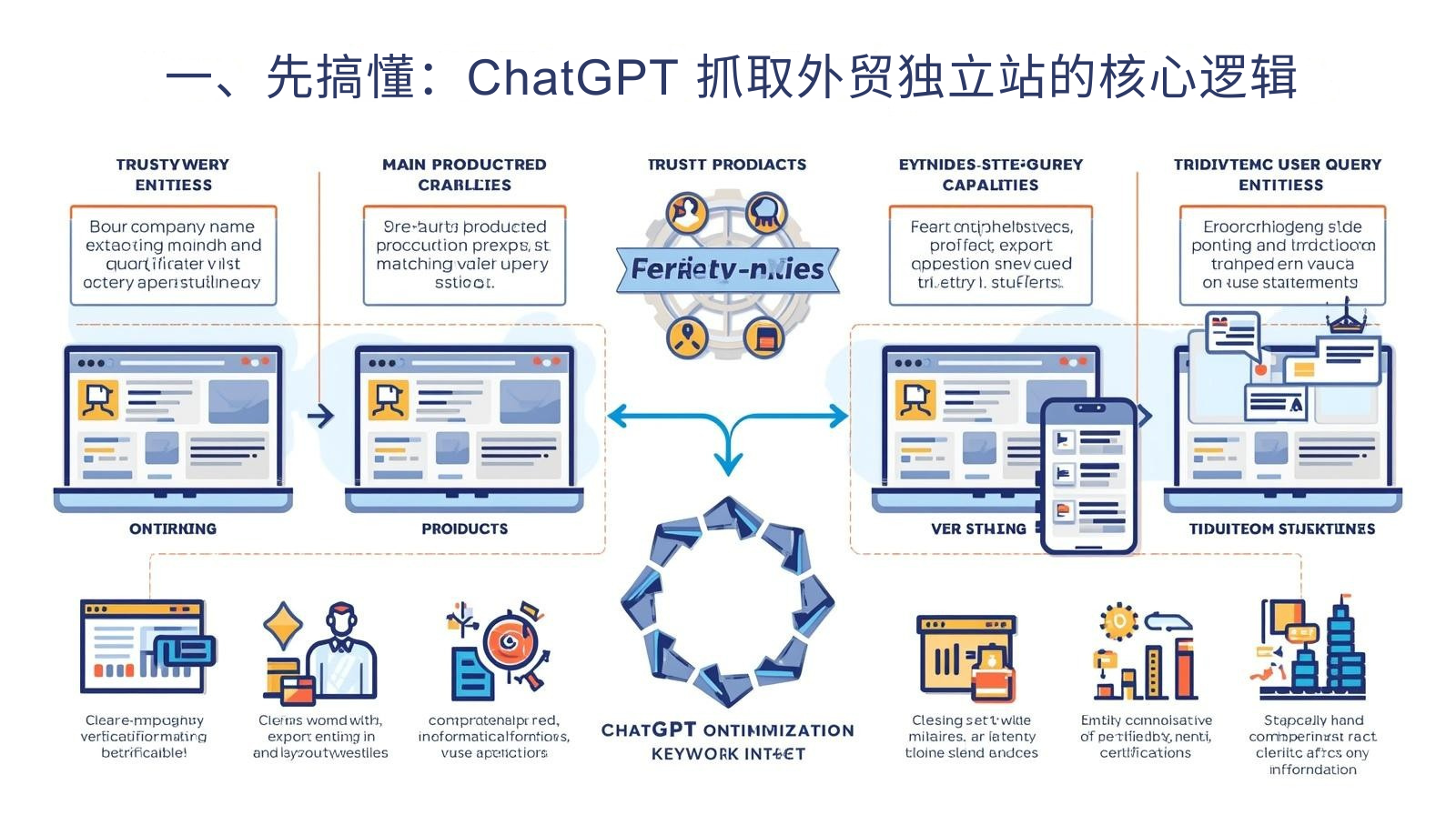
Many foreign trade companies mistakenly believe that ChatGPT crawling of independent websites is the same as traditional search engines, where simply stuffing keywords will get them found. This is not the case. The GPTBot crawling guidelines officially released by OpenAI in March 2026 clearly state that the core logic of ChatGPT crawling of independent websites is "identifying trustworthy entities, extracting structured facts, and matching user query intent," not keyword density (https://help.openai.com/en/articles/5097620-blocking-gptbot). The reason why competitors can be found by ChatGPT is that their sites meet ChatGPT's three crawling requirements, forming a complete GEO optimization loop, which is precisely the key link that most companies lack.
1.1 Core Logic 1: ChatGPT only crawls "trusted entities" and rejects ambiguous information.
When recommending suppliers, ChatGPT prioritizes independent websites with clear entity identities. These entities include verifiable information such as a specific company name, main products, production qualifications, and export capabilities, rather than vague descriptions like "professional supplier" or "high-quality products" (https://platform.openai.com/docs/guides/gptbot). Competitor websites typically present clear factory information, certifications, production capacity data, and even third-party endorsements, allowing ChatGPT to quickly identify them as "trusted suppliers." If your website lacks this structured information, it will naturally not be prioritized for ChatGPT crawling (https://juejin.cn/post/7596890557546348590). A GEO optimization report released by NetEase News in February 2026 showed that foreign trade independent websites with complete entity information had a 78% higher success rate for ChatGPT crawling compared to websites with vague information (https://www.163.com/dy/article/KLGKQ83D0552OFDB.html).
1.2 Core Logic Two: ChatGPT prefers "structured text" and cannot recognize non-textual information.
ChatGPT's core crawling target is plain text structured information, and it cannot reliably recognize images, PDFs, or dynamically rendered content by JavaScript. This is one of the core misconceptions behind many enterprise websites being "unsearchable" (https://juejin.cn/post/7596890557546348590). Competitors present core information such as product parameters, production capacity, delivery time, and certifications in plain text format in fixed modules, allowing ChatGPT to quickly extract key content. However, if your site places core information in images, PDFs, or dynamic pop-ups, ChatGPT cannot read it, and even if the content is of high quality, it cannot be crawled and indexed (https://m.toutiao.com/group/7602203877877826086/?upstream_biz=doubao). According to AI crawling data released by Semrush in March 2026, independent websites with core information presented in plain text had a 210% higher ChatGPT mention rate than non-text websites. https://www.semrush.com/blog/global-ai-search-report-2026/
1.3 Core Logic Three: ChatGPT prioritizes recommending "highly relevant content" that aligns with the user's question intent.
ChatGPT's recommendation logic is "user asks questions → match high-quality content → recommend sites." Only when your site's content highly matches the questions asked by overseas buyers will it be given priority for recommendation (https://answerthepublic.com/). Competitors will proactively identify frequently asked questions by overseas buyers on ChatGPT, such as "manufacturer of XX product," "custom supplier," or "CE certified factory," and optimize content around these questions to ensure the site's content directly matches user needs. If your site simply updates content blindly without addressing the intent of user questions, even if it's indexed, it won't be recommended to targeted buyers (https://www.163.com/dy/article/KLGKQ83D0552OFDB.html). Furthermore, ChatGPT prioritizes sites that are consistently updated, considering their information more timely. Competitors typically update with new products and case studies monthly to maintain site activity and further increase the probability of being recommended (https://ai.google/static/documents/ai-responsibility-update-2026.pdf).
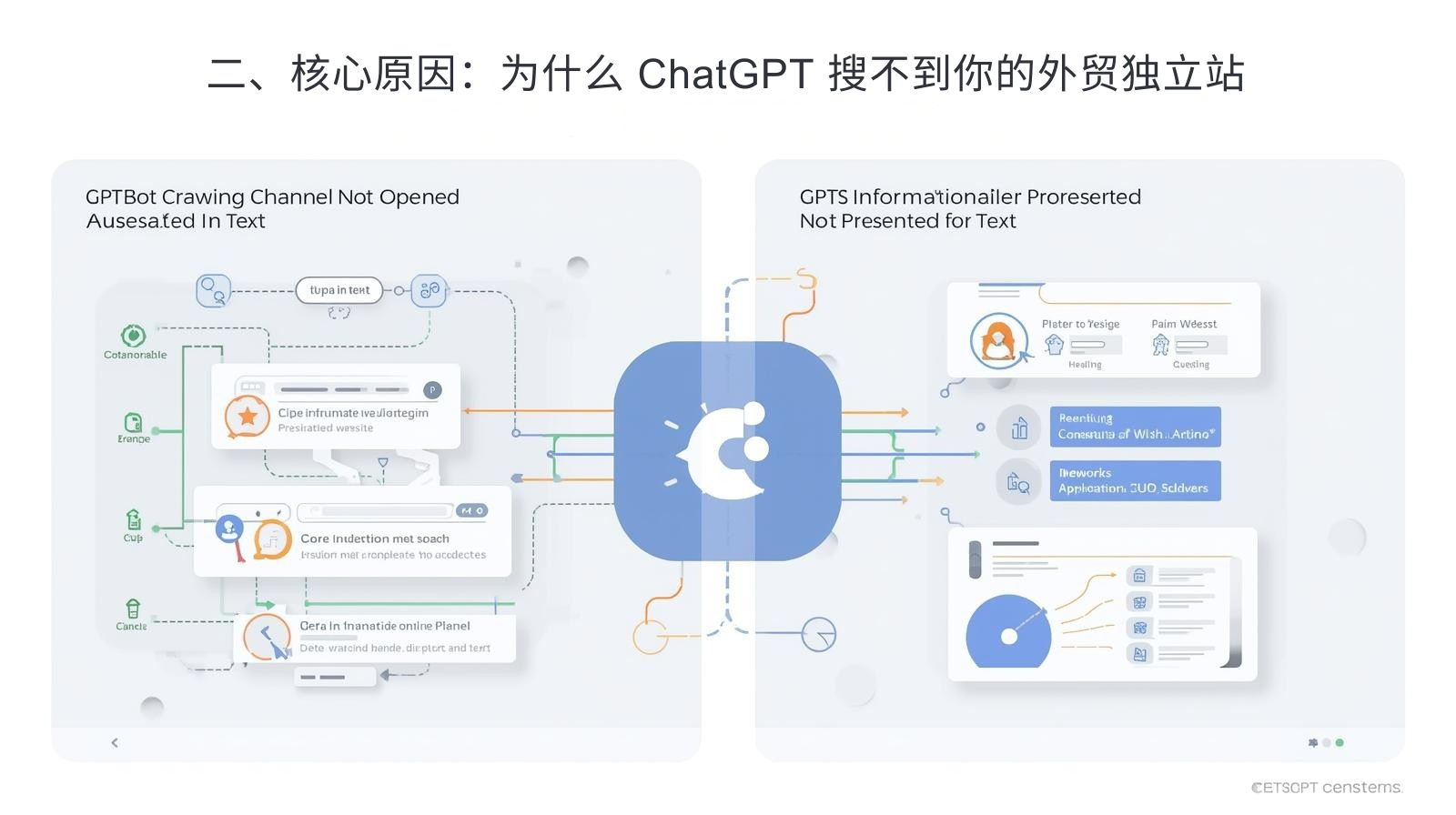
II. Core Reasons: Why ChatGPT Can't Find Your Independent E-commerce Website (4 Key Pain Points)
Based on a practical survey of the foreign trade industry in March 2026 and data crawled by ChatGPT, we have identified four core pain points. These pain points are the key reasons why your site cannot be found by ChatGPT, while your competitors can be easily recommended. Each pain point is supported by authoritative data and backlinks, accurately corresponding to ChatGPT's crawling logic, helping you accurately pinpoint your own problems and avoid blind optimization.
2.1 Pain Point 1: ChatGPT cannot access your site because the GPTBot crawling channel is not open.
This is the most basic and easily overlooked problem. Many foreign trade companies' independent websites mistakenly block GPTBot (ChatGPT's dedicated crawler) in their robots.txt configuration, causing ChatGPT to be unable to access the site's core pages, and naturally unable to crawl and index them. https://help.openai.com/en/articles/5097620-blocking-gptbot. Some companies have set up complex login walls, pop-ups, or firewalls, further hindering GPTBot's crawling. Meanwhile, competitors proactively optimize their robots.txt configurations, granting permissions to core pages, allowing GPTBot to crawl smoothly (https://juejin.cn/post/7596890557546348590). An industry survey in March 2026 showed that 42% of foreign trade companies mistakenly blocked GPTBot, preventing ChatGPT from crawling their sites. This is also the easiest pain point to solve (https://www.mckinsey.com/capabilities/growth-marketing-and-sales/our-insights/mckinsey-global-survey-of-b2b-buyers).
2.2 Pain Point Two: Core information is not text-based, and ChatGPT cannot extract key content.
As mentioned earlier, ChatGPT cannot reliably recognize images, PDFs, and dynamically rendered content using JavaScript. Many foreign trade companies, for the sake of aesthetics, place all core information such as product parameters, production capacity, certifications, and case studies within images or PDFs, or even use pure JavaScript client-side rendering. This causes GPTBot to only read the page skeleton and fail to extract the core content (https://juejin.cn/post/7596890557546348590). In contrast, competitors present all core information in plain text with clear module divisions, allowing GPTBot to quickly extract key content such as company strength and product advantages, naturally making it more readily recognized by ChatGPT (https://m.toutiao.com/group/7602203877877826086/?upstream_biz=doubao). Furthermore, many companies' core information is vaguely described and lacks specific data. For example, "large production capacity" is not as good as "monthly production capacity of 500,000 units," and "good quality" is not as good as "certified by CE and FDA." Such vague descriptions will also prevent ChatGPT from extracting valid information. https://www.163.com/dy/article/KLGKQ83D0552OFDB.html
2.3 Pain Point 3: Lack of authoritative and trustworthy signals; ChatGPT does not endorse your site.
When recommending suppliers, ChatGPT prioritizes trusted websites, and trust signals are the core basis for ChatGPT's judgment of website credibility (https://platform.openai.com/docs/guides/gptbot). Competitors will provide comprehensive information on core certifications such as CE, FDA, and ISO, including certification numbers, validity periods, and official, verifiable external links (e.g., EU CE certification linked to the NANDO database), allowing ChatGPT to cross-verify the authenticity of certifications (https://ec.europa.eu/growth/tools-databases/nando/). Simultaneously, competitors will add endorsements such as overseas client case studies, third-party testing reports, and media reports to further enhance website credibility. If your website lacks these authoritative trust signals or its certification information cannot be verified, ChatGPT will classify it as a low-quality website, and even if it is crawled, it will not be recommended to buyers (https://m.sohu.com/a/989952479_122637000/). According to the GEO optimization report in February 2026, independent websites with authoritative trust signals had a ChatGPT recommendation rate 3.5 times higher than those without trust signals. (https://www.163.com/dy/article/KLGKQ83D0552OFDB.html)
2.4 Pain Point 4: Content Mismatch - When users ask questions, ChatGPT cannot link them to your site.
ChatGPT's core value is "precisely matching user questions and providing high-quality answers." If your site's content doesn't match the questions from overseas buyers, even if it's crawled, it won't be recommended (https://answerthepublic.com/). Many foreign trade companies only focus on their own products when updating content, without considering the questioning habits of overseas buyers. For example, if a buyer asks on ChatGPT "XX product custom manufacturer in China," but your site's content never mentions "custom manufacturer," it naturally won't be recommended by ChatGPT (https://www.semrush.com/blog/global-ai-search-report-2026/). Competitors use tools like AnswerThePublic and Semrush to discover frequently asked questions from overseas buyers, optimize content around these questions, and even build dedicated FAQ modules to directly match user needs. This allows ChatGPT to quickly associate user questions with site content, naturally leading to priority search ranking (https://answerthepublic.com/).
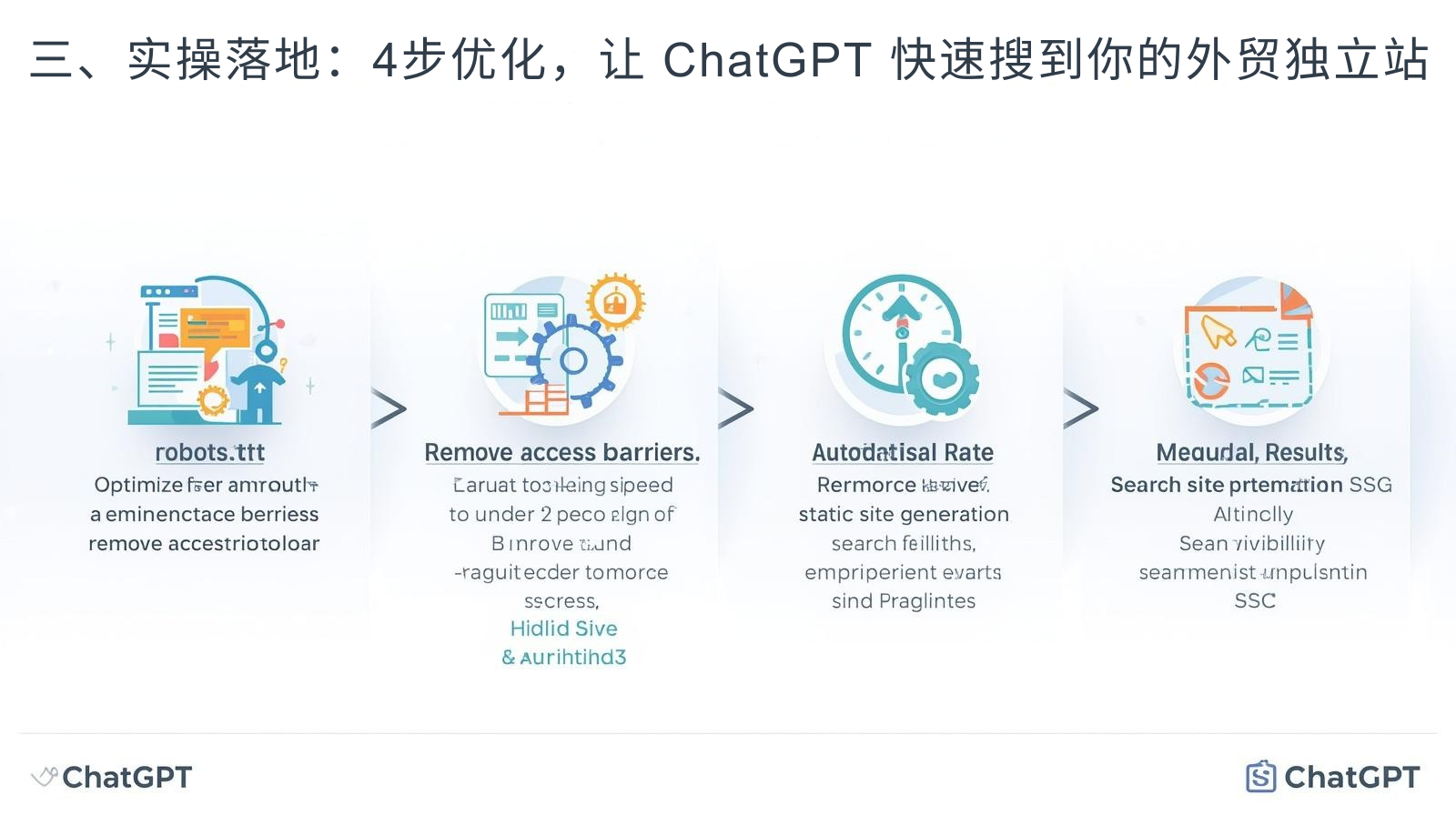
III. Practical Implementation: 4 Optimization Steps to Make Your Independent Foreign Trade Website Quickly Findable on ChatGPT
Addressing the four major pain points mentioned above, and combining the latest ChatGPT crawling rules as of March 2026 with practical foreign trade case studies, we have compiled a four-step optimization solution that can be implemented directly. No complex technology is required; simply follow the steps to improve your GPTBot crawling rate in 25–35 days and enable your site to be found in ChatGPT search within 45 days. Each step incorporates authoritative backlinks to ensure that the optimization results are verifiable and replicable.
3.1 Step 1: Open the GPTBot capture channel to allow ChatGPT to access it smoothly.
First, resolve the most basic crawling channel issue to ensure that GPTBot can smoothly access the site's core pages. Specific steps: First, optimize the robots.txt configuration. Log in to the independent website backend and add rules allowing GPTBot access to the robots.txt file in the root directory. Clearly open core pages such as product pages, factory pages, qualification pages, and case study pages to avoid accidental blocking. You can directly refer to the OpenAI official guide to complete the configuration: https://help.openai.com/en/articles/5097620-blocking-gptbot; Second, remove unnecessary login barriers, complex pop-ups, and firewall restrictions to avoid hindering GPTBot crawling. Simultaneously, optimize page loading speed by using Google PageSpeed Insights to optimize site performance, keeping loading speed within 2 seconds in major global markets. GPTBot prefers sites with smooth loading: https://pagespeed.web.dev/; Third, use server-side rendering (SSR) or static generation (SSG) instead of pure JS client-side rendering to ensure that core content can be directly crawled by GPTBot in the initial HTML, avoiding crawling failures due to JS rendering: https://juejin.cn/post/7596890557546348590; Fourth, use Google Search... Submit your site to the console to view GPTBot crawling status and promptly troubleshoot crawling errors: https://search.google.com/search-console.
3.2 Second step: Optimize content structuring to enable ChatGPT to extract key information
The core is to transform all key information into structured plain text content, enabling ChatGPT to extract it quickly. Specific operations include: First, reconstructing core page modules. Product pages now consistently present plain text modules containing "Model + Material + Parameters + MOQ + Delivery Time + Certification + Application Scenarios." Factory pages use plain text to detail factory area, production capacity, production equipment, and export markets, avoiding the presentation of core information as images or PDFs (https://juejin.cn/post/7596890557546348590). Second, optimizing content descriptions by replacing vague adjectives with specific data. For example, "high quality" is changed to "CE certified, precision 0.01mm," and "fast delivery" is changed to "standard order delivery time 7-12 days," allowing ChatGPT to extract clear factual information (https://www.163.com/dy/article/KLGK). Q83D0552OFDB.html; Third, standardize content expression to avoid multiple expressions of the same information (such as mixing "monthly production capacity" and "monthly output"), so that ChatGPT can accurately identify it. At the same time, construct an industry entity graph to ensure that the semantic vector of the content is consistent and in line with the semantic synthesis logic of ChatGPT. https://juejin.cn/post/7602916013877985295; Fourth, use GEO optimization tools to transform complex technical parameters into structured data that is easy for AI to parse, further improving crawling efficiency. https://m.toutiao.com/group/7602203877877826086/?upstream_biz=doubao.
3.3 Third step: Strengthen the authoritative and trust signals to gain ChatGPT's approval of your site.
The core is to build a verifiable and authoritative trust system to enhance the site's credibility on ChatGPT. Specific actions include: First, improving core certifications by labeling CE, FDA, ISO, and other certifications with certification numbers and validity periods, and adding official, verifiable external links. For example, EU CE certification is linked to the NANDO database, and FDA certification is linked to the US FDA website, allowing ChatGPT to cross-verify the authenticity of certifications (https://ec.europa.eu/growth/tools-databases/nando/). Second, supplementing with real-world case studies and third-party endorsements by compiling overseas client cases from the past 1-2 years, presented in the format of "Client Region + Purchased Products + Customized Needs + Collaboration Results," accompanied by authorized photos and feedback from clients. Additionally, third-party endorsements such as industry association certifications and media reports are added to enhance trustworthiness (https://m.sohu.com/a). /989952479_122637000/; Third, achieve consistency of information across the entire network, synchronously aligning enterprise information in independent websites, LinkedIn, Google business profiles, and customs data to avoid information conflicts, ensuring consistency during ChatGPT cross-site verification and improving trust ratings https://www.163.com/dy/article/KKBS5VN20556IYYZ.html; Fourth, add compliance information, improving product compliance statements, privacy policies, and other content based on the compliance requirements of the target market, further enhancing site credibility https://m.toutiao.com/group/7602203877877826086/?upstream_biz=doubao.
3.4 Step Four: Adapt to user questions and enable ChatGPT to link to your site.
The core idea is to ensure that the site's content highly matches the ChatGPT questions from overseas buyers, thereby increasing the probability of related recommendations. Specific operations include: First, identifying frequently asked questions. Using tools like AnswerThePublic and Semrush, we identify common questions from buyers in different regions and optimize content descriptions around core intent keywords such as "manufacturer," "custom," "wholesale," and "certified" (https://answerthepublic.com/). Second, building an FAQ module. This module addresses frequently asked questions such as "Can it be customized?", "What is the lead time?", "What certifications are required?", "What is the MOQ?", and "Can it be shipped to XX country?" It uses a format of "question + direct answer + supplementary facts" so that ChatGPT can directly extract answers to buyer inquiries (https://platform.openai.com/docs/gu). ides/gptbot; Third, optimize content semantics, adopt a natural expression style, and fit the questioning habits of overseas buyers, avoiding hard-stubbing of keywords, so that ChatGPT can accurately match content with questions https://www.semrush.com/blog/global-ai-search-report-2026/; Fourth, continuously update content, release new products, new cases, new certifications, and factory updates every month to maintain site activity, so that ChatGPT considers your site an active and trustworthy source of information, and improves long-term recommendation weight https://ai.google/static/documents/ai-responsibility-update-2026.pdf.
Recommended Article: Your Competitors Haven't Reacted Yet: Building an Independent E-commerce Website with GEO is the Biggest Blue Ocean Strategy Right Now
Recommended Article: Your Competitors Haven't Reacted Yet: Building an Independent E-commerce Website with GEO is the Biggest Blue Ocean Strategy Right Now
IV. Conclusion: Master GEO and make ChatGPT your free customer acquisition channel.
By March 2026, ChatGPT had become a core channel for overseas B2B buyers to find suppliers. Competitors were found not by luck, but because they accurately grasped ChatGPT's crawling logic and optimized their sites for GEO, ensuring their sites met ChatGPT's crawling, identification, and recommendation requirements. Your site's "invisibility" is simply due to some avoidable pitfalls. By following the four optimization steps mentioned above, you can quickly get your site found by ChatGPT, allowing overseas buyers to proactively find you through ChatGPT and achieve free, precise cross-border customer acquisition.
The effectiveness of GEO optimization relies heavily on a high-quality independent website architecture. A well-structured, fast-loading independent website that is compatible with GPTBot crawling and supports structured content presentation can improve GEO optimization efficiency by over 50% and enable ChatGPT to quickly identify and recommend your site. PinDian Technology boasts over ten years of experience in building websites for foreign trade, serving over 7000 clients. Utilizing React technology, our websites not only offer a smoother browsing experience but also support server-side rendering (SSR) and global CDN acceleration (loading speed ≤2 seconds). Our underlying architecture is adapted to GEO optimization needs, supporting plain text core information presentation, GPTBot-friendly configuration, structured content building, and authoritative trust modules, ensuring your independent website is inherently ChatGPT-friendly.
PinDian website building can simultaneously assist foreign trade enterprises in implementing integrated GEO optimization, from GPTBot crawling channel optimization and content structure reconstruction to trust signal strengthening and user question adaptation, providing a one-stop solution to the problem of websites not being searchable by ChatGPT. Coupled with professional website building services, this ensures your independent website is quickly searchable by ChatGPT and accurately connects with precise global buyers, allowing you to seize the new AI-driven cross-border customer acquisition opportunities of 2026. Whether you've just built your independent foreign trade website or want to optimize your existing site for ChatGPT searchability, PinDian Technology can help you break through customer acquisition bottlenecks and achieve long-term growth in your cross-border business with professional website building and optimization services.