A Complete Analysis of Independent Station Traffic → Order Conversion | 5-Step Diagnosis Method to Identify Loss Links | A Must-Read for Foreign Trade Decision Makers

  • Foreign trade stations
  • Foreign trade website
Posted by 广州品店科技有限公司 On Aug 21 2025

1. Shocking funnel loopholes: 90% of foreign trade independent stations are suffering from continuous bleeding

When an independent website has over 10,000 monthly visits but only a single-digit number of inquiries, the problem is not the quality of traffic, but the broken conversion link . Industry monitoring shows:

  • The average conversion rate for independent sites in the industrial equipment category is only 1.2% (McKinsey's latest B2B decision report)
  • System-optimized foreign trade sites can reduce customer acquisition costs by 67% (actual data from a valve manufacturer)

Google Analytics 4 Funnel Visualization Report reveals typical faults:

1000 visits
Product Page Stayer 320
Technical Document Downloads 85
Submit Inquiry12
Closed customer 3

Fatal gap : Technical document download → Inquiry stage loss rate is as high as 86%

2. Five-stage funnel diagnostic framework: Accurately locate the focus of churn

First stage: Traffic accuracy screening (30% of companies fail at the first stage)

Diagnostic Tools :

  • GA4 "User Acquisition Report" + "Event Tracking" core indicators :
  1. The proportion of users in the target country (for example, if the US traffic is less than 30% of the total, urgent adjustments must be made)
  2. High-value page bounce rate (product page > 65% indicates positioning misalignment) rescue plan :
  • Analyze competitor traffic structure through Similarweb
  • LinkedIn ad targeting "Position = Engineering Director" + "Industry = Manufacturing"

Second Stage: Value Transfer Efficiency (Decisive 3 Seconds)

Typical failure reason : A certain injection molding machine company’s product homepage had six certification icons stacked on top of each other. The customer’s core need, “daily production capacity data,” only appeared after scrolling three screens. Behavioral science optimization (based on the Fogg model ) :

  • Motivation : 3-second live video embedded in the first screen (equipment operation + dynamic display of production capacity figures)
  • Simplified operation : three-level switching of parameter table (basic version/engineer version/purchasing director version)
  • Action trigger : Floating the “ROI Calculator” button (120% increase in click-through rate)

The third stage: building a trust system (the core barrier to B2B decision-making)

Hardest hit area : Technical document download page → Inquiry submission page Four-dimensional reinforcement method :

  1. Technical trust : CAD drawing pages embedded with ISO certification query portal
  2. Service Trust : After-Sales Policy Comparison Table (Your Company vs. Industry Average)
  3. Social Proof : Fortune 500 Factory Inspection Video (Authorization Required)
  4. Decision security : Add "WhatsApp priority communication" entry

Stage 4: Closing the Decision Path (Blocking Competitors from Intercepting)

A typical cross-border procurement scenario : After downloading a white paper, a Brazilian purchasing manager received no response after 12 hours and turned to the competitor's automated interception system :
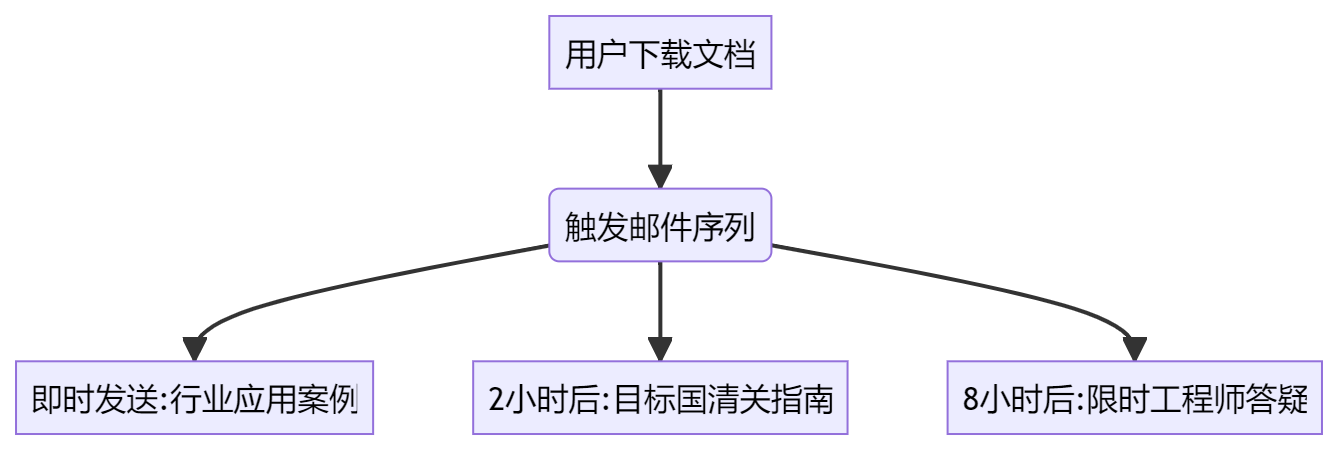
User downloads document
Triggering an email sequence
Instant Send: Industry Application Cases
2 hours later: Customs clearance guide for the target country
After 8 hours: Limited time engineer answering questions

Tool : HubSpot Marketing Automation (response time < 3 minutes)

Level 5: Sales Collaboration Efficiency (The Fatal Flaw at the Last Thing)

Diagnostic tool : Salesforce sales funnel report common problem case :

  • The salesperson repeatedly asks for basic parameters (the user has already downloaded the installation manual)
  • Strategies for cracking payment terms emails sent to engineers:
  1. CRM automatically tags user behavior (e.g., "pay attention to energy consumption data" or "browse after-sales terms")
  2. Pre-made multi-role script templates (three versions for technical/procurement/decision maker)

III. Cross-border minefield warning: 90% of companies fall into compliance traps

Cultural Decision-Making Differences

  • European and American customers : Direct link to CE/FDA certification (the latest version number must be marked)
  • Middle Eastern clients : Highlight endorsements from senior executives (leadership photos + royal procurement cases)
  • Southeast Asian customers : Showing the real scene of the local warehouse (with GPS positioning)

▎Data Privacy Red Line

  • EU user tracking requires explicit consent under GDPR ( Cookiebot solution recommended)
  • Chinese companies going global should obtain ISO 27701 privacy management system certification

▎Mobile experience collapse

Pinshop: The AI scalpel for independent station conversion funnels

Traditional pain points :

  • Data scattered across GA4/CRM/email systems
  • Optimization relies on manual experience and response is delayed

Solution : ✅Full -funnel intelligent monitor automatically marks 22 key churn points (from traffic source to order conversion) ✅Cross -channel intent map integrates website/LinkedIn/email data to generate customer intent scores ✅Real -time optimization engine based on Salesforce Einstein AI push solution (e.g.: "Brazilian users' churn increases sharply after downloading documents, suggesting triggering Portuguese video explanation")

>> Get the "Independent Station Conversion Funnel Physical Examination Report" + AI Optimization Solution Free Diagnosis Portal Immediately

Long-term value engine

  1. Data assetization : The funnel model can be reused for new product launches/regional expansion
  2. Intelligent decision-making : Historical data training dedicated diagnostic AI
  3. Organizational collaboration : Automatically generate technical/marketing/sales task lists

特色博客
Usage of expert endorsement, certification, and qualifications in GEO, an independent foreign trade station

Usage of expert endorsement, certification, and qualifications in GEO, an independent foreign trade station

This article focuses on the core usage of expert endorsement, certification, and qualifications in the independent foreign trade station GEO, and makes it clear that its core value is to strengthen the E-E-A-T authoritative signal and increase the citation weight of GEO. Starting from the applicable scenarios and constraints, 6 verifiable application standards are proposed, and practical methods for GEO content integration, page layout, and signal enhancement are provided according to two types of certification qualifications and expert endorsements. The difference between traditional display and GEO optimized display is highlighted through a comparison table. Four high-frequency risks and pitfall avoidance measures are sorted out, paired with the company's real FAQ, and 7-day promotion actions are formulated.

Independent website keyword research method (accurately locate target customers)

Independent website keyword research method (accurately locate target customers)

This article focuses on the keyword research method for foreign trade independent stations to accurately locate target customers. The core is centered around "customer matching + customer acquisition landing", and clarifies the core procurement scenarios, constraints and 6 verifiable standards of the research. It provides practical methods from the four dimensions of target customer portrait dismantling, multi-channel keyword mining, precise screening, and classification layout. Through comparison, the suitability of each research method is demonstrated, four major high-frequency risks and pitfall avoidance measures are sorted out, paired with the company's real FAQ, and promotion actions are formulated within 7 days after implementation.

How to improve GEO ranking using a question-and-answer structure

How to improve GEO ranking using a question-and-answer structure

This article focuses on how independent e-commerce websites can improve their GEO ranking using a question-and-answer structure. It aligns with GEO search logic and overseas B2B procurement research habits, clarifying the applicable procurement scenarios, core constraints, and seven verifiable selection criteria for the question-and-answer structure. Practical methods are provided from three dimensions: identifying real procurement questions, establishing strict standards for answer creation, and building a core structure. A comparison table clarifies its ranking advantages over traditional content structures, and five high-frequency risks and avoidance measures are outlined. Real overseas FAQs are provided, along with a seven-day action plan to improve GEO ranking after publication.

How to improve GEO ranking using a question-and-answer structure

How to improve GEO ranking using a question-and-answer structure

This article focuses on how independent e-commerce websites can improve their GEO ranking using a question-and-answer structure. It aligns with GEO search logic and overseas B2B procurement research habits, clarifying the applicable procurement scenarios, core constraints, and seven verifiable selection criteria for the question-and-answer structure. Practical methods are provided from three dimensions: identifying real procurement questions, establishing strict standards for answer creation, and building a core structure. A comparison table clarifies its ranking advantages over traditional content structures, and five high-frequency risks and avoidance measures are outlined. Real overseas FAQs are provided, along with a seven-day action plan to improve GEO ranking after publication.

Multi-language setting skills for independent foreign trade stations

Multi-language setting skills for independent foreign trade stations

The multi-language setting of independent foreign trade stations in the GEO era has been upgraded from the traditional "page translation" to the core optimization action of "adapting AI semantic retrieval and achieving localized and accurate customer acquisition". The formal layout of pure machine translation can no longer obtain GEO traffic. Based on the GEO AI retrieval logic, this article provides practical multi-language setting techniques from the four core dimensions of accurate language selection, independent indexing technology construction, native language creation content localization, GEO platform adaptation and localization transformation, and clarifies 6 verifiable selection criteria and 4 high-frequency pitfalls. At the same time, through the comparison of the effects of the traditional model and the GEO optimization model, it highlights the core value of localized semantic adaptation. Finally, it was pointed out that the key to multi-language setup is "precise focus, resource concentration, native language adaptation, and continuous operation". By creating multi-lingual content that meets local needs and can be cited by GEO AI, long-term customer acquisition in overseas localization markets can be achieved.

Long content vs. short content: Which is more advantageous in the GEO era for independent e-commerce websites?

Long content vs. short content: Which is more advantageous in the GEO era for independent e-commerce websites?

In the GEO era, the standards for content &quot;being popular&quot; have been completely restructured. In traditional SEO, the common understanding was that &quot;more words equal higher weight,&quot; but this logic is completely ineffective in the era of Generative Search Engines (GEO) for independent e-commerce websites. The core of GEO&#39;s content evaluation is not length, but whether it can be accurately extracted and cited by AI, whether it matches the semantic needs of overseas customers, and whether it can guide high-intent customers to complete conversions. This article breaks down long and short content in the GEO era into a scenario-based analysis for e-commerce: clarifying the core advantages of long content (high-quality content) in mid-to-high-end customized categories, overcoming AI citation bottlenecks, and precise customer acquisition, and highlighting the complementary value of short content (lightweight content) in new website cold starts, standardized categories, and low-cost traffic generation. Ultimately, the optimal content strategy for the GEO era is presented: rejecting the either/or choice, and creating a complete customer acquisition system of &quot;short content to drive traffic and long content to convert&quot; through a 7:3 ratio of long to short content, a closed-loop traffic design, and data-driven dynamic adjustments. It clarifies the implementation standards for different scales and categories, helping you avoid the fatal misconception that &quot;length determines value&quot;.