

Comparative Analysis of Cross-border Independent Station Logistics Solutions

  • Independent website industry application
  • Independent website operation strategy
Posted by 广州品店科技有限公司 On Aug 06 2025
For cross-border independent website operators, choosing the right logistics solution directly impacts customer experience, profit margins, and market competitiveness. According to Shopify's 2023 e-commerce trend report, 61% of consumers abandon their shopping carts due to high shipping costs, while 43% of buyers expect fast delivery within 1-2 days. Faced with such high customer expectations, establishing an efficient, reliable, and cost-effective logistics system is crucial for cross-border e-commerce success. This article will provide an in-depth comparison of mainstream logistics solutions to help you find the one that best suits your business.

International Direct Mail Model: Flexibility and Challenges

International Direct Mail Model: Flexibility and Challenges

International direct mail is the most basic cross-border logistics model, primarily including:

  1. Commercial Express Services: DHL, FedEx, UPS, etc.

    • Advantages: Wide global coverage, comprehensive tracking system, and extensive customs clearance experience
    • Disadvantages: High costs, with single-item shipping fees accounting for approximately 15-30% of the product value
    • Suitable for: High-priced products, time-sensitive orders, and startup businesses
  2. Postal Services: Postal systems in various countries (such as ePac) ket, EMS)

    • Advantages: Significantly lower costs than commercial express delivery, can reach remote areas worldwide
    • Disadvantages: Long delivery times (typically 10-30 days), limited tracking systems
    • Suitable for: Low-value goods, consumers with low timeliness requirements
  3. Dedicated Line Service: Regional dedicated line operators

    • Advantages: Offers price and delivery advantages within specific regions
    • Disadvantages: Limited coverage, inconsistent service standards
    • Suitable for: Optimized for specific high-volume markets

According to Pitney Bowes data, approximately 67% of cross-border parcels are delivered via postal services, 22% via commercial express delivery, and 11% via dedicated lines or other methods. When choosing a direct mail model, it is recommended to offer customers a variety of logistics options to balance cost and delivery time to meet diverse customer needs.

Overseas Warehousing Solutions: Improving the Localized Experience

Overseas Warehousing Solutions: Improving the Localized Experience

For sellers with stable sales, overseas warehousing offers significant competitive advantages:

  1. Self-built Overseas Warehousing

    • Advantages: Complete control over inventory and shipping processes, customizable customer experience
    • Disadvantages: Large initial investment (typically over $100,000 in startup capital) and complex management
    • Suitable for: Established sellers with monthly sales exceeding $500,000
  2. Third-Party Overseas Warehousing (3PL)

    • Advantages: No large initial investment required, easy to scale /li>
    • Disadvantages: Complex service fee structure, including warehousing fees, storage fees, and picking fees.
    • Suitable for: Mid-sized sellers with monthly sales between $50,000 and $500,000.
  3. Warehousing on platforms like Amazon FBA

    • Advantages: Seamless integration with platform sales, simple operations.
    • Disadvantages: High costs, limited brand exposure, suitable as a supplementary channel for independent websites.
    • Suitable for: Multi-channel sales strategies, with platforms and independent websites operating in parallel.

According to DHL Supply Chain research, sellers using overseas warehouses experience an average 70% reduction in delivery time, a 30% reduction in return processing costs, and a 25% increase in customer satisfaction. The overseas warehouse model is particularly suitable for businesses with stable sales and a moderate number of SKUs.
Mixed Logistics Strategy: Achieving the Optimal Balance

Mixed Logistics Strategy: Achieving the Optimal Balance

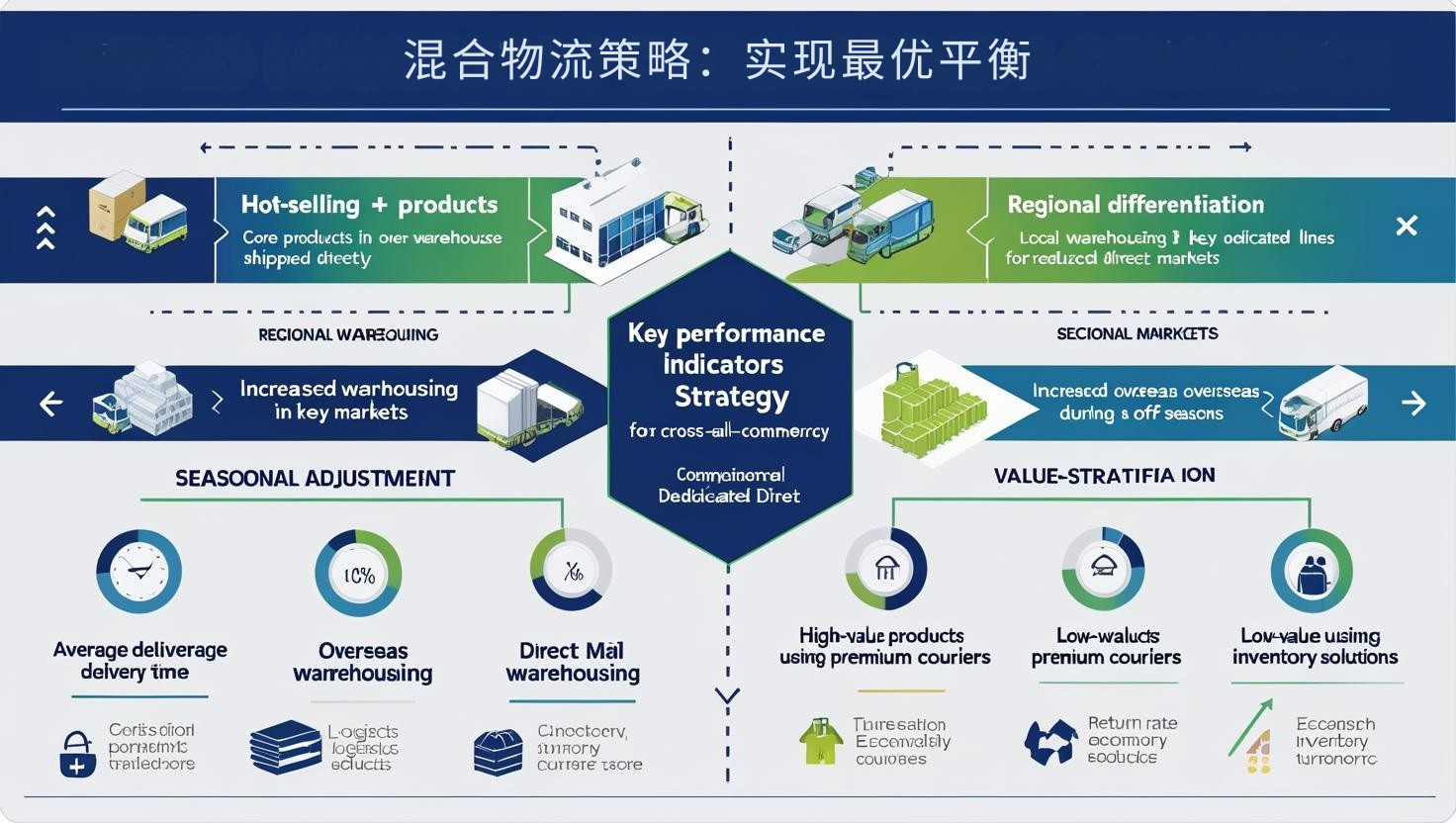
Most successful cross-border sellers adopt a mixed logistics strategy, flexibly adjusting it based on different product characteristics and market demand:

  1. Hot-selling products + alternative products strategy: Core products are pre-stocked in overseas warehouses, while long-tail products are shipped directly to achieve a balance between inventory and coverage.

  2. Regional differentiation strategy: Establish local warehousing in key markets, while using direct mail or dedicated lines for secondary markets.

  3. Seasonal Adjustment Strategy: Stock up overseas warehouses in advance during peak sales season, and reduce overseas inventory during off-season to lower storage costs.

  4. Value-Based Tiered Strategy: Use high-quality couriers to ensure safety and timeliness for high-value products; use economical logistics solutions for low-value products.

Building a successful cross-border logistics system requires continuous data analysis and optimization. We recommend regularly evaluating the following metrics: average delivery time, logistics cost ratio, customer satisfaction, return rate, and inventory turnover. Adjust your logistics strategy based on this data to find the optimal balance between cost control and customer experience.

Logistics is not just a cost center; it's also crucial for improving customer satisfaction and brand competitiveness. By choosing the right combination of logistics solutions, your cross-border business can achieve steady growth and long-term success.


特色博客
From Static to Dynamic: How Interactive Content Boosts User Engagement

From Static to Dynamic: How Interactive Content Boosts User Engagement

This article provides an interaction design framework verified by 6,800 companies. Through dynamic parameter calculation, religious compliance adaptation, engineer collaboration tools and other solutions, it transforms traditional static pages into highly sticky marketing engines.

Voice search optimization: the next traffic outlet for foreign trade websites

Voice search optimization: the next traffic outlet for foreign trade websites

This article provides a voice search optimization framework verified by 6,800 companies, and seizes the entrance to the next generation of search traffic through solutions such as industrial terminology voice database, religious compliance Q&A, and dynamic situational feedback.

In addition to the PC version, is your foreign trade website ready for VR/AR experience?

In addition to the PC version, is your foreign trade website ready for VR/AR experience?

This article reveals the VR/AR application solutions verified by 7,200 companies, and solves the trust and experience pain points of traditional foreign trade exhibitions through innovations such as Yuanverse exhibition hall, digital twin inspection, and remote engineer collaboration.

Cross-border B2C foreign trade independent station GEO: C-side client ChatGPT search conversion optimization skills

Cross-border B2C foreign trade independent station GEO: C-side client ChatGPT search conversion optimization skills

This article focuses on GEO optimization of cross-border B2C foreign trade independent stations, and the core solution is "the conversion problem of C-end customers after searching through ChatGPT". The opening chapter points out the differences between B2C and B-side customers - C-side customers make decisions quickly and their needs are concrete, which leads to the core of GEO optimization being "search-to-conversion full-link matching". The text is divided into three parts: the first is the search and conversion logic of C-side customers in the ChatGPT environment (scenario-based questions, short decision-making links, and preference for real experiences); the second is the 4-dimensional core optimization skills (accurate keyword mining and layout, C-side friendly lightweight content creation, trust signal construction, short-path conversion optimization). Each skill is accompanied by cases and practical templates such as yoga clothes, home furnishings, etc.; the third is 5 pitfall avoidance guides (avoiding generic keywords, official content, fake reviews, etc.). The full text fits the B2C scenario, with zero code and high implementation, helping foreign traders to efficiently convert the exposure recommended by ChatGPT into orders.

GEO rapid ranking method for independent foreign trade stations: 7 days for brands to appear in ChatGPT target search term results

GEO rapid ranking method for independent foreign trade stations: 7 days for brands to appear in ChatGPT target search term results

This article focuses on the demand for fast 7-day ranking of GEO, an independent foreign trade station, and proposes a solution of "accurately focusing on core signals" to address the pain point of "slow optimization results" for foreign traders. The core content is divided into three parts: the first is the underlying logic of rapid ranking (ChatGPT prioritizes capturing precise keywords, incremental content, and multi-source linkage signals); the second is the 7-day implementation plan, which breaks down the tasks of "word mining and positioning, core page optimization, lightweight content creation, technology optimization, cross-channel traffic, active push, monitoring and fine-tuning" tasks on a daily basis. Each link is accompanied by tools, templates and camping light cases; the third is 5 pitfall avoidance guides (avoiding multiple keywords, plagiarism, neglecting video transcription, etc.). The full text has zero coding and low threshold, helping GEO novices to get their brands to appear in the ChatGPT target search term results within 7 days by focusing on 3 high-potential keywords and lightweight content.

Lightweight foreign trade independent station GEO content: How short videos + short copy can be efficiently captured by ChatGPT

Lightweight foreign trade independent station GEO content: How short videos + short copy can be efficiently captured by ChatGPT

This article focuses on the GEO content lightweight strategy for independent foreign trade websites, and proposes an efficient solution of "short video + short copywriting" in view of the pain points of foreign trade people who "lack the energy to make long content and have no professional editing ability". The core content is divided into three parts: the first is the logic of ChatGPT capturing lightweight content (information density priority, multi-modal signal linkage, scene-based matching requirements); the second is the 5-step implementation method (short video creation templates and tools, short copywriting formulas, independent station embedding positions, content optimization skills, cross-channel linkage and traffic); the third is 4 pitfall avoidance guides (avoiding valueless verification, vague expressions, lack of video transcription, and low update frequency). The full text provides scripts, copywriting templates and free tools that can be directly copied to help foreign trade companies achieve efficient crawling and accurate exposure of ChatGPT with low-threshold content.