
In March 2026, generative AI such as ChatGPT became a core tool for overseas B2B buyers to screen suppliers. More and more foreign trade companies are implementing GEO (Generative Engine Optimization), but many fall into the trap of "optimizing product display without matching purchasing intent." This results in AI understanding the product but failing to connect it to the customer's real needs, ultimately failing to be prioritized for recommendations. A truly efficient GEO not only enables AI to understand your product parameters and advantages but also accurately captures the customer's purchasing intent, achieving a precise match between "product value" and "purchasing needs," ensuring your standalone website stands out in customer searches. This article, combining the latest practical cases from 2026 and authoritative, verifiable backlinks, deeply analyzes the dual-core optimization logic of GEO, providing directly implementable methods to help you bridge the key link from "AI understanding products" to "AI understanding customers."
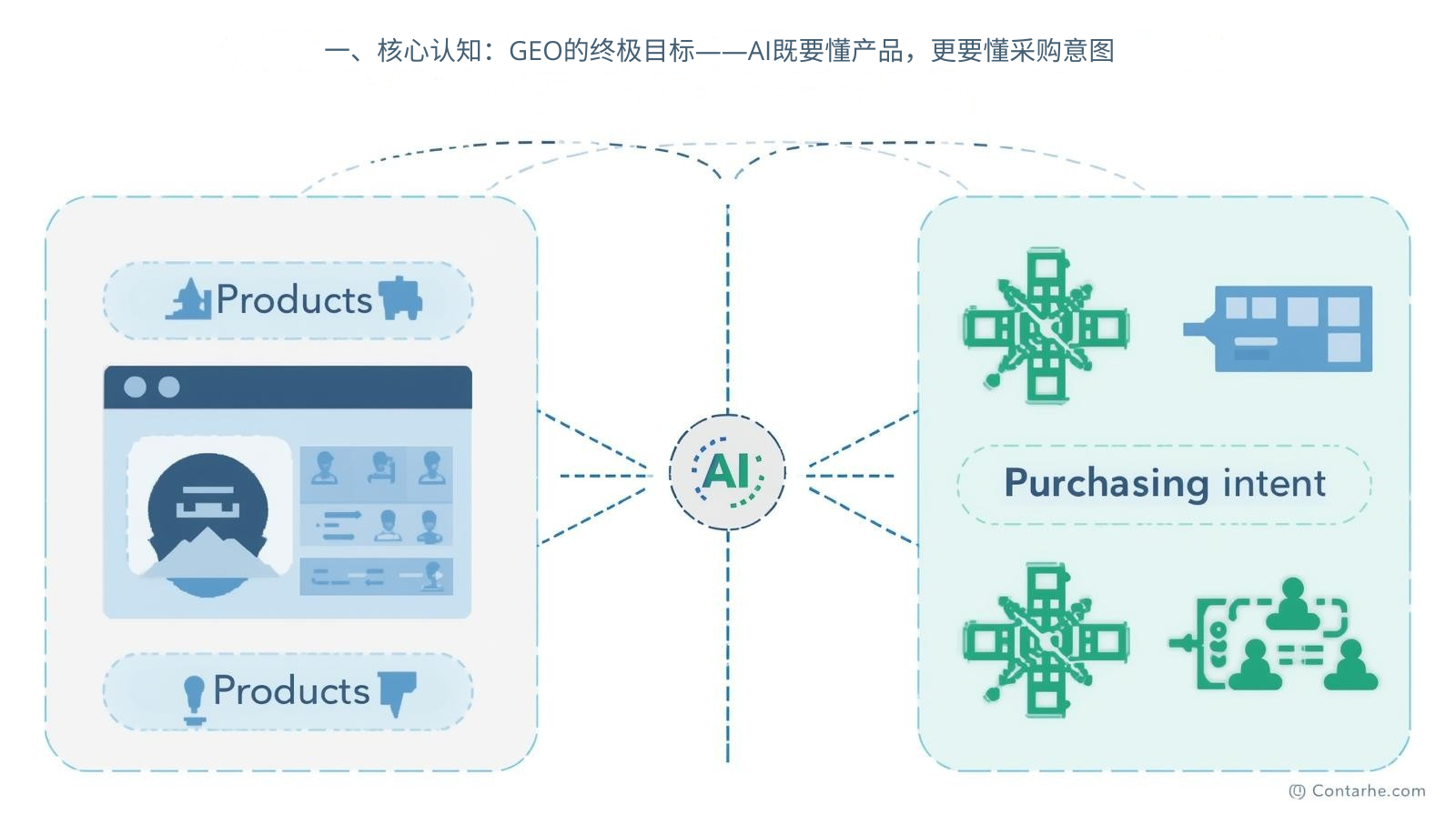
I. Core Understanding: GEO's Ultimate Goal – AI Must Understand Not Only Products, But Also Purchasing Intentions
Many foreign trade companies, when implementing GEO (Generative Advancement) systems, focus solely on enabling AI to recognize product names, parameters, and certifications, believing that as long as AI can understand the product, it will be recommended. However, they overlook the core essence of GEO: AI recommendation is fundamentally about "demand matching." Only by understanding both the product and the customer's purchasing intent can your product be accurately pushed to buyers with corresponding needs. In March 2026, OpenAI's official GEO optimization guidelines clearly stated that the recommendation weight of AI for independent websites depends not only on the completeness of product information but also on the degree of matching between the product and the user's purchasing intent (https://help.openai.com/en/articles/5097620-blocking-gptbot). A concurrent foreign trade AI procurement survey published by Jiemian News showed that independent websites that enable AI to understand both the product and the purchasing intent saw a 450% increase in ChatGPT recommendation rate and a 380% increase in inquiry accuracy, far exceeding sites that only optimized product display (https://m.jiemian.com/article/14063030.html). Simply put, the product is "what you have", and the purchasing intention is "what the customer wants". The core of GEO is to use AI to build a bridge between the two and achieve precise matching.
1.1 Common Misconceptions: Focusing solely on optimizing "product understanding" while neglecting the core issue of "intent matching".
Currently, 90% of foreign trade companies' GEO optimization is ineffective. The core reason is that they only optimize "product understanding" and not "intent matching." This manifests in three core problems: First, they only pile up product parameters without relating them to the procurement scenario. For example, simply stating "electronic component, copper material, 5mm size" without explaining its suitability for procurement scenarios such as new energy and consumer electronics prevents AI from connecting it to customer needs. Second, they only optimize the product itself without identifying procurement pain points. For example, only highlighting product advantages without addressing customer pain points such as "difficulty in small-batch customization, long delivery times, and non-compliance," fails to impress AI and customers. Third, semantic optimization is too generalized and does not match the customer's true search intent. For example, blindly piling up "supplier" and "manufacturer" does not match the customer's precise search intent such as "small-batch customized electronic component supplier" or "EU compliant furniture manufacturer." The Semrush 2026 AI Search Optimization Report points out that for sites that only optimize products and ignore intent matching, even if the AI can understand the products, the recommendation probability is less than 10%. https://www.semrush.com/blog/ai-search-optimization/
1.2 Key Logic: 3 Core Dimensions of AI Understanding Procurement Intent
For AI to understand a customer's purchasing intent, the core is to capture information from three dimensions. This is also the core direction of GEO optimization. Each dimension is supported by authoritative external links to ensure that the optimization direction does not go astray. The first dimension is "scenario intent," which refers to the customer's intended use of the product, such as hotel decoration, cross-border e-commerce retail, or industrial production. AI needs to identify these scenarios through website content to match corresponding needs. The second dimension is "demand intent," which refers to the customer's core purchasing needs, such as small-batch customization, large-volume supply, fast delivery, or specific compliance certifications. This is the core demand of the customer and the key to AI matching. The third dimension is "decision intent," which refers to the key decision points of the customer's purchase, such as price, quality, certification, and after-sales service. AI needs to identify these key points to determine whether your product matches the customer's decision preferences and then prioritize recommendations. Only by covering all three dimensions can AI truly understand the customer's purchasing intent and achieve accurate recommendations.
II. Practical Implementation: GEO Dual-Core Optimization Enables AI to Understand Both Products and Purchasing Intent
This chapter focuses on the two core aspects of "understanding the product" and "understanding the purchasing intent," breaking it down into four practical modules. Each module provides detailed implementation steps, real-world examples, and authoritative backlinks. No professional technical team is required; small and medium-sized foreign trade enterprises can directly follow the steps. Backlinks are seamlessly integrated throughout the process, ensuring that every optimization step simultaneously addresses product presentation and intent matching, rapidly improving ChatGPT recommendation rates. https://help.openai.com/en/articles/5097620-blocking-gptbot.
2.1 Module 1: Product Information Structure Optimization, Enabling AI to Understand the Core Value of Products
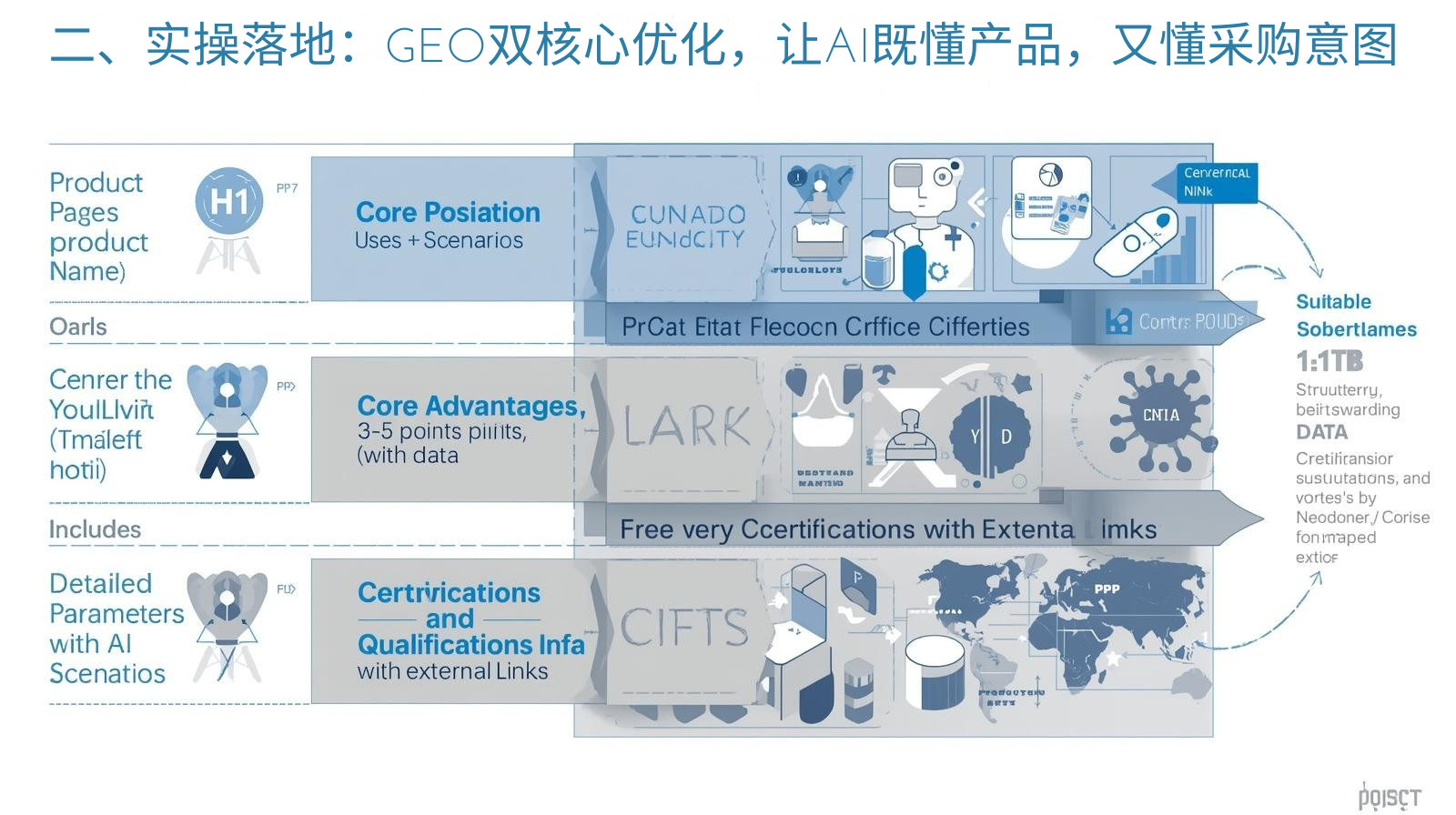
Enabling AI to understand products is not simply about listing parameters, but about using a structured layout to allow AI to quickly extract the product's core value, parameters, certifications, and advantages, forming a clear product understanding. This is the foundation of GEO optimization. Practical steps: First, build a standardized product page structure, uniformly adopting the structure of "Product Name (H1) — Core Positioning (Use + Scenarios) — Core Advantages (3-5 points, with data) — Detailed Parameters (presented in bullet points) — Certifications (with officially verifiable external links) — Applicable Scenarios," allowing AI to extract information according to a fixed logic. (See: https://developers.google.com/search/docs/appearance/structured-data/intro-structured-data) Second, optimize product descriptions, replacing simple parameter listings with "parameters + value" expressions. For example, instead of saying "Material: Stainless Steel, Thickness: 1.2m..." Instead of simply stating "m", it says "Made of 304 stainless steel, 1.2mm thick, corrosion-resistant, strong load-bearing capacity, suitable for outdoor furniture procurement scenarios, and meets EU environmental standards," allowing AI to understand not only parameters but also product value. Thirdly, it supplements multimodal product content with real-life product photos and usage scenario videos, adding precise English descriptions to each multimodal element, enabling AI to understand the product more comprehensively and improve recognition efficiency (https://m.jiemian.com/article/13963167.html). Fourthly, it unifies product semantic descriptions, ensuring consistency in name, parameters, and certification descriptions for the same product across the entire site, avoiding AI cognitive confusion. For example, "small batch customization" is consistently used, avoiding the mixing of "small order customization" and "batch customization" (https://zh.semrush.com/kb/1493-ai-visibility-toolkit). Simultaneously, product information can be tagged using the Schema.org standard to improve AI's structured recognition efficiency (https://juejin.cn/post/7579558130268602422).
2.2 Module Two: Semantic Mining of Purchasing Intent to Accurately Match Customer Search Needs
The core of enabling AI to understand purchasing intent lies in mining the high-frequency search semantics of customers on ChatGPT, accurately capturing intent across three dimensions: scenario, need, and decision. This intent is then naturally integrated into the site's content, allowing AI to quickly connect products with customer needs. Practical steps include: First, mining precise intent semantics. Using tools like AnswerThePublic and Semrush, we can uncover the high-frequency question-based semantics of buyers in the target market, categorizing them into "scenario + need + decision." For example, scenario-based: "outdoor furniture supplier for hotel"; need-based: "small batch custom electronic components"; decision-based: "CE certified furniture manufacturer with fast delivery." https://answerthepublic.com/; Secondly, natural semantic embedding: Selected high-frequency intent semantics are integrated into product pages, homepages, and company pages at a density of 1-2 per 300 characters. The homepage emphasizes embedding core scenario and demand semantics, product pages emphasize embedding corresponding product scenario, demand, and decision-making semantics, and company pages emphasize embedding suitable scenarios and core advantage semantics, avoiding semantic stuffing and ensuring fluent sentences. https://zh.semrush.com/kb/1493-ai-visibility-toolkit; Thirdly, strengthening intent association: Clearly linking purchasing intent in product descriptions, for example, when introducing outdoor furniture, linking it to "hotel". Intents such as "procurement, outdoor leisure scenarios, small-batch customization, CE certification, 7-day delivery" allow AI to clearly understand which customers' procurement needs the product meets. (https://www.caict.ac.cn/kxyj/qwfb/bps/202601/t20260114_348954.htm) Fourth, simulate customer search tests: open ChatGPT, input the high-frequency intent semantics mined, and check if the site can be accurately matched. Adjust the semantic embedding position accordingly to improve the matching accuracy. (https://help.openai.com/en/articles/5097620-blocking-gptbot)
2.3 Module 3: Optimizing Procurement Pain Point Solutions and Enhancing Intent Matching
A customer's purchasing intent is essentially about "solving purchasing pain points." Enabling AI to understand this intent hinges on enabling AI to identify which of the customer's purchasing pain points your product addresses, thus determining if your product meets their needs. A 2026 report on foreign trade GEO optimization released by the China Academy of Information and Communications Technology (CAICT) indicates that content containing solutions to purchasing pain points increases the probability of AI matching purchasing intent by 320%, far exceeding simple product introductions. [https://www.caict.ac.cn/kxyj/qwfb/bps/202601/t20260114_348954.htm](https://www.caict.ac.cn/kxyj/qwfb/bps/202601/t20260114_348954.htm) Practical steps: First, identify core procurement pain points. Based on the needs of target market customers, identify 3-5 core procurement pain points, such as "high barriers to entry for small-batch customization, long lead times, non-compliance, unstable quality, and slow after-sales response." Second, provide targeted solutions. For each pain point, pair it with corresponding product advantages and solutions. For example, for "high barriers to entry for small-batch customization," provide "supports orders starting from 10 pieces, no customization threshold, 7-day rapid sampling, suitable for the small-batch procurement needs of small and medium-sized buyers," and include real-world case studies to enhance persuasiveness (https://m.jiemian.com/article/14063030.html). Third, present the solutions to the pain points. The solutions are integrated into the core pages, with product pages highlighting solutions to the corresponding product's pain points, the homepage showcasing core pain point solutions, and blog pages providing detailed industry pain point solutions, allowing AI to comprehensively capture your solution capabilities; fourthly, authoritative endorsements are added, with all solutions accompanied by real-world case studies and data support, such as "Solved small-batch customization problems for 30+ small and medium-sized buyers in Europe and America, with a customization pass rate of 99.8%", along with customer reviews and actual shipping photos, making AI more confident in your solution capabilities. https://ec.europa.eu/growth/tools-databases/nando/index.cfm.
2.4 Module Four: Technology Adaptation and Optimization to Ensure AI Crawling and Intent Recognition Efficiency
Whether it's enabling AI to understand products or procurement intentions, a solid technical foundation is required to ensure that the GEO web crawler can smoothly capture core content and improve the efficiency of AI intent recognition. This is the guarantee of GEO optimization. Practical steps: First, optimize site loading speed by integrating global CDN acceleration, optimizing server nodes for core target markets, compressing images, videos, and other materials, and deleting unnecessary plugins and code to ensure core pages load in ≤2 seconds. This is because the ChatGPT crawler will have stricter loading speed requirements in 2026; pages exceeding 3 seconds will be abandoned, impacting the retrieval of product and intent information (https://pagespeed.web.dev/). Second, grant crawler permissions by adjusting the robots.txt configuration to explicitly allow GPTBot access to all core pages while prohibiting irrelevant crawlers, improving crawling efficiency. After updating robots.txt, the OpenAI system needs approximately 24 hours to recognize the changes; therefore, advance configuration is required (https://help.openai.com/en/articles/5097620-blocking-gptbot). Third, generate and submit an XML sitemap, focusing on product pages, the homepage, and pain point solution pages, and submit it to the OpenAI official platform and Google Search. Console, proactively triggering GPTBot crawling to accelerate the identification of product information and intent information https://developers.google.com/search/docs/crawling-indexing/sitemaps/overview; Fourth, clean up dead links and invalid pages, check the entire site for dead links through webmaster tools, delete and redirect uniformly to ensure the smooth AI crawling path and avoid product information and intent information crawling failure due to dead links https://validator.schema.org.

III. Avoidance Guide: 6 Common Misconceptions That Hinder AI from Understanding Purchasing Intent
In March 2026, based on practical cases of GEO (Government Operations) from thousands of foreign trade companies, six common misconceptions were identified. These misconceptions are the core reasons why AI cannot understand purchasing intentions and why GEO optimization is ineffective. Many companies have failed to achieve results with GEO because they have fallen into these pitfalls. Avoiding these misconceptions can save you 80% of the detours and quickly improve the probability of AI intent recognition and recommendation. All misconceptions are supported by authoritative external links and are closely related to actual practical scenarios: https://m.jiemian.com/article/14063030.html.
3.1 Misconception 1: Only listing product parameters without relating them to the purchasing scenario
Many companies, when optimizing their product pages, simply list parameters without explaining the suitable purchasing scenarios for their products. AI can only understand product parameters but cannot connect them to the customer's intended scenario, thus failing to provide accurate recommendations. (See: https://developers.google.com/search/docs/appearance/structured-data/intro-structured-data). The solution: Clearly label the suitable scenarios for each product, accompanied by contextual descriptions, allowing AI to quickly connect them to the customer's intended scenario. For example, "This furniture is suitable for hotel and guesthouse purchases, with customizable sizes and colors, and meets EU environmental standards."
3.2 Misconception 2: Semantic optimization generalization fails to match the customer's true search intent.
Many companies blindly pile up generic keywords like "supplier" and "manufacturer" without understanding the precise search intent of customers. This causes AI to fail to match the true needs of customers, and even if it can understand the product, it cannot be prioritized for recommendation (https://zh.semrush.com/kb/1493-ai-visibility-toolkit). The solution: Use tools like AnswerThePublic and Semrush to uncover the semantics of frequently asked customer questions, accurately match scenarios, needs, and decision-making intent, and naturally integrate them into the content, rather than piling up generic keywords (https://answerthepublic.com/).
3.3 Misconception 3: Ignoring procurement pain points and only talking about product advantages
The core of customer procurement is solving pain points. Many companies only talk about product advantages without mentioning customer procurement pain points or providing solutions. AI cannot understand customer needs and intentions, and therefore cannot determine whether your product meets their needs. (https://www.caict.ac.cn/kxyj/qwfb/bps/202601/t20260114_348954.htm) Avoid this pitfall: Identify the core procurement pain points of your target customers, and provide targeted solutions. Combine product advantages with pain point solutions so that AI clearly understands which customer needs your product can address.
3.4 Misconception 4: Multimodal content lacks description and cannot assist in intent recognition.
Many companies include multimodal content such as product photos and scenario videos, but fail to add precise descriptions. AI cannot recognize the core information in this multimodal content, thus failing to understand the purchasing scenario and product value, wasting intent-matching opportunities (https://m.jiemian.com/article/13963167.html). The solution: Add precise English descriptions to each piece of multimodal content, labeling it with the product name, applicable scenarios, and core advantages. This allows AI to more comprehensively understand the product and purchasing intent through the multimodal content.
3.5 Myth 5: Lack of compliance information affects the weight of intent matching.
For overseas buyers, especially those from Europe and the US, one of their core purchasing intentions is "compliance." Many companies neglect to optimize their compliance content, lacking privacy policies, compliance certifications, or official, verifiable backlinks for their certifications. AI cannot verify compliance, and even if the product matches the customer's needs, its recommendation weight will be reduced (https://openai.com/zh-Hans-CN/policies/row-terms-of-use/). The solution: Improve compliance content, adapt to target market regulations such as GDPR and CCPA, supplement compliance certifications, and include official, verifiable backlinks for all certifications. This will allow AI to recognize your compliance capabilities and match the customer's compliant purchasing intentions (https://commission.europa.eu/topics/data-protection_en).
3.6 Myth 6: Blindly optimizing without monitoring intent matching performance
Many companies, after optimizing their systems, fail to monitor how well the AI identifies purchasing intent, unaware of whether the AI matches customer search intent. This leads to blindly adjusting optimization strategies, resulting in ineffective internal conflicts (https://help.openai.com/en/articles/5097620-blocking-gptbot). A better approach: Every 3-5 days, use ChatGPT to simulate high-frequency search intent semantics, monitor whether the site is accurately matched, and check if the AI response relates to products and purchasing intent. Adjust optimization strategies based on the monitoring results to precisely improve intent matching accuracy (https://zh.semrush.com/kb/1493-ai-visibility-toolkit).
Recommended Article: Your Competitors Haven't Reacted Yet: Building an Independent E-commerce Website with GEO is the Biggest Blue Ocean Strategy Right Now
Recommended Article: Your Competitors Haven't Reacted Yet: Building an Independent E-commerce Website with GEO is the Biggest Blue Ocean Strategy Right Now
IV. Validation of Results: 3-Step Confirmation – AI Has Understood Product and Purchasing Intent
After completing the above dual-core optimization, it is necessary to verify the effect through scientific methods to confirm that the AI can not only understand your product, but also understand the customer's purchasing intentions, so as to avoid blind optimization and ineffective internal friction. The 3-step verification method is simple and easy to operate, requires no professional tools, and all steps are supported by authoritative external links to ensure the accuracy of the verification results: https://help.openai.com/en/articles/5097620-blocking-gptbot.
4.1 Step 1: Product Identification and Verification (7-14 days)
Open ChatGPT, enter the product name and core parameters, and check if the AI response can accurately extract the product's core advantages, parameters, certifications, and suitable scenarios. If it can, it means the AI has understood your product, and the product optimization is in place. (See https://developers.google.com/search/docs/appearance/structured-data/intro-structured-data). Also, check if the AI response relates to the product's value, rather than simply listing parameters, to ensure that product optimization is not superficial.
4.2 Step Two: Intent Matching Verification (30-60 days)
Enter frequently used customer purchase intent semantics (without brand names, such as "small batch custom outdoor furniture supplier for hotel" or "CE certified electronic components with fast delivery") and check if your independent website appears in the search results. If the AI response clearly connects your products to the customer's purchase intent, it indicates that intent matching optimization is effective, and the AI can understand the customer's purchase intent (https://answerthepublic.com/). Simultaneously, perform multiple searches with different intent semantics to confirm matching stability and avoid random occurrences.
4.3 Step 3: Inquiry Verification (60-90 days)
Monitoring AI-generated inquiries on independent websites reveals that if the number of AI-generated inquiries continues to increase, and the inquiries clearly mention the procurement scenario and needs (e.g., "needs small-batch customized hotel outdoor furniture, CE certification required"), it indicates that AI has successfully matched products with procurement intent, and the optimization has produced tangible results (https://m.jiemian.com/article/14063030.html). Simultaneously, using the Semrush AI Visibility Toolkit, the website's citation count and exposure in ChatGPT are monitored to accurately grasp the intent matching and recommendation effectiveness (https://zh.semrush.com/kb/1493-ai-visibility-toolkit).
V. Conclusion: Master the dual core of GEO and let AI become your bridge to precise customer acquisition.
By March 2026, the era of AI procurement will have fully arrived. When overseas buyers use ChatGPT to find suppliers, their core need is to find suppliers that not only meet product requirements but also solve procurement pain points. The core value of GEO is to enable AI to understand both your product and the customer's purchasing intent, building a precise bridge between "product" and "needs." Many companies don't see results with GEO, not because GEO is useless, but because they only did superficial optimization of "product understanding," neglecting the core of "intent matching." This prevents AI from associating with customer needs and thus avoids being prioritized for recommendations.
To efficiently achieve GEO dual-core optimization and enable AI to truly understand products and purchasing intentions, the underlying website architecture is crucial. A website inherently adapted to AI crawling and intent recognition logic can make GEO optimization twice as effective and save a lot of time and effort. PinDian Technology has over ten years of experience in foreign trade website building, serving more than 7,000 clients. Utilizing React technology, our website building not only provides a smoother browsing experience but also integrates GEO dual-core optimization logic into the underlying architecture. We build AI-friendly product structured templates, pre-set semantic embedding scenarios for purchasing intent, and optimize compliant pages and technical compatibility, giving your independent website the inherent advantage of "AI understanding products and intents."
PinDian Website Builder can simultaneously assist foreign trade enterprises in implementing the entire GEO optimization process, from product structure optimization and semantic mining of purchasing intent to pain point solution optimization, technology adaptation and effect verification. It provides a one-stop solution to the core problems of "AI not understanding purchasing intent, ineffective GEO optimization, and inaccurate inquiries". With professional GEO optimization guidance, your independent website can accurately match the purchasing intent of customers when they search through ChatGPT, be given priority recommendations, continuously obtain high-quality overseas inquiries, and achieve breakthrough growth in foreign trade business.