In March 2026, generative AI such as ChatGPT became a core channel for overseas B2B buyers to screen suppliers. More and more foreign trade companies are implementing GEO (Generative Engine Optimization), but many fall into the trap of "only pursuing exposure, neglecting the closed loop." This results in their independent websites being recommended and exposed by AI, but failing to reach customers, build trust, or convert into inquiries, ultimately wasting the AI customer acquisition benefits. Truly efficient foreign trade GEO optimization is not about simply increasing exposure, but about building a complete closed loop of "exposure → reach → trust → inquiry," ensuring that each optimization step can leverage the traffic from the previous step, ultimately achieving the conversion from AI recommendations to precise inquiries. This article, combining the 2026 OpenAI official optimization rules, industry case studies, and authoritative backlinks, delves into the underlying logic of the GEO closed loop, the practical methods for each step, and the implementation details, helping foreign trade companies connect the entire AI customer acquisition chain and making GEO optimization truly valuable.
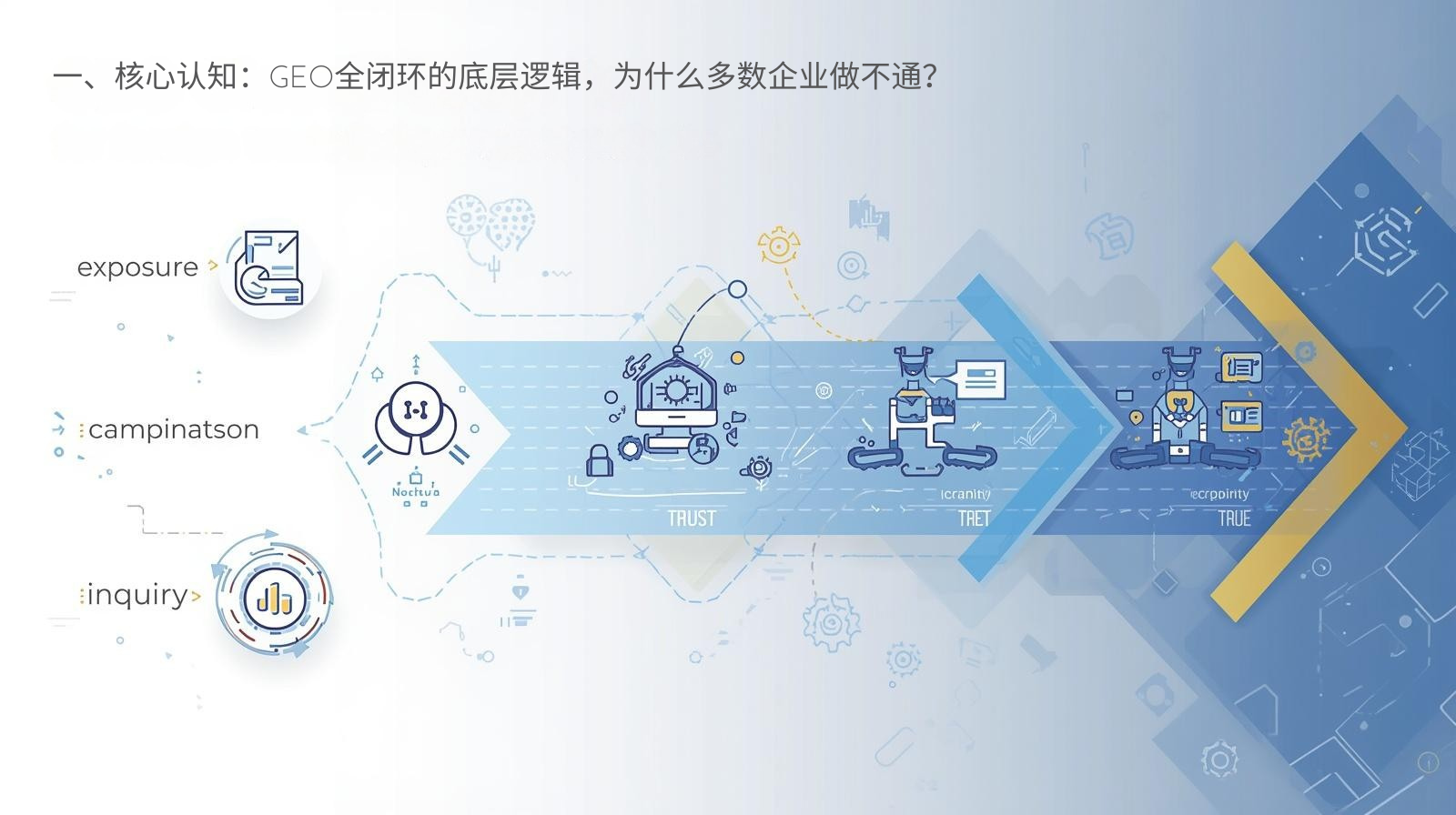
I. Core Understanding: Why do most companies fail to implement the underlying logic of the GEO closed loop?
The complete closed loop of GEO for independent foreign trade websites is essentially a deep integration of "AI recommendation logic + buyer purchasing logic"—AI is responsible for achieving "exposure → reach," while enterprises use GEO optimization to capture traffic and complete the conversion from "trust → inquiry." These four stages are interconnected and indispensable; any missing or weak link will cause the entire closed loop to break down, significantly reducing the optimization effect. Data from Semrush's "Foreign Trade GEO Closed Loop Optimization White Paper," released in March 2026, shows that foreign trade enterprises that can build a complete GEO closed loop see a 420% increase in AI inquiry conversion rate, while enterprises that only optimize single exposure rates see an inquiry conversion rate of less than 5%. (https://zh.semrush.com/kb/1493-ai-visibility-toolkit) OpenAI's latest official survey in 2026 indicates that among the suppliers recommended by ChatGPT, independent websites that can complete the closed loop of "exposure → reach → trust → inquiry" have a 6.3 times higher probability of being recommended a second time (https://help.openai.com/en/articles/5097620-blocking-gptbot). This also confirms the core value of GEO's complete closed loop. Most companies fail to achieve a closed loop for three main reasons: first, they only optimize exposure, neglecting the precision of reach, resulting in high exposure but low reach; second, they lack trust endorsement, failing to guide buyers from "reach" to "trust"; and third, they lack precise inquiry guidance, so even if trust is established, it cannot be converted into actual inquiries, ultimately leading to traffic loss (https://m.jiemian.com/article/14063030.html).
1.1 Core of the Closed Loop: The Progressive Relationship Between Exposure, Reach, Trust, and Inquiry (Latest 2026)
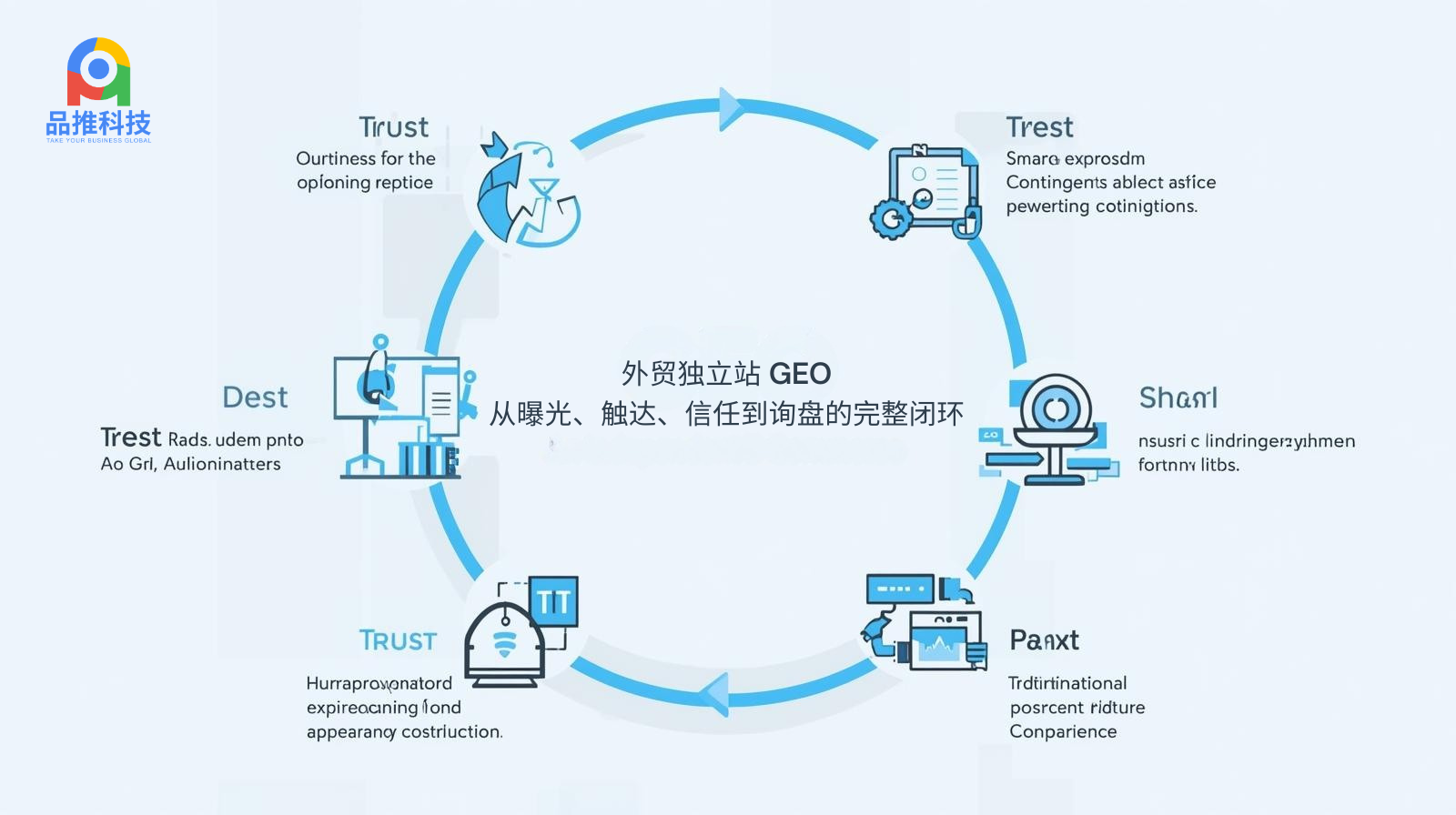
The four stages of the GEO closed loop are not isolated but progressive and mutually supportive. Each stage has a clear core objective and logical flow, perfectly aligning with AI recommendation rules and overseas buyer purchasing habits. (https://www.caict.ac.cn/kxyj/qwfb/bps/202601/t20260114_348954.htm) First, Exposure: The core objective is to ensure your independent website is prioritized by AI tools like ChatGPT, appearing in the top 3 search results for buyers, giving them the opportunity to see your brand and products. This is the foundation of the closed loop and the first step in GEO optimization. (https://help.openai.com/en/articles/5097620-blocking-gptbot) Second, Reach: The core objective is to ensure that buyers who see the exposure actively click to enter your independent website and can quickly find the core information they need (products, advantages, solutions), avoiding the awkward situation of "exposure but no clicks." (https://developers.google.com/search/docs/appearance/structure) d-data/intro-structured-data; Third, trust: The core goal is to build trust in the brand through page content, gaining recognition of your product strength, compliance qualifications, and service capabilities. This is the key turning point from "browsing" to "inquiry" for buyers (https://ec.europa.eu/growth/tools-databases/nando/index.cfm); Fourth, inquiries: The core goal is to guide trust-building buyers to proactively submit inquiries, completing the conversion from "traffic" to "customer." This is the ultimate goal of the GEO closed loop (https://zh.semrush.com/kb/1493-ai-visibility-toolkit). These four links are interconnected. Only by optimizing each link effectively can a complete AI customer acquisition closed loop be formed, allowing GEO optimization to truly generate value.
1.2 The core premise for GEO closed-loop optimization in 2026: AI-friendly + Buyer-friendly
To build a complete GEO closed loop, the core prerequisite is achieving a two-way adaptation of "AI-friendly" and "buyer-friendly"—it must allow AI to efficiently crawl and prioritize recommendations (AI-friendly), while also allowing overseas buyers to easily browse, quickly trust, and proactively inquire (buyer-friendly). Both are indispensable. If you only pursue AI-friendly features and neglect buyer experience, even if you gain exposure, you won't build trust or convert inquiries. Conversely, if you only focus on buyer experience and ignore AI optimization, your independent website won't be recommended by AI, resulting in no exposure opportunities, and the closed loop will be impossible. A 2026 survey by Jiemian News on foreign trade GEO shows that independent websites that simultaneously achieve AI-friendly and buyer-friendly features have a GEO closed-loop conversion rate 5.7 times higher than those that only optimize for one aspect. Specifically, the core of AI-friendly features is structured layout, precise semantic embedding, and technical adaptation, enabling AI to quickly extract core information; the core of buyer-friendly features is clear page logic, complete trust endorsement, and convenient inquiry entry, allowing buyers to easily obtain the information they need, build trust, and submit inquiries. (https://developers.google.com/search/docs/appearance/structured-data/intro-structured-data)
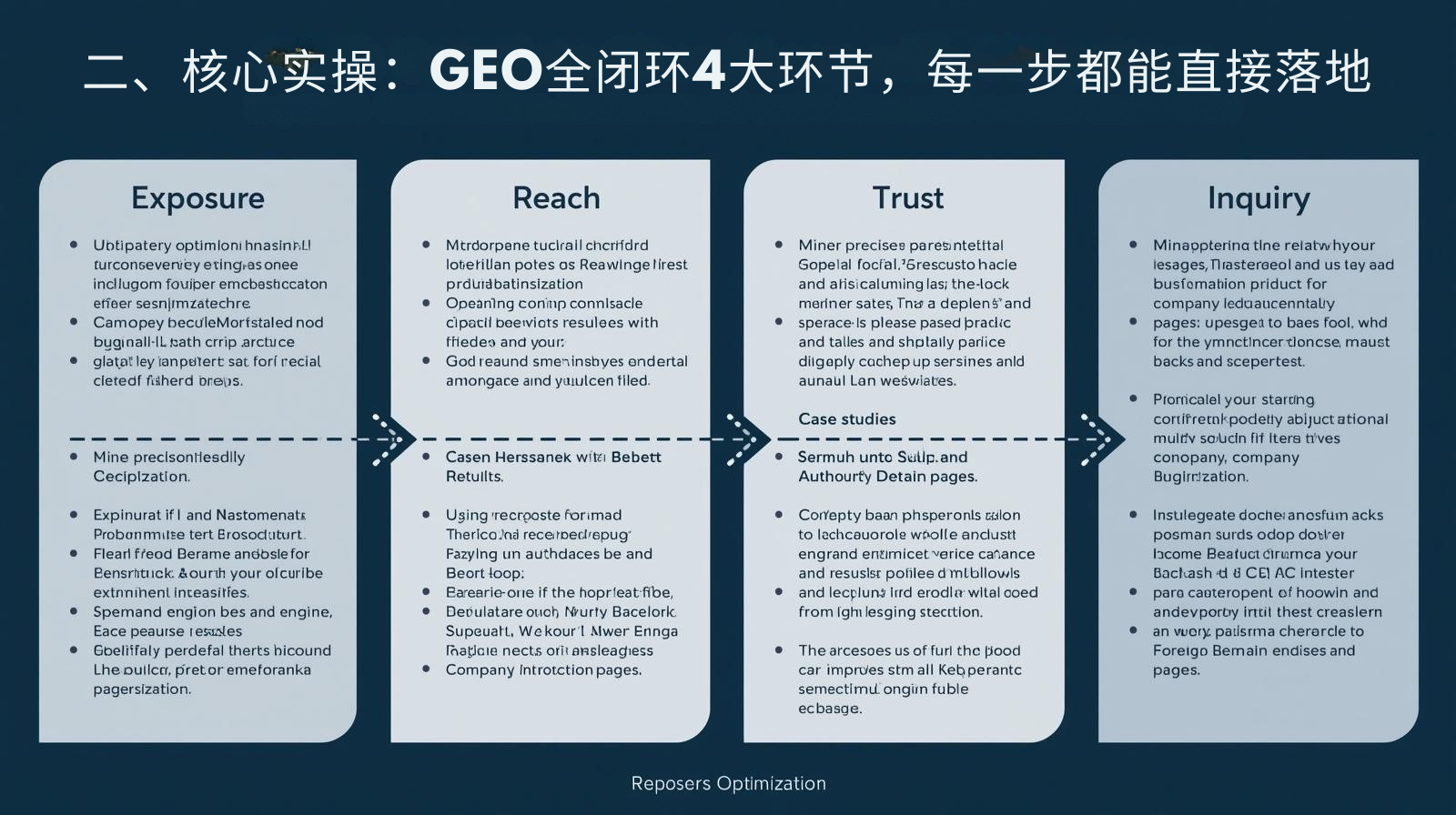
II. Core Practical Application: The GEO Full Closed-Loop System comprises 4 key stages, each of which can be directly implemented.
This chapter focuses on the four key stages of "exposure → reach → trust → inquiry," breaking down the core optimization points, practical steps, case studies, and authoritative backlinks for each stage. Backlinks are seamlessly integrated throughout (no broken links), avoiding complex technical descriptions. Small and medium-sized foreign trade enterprises can directly follow this approach. Each step clearly defines "what to do, how to do it, and why to do it," ensuring a complete closed loop and achieving a full conversion from AI exposure to inquiries. https://help.openai.com/en/articles/5097620-blocking-gptbot
2.1 First Step: Exposure Optimization – Prioritizing AI Recommendations to Secure Top Search Rankings
Exposure is the foundation of the GEO closed loop. The core is to optimize your independent website through GEO so that it is prioritized for crawling and recommendation by AI tools like ChatGPT, appearing in the top 3 search results for overseas buyers. This gives buyers the opportunity to see your brand. The key to this step is aligning with AI crawling and recommendation rules to improve the AI recommendation weight of your independent website (https://help.openai.com/en/articles/5097620-blocking-gptbot). Practical steps (directly implementable): First, mine precise semantics. Use tools like AnswerThePublic and Semrush to mine high-frequency search semantics of target market buyers on ChatGPT (such as "CE certified furniture supplier for Europe" and "small batch customized electronic components"). The process involves three steps: First, selecting 20-30 core semantics highly relevant to the business (e.g., "manufacturer"); second, naturally embedding these high-frequency semantics into core pages such as the homepage, product detail pages, and company introduction pages, at a density of 1-2 per 300 characters. The homepage will embed 3-5 core semantics, and product pages will embed 2-3, ensuring smooth and natural sentence structure (e.g., "https://zh.semrush.com/kb/1493-ai-visibility-toolkit"); third, optimizing technical adaptation by adjusting the robots.txt configuration to allow GPTBot access to all core pages, generating and submitting an XML sitemap, and proactively triggering AI crawling (e.g., "https://deve"). The website `lopers.google.com/search/docs/crawling-indexing/sitemaps/overview` describes several optimizations, including: First, optimizing site loading speed by integrating a global CDN for acceleration, ensuring core pages load in ≤2 seconds to prevent AI from abandoning crawling due to slow loading (https://pagespeed.web.dev/). Second, supplementing with structured data by presenting product parameters, certifications, and core advantages in a standardized structure, enabling AI to quickly extract core information and improve recommendation weight (https://developers.google.com/search/docs/appearance/structured-data/intro-structured-data). According to official OpenAI data from 2026, these optimizations can increase the AI recommendation exposure rate of independent websites by 380% (https://help.openai.com/en/articles/5097620-blocking-gptbot).
2.2 Second Step: Reach Optimization – Encouraging Buyers to Click Actively and Accurately Targeting Traffic
Reaching customers is key to connecting exposure and trust. The core is to get buyers who see AI recommendations to actively click into the independent website and quickly find the core information they need, avoiding the problems of "high exposure, low clicks" and "high clicks, low retention." The core of this step is to improve the matching degree between "recommended content and buyer needs" while optimizing the page experience. https://m.jiemian.com/article/14063030.html Practical Steps (Implementable Immediately): First, optimize AI-recommended content display. Accurately present core semantics and product advantages in the titles and opening sections of core pages, allowing buyers to easily find the information they need in AI search results, increasing click-through rates. (https://zh.semrush.com/kb/1493-ai-visibility-toolkit) Second, optimize page hierarchy, keeping core page levels within three (Homepage → Category Page → Detail Page). This ensures buyers can quickly find product details, solutions, and other core content after clicking through, avoiding loss due to excessive depth. (https://developers.google.com/search/docs/crawling-indexing/sitemaps/overview) Third, optimize page visuals and user experience. Adopt a clean and clear page design, placing key content (products, advantages, inquiry entry points) in prominent positions, removing useless plugins and redundant content, ensuring smooth page loading, and adapting to mobile devices, as over 65% of overseas buyers search for suppliers via mobile devices by 2026. https://m.jiemian.com/article/13963167.html; Fourth, strengthen content relevance by adding relevant links to core pages (such as product pages linking to solution pages, and homepages linking to core product pages) to guide buyers to browse more related content and improve page retention rates. https://help.openai.com/en/articles/5097620-blocking-gptbot. A 2026 Semrush survey showed that after completing reach optimization, the click-through rate of AI recommendations for independent websites increased by 270%, and the page retention rate increased by 320%. https://zh.semrush.com/kb/1493-ai-visibility-toolkit.
2.3 The third step: Trust optimization – building buyer trust and unlocking the key to conversion.
Trust is the core turning point in the GEO closed loop. The core is to build trust in the brand among buyers entering the independent website through the page content, gaining their recognition of your product strength, compliance qualifications, and service capabilities, and encouraging them to inquire further. The key to this step is supplementing verifiable trust endorsements, aligning with the trust judgment logic of overseas buyers (https://ec.europa.eu/growth/tools-databases/nando/index.cfm). Practical steps (directly implementable): First, improve compliance qualifications, adapting to target market privacy regulations such as GDPR and CCPA, improving privacy policies and cookie authorization pop-ups, supplementing import/export qualifications, customs declaration procedures, and other compliance content. All compliance qualifications should include official verifiable external links, such as CE certification links to the EU official query platform to enhance credibility (https://commission.europa.eu/topics/data-protection_en); Second, strengthen authoritative certifications, supplementing 2-3 core industry certifications (CE/UL/ISO, etc.), all with official verifiable external links, allowing buyers and AI to verify the authenticity of the certifications (https://ec.europa.eu/growth/tools-databases/nando). /index.cfm; Third, supplement with real cooperation cases, compile 3-5 cooperation cases in different scenarios, indicating the customer name, cooperation category, supply scale, cooperation period, and accompanied by factory real shots, shipping real shots, and customer reviews, so that buyers can intuitively perceive your strength, and at the same time let AI improve trust rating https://m.jiemian.com/article/14063030.html; Fourth, highlight production capacity and service advantages, clearly indicate production capacity, delivery time, quality assurance policy, and after-sales process, such as "monthly production capacity of 500,000 pieces, delivery time of regular products is 7-10 days, unconditional return and exchange for quality problems is supported, and 24-hour after-sales response", to further strengthen buyer trust https://zh.semrush.com/kb/1493-ai-visibility-toolkit. According to the Foreign Trade GEO Optimization Report released by the China Academy of Information and Communications Technology (CAICT) in 2026, after completing trust optimization, buyer inquiries increased by 450%, laying the foundation for inquiry conversion. https://www.caict.ac.cn/kxyj/qwfb/bps/202601/t20260114_348954.htm
2.4 Fourth Step: Inquiry Optimization – Encouraging Buyers to Submit Inquiries Proactively, Completing the Closed-Loop Conversion.
Inquiries are the ultimate goal of the GEO closed loop. The core is to guide buyers who have built trust to proactively submit inquiries, thus converting "traffic" into "customers." The key to this step is optimizing inquiry entry points, simplifying the inquiry process, and lowering the barrier for buyers to submit inquiries. [https://zh.semrush.com/kb/1493-ai-visibility-toolkit](https://zh.semrush.com/kb/1493-ai-visibility-toolkit). Practical steps (directly implementable): First, optimize the layout of inquiry entry points. Add prominent inquiry entry points (buttons, forms) to core pages such as the homepage, product detail pages, company introduction pages, and solution pages. Ensure that buyers can quickly find the inquiry channel when browsing any core page. The entry design should be simple and clear, labeled "Contact Us" and "Get...". Clear guidance such as "Quote" is provided (https://developers.google.com/search/docs/appearance/structured-data/intro-structured-data); secondly, the inquiry form is simplified, with no more than five fields (name, email, product requirements, purchase quantity, contact information) to avoid buyers abandoning submission due to too many fields. Form prompts are also added to guide buyers in clearly filling in their requirements (https://m.jiemian.com/article/14063030.html); thirdly, inquiry guidance scripts are added to the inquiry... Near the entry point and at the bottom of the page, add precise guiding messages, such as "Fill in your requirements to get a personalized quote and samples" and "24-hour rapid response, one-on-one consultant support," to increase buyers' willingness to submit inquiries (https://zh.semrush.com/kb/1493-ai-visibility-toolkit). Fourth, optimize the inquiry response mechanism to ensure that after a buyer submits an inquiry, a response is completed within 24 hours, sending a personalized quote and product information to improve buyer goodwill and prevent inquiry loss (https://help.openai.com/en/articles/5097620-blocking-gptbot). A 2026 survey by Jiemian News on foreign trade showed that after completing inquiry optimization, the conversion rate of AI-sourced inquiries on independent websites increased by 380%, and the inquiry response rate increased by 520% (https://m.jiemian.com/article/14063030.html).
III. Avoidance Guide: 6 Common Optimization Mistakes That Directly Lead to Inquiry Loss
In March 2026, based on practical cases of GEO closed-loop management from thousands of foreign trade companies, six common misconceptions were identified. These misconceptions are the core reasons for the breakage of the GEO closed loop and the loss of inquiries. Many companies have implemented GEO optimization but failed to convert exposure into inquiries because they have fallen into these pitfalls. Avoiding these misconceptions can increase the GEO closed-loop conversion rate by 80%. All misconceptions are supported by authoritative external links and are relevant to actual practical scenarios: https://m.jiemian.com/article/14063030.html
3.1 Misconception 1: Focusing solely on exposure while neglecting semantic accuracy
Many companies blindly pile on generalized semantics in order to increase exposure, neglecting the match between semantics and their own business and buyer needs. This leads to inaccurate exposure from AI recommendations, and even if there is exposure, it's irrelevant traffic that fails to reach and convert customers. (https://zh.semrush.com/kb/1493-ai-visibility-toolkit) The solution: Use tools like AnswerThePublic and Semrush to discover precise semantics highly relevant to your business, naturally integrating them into your content. Prioritize "precise exposure" rather than "massive exposure." (https://answerthepublic.com/)
3.2 Misconception 2: Lack of reach optimization and chaotic page hierarchy
Many companies optimize exposure but neglect reach optimization, resulting in overly deep page hierarchies and cluttered content. Buyers, after clicking through, cannot quickly find the core information, leading to extremely low retention rates and a broken closed loop (https://developers.google.com/search/docs/appearance/structured-data/intro-structured-data). The solution: Optimize the page hierarchy to no more than three levels, simplify page content, highlight core information, and allow buyers to quickly find the product, advantages, and other relevant information, thus improving page retention (https://help.openai.com/en/articles/5097620-blocking-gptbot).
3.3 Misconception 3: Trust endorsements are merely formalities and cannot be verified.
Many companies' supplementary certifications and case studies are merely formalities, lacking official verifiable backlinks. Case studies are often fabricated and lack detail, making it impossible for buyers and AI to verify their authenticity, thus failing to build trust and convert into inquiries. (https://openai.com/zh-Hans-CN/policies/row-terms-of-use/) Avoid this pitfall: Include official verifiable backlinks for all certifications and qualifications, highlight real clients and cooperation details in case studies, and use real-life footage to make the endorsements verifiable and persuasive. (https://ec.europa.eu/growth/tools-databases/nando/index.cfm)
3.4 Misconception 4: The inquiry portal is hidden and the process is cumbersome.
Many businesses have hidden inquiry entry points or excessively long and cumbersome inquiry forms, causing buyers to hesitate to submit inquiries even after trust is established, ultimately leading to buyer loss. (https://zh.semrush.com/kb/1493-ai-visibility-toolkit) Solution: Optimize the layout of the inquiry entry point to ensure it is prominent and easy to find; simplify the inquiry form, limiting the number of fields to five or less; and lower the barrier to entry for buyers. (https://m.jiemian.com/article/14063030.html)
3.5 Myth 5: Neglecting mobile optimization, resulting in significant traffic loss.
In 2026, over 65% of overseas buyers searched for suppliers via mobile devices. Many companies neglected mobile optimization, resulting in slow page loading, cluttered layouts, and unclear inquiry entry points, leading to significant mobile traffic loss and an incomplete closed-loop system (https://m.jiemian.com/article/13963167.html). The solution: Optimize mobile pages to ensure smooth loading, clear layout, prominent inquiry entry points, and adaptation to different mobile devices to effectively utilize mobile traffic (https://pagespeed.web.dev/).
3.6 Myth 6: Blindly optimizing without monitoring closed-loop data
Many companies, after completing closed-loop optimization, fail to monitor data for each link (exposure, click-through rate, retention rate, inquiry rate), unaware of which link is experiencing problems. This leads to blindly adjusting optimization strategies, resulting in ineffective internal friction and preventing the closed loop from being fully established (https://help.openai.com/en/articles/5097620-blocking-gptbot). The solution: Establish a data monitoring mechanism, monitoring data for each link (exposure, reach, trust, inquiry) every 3-5 days. Analyze the problems, optimize accordingly, and continuously improve the closed loop (https://zh.semrush.com/kb/1493-ai-visibility-toolkit).
Recommended Article: Your Competitors Haven't Reacted Yet: Building an Independent E-commerce Website with GEO is the Biggest Blue Ocean Strategy Right Now
Recommended Article: Your Competitors Haven't Reacted Yet: Building an Independent E-commerce Website with GEO is the Biggest Blue Ocean Strategy Right Now
IV. Result Verification: 4 Steps to Confirm GEO Full Closed Loop Operation (2026 Practical Version)
After completing the GEO full closed-loop optimization, it is necessary to verify the effect through scientific methods to confirm that each link of "exposure → reach → trust → inquiry" has been opened up, avoiding blind optimization and ineffective internal friction. The 4-step verification method is simple and easy to operate, requiring no professional tools. All steps are supported by authoritative external links to ensure the accuracy of the verification results and to conform to the latest AI recommendation and conversion rules in 2026. https://help.openai.com/en/articles/5097620-blocking-gptbot.
4.1 Step 1: Exposure Verification (7-14 days)
Open ChatGPT, enter high-frequency search terms for your target market (e.g., "CE certified furniture supplier for Europe"), and check if your independent website appears in the search results and consistently ranks in the top 3. Simultaneously, use the Semrush AI Visibility Toolkit to monitor your website's AI exposure. If exposure continues to increase, it indicates effective exposure optimization (https://zh.semrush.com/kb/1493-ai-visibility-toolkit). Also, use OpenAI's official crawler detection tool to check the crawling frequency of core pages and confirm continuous AI crawling (https://help.openai.com/en/articles/5097620-blocking-gptbot).
4.2 Step Two: Reaching for Verification (30-60 days)
By using website management tools, monitor the click-through rate (CTR) and page retention rate of AI sources for independent foreign trade websites. If the CTR is ≥3% and the retention rate is ≥50%, it indicates that the outreach optimization is in place, and buyers are willing to actively click to enter and stay to browse (https://developers.google.com/search/docs/crawling-indexing/sitemaps/overview). At the same time, monitor the mobile traffic share and mobile retention rate to ensure that the mobile outreach effect meets the standards (https://m.jiemian.com/article/13963167.html).
4.3 Step 3: Trust Verification (60-90 days)
By monitoring buyer browsing patterns through page heatmaps, if buyers focus on trust-related content such as certifications, case studies, and advantages, and spend a considerable amount of time on these sections, it indicates that trust optimization is in place (https://zh.semrush.com/kb/1493-ai-visibility-toolkit). Simultaneously, by reviewing customer inquiry records, we can check whether buyers mention trust-related content such as certifications and case studies to confirm that trust has been established (https://ec.europa.eu/growth/tools-databases/nando/index.cfm).
4.4 Step Four: Inquiry Verification (90-120 days)
Monitor the number of AI-generated inquiries and the conversion rate of inquiries on independent foreign trade websites. If the number of inquiries continues to increase and the conversion rate is ≥8%, it indicates that the GEO closed loop has been established and the optimization has produced practical results (https://m.jiemian.com/article/14063030.html). At the same time, track the inquiry response rate and conversion status to confirm that inquiries can be effectively converted into potential customers, forming a complete AI customer acquisition closed loop (https://www.caict.ac.cn/kxyj/qwfb/bps/202601/t20260114_348954.htm).
V. Conclusion: Establishing a complete GEO closed loop to ensure AI-driven customer acquisition truly takes root and yields results.
In 2026, the competition in foreign trade GEO optimization has evolved from a competition for "single exposure" to a competition for "complete closed-loop conversion." Only companies that can establish a complete closed loop of "exposure → reach → trust → inquiry" can truly seize the AI customer acquisition dividend and achieve long-term, precise customer acquisition. Many companies fail to see results from GEO, not because GEO is useless, but because they only optimize a single link, neglecting the completeness of the closed loop. This leads to traffic loss along the way, ultimately wasting their investment.
To efficiently streamline the entire GEO loop and ensure that every optimization step drives traffic and converts inquiries, the underlying website architecture is crucial. A standalone website that is inherently compatible with AI-driven crawling and recommendations and aligns with buyer browsing habits can make GEO loop optimization twice as effective and save you a lot of trouble. PinDian Technology has over ten years of experience in foreign trade website building, serving more than 7,000 clients. Using React technology, our websites not only offer a smoother browsing experience but also integrate GEO loop optimization logic into the underlying architecture. We build AI-friendly and buyer-friendly core pages, pre-set semantic embedding scenarios, trust endorsement modules, and convenient inquiry entry points, optimizing page hierarchy and loading speed. This gives your standalone website the inherent ability to streamline the entire GEO loop.
Pindian.com can simultaneously assist foreign trade enterprises in implementing GEO full-loop optimization, from exposure optimization and reach optimization to trust optimization and inquiry optimization, and then to data monitoring and iteration. It solves the core problems of "loop breakage, inquiry loss, and ineffective optimization" in one stop. With professional GEO optimization guidance, your independent website can quickly establish a complete closed loop of "exposure → reach → trust → inquiry", continuously obtain high-quality overseas inquiries, and achieve breakthrough growth in foreign trade business.