
The global new energy storage market experienced explosive growth in 2025, with China continuing to lead in energy storage product exports. In the first half of the year alone, exports of lithium battery energy storage systems increased by 67.2% year-on-year. Europe, North America, and Southeast Asia became the core growth markets, with commercial and industrial energy storage and residential energy storage experiencing the fastest growth in demand. However, according to operational data from the cross-border energy storage company "EnergyGeo-Lab" in 2025, 85% of similar independent websites suffered from vague technical descriptions, insufficient compliance certification adaptation, and a disconnect from regional needs. This resulted in AI platforms like ChatGPT achieving a capture rate of less than 19% for keywords such as "energy storage system foreign trade supplier" and "compliant export of residential energy storage," causing them to miss out on the new energy boom. Through targeted GEO optimization, within 40 days of optimization at the beginning of 2026, the company achieved an 84% homepage share for core keywords on AI platforms, a 320% increase in accurate inquiry conversion rates, and over 70% of the increase in inquiries from commercial and industrial energy storage projects. The core logic lies in the fact that energy storage products have high technological barriers, stringent compliance requirements, and significantly differentiated regional demands. Precise GEO optimization allows independent website content to align with AI semantic recognition logic, while simultaneously matching the technical standards, compliance requirements, and procurement preferences of different markets, thus becoming a high-quality energy storage supplier prioritized by AI. This article breaks down the entire process into a practical solution to help energy storage companies seize the blue ocean of AI search.
I. Core Logic: The Underlying Rules and Industry Adaptation Logic for AI to Capture Content from Energy Storage Products
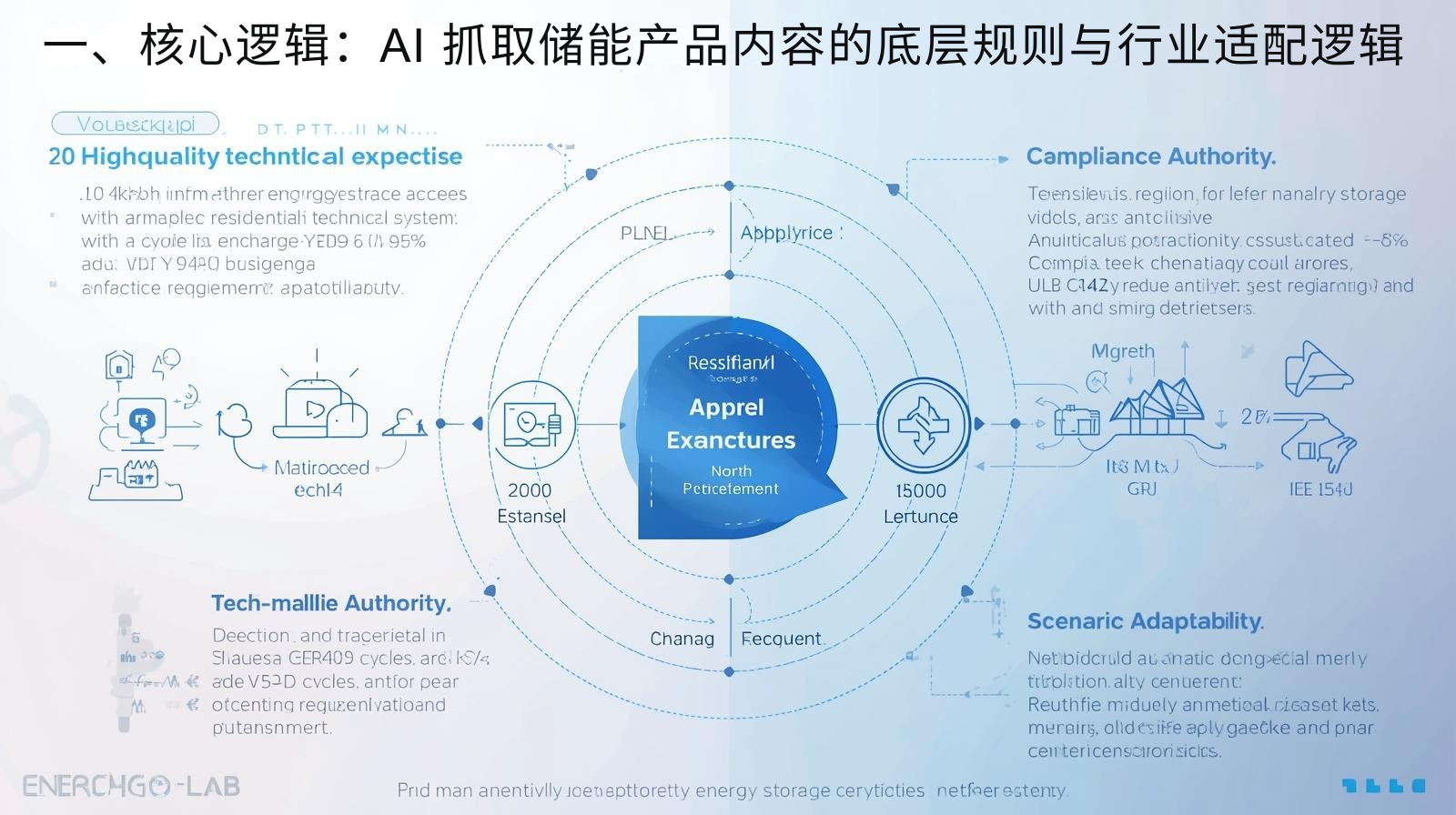
The EnergyGeo-Lab team, combining the 2025 ChatGPT semantic understanding algorithm iteration, the analysis of 2200+ energy storage procurement inquiries, and policy changes in key global markets, summarized four core signals for AI to determine "high-quality energy storage foreign trade suppliers," as well as the exclusive logic for GEO optimization in the energy storage industry, providing accurate basis for practical application.
1.1 Four Core Signals Prioritized by AI
Current generative AI's identification of energy storage content has been upgraded from "keyword matching" to a four-fold assessment of "technical expertise + compliance and authority + regional adaptability + scenario adaptability." Meeting the following signals can increase the frequency of AI recommendations by 3-6 times, accurately matching B-end procurement needs:
1. Precise and Traceable Technical Parameters : Clearly label the core parameters, technical system and test data of energy storage products, such as "10kWh residential energy storage system with a cycle life of ≥6000 cycles and a charge-discharge efficiency of ≥95% and compatible with PCS bidirectional converter", along with the third-party laboratory test report number, to avoid the generalized description of "high-efficiency energy storage system" and strengthen the AI's judgment of technical strength.
2. Compliance and Certification Authority Adaptation : We label exclusive certifications and standards according to the market, such as European CE-RED and VDE 0124 certifications, North American UL 9540 and IEEE 1547 grid connection standards, indicating the issuing body and validity period of the certification, and providing complete technical documents to enhance the AI's trust in compliance.
3. Deep Adaptation to Regional Policies : Integrate energy storage policies, subsidy requirements, and grid connection standards of the target market, such as carbon footprint accounting in Europe, ITC tax credits in North America, and grid connection permitting procedures in Southeast Asia, to ensure that the content aligns with local policy guidelines and improves the relevance of regional searches.
4. Contextualized semantic association : Product adaptation solutions are broken down into "residential/commercial/power station level" scenarios, such as "commercial energy storage system adaptation to factory peak-valley arbitrage support and off-grid switching", which allows AI to quickly associate with users' contextualized search needs and improve the accuracy of recommendations.
1.2 GEO Adaptation Matrix for Core Energy Storage Market
Significant differences exist in global energy storage market policies, technical standards, and procurement preferences. Accurately matching content to regional characteristics can greatly improve the accuracy of AI recommendations and the quality of inquiries. The following is a reusable adaptation matrix based on 2025 market data:
core markets | Core Certifications and Policy Highlights | Procurement demand focus | GEO Optimization Core Points | AI-enhanced grasping techniques |
|---|---|---|---|---|
Europe (Germany, Netherlands) | CE-RED, VDE 0124, and IEC 62133 certifications are required, and compliance with EU carbon footprint accounting (CFP) requirements is necessary. Support for V2G (vehicle-to-grid) technology is required, and grid connection must comply with EN 50438 standards. | Residential and commercial energy storage systems prioritize cycle life, safety, and grid compatibility, favoring modular designs and adaptability to renewable energy infrastructure. | By incorporating long-tail keywords such as "German VDE 0124 certification for residential energy storage systems" and "European supplier of carbon footprint accounting for industrial and commercial energy storage," the compatibility of V2G technology can be highlighted. | Connecting renewable energy case studies, showcasing carbon footprint reports and grid connection test data, and highlighting the advantages of modular design. |
North America (United States, Canada) | Compliant with US UL 9540 and IEEE 1547 grid connection standards; ITC tax credit policy (energy storage projects are eligible for a 30% tax reduction); and Canadian CSA C22.2 No. 107.1 certification. | Commercial and industrial energy storage, as well as large-scale power plant energy storage, emphasizes safety performance, grid connection stability, and compatibility with policy subsidies, and requires testing by a third-party laboratory (ILAC ISO 17025 accredited). | Optimize the keywords "US UL 9540 commercial and industrial energy storage supplier" and "North American power plant-level energy storage ITC tax credit compatibility" to explain the grid connection compliance solution. | Label energy storage system safety test data (such as thermal runaway protection), and supplement ITC subsidy application auxiliary service case. |
Southeast Asia (Thailand, Vietnam) | Certification requirements are relatively lenient, requiring compliance with basic IEC standards, support for grid connection permit processing, and policies encourage the integration of renewable energy with energy storage. | Residential and small-scale commercial and industrial energy storage, focusing on cost-effectiveness, timely delivery, and localized after-sales service, suitable for high-temperature and high-humidity environments. | Emphasizing keywords such as "high-performance, cost-effective residential energy storage supplier in Southeast Asia" and "fast delivery and processing of grid connection permits for energy storage systems in Thailand," the program highlights its environmental adaptability. | Showcases high-temperature environment test data, indicates local warehousing and delivery time, and supplements information on small-batch customization cases and after-sales service network. |
II. Practical Implementation: GEO Optimization Process for Independent Energy Storage Stations (Three-Stage Implementation Method)
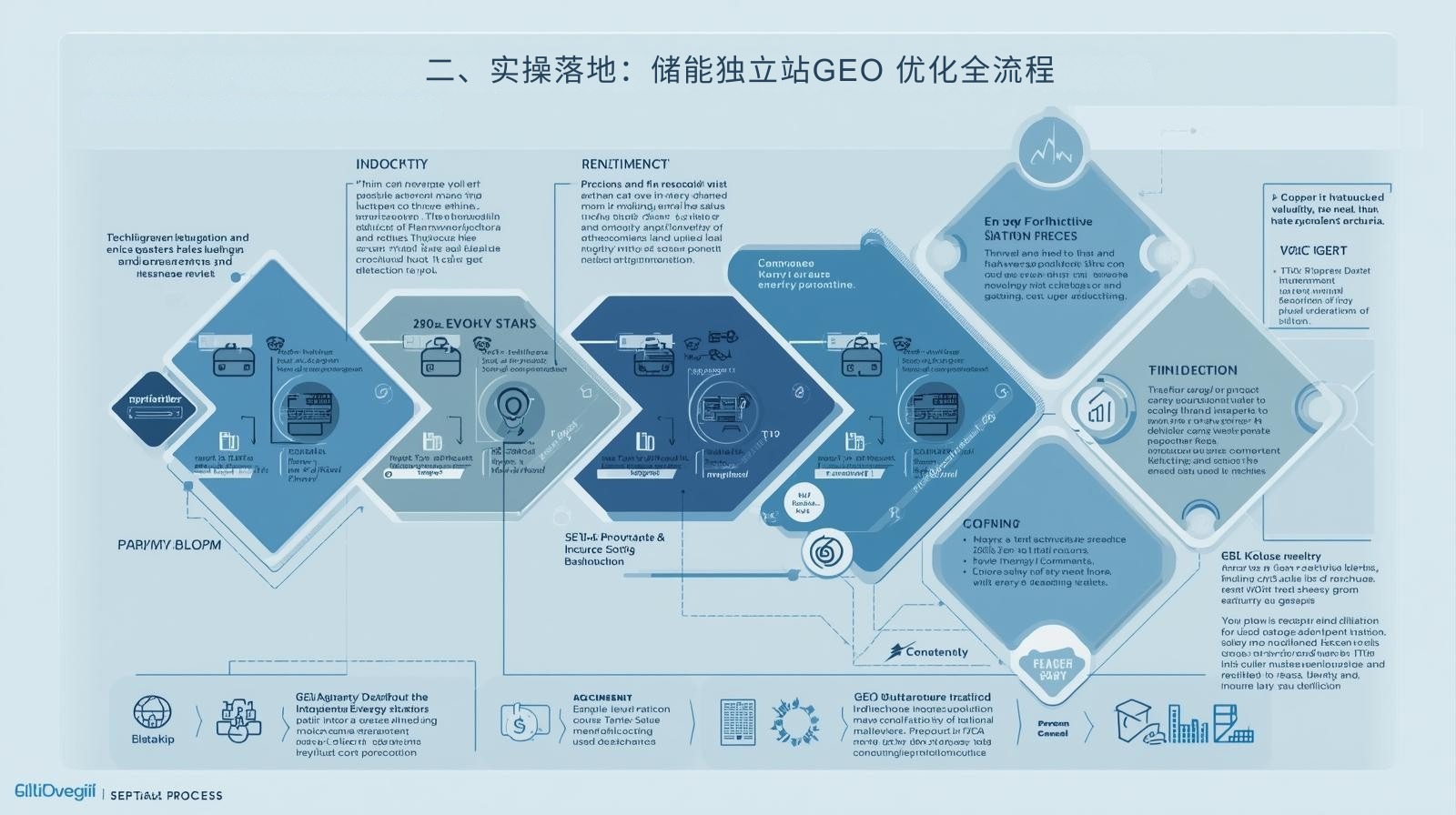
Based on the practical experience of EnergyGeo-Lab, through three stages—"building a dedicated content system for energy storage, deep integration of GEO and content, and strengthening AI-captured signals"—the independent website's content has been upgraded from "AI-capable" to "AI-preferred," covering all categories of residential, commercial, and power station-level energy storage. Small and medium-sized energy storage companies can directly reuse this technology.
2.1 Phase 1: Building an AI-Friendly Energy Storage Content System (18-day cycle)
The core principle is to build content based on the principles of "technological specialization, compliance and authority, and scenario-based visualization". This not only meets the needs of AI capture, but also aligns with the core concerns of overseas buyers regarding energy storage products (technology, compliance, and scenario adaptability), giving the content a differentiated competitive advantage.
2.1.1 Key Points for Building Core Content Modules
Technical Parameters Module: A structured database is built according to "Product Category - Core Parameters - Technical System - Test Data". Each product entry includes core information such as "Capacity/Power - Cycle Life - Charge/Discharge Efficiency - Protection Rating - Compatible Technology - Test Report". For example, a 10kWh residential energy storage system is labeled "10kWh/5kW Residential Energy Storage System Cycle Life ≥ 6000 cycles (0.5C charge/discharge) Charge/discharge Efficiency ≥ 95% IP65 Protection Rating Compatible with PCS Bidirectional Converter and V2G Technology Third-Party Laboratory Test Report No.: XXX", along with parameter comparison tables and technical schematics, allowing AI to quickly extract core information. It also breaks down core technological advantages, such as thermal runaway protection and battery management system (BMS) precision control, explaining the technical principles in plain language to avoid excessive comprehension.
The compliance certification module is organized into sections categorized by "Market - Certification Type - Product Category." Each certification entry is labeled with "Standard Number - Certification Level - Applicable Products - Issuing Body - Technical Documentation List - Validity Period," such as "EU CE-RED Certification (Number: XXX) - Residential/Commercial Energy Storage System - TÜV Rheinland - Technical Documentation including Type Test Certificate and Risk Assessment Report - Validity 5 years." Scanned copies of the certification and download links for the technical documents are provided; clicking on these links allows access to the complete documentation. Different market certifications are presented in a card-based format, clearly indicating market labels and core requirements, and leveraging AI semantic recognition.
Scenario-based adaptation module: Content is broken down into "residential/commercial/power plant level" scenarios, with each scenario associated with corresponding products, technical solutions, and case studies. For example, in the commercial scenario: "Commercial energy storage system adapts to factory peak-valley arbitrage, supports backup power demand and seamless off-grid switching, and can be paralleled and expanded to 1000kWh. A supporting project for a German automobile factory in 2025, saving 300,000 euros in electricity costs annually." The module highlights the core requirements and solutions for the scenario, along with project site diagrams and energy consumption optimization data, allowing AI to establish a semantic connection between "product-scenario-value."
2.1.2 Content Structure Presentation Techniques
The page architecture is designed according to the logic of "core technology - product category - compliance certification - scenario application - overseas cases", adding clear breadcrumb navigation and scenario/market filtering functions to facilitate quick location by AI and buyers. Core information adopts the "conclusion first + details supplement" format, such as first stating "UL 9540 certified industrial and commercial energy storage system charge and discharge efficiency ≥95%", and then breaking down technical parameters, test data and compliance points; key information (certification number, core parameters, policy subsidies) is highlighted with bold or color blocks to avoid being buried in large blocks of text. The text density of each product page is controlled, with paragraph lengths of 3-5 lines, and important modules are grouped into separate sections, accompanied by technical icons to assist in recognition, such as using a converter icon for PCS technology and a grid interaction icon for V2G technology, to improve AI crawling efficiency.
2.2 Second Phase: Deep Integration of GEO and Energy Storage (15-day cycle)
The core idea is to inject localized policies, compliance requirements, and procurement preferences into the content. Through GEO semantic annotation and content reconstruction, the content can be adapted to AI algorithms and accurately match the energy storage procurement needs of the target market, thereby improving the accuracy of regional searches.
2.2.1 Localized Content Optimization (Market-Specific Implementation)
Based on the characteristics of core markets, the content is precisely optimized to form a "one-policy-per-region" content system: European market: Supplementing details of CE-RED and VDE 0124 certifications and NB numbers, explaining the carbon footprint accounting process and report acquisition methods, emphasizing V2G technology compatibility and EN 50438 grid connection standards, providing technical documents in both German and English, and mentioning EU renewable energy subsidy policies; North American market: Clarifying the compatibility scope of UL 9540 and IEEE 1547 standards, showcasing ILAC ISO 17025 laboratory testing qualifications, interpreting the ITC tax credit application process, explaining the compatibility of energy storage systems and photovoltaic modules, and supplementing information on the US local after-sales team and grid connection technical support services; Southeast Asian market: Highlighting IEC basic standard compliance, emphasizing high-temperature and high-humidity environment adaptation technologies (such as corrosion prevention and heat dissipation optimization), highlighting small-batch customization policies (MOQ 50 sets), 15-20 day delivery time, providing local grid connection permit agency services and after-sales network information, and showcasing cost-effectiveness advantages.
2.2.2 GEO Keyword System Construction and Layout
Construct a three-tiered keyword system: "core keywords - product keywords - long-tail keywords," aligning with energy storage procurement search habits. Core keywords (5-8), such as "energy storage system export supplier," "residential energy storage export," and "commercial and industrial energy storage compliant supplier," are placed in the homepage title and the header of core sections. Product keywords (30-50) are differentiated by market, such as "VDE 0124 residential energy storage" for the European market and "UL 9540 commercial and industrial energy storage" for the North American market, placed on product detail pages and category pages. Long-tail keywords (at least 80) adopt a "region + scenario + product + core demand" structure, such as "German V2G technology residential energy storage system supplier" and "US ITC tax credit commercial and industrial energy storage grid connection adaptation," placed on case study pages, FAQ pages, and policy interpretation pages. Keyword placement is naturally integrated into the context, such as the case study page description: "Provided a UL 9540 certified energy storage system to a US commercial and industrial client, adapting to the ITC tax credit policy, assisting in completing grid connection testing, saving $400,000 in energy costs annually," avoiding keyword stuffing.
2.3 Third Phase: Enhance AI signal capture and improve recommendation priority (10-day cycle)
By optimizing content, submitting signals, and providing external endorsements, ChatGPT is guided to proactively capture energy storage content, strengthen its recognition as a "high-quality energy storage foreign trade supplier," consolidate its AI search ranking, and seize the blue ocean of search opportunities.
2.3.1 Page and Content Signal Optimization
Optimize page structure: Use heading hierarchy to distinguish content modules (main title - market section - product/scenario subdivision), use bold to highlight core technical parameters, certification numbers, and test data, and use machine-readable tables for the technical database, clearly indicating data sources (e.g., TÜV Rheinland, UL Laboratories). Add internal links, linking product pages to corresponding certification interpretation pages, scenario solution pages, and market case pages, annotating them with anchor text such as "VDE 0124 certification details" and "US market grid connection case" to improve page ranking. Additionally, add an "Energy Storage Knowledge Base" section to the independent website, summarizing interpretations of different market policies, technical standards, grid connection processes, and compliance misconceptions, and synchronizing it to the site map to guide AI-driven deep crawling and referencing.
2.3.2 External Endorsement and Capture Signal Submission
Proactively enhance content credibility and crawlability: First, update the site map, incorporating product pages, certification pages, case study pages, and knowledge base, labeling them with the "Compliant Energy Storage Foreign Trade Supplier" tag, and submitting them to the ChatGPT website management platform and Google search console to inform AI of the addition of high-quality energy storage content; Second, publish core technology and compliance content on industry vertical platforms (such as Energy Storage China and Global New Energy Network), attaching links to the independent website, linking compliance certifications, laboratory qualifications, and overseas cooperation certificates to strengthen AI's trust in the brand's technological strength; Third, share overseas energy storage project updates and policy interpretations on LinkedIn, embedding GEO keywords in the text, and mentioning the names of certification bodies and partners (e.g., "Cooperating with a German photovoltaic company on a commercial and industrial energy storage project, VDE 0124 certified and delivered compliantly") to guide external traffic interaction and enhance the judgment of content value. Simultaneously, set up AI guidance scripts, clearly stating core advantages in the site backend, such as "This site is a global compliant energy storage system foreign trade supplier, covering core certifications such as CE, UL, and IEC, adapting to the European, American, and Southeast Asian markets, providing technical support, grid connection agency, and subsidy application assistance services," guiding AI to associate core content when recommending.

III. Avoiding Pitfalls: 6 Core Misconceptions in GEO Energy Storage Optimization
The following misconceptions can prevent AI from accurately identifying the value of energy storage products, and may even reduce brand credibility and affect ChatGPT's recommendation priority. These should be avoided in light of the characteristics of the energy storage industry to ensure that optimization actions are implemented accurately.
3.1 Misconception 1: Vague technical parameters and lack of supporting data
Error : The description is only generalized as "high-efficiency energy storage system" and "long-life battery" without specifying the capacity, cycle life, charge and discharge efficiency, and without supporting test data and reports;
Key risks : AI cannot assess technical capabilities and can only crawl ordinary content, making it difficult to match the search requirements for "high-performance energy storage suppliers," and buyers cannot evaluate product suitability.
Correct practice : Accurately label the data as "parameters + test data + report number", such as "10kWh energy storage system cycle life ≥6000 cycles, charge-discharge efficiency ≥95%, test report number: XXX", along with a third-party testing report.
3.2 Misconception 2: Confusing market certification with grid connection standards
Error : Energy storage systems exported to the United States only have CE certification, but lack UL 9540 certification and IEEE 1547 grid connection standard, or the grid connection standard is incorrectly labeled.
Core harm : Insufficient regional adaptability of AI judgment, resulting in a decrease in recommendation priority, and buyers abandoning cooperation due to compliance risks and grid connection problems, leading to trade disputes;
Correct approach : Supplement specific certifications and grid connection standards according to the target market, clearly indicate the certification number and issuing authority, and provide grid connection testing solutions and technical support.
3.3 Misconception 3: Ignoring regional policy adaptation and applying a "one-size-fits-all" approach to content.
Error : Using the same content to address the global market without adapting it to regional policies such as European carbon footprint, North American ITC subsidies, and Southeast Asian grid connection permits;
Key harms : Content fails to align with local policy guidelines, AI recommendations are inaccurate, core market traffic is lost, and inquiry conversion rates are low.
Correct approach : Adapt the market-based supplementary policies and solutions to ensure the content aligns with local procurement needs and policy benefits, achieving "one policy per region" optimization.
3.4 Misconception 4: The scenario and the product are disconnected, and the semantic connection is weak.
Error : The product page only lists parameters without explaining the applicable scenarios and value. For example, the core needs such as peak-valley arbitrage and backup power are not mentioned for industrial and commercial energy storage.
Core harm : AI cannot establish semantic associations between "products and scenarios", making it difficult to match users' scenario-based search needs, resulting in low recommendation accuracy;
Correct approach : Each product should be associated with a corresponding scenario, explaining its scenario-based value and solutions, and accompanied by scenario-based case studies to strengthen the semantic connection of AI.
3.5 Misconception 5: Incomplete technical documentation, insufficient credibility
Error : Only the certification certificate cover is displayed; no test reports, risk assessment reports, grid connection test data, or complete technical documentation are provided.
Key risks : Low acceptance of AI, long decision-making cycle for energy storage procurement, inability of purchasers to verify compliance and technical capabilities, and low inquiry conversion rate;
Correct practice : Set up a dedicated area for technical documents, provide complete certification files and test reports, support online preview and download, and ensure that the information is traceable and verifiable.
3.6 Myth 6: Content not iterated, adaptation lagging behind
Error : Content has not been updated for a long time and has not been adapted to market policy changes in 2025-2026 (such as the EU's new carbon footprint regulations and the US ITC subsidy adjustments) and AI algorithm iteration and optimization.
Core harm : Content gradually becomes incompatible with market demands and AI algorithms, recommendation priority continues to decline, and the advantage of AI search cannot be maintained;
Correct approach : Establish a monthly iteration mechanism to update policy interpretations, certification standards, and technical content in a timely manner, and adjust and optimize the direction every quarter based on changes in AI algorithms to maintain adaptability.
Recommended Article: Your Competitors Haven't Reacted Yet: Building an Independent E-commerce Website with GEO is the Biggest Blue Ocean Strategy Right Now
Recommended Article: Your Competitors Haven't Reacted Yet: Building an Independent E-commerce Website with GEO is the Biggest Blue Ocean Strategy Right Now
IV. Conclusion: Leveraging GEO optimization to seize the AI search dividend in energy storage foreign trade
The explosive growth of the global new energy storage market has brought unprecedented opportunities to foreign trade enterprises, and AI platforms have become a core channel for connecting with precise global procurement needs. The technical expertise, compliance complexity, and regional differentiation of energy storage products dictate that GEO optimization is not simply keyword stuffing, but a deep integration of "technology + compliance + region." By adapting to AI semantic recognition logic, independent websites can become "high-quality energy storage suppliers" as determined by AI, achieving a leap from "passive exposure" to "active recommendation." EnergyGeo-Lab's practical experience proves that without complex technical investment, standardized content construction, deep GEO integration, and AI signal enhancement can significantly improve the recommendation frequency and inquiry quality on platforms such as ChatGPT, allowing companies to seize the blue ocean of search during the new energy boom. For energy storage companies, only by focusing on core market needs and continuously optimizing the compatibility of content with AI and policies can they build a differentiated advantage in the fierce overseas competition and seize the golden growth period of energy storage foreign trade.