

In March 2026, generative AI has become the mainstream entrance for overseas B-side buyers to find suppliers and select products. The goal of GEO (Generative Engine Optimization) is to have your independent website recognized by AI tools such as ChatGPT and recommended to precise buyers. If you want to appear in AI search results stably in the long term, Compliance is an insurmountable underlying prerequisite. AI platforms such as OpenAI and Google will continue to tighten content capture, data usage and site security rules in 2026. Non-compliant sites will be directly restricted from crawling, have their recommendation weight reduced, or even be permanently excluded from AI answers. Focusing on the core dimensions of GEO compliance, this article provides practical solutions that can be directly implemented to help independent foreign trade websites maintain the compliance bottom line of AI recommendations.
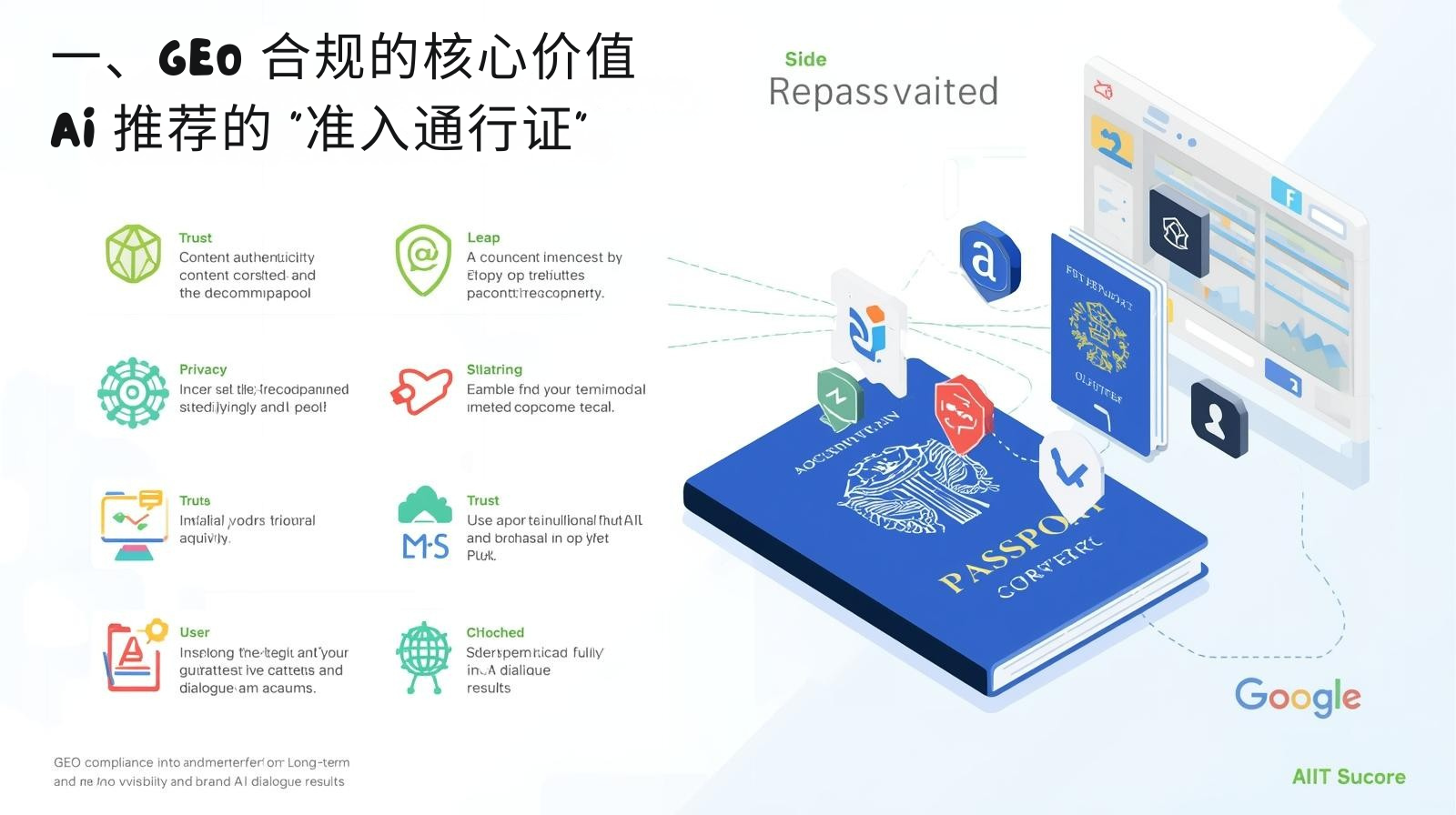
1. The core value of GEO compliance: recommended by AI "Access Pass"
The essence of GEO is to allow the content of independent sites to be correctly understood, trusted and included in the recommendation pool by the AI model. Compliance determines whether your site can enter this pool and how long it can stay. In March 2026, OpenAI officials clearly required that all sites crawled by GPTBot must comply with the four principles of authentic content, privacy compliance, clear copyright, and access friendliness https://help.openai.com/en/articles/5097620-blocking-gptbot, Google also updated its AI search guidelines at the same time, listing compliance as the primary indicator of the E-E-A-T evaluation system https://developers.google.com/search/blog/2026/ai-driven-b2b-search.
For independent foreign trade websites, GEO compliance is not an additional burden, but a basic guarantee for long-term and stable access to AI traffic. If compliance is not in place, even if it is included in AI in the short term, it will be quickly eliminated in subsequent rule updates. Only by ensuring solid compliance can the brand continue to appear in the AI dialogue results of target buyers.
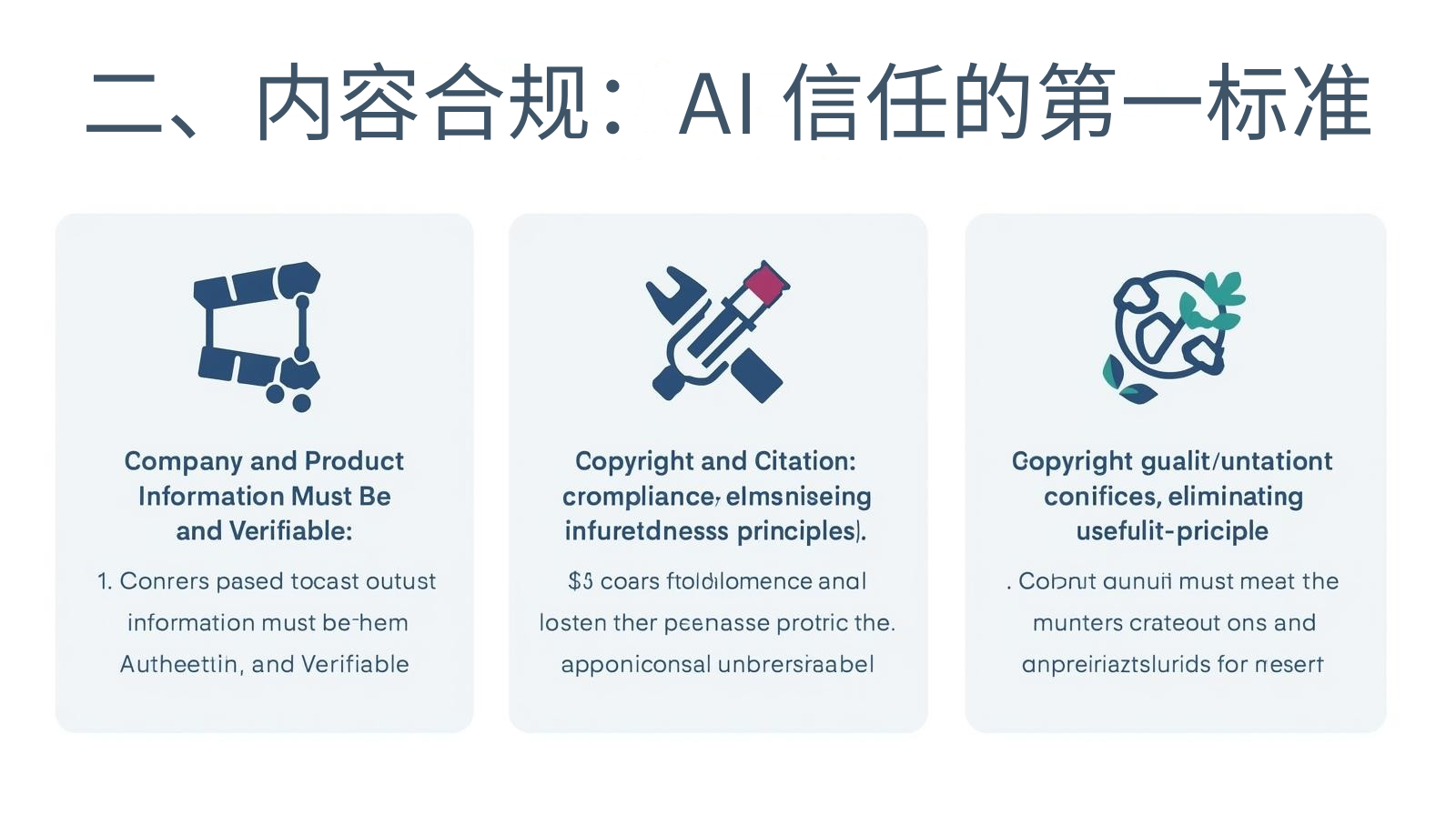
2. Content compliance: the first standard of AI trust
The core of AI recommendations is “useful, authentic, and verifiable”. Content compliance directly determines whether AI trusts your site information.
Company and product information must be true and verifiable
Company profile, factory address, production capacity scale, qualification certification and other information must be consistent with the actual situation. It is prohibited to fabricate factory strength, forge cooperation cases, and exaggerate certification qualifications. All CE, FDA, ISO and other certifications should display verifiable numbers and link to the official query platform https://ec.europa.eu/growth/tools-databases/nando/index.cfm, AI will automatically verify the authenticity of the information, and false content will directly reduce the site rating.
False propaganda and illegal promises are prohibited in product descriptions
Descriptions of product functions, materials, performance, delivery dates, etc. must be realistic, do not use absolute terms, and do not make promises beyond the scope of capabilities. High-risk categories strictly abide by target market regulations, and do not illegally promote medical, legal, and financial-related effects. OpenAI clearly prohibits the provision of high-risk professional advice through generative content in the usage policy updated in February 2026 https://openai.com/zh-Hans-CN/policies/row-terms-of-use/.
Copyright and citation compliance to eliminate the risk of infringement
All pictures, videos, copywriting, and fonts on the site must use genuine authorized resources. When citing industry data, reports, and cases, the source must be marked and legal external links must be added. The AI system will automatically detect copyright risks, and infringing content will be removed from recommendation qualifications. Long-term infringement will result in site-wide crawling restrictions.
Content quality meets AI usefulness principles
Reject low-quality duplication, garbled machine translation, and worthless content. Google has made it clear in 2026 that large-scale, low-value AI-generated content will be judged as spam https://ai.google.dev/gemini-api/docs/usage-policies?authuser=4&hl=zh-cn, Foreign trade independent stations should provide clear, complete and professional product and factory information based on the real needs of buyers, and meet AI's criteria for "useful content".

3.Crawler and access compliance: let AI Smooth and legal crawling
AI needs to read the site content through the official crawler. Access compliance is a prerequisite for normal inclusion and is also the technical basis for GEO optimization.
Configure crawler permissions correctly and do not block official AI crawlers
Ensure that the site allows official crawlers such as GPTBot and GoogleBot AI to access normally, does not use wrong rules to block core pages, and does not abuse the interception mechanism to cause crawling failures. You can check the configuration requirements through the official crawler documentation https://help.openai.com/en/articles/5097620-blocking-gptbot to ensure that AI can stably read core pages such as home page, product page, about us, and factory introduction.
Site access is stable and global loading speed meets standards
AI crawlers have extremely high requirements for site availability and loading speed. Frequent downtime, loading timeouts, and regional access barriers will all lead to crawling failures. Foreign trade stations should use global CDN and stable servers to ensure that the loading speed in core markets such as Europe and the United States meets the standards. At the same time, ensure that SSL encryption is normal and there are no security risk prompts. If the security does not meet the standards, the AI will directly refuse to crawl https://pagespeed.web.dev/.
Clear structure makes it easier for AI to understand page information
Use standardized hierarchical titles, clear page layout, standardized product and factory information structure, avoid using complex pop-up windows, and forcing login to view content. Content that cannot be parsed by AI is equivalent to non-existence. Structured and transparent pages can greatly increase the probability of recognition and recommendation https://validator.schema.org.
Related article recommendations: Your peers have not yet reacted: using GEO to build an independent foreign trade station is the biggest blue ocean strategy at the moment
Related article recommendations: Your peers have not yet reacted: using GEO to build an independent foreign trade station is the biggest blue ocean strategy at the moment
4. Privacy and data compliance: mandatory requirements in the global market
Global data regulation will continue to tighten in 2026. Privacy compliance is not only a legal requirement, but also an important dimension for AI to evaluate the credibility of a site.
Comply with mainstream privacy regulations such as GDPR and CCPA
Independent websites facing markets such as the European Union and the United States must be equipped with complete and compliant privacy policies, cookie authorization pop-ups, and user data deletion channels. Obtaining user data must require explicit active consent, and default check-box authorization is prohibited. The EU GDPR penalties for violations can reach up to 4% of global revenue https://commission.europa.eu/topics/data-protection_en, non-compliant sites will be restricted by AI to recommendations in the corresponding region.
Secure storage and legal use of user data
Do not collect unnecessary information, encrypt and store user data such as inquiry forms, contact information, etc., do not leak, abuse, or resell to third parties, establish a data security and leakage emergency mechanism, and the AI platform will give priority to recommending sites with complete data protection capabilities https://www.iso.org/standard/27001.html.
Comply with third-party tools and code
Third-party tools such as statistics, customer service, and marketing must choose compliant service providers. They must not embed malicious code, illegal tracking code, or collect user behavior data beyond the necessary scope. Code violations will cause the site to be marked as unsafe and directly lose the qualification for AI recommendation.
5. Practical implementation: Complete GEO compliance self-inspection and optimization in 3 steps
Step 1: Full self-inspection of content compliance (1–3 days)
Check the authenticity of company information, product parameters, certification qualifications, and case descriptions one by one, replace non-genuine pictures and materials, correct illegal promotional terms, and add authoritative external links to quoted content to ensure that all information is verifiable, non-infringing, and low-risk.
Step 2: Crawler and access compliance optimization (3–7 days)
Check and correct the crawler configuration to ensure that the official AI crawler can normally access core pages, use tools to detect global loading speed and availability, optimize page structure and rendering efficiency, so that AI can smoothly and completely read the entire site content.
Step Three: Privacy and Data Compliance Deployment (Long-term)
Launch privacy policies and cookie pop-ups that comply with GDPR and other requirements, standardize the form authorization process, regularly check the compliance of third-party tools, establish a data security management system, and maintain continuous and stable compliance status.
Only with a foundation of compliance can GEO create long-term value
In the AI procurement era of 2026, GEO is the key path for independent foreign trade stations to obtain accurate B-side traffic, and Compliance is the prerequisite for all GEO optimization. Only sites with authentic content, crawler-friendly, privacy and security, and stable access can be trusted by AI for a long time and continue to be recommended. If you want to stand firmly at the forefront of AI traffic, you must first establish solid compliance, and then optimize structured content and professional information to keep your brand appearing in the AI search results of target buyers.
To make GEO compliance more worry-free and implementation more efficient, a professional website infrastructure is crucial. Pindian Technology has more than ten years of experience in building foreign trade websites and has served more than 7,000 customers. It uses React technology to build an independent website. Page browsing is silky and smooth. It has built-in capabilities such as global CDN acceleration, SSL security encryption, crawler-friendly architecture, and GDPR compliance templates. It adapts AI crawling and GEO optimization requirements from the bottom up to help you achieve full-dimensional compliance of content, access, and privacy in one stop. It allows your independent website to be born with genes that are recommended by AI for long-term stability, and easily captures the generative style. New foreign trade opportunities brought by AI.