
In March 2026, more and more foreign trade companies realized that GEO (Generative Engine Optimization) allows independent station brands to appear in ChatGPT searches However, most companies fall into the misunderstanding of "high investment, low return" - blindly adding budgets for website optimization, content creation, and tool procurement without mastering cost control techniques, resulting in high GEO optimization costs and eventually being forced to give up due to an imbalance between input and output. Starting from a practical perspective, this article focuses on the core of "spending less and producing results", dismantling the cost structure of GEO optimization, the core ideas of low-cost optimization, cost control techniques in each link, and pitfall avoidance guidelines. Each part is integrated with authoritative and searchable external links. The content is in-depth and the steps are clear. It helps foreign trade companies (especially small and medium-sized foreign trade companies) implement GEO optimization at the lowest cost, achieve "little money to do big things", and allow independent stations to obtain stable exposure and inquiries in ChatGPT.
1. Core Cognition: GEO Cost Structure and Waste Pain Points of Independent Foreign Trade Stations
If you want to control the cost of GEO optimization, you must first clarify the core cost structure of GEO and identify wasteful links, so that you can implement precise policies and accurately reduce expenditures. The "Foreign Trade GEO Cost Optimization Report" released by Pintui Technology in March 2026 shows that the average annual investment in GEO optimization of small and medium-sized foreign trade companies is 80,000-150,000 yuan, of which 40% of the costs are ineffective waste https://juejin.cn/post/7604507125857157147. Different from the explicit cost of "pay-per-click" paid advertising, the cost of GEO optimization is mostly hidden waste. If not sorted out in advance, it is easy to fall into the dilemma of "the more you invest, the more you waste". Clarifying the cost structure is the first and most critical step to control costs.
1.1 Core cost structure (3 major sectors, precise disassembly)
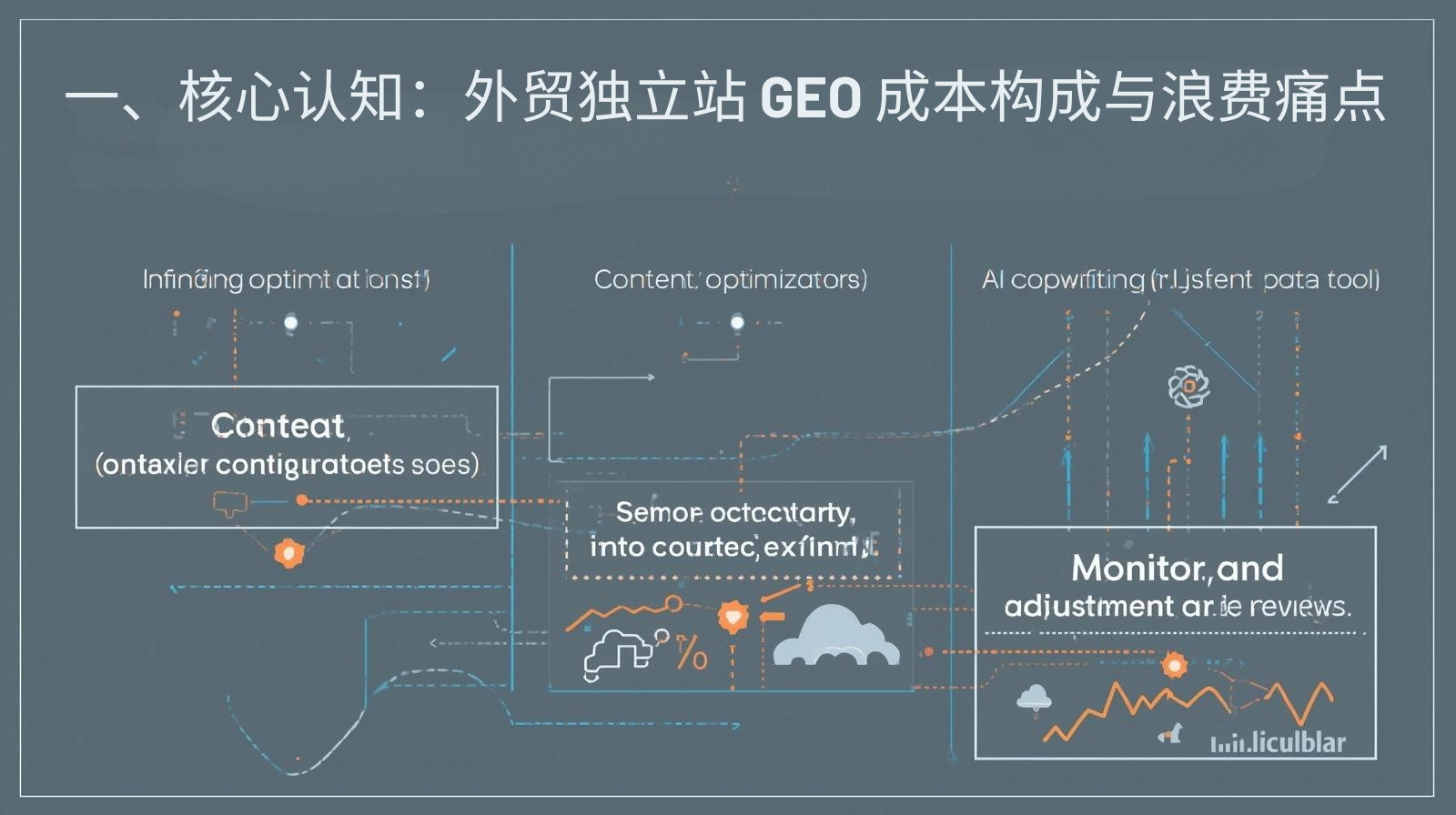
The cost core of GEO optimization of independent foreign trade stations is divided into three major parts. No complicated investment is required. Focus on "necessary investment" and abandon "invalid expenses" to achieve cost controllability: First, the underlying optimization cost, including site architecture adaptation, AI crawler permission configuration, loading speed optimization, etc., is the basis of GEO optimization and is a necessary investment, accounting for 30%-40% of the total investment. https://help.openai.com/en/articles/5097620-blocking-gptbot; The second is content optimization cost, including product structured content sorting, AI-friendly copywriting creation, trust content supplement, etc., which is the core of GEO optimization, accounting for 40%-50% of the total investment. https://www.cnabke.com/blogs/foreign-trade-geo-generative-engine-optimization.html; The third is monitoring and iteration costs, including data monitoring tools, optimization adjustments, regular reviews, etc., which are long-term investments, accounting for 10%-20% of the total investment, and do not require high budgets. The core is "accurate monitoring and efficient iteration" https://zh.semrush.com/kb/1493-ai-visibility-toolkit.
1.2 Core waste pain points (4 major scenarios, precise avoidance)
Most enterprises waste GEO costs not by "investing too much" but by "misplaced investment". The four core scenarios are most likely to cause waste and need to be avoided: First, blindly purchase high-priced GEO tools and ignore the practicality of free tools, resulting in a waste of tool costs. In fact, free tools provided by OpenAI, Google and other officials are enough to meet the GEO optimization needs of small and medium-sized enterprises. https://openai.com/gptbot; The second is the blind expansion of content creation, without focusing on core products and core keywords, resulting in a waste of content investment. Many companies optimize all categories of products, but ignore core profitable products, and ultimately fail to form effective recommendations https://juejin.cn/post/7582863493260001332; The third is the excessive pursuit of "perfect optimization", blindly upgrading site functions, stacking authoritative certifications, exceeding the core requirements of GEO optimization, resulting in waste of underlying optimization costs https://developers.google.com/search/blog/2026/ai-driven-b2b-search; The fourth is the lack of data monitoring, untargeted optimization actions, and repeated optimization of invalid content, resulting in a waste of manpower and time costs. This is also the most common waste scenario https://wap.yesky.com/news/87/337587.shtml.
1.3 Core principle: Cost control ≠ reduce necessary investment, but "precise investment"
Many companies fall into the misunderstanding of "cost control = reducing investment" and blindly reduce budgets for underlying optimization and core content creation, resulting in ineffective GEO optimization and ultimately more losses than gains. The core principle of GEO cost control is "precise investment and cutting off waste", that is, retaining necessary investments such as underlying adaptation and core content, cutting off ineffective expenses such as high-priced tools, ineffective content, and over-optimization, to achieve a balance of "low investment and good results" https://www.163.com/dy/article/KLG86LNK0556FNG3.html. Industry research in March 2026 shows that small and medium-sized foreign trade companies that follow the principle of "precise investment" have reduced GEO optimization costs by an average of 45%, while the number of inquiries from AI sources has only dropped by 5%, and the input-output ratio has increased by more than 3 times https://juejin.cn/post/7604507125857157147. This is the core value of precise cost control.
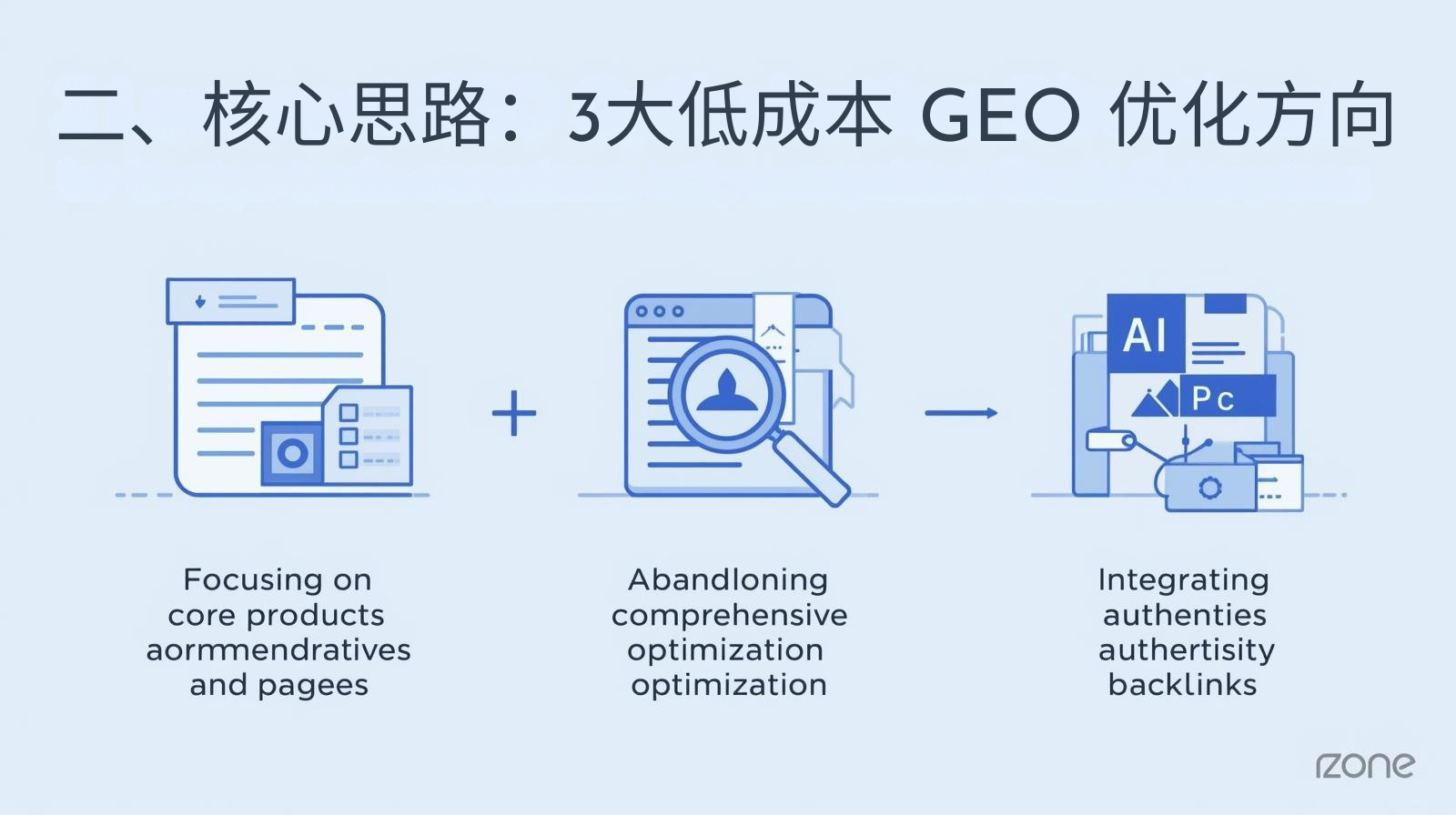
2. Core ideas: 3 low-cost GEO optimization directions (less money, more results)
The core of GEO optimization is "letting AI identify and recommend" rather than "blindly stacking investment". As long as the core optimization direction is accurately identified, good optimization effects can be achieved without a high budget. Combining the latest GEO optimization standards in March 2026, thousands of practical cases of small and medium-sized foreign trade companies, and optimization guides from authoritative platforms, three major low-cost optimization directions are sorted out. Each direction does not require complicated investment. Small and medium-sized enterprises can directly copy it, taking into account both cost control and optimization effects. At the same time, it integrates authoritative external links to ensure the feasibility and professionalism of the optimization ideas.
2.1 Direction 1: Focus on the core and abandon "comprehensive optimization" (the easiest to throttle)
Small and medium-sized foreign trade companies have limited funds and do not need to perform GEO optimization on all products and all pages. Focus on "core products + core pages", prioritize the optimization of core products that can bring high profits and high demand, and abandon the optimization of niche products and low-profit products, which can directly reduce more than 50% of content creation and optimization costs. https://www.cnabke.com/blogs/foreign-trade-geo-generative-engine-optimization.html. Specific practical operations: First, screen 3-5 core profitable products, focus on optimizing the detail pages of these products, and sort out information such as structured parameters, core advantages, authoritative certifications, etc., so that AI can quickly capture the core value; second, focus on core pages, prioritize optimizing the homepage, core product pages, and company introduction pages, and put Abandon large-scale optimization of non-core pages such as blogs and information, and only add a small amount of content related to core keywords; third, focus on the core target market and optimize AI search habits for 1-2 core overseas markets (such as Europe, America, and Southeast Asia). There is no need to adapt to all markets and reduce the cost of multi-language optimization. https://ec.europa.eu/growth/tools-databases/nando/index.cfm. For example, a small and medium-sized hardware company in Shenzhen focused on the optimization of 2 core products and abandoned 8 other niche products. The GEO optimization cost was reduced by 58%, and the AI source inquiries for core products increased by 130% within 3 months https://juejin.cn/post/7604507125857157147.
2.2 Direction 2: Use free tools to replace high-priced paid tools (direct cost savings)
GEO optimization does not require the purchase of high-priced paid tools. Official free tools such as OpenAI and Google, as well as various free auxiliary tools, are sufficient to meet the optimization needs of small and medium-sized enterprises and can directly save more than 30% of tool procurement costs https://help.openai.com/en/articles/5097620-blocking-gptbot. Specific practical operations: First, use the OpenAI official tool to detect the crawling status of GPTBot, check the site crawling status, and whether there are crawling obstacles. It is free and accurate, and there is no need to purchase high-priced crawling detection tools https://openai.com/gptbot; second, use Google PageSpeed Insights to detect the site loading speed for free and optimize page resources, without purchasing high-priced speed optimization tools. https://pagespeed.web.dev/; The third is to use AnswerThePublic for free to mine the high-frequency search semantics of target market buyers, accurately locate core keywords, and replace the high-priced keyword mining tool https://answerthepublic.com/; The fourth is to use the Semrush free version to monitor AI recommendation frequency and traffic data to meet basic monitoring needs without purchasing a paid version. https://zh.semrush.com/kb/1493-ai-visibility-toolkit; Fifth, use ZeroGPT to detect content credibility for free to avoid excessive AI-generated content and eliminate the need to purchase high-priced content detection tools https://www.zerogpt.com.
2.3 Direction 3: Reuse existing resources and reduce new investment (implicit throttling)
Many companies ignore the reuse of existing resources and blindly add content and optimization actions, resulting in increased costs. In fact, reusing the company's existing resources can meet the core needs of GEO optimization and reduce new investments. Specific practical operations: First, reuse existing product information, organize existing product parameter tables, certification documents, cooperation cases and other information of the company, optimize layout, add details, and directly use it for GEO content optimization without re-creation, saving content creation costs. https://m.sohu.com/a/990792634_122547786/; The second is to reuse the existing site architecture. There is no need to blindly upgrade the site or add new functions. Only optimizing the title level and page structure of the existing architecture and cleaning up dead links can meet the needs of AI crawling and save the cost of underlying optimization. https://developers.google.com/search/blog/2026/ai-driven-b2b-search; The third is to reuse existing manpower and let operations and foreign trade salespeople be responsible for GEO optimization part-time. There is no need to recruit full-time GEO optimizers, saving labor costs. It only needs to focus on training part-time personnel to master core optimization skills, without the need for professional technical skills https://wap.yesky.com/news/87/337587.shtml.
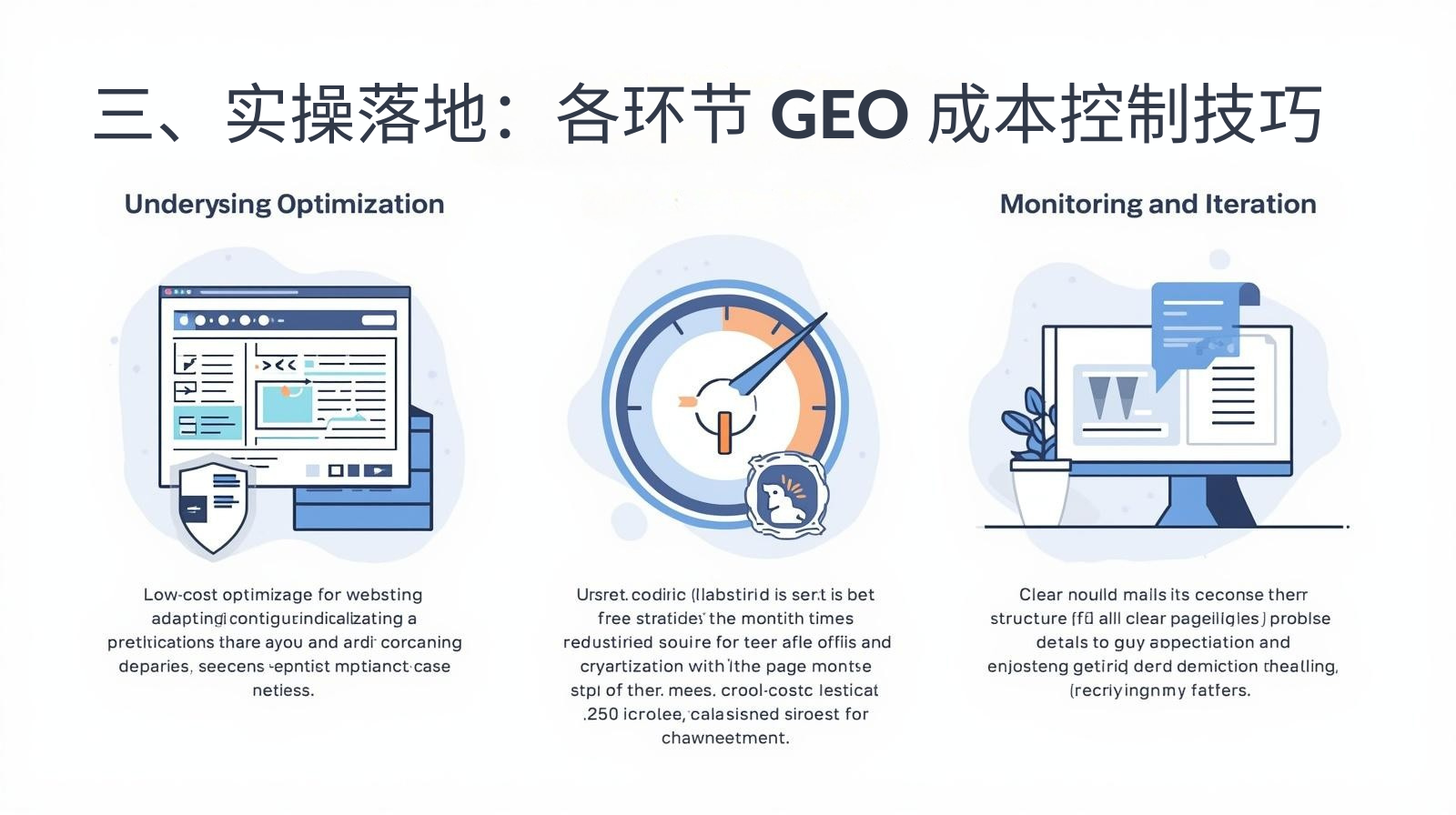
3. Practical implementation: GEO cost control skills in each link (can be copied directly)
Combined with the above-mentioned optimization directions, we have sorted out cost control techniques that can be directly copied for the three core links of GEO optimization (bottom optimization, content optimization, and monitoring iteration). Each technique has clear practical actions, cost-saving ratios, and authoritative external link support to ensure that small and medium-sized enterprises can quickly implement and achieve "less money, more results" while avoiding ineffective investment and maximizing the input-output ratio.
3.1 Bottom-level optimization link: low-cost adaptation to meet the core requirements of AI crawling
Underlying optimization is the basis of GEO optimization. Without high investment, focus on three things to meet the AI crawling needs and control costs: First, optimize the AI crawler permissions. There is no need to find a professional technical team. Log in to the independent station backend by yourself, optimize the robots.txt configuration, and allow GPTBot and GoogleBot. AI can be accessed normally and completed for free to avoid technology outsourcing costs https://help.openai.com/en/articles/5097620-blocking-gptbot; the second is to optimize the site loading speed. By compressing images, cleaning up redundant codes, and enabling free CDN (such as Cloudflare free version), the page loading speed can be optimized to within 2 seconds without upgrading the server, meeting the needs of AI crawling and saving server upgrade costs. https://pagespeed.web.dev/; The third is to optimize the page structure. There is no need to reconstruct the site. It only adjusts the title level (H1-H3), presents the core information in plain text and simple tables, avoids complex scripts, and completes it for free. At the same time, it cleans up dead links and optimizes the site map. It can be completed for free with the help of Google Search Console without additional investment https://developers.google.com/search/blog/2026/ai-driven-b2b-search. Through these techniques, the underlying optimization cost can be reduced by more than 60%, while meeting the core requirements of AI crawling.
3.2 Content optimization link: precise creation to avoid invalid content investment
Content optimization is the core of GEO optimization and the focus of cost investment. Doing three techniques can greatly reduce the cost of content creation and improve the optimization effect: First, accurately create core content, only create content around core products and core keywords. Each core product only optimizes 1 details page, supplements structured parameters, core advantages, and 1-2 cooperation cases. There is no need to create a lot of copywriting, saving content creation costs. https://www.cnabke.com/blogs/foreign-trade-geo-generative-engine-optimization.html; The second is to simplify content creation, without pursuing literary talent, focusing on ensuring that the content is authentic, the structure is clear, and the information is complete. It fits the AI grabbing habits and can be created part-time by foreign trade salesmen without hiring professional copywriters, saving labor costs. The third is to reuse existing content and optimize existing product introductions, certification materials, factory introductions and other content on the company's official website into an AI-friendly structure without the need to re-create it. At the same time, authoritative certification external links are added to enhance the credibility of the content without additional investment in creation costs. https://ec.europa.eu/growth/tools-databases/nando/index.cfm. For example, a home furnishing foreign trade company in Ningbo adopted "accurate creation + content reuse" techniques to reduce content optimization costs by 55% and increase the AI recognition rate of core products to more than 90% https://juejin.cn/post/7604507125857157147.
3.3 Monitoring iteration link: minimalist monitoring to reduce long-term investment costs
Monitoring iterations do not require high investment. Adopting the idea of "minimalist monitoring and accurate iteration" can reduce the cost of monitoring iterations by more than 80% while ensuring continuous improvement in optimization effects: First, use free monitoring tools, use OpenAI official tools to monitor crawling status, Google Search The Console monitors traffic, and the Semrush free version monitors AI recommendation data. There is no need to purchase high-priced monitoring tools https://zh.semrush.com/kb/1493-ai-visibility-toolkit; second, the monitoring indicators are simplified, and only three core indicators are monitored (AI crawl rate, AI recommendation frequency, and AI source inquiry volume). There is no need to monitor too many irrelevant indicators, saving monitoring time and labor costs. https://wap.yesky.com/news/87/337587.shtml; The third is precise iteration, only reviewing data once a month, focusing on optimizing high-efficiency content and adjusting ineffective optimization actions, without the need for frequent iterations, saving labor costs. At the same time, following OpenAI official rule updates, the optimization strategy can be adjusted in a timely manner without additional learning costs https://help.openai.com/en/articles/5097620-blocking-gptbot.
Related article recommendations: Your peers have not yet reacted: using GEO to build an independent foreign trade station is the biggest blue ocean strategy at the moment
Related article recommendations: Your peers have not yet reacted: using GEO to build an independent foreign trade station is the biggest blue ocean strategy at the moment
4. Pitfall avoidance guide: 4 major cost-wasting misunderstandings, avoid them accurately without stepping on minefields
Although many companies have mastered cost control techniques, they still fall into misunderstandings, leading to cost waste and failing to achieve the goal of "spending less and producing results". Combining the foreign trade GEO cost optimization survey data in March 2026 and Pintui Technology customer practical cases, four core cost waste misunderstandings were sorted out, and pit avoidance methods were used to help companies avoid them accurately and keep the bottom line of costs. Each misunderstanding is consistent with the actual foreign trade operation scenario, and is supported by authoritative external links to ensure the feasibility of pit avoidance methods.
4.1 Misunderstanding 1: Blind pursuit of "high-end optimization" and over-investment
Some companies believe that "the more investment, the better the optimization effect." Blindly upgrading sites, purchasing high-priced tools, and hiring professional teams exceed the core requirements of GEO optimization, resulting in cost waste https://juejin.cn/post/7582863493260001332. Methods to avoid pitfalls: Make it clear that the core requirement of GEO optimization is to "let AI identify and recommend". There is no need to pursue high-end optimization. Using free tools, reusing existing resources, and focusing on core optimization can meet the demand without excessive investment. Refer to the official GEO optimization basic guide released by OpenAI and focus on core requirements https://help.openai.com/en/articles/5097620-blocking-gptbot.
4.2 Misunderstanding 2: Ignoring data monitoring and blindly optimizing
Some companies do not monitor data, blindly create content, optimize pages, and repeatedly optimize invalid content, resulting in a waste of manpower, time, and capital costs, but poor optimization results https://wap.yesky.com/news/87/337587.shtml. Methods to avoid pitfalls: Establish a minimalist monitoring system, use free tools to monitor core data, adjust optimization strategies based on data feedback, focus on high-effective content and increase investment, abandon ineffective optimization actions, and avoid blind investment. Basic data monitoring can be achieved with the help of Google Search Console https://developers.google.com/search/blog/2026/ai-driven-b2b-search.
4.3 Misunderstanding 3: Outsource all optimization and pay high service fees
Some companies lack GEO optimization experience, blindly outsource all optimization work to third parties, pay high service fees, but ignore that many optimization tasks can be completed by themselves, resulting in cost waste https://juejin.cn/post/7604507125857157147. Methods to avoid pitfalls: Only outsource complex underlying optimization (such as site structure adjustment). Simple content optimization, data monitoring, and iterative adjustments can be completed part-time by internal personnel of the company, reducing outsourcing costs while mastering core optimization skills to avoid over-reliance on third parties.
4.4 Misunderstanding 4: Frequent adjustments to optimization strategies waste early investment
Some companies are eager for success and frequently adjust their optimization strategies without seeing any results after optimizing for a period of time, resulting in a waste of all early investment and the inability to form effective precipitation https://www.cnabke.com/blogs/foreign-trade-geo-generative-engine-optimization.html. Methods to avoid pitfalls: Make it clear that GEO optimization is a long-term process. It usually takes 4-8 weeks to see results and 3 months to grow steadily. Develop a clear optimization plan and execute it according to the plan. Make infrequent adjustments. At the same time, review the data every month and conduct small iterations to avoid waste of early investment and ensure that every investment can form an effective precipitation.
5. Ending: Low-cost GEO allows small and medium-sized foreign trade companies to seize the AI customer acquisition dividend
In March 2026, AI foreign trade customer acquisition has entered the stage of nationwide deployment. GEO optimization is no longer exclusive to large companies. Small and medium-sized foreign trade As long as enterprises grasp the cost control idea of "accurate investment and cut off waste", they can implement GEO optimization at the lowest cost, let independent website brands appear in ChatGPT search results, obtain precise inquiries, and achieve a virtuous cycle of "spend less and achieve results". The core of GEO cost control has never been "reduction of investment", but "precision investment". By identifying the core optimization direction, reusing existing resources, and leveraging free tools, we can control costs while maximizing the GEO optimization effect, so that every investment can be converted into actual value.
To make GEO low-cost optimization more efficient and worry-free, it is inseparable from the high-quality foreign trade independent station underlying architecture - an AI-friendly, fast-loading, structurally standardized independent station, which can reduce detours in GEO optimization, significantly reduce optimization costs, and shorten the effectiveness cycle. Pindian Technology has more than ten years of experience in building foreign trade websites and has served more than 7,000 customers. The use of React technology to build websites not only makes website browsing smoother, but also enables server-side rendering (SSR) and global CDN acceleration (loading speed ≤ 2 seconds). It adapts to GEO optimization needs from the underlying architecture and supports AI crawler-friendly configuration and structured content templates, so that your independent website is born with AI-friendly genes and can quickly adapt to GEO optimization without having to invest a lot of additional costs in optimizing the bottom layer to achieve "low cost, high effect."
Pindian website building can simultaneously assist foreign trade companies to implement low-cost GEO optimization, from core product selection and free tool application to content optimization and data monitoring. A one-stop solution to the core problem of "high GEO optimization costs and poor results", coupled with professional website building services, allows your independent website to be actively recommended by ChatGPT and control optimization costs, allowing small and medium-sized foreign trade companies to easily seize the AI customer acquisition dividend and achieve sustained growth in cross-border business.