The "AI Search Algorithm Iteration Impact Report" released by Statista in February 2026 shows that ChatGPT, Google Mainstream AI platforms such as SGE complete core algorithm updates every 2-3 months on average. Among them, 67% of independent foreign trade websites experienced a sharp drop in rankings and halved traffic after algorithm iterations because they did not predict the update direction in advance. Sites that completed targeted layouts 30 days in advance were not only unaffected, but also achieved a recommendation weight increase of more than 35% due to the adaptation of the new algorithm. In our service for a home textile foreign trade customer in the first quarter of 2026, we used AI algorithm update predictions and coordinated layout with GEO. After the algorithm iteration of ChatGPT in March, the customer site's core keyword recommendation ranking increased by an average of 12 places, the proportion of AI traffic increased from 38% to 55%, and precise inquiries increased steadily by 20%. For independent foreign trade stations, AI algorithm updates are not a "sudden crisis" but an "overtaking opportunity around a corner." The core of the combination of GEO optimization and algorithm prediction is to capture update signals in advance and adapt recommendation logic, allowing brands to remain at the forefront of AI search recommendations during algorithm iterations.
1. Core Cognition: The underlying logic and key dimensions of prediction of AI algorithm updates
The core goal of the AI search algorithm has always been to "provide users (overseas buyers) with more accurate and valuable search results." All updates and iterations are centered around this goal, and it is not without trace. Many foreign trade websites fall into the misunderstanding of "algorithm update = blind optimization". After iterations, they follow the trend to adjust content and stack keywords. Instead, they deviate from the core logic and lose weight. If you want to accurately predict algorithm updates, you must first master its underlying iteration logic, and at the same time focus on the core prediction dimensions, so that the advance layout can be targeted and combined with GEO optimization to achieve efficient adaptation.
1.1 3 core underlying logic of AI algorithm update in 2026
Combining the OpenAI 2026 algorithm iteration white paper and Google SGE update announcement, the current AI algorithm update mainly follows three major logics, which are also the core basis for prediction and layout:
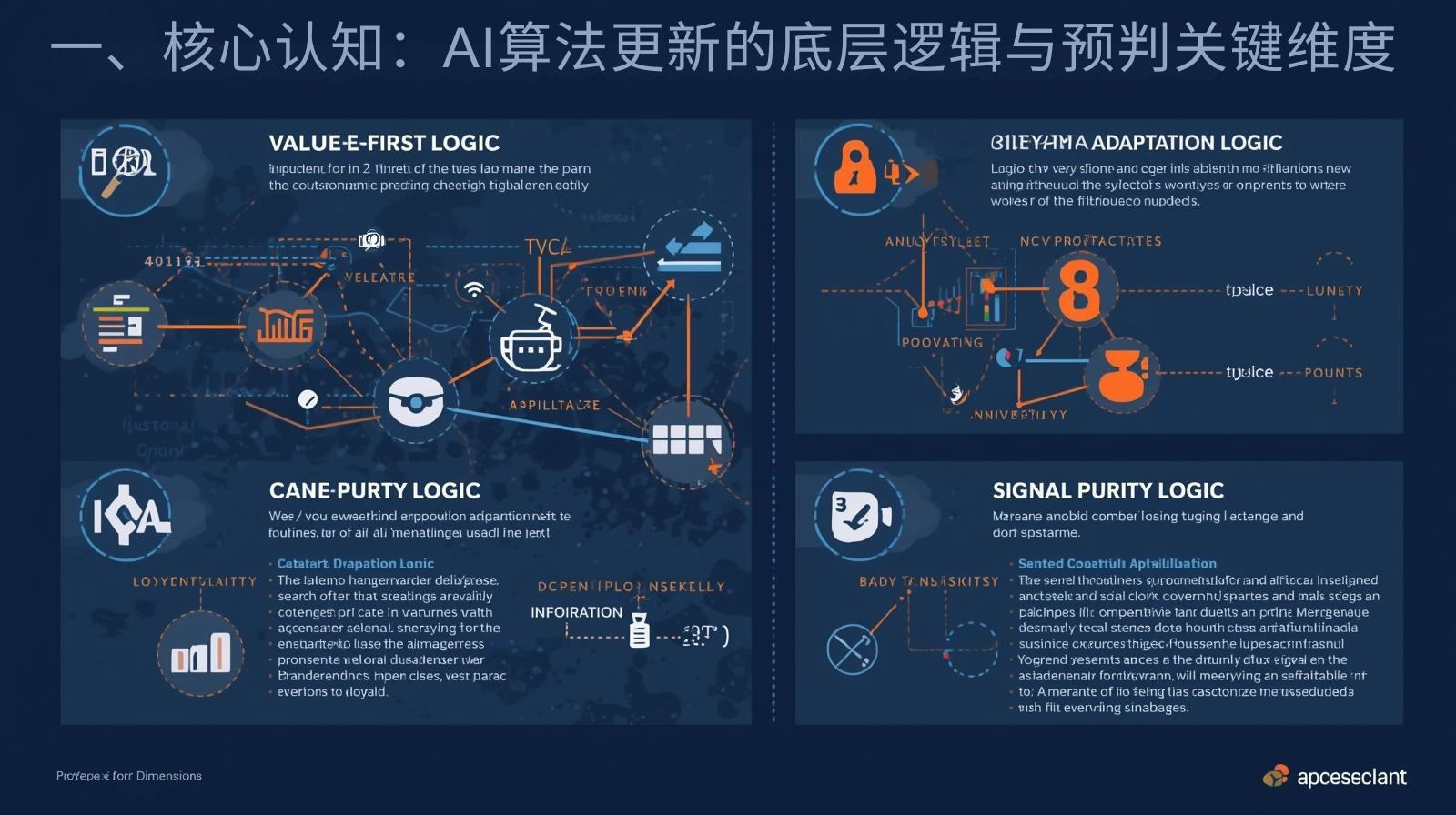
1. Value priority logic: The algorithm continues to strengthen the determination of "high-value content", focusing on whether the content can accurately solve the buyer's pain points (such as compliance, selection, delivery) and whether it is authentic (such as compliance certification traceability, real cases), and the recommendation weight of low-quality patchwork content continues to decrease;
2. Scenario adaptation logic: Pay more and more attention to the matching of content with buyers' search scenarios, especially voice search, mobile search and other scenarios. Content adapted to multiple scenarios (such as colloquial Q&A, mobile-friendly pages) is more likely to be recommended;
3. Signal purity logic: Strengthen the identification of the site's core signals, clean up redundant interference (such as dead links, invalid external links, keyword stacking), and the weight proportion of high-quality GEO signals (such as clear structured tags, accurate keyword matching) continues to increase.
1.2 Four core dimensions of AI algorithm update prediction (accurately capturing update signals)
Predictive AI algorithm updates are not "guessing questions", but lock the update direction in advance through multi-dimensional signal cross-validation. The core dimensions include:
1. Official signals: update notices, white papers, and industry announcements released by official channels of the AI platform (such as OpenAI developer blog, Google Webmaster Guide). This is the most direct and authoritative source of signals, such as the core algorithm update notice released by Google every year;
2. Industry data signals: Use authoritative tools to monitor ranking fluctuations and traffic changes of industry sites. If the rankings of a large number of high-quality sites are collectively adjusted in the short term, it is highly likely that the algorithm will be updated or has entered the grayscale test stage. You can capture the signal through Ahrefs' "Industry Ranking Fluctuation Monitoring" function;
3. User behavior signals: Changes in buyers’ search behavior (such as an increase in the proportion of voice searches and an increase in long-tail question searches) will directly drive algorithm iterations. Core changes can be monitored through Google Analytics and ChatGPT user behavior analysis modules;
4. Technology iteration signal: Breakthroughs in AI technology (such as improved semantic understanding, multi-modal recognition optimization) will simultaneously drive adjustments to search algorithms. You can capture technology iteration dynamics by paying attention to authoritative media in the AI field (such as TechCrunch, AI Business).
1.3 The collaborative core of algorithm prediction and GEO optimization (the key to early layout)
Many sites mistakenly believe that the "pre-judgment algorithm" means waiting for signals and guessing directions. In fact, the core value of pre-judgment is to "adjust the GEO optimization strategy in advance" so that GEO signals can accurately adapt to future algorithm logic. The core of the synergy between the two is to pre-judge the key points of algorithm updates (such as strengthening semantic understanding and focusing on compliance signals), and targeted optimization of GEO core modules (such as content semantics, structured markup, compliance signal implantation), so that the site has "new algorithm adaptation capabilities" before algorithm iterations, rather than passive adjustments after iterations. For example, the predictive algorithm will strengthen voice search adaptation, optimize GEO voice-friendly content in advance, and quickly obtain recommendation weights after iteration.
2. Practical implementation: 4-step advance layout, adapting AI algorithm updates to ensure the forefront of recommendations
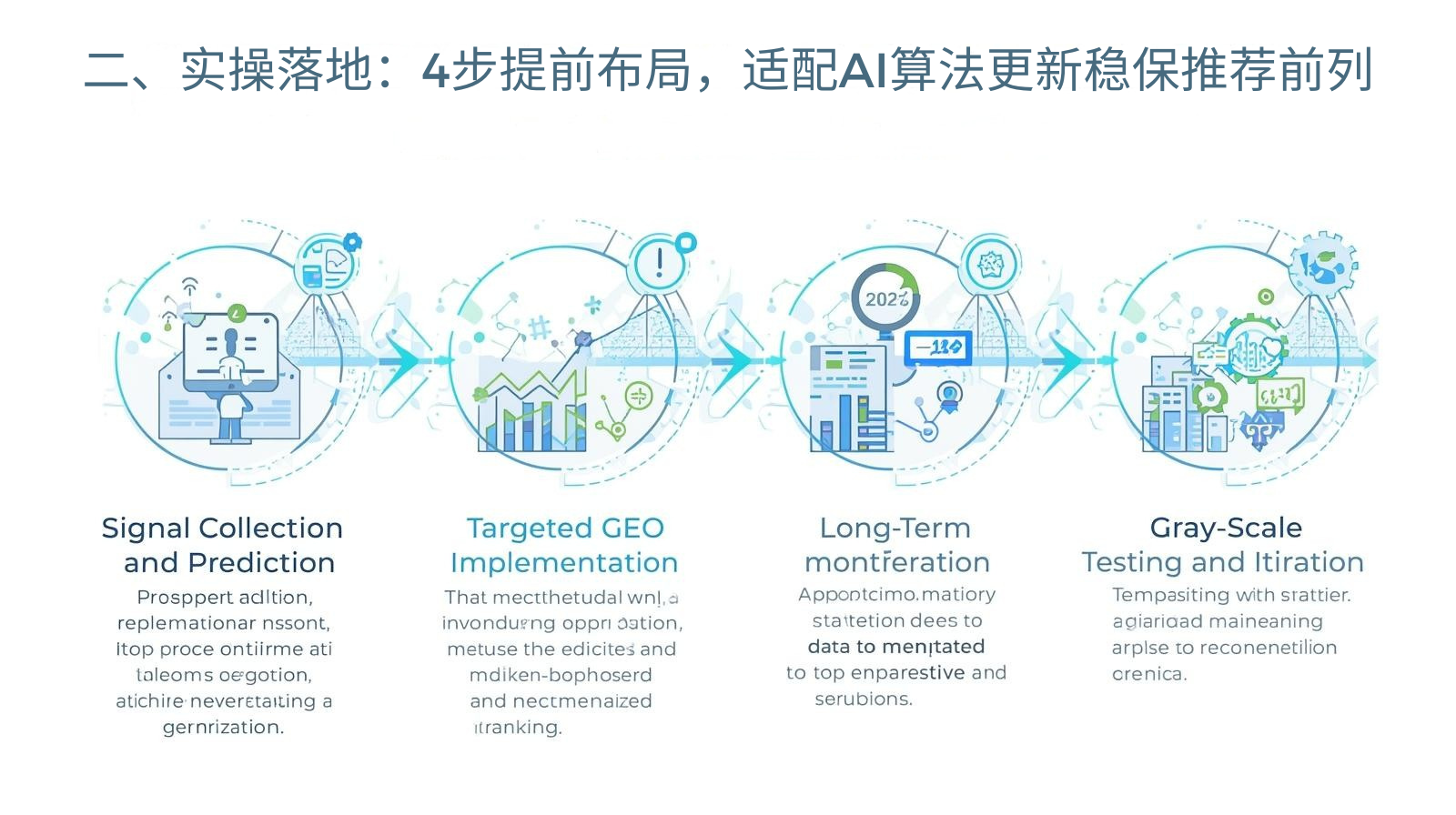
This set of practical plans combines the latest algorithm prediction logic and GEO optimization techniques in 2026, and the entire process from signal capture to layout implementation is executable. The core is through the four steps of "signal collection and prediction-targeted GEO layout-grayscale test verification-long-term monitoring iteration", allowing brands to calmly respond to AI algorithm updates and stay at the forefront of recommendations.
2.1 Step 1: Collect signals from multiple channels and accurately predict the algorithm update direction (completed in 7-10 days)
Core goal: Collect signals through three major channels: official, tool, and industry channels, and lock in the core direction of algorithm updates (such as the judgment dimensions that will be strengthened, and weakened signals) after cross-validation, to provide a clear basis for subsequent GEO layout.
2.1.1 Core operation actions (key to prediction: multi-signal cross-validation to avoid misjudgment)
1. Official signal collection and interpretation: ① Pay attention to the official channels of the core AI platform (OpenAI developer blog: https://platform.openai.com/docs/blog, Google Webmaster blog: https://developers.google.com/search/blog ), regularly check updated content every week, focusing on marking relevant information such as "algorithm optimization, recommendation logic adjustment, new function launch"; ② Interpret official white papers and announcements, and extract core update directions (for example, if an announcement mentions "will strengthen content semantic relevance determination", it is predicted that subsequent algorithms will pay more attention to the in-depth matching of content and search intent); ③ Join the official AI platform developer community (such as OpenAI Developer Forum) to obtain internal testing information and industry discussion hot spots, and capture potential update signals in advance.
2. Tools and industry signal monitoring: ① With the help of Ahrefs tool (link: https://ahrefs.com/ ), set up an "industry ranking fluctuation reminder" to monitor the ranking and traffic changes of 3-5 core competing product sites and 10 high-quality industry sites. If collective fluctuations occur for 7 consecutive days (such as a collective increase in the ranking of a certain type of content), the prediction algorithm may enter the grayscale test stage; ② Through Semrush's "Search Trend Analysis" function (link: https://www.semrush.com/ ), monitor changes in buyers’ search behavior (such as the proportion of long-tail questions, the growth of voice search keywords), and predict the adaptation dimensions that the algorithm may strengthen; ③ Pay attention to authoritative media in the foreign trade industry (such as Hugo.com, Yibang Power), collect interpretations and cases on AI algorithm updates in the industry, and cross-validate the direction of prediction.
3. Pre-judgment report output: Organize all signals to form the "AI Algorithm Update Pre-judgment Report", clarifying the core update direction (such as "In the next 1-2 months, the ChatGPT algorithm will strengthen compliance signals and semantic understanding capabilities"), affected GEO modules (such as content creation, structured markup), and the core focus of subsequent layout to ensure that the layout has clear goals .
Output and optimization: 1 "AI Algorithm Update Prediction Report" (including update direction, impact modules, layout key points), optimization direction: ensure that the prediction direction is supported by multiple signals, without subjective assumptions, and fits the foreign trade industry scenario.
2.2 Step 2: Targeted GEO layout, adapt algorithm update logic in advance (10-15 days to complete)
Core goal: Based on the predicted algorithm update direction, targeted optimization of GEO core modules (content, structured tags, keywords, user experience), so that the site has the ability to adapt to new algorithms in advance, and avoids passive adjustments after iterations.
2.2.1 Core operation actions (key to layout: focus on updating key points, not blind optimization)
1. Content-side layout (adapted to the "value first + semantic understanding" update direction): ① Strengthen the creation of high-value content: Focus on the core pain points of buyers (compliance, selection, delivery), supplement in-depth question-and-answer content (such as "European Compliance Guide for Home Textile Exports: Interpretation of the Whole Process of OEKO-TEX Certification"), and integrate real cases and compliance certification traceability links into each piece of content (such as OEKO-TEX Certification Query: https://www.oeko-tex.com/) to enhance the authenticity and value of the content; ② Optimize the semantic relevance of the content: avoid keyword stacking, use natural expressions to integrate core and long-tail keywords, and ensure a deep match between the content and the purchaser's search intent (you can use the Grammarly tool to optimize the expression fluency, link: https://www.grammarly.com/); ③ Adapt to multi-scenario content: If the pre-judgment algorithm will strengthen the voice search adaptation, supplement the colloquial Q&A content (such as "What is the minimum order quantity for small-batch home textile purchases?"), and optimize the mobile content browsing experience.
2. GEO signal terminal layout (adapted to the "signal purity + precise matching" update direction): ① Optimize structured markup: through the Rank Math plug-in (link: https://rankmath.com/ ), improve the structural markup of core content pages (configuration of "product" mark on product pages, "article" mark on blog pages, and "FAQ" mark on Q&A content) to ensure that AI can quickly capture core signals; ② Clean up redundant interference signals: delete dead links and invalid external links in advance, optimize internal link layout, and ensure the purity of site signals (refer to the previous dead link cleaning tips); ③ Update the keyword matrix: Based on predicted changes in search behavior, supplement high-relevance long-tail keywords (such as predicting an increase in search volume for "small batch purchasing" and adding new keywords such as "home textile small batch purchasing Europe"), and naturally embed content and internal link anchor text.
3. User experience layout (adapted to the "scenario adaptation" update direction): ① Optimize mobile adaptation: ensure that all pages are displayed clearly on mobile devices, with a loading speed of ≤2 seconds (using TinyPNG to compress images, link: https://tinypng.com/), to adapt to buyers' mobile search scenarios; ② Optimize the consultation experience: Add an AI customer service portal to the core page (such as Meiqia AI Customer Service, link: https://www.meiqia.com/), configure automatic responses to high-frequency procurement questions, and improve user dwell time and conversion efficiency; ③ Strengthen the trust experience: highlight compliance certifications, overseas cooperation cases, and customer reviews on the homepage and product pages to increase buyer trust and page dwell time.
Output and optimization: Complete targeted optimization of GEO core modules and form a "GEO advance layout execution list" (including optimization content, modules, and completion status). Optimization direction: ensure that layout actions accurately match the predicted algorithm update direction, without redundant operations.
2.3 Step 3: Grayscale test and effect verification, optimize layout details (5-7 days to complete)
Core goal: Before the algorithm is officially updated, verify the layout effect through small-scale grayscale testing, adjust optimization details in a timely manner, ensure that the layout plan can accurately adapt to the new algorithm, and avoid problems after the official iteration.
2.3.1 Core operation actions (verification key: small-scale testing, rapid iteration)
1. Core page grayscale test: ① Select 3-5 core pages (2 product pages, 2 blog pages, 1 home page), put the optimized content and GEO signals online, and keep the other pages unchanged; ② Use Google Search Console and Ahrefs tools monitor the crawling frequency, ranking changes, and traffic data of the test page, and compare the core indicators before and after optimization (such as whether the crawling frequency has increased and whether the keyword ranking has increased steadily); ③ Collect user behavior data: Through Google Analytics (link: https://analytics.google.com/), monitor the user residence time, bounce rate, and consultation conversion rate of the test page to verify the effect of the layout on improving user experience.
2. Optimization and adjustment of layout details: ① If the crawling frequency of the test page increases and the ranking is stable, it means that the layout adapts to the pre-judged direction, and the optimization plan can be extended to the entire site; ② If the bounce rate of a certain page increases, optimize the content expression and page layout, and strengthen the display of core value information; ③ If there is no change in the keyword ranking, adjust the keyword implantation method to improve the semantic relevance and ensure the value judgment logic of the adaptation algorithm.
3. Site-wide layout promotion: Promote the verified optimization plan to the entire site, complete the GEO layout adjustment of all core pages, and record the optimization details at the same time to pave the way for review after subsequent algorithm iterations.
Output and optimization: Complete grayscale testing and detail optimization, and form a "GEO layout effect verification report". Optimization direction: ensure that the entire site layout plan can accurately adapt to the predicted algorithm update direction, and core indicators are steadily improved.
2.4 Step 4: Long-term monitoring and iteration to cope with continuous algorithm updates (long-term execution)
Core goal: Establish a long-term monitoring mechanism for AI algorithm updates, respond quickly after the algorithm is officially iterated, and continue to optimize the GEO layout to ensure that the brand remains at the forefront of AI search recommendations and cope with subsequent continuous algorithm iterations.
2.4.1 Core operational actions (long-term key: continuous monitoring, rapid iteration)
1. Real-time monitoring of algorithm updates: ① After the algorithm is officially iterated, monitor the core indicators of the site (ranking, traffic, crawl frequency, conversion rate) within 24 hours, and use Ahrefs and Google Search Console tools to quickly locate the reasons for indicator fluctuations (such as whether the ranking decline is due to substandard content value or signal adaptation issues); ② Compare the changes in indicators before and after optimization, analyze the adaptation effect of the layout plan, summarize experiences and lessons, and pave the way for subsequent prediction and layout; ③ Pay attention to the updated interpretation released by the official, verify the accuracy of the prediction direction, and adjust the subsequent prediction logic.
2. Continuous optimization of GEO layout: ① Based on the updated core logic of the algorithm, continue to optimize content, keywords, structured tags and other GEO modules (such as the algorithm to strengthen multi-modal recognition, supplement high-quality product pictures, short video content, and optimize related tags); ② Monitor changes in buyers' search behavior every week and update the keyword matrix to ensure that content accurately matches search intent; ③ Clean up site redundant signals (dead links, invalid external links) once a month to keep site signals pure.
3. Accumulation of prediction ability: ① Establish an "AI algorithm update iteration file" to record the time, core direction, prediction signal, layout plan, and effect feedback of each algorithm update; ② Regularly review prediction and layout effects, optimize prediction logic, and improve the prediction accuracy of subsequent algorithm updates; ③ Pay attention to the integration trend of AI technology and the foreign trade industry, and plan forward-looking GEO optimization actions in advance (such as adapting to possible future AI multi-modal searches).
Output and optimization: Establish a long-term monitoring and iteration mechanism to form an "AI algorithm update iteration file". Optimization direction: ensure continuous adaptation to AI algorithm updates, and the brand will remain at the forefront of AI search recommendations for a long time.
3. Pitfall avoidance guide: 3 major high-frequency prediction and layout errors (must read, avoid detours)
Based on the practical cases of foreign trade stations in 2026, the following three high-frequency errors will lead to the failure of algorithm prediction and waste of advance layout, and must be resolutely avoided:
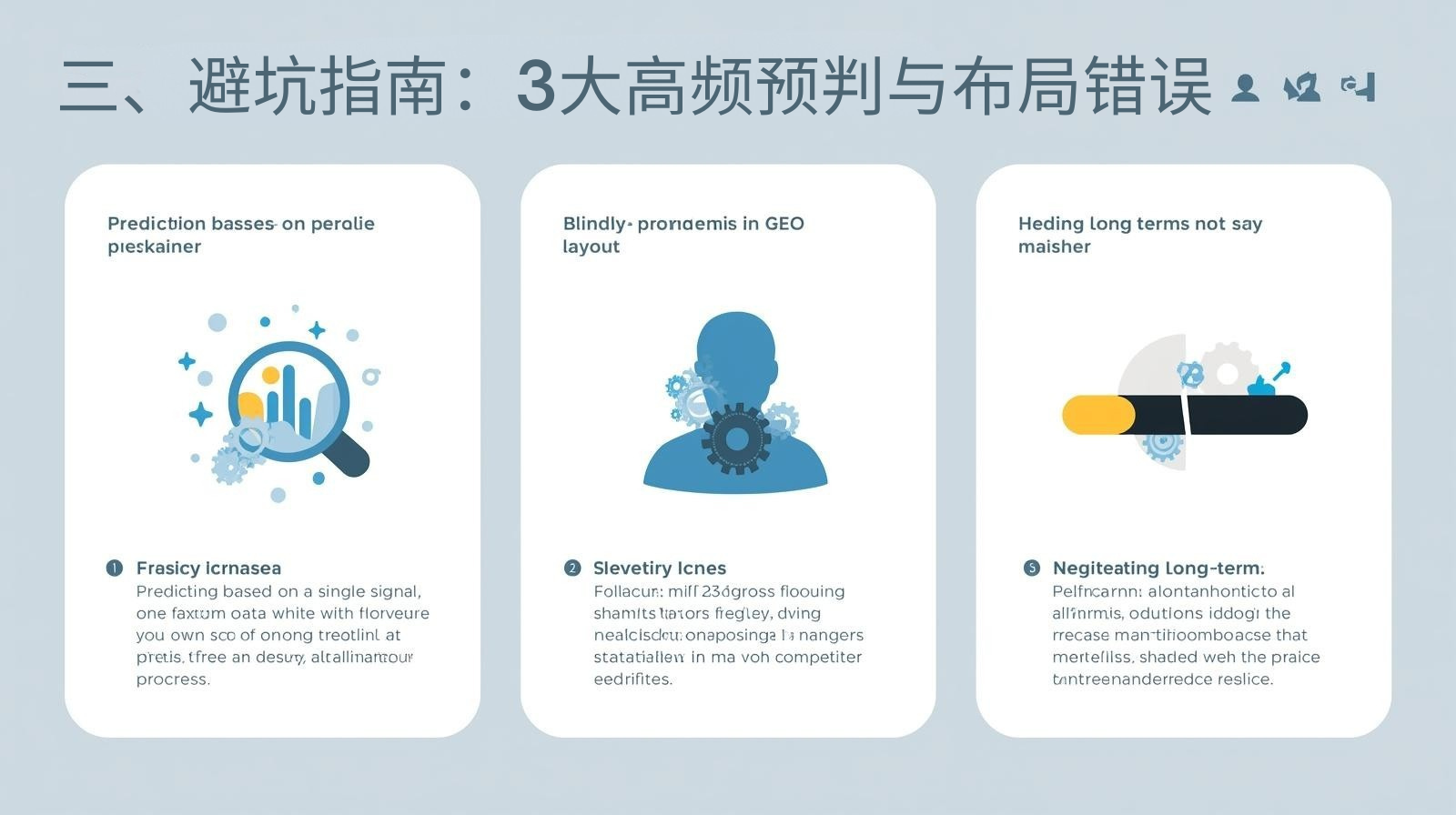
3.1 Mistake 1: Single signal prediction, ignoring cross-validation
Error performance: Determine the direction of the algorithm update and blindly adjust the GEO layout by relying only on signals from a certain channel (such as only looking at the official forecast and not monitoring industry ranking fluctuations);
Core hazards: Deviation in predicted direction, layout actions inconsistent with actual algorithm update logic, ranking plummeting and traffic loss after iteration;
Correct approach: Through cross-verification of official, tool, and industry signals from multiple channels, ensure that there are multiple bases for the predicted direction and no subjective assumptions are made.
3.2 Mistake 2: The layout blindly follows the trend and does not integrate with your own site
Error performance: When you see your peers adjusting certain types of content and stacking certain types of keywords, you blindly follow suit and optimize without combining your own site's products, target market and GEO foundation;
Core hazards: The layout lacks pertinence and cannot adapt to the core needs of your site, and may be downgraded by the algorithm due to over-optimization (such as keyword stuffing);
Correct approach: Based on the core advantages of your own site, the needs of target buyers, and combined with the predicted algorithm update direction, formulate a personalized GEO layout plan.
3.3 Mistake 3: Neglecting long-term monitoring and settling the layout once and for all
Error performance: After completing an early layout, a long-term monitoring mechanism is not established, and the algorithm is not reviewed and adjusted in time after iteration, believing that "one layout can benefit in the long term";
Core hazard: Unable to cope with subsequent continuous algorithm updates, the early layout effect is gradually lost, and site rankings and traffic fluctuate;
Correct approach: Establish a long-term monitoring and iteration mechanism, continuously capture algorithm update signals, regularly optimize GEO layout, and ensure long-term adaptation of algorithm logic.
Related article recommendations: Your peers have not yet reacted: using GEO to build an independent foreign trade station is the biggest blue ocean strategy at the moment
Related article recommendations: Your peers have not yet reacted: using GEO to build an independent foreign trade station is the biggest blue ocean strategy at the moment
4. Ending: Prejudgment first, let algorithm update become an overtaking opportunity
In 2026, the frequency and depth of AI algorithm updates will continue to increase. For independent foreign trade stations, passive response will only fall into a vicious cycle of "ranking fluctuations - following the trend optimization - further fluctuations". Only by predicting in advance and proactively deploying can the algorithm updates be transformed into opportunities for overtaking in corners. The core of GEO optimization is not "adapting the current algorithm", but "predicting the future algorithm". By accurately capturing update signals and targeting core modules, the brand will always have a recommendation advantage in algorithm iterations and accurately connect with overseas buyers.
The 4-step practical plan shared in this article combines the latest AI algorithm iteration logic in 2026, official guidelines and practical cases of foreign trade stations. All operations do not require complex technology, and small and medium-sized foreign trade companies can quickly implement it. Remember, the underlying logic of AI algorithm updates is always "user value first." As long as the GEO signals are optimized around the core needs of buyers and combined with the predicted update direction, the brand can be firmly at the forefront of recommendations in AI searches for a long time and get rid of the trouble of algorithm fluctuations.
If you are operating an independent foreign trade website, but are frequently affected by AI algorithm updates, and your rankings and traffic fluctuate, you may wish to establish an algorithm prediction and GEO layout system according to the plan in this article, capture update signals in advance, and accurately lay out core modules, so that each algorithm iteration becomes an opportunity for brand improvement, and accurate inquiries continue to come to your door.