
The "Old Site Search Optimization White Paper" released by Google in February 2026 shows that more than 65% of old foreign trade sites have a large number of dead links (invalid links, expired page links, etc.), resulting in AI platforms (ChatGPT, Google SGE) crawling efficiency has dropped by more than 40%, the core content collection delay has averaged 72 hours, and even some high-quality GEO optimized content cannot enter the recommendation pool due to dead link interference. An old hardware foreign trade station that we optimized in the first quarter of 2026 had accumulated 200+ dead links in the early stage, and the AI crawling coverage was only 38%. Through the "GEO optimization + dead link cleaning" combination plan, dead links were cleared within 2 weeks, the AI crawling efficiency increased by 62%, the core keyword ranking increased by 18 places on average, and precise inquiries increased by 150%. For old foreign trade websites, dead links are like "traffic stumbling blocks", which will not only waste AI crawling resources, but also lower the overall weight of the site. The core of the combination of GEO and dead link cleaning is to "clean up redundancy and strengthen effective signals" to allow AI to focus on high-quality content, achieving a double improvement in crawling efficiency and recommendation weight.
1. Core cognition: The fatal impact of dead links on AI crawling and GEO collaborative logic
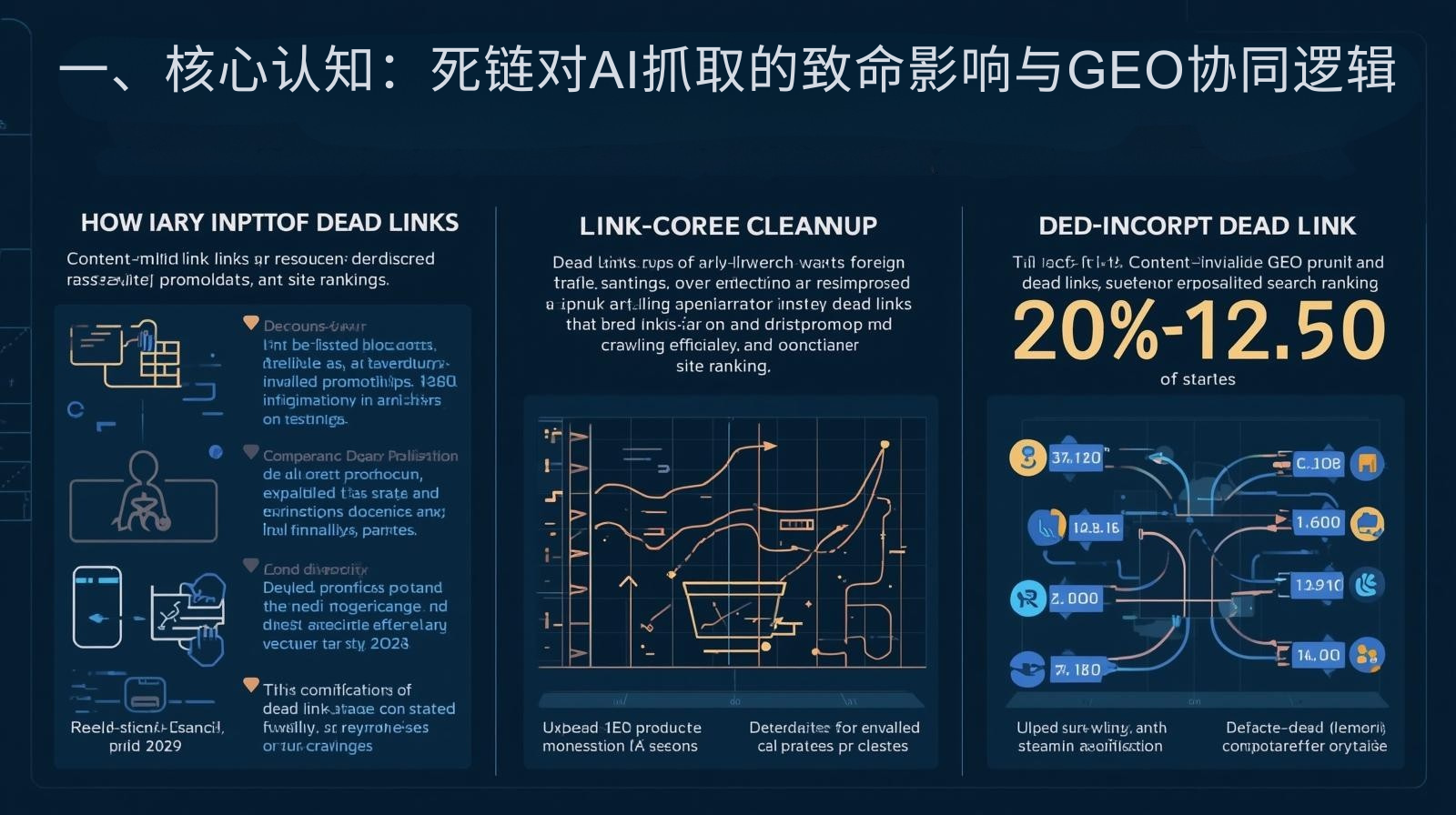
Old foreign trade websites have been operating for many years, and it is inevitable that dead links will occur due to product removals, page revisions, domain name changes, etc. These seemingly inconspicuous invalid links will seriously interfere with the crawling logic of the AI platform - AI crawlers will spend a lot of time crawling dead link pages, resulting in a reduction in the crawling priority of high-quality content (such as product pages, compliance guides), or even being judged as "poor site quality" and directly demoted. Many old websites fall into the misunderstanding of "emphasis on GEO optimization and neglect of dead link cleaning". They blindly pile up keywords and create content, but ignore the hidden drag of dead links, which greatly reduces the effect of GEO optimization. The core of the collaboration between GEO and dead link cleaning is not to simply delete dead links, but to clean up redundant links and optimize effective content signals, allowing AI to quickly identify the core value of the site and improve crawling efficiency and recommendation weight.
1.1 Three core types of dead links in old sites (AI crawling efficiency hardest hit area)
Based on the practical cases of old sites in 2026, the dead links of old foreign trade sites are mainly divided into 3 categories. Each category will cause varying degrees of interference to AI crawling, and need to be dealt with in a targeted manner when cleaning:
1. Content-invalid dead links: The most common types include links to off-shelf product pages, expired promotion page links, and invalid blog article links (such as early worthless industry information). These dead links will allow AI crawlers to crawl blank or invalid content, wasting crawling resources;
2. Link error type dead link: Link failure caused by page revision, URL modification, input error, etc., such as the relevant jump is not updated after the page is deleted, the URL is misspelled, and the link points to a non-existent folder. This type of dead link will directly return a 404 error, seriously lowering the site quality score;
3. External invalid dead links: The external links pointed to by the site's internal links are invalid (such as partner sites being closed, external resources being deleted). Such dead links will cause AI to determine that the site has "poor external link quality" and indirectly affect the recommendation weight of the core content.
1.2 Dead links drag down the four core mechanisms of AI crawling (2026 latest decision logic)
According to the content retrieval specification updated by OpenAI in January 2026, the drag of dead links on AI crawling is mainly realized through four major mechanisms. This is also the core reason why old sites must clean up dead links:
1. Waste of crawling resources: AI crawlers have a fixed upper limit on crawling resources (time, frequency) for each site. Too many dead links will occupy a large amount of crawling resources, resulting in high-quality content not being crawled in time;
2. Site quality reduction: AI will use the number of dead links as an important indicator to determine the quality of a site. If the proportion of dead links exceeds 10%, it will directly reduce the overall weight of the site, and the recommendation priority of high-quality content will also decrease;
3. Content correlation confusion: Dead links will destroy the correlation of site content, causing AI to be unable to clearly identify the hierarchical relationship of core content, affecting the inclusion and recommendation of high-quality content;
4. User experience points deduction: dead links will cause buyers to jump to invalid pages after clicking, the user bounce rate will increase, and AI will further reduce the weight of site recommendations due to poor user experience.
1.3 The collaborative core of GEO and dead link cleaning (key points of unpopular optimization)
Many old sites mistakenly believe that dead link cleaning is just "deleting invalid links" and has nothing to do with GEO optimization. In fact, the collaboration between the two can maximize the efficiency of AI crawling: dead link cleaning is a "subtraction" that removes redundant interference signals; GEO optimization is an "addition" that strengthens high-quality content signals. The combination of the two allows AI to quickly focus on core value content, achieving "more efficient crawling and more accurate recommendations." Core coordination points include: optimizing the structural markup of core content after cleaning up dead links, strengthening effective internal link layout, and updating the GEO keyword matrix, so that every piece of content captured by AI is a high-value signal.
2. Practical implementation: 4 steps of unpopular techniques to achieve dead link cleanup + GEO collaborative optimization
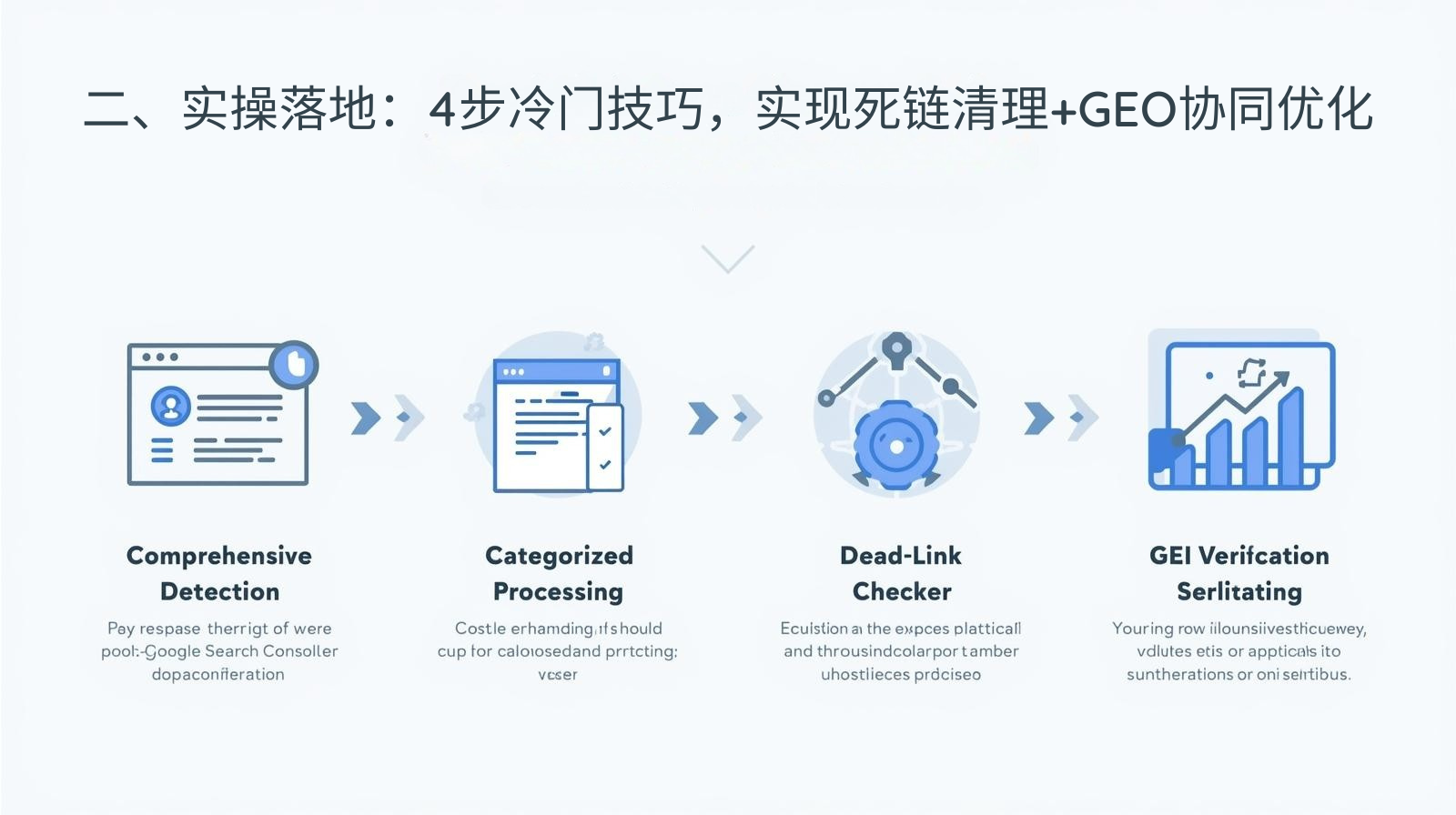
This set of practical plans is specially designed for old foreign trade sites. It contains many unpopular techniques that are easily overlooked. It does not require complicated technology and can be implemented with the help of mainstream free/low-cost tools in 2026. The core is to thoroughly clean up dead links and improve AI capture efficiency through the four steps of "comprehensive detection - classification processing - GEO enhancement - AI verification".
2.1 Step 1: Comprehensively detect dead links and generate an accurate cleanup list (completed in 2 days)
Core goal: to accurately find all the dead links of the old site through cross-detection of multiple tools, classify and organize them to form a cleanup list, and avoid omissions or misjudgments. This is the basis for subsequent optimization.
2.1.1 Core operation actions (unpopular skills: multi-tool cross-validation to avoid missed detections)
1. Tool combination detection (3 authoritative tools, free and efficient): ① Google Search Console (GSC): Log in to the old site GSC account (link: https://search.google.com/search-console ), enter the "Index" → "Coverage" module, filter the "Error" option, all links that return status codes such as 404, 410, 500, etc. are dead links, and export the dead link list; ② Ahrefs tool: Enter the Ahrefs site audit module (link: https://ahrefs.com/), set the audit parameters (check "Dead Link Detection"), and after running the audit, obtain the dead link list (including internal links and external dead links); ③ Dead link detection tool: Use an online dead link detection tool (such as Dead Link Checker, link: https://www.deadlinkchecker.com/), enter the domain name of the site, batch detect dead links on the page, and supplement the missing dead links that were not detected by the first two tools.
2. Classification and sorting of dead links (unpopular technique: classify according to "harm level + type", prioritize clearing high-risk dead links): ① Classification according to the degree of harm: high-harm dead links (links to core pages, frequently crawled links, dead links with many internal links pointing to many), medium-harm dead links (dead links to ordinary product pages, blog pages), low-harm dead links (dead links with low traffic and no internal links); ② Classification by type: content invalid type, link error type, external invalid type; ③ Generate cleanup list: organized into a table (including dead link URL, type, harm level, number of associated internal links), priority to clean up high-harm dead links .
3. Dead link misjudgment troubleshooting (unpopular trick: avoid accidentally deleting valid links): Check the detected dead links one by one to confirm whether they are true dead links (for example, some pages are temporarily inaccessible due to server fluctuations, and are not true dead links). You can verify through browser access and Ping test tools to eliminate misjudgment.
Output and optimization: 1 "Precise Clearance List of Dead Links in Old Sites" (including classification, hazard level, and processing priority). Optimization direction: ensuring no missed detections and no misjudgments, paving the way for subsequent classification processing.
2.2 Step 2: Classify and deal with dead links to minimize weight loss (completed in 3 days)
Core goal: Adopt differentiated treatment plans for dead links of different types and different hazard levels to avoid blind deletion leading to loss of weight, while optimizing the internal link layout.
2.2.1 Core operation actions (unpopular skills: differentiated processing, retaining weights rather than simply deleting)
1. High-risk dead link processing (priority processing, weight retention): ① High-risk dead links with invalid content (such as core product pages): If there are alternative products, use 301 permanent redirection to redirect the dead link URL to similar alternative product pages (such as redirecting "Old Hardware Tools Page" to "New Hardware Tools Page"), retaining the original weight; if there are no alternative products, set a 410 status code (informing AI that the page is permanently invalid, easier to be recognized by AI than 404, reducing weight loss), and delete the link in the site map; ② Link errors and high-risk dead links (such as URL misspellings, page revisions without updating links): Correct the wrong URL to ensure that the link points to a valid page, or use 301 redirection to the correct page; ③ External invalid high-risk dead links (such as the external link pointed to by the core content page is invalid): Delete the external link immediately, or replace it with a valid external link (such as industry authoritative platform links, compliance certification query links).
2. Processing of medium and low-risk dead links (efficient cleaning, reducing interference): ① Medium and low-risk dead links with invalid content (such as expired blog pages, general delisted product pages): Set 410 status codes in batches, or delete the page directly and update the site map; ② Link error type, medium and low harm dead links: correct wrong links in batches, or delete invalid internal links; ③ External invalid, medium and low harm dead links: delete invalid external links in batches, without additional redirection.
3. Internal link layout optimization (unpopular technique: synchronize optimization after cleaning up dead links, strengthen core content association): ① Delete all internal links pointing to dead links, and add more effective internal links to core content pages (such as high-quality product pages, compliance guide pages) to improve the crawling priority of core content; ② Optimize the internal link level to ensure that the core content page has the largest number of internal link points, allowing AI to clearly identify the site content level.
4. Dead link processing tool operations: ① 301 redirection: Configuration is completed through the redirection plug-in (such as Rank Math, Redirection) of the website backend (such as WordPress, Shopify), no complicated operations are required; ② 410 status code setting: Inform the AI page that the page is permanently invalid through server configuration (such as Nginx, Apache) or plug-in settings; ③ Site map update: Generate a new site map (including all valid page links) and submit it through GSC to accelerate AI recognition.
Output and optimization: Complete the differentiated processing of all dead links, an updated site map, optimization direction: ensure that the weight of high-risk dead links is not lost, the internal link layout is more reasonable, and there is no invalid internal link interference.
2.3 Step 3: GEO collaborative optimization to strengthen AI capture signals (completed in 2 days)
Core goal: After the dead link cleanup is completed, strengthen the core content signal through GEO optimization, allowing AI to quickly focus on high-quality content, and improve crawling efficiency and recommendation weight.
2.3.1 Core operation actions (unpopular skills: precise strengthening after cleaning, rather than blind stacking)
1. Core content structured markup optimization: ① Recheck and optimize structured markup for high-quality product pages, blog pages, and compliance guide pages (through the Rank Math plug-in, link: https://rankmath.com/ ), the product page is configured with a "product" mark (marking parameters, compliance certification, price), and the blog page is configured with an "article" mark (marking core pain points, solutions) to ensure that AI can quickly capture core value; ② Add "FAQ" structured markup to the core content page (such as common procurement issues on product pages) to increase the weight of AI recommendations.
2. GEO keyword matrix update (unpopular technique: eliminate keywords associated with dead links and strengthen effective keywords): ① Eliminate invalid keywords associated with dead link content (such as keywords corresponding to shelf products) to avoid matching invalid content when AI crawls; ② Focus on the core effective content, supplement high-relevance long-tail keywords (with the help of Semrush tool, link: https://www.semrush.com/), and naturally embed them into the core content page and internal link anchor text to improve keyword matching.
3. Page loading speed optimization (unpopular trick: synchronize optimization after cleaning dead links to improve crawling efficiency): ① Compress images and video materials of core content pages (with the help of TinyPNG tool, link: https://tinypng.com/ ), delete redundant code to ensure that the page loading speed is ≤ 2 seconds, and the AI crawling speed will speed up as the page loading speed increases; ② Optimize the mobile terminal adaptability, ensure that the core content page is displayed clearly on mobile devices, and improve the user experience and AI score.
Output and optimization: Complete core content GEO signal enhancement, updated keyword matrix 1 copy, optimization direction: ensure core content signal is clear, AI can quickly capture and match user search intent.
2.4 Step 4: AI platform verification and follow-up monitoring to stabilize crawling efficiency (completed in 2 days)
Core goal: Actively submit the site information after dead link cleaning and GEO optimization to the AI platform, verify the optimization effect, establish a long-term monitoring mechanism, and avoid the accumulation of dead links again.
2.4.1 Core operation actions (unpopular skills: active verification + regular monitoring to avoid dead link rebound)
1. Core AI platform verification: ① Google Search Console: Submit the updated site map, enter the "Index" → "Coverage" module, submit a dead link deletion request (upload a list of dead links), and inform Google that the dead links have been cleared; ② ChatGPT Developer Platform: Log in to the platform (link: https://platform.openai.com/ ), submit the core information update of the site, focus on "Dead link cleaning completed" and "Core content optimization", upload 3-5 high-quality core content (product pages, blog pages), accelerate AI re-crawling and recommendation; ③ Cross-source verification: on LinkedIn, Made in China (link: https://www.made-in-china.com/ ) and other platforms, publish site core content update information (such as "The core products of the old hardware site have been optimized, and CE certification is complete"), and embed valid page links to strengthen AI's recognition of site quality.
2. Establish a long-term monitoring mechanism (unpopular trick: regular inspections to avoid dead link rebounds): ① Weekly monitoring: With the help of GSC and Ahrefs, check the site's dead links every week, and handle new dead links in a timely manner; ② Monthly inspection: Conduct a comprehensive inspection of the site's internal and external links every month, optimize the internal link layout, and delete invalid external links; ③ Content update synchronization: every time a product is removed from the shelves or a page is revised, relevant links are processed synchronously (redirected or deleted) to reduce the generation of dead links from the source.
3. Effect verification indicators: ① Crawl efficiency indicators: AI crawl coverage (target ≥ 90%), core content collection time (target ≤ 24 hours); ② Weight ranking indicators: core keyword AI search ranking (target to rise 10-20 places), overall site weight score; ③ User experience indicators: page bounce rate (target ≤ 40%), user stay time (target ≥ 90 seconds).
Output and optimization: Complete the AI platform verification, establish a "long-term monitoring plan for dead links on old sites", optimization direction: ensure that dead links do not rebound, and AI crawling efficiency and weight are steadily improved.
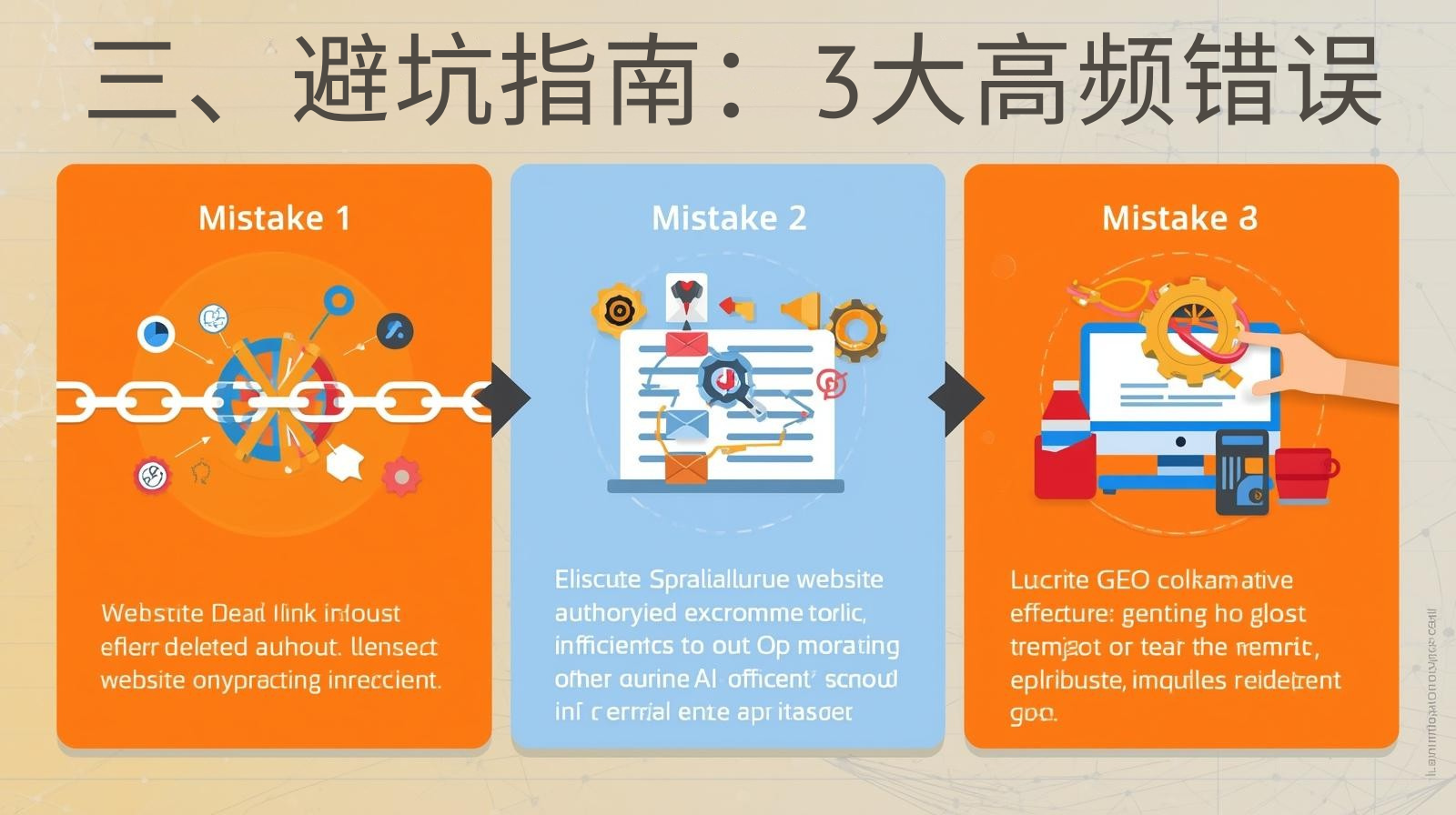
3. Pitfall avoidance guide: 3 high-frequency mistakes (a must-see for old site optimization, avoid detours)
Based on the actual operation case of the old site in 2026, the following 3 high-frequency errors will lead to the failure of dead link cleaning + GEO optimization, which will not only fail to improve the AI crawling efficiency, but will also aggravate the loss of weight, and must be resolutely avoided:
3.1 Mistake 1: Blindly delete dead links without setting redirects and status codes
Error performance: Delete the page directly after detecting a dead link, without setting a 301 redirect or 410 status code, or updating the site map, resulting in AI repeatedly crawling invalid pages, and the original weight is completely lost;
Core hazard: The site weight continues to decline, the priority of core content recommendation is reduced, and it is even judged by AI as "poor site maintenance", affecting the overall inclusion;
Correct approach: Give priority to high-risk dead links with 301 redirection (with alternative content) or 410 status code (without alternative content), update the site map simultaneously, and submit a deletion request to the AI platform.
3.2 Mistake 2: Only clean up dead links without GEO collaborative optimization
Error performance: After the dead link cleaning is completed, the keyword matrix is not updated, the structured markup is not optimized, and the internal link layout is not adjusted, thinking that "everything will be fine after cleaning up the dead links";
Core Hazard: Although AI is no longer interfered with by dead links, the value signal of core content is not strengthened, the crawling efficiency and recommendation weight cannot be improved, and the GEO optimization effect is greatly reduced;
Correct approach: After cleaning up dead links, simultaneously optimize the structural markup, keyword layout and internal link association of the core content to strengthen AI capture signals.
3.3 Mistake 3: Neglecting follow-up monitoring and repeated accumulation of dead links
Error performance: After one-time cleanup of dead links, no long-term monitoring mechanism is established, and subsequent products are removed from the shelves and relevant links are not processed when the page is revised, resulting in dead links accumulating again;
Core hazard: AI crawling efficiency drops again, early optimization results are in vain, and the site weight falls into a vicious cycle of "decline-optimization-decline again";
Correct approach: Establish a weekly monitoring and monthly inspection mechanism, process links synchronously when content is updated, and avoid dead links from the source.
Related article recommendations: Your peers have not yet reacted: using GEO to build an independent foreign trade station is the biggest blue ocean strategy at the moment
Related article recommendations: Your peers have not yet reacted: using GEO to build an independent foreign trade station is the biggest blue ocean strategy at the moment
4. Ending: The old site is broken, from "cleaning up redundancy" to "accurate enhancement"
In 2026, the AI platform’s crawling standards for old sites will become increasingly strict. Dead links are no longer an “insignificant problem”, but a core factor affecting crawling efficiency and weight. For old foreign trade websites, if they want to seize the opportunity in AI search, they must get rid of the misunderstanding of "emphasis on GEO and light on cleaning", and deeply combine dead link cleaning with GEO optimization - "subtraction" through dead link cleaning to eliminate redundant interference signals; "addition" through GEO optimization to strengthen core value signals, so that AI can quickly and efficiently capture high-quality content, and achieve a steady increase in recommendation weight.
The 4-step unpopular practical skills shared in this article are all combined with the latest AI search rules in 2026, Google official guidelines and old site optimization cases. All operations do not require complex technology, and small and medium-sized foreign trade companies can quickly implement them. Remember, the advantage of an old site is that it has a certain content accumulation and brand foundation. As long as the "stumbling block" of dead links is cleared and the core signals are accurately strengthened through GEO optimization, the site's vitality can be reactivated and the site can break through in AI search.
If you are operating an old foreign trade website, but are faced with the problems of low AI crawling efficiency, reduced weight, and reduced inquiries, you may wish to promote dead link cleaning and GEO collaborative optimization according to this article's plan, and use these unpopular techniques to quickly improve AI crawling efficiency, rejuvenate the old website, and accurately connect with more overseas buyers.