The foreign trade voice search survey report released by NetEase News Client in January 2026 shows that currently 62% of overseas foreign trade buyers We are used to searching for suppliers through voice (such as mobile assistants, smart speakers, car systems, etc.). 78% of the voice search results only display 3-5 core answers. For brands that can enter the recommendation pool, the inquiry conversion efficiency is 4.2 times higher than traditional text searches. . At the same time, an IDC report predicts that the global generative AI search market will reach 48 billion yuan in 2026, and voice interaction will account for more than 55%. Voice search is becoming a new blue ocean of traffic for independent foreign trade websites. For foreign trade companies, the core of the combination of GEO (generative engine optimization) and AI voice broadcast content is to adapt brand content to the "colloquial, scene-based, question-and-answer" characteristics of voice search, which not only meets the retrieval rules of AI platforms such as ChatGPT, but also accurately matches the purchaser's voice search intention, achieving the customer acquisition effect of "voice search means priority matching".
1. Core cognition: The matching logic of AI voice search and the key to adapting GEO+ voice broadcasting
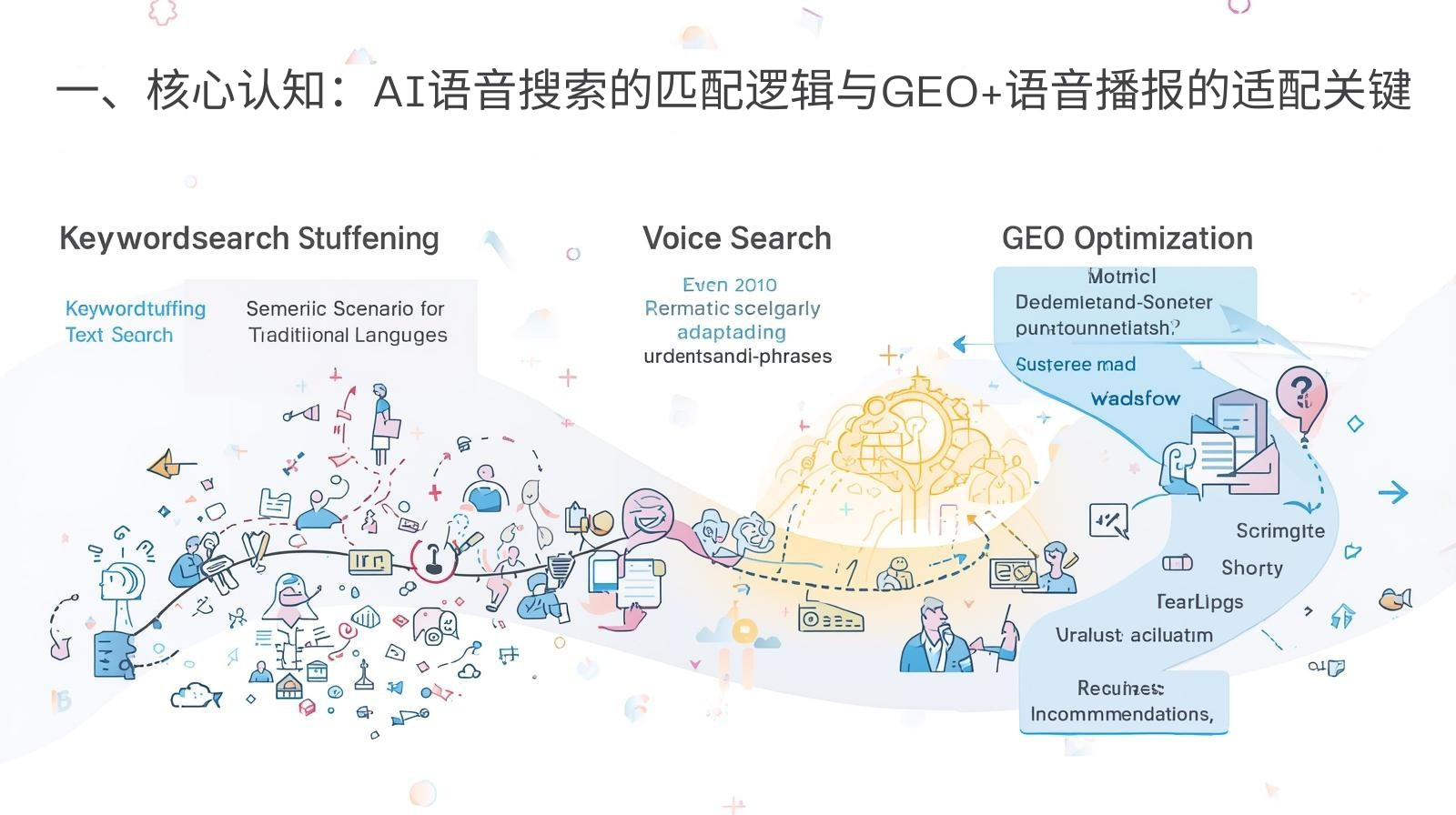
The core difference between AI voice search and traditional text search is that "interaction form and content requirements are different" - text search tends to stack keywords (such as "outdoor lights solar energy foreign trade"), while voice search is closer to natural dialogue (such as "Are there any foreign trade suppliers of solar outdoor lights that support small batch purchases?"). This difference determines that the optimization logic of voice broadcast content must shift from "keyword adaptation" to "semantic scene adaptation". The core value of GEO optimization is to allow the AI platform to quickly identify the value of such voice-friendly content and include it in the voice search priority recommendation pool. Many independent foreign trade websites fall into the misunderstanding of "converting text content directly to speech", resulting in blunt content that cannot match the voice search intent. Even after GEO optimization, it is difficult to obtain voice recommendation weight.
1.1 Three core logics for priority matching of AI voice search in 2026
Combining the Google Voice Search Optimization Guide and ChatGPT Voice Retrieval Rules, the AI platform will prioritize content screening according to the following three dimensions when matching voice search results. This is also the core basis for GEO+ voice broadcast content optimization:
1. Semantic Adaptability: Prioritize content that can directly answer voice questions, and the expression is natural and colloquial, without stiff keyword stacking. For example, when a buyer asks "How to judge whether a foreign trade supplier is compliant?", content that can clearly give 3-4 core judgment standards is more likely to be recommended than content that simply lists "compliance certification, qualification documents";
2. Content structure: Prefer content with a clear structure and prominent focus, especially a "question-and-answer structure" (asking questions first, then giving clear conclusions, and finally adding explanations). This structure allows AI to quickly capture core answers and facilitate direct presentation during voice broadcast;
3. Trust in authority: Give priority to recommending content with high credibility, including content with traceable compliance certification, real cooperation cases, and authoritative data support. At the same time, there are strict requirements for page loading speed and mobile adaptability (most voice search users are mobile scenarios).
1.2 Four core adaptation principles of GEO+AI voice broadcast content
To achieve priority matching in voice search, GEO optimization and voice broadcast content must follow the four principles of "colloquial, scenario-based, question-and-answer, and verifiable", and none of them can be missing:
1. Colloquial expression: The content expression is close to natural dialogue and avoids the accumulation of professional terms. For example, "can also receive orders in small batches" instead of "support minimum order quantity", and "the product can successfully pass European customs clearance" instead of "comply with EU CE certification standards";
2. Scenario-based coverage: Create content around common voice search scenarios of buyers, such as procurement preparation scenarios ("What should I pay attention to when purchasing foreign trade products for the first time?"), product selection scenarios ("Which material is better for outdoor solar lights?"), and compliance clearance scenarios ("What certifications are required for electronic products exported to the United States?");
3. Question-and-answer structure: The core content adopts the structure of "question + clear answer + supplementary explanation". Each question is limited to 1-2 sentences of explanation, which is convenient for AI to capture and voice broadcast;
4. Verifiable enhancement: Incorporate traceable trust signals into the content, such as compliance certification with official query links, and cases containing real scene descriptions, to improve AI's judgment of the authority of the content.
1.3 Core optimization misunderstandings (voice search matching hardest hit area)
Based on the 2026 foreign trade practical cases, the following three misunderstandings will directly cause the voice broadcast content to be unable to be prioritized by AI, and even if GEO optimization is done, it will have no effect: First, the text content is directly converted into speech, with blunt expressions and no question and answer structure. , unable to match the intent of voice search; second, the content focuses on product promotion and is not created around the buyer's pain points and problems. For example, it only introduces "product materials and prices" and does not answer "what scenarios is the product suitable for" and "what is the procurement process"; third, mobile adaptation and loading speed are ignored. Most voice search users are in mobile scenarios, and the page loading speed exceeding 3 seconds will directly reduce the recommendation weight. .
2. Practical implementation: 4 steps to create GEO+AI voice broadcast content to achieve priority matching in voice search
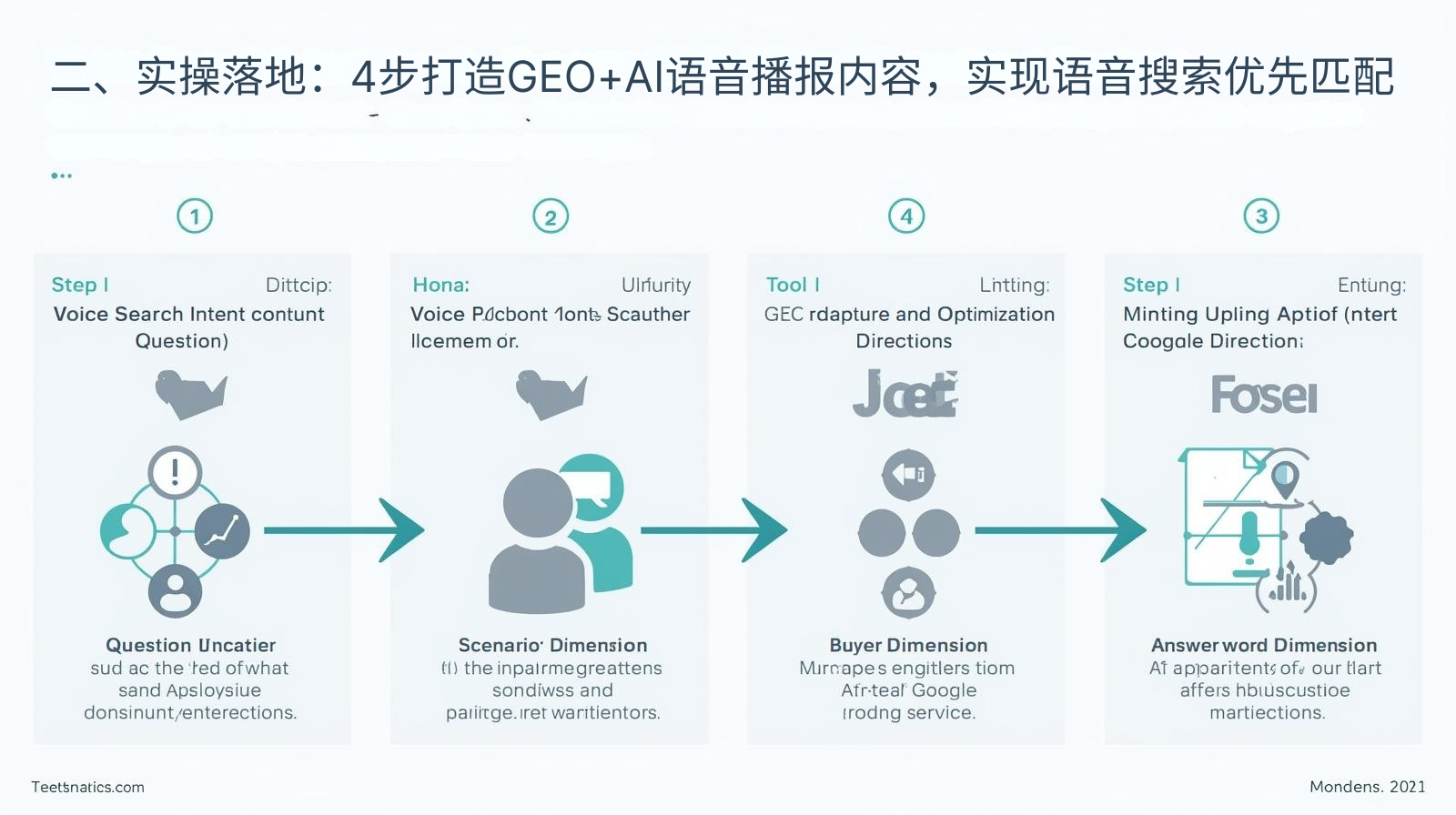
This solution fully fits the actual operation scenario of independent foreign trade stations. It does not require complicated technology and can be implemented directly. The core is through the four steps of "voice search intent mining-voice broadcast content creation-GEO adaptation optimization-AI platform docking verification", so that brand content can be quickly recognized by AI and accurately match the purchaser's voice search needs.
2.1 Step 1: Dig out buyers’ voice search intentions and lock in the core optimization direction (completed in 1-2 days)
Core goal: to accurately mine buyers’ voice search scenarios and problems for their own products, provide a basis for voice broadcast content creation and GEO keyword layout, and avoid blind optimization.
2.1.1 Core operation actions
1. Three major dimensions for mining voice search problems: ① Question word dimension: focusing on question words such as "how, whether, need, when, which", combined with core product mining questions (such as "How to find a reliable foreign trade supplier of outdoor products?" "Do solar lights export to Europe require CE certification?"); ② Scenario dimension: dismantle the buyer’s full-process scenarios (purchasing preparation, product selection, compliance clearance, delivery and after-sales), and explore 3-5 high-frequency voice questions for each scenario (such as delivery after-sales scenario: "How long is the delivery cycle of foreign trade suppliers?" "How to deal with product quality problems?"); ③ Tool dimension: Use Answer the Public (free tool) to enter core product words (such as "solar outdoor" light"), obtain commonly used voice questions from buyers, and view recommended questions related to voice search through Google's autocomplete function.
2. Speech keyword matrix construction: ① Core keyword conversion: Convert traditional core words (such as "solar outdoor light foreign trade") into speech-friendly sentences (such as "solar outdoor light foreign trade supplier recommendation" "solar outdoor light supplier that supports small batch procurement"); ② Long-tail keyword mining: Extract long-tail keywords (such as "European CE-certified solar outdoor light supplier" and "How long is the delivery cycle of foreign trade suppliers" around the voice issues being mined); ③ Keyword verification: Use the Google Keyword Planner tool to screen voice-friendly keywords with a monthly search volume of 30-500 and low competition to ensure optimized cost performance.
3. Optimization direction locking: Organize and form a "List of Buyer Voice Search Questions and Keywords" to clarify the core answers and content creation directions corresponding to each question to ensure that subsequent content creation accurately matches needs.
2.2 Step 2: Create AI voice-friendly broadcast content to adapt to voice search needs (completed in 2-3 days)
Core goal: Create "colloquial, scene-based, question-and-answer" voice broadcast content around the excavated questions and keywords, and integrate trust signals to ensure that the content can be captured by AI and quickly recognized by buyers.
2.2.1 Core operation actions
1. Core content types and creation specifications: ① Product page Q&A module: Add a "Purchasing FAQ" block in the middle or bottom of the product page. Each question corresponds to 1-2 colloquial answers (for example, question: "Does this product support small batch purchasing?" Answer: "Yes, our minimum order quantity is 50 pieces. It is especially suitable for cross-border e-commerce sellers and small wholesalers. It can be shipped within 7 days after the order is placed."). Each question naturally incorporates 1-2 long-tail keywords; ② Blog topic content: Create a question-and-answer blog around core scenarios (such as "2026 Foreign Trade Procurement of Solar Lights Must-Read: Answers to 5 High-Frequency Questions"), using a "total-point" structure. The core value is summarized at the beginning, each question in the middle is divided into separate paragraphs, the answers are clear, and guiding content is added at the end (such as "If you need to obtain an exclusive procurement plan, you can directly consult our customer service by voice or text"); ③ Brand introduction voice content: Optimize About On the Us page, add a colloquial statement about the brand's core advantages (such as "We are a foreign trade supplier specializing in solar outdoor products, with 10 years of export experience. Our products have passed CE and FDA dual certifications, support small batch customization and fast delivery, and are the preferred partner for many overseas buyers").
2. Optimization of voice broadcast effect: ① Standard expression: avoid splitting long sentences, control each sentence within 15 words, the expression is natural and smooth, and there is no stiffness in reading; ② Strengthening of key information: core advantages (such as compliance certification, delivery cycle, small batch support) are given priority in the answer, and keywords can be repeated appropriately (but not stacked); ③ Use SSML to optimize the speech synthesis effect: fine-tune the speech rate, pitch and pause of the voice broadcast through Speech Synthesis Markup Language (SSML) to make the synthesized speech more natural, such as setting a short pause at the core advantage to highlight the key points without complicated operations. After optimization is completed through the online SSML editor, it can be embedded in the page content.
3. Trust signal integration: ① Compliance certification: When certification is mentioned in the answer, an official query link is attached (such as "Our products have passed the EU CE certification, which can be obtained through https://ec.europa.eu/growth/tools-databases/nando/index.cfm?fuseaction=notifiedbody.main Official website to check the authenticity of the certification"); ② Case support: Some of the answers to questions incorporate real cases (such as "Many European cross-border e-commerce sellers cooperate with us, for example, a German seller purchases 200 pieces every month, and the product customs clearance is very smooth, and the customer praise rate is very high"); ③ Data support: Use specific data to enhance credibility (such as "Our delivery cycle is stable at 7-10 days, and the on-time delivery rate is as high as 98%").
2.3 Step 3: GEO adaptation optimization to allow AI to quickly capture voice broadcast content (completed in 1-2 days)
Core goal: Through optimization such as structured markup, keyword layout, and page adaptation, the AI platform can quickly identify the core value and voice-friendly attributes of voice broadcast content, and improve the weight of voice search recommendations.
2.3.1 Core operation actions
1. Structured markup configuration: ① Install Rank The Math plug-in configures exclusive structured tags for voice broadcast content, configures "FAQ" tags for product page Q&A modules, configures "Article" tags for blog topic content, and configures "Organization" tags for brand introduction voice content to mark core questions, answers, keywords and other information, allowing AI to quickly capture the core of the content; ② Configure "Speech" tags for SSML voice content to mark the language, speaking speed, pitch and other parameters of the voice broadcast to improve AI's recognition efficiency of speech content.
2. Precise keyword layout: ① Page title: Naturally integrated into voice-friendly core keywords (such as "Solar outdoor lights foreign trade supplier_Support small batch procurement_CE certification"); ② Content layout: Long-tail keywords are naturally embedded in the question and answer module of the product page and blog content to avoid stacking; ③ URL optimization: The blog page URL contains core keywords (such as "solar-outdoor-light-foreign-trade-faq") to facilitate AI to identify the content theme.
3. Page adaptation optimization: ① Mobile adaptation: Ensure that the page is clearly displayed on mobile devices such as mobile phones and tablets, the Q&A module is easy to browse, and the voice play button (if needed) is in a prominent position; ② Loading speed optimization: Compress page images and voice materials (use the TinyPNG tool to compress images) to ensure page loading speed ≤ 2 seconds, adapting to the mobile usage scenarios of voice search users; ③ Voice playback entrance optimization: Add a voice playback button to core pages (product pages, blog pages), labeled "Click to listen to purchasing FAQs" to improve user experience, while allowing AI to recognize the voice-friendly attributes of the page.
2.4 Step 4: AI platform docking and effect verification to ensure priority matching (completed in 1 day)
Core goal: actively submit voice broadcast content to the AI platform, verify the optimization effect, adjust the optimization strategy in a timely manner, and ensure that the content can stably enter the voice search recommendation pool.
2.4.1 Core operation actions
1. Core AI platform docking: ① ChatGPT developer platform: login platform (https://platform.openai.com/ ), register a corporate account, and when submitting the core information of the independent site, focus on tags such as "voice-friendly content" and "purchasing Q&A content", upload 3-5 core voice broadcast content (product Q&A, blog topics), submit for review, and accelerate AI inclusion and recommendation; ② Google Search Console: Submit site map (including all voice broadcast content pages), submit FAQ, Article and other structured data in the "Enhanced Results" module to ensure that Google SGE can recognize and recommend voice search results; ③ Cross-source verification: Publish content related to voice search (such as "FAQ on Purchasing Solar Outdoor Lights") on platforms such as LinkedIn and Made-in-China (https://www.made-in-china.com/), and embed links to independent sites to allow AI to confirm the authenticity and authority of the content through multi-source verification.
2. Effect verification and optimization adjustment: ① Core verification indicators: voice search keyword ranking (whether core keywords enter the TOP5 of AI voice search), voice playback volume, page dwell time, consultation conversion rate; ② Tool monitoring: with the help of Google Analytics monitors the source of page visits (whether there is AI voice search entrance traffic), and monitors the ranking changes of core keywords through Ahrefs; ③ Iterative optimization: if the core keywords have not entered the recommendation pool, optimize the colloquial degree and question-and-answer structure of the content; if the page stay time is short, add more detailed answers and cases; if the consultation conversion rate is low, optimize the introductory content and consultation entrance.
3. Pitfall avoidance guide: 3 major high-frequency optimization mistakes (must read, avoid detours)
Based on the practical cases of foreign trade independent stations in 2026, the following 3 high-frequency errors will directly lead to the failure of GEO+AI voice broadcast content optimization, and the voice search priority matching cannot be achieved, and must be resolutely avoided:
3.1 Mistake 1: The text content is directly converted to speech, and the expression is blunt and unadapted
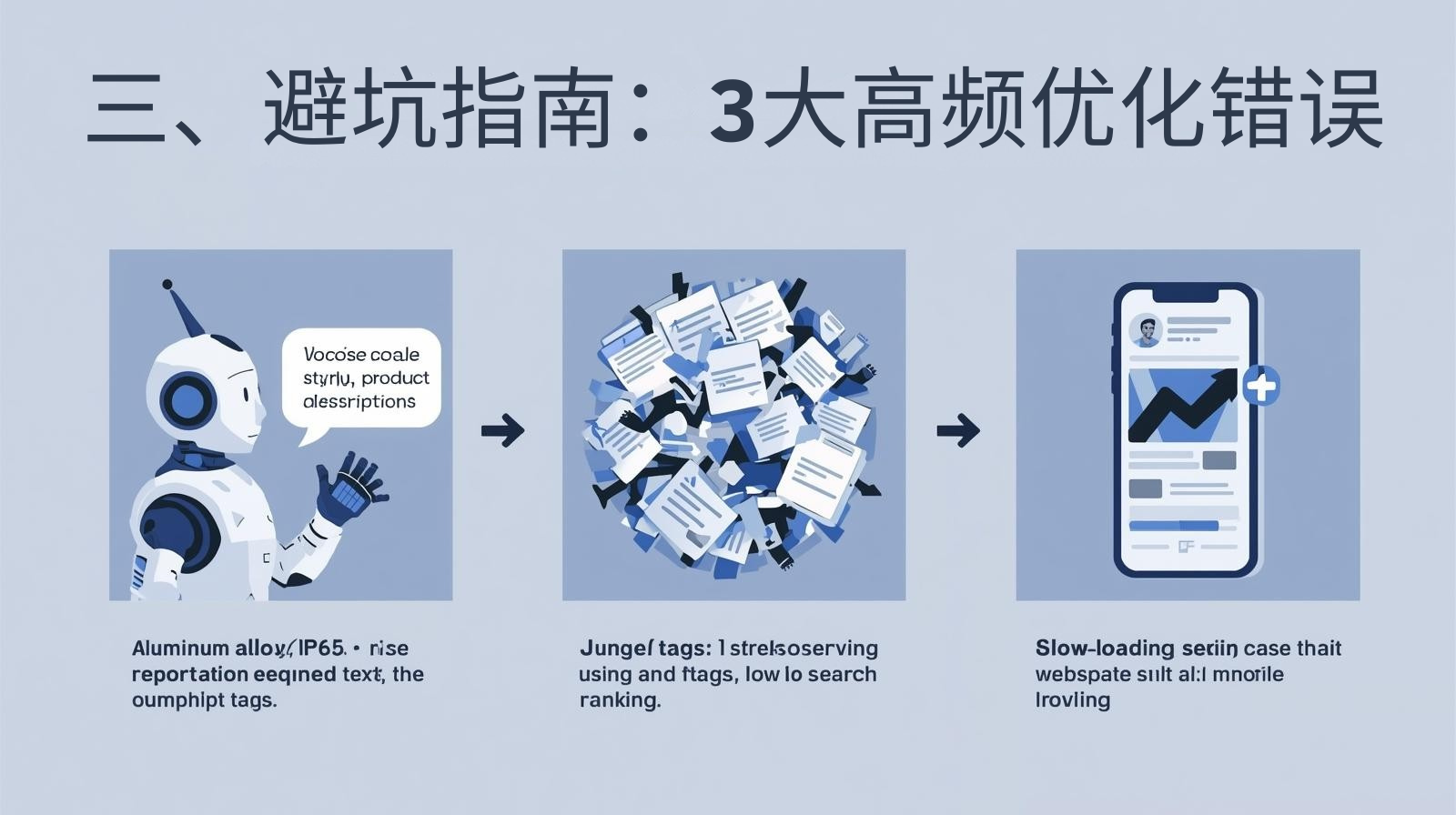
Error performance: The text description on the product page (such as "Product material: aluminum alloy, waterproof grade: IP65, minimum order quantity: 50 pieces") is directly converted into voice content. The expression is blunt, has no question and answer structure, and cannot match the purchaser's voice search intention;
Core hazard: AI cannot identify the voice-friendly attributes of the content. Even if it is included, it will not be included in the voice search recommendation pool, and buyers cannot match the brand when searching by voice;
Correct approach: Create exclusive content around buyers’ voice questions, and use colloquial expressions and question-and-answer structures to ensure that the content is natural and smooth and meets the needs of voice search.
3.2 Mistake 2: Ignoring structured markup, AI cannot capture core content
Error performance: High-quality voice broadcast content is created, but structured tags such as FAQ and Article are not configured. AI cannot quickly capture core questions and answers, and can only be included as ordinary text content;
Core hazard: The content cannot obtain voice search recommendation weight, the core keyword ranking is always low, and priority matching cannot be achieved;
Correct approach: Use plugins such as Rank Math to configure exclusive structured tags for different types of voice broadcast content to ensure that AI can quickly identify core values.
3.3 Mistake 3: Slow page loading and poor mobile adaptation
Error performance: The page pictures and voice materials are not compressed, the loading speed exceeds 3 seconds, the mobile page layout is confusing, and the Q&A module and voice playback entrance are difficult to find;
Core hazard: Voice search users are mostly mobile scenarios, slow loading and poor adaptation will cause users to jump out quickly, and AI will reduce the weight of recommendations due to poor user experience;
Correct approach: Compress the page materials, optimize the loading speed, ensure that the mobile page is well adapted, and the core content and voice playback entrance are prominently located.
Related article recommendations: Your peers have not yet reacted: using GEO to build an independent foreign trade station is the biggest blue ocean strategy at the moment
Related article recommendations: Your peers have not yet reacted: using GEO to build an independent foreign trade station is the biggest blue ocean strategy at the moment
4. Ending: In the era of voice search, let GEO+ voice broadcast become a new engine for brand customer acquisition
In 2026, voice search has changed from "optional" to "required", and the interaction habits of overseas buyers are shifting from "text input" to "voice conversation." If independent foreign trade stations want to seize the traffic dividend, they must do a good job in deep integration of GEO and AI voice broadcast content. The core of GEO optimization is not simply keyword ranking, but allows the AI platform to quickly identify the voice-friendly attributes and core values of the content; the core of the voice broadcast content is not "the ability to speak", but "the ability to accurately match the purchaser's voice search intent, allowing AI to give priority to recommendations."
The 4-step practical plan shared in this article combines the latest voice search rules, authoritative reports and practical cases in 2026. All operations do not require complex technology, and can be quickly implemented by small and medium-sized foreign trade companies and foreign trade SOHOs. Remember, the core competitiveness of voice search is "adaptation of scenarios and questions and answers." As long as you create content around the real voice needs of buyers, and do a good job of GEO adaptation and docking with the AI platform, your brand can achieve priority matching when buyers search for foreign trade suppliers by voice, and quickly obtain accurate inquiries.
As the AI search ecosystem continues to iterate, whoever can take the lead in adapting to voice interaction scenarios will stand out in the homogeneous competition and become the preferred brand for overseas buyers. Take action immediately and promote optimization according to the plan in this article, so that your independent website can seize the opportunity in voice search and let accurate inquiries come to your door.