
A report titled "AI Platform Content Recommendation Trends Report" released by OpenAI and Ahrefs in February 2026 revealed that when foreign trade buyers obtained supplier information through AI platforms (ChatGPT, Google SGE, etc.), 78% of clicks were concentrated in AI recommendation slots (including related recommendations, similar brand recommendations, and supplementary information recommendations), while only 22% of clicks came from active search results page ranking. This means that for independent foreign trade websites to gain more AI exposure and capture the attention of target buyers, simply optimizing search rankings is far from enough. They must also thoroughly understand the AI content recommendation mechanism and, through GEO (Generative Engine Optimization) adaptation rules, proactively display brands in AI-related recommendation slots. This achieves a dual breakthrough of "search exposure + recommendation exposure," overcoming the operational dilemma of "low search ranking and insufficient exposure" for foreign trade websites, and allowing high-quality brands to be discovered by more targeted buyers.
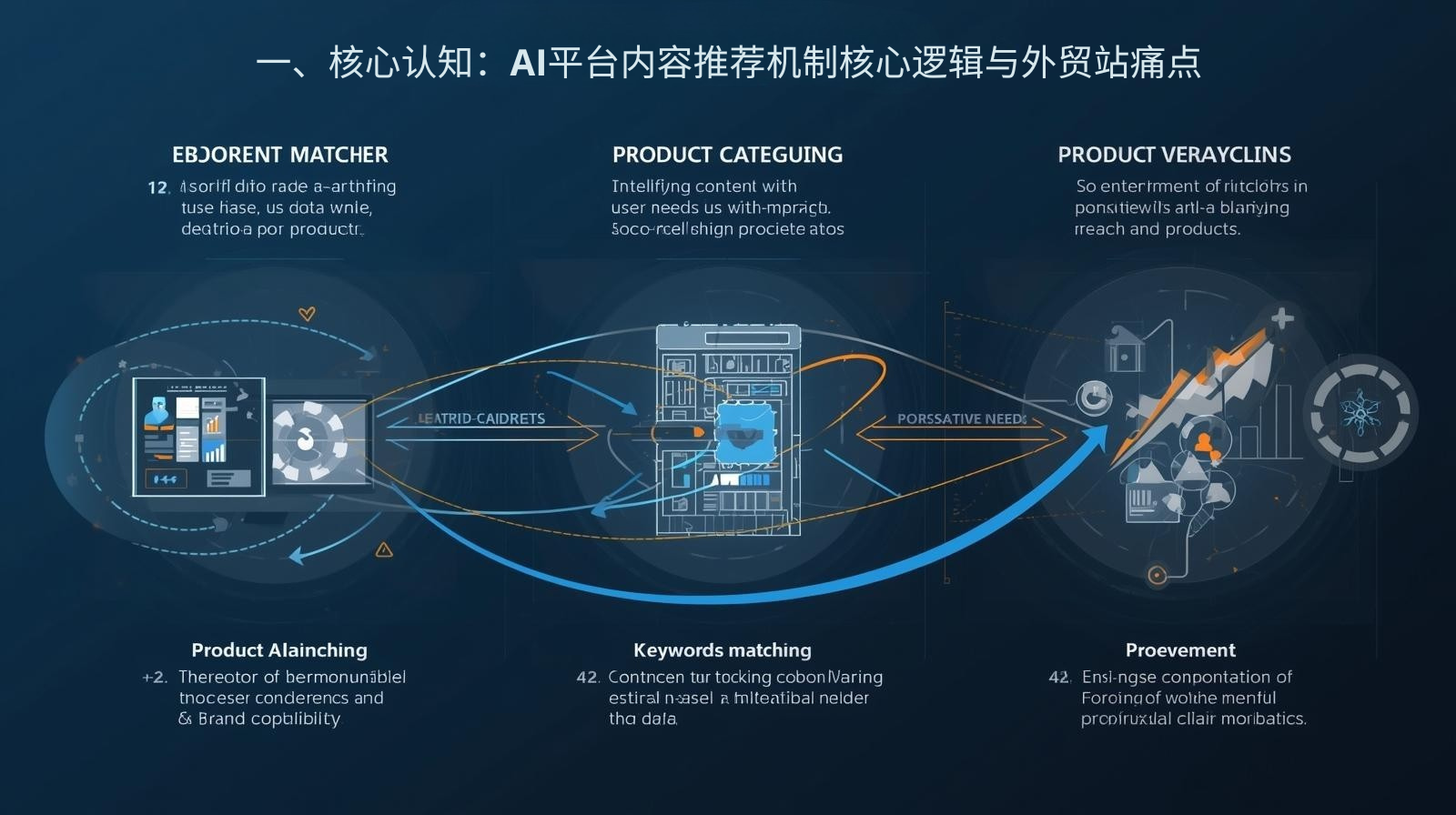
I. Core Understanding: The Core Logic of AI Platform Content Recommendation Mechanism and Pain Points of Foreign Trade Websites
AI-powered content recommendations are not random; they are based on intelligent algorithms that match user needs, determine content value, and filter brand credibility. The core principle is "precise targeting and proactive push." When buyers search for a specific type of foreign trade product or browse related content, AI uses its own recommendation rules to push highly relevant brands, products, and content. Whether a foreign trade website can enter the recommendation pool and appear in a featured position depends on whether it meets the core requirements of the AI recommendation mechanism. The reason most foreign trade websites fail to gain exposure through AI recommendations is that they haven't fully grasped the recommendation rules, and their content and GEO optimization don't align with AI's judgment standards, preventing them from entering the AI recommendation pool.
1.1 Three Core Rules for AI Platform's Foreign Trade Content Recommendation (Latest Mechanism in 2026)
Based on OpenAI's February 2026 updated "Generative Content Recommendation Mechanism Specification" (link: https://platform.openai.com/docs/guides/generative-search/recommendation-mechanism) and practical verification in the foreign trade industry, AI platforms such as ChatGPT and Google SGE, for recommending foreign trade content, adhere to three core rules, which are also the core basis for GEO+AI optimization and directly determine whether a brand can appear in the recommendation position:
1. Strong Relevance Rule: AI prioritizes recommending content and brands that are highly relevant to the buyer's current search needs and browsing behavior. The higher the relevance, the higher the recommendation priority. The core judgment dimensions include keyword matching, product category matching, and matching of procurement needs (such as customization, MOQ, compliance). This is the basis for entering the AI recommendation pool.
2. Content Value Priority Rule: AI will prioritize recommending brands and content with high quality and clear value. In the context of foreign trade, the core standards for high-quality content are "concrete product selling points, complete compliance certifications, and verifiable case studies," rather than general statements. Refer to Hugo.com's 2026 Guide to Optimizing AI-Recommended Content for Foreign Trade (link: https://www.cifnews.com/).
3. Interaction and Credibility Endorsement Rules: AI will combine user interaction data (clicks, dwell time, consultation conversion) and brand credibility (compliance certification, industry endorsement, user reviews) to determine whether to push a recommendation slot. The better the interaction data and the higher the credibility, the easier it is to obtain long-term recommendations, which is the key to consolidating the recommendation slot.
1.2 Four Core Pain Points Why Independent Foreign Trade Websites Cannot Enter AI Recommendation Slots
Based on a practical survey of independent e-commerce websites in 2026, most websites struggled to appear in AI platform recommendation slots. This stemmed from four main pain points, which directly prevented websites from entering the AI recommendation pool or from receiving long-term recommendations after entry. These pain points require targeted solutions:
1. Misunderstanding the recommendation rules and blindly optimizing: equating AI recommendation slots with search rankings and only optimizing keyword sorting without adapting to the AI recommendation rules of "demand relevance, content value, and interactive endorsement" will result in failure to enter the AI recommendation pool;
2. Content is highly homogenized and lacks core value: Product pages and information pages plagiarize competitors' content, merely listing parameters and general selling points, without concretely presenting compliance certifications and real-world cases. AI judges the content to be of low value and fails to recommend it.
3. Lack of GEO recommendation signals: GEO signals that are not configured to adapt to AI recommendation mechanisms are not configured. The content lacks clear semantic connections and structured tags. AI cannot accurately identify the core value of the content and brand positioning, making it difficult to match the needs of buyers.
4. Neglecting interaction and credibility building: Focusing only on content optimization without guiding user interaction, lacking authoritative compliance certification, user reviews, and other endorsements, even if it enters the recommendation pool, it will be disqualified by AI due to poor interaction data and insufficient credibility.
1.3 The Exclusive Value of GEO Optimization in Seizing AI Recommendation Spots
The core value of GEO (Generative Engine Optimization) is not simply optimizing search rankings, but rather precisely adapting to AI-generated recommendation mechanisms to help foreign trade websites "thoroughly understand and align with the rules," quickly entering the AI recommendation pool and solidifying their recommended positions. For independent foreign trade websites, the exclusive value of GEO optimization lies in three aspects: First, through precise keyword layout and semantic association, it enhances the relevance of content to buyers' needs, helping them enter the recommendation pool; second, through content value optimization and structured tagging configuration, it strengthens AI's judgment of content value, increasing recommendation priority; and third, through enhanced credibility signals and interactive guidance, it solidifies recommended positions, achieving long-term recommended exposure. As stated in the Global Sources 2026 Foreign Trade AI Operations Report (link: https://www.globalources.com/), "AI recommendation positions are a new incremental entry point for foreign trade websites, and GEO optimization is the core bridge connecting to this entry point. Thorough understanding of the rules + precise optimization are essential for brands to continuously appear in recommended positions."
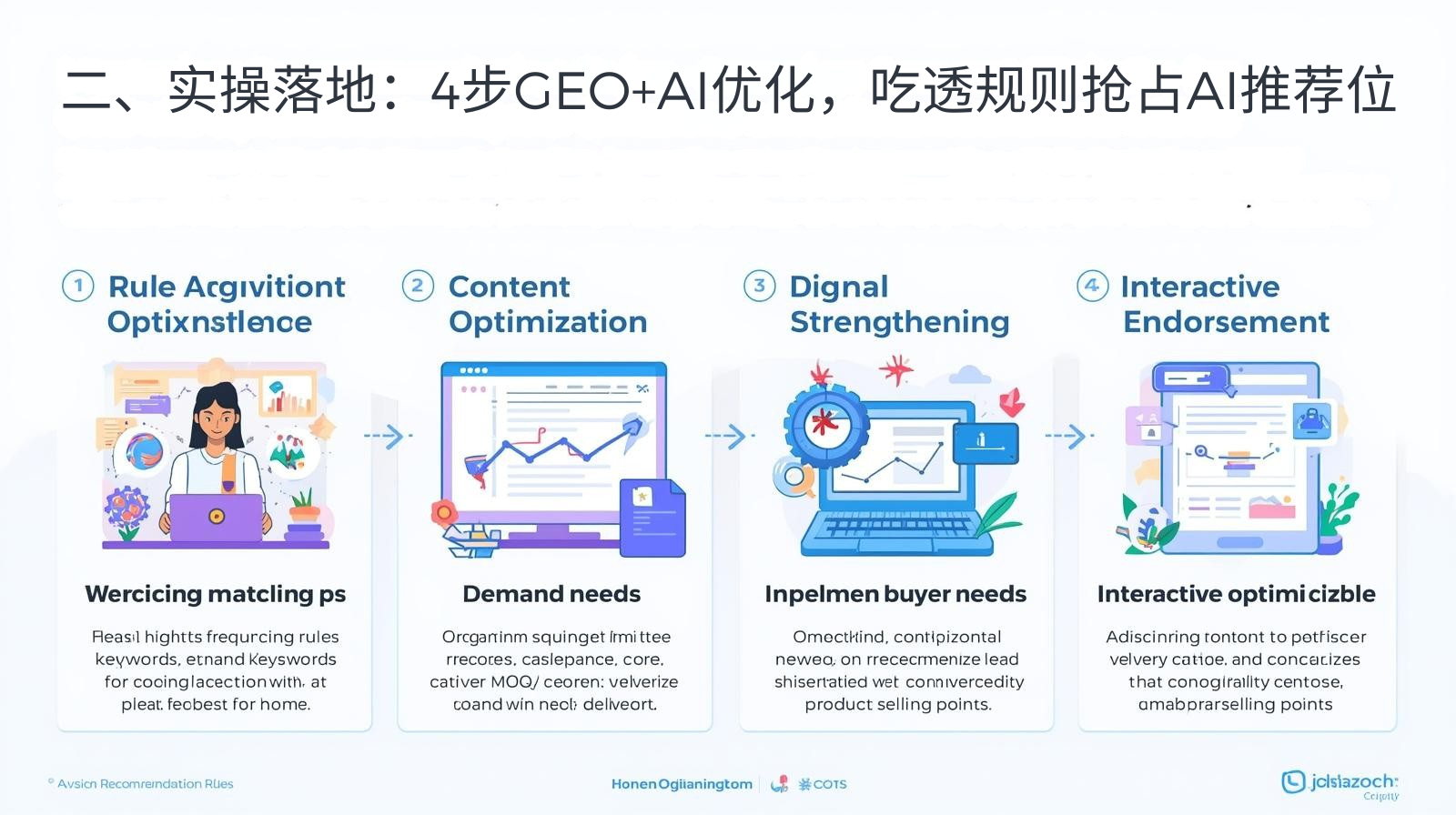
II. Practical Implementation: 4 Steps to GEO+AI Optimization, Mastering the Rules to Seize AI Recommendation Spots
This solution aligns with the multi-platform AI content recommendation mechanism of 2026, providing a complete textual description of the practical steps, avoiding code manipulation. It focuses on four core aspects for foreign trade websites: "rule adaptation, content optimization, signal enhancement, and interactive endorsement." Each step incorporates authoritative backlinks specific to foreign trade, ensuring strong practicality and direct implementation. Whether for new or established websites, this solution can be applied to thoroughly understand AI recommendation rules and allow brands to proactively appear in relevant recommendation positions on AI platforms, achieving dual exposure.
2.1 Step 1: Thoroughly Understand the Recommendation Rules – Accurately Align with the Core Requirements of AI Recommendation
Core objective: Say goodbye to "blind optimization," accurately interpret the three core rules of AI recommendation, combine them with the needs of foreign trade buyers, clarify the direction of site optimization, and ensure that every step of optimization is in line with the AI recommendation logic to avoid wasting resources. This is the basic prerequisite for entering the AI recommendation pool.
2.1.1 Core Operation Actions
1. Rule Decomposition and Demand Matching: ① Implementation of Rules with Strong Demand Relevance: Using Semrush (link: https://www.semrush.com/), analyze the high-frequency search keywords and search intents of buyers in 2026 (e.g., the core intent of "customized genuine leather accessories" is small-batch customization and compliance), and sort out the core needs of buyers (compliance, customization, MOQ, delivery time) to ensure that the site content and products are highly matched with these needs; ② Implementation of Content Value Rules: Clarify the standards for high-quality AI content in foreign trade, abandon general content, and focus on "concretizing product selling points, complete compliance certifications, and real cases." For example, product pages should focus on materials, craftsmanship, and compliance certifications, while information pages should focus on industry insights and purchasing skills, rather than irrelevant content; ③ Implementation of Interaction and Credibility Rules: Plan the direction of interaction guidance and credibility building, such as adding consultation buttons to product pages, adding user reviews to case study pages, and adding compliance certification labels to the homepage;
2. Recommendation Pool Threshold Adaptation: ① Content Compliance Optimization: Ensure all content on the site complies with the compliance requirements of the target market (such as EU REACH, US FDA), and add a compliance certification query link (link: https://ec.europa.eu/growth/single-market/european-standards/ce-marking_en) to avoid being excluded from the recommendation pool due to compliance issues; ② Content Originality Guarantee: All content (product descriptions, information, case studies) is original, avoiding plagiarism from competitors, with an originality of ≥90% (detected by Copyscape tool, link: https://www.copyscape.com/), and AI will give zero recommendations to plagiarized content; ③ Site Basic Optimization: Compress images using TinyPNG (link: https://tinypng.com/) and configure global CDN acceleration (such as Cloudflare, link: https://www.cloudflare.com/) to ensure overseas loading speed is ≤2 seconds. Sites with loading speeds below the standard will be directly excluded from the recommendation pool;
3. Competitor Analysis: Using Ahrefs tools (link: https://ahrefs.com/), analyze competitor sites that have already entered the AI recommendation slot, dissect their content optimization, keyword layout, and credibility endorsement strategies, learn from their strengths, avoid their weaknesses, focus on analyzing competitors' content value presentation and interactive guidance methods, and formulate your own optimization plan.
2.1.2 Key Points of Practical Application
The core of thoroughly understanding the rules is "implementation," not just interpretation. Each rule must correspond to specific optimization actions to avoid "armchair theorizing." Demand matching must be precise, focusing on the core needs of buyers in 2026 and avoiding the blind piling up of irrelevant content. The recommendation pool thresholds (compliance, originality, loading speed) are fundamental and must be met first; otherwise, subsequent optimizations will be ineffective. Competitor analysis should focus on "learning from their strengths," not copying them. Combine your own brand characteristics to create differentiated content and enhance your recommendation competitiveness.
2.2 Second Step: GEO Content Adaptation – Creating High-Quality Content that Meets Recommendation Criteria
Core objective: Based on AI recommendation rules, create foreign trade-specific content that is "highly relevant to demand and of high value." Through GEO optimization, ensure that the content accurately matches the needs of buyers and is judged as high-quality content by AI, thereby increasing the probability of entering the recommendation pool. This is the core step in securing a recommendation spot.
2.2.1 Core Operation Actions
1. Product Page Content Optimization (Core Focus): ① Concretize Selling Points and Relate Them to Needs: Each product page should present its core selling points in detail using coherent text, accurately addressing the needs of buyers. Example: "This product is a compliant genuine leather accessory for European and American export markets. It uses imported Italian top-grain genuine leather, has passed SGS material testing (link: https://www.sgsgroup.com/) and EU REACH certification, supports small-batch customization (MOQ50), and offers a fast 15-day delivery time. It perfectly meets the purchasing needs of cross-border e-commerce sellers and offline physical stores, solving the core pain points of buyers' 'small batch, high compliance, and fast delivery' needs." ② Enrich Content: Add detailed product descriptions, compliance certification displays, real cooperation cases, customization processes, and after-sales guarantees to enhance content depth and make AI recognize the value of the content. ③ Keyword Layout: Naturally integrate high-frequency keywords and long-tail keywords for 2026, focusing on "product + need" keywords (such as "compliant genuine leather accessory customization" and "small-batch export accessories") to ensure a high degree of relevance to buyers' search needs.
2. Optimization of Information Page Content: ① Precise Targeting: The information page focuses on the core needs of foreign trade buyers, publishing content such as "compliance guidelines, procurement tips, and industry trends," such as "Detailed Explanation of Compliance Requirements for Genuine Leather Accessories in Europe and America in 2026" and "Tips for Avoiding Pitfalls in Small-Batch Procurement in Foreign Trade," avoiding the publication of irrelevant information; ② Value Output: Each article provides practical value, such as compliance guidelines that clarify specific compliance standards, procurement tips that provide actionable methods, and cite authoritative reports (link: https://www.globalources.com/) to enhance the credibility of the content; ③ Related Guidance: Add relevant product links at the end of the information page to guide users to browse product pages, improve the relevance between content and products, and help the content enter the recommendation pool;
3. Brand Content Optimization: Build dedicated pages for "Brand Introduction" and "Cooperation Cases" to present the brand's strength, production qualifications, cooperative clients (with privacy settings removed), and client feedback in detail. Add industry endorsements (such as a link to Made-in-China.com: https://www.made-in-china.com/) to gain AI recognition of brand credibility and improve recommendation priority. The content presentation should be smooth, with relatively long lines of text and avoid splitting into short sentences to suit the reading habits of buyers.
2.2.2 Key Points of Practical Application
The core of content adaptation is "demand relevance + value output." Avoid blindly piling up content; each piece must align with the buyer's needs and deliver practical value. Product pages are the core, focusing on optimizing the visualization of selling points and compliance endorsements. Information pages are secondary, focusing on improving user retention and related guidance. All content must be original and compliant, with authoritative external links added to ensure verifiability, allowing AI to quickly determine content quality and increase the probability of it entering the recommendation pool.
2.3 Step 3: Recommendation Signal Enhancement – Enabling AI to Quickly Identify and Push Recommended Positions
Core objective: For optimized high-quality content, supplement it with GEO signals adapted to the AI recommendation mechanism, improve structured tagging, semantic association, and credibility signals, so that AI can quickly identify the core value of the content, brand positioning, and relevance to needs, and proactively push the brand to relevant recommendation positions. This is the key to seizing recommendation positions.
2.3.1 Core Operation Actions
1. Structured Tagging Configuration (Core Recommendation Signal): Using the Rank Math optimization plugin (link: https://rankmath.com/), configure dedicated structured tags for all core content on your site. The entire process is described in text, requiring no code: ① Product Page: Configure the "Product" tag to label the product name, key selling points, compliance certifications, price, customized services, and other core information. Add "Certification" and "Review" sub-tags to link compliance certification query links and customer reviews; ② News Page: Configure the "Article" tag to label the article's core theme, industry category, and authoritative citation links, allowing AI to quickly identify content type and value; ③ Brand Page: Configure the "Organization" tag to label brand information, production qualifications, and industry endorsements, enhancing brand credibility and recognition. Simultaneously, configure the "RelatedContent" tag for all content to link related products and news, strengthening semantic connections and assisting AI recommendations.
2. Semantic Relevance Enhancement: ① Internal Relevance: Add highly relevant internal links between content, such as linking product pages to related case study pages and news pages, and linking news pages to related product pages, forming a semantic relationship network of "product-news-case study," allowing AI to clearly identify content relevance; ② Keyword Semantic Expansion: Naturally integrate semantic related words of keywords into the content, such as pairing "genuine leather accessories" with "top-grain genuine leather, hand-polished, material testing," and "compliance" with "REACH certification, FDA certification, EU standards," to enhance the relevance of content to needs and assist AI recommendations;
3. Enhanced Credibility Signals: ① Compliance Certification Display: Add compliance certification logos and official verification links in prominent positions on the homepage and product pages, allowing AI and buyers to quickly identify compliance; ② Industry Endorsements and User Reviews: Add logos of authoritative foreign trade platforms (such as Made-in-China.com, Global Sources) and industry association certifications (such as the Italian Leather Association link: https://www.icec.it/), collect genuine reviews from overseas customers, and display them on case study pages and product pages to strengthen brand credibility and increase recommendation priority.
2.3.2 Key Points of Practical Application
The core of recommendation signal enhancement is "comprehensiveness and accuracy." Structured tags must correspond one-to-one with the content, without omitting core information and credibility signals; semantic associations must be natural, avoiding the forced stacking of internal links, and focusing on highly relevant content; credibility signals must be verifiable, and all certifications and endorsements must have official external links to avoid false endorsements, otherwise they will be judged as violations by AI and permanently excluded from the recommendation pool; you can refer to the OpenAI 2026 GEO Signal Optimization Guide (link: https://platform.openai.com/docs/guides/generative-search) to improve signal configuration.
2.4 Fourth Step: Data Monitoring and Iteration – Consolidating AI Recommendation Positions and Achieving Long-Term Exposure
Core objective: Through data monitoring, understand the site's exposure and interaction data in AI recommendation slots, optimize weaknesses and strengthen strengths, and adjust optimization strategies in a timely manner in conjunction with AI algorithm iterations to consolidate recommendation slots, avoid being disqualified by AI, achieve long-term recommendation exposure, and maximize the value of recommendation slots.
2.4.1 Core Operation Actions
1. Recommendation Placement Data Monitoring: ① Tool Monitoring: Monitor the site's exposure, clicks, dwell time, and conversion rate in recommendation placements on the AI platform using Google Search Console (link: https://search.google.com/search-console) and Semrush tools, focusing on the performance of "related recommendations" and "similar brand recommendations"; ② Data Filtering: Filter out high-performing content (high exposure, high clicks) and low-performing content (low exposure, low clicks), analyze the advantages of high-performing content (such as keyword matching, content value, and interactive guidance), and identify the problems of low-performing content (such as low relevance to demand and empty content);
2. Optimization and Iteration: ① Enhancement of Excellent Content: For content with high exposure and high click-through rates, add more details (such as adding case studies and updating compliance certifications), strengthen semantic relevance and interactive guidance, improve recommendation priority, and consolidate the recommendation position; ② Optimization of Poor Content: For content with low exposure and low click-through rates, re-optimize keyword layout, add core value (such as adding compliance certifications and concrete selling points), adjust internal links, and improve demand relevance. If there is still no improvement after optimization, optimization can be paused, and resources can be concentrated on excellent content; ③ Optimization of Interaction Data: On content pages with high exposure in the recommendation position, strengthen interactive guidance, such as adding "Inquire Now" and "Online Consultation" buttons, pushing promotional activities, guiding users to click and consult, improving interaction data, feeding back into AI recommendations, and consolidating the recommendation position;
3. Algorithm Iteration and Adaptation: ① Regular Monitoring: Monitor monthly algorithm update announcements from OpenAI and Google SGE (link: https://platform.openai.com/docs/updates) to understand changes in the AI recommendation mechanism and adjust optimization strategies accordingly; ② Content Updates: Update core content (product pages, news pages) quarterly, supplementing with the latest compliance standards, industry data, and case studies up to 2026 to ensure content timeliness and adapt to the timeliness requirements of AI recommendations, avoiding disqualification from recommendations due to outdated content.
2.4.2 Key Points of Practical Application
The core of data monitoring and iteration is "precise optimization and continuous adaptation." The focus of monitoring is on data related to recommendation positions, rather than simply search ranking data. Optimization iteration needs to be targeted and not blindly adjusted, with a focus on strengthening excellent content and rectifying poor content. Algorithm iteration and adaptation are long-term guarantees, requiring timely follow-up on changes in AI recommendation rules and adjustments to optimization strategies to avoid losing recommendation positions due to rule changes. Interactive data optimization needs to align with user needs, avoid forced guidance, and improve user experience in order to achieve long-term recommendation exposure.
III. Avoidance Guide: 4 Frequently Mistakes to Secure a Spot in AI Recommendations (Must Avoid)
Based on practical lessons learned from operating independent e-commerce websites in 2026, the following four mistakes will directly cause GEO+AI optimization to fail, preventing the site from entering the AI recommendation pool, failing to secure recommendation slots, or even being judged as violating regulations by AI and permanently losing recommendation eligibility. These mistakes must be avoided at all costs. Each mistake is accompanied by a specific corrective plan to ensure efficient and effective optimization:
3.1 Mistake 1: Confusing "search ranking" with "AI recommendation slots" and blindly optimizing
Common mistakes : Believing that optimizing keyword rankings will automatically place the product in AI recommendations, focusing solely on keyword stuffing and backlink building, failing to adapt to the "content value and interactive endorsement" rules of AI recommendations, and neglecting content optimization and credibility building.
Key risks : Even with high keyword rankings, you may not be able to enter the AI recommendation pool, missing out on exposure opportunities; blindly piling up keywords and backlinks will result in stiff content and a poor user experience, which will actually lower search rankings and AI recognition; neglecting recommendation optimization for a long time will allow competitors to seize recommendation resources and you will lose your core exposure entry point.
Correct approach : Clearly distinguish between "search ranking" and "AI recommendation slots," as their optimization logic differs. They need to be optimized simultaneously, with a focus on adapting to the recommendation rules. Optimize content value, relevance to needs, and interactive endorsements, rather than simply focusing on keywords and backlinks, ensuring that every optimization step aligns with the AI recommendation mechanism.
3.2 Error Two: Homogeneous and empty content, lacking core value.
Errors include : product pages merely listing parameters and images; information pages plagiarizing competitors' content; failure to concretely present product selling points, compliance certifications, and case studies; content lacking practical value and failing to address the core pain points of buyers; and blindly piling up industry hot topics that are irrelevant to the core content.
Key harms : AI determines that content has low value and excludes it directly from the recommendation pool, preventing it from gaining exposure through recommendation slots; homogenized and empty content leads to short user dwell time, high bounce rate, and poor interaction data, further reducing AI's approval rating; plagiarized content will be judged as a violation by AI, affecting the overall weight of the site and even resulting in penalties.
Correct approach : Abandon homogenized and empty content, and create original, high-quality, and valuable content; product pages should highlight concrete selling points, compliance certifications, and case studies, while information pages should focus on providing practical and useful information that aligns with the core needs of buyers; avoid blindly piling up trending topics, and ensure that the content is logically clear and of explicit value, so that both AI and buyers can obtain effective information.
3.3 Error 3: Lack of GEO recommendation signals prevents AI from recognizing content value.
Errors include : lack of structured markup, mismatch between structured markup and content; lack of semantic connection between content items and disorganized internal links; and failure to add credibility signals such as compliance certifications and industry endorsements, preventing AI from accurately identifying the core value and brand positioning of the content.
Key risks : AI cannot accurately identify the core value of content, relevance to needs, and brand credibility. Even if the content is of high quality, it will be difficult to enter the recommendation pool. Confused semantic relationships and invalid internal links will make it difficult for AI to crawl and form recommendation associations. The lack of credibility signals will reduce the priority of AI recommendations. Even if it enters the recommendation pool, it will be difficult to get long-term recommendations.
Correct approach : Fully configure structured tags to ensure a one-to-one correspondence between tags and content, and supplement with credibility sub-tags; optimize internal links to create a semantic association network and strengthen content relevance; add compliance certifications and industry endorsements, and attach official external links to enable AI to quickly identify content value and brand credibility.
3.4 Error 4: Failure to monitor and iterate after optimization, resulting in missed recommendation slots.
Error manifestations : After completing the 4-step optimization, data such as exposure, clicks, and interactions of the recommended position were not monitored, making it impossible to grasp the optimization effect; the optimization strategy was not adjusted in conjunction with AI algorithm iterations; the content was not updated for a long time, resulting in outdated timeliness and causing the AI to disqualify it from recommendation.
Key risks include : failure to detect optimization vulnerabilities in a timely manner (such as low relevance of content to needs and poor interaction data), resulting in unsustainable optimization effects; inability to adapt to AI algorithm iterations, leading to outdated optimization strategies and gradual exclusion of the site from the recommendation pool; and outdated content that fails to meet the latest needs of buyers, resulting in a continuous decline in exposure in recommendation slots and ultimately the loss of recommendation eligibility.
Correct approach : Establish a routine monitoring mechanism, monitor relevant data for recommendation slots weekly, analyze and optimize performance monthly, and adjust strategies accordingly; keep up with AI algorithm updates in a timely manner to adapt to the latest recommendation rules; update core content quarterly, supplement with the latest compliance standards and industry data to ensure content timeliness, consolidate recommendation slots, and achieve long-term exposure.
Recommended Article: Your Competitors Haven't Reacted Yet: Building an Independent E-commerce Website with GEO is the Biggest Blue Ocean Strategy Right Now
Recommended Article: Your Competitors Haven't Reacted Yet: Building an Independent E-commerce Website with GEO is the Biggest Blue Ocean Strategy Right Now
IV. Conclusion: Master the recommendation rules and use GEO+AI to seize new opportunities for exposure in foreign trade.
In 2026, the competition for AI exposure on independent e-commerce websites shifted from "passive search" to "active recommendation." AI recommendation slots became the core entry point for brands to acquire precise buyers and increase exposure. The reason many e-commerce websites failed to achieve breakthroughs was not due to insufficient brand strength or subpar product quality, but rather a failure to fully understand the AI content recommendation mechanism. Blindly optimizing and missing recommendation resources ultimately led to a dilemma of "high investment, low exposure." The core of GEO+AI content recommendation mechanism optimization is to help e-commerce websites "connect with, adapt to, and utilize the rules." Through precise demand matching, high-quality content creation, comprehensive signal enhancement, and continuous iterative optimization, brands proactively appear in relevant recommendation slots on the AI platform, achieving a dual breakthrough of "search exposure + recommendation exposure," allowing more precise buyers to actively discover brands and inquire about cooperation.
To fully grasp AI recommendation rules and maintain a long-term leading position in recommendations, a smooth, stable website foundation optimized for GEO and AI is crucial. Many foreign trade websites suffer from outdated website building technology, slow loading times, and poor page adaptability. Even with optimized content and perfect signal configuration, they struggle to be efficiently recognized by AI, impacting user interaction and preventing them from securing recommended positions. PinDian Technology, with over ten years of experience in building foreign trade websites and serving over 7000 clients, uses React technology to build and optimize websites. This not only ensures a smoother browsing experience (overseas loading speed ≤2 seconds, perfectly adapting to multi-device access) but also fundamentally adapts to AI content recommendation mechanisms and GEO optimization needs. Built-in structured markup for quick configuration, content optimization templates, and semantic association tools, along with support for compliant certification display and interactive guidance module construction, give websites a natural advantage in AI recommendations, helping brands quickly enter the AI recommendation pool and solidify their recommended positions. PinDian website building can simultaneously assist businesses in understanding AI recommendation rules, optimizing high-quality content, configuring GEO recommendation signals, and monitoring and iterative optimization. Combined with the 4-step practical solution outlined in this article, it will help your independent foreign trade website fully grasp the recommendation rules, easily secure relevant recommendation positions on the AI platform, and achieve a double increase in exposure and inquiries. If your site is facing the dilemma of "inability to enter AI recommendation positions, insufficient exposure, and low inquiry conversion rates," consider choosing PinDian Technology. With professional website building and optimization services + precise GEO + AI strategies, seize the new opportunities for AI recommendation exposure in foreign trade in 2026.