
A report titled "AI-Driven Product Information Capture and Procurement Conversion Report for Foreign Trade," jointly released by Ahrefs and Global Sources in February 2026, revealed that 69% of independent foreign trade websites suffer from a disconnect between AI-driven product information capture and procurement needs. While AI platforms can capture product page content, they primarily capture general parameters and images, failing to accurately capture buyers' core concerns (such as compliance, MOQ, delivery time, and customization capabilities), resulting in "exposure without inquiries." The core issue lies in the fact that most foreign trade websites focus solely on "whether AI can capture information," neglecting "whether the captured information matches procurement needs." The core value of GEO (Generative Engine Optimization) combined with a product manager's perspective is to break down procurement needs using a product manager's mindset, reverse-engineer product content, and then adapt GEO to AI capture rules, allowing AI to prioritize capturing the product information most relevant to buyers. This achieves "precise AI capture and efficient demand matching," resolving the core dilemma of "disconnect between exposure and inquiries" for foreign trade websites.
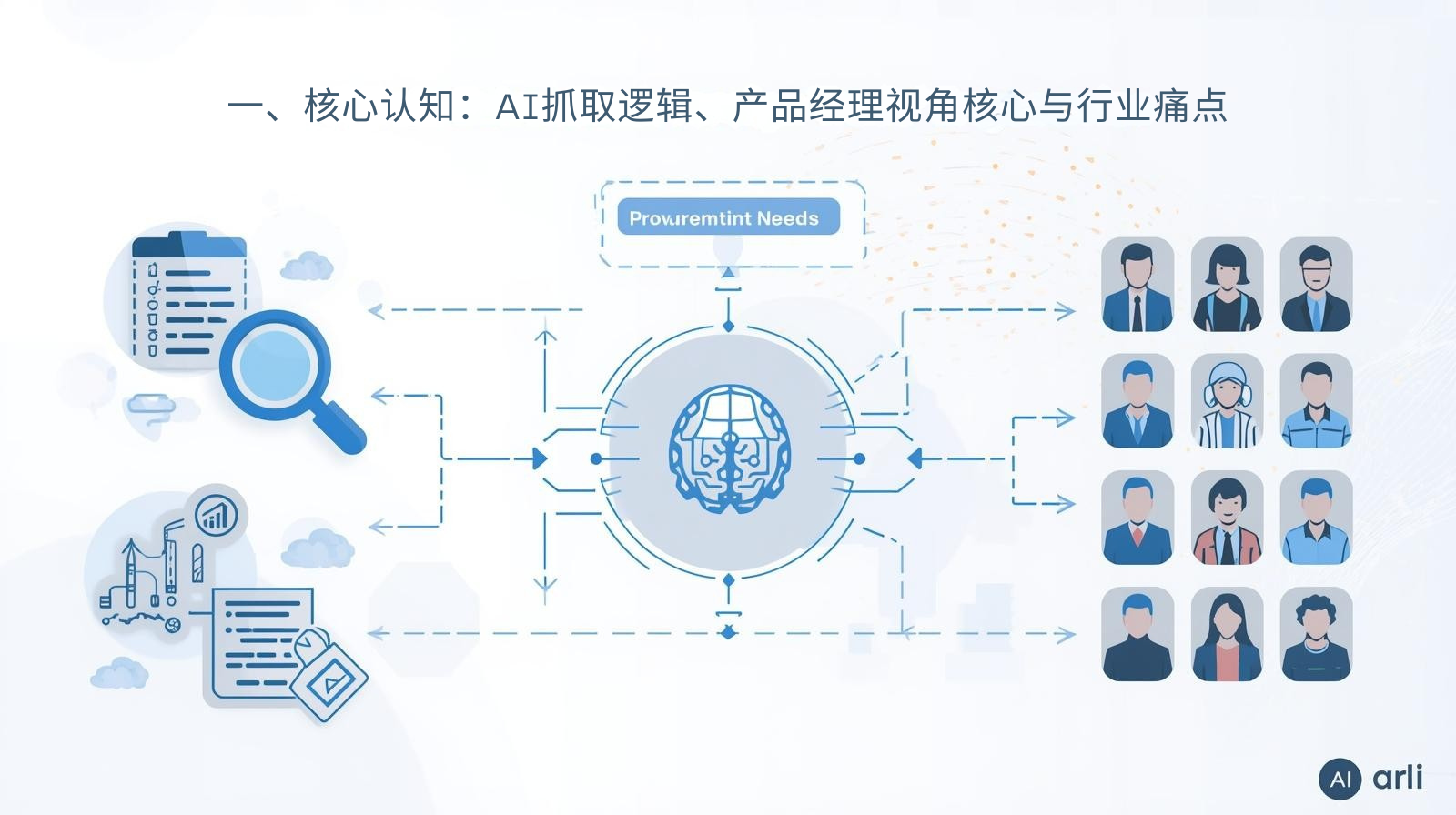
I. Core Understanding: AI Data Acquisition Logic, Core Perspectives from a Product Manager's Perspective, and Industry Pain Points
The core of AI platforms in capturing foreign trade product information is "capturing valuable content that matches demand," while the core from a product manager's perspective is "defining product content in reverse, guided by procurement needs." The key to combining the two is "ensuring that the content captured by AI is exactly what buyers want to see." The current core problem with foreign trade websites lies in creating content detached from procurement needs and performing GEO optimization detached from AI's capture rules, resulting in product information being presented in a "self-indulgent" manner, failing to be accurately identified by AI as "high-quality content that fits procurement needs." Only by clearly understanding the core logic and pain points of these three aspects can optimization be targeted and effective.
1.1 The 3 Core Logics of AI Platforms for Capturing Foreign Trade Product Information (Latest Mechanism in 2026)
Based on OpenAI's February 2026 updated "Generative Search Product Information Crawling Specification" (link: https://platform.openai.com/docs/guides/generative-search/product-information) and practical verification in foreign trade, AI platforms such as ChatGPT and Google SGE follow three core logics when crawling foreign trade product information. These logics are also the core basis for GEO optimization and directly determine the priority and demand matching degree of product information crawling:
1. Logic for matching keywords to meet demand: AI prioritizes content that contains keywords that buyers search for frequently (especially keywords that are related to "product + demand", such as "compliant dress MOQ100"). The more accurate the keyword matching and the more natural the layout, the higher the priority of content being captured.
2. Content Value Focus Logic: AI will filter the core value of content and prioritize content that "focuses on procurement needs and solves procurement pain points". In foreign trade scenarios, the core procurement needs are compliance, MOQ, delivery time, customization capabilities, and after-sales guarantee, rather than irrelevant brand promotion.
3. Structured Recognition Logic: AI quickly captures core information through structured tags. If product information lacks a clear structured presentation (such as compliance certifications, product parameters, and customization processes not being clearly marked), AI will have difficulty recognizing core value and may even capture invalid information. Refer to Hugo.com's 2026 Guide to AI Capture and Optimization of Foreign Trade Products (link: https://www.cifnews.com/).
1.2 The core of the product manager's perspective: Defining product content based on procurement needs.
In foreign trade scenarios, the product manager's perspective is not the traditional "product development perspective," but rather a "procurement needs breakdown perspective." The core is to stand in the shoes of overseas buyers (primarily B2B, such as cross-border e-commerce sellers and offline wholesalers), breaking down their most important information and core pain points in their purchasing decisions, and then transforming these needs into content that can be presented on the product page, ensuring the content "precisely addresses the procurement needs." There are three key points, which are also the core directions for content optimization:
1. Deconstruct core needs: Distinguish between the buyer's "essential information" (compliance certification, MOQ, delivery time, product parameters) and "secondary information" (brand story, R&D process), and prioritize presenting essential information so that the buyer can quickly obtain the core decision-making basis;
2. Address hidden pain points: Pain points that buyers often don't explicitly mention (such as compliance risks, delivery delays, and inefficient customized communication) need to be addressed in advance through the content, such as clearly stating "EU REACH certification, test reports available" and "compensation plan for delayed delivery";
3. Contextualized presentation: Combine the buyer's usage scenario (such as cross-border e-commerce retail, offline wholesale) to present the product's adaptability, such as "compatible with Amazon FBA shipping, supports small batch customization, and can provide English product manuals", so that buyers can intuitively see the product value.
1.3 Four core pain points in optimizing product information on foreign trade websites (the key to the disconnect between AI and demand)
Based on a practical survey of independent e-commerce websites in 2026, most websites failed to achieve "AI-driven information retrieval tailored to procurement needs." This stemmed from the following four major pain points, which contradict both the product manager's demand-driven perspective and the logic of AI-driven information retrieval, and require key solutions:
1. Self-indulgent content, detached from procurement needs: The product page focuses on promoting brand strength and product appearance, but fails to present core information that buyers care about, such as compliance, MOQ, and delivery time. The content crawled by AI has no demand value.
2. Information is cluttered and presented without structure: Product parameters, compliance certifications, and customization processes are mixed together and lack clear classification. AI cannot quickly grasp core demand information and may even grasp irrelevant content.
3. GEO is disconnected from content: Only keyword stuffing and structured tag configuration are done without optimizing content in conjunction with procurement needs. As a result, GEO optimization cannot guide AI to capture information that fits the needs, and the captured content is still disconnected from the procurement needs.
4. Ignoring procurement scenarios and hidden pain points: The product value is not presented in conjunction with the buyer's usage scenarios, and hidden pain points such as compliance and delivery time are not addressed in advance. Even if AI captures product information, it cannot impress buyers and is difficult to convert into inquiries.
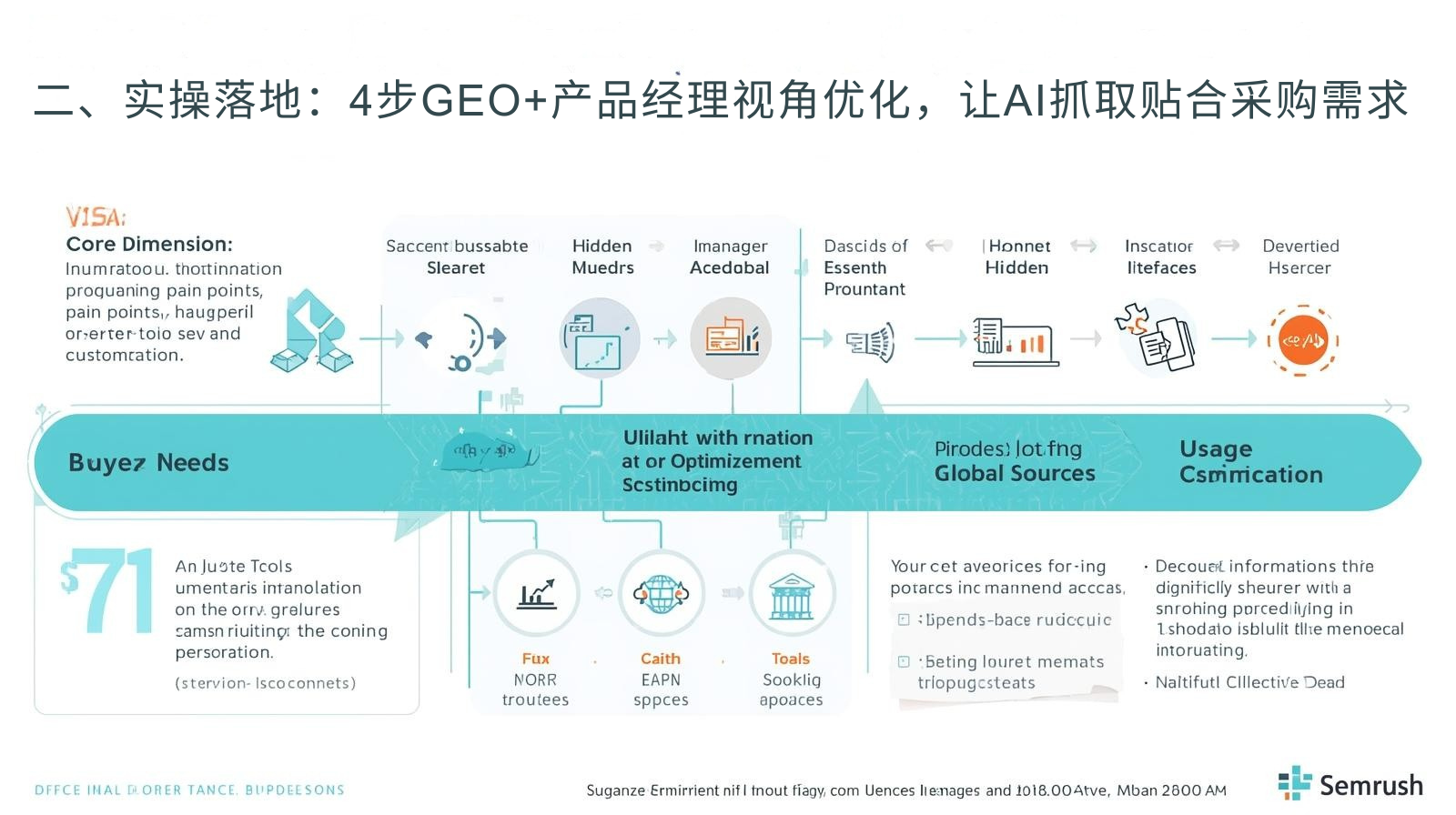
II. Practical Implementation: 4 Steps of Optimization from a GEO + Product Manager Perspective to Enable AI to Capture Procurement Needs
This solution aligns with the AI product information capture logic of 2026, describing the practical steps in text throughout to avoid coding operations. It breaks down procurement requirements from a product manager's perspective and uses GEO optimization to guide AI in capturing core requirements information. The solution is broken down into four steps: "requirement decomposition - content optimization - GEO adaptation - data verification". Each step incorporates authoritative external links specific to foreign trade, ensuring strong practicality and direct implementation. It can be applied to both new and existing websites, achieving "precise AI capture and efficient demand matching".
2.1 Step 1: Product Manager's Perspective – Deconstructing Procurement Requirements and Identifying Optimization Priorities
Core objective: Using a product manager's mindset, accurately analyze the core needs, hidden pain points, and usage scenarios of overseas buyers, clarify the presentation focus and priority of product content, provide a basis for subsequent content optimization and GEO adaptation, avoid blind optimization, and ensure that the content aligns with procurement needs.
2.1.1 Core Operation Actions
1. Procurement Needs Breakdown (Tools + Dimensions): ① Tool Support: Analyze high-frequency search keywords and search intent of buyers in 2026 using Semrush (link: https://www.semrush.com/), and understand the core pain points of current foreign trade procurement through the Global Sources Procurement Needs Report (link: https://www.globalources.com/); ② Core Dimension Breakdown: Break down needs from 4 core dimensions—essential information (compliance certification, MOQ, delivery time, core product parameters), hidden pain points (compliance risks, delivery delays, customization communication, after-sales support), usage scenarios (cross-border e-commerce, offline wholesale, engineering procurement), and decision support (real-world cases, customer reviews, sample policies);
2. Prioritization of Needs: Based on the procurement decision-making logic, the content is prioritized as follows: essential information (first priority, 60%) > solutions to hidden pain points (second priority, 20%) > scenario-based adaptation (third priority, 15%) > decision support (fourth priority, 5%), to prevent secondary information from taking over the core position;
3. Competitor Benchmarking Optimization: Analyze competitor sites with high exposure and inquiries using Ahrefs tools (link: https://ahrefs.com/), dissect their product page content presentation logic, focus on how competitors present procurement needs information and address hidden pain points, learn from their advantages, and optimize them in combination with your own product features to create differentiated content.
2.1.2 Key Points of Practical Application
The core of demand breakdown is to "stand from the buyer's perspective," rather than from one's own promotional perspective, to avoid "self-indulgent" breakdown; it needs to be combined with the latest procurement trends in 2026 (such as the increase in demand for small-batch customization and stricter compliance requirements) to ensure that the demand breakdown is in line with the current market; the priority ranking must strictly follow the procurement decision-making logic, and prioritize presenting the core information that the buyer wants to see at first glance, so that when AI is crawling, it can quickly capture high-value demand content.
2.2 Second Step: Content Optimization – Demand-Driven Creation of AI-Easily Captured Product Content
Core objective: Based on the breakdown of procurement needs, optimize product page content from a product manager's perspective to achieve "accurate information, clear structure, highlighting pain points, and scenario adaptation." This ensures that the content not only aligns with procurement needs but also conforms to the AI content value focus logic, laying the foundation for subsequent GEO optimization. This is the core step in enabling AI to capture information that fits the needs.
2.2.1 Core Operation Actions
1. Product Page Content Restructuring (Key Point): ① Top Core Area (First Impression): Present essential information, concisely labeled with "Compliance Certification + MOQ + Core Delivery Time," example: "EU REACH Certification | MOQ 50 minimum order | 15-day fast delivery | Supports small batch customization," accompanied by the compliance certification logo (link: https://ec.europa.eu/growth/single-market/european-standards/ce-marking_en); ② Middle Core Area: Present detailed information in modules—product parameters (focusing on materials, specifications, and compatibility standards that buyers care about), pain point solutions (compliance guarantees, delivery time commitments, after-sales solutions), and scenario-based adaptation (explaining product compatibility advantages in cross-border e-commerce and offline wholesale scenarios); ③ Bottom Auxiliary Area: Present decision-making support information (real cooperation cases, customer reviews, sample policies). Cases should indicate the type of buyer and the scale of cooperation to enhance credibility.
2. Content Language and Value Presentation: ① Use concise and precise language, avoiding redundant promotion. Each line should be long and logically coherent, catering to the reading habits of overseas buyers. Emphasize the "problem solved" and "value provided" statements, such as "Supports small-batch customization, addressing the pain point of 'high inventory risk' for cross-border e-commerce sellers"; ② Strengthen the layout of demand keywords: Naturally integrate long-tail keywords related to "product + demand" (such as "EU compliant genuine leather accessories MOQ50" and "15-day delivery time for cross-border e-commerce dresses"), placing them in titles, paragraph first sentences, and core module titles, with a density controlled at around 2%, avoiding keyword stuffing; ③ Compliance and quality endorsement: Add authoritative certification links (such as SGS material testing link: https://www.sgsgroup.com/), indicating "test reports available" and "supports third-party inspection," alleviating buyers' concerns about compliance and quality.
3. Redundant content cleanup: Delete content that is irrelevant to the procurement needs (such as lengthy brand stories, R&D processes, and irrelevant honors) to avoid diluting core demand information, allowing AI to quickly focus on the content that buyers care about and improve the accuracy of data capture.
2.2.2 Key Points of Practical Application
The core of content optimization is "demand-oriented + clear structure". Each module should correspond to a specific need of the buyer and avoid irrelevant content. Keyword layout should be natural and fit the semantics of the content, highlighting long-tail keywords related to "product + demand" to improve the AI's demand matching accuracy. Information such as compliance certifications and case studies should be verifiable and official external links should be added to enhance buyer trust and improve the AI's judgment of content value.
2.3 Step 3: GEO Adaptation – Guiding AI to prioritize the capture of core information that aligns with procurement needs
Core objective: By combining AI crawling logic with GEO optimization and optimized product content, and through structured tagging, semantic association, and weighting, guide AI to prioritize crawling the core needs information that buyers care about, ensuring that the content crawled by AI is the content that buyers want to see, thereby improving the crawling priority and the degree of matching with needs.
2.3.1 Core Operation Actions
1. Precise Configuration of Structured Tags (Core): Utilize the Rank Math optimization plugin (link: https://rankmath.com/) to configure dedicated structured tags for core modules of the product page. The entire process is described in text, requiring no code: ① Core Tags: Configure the "Product" tag to highlight key information that buyers care about (name, compliance certification, MOQ, delivery time, price range), ensuring a one-to-one correspondence between tags and content; ② Sub-tag Supplements: Configure the "Certification" tag for compliance certification, linking it to the official compliance certification query link; configure "Review" and "CaseStudy" tags for case studies and customer reviews; configure the "Offer" tag for customized services and delivery commitments, allowing AI to quickly identify core needs; ③ Contextualized Tags: Add the "UsageScenario" tag to indicate the appropriate procurement scenario for the product (cross-border e-commerce, offline wholesale), improving the accuracy of AI-driven contextualized recommendations and data capture;
2. Semantic Relationships and Weighting: ① Internal Semantic Relationships: Add internal links between core modules on product pages (such as compliance and customization modules), and link to relevant case study pages and compliance information pages (such as the "EU REACH Compliance Guidelines 2026") to form a semantic relationship network of "demand-solution-case study," allowing AI to clearly identify the content logic and core value; ② Weighting: Prioritize links to core product pages on the site homepage and navigation bar, and prioritize the display of "high-demand, high-match" products on product category pages to increase the weight of core product pages and guide AI to crawl them first;
3. AI-friendly crawling optimization: ① Site basic optimization: Compress images using TinyPNG (link: https://tinypng.com/) and configure global CDN acceleration (such as Cloudflare, link: https://www.cloudflare.com/) to ensure that product pages load in overseas locations in ≤2 seconds. Substandard loading speed will reduce the AI's willingness to crawl. ② Content recognizability: Avoid using images to replace text to present core requirement information (such as MOQ, delivery time, compliance certification). Ensure that AI can accurately crawl text information. Images should have alt attributes and be labeled with core requirement keywords.
2.3.2 Key Points of Practical Application
The core of GEO adaptation is to "guide AI to capture core demand information," rather than simply configuring tags or stuffing keywords. Structured tags must accurately correspond to the modules that buyers care about, without omitting core demand information. Semantic associations must fit the content logic, and weighting should focus on core product pages. Avoid using images to replace core text information to ensure that AI can accurately identify and capture content that fits the procurement needs. You can refer to the OpenAI 2026 GEO Signal Optimization Guide (link: https://platform.openai.com/docs/guides/generative-search) to improve your adaptation strategy.
2.4 Step Four: Data Validation and Iteration – Continuously Aligning with Procurement Needs and AI Data Extraction Rules
Core objective: Using a product manager's retrospective approach, through data monitoring, verify whether the product information captured by AI aligns with procurement needs and whether the optimization effect meets the standards. Combining changes in procurement needs in 2026 with AI algorithm iterations, continuously optimize content and GEO configuration to ensure that the information captured by AI always aligns with procurement needs and achieves a closed loop of "exposure-inquiry" conversion.
2.4.1 Core Operation Actions
1. Core Data Monitoring: ① Data Capture: Monitor AI-captured product information keywords through Google Search Console (link: https://search.google.com/search-console) to determine if the captured content represents high-frequency keywords needed by buyers and aligns with core needs; ② Conversion Data: Monitor product page clicks, dwell time, and inquiry conversion rates through Google Analytics (link: https://analytics.google.com/), focusing on analyzing the match between "captured keywords" and "inquiry keywords." A low match indicates that the AI-captured information does not meet procurement needs; ③ Demand Data: Regularly review procurement demand reports from Semrush and Global Sources to track changes in procurement demand in 2026 (such as compliance standard updates and MOQ requirement adjustments);
2. Optimization and Iteration: ① Crawling Optimization: If the information crawled by AI is not core demand information, adjust keyword layout and structured tagging to strengthen the semantic connection of core demand modules and guide AI to re-crawl core content; ② Content Iteration: Update product page content based on changes in procurement needs (such as compliance certification updates, delivery time optimization, and scenario adaptation adjustments), and update core information quarterly to ensure that the content fits current procurement needs; ③ Pain Point Iteration: Collect new pain points reported by buyers during the inquiry process and add them to the product page content. For example, if a buyer reports "needs an English operation manual," a relevant module can be added to improve the matching degree of needs;
3. Competitor Iteration and Benchmarking: Every six months, we re-analyze the content and GEO optimization strategies of competitors' high-inquiry sites, learn from their new methods of adapting to procurement needs, and combine them with our own product characteristics to optimize content presentation and GEO configuration to maintain competitiveness.
2.4.2 Key Points of Practical Application
The core of data validation is "accuracy of data capture + conversion effect," focusing on the matching degree between AI-captured keywords and procurement needs, rather than simply the frequency of data capture. Optimization and iteration need to be continuous, adapting to changes in procurement needs and keeping up with AI algorithm updates (refer to OpenAI's official announcements: https://platform.openai.com/docs/updates). Always keep procurement needs at the core, and avoid deviating from the actual needs of the buyer by excessively pursuing AI capture.
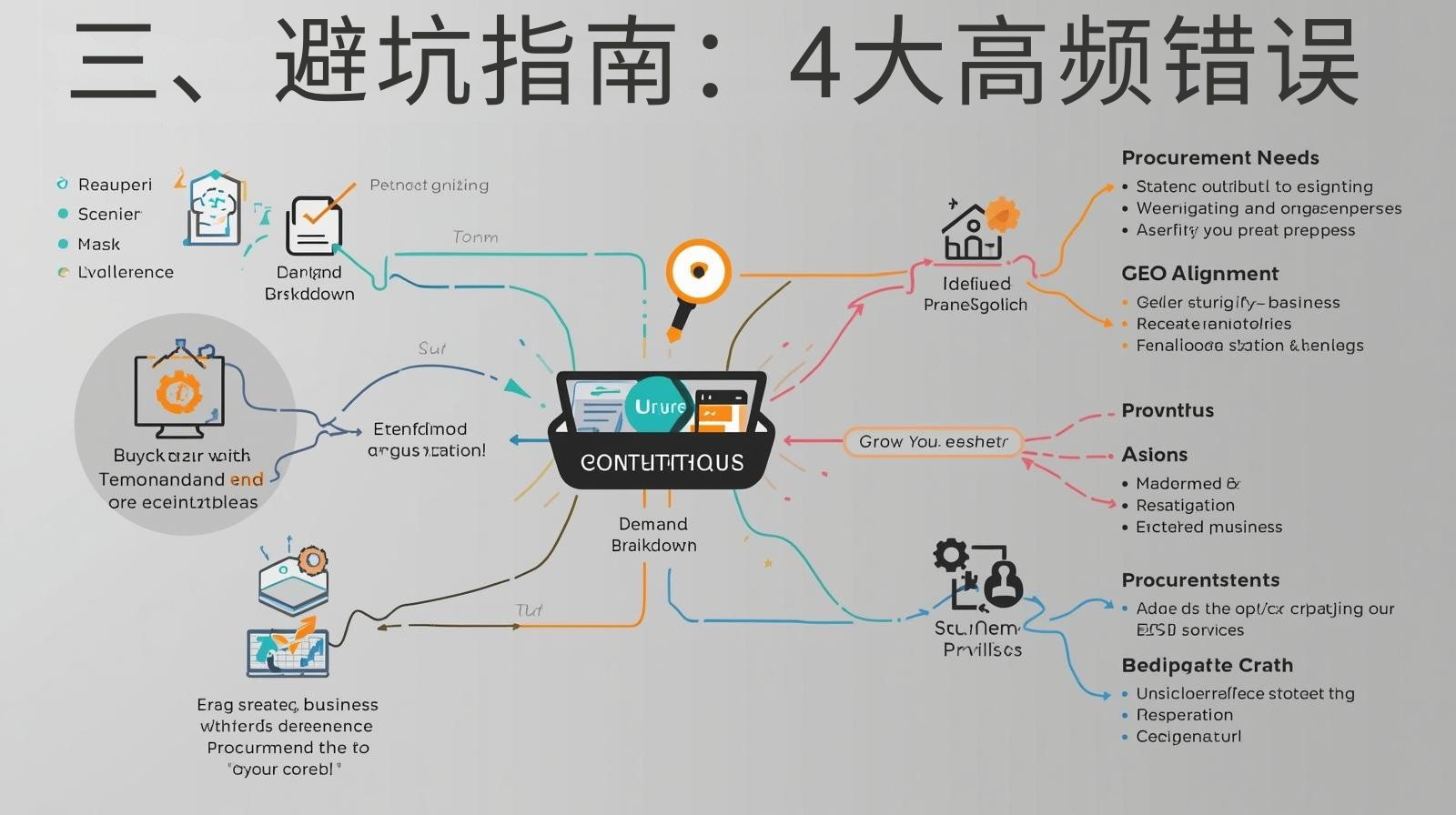
III. Pitfall Avoidance Guide: 4 Frequently Used Mistakes (Must be avoided, otherwise AI crawling will become disconnected from needs)
Based on practical lessons learned from independent e-commerce websites in 2026, the following four mistakes will directly lead to the failure of GEO+ product manager perspective optimization, the product information captured by AI will still be out of touch with procurement needs, and the "exposure-inquiry" conversion will not be achieved. These mistakes must be avoided. Each mistake is accompanied by a specific corrective plan to ensure that optimization does not go astray.
3.1 Mistake 1: Ignoring requirement breakdown and blindly optimizing content and GEO
Errors include : failure to break down procurement needs, focusing instead on self-promotion, blindly piling up keywords and configuring structured tags, presenting irrelevant content on product pages, and failing to focus on core information that buyers care about, such as compliance, MOQ, and delivery time.
Key harms : The content crawled by AI has no demand value. Even if the crawling frequency is high, it cannot match the search needs of buyers, resulting in "exposure but no inquiries"; GEO optimization is disconnected from content and cannot guide AI to crawl core demand information, resulting in wasted optimization resources; the content is detached from the procurement needs, making it difficult to impress buyers and generate conversions.
The correct approach is to first use tools and reports to break down the core needs and hidden pain points of buyers in 2026, clarify the priority of content presentation, and then optimize the content and adapt it to GEO based on the needs, ensuring that each optimization step is in line with the procurement needs and avoiding blind spots.
3.2 Error 2: The content structure is chaotic, and the core requirements information is diluted.
Error symptoms : The product page content is disorganized, with core requirements information (compliance, MOQ, delivery time) mixed with redundant content and not presented in separate modules; core requirements information is placed at the bottom of the page, while secondary information occupies the top core position, making it difficult for AI to quickly grasp the core content.
Key risks : AI struggles to identify core needs and may scrape irrelevant, redundant content, leading to a disconnect between the scraped information and procurement requirements; buyers cannot quickly find the core decision-making basis, resulting in high bounce rates and poor interaction data, further reducing the priority of AI scraping; core needs information is diluted, failing to impress buyers and impacting inquiry conversion.
Correct approach : Restructure the product page content structure according to the priority of "essential information - pain point solutions - scenario adaptation - decision support", and present it clearly in modules; place core demand information at the top of the page, remove all redundant content, and ensure that core demand information is prominent so that both AI and buyers can quickly capture it.
3.3 Error 3: GEO is disconnected from content, and the tag configuration is inaccurate.
Errors include : mismatch between structured tags and product content, such as compliance certifications and MOQ tags that do not match the actual content on the product page; failure to configure dedicated tags for core requirement modules, with only basic tags configured; and confusing semantic relationships, with irrelevant internal links that fail to guide AI to crawl core content.
Key risks : AI cannot accurately identify core needs through tagging, resulting in content that is out of touch with procurement requirements; inaccurate tagging configuration may lead AI to judge the content as "false," lowering the site's ranking; and confused semantic relationships prevent AI from recognizing content logic, resulting in low crawling efficiency and a decrease in crawling priority.
Correct approach : Structured tags must correspond one-to-one with the product page content, accurately marking the core information that buyers care about, and configuring exclusive sub-tags for core demand modules; optimize internal links, create a semantic relationship network that fits the needs, and guide AI to prioritize crawling the content of core demand modules.
3.4 Error 4: Optimization without monitoring or iteration, detached from requirements and algorithm changes.
Error manifestations : After optimization, the AI-captured and transformed data was not monitored, making it impossible to determine whether the captured information matched the procurement needs; the content and GEO configuration were not continuously optimized in conjunction with changes in procurement needs in 2026 and AI algorithm iterations, resulting in long-term lack of content updates and outdated timeliness.
Key harms include : failure to detect optimization loopholes in a timely manner, such as AI-fetched information not matching needs, decline in core keyword rankings, and unsustainable optimization effects; outdated content that cannot adapt to procurement needs and changes in AI algorithms, leading to a gradual decrease in AI crawling priority and eventual loss of exposure; and inability to keep up with new pain points of buyers, making it difficult to maintain inquiry conversion efficiency.
Correct approach : Establish a routine monitoring mechanism, monitor and capture data and conversion data weekly, and analyze and optimize the results monthly; update the core content of the product page quarterly to adapt to changes in procurement needs; keep up with AI algorithm iterations in a timely manner, adjust the GEO optimization strategy, and ensure that the information captured by AI always aligns with procurement needs.
Recommended Article: Your Competitors Haven't Reacted Yet: Building an Independent E-commerce Website with GEO is the Biggest Blue Ocean Strategy Right Now
Recommended Article: Your Competitors Haven't Reacted Yet: Building an Independent E-commerce Website with GEO is the Biggest Blue Ocean Strategy Right Now
IV. Conclusion: Breaking the deadlock from a product manager's perspective, using GEO to enable AI to accurately capture and reach procurement needs.
In 2026, the competition among independent e-commerce websites using AI for content scraping has evolved from "whether they can scrape content" to "whether the scraped information matches the purchasing needs." Simple GEO optimization or content optimization is no longer sufficient to meet the conversion requirements from "exposure" to "inquiries." The core logic of GEO+ from a product manager's perspective is "taking purchasing needs as the core and using GEO to guide AI for precise scraping"—the product manager's perspective solves the problem of "content matching needs," while GEO optimization solves the problem of "AI precise scraping." The combination of the two ensures that every piece of product information scraped by AI is the core information that buyers want to see, truly converting exposure into inquiries and breaking the dilemma of "high exposure, low conversion" for e-commerce websites.
To achieve this precise match between "demand and crawling," a smooth, stable website foundation adapted to GEO optimization and content presentation is crucial. Many foreign trade websites suffer from outdated website building technology, slow page loading, and cluttered content layouts. Even with proper demand breakdown and GEO configuration, they struggle to enable AI to efficiently crawl core content, negatively impacting the buyer's reading experience and hindering inquiry conversion. PinDian Technology, with over ten years of experience in foreign trade website building and serving over 7,000 clients, uses React technology to build and optimize websites. This not only ensures a smoother browsing experience (overseas loading speed ≤2 seconds, perfectly adaptable to multi-terminal access) but also fundamentally adapts to GEO optimization and product manager-centric content presentation needs—including built-in structured product page templates, quick configuration entry for GEO structured tags, and demand-oriented content editing tools. It also supports compliance certification modules and scenario-based presentation modules, giving the website a natural advantage of being both "AI-friendly for crawling" and "aligned with procurement needs." PinDian website building can simultaneously assist businesses in breaking down procurement needs, optimizing product content, configuring GEO signals, and monitoring and iteratively optimizing. Combined with the 4-step practical solution outlined in this article, it enables your independent foreign trade website to achieve precise matching between AI-driven information capture and procurement needs, improving inquiry conversion rates. If your site is facing the dilemma of "AI capture being disconnected from procurement needs, resulting in exposure but no inquiries," consider PinDian Technology. With professional website building and optimization services, precise GEO and product manager-centric strategies, you can seize the new opportunities for AI-driven customer acquisition in foreign trade in 2026.