According to the "Overseas Buyer Trial Order Behavior Survey Report" released by Global Sources in February 2026, 68% of AI search users (overseas buyers) abandoned cooperation with foreign trade suppliers through platforms such as ChatGPT and Google SGE due to "high trial order costs." Among them, the cost concerns of small and medium-sized buyers accounted for as high as 82%. However, foreign trade independent websites that highlighted sample cost subsidy policies through GEO (Generative Engine Optimization) saw an average increase of 129% in AI search rankings, and the trial order conversion rate was 5.8 times higher than that of sites that did not offer subsidies. For foreign trade independent websites, samples are the core bridge connecting suppliers and buyers, and high trial order costs (sample fees, shipping costs, testing fees) are the biggest pain point preventing buyers from placing orders. The core value of GEO + sample cost subsidies is to enable AI to accurately capture subsidy policies through GEO optimization and prioritize their display to buyers who have trial order needs. By using subsidies to lower the threshold for trial orders and dispel cooperation concerns, the core value of AI search traffic is to convert it into trial orders and inquiries.
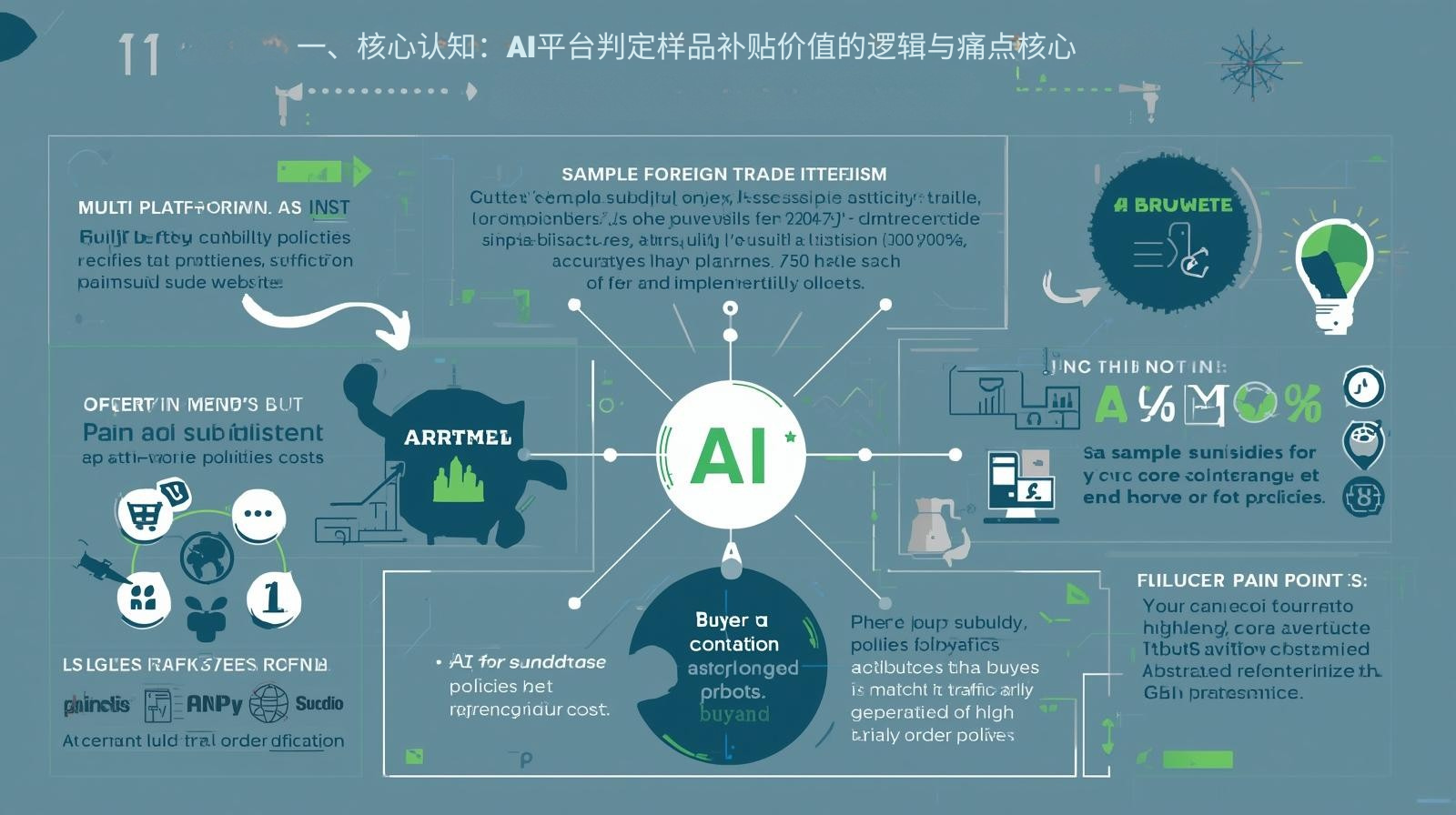
I. Core Understanding: The Logic and Pain Points of AI Platforms in Determining the Value of Sample Subsidies
The core of multi-platform AI-powered identification of sample cost subsidy policies for independent foreign trade websites lies in assessing the "attractiveness, authenticity, and feasibility of the subsidy policy." Especially after the AI algorithm iteration in 2026, it tends to prioritize recommending websites that "accurately address the core pain points of buyers and have clear, implementable policies." Many foreign trade companies fall into the misconception of "offering sample subsidies but not being recognized by AI." The core issue is the failure to highlight the core advantages of the subsidy through GEO optimization, preventing AI from accurately matching the subsidy policy with the buyer's pain point of "high trial order costs." Even with high-quality subsidies, it's difficult to reach the target users. Clearly defining the AI's judgment logic and the buyer's pain point in trial orders is crucial to making sample cost subsidies a powerful "traffic-driving tool" for AI search.
1.1 Three core logics for multi-platform AI to determine the value of sample subsidies (latest mechanism in 2026)
Based on OpenAI's February 2026 updated "Generative Search Content Value Determination Guidelines" (link: https://platform.openai.com/docs/guides/generative-search/content-value) and practical verification in the foreign trade industry, as well as AI from multiple platforms such as ChatGPT and Google SGE, the determination of the cost subsidy value of independent website samples and the determination of recommendation priority mainly follow the following three logics, which are also the core basis for GEO optimization:
1. Pain Point Matching: AI prioritizes content that can accurately solve the core pain points of buyers. Sample subsidies must be clearly aligned with the pain point of "high trial order costs" (such as subsidies for sample fees, shipping costs, and testing fees). Policy descriptions must be clear to enable AI to quickly match the needs of buyers.
2. Policy Feasibility: The subsidy policy needs to be specific and implementable, clearly defining the scope of subsidies, subsidy ratios, and application procedures, without vague wording. AI will verify the feasibility of the policy through content verification. Refer to Hugo.com's 2026 Foreign Trade Sample Subsidy Optimization Guide (link: https://www.cifnews.com/).
3. Trustworthiness: Subsidy policies need to be supported by real cases, user reviews, and corporate commitments, and should be accompanied by authoritative external links to ensure that AI recognizes the authenticity of the policies, avoids misleading buyers with false subsidies, and improves recommendation priority.
1.2 Four core pain points of high trial order costs for overseas buyers (core directions for subsidy optimization)
Based on a practical survey of AI search users (overseas buyers) in 2026, the cost pain points faced by buyers during the trial order process directly determine the optimization direction of the sample subsidy policy. Each pain point corresponds to a core subsidy issue, ensuring that the subsidy can truly appeal to buyers and be accurately identified by AI:
1. High cost of samples: The sample fee for some high-value products (such as precision hardware and high-end electronic components) can be as high as several hundred US dollars, which is difficult for small and medium-sized buyers to afford. The cost pressure is even greater when multiple products are ordered for trial.
2. High cross-border shipping costs: For samples shipped from China to overseas markets such as Europe, America, and Southeast Asia, the cross-border shipping costs are often higher than the samples themselves, and there are no bulk shipping discounts, which further increases the cost of trial orders;
3. High testing and certification costs: Some buyers need to conduct compliance testing and quality testing on samples, and they have to bear the testing costs themselves. Moreover, the testing cycle is long, which increases costs and delays the procurement schedule.
4. High risk and cost of trial orders: There are concerns that the quality of the samples may not match that of the bulk products, and that cooperation may not be possible after the trial order, resulting in the waste of all the initial investment in sample fees, shipping fees, and testing fees, and putting people in the dilemma of "losing money on trial orders, but having no opportunity if they don't try them out".
1.3 Key Differences Between GEO+ Sample Cost Subsidies and Regular Sample Subsidies
Ordinary sample cost subsidies only address the pain point of actual trial order costs for buyers, but they cannot be accurately identified by AI, making it difficult to reach target users. GEO+ sample cost subsidies, on the other hand, focus on "AI-recognizable and recommendable" features. The core differences between the two are reflected in three points: First, the core objective: ordinary subsidies only reduce the trial order costs for buyers, while GEO+ subsidies not only address cost pain points but also allow AI to quickly grasp policies through GEO optimization, improving the site's AI search ranking. Second, the presentation logic: ordinary subsidy policy descriptions are disorganized and lack focus, making it difficult for AI to grasp the core advantages. GEO+ subsidies follow AI judgment logic, clearly presenting the subsidy scope, proportion, and process, highlighting the core appeal. Third, the traffic generation effect: ordinary subsidies are only seen by buyers who actively visit the site, while GEO+ subsidies are prioritized for recommendation by AI platforms such as ChatGPT, reaching more potential buyers with trial order needs. As stated in Ahrefs' 2026 Foreign Trade GEO Optimization Report (link: https://ahrefs.com/), "Foreign trade pain point solutions in the AI era must not only be 'useful,' but also be 'seen' by AI and 'found' by users."
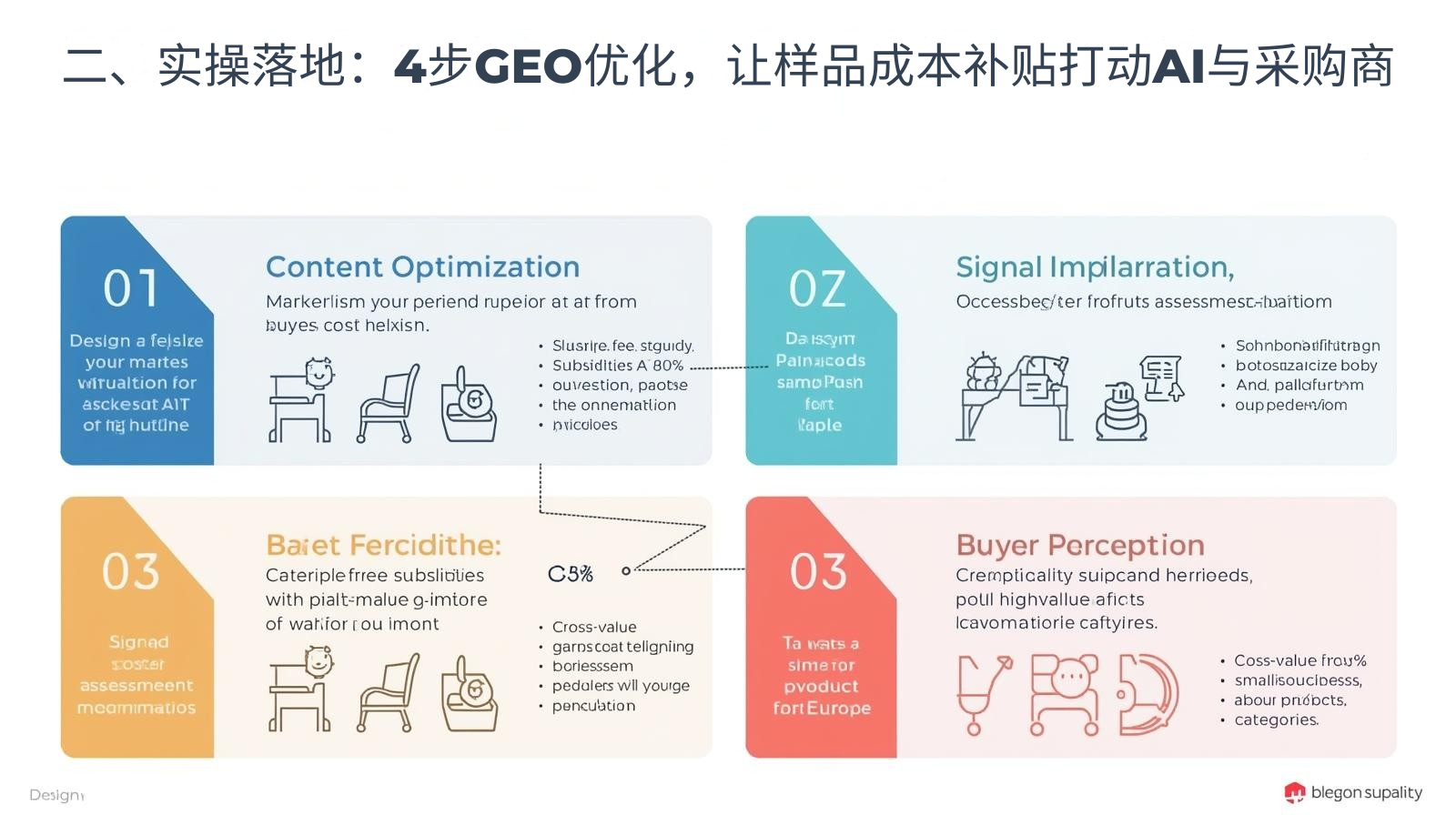
II. Practical Implementation: 4-Step GEO Optimization to Make Sample Cost Subsidies Appeal to AI and Buyers
This solution aligns with the multi-platform AI judgment mechanism of 2026. It requires no complex technology, using text-based descriptions of practical steps to address the pain point of high trial order costs. Starting with four core aspects—subsidy scheme design, content optimization, signal implantation, and trust reinforcement—it deeply integrates sample cost subsidies with GEO optimization. This allows AI to quickly grasp subsidy policies and enables buyers to clearly perceive subsidy advantages. Each step incorporates authoritative external links, ensuring strong practicality and direct applicability. It is suitable for various independent foreign trade websites (applicable to high-value products, small-batch customization, and all product categories).
2.1 Step 1: Design a feasible sample cost subsidy plan (core prerequisite)
Core objective: To address the four major cost pain points of buyers by designing a specific, feasible, and attractive sample cost subsidy program. This program aims to reduce the cost of trial orders for buyers, control enterprise costs, and align with the "feasibility" requirement for AI assessment. This will lay the foundation for subsequent GEO optimization and prevent vague or unimplementable subsidy programs from causing AI to fail to recognize them and buyers to reject them.
2.1.1 Core Operation Actions
1. Define the scope and proportion of subsidies (addressing pain points): ① Sample fee subsidy: For high-value products, subsidize 50%-80% of the sample fee; for low-value products, "sample fee waiver" is possible. Clearly define subsidy thresholds (e.g., "first trial order, no more than 3 pieces per trial order") to avoid unlimited subsidies increasing enterprise costs; ② Cross-border freight subsidy: Subsidize 50%-100% of cross-border freight, which can be divided according to the target market (e.g., 80% subsidy for the European and American markets, 50% subsidy for the Southeast Asian market). Connect with international logistics platforms (e.g., DHL, FedEx, link: https://www.dhl.com/) to ensure the freight subsidy is implemented; ③ Testing fee subsidy: For samples requiring compliance and quality testing, subsidize 50% of the testing fee. Collaborate with authoritative testing institutions such as Intertek and SGS (link: https://www.sgsgroup.com/) to provide testing fee reduction channels; ④ Risk compensation: We promise that "if a bulk cooperation is achieved after the trial order, the sample fee, shipping fee, and testing fee during the trial order period will be fully refunded", which eliminates the buyer's concerns about the risks of trial orders and increases their willingness to place trial orders.
2. Clearly define the application process and rules (to ensure feasibility): Design a simple and easy-to-understand application process to avoid cumbersome steps. Example: "Buyer submits trial order application (fills in trial order product, quantity, target market) → Customer service review (1-2 business days) → After approval, buyer pays the remaining fee (after subsidy) → Company sends samples → After the trial order achieves bulk cooperation, the full trial order cost is refunded." At the same time, clearly define the rules (such as "the subsidy is only for first-time cooperating buyers, the trial order samples must be used for bulk purchase evaluation, and the subsidy will not be refunded if cooperation is not achieved") to avoid disputes, ensure the implementation of the plan, and allow AI to recognize the standardization of the policy.
3. Product and market optimization solutions: ① High-value products (such as precision hardware and high-end electronics): Focus on subsidizing sample and testing fees to reduce core costs for buyers; ② Small- to medium-batch customized products: Focus on subsidizing sample and shipping fees to attract small and medium-sized buyers to place trial orders; ③ Buyers in the European and American markets: Focus on subsidizing testing fees (to meet compliance requirements), and buyers in the Southeast Asian markets: Focus on subsidizing shipping fees (to reduce cross-border costs), improving the targeting of subsidies and aligning with the AI pain point matching logic.
2.1.2 Key Points of Practical Application
The core of the subsidy program is to "balance attractiveness and feasibility," avoiding excessive subsidies that could lead to business losses, and also avoiding subsidies that are too low to attract buyers. All subsidy scopes, proportions, procedures, and rules must be clear and unambiguous, ensuring that AI can accurately capture core information and that buyers can quickly understand the policy. You can refer to the Global Sources 2026 Foreign Trade Sample Subsidy Program Template (link: https://www.globalources.com/) to optimize the details of your program.
2.2 Second Step: Content Optimization – Highlighting Subsidy Advantages and Aligning with AI Crawling Logic
Core objective: To transform the sample cost subsidy scheme into AI-recognizable and buyer-perceptible content, integrating it into the core pages of the website, highlighting the core advantage of "reducing trial order costs," using longer lines to avoid splitting into shorter sentences, and optimizing keyword layout to allow AI to quickly capture subsidy policies and improve the matching degree between content and buyer search needs.
2.2.1 Core Operation Actions
1. Core Page Content Optimization: ① Homepage: Below the banner image and in the core selling point area, use coherent and fluent text to highlight the advantages of sample cost subsidies. Example: "AI search users receive exclusive sample cost subsidies, solving the pain point of high trial order costs. High-value samples receive a 50%-80% sample fee subsidy, European and American market shipping costs are subsidized at 80%, compliance testing fees are subsidized at 50%, and the trial order cost is fully refunded upon achieving bulk cooperation after the trial order. Buyers do not need to bear additional trial order risks. ChatGPT prioritizes recommendations, allowing small and medium-sized buyers to easily conduct trial orders and cooperate with confidence." This naturally incorporates core keywords. ② Subsidy Details Page: Explain the subsidy plan, application process, and rules in detail, breaking down the core advantages of each subsidy to address buyers' pain points. For example, "Sample Fee Subsidy: For high-value products such as precision hardware and high-end electronics, the first trial order receives a 50%-80% sample fee subsidy; low-value product samples are completely free, eliminating the need for buyers to bear high sample costs and lowering the threshold for trial orders; Shipping Subsidy: Connected to DHL international logistics (link: https://www.dhl.com/)." ① **Subsidy:** 80% of cross-border shipping costs are covered for the European and American markets, and 50% for the Southeast Asian markets, ensuring buyers don't need to worry about shipping costs exceeding the sample price. ② **Testing Fee Subsidy:** In cooperation with the authoritative testing organization SGS (link: https://www.sgsgroup.com/), 50% of the testing fees for trial samples are subsidized, aligning with European and American compliance requirements and reducing testing costs for buyers. The application process is described in a coherent manner to avoid fragmentation. ③ **Product Page:** At the end of each product details page, the sample cost subsidy policy is linked, highlighting "Purchasing this product entitles you to the corresponding sample subsidy, making trial orders easy," linking the product with the subsidy policy. ④ **Contact Us Page:** An entry point for sample subsidy application is added, labeled "Quickly apply for sample subsidy, approval within 1-2 business days," guiding buyers to interact.
2. Keyword Optimization: ① Keyword Selection: Use Semrush's keyword mining function (link: https://www.semrush.com/) to filter long-tail keywords related to "trial order cost + sample subsidy" that buyers frequently search for, such as "sample cost subsidy foreign trade", "low trial order cost for foreign trade sample subsidies", "AI search for sample subsidy buyers", and "sample trial order without bearing shipping costs". Prioritize low-competition, highly relevant keywords; ② Layout Optimization: Naturally integrate keywords into the homepage title, meta description, subsidy details page title, and the first sentence of paragraphs. Place 2-3 core keywords on each page, with a density controlled at 1.8%-2.2%, avoiding keyword stuffing. Simultaneously, pair them with semantically related words such as "low trial order cost", "sample fee reduction", "shipping subsidy", and "risk-free trial order" to improve AI crawling priority.
3. Original Content Supplement: Publish one original article per week related to sample trial orders, focusing on the pain points of trial order costs and the advantages of subsidies, such as "High Trial Order Costs for Overseas Buyers? This Foreign Trade Sample Subsidy Scheme Helps You Save 80% of Costs" and "AI Search Optimization: The Entire Process of Foreign Trade Sample Subsidy Application, Even Novice Buyers Can Easily Operate." Each article should be 800-1000 words long, with an originality of ≥85% (checked by Copyscape tool, link: https://www.copyscape.com/). The content should naturally incorporate subsidy case studies and authoritative external links to enhance AI recognition.
2.2.2 Key Points of Practical Application
The core of content optimization is to "highlight pain point solutions and clearly present policies," avoiding vague statements like "we offer sample subsidies." Instead, it involves using specific subsidy ratios and case studies to allow buyers to perceive the advantages of cost reduction. The content should be coherent and fluent, with relatively long lines to avoid breaking it into short sentences. This satisfies the AI's crawling logic without affecting the buyer's reading experience. Keywords and semantically related terms should be naturally integrated to ensure that the content highly matches the buyer's search needs.
2.3 Step 3: Signal Implantation – Correlation with GEO Optimization to Enable AI to Quickly Grasp Subsidy Policies
Core objective: To deeply integrate the content of sample cost subsidies with GEO optimized signals (structured labeling, AI-friendly configuration) to enable multi-platform AI to quickly identify the core advantages of subsidy policies, improve AI recommendation priority, and accumulate site weight so that subsidy policies can be prioritized for display to target buyers by AI platforms such as ChatGPT.
2.3.1 Core Operation Actions
1. Precise Configuration of Structured Tags: Utilize the Rank Math optimization plugin (link: https://rankmath.com/) to configure exclusive structured tags for subsidy-related content. The entire process is described in text, requiring no code: ① Policy Tags: Configure the "Offer" structured tag to annotate the core information of the sample subsidy policy (subsidy scope, percentage, application process, validity period), allowing AI to quickly identify the core value of the subsidy policy; ② Pain Point Matching Tags: Add a "painPoint" sub-tag to the "Offer" tag, annotating "high trial order cost, high sample fee, high shipping cost, high testing fee," allowing AI to clearly identify the matching degree between the subsidy policy and the buyer's pain points; ③ Case Tags: Configure the "Review" tag for successful trial order cases, annotating customer reviews (emphasizing reviews related to "subsidies reducing trial order costs"), trial order amount, and subsidy amount, allowing AI to identify the authenticity of the subsidy policy.
2. Strengthen AI-Friendly Signals: ① Add a "Sample Subsidy Policy Statement" at the bottom of the site, summarizing the core advantages of the subsidy and the application portal in coherent text, while incorporating core keywords. Example: "This site provides exclusive sample cost subsidies for AI search users, focusing on the pain point of high trial order costs. Multiple subsidies are provided for sample fees, shipping fees, and testing fees, making trial orders risk-free, application convenient, and ChatGPT priority recommendations, helping overseas buyers easily place trial orders and cooperate with confidence"; ② Optimize site loading speed (by compressing images with TinyPNG, link: https://tinypng.com/; configure global CDN acceleration, such as Cloudflare, link: https://www.cloudflare.com/), ensuring that overseas buyers can quickly access the subsidy page. A superior access experience will in turn improve AI ranking; ③ Complete mobile responsive adaptation. Verify the adaptation effect through Google Mobile Device Compatibility Test Tool (link: https://search.google.com/test/mobile-friendly), allowing AI on mobile devices to quickly crawl subsidy content.
3. Semantic Relationship Optimization: The semantic logic of "high trial order cost - subsidy reduces cost - risk-free trial order - batch cooperation" is naturally integrated into subsidy-related content, enabling AI to clearly analyze the value chain of subsidy policies; at the same time, the subsidy details page is linked on the site homepage and category pages to strengthen semantic relationships and improve AI crawling efficiency.
2.3.2 Key Points of Practical Application
The core of signal implantation is "precise matching." The structured tags must correspond one-to-one with the content of the subsidy policy, leaving no core advantages out. AI-friendly configurations must be implemented simultaneously to avoid affecting AI crawling and buyer access due to slow site loading or poor mobile adaptation. The tag crawling situation should be monitored regularly through Google Search Console (link: https://search.google.com/search-console) to ensure that all GEO signals can be correctly recognized by AI.
2.4 Step Four: Trust Building – Making subsidy policies more credible and persuading AI and buyers.
Core objective: To enhance the credibility of sample cost subsidy policies through authoritative endorsements and real-world case studies, thereby increasing AI's acceptance of the policies and accelerating their recommendation priority, while also alleviating buyers' concerns about "fake subsidies and impracticality," encouraging them to actively apply for subsidies and participate in trial orders.
2.4.1 Core Operation Actions
1. Endorsement by Authoritative Institutions: ① Sign cooperation agreements with international logistics platforms (DHL, FedEx, link: https://www.dhl.com/) and authoritative testing institutions (SGS, Intertek, link: https://www.intertek.com/), add the partner institution logo and official cooperation link to the subsidy details page, and indicate "Cooperation with authoritative institutions ensures the subsidy policy is genuine and implementable, and freight and testing fee subsidies go directly to buyers"; ② Join authoritative foreign trade platforms such as Made-in-China.com and Global Sources (link: https://www.made-in-china.com/), complete store information, add platform entry links to the independent website, achieve two-way endorsement, and let both AI and buyers recognize the authority of the site.
2. Real-world case studies: ① Showcase 3-5 successful trial orders from different countries and product categories. Each case highlights the cost reduction effect of the subsidy, such as "A European and American precision hardware buyer saved 80% on sample fees and 70% on testing fees through our sample subsidy. After the trial order, a $100,000 bulk cooperation was achieved with no additional costs incurred." Customer privacy information is concealed, and a thumbnail of the trial order subsidy voucher is added (click to view the full voucher); ② Collect customer reviews, focusing on reviews related to "timely subsidies, cost reduction, and convenient application," and display them on the subsidy details page. At the same time, configure a structured "Review" tag to allow AI to capture customer review information and improve recommendation priority.
3. Corporate Commitment: Add an official corporate commitment to the subsidy details page, using consistent text to state: "The sample cost subsidy policy is genuine and effective, strictly implemented according to the plan, with no hidden costs, transparent application and review process, feedback within 1-2 business days, and a full refund of trial order costs if bulk cooperation is achieved after a trial order. Any violations can be reported through official channels." Include the company's business license and contact information to enhance credibility; cite the "Foreign Trade Enterprise Integrity Management Standards" (link: https://www.mofcom.gov.cn/) to strengthen the company's integrity endorsement.
2.4.2 Key Points of Practical Application
The core of trust enhancement is "authenticity and verifiability." All partner institutions, cases, vouchers, and commitments must be genuine and valid. External links must be official and valid links to avoid false endorsements. Cases and reviews should highlight the core message of "subsidies reducing trial order costs," aligning with the core selling points of GEO optimization, so that both AI and buyers can perceive the authenticity and value of the subsidy policy. The validity of partner links and vouchers should be checked regularly to avoid dead links affecting credibility.
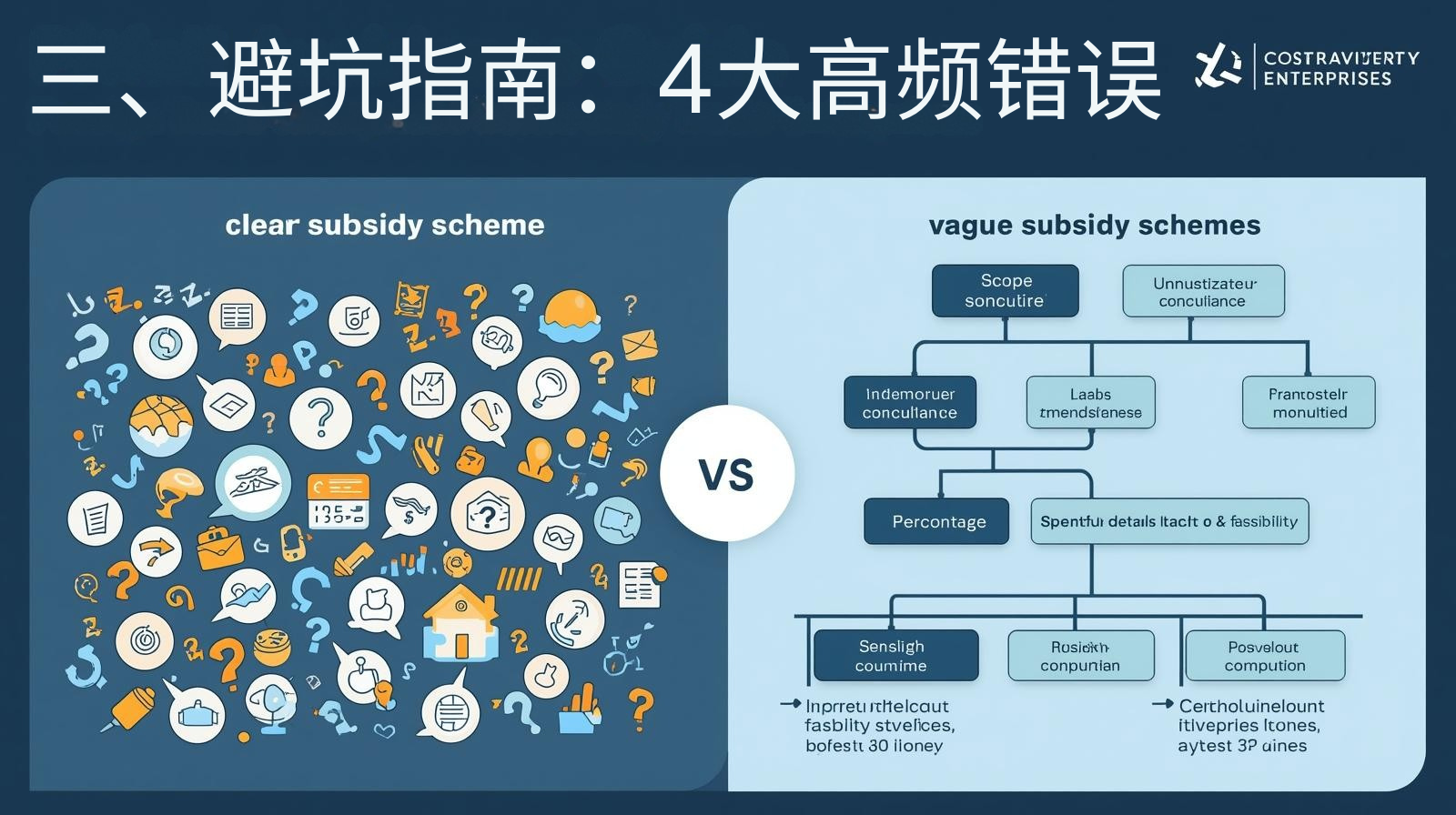
III. Avoidance Guide: 4 Frequently Used Mistakes (Must be avoided, otherwise it will affect AI recognition and buyer trust)
Based on practical lessons learned by foreign trade enterprises in 2026, the following four mistakes will directly lead to the failure of GEO+ sample cost subsidy optimization, the inability of AI on multiple platforms to accurately identify subsidy policies, and buyers' failure to recognize the subsidy advantages. These mistakes can even affect website reputation and AI recommendation priority. It is imperative to avoid these mistakes, and each mistake is accompanied by a specific corrective plan:
3.1 Error 1: The subsidy plan is vague, lacking specific details and feasibility.
Errors include : simply mentioning "we provide sample subsidies" without specifying the scope, percentage, or application process of the subsidy, such as "sample fee subsidy, shipping fee subsidy, please consult customer service for details," which is vague and lacks specific details; unreasonable subsidy schemes, such as excessively high subsidy percentages (100% subsidy for high-value samples) making it impossible for companies to implement, or excessively high subsidy thresholds (requiring a large deposit in advance) making it impossible for buyers to participate.
Key harms : AI determines that subsidy policies are not feasible or valuable, and therefore does not crawl or recommend them, preventing websites from highlighting their advantages in AI search; buyers cannot understand the subsidy policies, cannot perceive the advantages of cost reduction, and will not actively apply for subsidies or participate in trial orders; the subsidy plan cannot be implemented and ultimately becomes a "gimmick," damaging brand reputation.
Correct approach : The subsidy plan should clearly specify the scope, percentage, application process, and rules, without vague wording, and be supported by specific data (such as "subsidizing 50%-80% of sample fees"). A reasonable subsidy plan should be designed, balancing attractiveness and feasibility, taking into account both the company's costs and the buyer's pain points. You can refer to the Global Sources 2026 Foreign Trade Sample Subsidy Plan Template (link: https://www.globalources.com/) to optimize the plan details and ensure its feasibility.
3.2 Error 2: GEO signal missing, AI unable to recognize subsidy policy
Errors : Sample subsidy schemes are available, and the content highlights the advantages of subsidies, but relevant structured tags are not configured, keywords and semantic associations are not optimized, and GEO signals are missing; the subsidy content is not related to the pain points and keywords of buyers, and AI cannot identify the core value of the subsidy policy, nor can it match the search needs of buyers.
Key harms : Even if the subsidy program is of high quality and the content is clear, it is difficult to be prioritized by AI platforms such as ChatGPT. Buyers cannot find the subsidy policy when searching through AI, thus missing out on core traffic; the site's authority cannot be accumulated, and it remains in the lower half of the AI search ranking for a long time, so the value of the subsidy policy cannot be realized.
Correct approach : Configure structured tags such as "Offer" and "Review" according to the practical steps, optimize core keywords and semantic associations, and add AI-friendly signals; ensure that the subsidy content is highly related to the buyer's pain points and keywords to form a complete semantic system; regularly monitor the GEO signal capture situation, and make timely adjustments and optimizations to ensure that AI can quickly identify subsidy policies.
3.3 Error 3: False subsidies, policy does not match actual implementation
Errors include : false advertising of subsidy policies (e.g., labeling "sample fee waived" but actually charging high handling fees; labeling "80% freight subsidy" but actually only subsidizing 20%); fabricating trial order cases and customer reviews, or falsely labeling cooperation with authoritative institutions without genuine cooperation; and delaying or unjustifiably rejecting subsidy applications, preventing subsidies from being truly implemented.
Key harms : Once identified by AI on multiple platforms, the site will be permanently downgraded in recommendation priority or even blocked; if buyers find that the actual subsidies do not match the advertisements, they will directly abandon the cooperation and complain to industry platforms, damaging brand reputation; false subsidies will affect the overall AI weight of the site, making it impossible for other content to be properly crawled by AI.
Correct practice : All subsidy policies must be genuine and valid, strictly implemented according to the plan, with no hidden costs or false advertising; trial order cases, customer reviews, and partner institutions must all be verifiable, and external links must be official and valid links; standardize the subsidy application review process, provide feedback within 1-2 working days, ensure that subsidies are truly implemented, and let buyers feel our sincerity.
3.4 Mistake 4: Neglecting optimization and iteration, subsidy schemes are out of touch with demand.
Errors include : after completing the design and optimization of a subsidy program and GEO, no further updates or optimizations are made; the subsidy program and optimization strategies are not adjusted in a timely manner after changes in buyer demand (such as small and medium-sized buyers paying more attention to freight subsidies), AI algorithm iterations, and changes in industry trends; and the subsidy effect is not monitored, making it impossible to identify problems in the program.
Key harms : The subsidy program fails to meet the latest needs of buyers, resulting in a continuous decline in trial order conversion rates; it cannot adapt to AI algorithm iterations, leading to a gradual decline in the site's AI search ranking, and the subsidy policy cannot be prioritized by AI; problems in the subsidy program cannot be resolved in a timely manner, resulting in wasted corporate costs and loss of buyers.
Correct approach : Establish a regular iteration mechanism to monitor subsidy effectiveness monthly (trial order application volume, conversion rate, AI recognition accuracy), and adjust the subsidy scheme and GEO optimization strategy quarterly based on buyer needs, AI algorithm iterations (follow OpenAI's official announcements, link: https://platform.openai.com/docs/updates), and industry trends; collect buyer feedback to optimize the subsidy application process and subsidy ratio, ensuring that the subsidy scheme always meets needs and the optimization effect continues to improve.
Recommended Article: Your Competitors Haven't Reacted Yet: Building an Independent E-commerce Website with GEO is the Biggest Blue Ocean Strategy Right Now
Recommended Article: Your Competitors Haven't Reacted Yet: Building an Independent E-commerce Website with GEO is the Biggest Blue Ocean Strategy Right Now
IV. Conclusion: Addressing pain points with subsidies and seizing the initiative in trial order conversion using GEO+AI.
In 2026, AI search has become a core channel for overseas buyers to find foreign trade suppliers. However, the high cost of trial orders is the biggest pain point hindering cooperation among buyers and a key breakthrough for independent foreign trade websites to achieve traffic conversion. The core logic of GEO+ sample cost subsidies is not simply "launching subsidies + optimizing rankings," but rather using GEO optimization to allow AI from multiple platforms like ChatGPT to quickly identify subsidy policies and accurately push them to buyers with trial order needs. Subsidies lower the threshold for trial orders, dispel concerns about cooperation, and achieve a closed loop of "AI recommendation - pain point resolution - trial order conversion - bulk cooperation." For foreign trade companies, ignoring sample cost subsidies means missing a core opportunity to attract small and medium-sized buyers; ignoring GEO optimization, even with high-quality subsidies, makes it difficult to reach target users and achieve breakthroughs in traffic and conversion.
To maximize the optimization effect of GEO+ sample cost subsidies, a smooth, stable, and GEO-optimized independent website is the core carrier. Many foreign trade companies, during the optimization process, suffer from weak website foundations, cumbersome structured markup configurations, slow overseas loading, and disorganized content layout. Even with significant investment in designing subsidy plans and GEO optimization, their websites struggle to be efficiently crawled by multi-platform AI, negatively impacting the browsing experience for buyers and failing to fully convey the subsidy advantages. PinDian Technology, with over ten years of experience in foreign trade website building and serving over 7000 clients, uses React technology to build websites. This not only ensures a smoother browsing experience (overseas loading speed ≤2 seconds, perfectly adapting to multi-terminal access) but also fundamentally adapts to the optimization needs of GEO+ sample cost subsidies—including built-in structured markup templates for subsidy policies, keyword layout tools, and a global CDN acceleration module. It also supports the efficient presentation of authoritative endorsement information (partner institutions, case evidence), making subsidy policy optimization more efficient and accurate, and giving the website a natural advantage in multi-platform AI recognition. PinDian website building can simultaneously assist businesses in designing feasible sample cost subsidy plans, optimizing GEO signal implantation, and sorting out core keywords. Combined with the 4-step practical solution in this article, it allows your independent foreign trade website to quickly highlight the advantages of sample cost subsidies, gain priority recommendations from AI platforms such as ChatGPT, solve the pain point of high trial order costs for buyers, and achieve a double increase in trial order conversion rates and bulk cooperation volume. If your foreign trade website is facing the dilemma of "low AI search traffic, low buyer willingness to place trial orders, and high trial order costs leading to difficult conversions," consider PinDian Technology. With professional website building services and precise GEO optimization, use subsidies to overcome pain points and seize the core opportunity for AI-driven customer acquisition in foreign trade in 2026.