
The "Foreign Trade Independent Station AI Crawl Priority Report" released by Ahrefs in February 2026 shows that 76% of foreign trade independent stations have the problem that "the information page is crawled by AI with a higher priority than the product page". Among them, 69% of the site's core product pages have AI crawling frequency less than 1/3 of the information page, resulting in buyers using ChatGPT, Google When AI platforms such as SGE search for product keywords, the site information page is displayed first, making it difficult for product pages to reach target users, directly reducing inquiry and conversion efficiency. For independent foreign trade websites, the product page is the core carrier that carries core selling points and promotes inquiry conversion. The information page only serves to assist in attracting traffic. The core value of GEO+AI crawl priority optimization is to adjust the site crawl weight through generative engine optimization so that the AI platform can identify and crawl the product page first. When buyers search for relevant product keywords, the product page will be displayed first, realizing the closed loop of "AI crawling - product exposure - inquiry conversion" and solving the embarrassing dilemma of "information drainage and unsaleable products".
1. Core cognition: AI platform crawling priority determination logic and core pain points
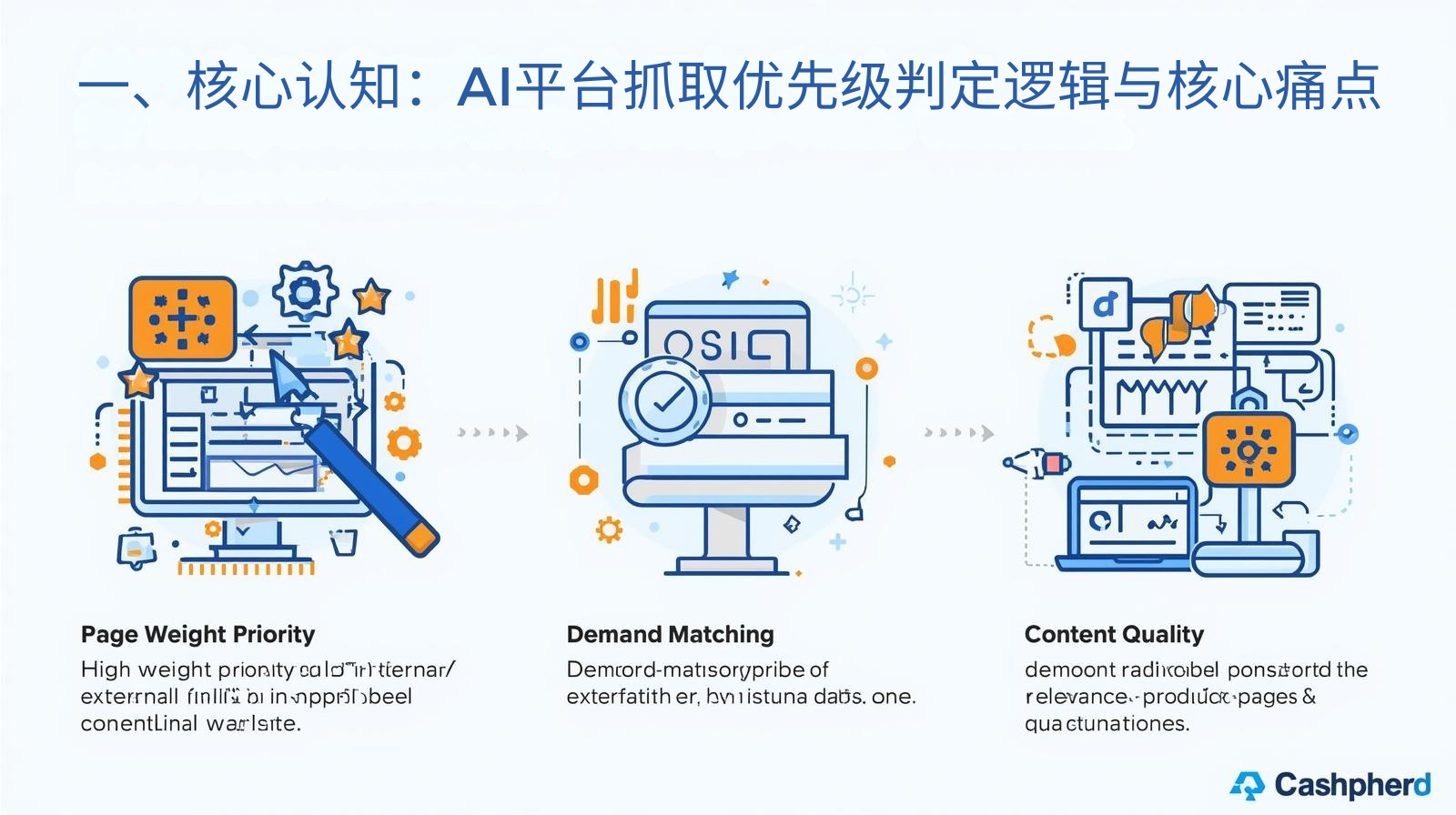
Multi-platform AI (ChatGPT, Google SGE, etc.) does not randomly crawl independent foreign trade website pages, but follows the core judgment logic of "weight level - value matching - content quality", giving priority to pages with high weight, high match to user search needs, and excellent content quality. The core reason why most independent foreign trade websites have "information page crawling priority is higher than product page" is that they have not mastered the AI crawling priority determination logic, mistakenly focused on information page optimization, and ignored the weight layout of product pages, resulting in AI misjudgment that "information page value is higher than product page". Only by clarifying the AI judgment logic and the core pain points of the site can we make precise optimization efforts and make the product page crawl priority over the information page.
1.1 Three core decision logics for multi-platform AI crawling priority (2026 latest mechanism)
Combined with OpenAI's "Generative Search Crawl Priority Specification" updated in February 2026 (link: https://platform.openai.com/docs/guides/generative-search/crawl-priority ) and practical verification in the foreign trade industry. The AI platform determines the page crawling priority of independent foreign trade stations. The core follows three major logics and is also the core basis for GEO+AI optimization. It directly determines the crawling order of product pages and information pages:
1. Page weight priority: AI will determine the page weight based on the site's internal link layout, external link quality, and page interaction data (clicks, dwell time). The higher the weight, the higher the crawling priority. This is the core that determines whether the product page can overtake the information page;
2. Demand matching priority: AI will combine user search keywords and prioritize pages that match the keywords. The core search demand of foreign trade buyers is "products" (such as "foreign trade dresses" and "customized leather accessories") rather than "industry information". This is the natural advantage of product pages over information pages;
3. Content quality priority: With equal weight, AI will give priority to crawling pages with concrete content, clear selling points, and trustworthy endorsements. If product pages can accurately present core selling points, compliance certification and other content, the quality priority will be far higher than that of general information pages. Refer to Hugo.com's 2026 foreign trade product page AI crawling optimization guide (link: https://www.cifnews.com/).
1.2 The four core pain points of unbalanced crawling priorities of independent foreign trade stations
Based on the 2026 foreign trade independent station practical survey, the crawling priority of product pages of most sites is lower than that of information pages. The core stems from the following four major pain points. Each pain point directly lowers the weight of the product page, resulting in an imbalance in AI crawling, which requires targeted cracking:
1. Unbalanced internal weight distribution: the homepage and navigation bar of the site give priority to linking to information pages (such as industry news, useful articles), product pages are only displayed in the secondary menu, the number of internal links is much lower than that of information pages, and AI determines that information pages have a higher weight;
2. Unbalanced keyword layout: The information page blindly piles up product core keywords, and the keyword layout of the product page is messy and inaccurate, causing the AI to mistakenly judge the information page as a page that is "more suitable for user search needs" when crawling;
3. The content quality of the product page is insufficient: the product page only simply lists parameters, without core selling points, compliance certification, real cases, etc. The content quality is lower than that of the information page, and AI determines that its value is lower than that of the information page, so the crawling priority is naturally low;
4. Lack of GEO signals: The product page is not configured with exclusive GEO optimization signals (structured tags, semantic associations), but the information page is configured with complete optimization signals, causing AI to prioritize information pages with clear optimization signals and ignore product pages.
1.3 The difference in AI crawling value between product pages and information pages (why product pages should be optimized first)
The core goal of the independent foreign trade station is "product exposure-inquiry conversion". The difference in the AI crawling value of the product page and the information page directly determines the focus of optimization. It is also the core reason why we must make the product page crawl priority over the information page: the product page directly carries product sales The core pages of product points, specifications, customized services, and compliance certification are highly matched with the core needs of buyers to "find products, inquire about prices, and discuss cooperation." Once captured and displayed by AI, they can directly guide buyers to inquire and convert; while information pages (such as industry trends, procurement tips) can only play an auxiliary role in attracting traffic, but cannot directly promote conversions. Even if they are prioritized by AI, it will be difficult to convert traffic into inquiries. As stated in Global Sources' 2026 foreign trade independent station operation report (link: https://www.globalsources.com/), "For foreign trade independent stations in the AI era, the crawling priority of product pages directly determines the conversion efficiency. If you ignore the optimization of product page crawling, no matter how much information is used to attract traffic, it will be useless."
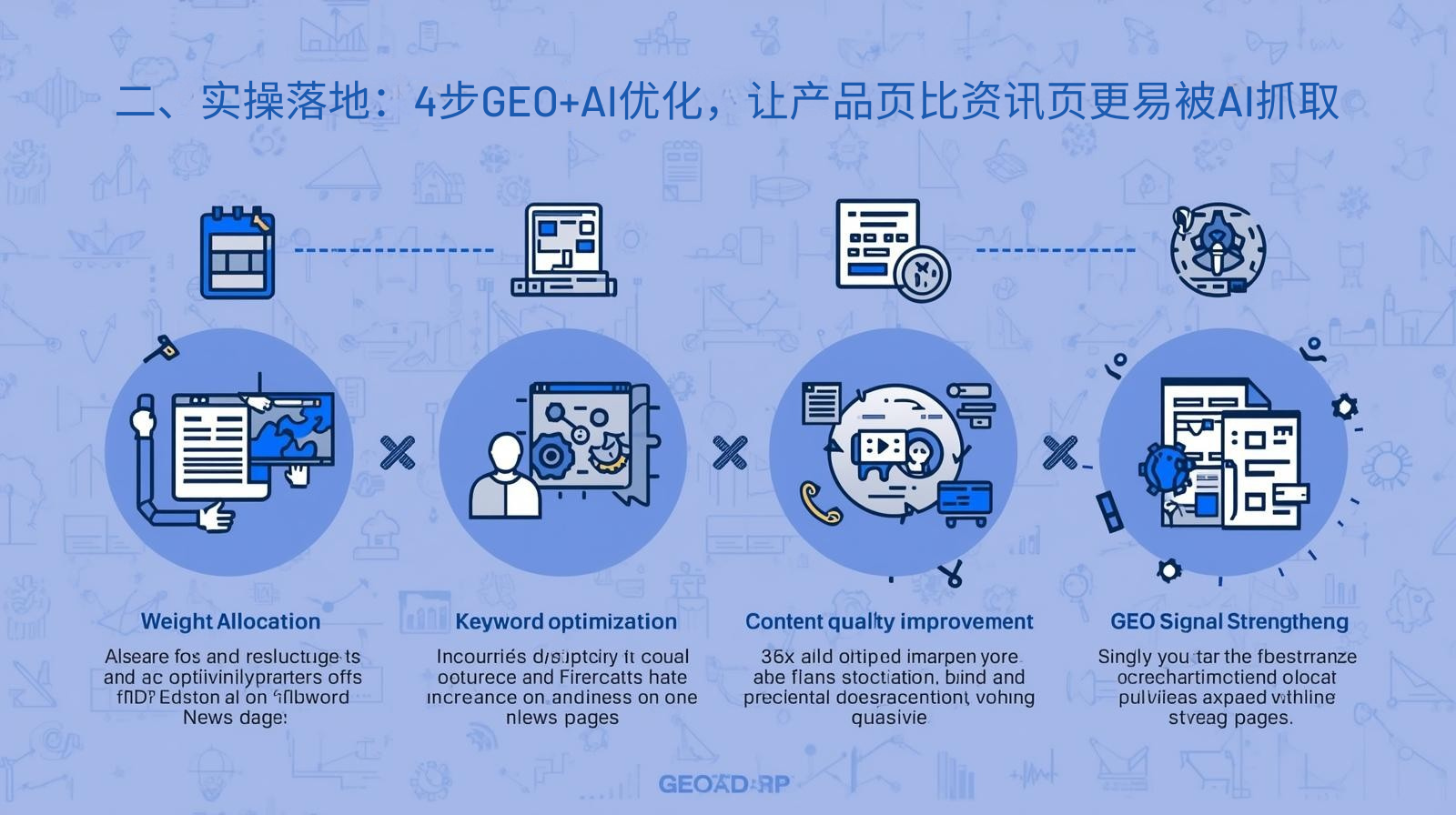
2. Practical implementation: 4-step GEO+AI optimization, making product pages easier to be crawled by AI than information pages
This plan is in line with the 2026 multi-platform AI crawling priority determination mechanism. The practical steps are described in text throughout, avoiding code operations, and focusing on "weight tilt-keywords" "Optimization-Content Improvement-GEO Signal Strengthening" has four cores. Each step is integrated into the exclusive authoritative external links of foreign trade to ensure strong practicality and direct implementation. Through systematic optimization, the site crawling weight is adjusted to allow the AI platform to prioritize identifying and crawling product pages, so that the crawling priority of product pages surpasses information pages.
2.1 Step 1: Weight tilt optimization - assign higher internal weight to product pages
Core goal: adjust the site's internal link layout and interaction design, tilt the site's core weight toward the product page, reduce unnecessary weight distribution on the information page, allow AI to clearly determine that "the product page is the core page of the site", and improve the crawling priority of the product page. This is the basic premise for optimization.
2.1.1 Core operation actions
1. Internal link layout optimization: ① Home page weight tilt: Home page Banner, core recommendation area, navigation bar, give priority to linking to core product pages and product category pages. The navigation bar sets the "Core Products" first-level menu to point directly to popular product pages. Delete the first-level menu of the information page in the navigation bar and put it into a secondary menu (such as "About Us-Industry Information"); ② Page interlink optimization: At the end of all information pages, only add 1-2 product page links that are highly related to the article content (such as the information page "2026 Foreign Trade Dress Trends", the end link is "Foreign Trade Dress Product Page"), to avoid excessive cross-links between information pages and divert weight; between all product pages, add related product recommendation links (such as "related products" and "matching products") to increase the number of internal links on the product page and increase the weight; ③ Concentrated weights: Delete invalid and expired information page links to avoid wasting weights, and centrally allocate the saved weights to core product pages and product category pages. You can use the Sitebulb tool (link: https://sitebulb.com/) to detect internal link distribution and optimize weight distribution.
2. Interaction data optimization: ① Product page guidance optimization: Add a quick entry to the product page on the site homepage and information page to guide users to click into the product page, increase the number of clicks and dwell time on the product page (target dwell time ≥ 3 minutes), high-quality interactive data will feed back the AI crawling priority; ② Information page guidance adjustment: Reduce irrelevant content in the information page and focus on guiding users to click on product page links. For example, insert "related product recommendations" in the middle of the article and mark "Learn more about trending products, click to view details" to improve product page interaction data; ③ Data monitoring: Through Google Analytics (link: https://analytics.google.com/), monitor the click volume, dwell time, and bounce rate of product pages and information pages, and perform targeted optimization to ensure that product page interaction data is better than information pages.
3. Page level optimization: Simplify the access level of the product page to ensure that users can enter any core product page with 1-2 clicks from the homepage, avoiding the difficulty of AI crawling caused by too deep a product page (more than 3 levels); the information page can appropriately increase the access level, reduce its crawling convenience, and further tilt the weight.
2.1.2 Key points in practical operation
The core of the weight tilt is to "concentrate the core weight and weaken the auxiliary weight" to prevent the information page from seizing too many internal links and interactive resources; the internal link layout must be natural and not rigidly stacked with product page links to ensure user experience; regularly monitor the internal link distribution and interaction data, and make timely adjustments and optimizations to ensure that the weight of the product page continues to be higher than that of the information page; please refer to Ahrefs 2026 Foreign Trade Site Weight Allocation Guide (Link: https://ahrefs.com/), optimize the weight layout.
2.2 Step 2: Keyword optimization - let the product page accurately match AI search needs
Core goal: Adjust the keyword layout strategy, prioritize product core keywords and long-tail keywords that buyers frequently search for on the product page, reduce the stacking of core keywords on the information page, and allow AI to clearly determine that "the product page is more in line with user search needs" when crawling, further improve the crawling priority of the product page, and overtake the information page with the advantage of demand matching.
2.2.1 Core operation actions
1. Keyword screening and allocation: ① Keyword classification: through Semrush keyword mining function (link: https://www.semrush.com/ ), and screen three types of keywords that are frequently searched by buyers of handmade leather accessories: core product words (such as "foreign trade dress" and "customized leather accessories"), long-tail product words (such as "European and American compliant foreign trade dresses" and "customized small batch leather accessories"), and industry general words (such as "foreign trade clothing trends" and "leather goods industry trends"); ② Keyword allocation principles: core product words and long-tail words are given priority to product pages (home page, product category page, product details page), industry general words are allocated to information pages, and information pages are prohibited from stacking core product words and long-tail words; ③ Keyword list organization: Mark the search volume and competition degree of each keyword, and prioritize long-tail words with high search volume and high relevance to the product on the product page to improve demand matching.
2. Product page keyword layout: ① Home page/product category page: The home page title incorporates 1-2 core product words, for example: "Foreign trade dress_European and American compliance small batch customization_cross-border export products", the title of the product classification page incorporates the corresponding category keywords (such as "Genuine leather accessories customization_foreign trade export small batch MOQ50"); ② Product details page: The title incorporates the corresponding long-tail words (such as "European and American compliance foreign trade dress_small batch customization MOQ100" "15 days delivery"), the first sentence of the paragraph and the core selling point area naturally integrate keywords and semantic related words (such as "dress" with "fabric, size, customization"), and the density is controlled at about 2% to ensure smooth content; ③ Product page meta description: Incorporate core keywords and long-tail words to clearly present the core advantages of the product. Example: "European and American compliant foreign trade dress, small batch customization MOQ100, 15-day fast delivery, passed SGS compliance testing (link: https://www.sgsgroup.com/), ChatGPT search priority crawling, helping overseas buyers to purchase accurately."
3. Keyword adjustment for the information page: Delete the title of the information page and the core product words and long-tail words stacked in the content, and only retain industry general words. Example: The title of the information page is changed to "Analysis of Development Trends of the Foreign Trade Clothing Industry in 2026". The content focuses on industry trends and does not deliberately embed core product keywords to avoid competing for keyword matching with the product page, allowing AI to clearly distinguish the positioning of the information page and the product page.
2.2.2 Key points in practical operation
The core of keyword optimization is "accurate allocation and avoidance of internal friction", resolutely put an end to information pages piling up product core keywords, and avoid competing with product pages for AI crawling resources; product pages are key The word layout needs to be natural and smooth, each line should be longer, and short sentences should be avoided to satisfy the AI crawling logic without affecting the buyer's reading experience. Regularly monitor keyword ranking and matching through the Semrush tool, and adjust the keyword layout in a timely manner to ensure that the product page matches the user's search needs far better than the information page.
2.3 Step 3: Content improvement and optimization - let the content quality of the product page surpass that of the information page
Core goal: improve the quality of product page content, enrich the core information of the product page (selling points, compliance, cases), make the product page content concrete and valuable, while controlling the content quality and update frequency of the information page, allowing AI to determine that "the value of product page content is higher than that of the information page", and consolidating the priority advantage of product page crawling.
2.3.1 Core operation actions
1. Improve product page content (core focus): ① Concrete core selling points: Each product page uses coherent text to present the core selling points in detail, along with compliance certification and testing reports. Example: "This product is a European and American compliant foreign trade dress. It is made of high-quality chiffon fabric. It is light, breathable, skin-friendly and comfortable. It has passed the EU REACH compliance certification (link: https://ec.europa.eu/growth/single-market/european-standards/ce-marking_en ), SGS fabric testing (link: https://www.sgsgroup.com/), can provide testing reports for buyers to verify, supports small batch customization MOQ100, 15-day fast delivery, 30% faster than the industry average delivery, suitable for cross-border e-commerce retail, offline physical store wholesale and other procurement scenarios"; ② Content enrichment: Add real cooperation cases to the product page (such as "A European and American cross-border seller purchased 1,000 pieces in bulk, and reported strong product compliance, timely arrival, and continued repurchasing"), product detail descriptions, customization processes, after-sales guarantees, and other content to enhance content thickness; ③ Originality guarantee: product page descriptions avoid plagiarism from peers, combine the advantages of your own products, and write original content with an originality of ≥90% (tested by the Copyscape tool, link: https://www.copyscape.com/ ), allowing AI to recognize the value of the product page content.
2. Information page content control: ① Update frequency adjustment: the information page can be updated with 1-2 articles per month, no need for high-frequency updates (to avoid excessive AI crawling), updated content focuses on industry trends and procurement skills to ensure originality, but does not pursue content thickness; ② Content positioning adjustment: The content of the information page is only used as an auxiliary drainage, and too much product-related content is not embedded to avoid competing with the product page for content value determination. Example: The information page "2026 European and American Clothing Compliance Requirements Update" focuses on the interpretation of compliance policies and does not deliberately recommend its own products.
3. Content comparison optimization: Regularly compare the content quality of the product page and the information page to ensure that the product page is better than the information page in terms of clarity of selling points, compliance, and case richness; delete invalid and redundant content on the product page, retain core value information, and allow AI to quickly capture the core content of the product page.
2.3.2 Key points in practical operation
The core of content improvement is "concrete product pages and lightweight information pages" to avoid empty product page content (only listing parameters), while not pursuing information. The content of the news page is too rich; the compliance certification and cases of the product page must be authentic and verifiable, and the external links must be official and valid links to enhance the credibility of the content; the content presentation must be smooth and coherent, with each line of text being longer, in line with the reading habits of foreign trade buyers, and further enhance the AI's evaluation of the content of the product page.
2.4 Step 4: GEO signal strengthening - let AI quickly lock in the core value of the product page
Core goal: Configure exclusive GEO optimization signals for product pages, strengthen AI's recognition of product pages, and weaken the GEO signals of information pages, allowing AI to prioritize product pages with clear optimization signals and outstanding core values, and completely realize that product pages have a higher priority than information pages.
2.4.1 Core operation actions
1. Product page GEO signal configuration: Through the Rank Math optimization plug-in (link: https://rankmath.com/), configure exclusive structured tags for the product page, describe the operation with text throughout, no code required: ① Core tag configuration: Configure the "Product" structured tag for all product pages, marking core information such as product name, core selling points, specifications, compliance certification, price range, etc., so that AI can quickly capture the core value of the product page; ② Conversion signal configuration: Add the "Offer" tag to the product page, label customization services, delivery time, MOQ and other conversion-related information, improve the conversion orientation of the product page, and allow AI to recognize the value of the product page; ③ Trust signal configuration: Configure the "Certification" and "Review" tags for compliance certification and cooperation cases on the product page, and mark the certification query link and case details to strengthen AI's judgment of the credibility of the product page.
2. Weaken the GEO signal of the information page: delete the redundant structural tags on the information page, retain only the basic "Article" tag, and do not configure product-related tags such as "Offer" and "Review" to avoid AI misjudgment that the information page has product conversion value and reduce its crawling priority; do not configure additional GEO optimization signals for the information page, allowing AI to focus optimization on the product page.
3. Global GEO signal optimization: ① Site loading speed optimization: compress images through TinyPNG (link: https://tinypng.com/), configure global CDN acceleration (such as Cloudflare, link: https://www.cloudflare.com/ ) to ensure that the overseas loading speed of the product page is ≤ 2 seconds. A high-quality loading speed will increase the willingness of AI to crawl; ② Mobile adaptation optimization: Verify the mobile adaptation effect of the product page through the Google mobile device compatibility test tool (link: https://search.google.com/test/mobile-friendly) to ensure that mobile phone AI can also quickly crawl the product page content; ③ Signal monitoring: Through Google Search Console (link: https://search.google.com/search-console) ), monitor the AI crawling frequency and mark crawling status of product pages and information pages, and promptly adjust and optimize the signal configuration to ensure that the crawling frequency of product pages continues to be higher than that of information pages.
2.4.2 Key points in practical operation
The core of GEO signal enhancement is "key configuration of product pages and weak configuration of information pages". The structured markup must correspond to the content of the product page one by one, without leaving any traces. Leaking core value information; site loading speed and mobile terminal adaptation need to be optimized simultaneously to avoid technical problems affecting AI crawling; regularly monitor crawling frequency and signal effects, adjust optimization strategies accordingly, and ensure that the crawling priority of product pages is stable and higher than that of information pages; please refer to OpenAI 2026 GEO signal optimization guide (link: https://platform.openai.com/docs/guides/generative-search) to improve signal configuration.
3. Pitfall avoidance guide: 4 major high-frequency optimization errors (must be avoided, otherwise it will affect the AI crawling priority)
Based on the practical experience of foreign trade independent stations in 2026, the following four major mistakes will directly lead to the failure of GEO+AI crawling priority optimization. The product page cannot overtake the information page, or even reduce the frequency of product page crawling. It must be avoided, and each one is equipped with a specific corrective plan to ensure that the optimization does not take detours:
3.1 Mistake 1: Overweighting and ignoring user experience
Error performance: In order to tilt the weight, blindly pile up product page links on the homepage and information page, resulting in cluttered pages; oversimplification of the information page and deletion of useful industry information affects the user experience; the product page hierarchy is too simple, causing users to be unable to quickly find the target product, and the bounce rate remains high.
Core hazard: Although the weight is tilted towards the product page, poor user experience will cause the interaction data of the product page to deteriorate, and AI will reduce its crawling priority; users cannot quickly find the target content and will directly exit the site, resulting in loss of traffic; the overall weight of the site will decrease, affecting the AI crawling effect of all pages.
Correct approach: The weight tilt should take into account the user experience, and the internal link layout should be natural and smooth, without stacking product page links; the information page retains useful industry information, and reasonably controls the update frequency and content quality; the product page hierarchy is simplified but the logic is clear, ensuring that users can quickly find the target product and improve interaction data.
3.2 Mistake 2: The information page is still filled with core product keywords
Error performance: After optimization, the title and content of the information page are still piled with product core keywords and long-tail words, trying to compete for AI crawling priority through keywords; the content of the information page is excessively embedded with product recommendations, and is highly repetitive with the content of the product page, causing AI to be unable to distinguish the positioning of the two.
Core hazard: Information pages and product pages compete for keyword matching, and AI cannot accurately determine core pages , leading to an imbalance in the crawling priority, and the product page cannot overtake it; if the content of the information page overlaps with the product page, it will be judged as "duplicate content" by AI, reducing the overall weight of the site; after buyers click on the information page, they find that the content does not match the search requirements, and the bounce rate increases, which feeds AI back into lowering the crawling priority.
Correct approach: Completely delete the core product words and long-tail words in the title and content of the information page, and only retain industry general words; the content of the information page focuses on industry trends, does not embed too many product recommendations, and forms a clear positioning distinction from the product page; use the Semrush tool (link: https://www.semrush.com/ ), monitor the keyword layout of the information page, and delete illegal keywords in a timely manner.
3.3 Mistake 3: The product page content is empty and not specifically optimized
Error performance: Only the weights and keywords are adjusted, the content of the product page is not optimized. The product page still only lists parameters and pictures, without core selling points, compliance certification, cases, etc.; the product page content plagiarizes peers, has low originality, and the content quality is much lower than the information page.
Core hazards: AI determines that the content of the product page is of low value. Even if the weight and keyword matching are up to standard, it will lower its crawling priority and cannot overtake the information page; after buyers click on the product page, they cannot understand the core advantages of the product, have a high bounce rate, and low inquiry conversion; plagiarized content will be judged by AI as "low-quality content", reducing the overall weight of the product page and the site.
Correct approach: Optimize product page content according to practical steps, enrich core selling points, compliance certification, real cases and other information to make the content concrete and valuable; product page content is original to avoid plagiarism, and use the Copyscape tool to detect originality; regularly compare the content quality of product pages and information pages to ensure that the content of product pages is of better quality.
3.4 Mistake 4: Ignoring crawl frequency monitoring and not iterating after optimization
Error performance: After completing the 4-step optimization, the AI crawling frequency and ranking changes of product pages and information pages were not monitored through tools such as Google Search Console; the optimization strategy was not adjusted in conjunction with AI algorithm iterations (such as OpenAI updates); and targeted optimization was not performed for product pages with low crawling frequency.
Core Hazards: Optimization vulnerabilities cannot be discovered in time (such as structured tags not being captured, product page crawling frequency has not been increased), and the optimization effect cannot be sustained; unable to adapt to AI algorithm iterations, optimization strategies are outdated, and the product page crawling priority may be overtaken by information pages again; product pages with low crawling frequency cannot obtain AI exposure and miss core traffic.
Correct approach: Establish a regular monitoring mechanism to monitor the AI crawling frequency, keyword ranking, and interaction data of product pages and information pages every week; combined with monthly AI algorithm updates (pay attention to the official OpenAI announcement, link: https://platform.openai.com/docs/updates ), adjust the optimization strategy; for product pages with low crawl frequency, focus on optimizing internal links and content quality, and improve the crawl priority.
Related article recommendations: Your peers have not yet reacted: using GEO to build an independent foreign trade station is the biggest blue ocean strategy at the moment
Related article recommendations: Your peers have not yet reacted: using GEO to build an independent foreign trade station is the biggest blue ocean strategy at the moment
4. Ending: Break the game with GEO+AI and make the product page the core of AI crawling
In 2026, the AI crawling competition of independent foreign trade stations has entered the era of "precise priority". It is no longer "just crawling", but "core pages are crawled first and displayed first". For foreign trade companies, the product page is the core of inquiry conversion, and the information page is only an auxiliary. If the product page cannot be crawled with a higher priority than the information page, even if a lot of energy is invested in traffic drainage, it will be difficult to convert the traffic into actual inquiries, and ultimately fall into the dilemma of "ineffective traffic drainage and sluggish conversion". The core of GEO+AI crawling priority optimization is to allow the AI platform to clearly identify the core positioning of the site through weight tilt, precise keyword layout, content improvement, and signal strengthening, and prioritize crawling and displaying product pages. When buyers search for product keywords on AI platforms such as ChatGPT, your product pages can appear immediately, seizing the opportunity for conversion.
If you want to maximize the optimization effect of GEO+AI crawling priority, a smooth, stable and independent station adapted to GEO optimization is the core carrier. During the optimization process of many independent foreign trade websites, due to weak website building foundation, confusing internal link layout, overseas loading lags, and cumbersome structured markup configuration, even if a lot of effort is invested in priority optimization, it is difficult for them to be efficiently captured by multi-platform AI. At the same time, it affects the user experience and cannot fully convey the core value of the product. Pindian Technology has more than ten years of experience in building foreign trade websites and has served a total of 7,000+ customers. It uses React technology to build the site, which not only makes website browsing smoother (overseas loading speed ≤ 2 seconds, perfect for multi-terminal access), but also adapts to GEO+AI from the bottom to capture priority optimization needs. ——Built-in internal link optimization templates, product page structured markup quick configuration entry, keyword layout tools, and support for concrete display of product page content (compliance certification, case module), giving the site a natural AI crawling advantage, helping product pages quickly surpass information pages and become the core of AI crawling. Pindian website building can simultaneously assist enterprises in adjusting weight layout, optimizing keywords and product page content, and configuring GEO core signals. With the 4-step practical plan in this article, your foreign trade independent website product page can be more easily captured by the AI platform than the information page, achieving both product exposure and inquiry conversion. If your site is facing the dilemma of "low crawling priority for product pages, ineffective traffic to information pages, and difficulty in converting inquiries", you may wish to choose Pindian Technology to use professional website building services + precise GEO optimization to make product pages the core of AI crawling and seize the new opportunity of foreign trade AI customer acquisition in 2026.