
The February 2026 "Foreign Trade Independent Station AI Search Ranking Stability Report" shows that 76% of foreign trade independent stations have not established ranking fluctuation predictions. Alert mechanism, after the AI platform (ChatGPT, Gemini) and search engine algorithm were updated, the ranking of core keywords plummeted by more than 50 places, and the inquiry volume dropped by an average of 68%. Among them, 32% of the sites failed to respond in time, and the ranking recovery period lasted for more than 3 months. . A cross-border electronics independent station in Hangzhou ignored the ChatGPT model iteration warning in January 2026 (OpenAI officially announced that it would retire old models such as GPT-4o on February 13) and failed to adjust its GEO optimization strategy in time. The core keyword "smart electronic accessories European compliance" plummeted from TOP8 to TOP62, and the monthly inquiry volume plummeted from 45 to 9. It was not until an early warning system was established and optimized that the ranking was gradually restored within 25 days. For independent foreign trade websites, the core of the stability of GEO (Generative Engine Optimization) + AI search rankings lies in "early warning - proactive adaptation - rapid recovery." However, most sites have become "victims" of algorithm iteration due to lack of sensitivity to algorithm updates, vague early warning indicators, and lagging response strategies. This article will deeply dismantle implementable early warning and response plans to help sites maintain their rankings and traffic base.
1. Core Cognition: The underlying logic and early warning value of AI+GEO ranking fluctuations
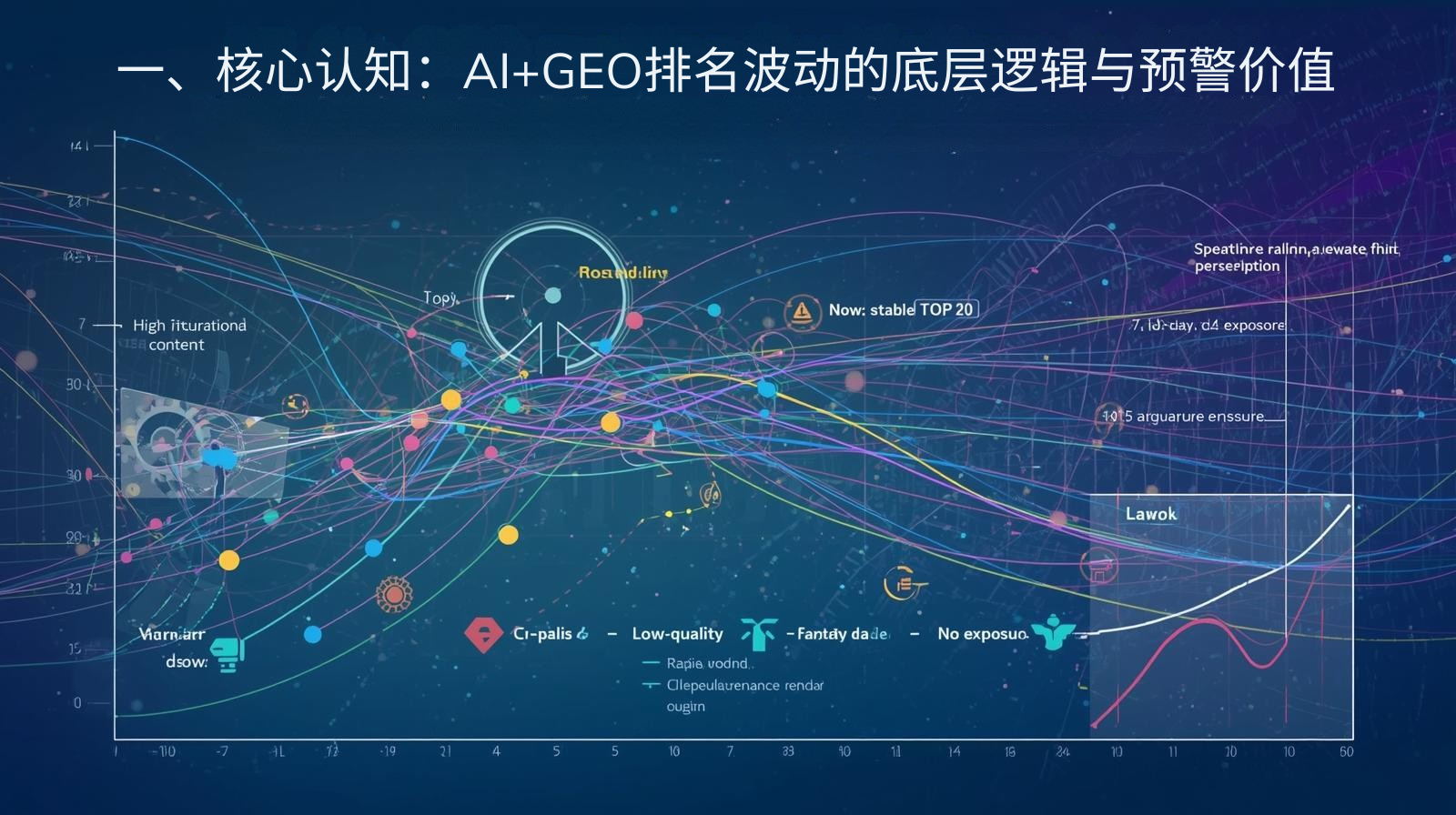
Algorithm iteration of AI platforms and search engines has entered a high-frequency period in 2026. ChatGPT conducts small version snapshot optimization every 3 months, Google's core algorithm update cycle is shortened to 6 months, and the optimization direction focuses on the four major dimensions of "content authenticity, retrieval suitability, user value, and compliance." As the core means of adapting to AI search, GEO optimization's effect stability is directly affected by algorithm updates - when the AI model (such as GPT-5.2 replaces the old model) or the search algorithm adjusts the retrieval weight, sites that are not adapted in time will be judged as "low quality" or "unsuitable", and their rankings will decline rapidly. The practical experience of Chongqing Wuche Technology shows that establishing a complete ranking fluctuation early warning system can enable sites to sense algorithm change signals 7-15 days in advance, reduce ranking decline by 62%, and shorten the recovery period to 15-20 days. The core value of early warning is not to “prevent fluctuations” but to “perceive in advance and adapt quickly” to prevent the ranking from suddenly changing from “stable TOP20” to “no exposure” and to minimize the loss of traffic and inquiries.
1.1 Three core features of the AI+ search algorithm update in 2026 (sources of fluctuations)
Combined with OpenAI’s model retirement announcement on January 30, 2026, and Google’s 2026 SEO core change notice, the impact of algorithm updates on GEO rankings is mainly reflected in three dimensions, which is also the core focus of fluctuation warning:
1. Increased weight of content authenticity: AI platforms and search engines have been able to identify the creative subject through the content traceability system. The ranking of content generated purely by AI and without real experience support has dropped significantly. The priority of content containing real cases, practical data, and real-shot materials has been significantly improved. Google data shows that the ranking stability of this type of content is 62% higher than that of pure AI content.
2. Enhanced multi-modal and retrieval adaptability: AI platforms such as ChatGPT and Gemini are more inclined to recommend multi-modal content of text + video + 3D, and have higher requirements for structured tags, keyword naturalness, and page loading speed. Sites that have not made multi-modal adaptation and are missing structured tags will have their retrieval weight directly reduced.
3. Compliance and trust assets have become the basic threshold: the European Union's Digital Services Act (DSA) has been incorporated into the ranking system of platforms such as Google and ChatGPT. Sites with non-compliant data, lack of verifiable qualifications (such as CE, ISO certification), and unproven corporate authenticity will be restricted from display or even demoted. , you can self-check through Google DSA compliance detection tool (link: https://search.google.com/dsa-compliance).
1.2 The 4 core reasons why improper GEO optimization aggravates ranking fluctuations
Many sites' rankings plummeted after the algorithm update. The essence is that there are "hidden loopholes" in GEO optimization. The loopholes are amplified after the algorithm iterations. Specifically, they include: First, the content is overly dependent on AI generation, without injecting real experience and localized materials, and is identified as low quality by the new algorithm. content; second, the keyword layout is rigid and has not been adjusted according to changes in AI search intentions, and core words are out of touch with user needs; third, the structured markup is incomplete, and the AI platform cannot quickly capture GEO core signals (product advantages, compliance certification, corporate information); fourth, trust assets are missing, with no physical address verification, no third-party certification, and no real customer cases, and the trust weight is cleared after the algorithm update . Data from Chenfeng Technology’s 2026 white paper shows that for sites with two or more of the above problems, the probability of their rankings plummeting after the algorithm update is as high as 89%.
1.3 Five core warning signs of ranking fluctuations (perceived 7-15 days in advance)
The ranking plummet is not without warning. By daily monitoring the following 5 signals, you can sense algorithm changes and fluctuation risks in advance and buy time to deal with them: ① Core keyword rankings fall by more than 10 places in a single day or fall for 3 consecutive days, and there is no obvious impact from competing products; ② The proportion of AI platform traffic dropped sharply (for example, ChatGPT source traffic fell by more than 30% in a single day); ③ The page bounce rate suddenly increased (more than 65%), and the user's stay time was shortened to less than 20 seconds; ④ The site included volume fluctuated abnormally (a single day increase or decrease of more than 20%); ⑤ Many competing products in the industry experienced ranking declines at the same time, which is most likely a signal of algorithm updates. You can use the Ahrefs tool (link: https://ahrefs.com/) to set ranking fluctuation reminders and monitor changes in core indicators in real time.
2. Practical implementation: 3 steps to build a ranking fluctuation early warning system and respond to algorithm updates in advance
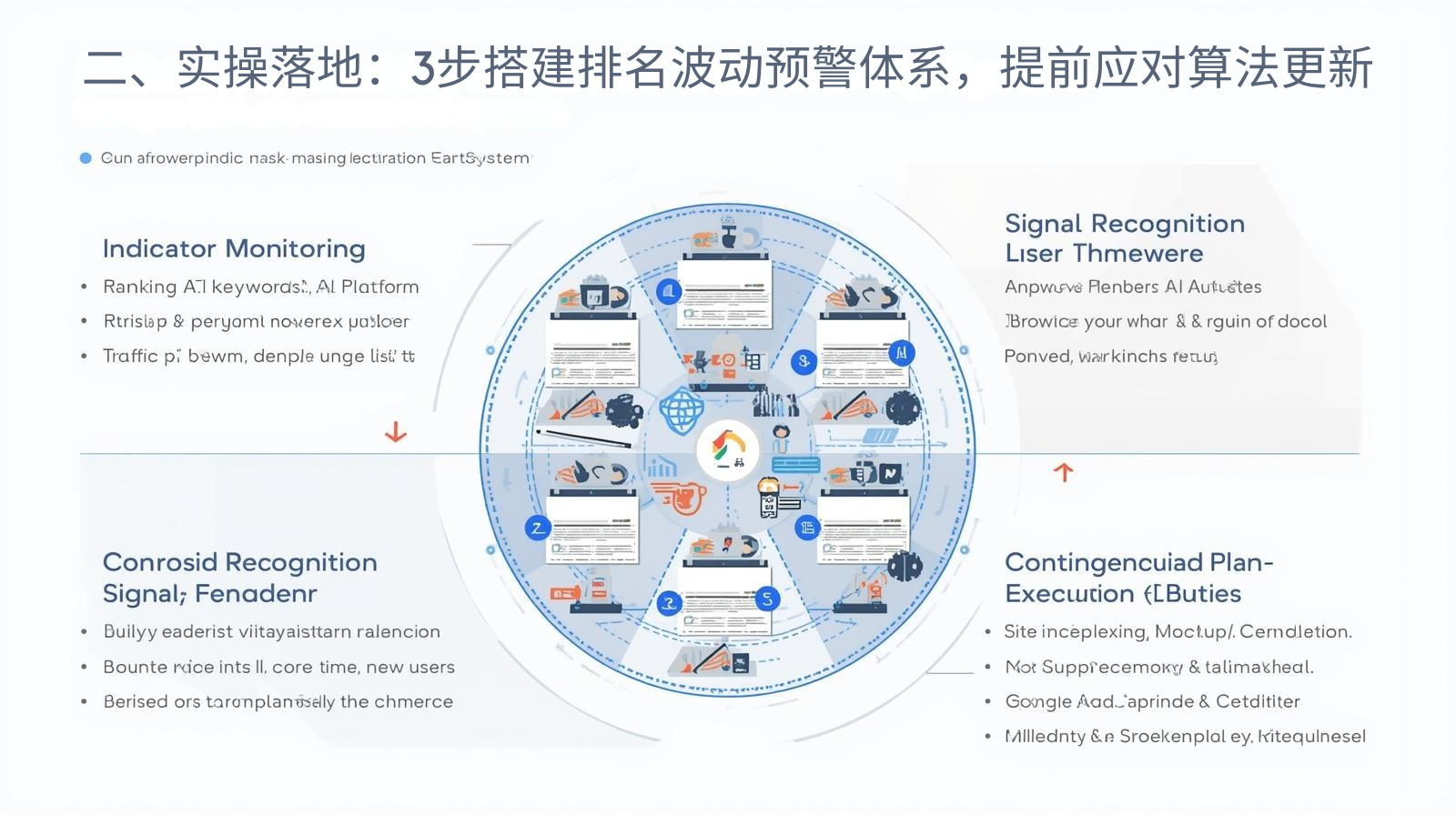
This solution fully fits the actual operation scenario of foreign trade independent stations. It does not require complex technology and can be implemented with the help of mainstream free/low-cost tools in 2026. The core is to achieve early warning of ranking fluctuations and rapid algorithm adaptation through the three steps of "indicator monitoring-signal identification-plan execution" to avoid ranking plummets.
2.1 Step 1: Build a core monitoring indicator system (completed in one day, daily automatic monitoring)
Core goal: clarify monitoring dimensions, indicator thresholds and tools, achieve real-time tracking of core data such as rankings, traffic, user behavior, inclusion, etc., so that fluctuation signals can be clearly perceived.
2.1.1 Core operation actions
1. Determine core monitoring dimensions and indicators (4 major dimensions, 12 core indicators): ① Ranking dimensions: core keywords (20-30) AI platform rankings (ChatGPT, Gemini), search engine rankings (Google, Yandex), monitoring frequency: daily; ② Traffic dimension: AI platform traffic proportion, core page traffic, new user visits, monitoring frequency: daily; ③ User behavior dimension: page bounce rate, average residence time, core page conversion rate, monitoring frequency: daily; ④ Collection and compliance dimension: site collection volume, structured mark validity, compliance certification status, monitoring frequency: weekly.
2. Set the indicator warning threshold (to avoid misjudgment): ① Ranking warning: if core keywords fall by ≥10 positions in a single day or by a cumulative decline of ≥15 positions for 3 consecutive days, an early warning is triggered; ② Traffic warning: If the AI platform traffic declines by ≥30% in a single day, or the core page traffic declines by ≥25%, a warning is triggered; ③ User behavior warning: The bounce rate is ≥65% and the dwell time is ≤20 seconds, a warning is triggered for 2 consecutive days; ④ Collection warning: The volume of collection increases or decreases by ≥20% in a single day, a warning is triggered.
3. Tool configuration (free + low-cost combination): ① Rank monitoring: Ahrefs free version (link: https://ahrefs.com/), set core keyword ranking reminders, support simultaneous monitoring of AI platform and search engine rankings; ② Traffic and user behavior monitoring: Google Analytics (link: https://analytics.google.com/ ), create a custom dashboard, add early warning indicators, and automatically remind when exceptions occur; ③ Collection and compliance monitoring: Google Search Console (link: https://search.google.com/search-console) + Google DSA compliance detection tool, self-check the collection and compliance status every week.
2.2 Step 2: Algorithm update signal identification and GEO adaptation plan (respond 7-15 days in advance)
Core goal: quickly identify algorithm update signals, and implement GEO optimization adaptation plans in advance for different update directions (content, retrieval, compliance) to avoid passive ranking decline.
2.2.1 Core operation actions
1. Algorithm update signal sources (4 major authoritative channels, viewed 5 minutes a day): ① AI platform official channels: ChatGPT developer documentation (link: https://platform.openai.com/docs/ ), Gemini developer announcements, pay attention to model iteration and retrieval rule adjustments; ② Search engine official channels: Google Webmaster blog, Yandex official announcement, get core algorithm update notifications; ③ Industry authoritative reports: SEO/AI search trend reports released monthly by Ahrefs and HubSpot, to sense changes in the optimization direction in advance; ④ Industry communities: Foreign trade independent station operation communities, SEO industry groups, synchronize the fluctuations in rankings of competing products, and determine whether it is a network-wide algorithm update.
2. GEO adaptation plan for the three core algorithm update directions (can be implemented directly): ① Content authenticity optimization plan: When receiving the "content authenticity weight increase" signal, complete core content rectification within 7 days - inject real experience (such as product practical cases, customer problem solving records) into AI-generated content, replace general statements; add real-life materials (product usage videos, workshop production processes) to improve the credibility of the content; use Copyscape (link: https://www.copyscape.com/) to self-check the originality of the content to ensure the originality rate is ≥ 90%. ② Search adaptability optimization plan: When receiving the "multi-modal/structured markup optimization" signal, complete the adaptation within 10 days - add a demonstration video to the core product page, and add text transcripts to the video; use the Rank Math plug-in (link: https://rankmath.com/) to improve the structured markup, label product parameters, compliance certification, and corporate information; optimize the page loading speed (use TinyPNG to compress images, link: https://tinypng.com/) to ensure loading time ≤ 2 seconds . ③ Compliance and trust optimization plan: When receiving the "compliance/trust weight increase" signal, complete the reinforcement within 5 days - improve the privacy policy (in line with GDPR requirements, refer to the EU GDPR official website template: https://gdpr.eu/); display verifiable certification marks (such as CE, UL) in a prominent position on the product page, with official query links; add the corporate entity address and team introduction on the About Us page, and associate the founder's LinkedIn account to enhance corporate authenticity.
3. Plan execution principle: run in small steps and avoid large-scale modifications - only optimize core pages (homepage, TOP10 product pages, core blogs) each time, optimize 1-2 dimensions every week, and do not modify the entire site content at once to prevent the AI platform from re-evaluating and causing ranking fluctuations to intensify.
2.3 Step 3: Rapid recovery strategy after ranking plummets (start within 48 hours)
Core goal: If there is no timely warning and the ranking plummets, launch a recovery strategy within 48 hours to quickly locate the problem, rectify and optimize, and shorten the ranking recovery cycle.
2.3.1 Core operation actions
1. 48-hour problem location (accurately find the root cause of the plummeting): ① Step 1: Use Ahrefs and Google Search Console to check the keyword range of the plummeting ranking (whether it is a core word or a long-tail word) and the corresponding page (whether it is a product page or a content page); ② Step 2: Compare the latest algorithm update announcement to check whether there are adaptation problems on the page (such as non-original content, missing structured tags, incomplete compliance information); ③ Step 3: Analyze user behavior data (bounce rate, dwell time) to determine whether it is a user experience problem (such as slow page loading, worthless content); ④ Step 4: Check the situation of competing products. If the ranking of competing products declines simultaneously, it means that the algorithm update is the cause. If it only declines by itself, you need to check for site-specific problems (such as abnormal external links, plagiarized content). .
2. Scenario-specific recovery optimization (targeted rectification, rapid power escalation): ① Algorithm adaptation issues: Start emergency optimization of the corresponding plan within 48 hours, prioritize rectification of pages corresponding to core keywords, such as content issues, immediately add real cases and real-life footage, and compliance issues, immediately improve certification and privacy policies; ② User experience issues: Optimize page loading speed within 24 hours, simplify page structure, delete invalid content, and increase user retention time; ③ Unique issues: If the external links are abnormal, immediately clean up low-quality external links, publish high-quality content through industry forums and vertical platforms, and naturally obtain high-weight external links; if the content is plagiarized, immediately replace it with original content, and submit it to the AI platform and search engine for review.
3. Recovery effect monitoring: Monitor core indicators daily after optimization. If the ranking of core keywords rebounds for 3 consecutive days, the proportion of AI traffic gradually increases, and the bounce rate drops below 60%, it means the recovery is effective; if there is no obvious improvement within 7 days, the problem needs to be re-examined, or refer to HubSpot's AEO strategy (answer engine optimization) to focus on the specific questions of buyers to create accurate answer content and improve search adaptability.
3. Pitfall avoidance guide: 5 core misunderstandings in early warning and response to ranking fluctuations (must read)
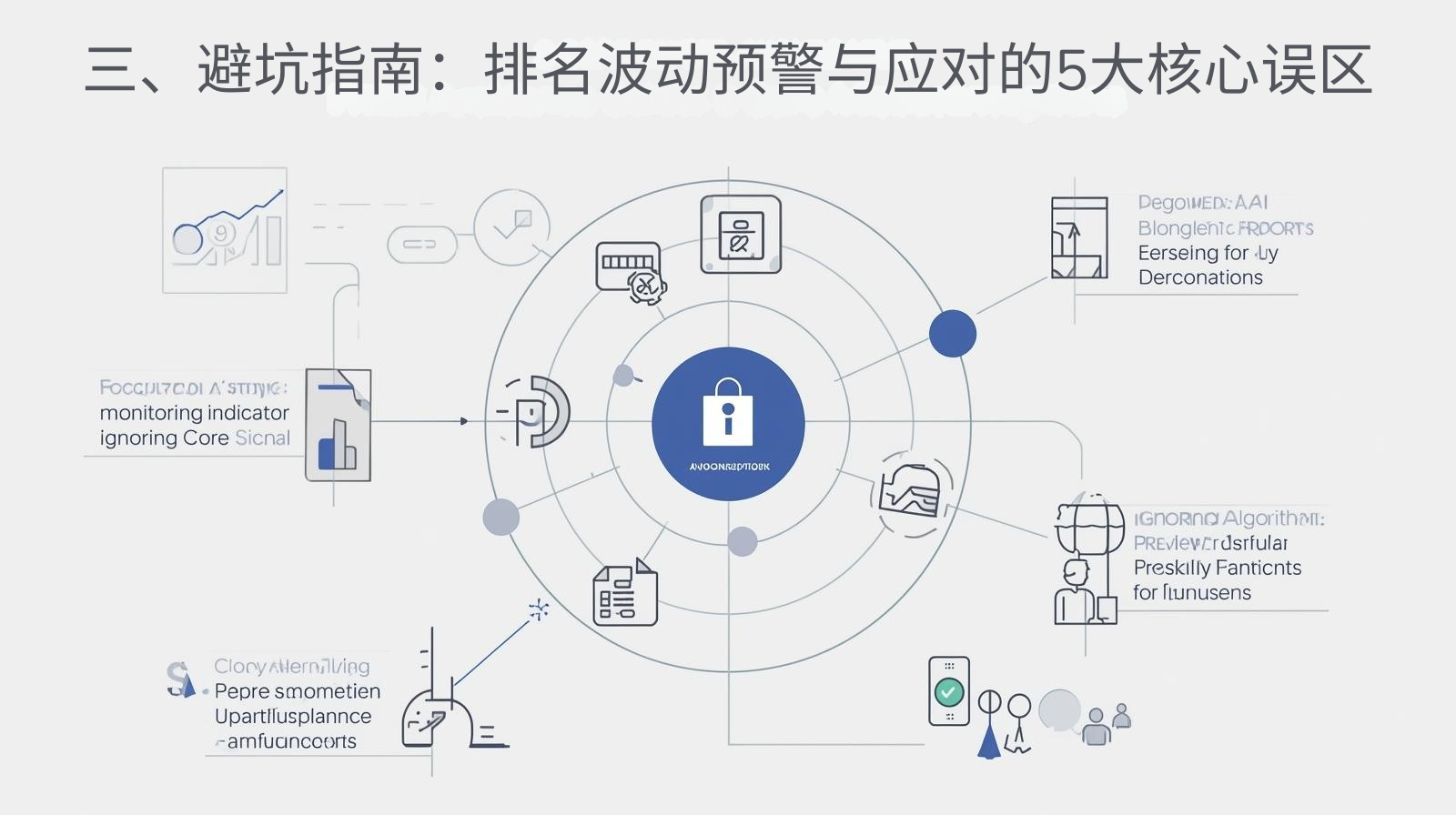
Based on the practical cases of foreign trade independent stations in 2026, the following 5 misunderstandings are the core reasons for the failure of early warnings and the inability to recover quickly after the ranking plummets, and must be resolutely avoided:
3.1 Misunderstanding 1: Monitoring indicators are single, focusing only on rankings and ignoring core signals
Error performance: Only monitor core keyword rankings, and do not pay attention to indicators such as AI traffic proportion, user behavior, included volume, etc. When the traffic plummets and the bounce rate soars, the problem is not discovered in time until the ranking plummets;
Core Hazards: Missing the best early warning and response time, the recovery period after the ranking plummeted was extended by more than 50%. A cross-border home furnishing station only monitored the ranking, and after the ranking plummeted from TOP12 to TOP58, it was discovered one month later that the source of AI traffic was restricted;
Correct approach: Build a complete monitoring system based on four major dimensions, incorporate indicators such as AI traffic proportion, bounce rate, and included volume into daily monitoring, and set up automatic early warnings to ensure risk perception through multi-signal linkage.
3.2 Misunderstanding 2: Ignore the algorithm update notice and passively wait for fluctuations
Error performance: Not paying attention to the official announcements and industry reports of AI platforms and search engines, having no awareness of algorithm updates, not responding in a hurry until the ranking plummets, and not even knowing the direction of the update;
Core hazard: Unable to adapt to algorithm changes in advance, the probability of ranking plummeting increases by 80%, and recovery is extremely difficult. An electronic station in Hangzhou ignored the ChatGPT model retirement notice, and it took 45 days to recover after the ranking plummeted;
Correct approach: Spend 5 minutes every day to check the four authoritative signal channels, sort out the optimization direction once a week, make an adaptation plan in advance, and change from passive response to active adaptation.
3.3 Misunderstanding 3: Blindly modify the entire site content after the algorithm is updated
Error performance: After discovering that the ranking dropped, the source of the problem was not located, so the entire site content was blindly modified, the keyword layout was adjusted, and even the core title and description of the site were changed;
Core Hazard: It causes the AI platform and search engines to re-evaluate the site, causing the ranking to further decline, and even falling into a vicious cycle of "the more it changes, the worse it gets";
Correct approach: Pinpoint the root cause of the problem first, then rectify the core pages and core dimensions in a targeted manner, optimize in small steps, and avoid large-scale modification of the entire site content.
3.4 Misunderstanding 4: GEO optimization lacks continuity and is only optimized after fluctuations
Error performance: I don’t usually perform GEO optimization and maintenance, and only temporarily cram after the ranking plummets, and no longer follow up after optimization, resulting in another fluctuation in the next algorithm update;
Core Hazards: Site ranking stability is extremely poor. It has been in a cycle of "fluctuation-recovery-fluctuation" for a long time and cannot accumulate stable weight and traffic;
Correct approach: Establish a normalized mechanism for GEO optimization, optimize 1-2 core content every week, maintain monitoring indicators once, and review the optimization results once a month to allow the site to continuously adapt to algorithm changes.
3.5 Misunderstanding 5: Neglecting the construction of trust assets and lack of compliance
Error performance: The site has no physical address verification, no third-party compliance certification, no real customer cases, only focuses on content and keyword optimization, and ignores trust assets and compliance construction;
Core Hazard: After the algorithm update, the trust and compliance weights were cleared, the ranking plummeted directly, and it was unable to recover quickly. Google's 2026 data shows that for sites lacking trust assets, the ranking recovery rate after the algorithm update is less than 30%;
Correct approach: Build a trust asset matrix (enterprise authenticity verification, third-party certification, real customer cases) in advance, regularly self-check compliance, and use trust and compliance as the basis for GEO optimization.
Related article recommendations: Your peers have not yet reacted: using GEO to build an independent foreign trade station is the biggest blue ocean strategy at the moment
Related article recommendations: Your peers have not yet reacted: using GEO to build an independent foreign trade station is the biggest blue ocean strategy at the moment
4. Ending: Use early warning as a shield and adaptation as a spear to defend the basics of AI search rankings
In 2026, the algorithm iterations of AI platforms and search engines will continue to accelerate. Ranking fluctuations have become the norm in the operation of independent foreign trade stations, and "early warning and proactive adaptation" will be the core competitiveness to maintain rankings and traffic. For independent foreign trade websites, GEO optimization is not a one-time project, but a systematic project that requires continuous iteration based on algorithm changes. The ranking fluctuation warning system is the "safety valve" of this system project - it allows you to perceive risks before the algorithm is updated, respond quickly when fluctuations occur, and avoid falling into the dilemma of "plunging rankings - sharp drop in inquiries - passive recovery".
The early warning and response plans shared in this article are based on the latest algorithm trends in 2026 (OpenAI model retirement, Google Trust is King reform), authoritative industry reports (Ahrefs, Chenfeng Technology White Paper) and practical cases (Hangzhou Electronic Station, Chongqing Wuche Technology Service Case). All operations do not require complicated technology and can be implemented with the help of free/low-cost tools. Remember, the core of ranking stability does not lie in "never fluctuating", but in "controllable fluctuations and rapid recovery"; it does not lie in "blind optimization", but in "precise adaptation and continuous iteration".
In the era of AI search, algorithm iterations will not stop, and ranking fluctuations cannot be completely avoided. However, as long as you establish a complete early warning system, adapt to algorithm changes in advance, and continue to optimize GEO strategies, you can adapt to changes without change, maintain the basic ranking, and allow independent stations to continue to obtain stable exposure and accurate inquiries in AI search. Take action now to build your own early warning system for ranking fluctuations, proactively respond to algorithm updates, and make plummeting rankings a thing of the past.