2025 saw a period of intensive adjustments to global foreign trade compliance policies, with policy iterations such as increased US tariffs, simplified GDPR compliance obligations in the EU, and updates to Saudi Arabia's business registration law making compliance capability a core consideration in foreign trade procurement decisions. According to operational data from cross-border compliance service company LegalGeo-Global in 2025, 78% of independent foreign trade websites suffered from unclear legal content and insufficient regional compliance adaptation, resulting in AI platforms like ChatGPT capturing less than 22% of keywords related to "foreign trade compliance service providers" and "cross-border contract legal protection," thus missing out on valuable procurement opportunities. However, through in-depth optimization of GEO+'s foreign trade legal services, within 35 days of optimization at the beginning of 2026, the company saw its core keywords on the first page of search results on AI platforms reach 85%, and the conversion rate of compliance-related inquiries increased by 310%, with the US and EU markets contributing over 70% of the increase in inquiries. The core logic lies in the fact that foreign trade buyers (especially B2B) have a strong demand for legal risk control in cross-border transactions. Precise GEO optimization allows the legal content of independent websites to align with AI semantic recognition logic, while also matching the policy requirements and compliance pain points of different markets, thus becoming a compliance-assured supplier prioritized by AI. This article breaks down the entire process into a practical solution to help foreign trade companies seize AI search traffic by focusing on compliance.

I. Core Logic: The Underlying Rules and Industry Adaptation Logic for AI to Capture Foreign Trade Legal Content
The LegalGeo-Global team, combining the 2025 ChatGPT semantic understanding algorithm iteration, analysis of 2100+ foreign trade compliance inquiries, and updates to legal policies in core global markets (such as US tariff adjustments and EU GDPR revisions), has summarized four core signals for AI to determine "high-quality foreign trade legal service providers," as well as the exclusive optimization logic for GEO+ legal services in the foreign trade industry, providing accurate basis for practical application.
1.1 Four Core Signals Prioritized by AI
Current generative AI for recognizing legal content related to foreign trade has been upgraded from "keyword matching" to a four-fold assessment of "compliance authority + regional adaptability + case evidence + service visualization". Meeting the following signals can increase the frequency of AI recommendations by 3-6 times, accurately matching the legal needs of buyers:
1. Compliance, Authority, and Traceability : Clearly indicate the legal terms on which the service is based, the qualifications of the cooperating law firms, and the resources of the certification bodies, such as "Relying on the global legal service network of the China Council for the Promotion of International Trade, we provide Hague Apostille certification agency services, which comply with the provisions of the Convention on the Elimination of the Requirement for Authentication of Foreign Public Documents," accompanied by authorization certificates from cooperating institutions, avoiding the generalized description of "professional foreign trade legal services," and strengthening the AI's judgment of authority.
2. Precisely tailored legal services for different markets : We provide customized legal services for different markets. For example, in the US market, we emphasize tariff planning and response to Section 337 investigations; in the EU market, we focus on GDPR data compliance and carbon footprint accounting; and in the Saudi market, we emphasize business registration compliance. This ensures that the content aligns with local policy guidelines and improves the relevance of regional search results.
3. Case-based evidence : Present specific compliance dispute resolution cases, labeled with "market - dispute type - service solution - result", such as "In 2025, we assisted a Suzhou company in handling the recovery of $95,000 in overdue payments from Pakistan, and recovered the full amount of losses through the 'International Commercial Urging Performance Letter' + China Export & Credit Insurance Corporation claim", using real-world cases to enhance the credibility of AI.
4. Service process visualization : Break down the entire legal service process, timeliness, and scope of protection, such as "Hague Apostille processing: 1 day for document review - 2 days for expedited processing in collaboration with the China Council for the Promotion of International Trade - certificate issuance and delivery, full progress tracking to ensure compliance with international bidding timeliness requirements", allowing AI to clearly identify the service value.
1.2 Legal and GEO Adaptation Matrix for Core Foreign Trade Markets
Significant differences exist in legal policies across global foreign trade markets. Accurately matching content to regional compliance requirements can greatly improve the accuracy of AI recommendations and the quality of inquiries. The following is a reusable adaptation matrix based on the latest policies in 2025:
core markets | Core Legal Policies and Compliance Points | Procurement legal needs focus | GEO Optimization Core Points | AI-enhanced grasping techniques |
|---|---|---|---|---|
Europe (EU, Germany) | In May 2025, the EU simplified GDPR compliance obligations, exempting companies with ≤750 employees from certain processing activity recording requirements; Malaysia enacted the Carbon Capture, Utilization and Storage Act 2025, which is linked to EU carbon footprint accounting. | Data compliance, carbon footprint compliance, cross-border contract review, Hague Apostille certification; emphasis is placed on simplifying compliance processes and controlling costs. | Include long-tail keywords such as "EU GDPR compliance foreign trade legal services" and "German carbon footprint accounting cross-border contract review," highlighting the key obligations under the simplified GDPR. | Cases from the China Council for the Promotion of International Trade (CCPIT) Legal Services Network demonstrate simplified GDPR compliance procedures and supplement carbon footprint reporting agency services. |
North America (United States, Canada) | In April 2025, the United States will raise tariffs on Chinese goods to 84%, and in August, the ITC will issue final rulings on several Section 337 investigations; the American Arbitration Association will update its "Guidelines for Drafting Dispute Resolution Clauses". | Tariff planning, response to Section 337 investigations, drafting arbitration clauses, and intellectual property rights protection; with a focus on risk assessment and efficient dispute resolution. | Optimize keywords such as "US Section 337 investigation response foreign trade legal affairs" and "US tariff planning compliance services against China," and explain the arbitration clause adaptation scheme. | This document includes data on tariff planning cases, demonstrates the process for responding to Section 337 investigations, and references model clauses from the American Arbitration Association guidelines. |
Middle East (Saudi Arabia, UAE) | In April 2025, Saudi Arabia's Business Registration Law and Trade Name Law will come into effect, implementing an electronic annual confirmation system; the UAE will follow suit with digital asset regulatory policies. | Business registration compliance, trade name protection, and cross-border payment recovery, with a focus on localized legal coordination and timeliness. | The keywords "Saudi commercial registration compliance legal services" and "Middle East cross-border payment collection urging performance letter" are incorporated to highlight the compatibility with electronic registration. | Showcases Saudi business registration agency cases, highlighting localized legal team support, and supplementing with successful examples of letters urging performance. |
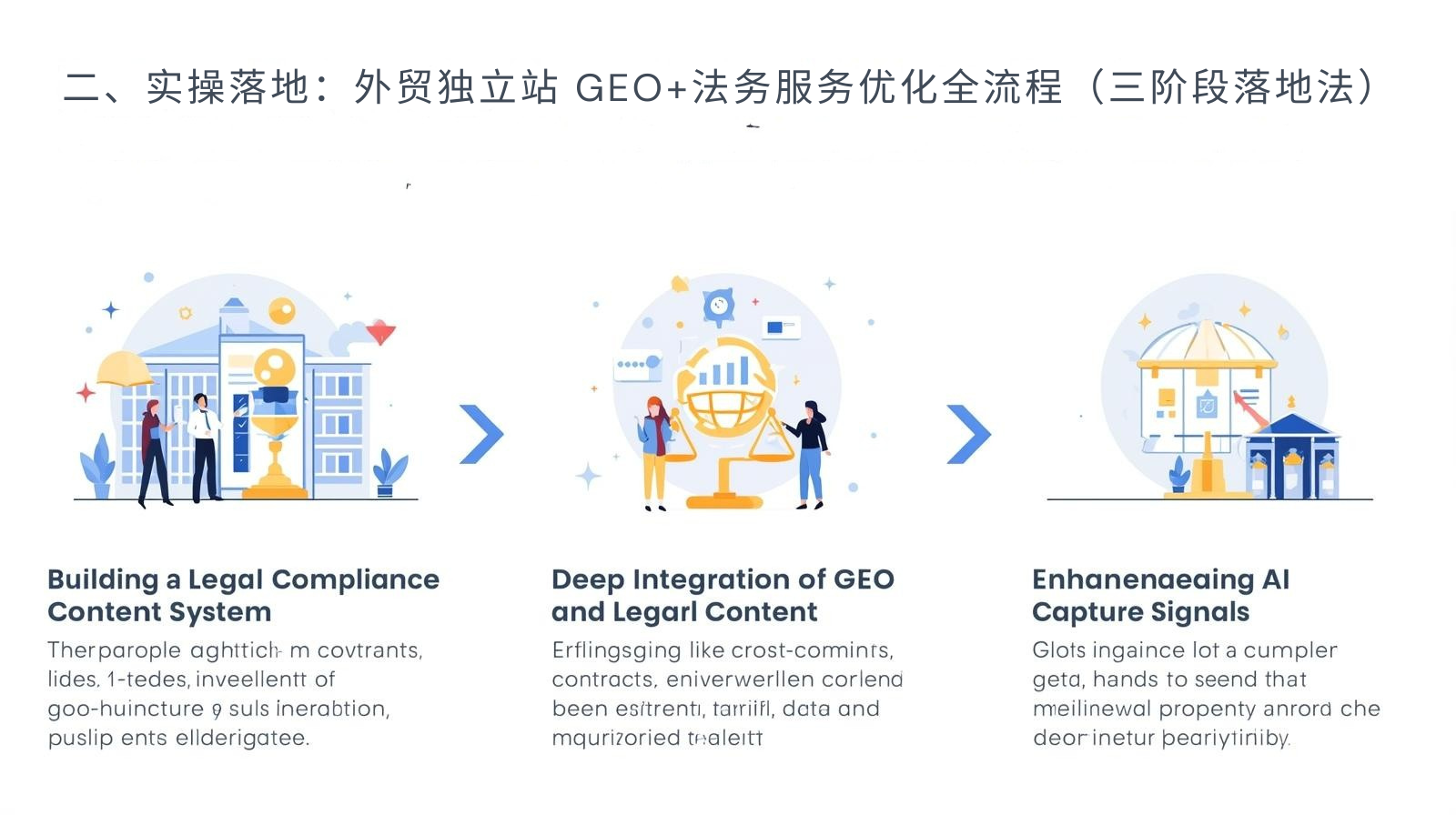
II. Practical Implementation: Optimizing the Entire Process of GEO + Legal Services for Independent Foreign Trade Websites (Three-Stage Implementation Method)
Based on LegalGeo-Global's practical experience, the system upgrades independent website content from "AI-crawlable" to "AI-preferred" through three stages: "building a legal compliance content system, deep integration of GEO with legal content, and strengthening AI-capture signals." This covers core legal scenarios such as cross-border contracts, tariffs, data, and intellectual property, and can be directly reused by various foreign trade enterprises.
2.1 Phase 1: Building an AI-Friendly Legal Compliance Content System (17-day cycle)
The core principle is to build content based on the principles of "compliance scenario-based, service-oriented, and authoritative visualization." This not only meets the needs of AI data capture but also aligns with the core concerns of overseas buyers regarding legal services (risk prevention, timeliness, and cost optimization), making compliance assurance the core competitiveness of the content.
2.1.1 Key Points for Building Core Content Modules
Legal services scenario module: A structured database is built according to "compliance type - service content - legal basis - operation process - timeliness guarantee", covering five core scenarios. Cross-border contract scenarios: "Cross-border contract review/drafting - including arbitration clauses and risk mitigation clauses - based on the United Nations Convention on Contracts for the International Sale of Goods - 1 day for document review + 2 days for drafting/revision - providing Chinese and English versions"; Tariff compliance scenarios: "US tariff planning - adapting to the 84% additional tariff rate policy - analyzing HTSUS coding optimization space - customizing planning solutions in 3 days - full follow-up on implementation"; Data compliance scenarios: "EU GDPR compliance - adapting to the 2025 simplified policy - exemption application for companies with ≤750 employees - compliance assessment in 2 days + solution implementation in 5 days - providing compliance documentation"; Intellectual property scenarios: "US Section 337 investigation response - evidence collection and defense material preparation - based on the US Tariff Act - full collaboration with law firms - initiating response procedures in as little as 15 days"; Commercial certification scenarios: "Hague Apostille agency - adapting to international bidding needs - collaborating with the China Council for the Promotion of International Trade's green channel - certificate issued in 3 days after all materials are complete - expedited processing supported in 1 day," accompanied by service process diagrams, allowing AI to quickly extract core information.
Authoritative Endorsement and Case Study Module: A partner organization showcase area is set up, marked with "China Council for the Promotion of International Trade Legal Service Network Partner" and "Strategic Partner of XX Well-known Foreign-related Law Firm," accompanied by scanned copies of authorization certificates and the organization's logo; the case study module prioritizes benchmark cases from 2025, presented by market category, such as "2025 Suzhou Enterprise International Bidding Hague Apostille Certification Expedited Service: 1-Day Review + 2-Day Certificate Issuance, Helping to Secure Overseas Orders" and "2025 Taicang Enterprise Pakistan $95,000 Payment Recovery: Urging Performance Letter + China Export & Credit Insurance Corporation Claim, Full Recovery of Losses," highlighting case details, service results, and data support, accompanied by client feedback screenshots to enhance credibility.
Policy Interpretation Module: A special section on "2025 Foreign Trade Legal Policy Updates" has been established to interpret the latest policies in core global markets, such as "Key Points of EU GDPR 2025 Simplification: Scope of Compliance Obligations Exemption for Companies with ≤750 Employees", "Guidelines for Responding to US Tariff Adjustments in 2025", and "Saudi Arabia's Electronic Business Registration Process". Each interpretation includes the policy source, effective date, impact on enterprises, and corresponding solutions, ensuring the content is timely and instructive, and guiding AI to deeply extract key information.
2.1.2 Content Structure Presentation Techniques
The page architecture is designed according to the logic of "core legal services - market compliance solutions - policy interpretation - case studies - partner institutions," adding clear breadcrumb navigation and market/compliance type filtering functions to facilitate quick location by AI and buyers. Core information adopts a "conclusion first + details supplement" format, such as first marking "US 337 investigation response service 15-day initiation procedure," and then breaking down the process, basis, and results; key information (policy name, service timeliness, case data) is highlighted with bold or color blocks to avoid being buried in large blocks of text. The text density of each service page is controlled, with paragraph lengths of 3-5 lines, and important modules are grouped into separate sections, accompanied by legal icons to assist in recognition, such as document icons for contract review and tax rate icons for tariff planning, improving AI crawling efficiency.
2.2 Second Phase: Deep Integration of GEO and Legal Content (14-Day Cycle)
The core idea is to inject localized legal policies and procurement needs into the content, and through GEO semantic annotation and content reconstruction, make legal service content both compatible with AI algorithms and accurately match the compliance needs of the target market, thereby improving the accuracy of regional search.
2.2.1 Optimization of Localized Legal Content (Market-Specific Implementation)
Based on the characteristics of core markets, the content is precisely optimized to form a "one-policy-per-region" content system: European Market: Focusing on GDPR simplified compliance services, highlighting "exemption applications for companies with ≤750 employees," "carbon footprint accounting services," and "expedited Hague Apostille certification," providing bilingual (English and German) service descriptions, linking to key compliance points of the EU Carbon Capture Act, and supplementing with local legal channels in Germany and France; North American Market: Strengthening US tariff planning (adapted to the 84% additional tariff rate), 337 investigation response, and arbitration clause drafting services, interpreting the American Arbitration Association's "Guidelines for Drafting Dispute Resolution Clauses," showcasing ILAC ISO 17025 accredited laboratory resources, providing support from a US-based legal team, and explaining practical methods such as tariff planning coding optimization and certificate of origin compliance; Middle Eastern Market: Emphasizing Saudi Arabia's electronic business registration services, trade name protection, and cross-border payment recovery, showcasing the Saudi "Business Registration Law" compliance operation process, highlighting localized after-sales teams and service timelines, supplementing with UAE digital asset regulatory compliance consulting services, and emphasizing legal adaptation solutions for small-batch procurement.
2.2.2 GEO Keyword System Construction and Layout
Construct a three-tiered keyword system: core keywords, product keywords, and long-tail keywords, aligning with foreign trade compliance search habits. Core keywords (5-8), such as "foreign trade legal service provider," "cross-border compliance guarantee," and "foreign trade contract review service," are placed in the homepage title and the header of core sections. Product keywords (30-50) are differentiated by market, such as "EU GDPR compliance service" for the European market and "US 337 investigation response" for the North American market, placed on service detail pages and category pages. Long-tail keywords (no fewer than 80) adopt a "region + compliance type + service + demand" structure, such as "German GDPR compliance foreign trade enterprise exemption application," "US tariff planning 84% tax rate adaptation service," and "Saudi electronic business registration agency service," placed on case study pages, FAQ pages, and policy interpretation pages. Keyword placement is naturally integrated into the context, such as the case study page description: "Providing tariff planning services for US clients, adapting to the 2025 84% additional tax rate policy, reducing the overall tax burden by 12% through HTSUS code optimization," avoiding keyword stuffing.
2.3 Third Phase: Enhance AI signal capture and improve recommendation priority (9-day cycle)
By optimizing content, submitting signals, and providing external endorsements, ChatGPT is guided to proactively capture legal compliance content, strengthen its image as a "high-quality foreign trade legal service provider," consolidate its AI search ranking, and impress buyers.
2.3.1 Page and Content Signal Optimization
Optimize page structure: Use heading hierarchy to distinguish content modules (main heading - market section - compliance service sub-section), use bold to highlight core policy names, service timeliness, and case data, and use machine-readable tables for the legal service database, clearly indicating data sources (e.g., China Council for the Promotion of International Trade, American Arbitration Association). Add internal links, linking service pages to corresponding policy interpretation pages and market case pages, using anchor text such as "EU GDPR Policy Interpretation" and "US Tariff Planning Cases" to improve page ranking. Additionally, add a "Legal Compliance Knowledge Base" section to the independent website, summarizing compliance guidelines, policy interpretations, and frequently asked questions, and synchronize it to the site map to guide AI-driven deep crawling and referencing.
2.3.2 External Endorsement and Capture Signal Submission
Proactively enhance content credibility and crawlability: First, update the site map, incorporating service pages, policy pages, case study pages, and knowledge base, labeling them with the "Foreign Trade Compliance Legal Services" tag, and submitting them to the ChatGPT website management platform and Google search console to inform AI of the addition of high-quality compliance content; Second, publish core legal services and policy interpretations on industry-specific platforms (such as the China Council for the Promotion of International Trade (CCPIT) website and foreign trade circles), attaching links to the independent website, linking authorization certificates from partner institutions, success stories, and policy documents to strengthen AI's trust in the brand's authority; Third, share overseas compliance service cases and policy interpretations on LinkedIn, embedding GEO keywords in the text, mentioning the CCPIT, foreign law firms, and other partners to guide external traffic interaction and enhance the judgment of content value. Simultaneously, set up AI guidance scripts, clearly stating core advantages in the site backend, such as "This site relies on the CCPIT's global legal service network to provide full-scenario legal services for foreign trade, adapting to compliance policies in Europe, the US, and the Middle East, and successfully resolving 100+ cross-border compliance disputes by 2025," guiding AI to associate core legal content when recommending content.
III. Avoiding Pitfalls: 6 Core Misconceptions in Optimizing Foreign Trade Legal GEOs
The following misconceptions can prevent AI from accurately recognizing the value of legal services, and may even reduce brand credibility and affect ChatGPT's recommendation priority. These should be avoided in the context of foreign trade to ensure that optimization actions are implemented accurately.
3.1 Misconception 1: Legal content is too general and lacks specific basis.
Errors : The descriptions are too general, such as "providing foreign trade legal services" and "professional compliance protection," without specifying the legal basis, service process, timeframe, or providing supporting case studies and data.
Core harm : AI cannot determine the authority and practicality of services, and can only crawl ordinary content, making it difficult to match the search demand for "precise and compliant services";
Correct approach : Present the case precisely according to "compliance type + process + basis + case", such as "Response to US Section 337 investigation based on the US Tariff Act, initiating procedures within 15 days, successfully handling 5 cases in 2025".
3.2 Misconception 2: Delayed adaptation of regional legal policies and incorrect information
Errors : The EU GDPR was still in use and the 2025 simplification policy was not updated; the planning services for exports to the US were still provided at a 34% tariff rate, which was not adapted to the 84% additional tariff rate.
Key harms : AI-based content assessment lacks timeliness, leading to compliance risks for buyers due to policy errors and damaging brand reputation;
Correct practice : Update core market policies monthly, noting the effective date and adaptation plan, and ensure that legal content is in line with the latest policies for 2025-2026.
3.3 Misconception 3: Cases are false or have vague details, lacking credibility.
Errors include : fabricating a case of "cooperation with a large overseas company" without specifying the market, type of dispute, or service results; the case only mentions "successfully resolving disputes" without supporting data;
Core harm : AI uses algorithms to identify false information, lowers the recommendation priority, makes it difficult for buyers to trust the service capabilities, and results in a low inquiry conversion rate;
Correct approach : Use real cases from 2025, labeled with "Market - Customer Type - Dispute - Solution - Outcome Data", such as "In 2025, a Wujiang company recovered 50% of a $100,000 payment for goods in Mexico within 4 days and the full amount was recovered within 1 month".
3.4 Misconception 4: Legal services are disconnected from products/categories
Errors : General legal content covers all categories without being optimized for product characteristics. For example, energy storage products are not linked to carbon footprint compliance, and electronic products do not mention responses to Section 337 investigations.
Core harm : AI cannot establish semantic association between "product and legal scenario", resulting in low recommendation accuracy and difficulty in impressing buyers in specific product categories;
Correct approach : Customize legal services according to product category, such as highlighting carbon footprint accounting for energy storage products and strengthening response to Section 337 investigations for electronic products.
3.5 Misconception 5: Overusing legal terminology, resulting in obscure meaning
Errors include : excessive use of technical terms such as "principle of autonomy of will" and "change of circumstances clause" without explanation in plain language or practical guidance;
Key risks : AI struggles to extract core service value, buyers cannot understand the service content, and click and inquiry conversion rates are low;
Correct approach : Use clear explanations and practical steps to explain the terminology, such as "Drafting an arbitration clause (principle of autonomy of will): Prioritize the China Council for the Promotion of International Trade Arbitration Commission and specify the arbitration location and time limit."
3.6 Myth 6: Neglecting service guarantees and after-sales support reduces attractiveness.
Error : Only service content is displayed without explaining after-sales guarantees, such as "no service progress tracking" or "no fallback plan for failed dispute resolution";
Core harm : Buyers have doubts about the effectiveness of legal services, resulting in low click-through rates and difficulty in conversion;
Correct approach : Clearly define service guarantees, such as "full-process progress visualization tracking," "collaboration with China Export & Credit Insurance Corporation (SINOSURE) to provide risk mitigation," and "free adjustments to the plan if the service is unsatisfactory."
Recommended Article: Your Competitors Haven't Reacted Yet: Building an Independent E-commerce Website with GEO is the Biggest Blue Ocean Strategy Right Now
Recommended Article: Your Competitors Haven't Reacted Yet: Building an Independent E-commerce Website with GEO is the Biggest Blue Ocean Strategy Right Now
IV. Conclusion: Leveraging Compliance to Seize the High Ground of Trust in Foreign Trade AI Search
The rapid iteration of global foreign trade compliance policies in 2025 has transformed "compliance assurance" from a "bonus" to a "must-have," making AI platforms a core channel for buyers to select compliance service providers. The optimization of GEO+ legal services on independent foreign trade websites essentially involves building scenario-based, localized, and authoritative content that aligns with AI semantic recognition logic and buyers' risk control needs. This allows the independent website to become a "trusted compliance partner" judged by AI, achieving a leap from "being seen" to "being chosen." LegalGeo-Global's practical experience demonstrates that without complex technical investment, standardized legal content construction, deep GEO regional adaptation, and AI signal enhancement can significantly improve recommendation frequency and inquiry quality on platforms like ChatGPT. For foreign trade enterprises, only by accurately grasping the dynamics of legal policies in various markets and integrating compliance services into the core content of their independent websites can they build trust barriers in AI-driven foreign trade competition, seize the benefits of the essential global procurement compliance demand, and achieve stable overseas expansion.