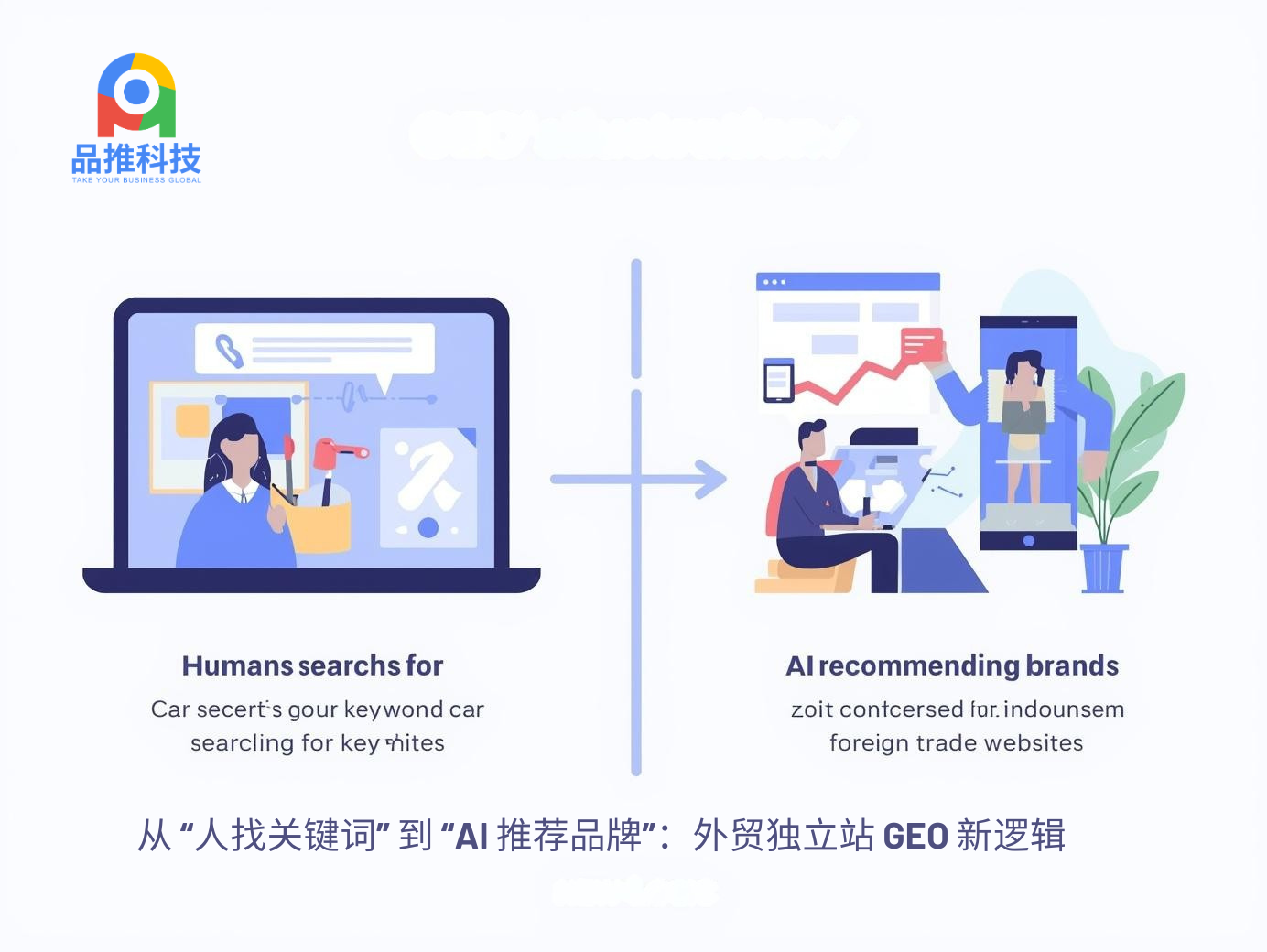

In February 2026, the foreign trade industry is undergoing a complete customer acquisition paradigm shift.
In the past ten years, what we have been doing is "people looking for keywords": buyers enter keywords into Google, and you compete for rankings, clicks, and inquiries. But today, more and more buyers no longer search manually, but directly ask AI: "Help me find a Chinese supplier that is suitable for the EU market, has certification, and can customize small batches."
The traffic entrance has been moved from Search box to AI dialogue window, and the customer acquisition logic has changed from “keyword competition” to “AI trust recommendation”.
This is the core problem that GEO (Generative Engine Optimization) wants to solve: let your brand not be ranked at the front of the search page, but appear directly in AI’s answers.
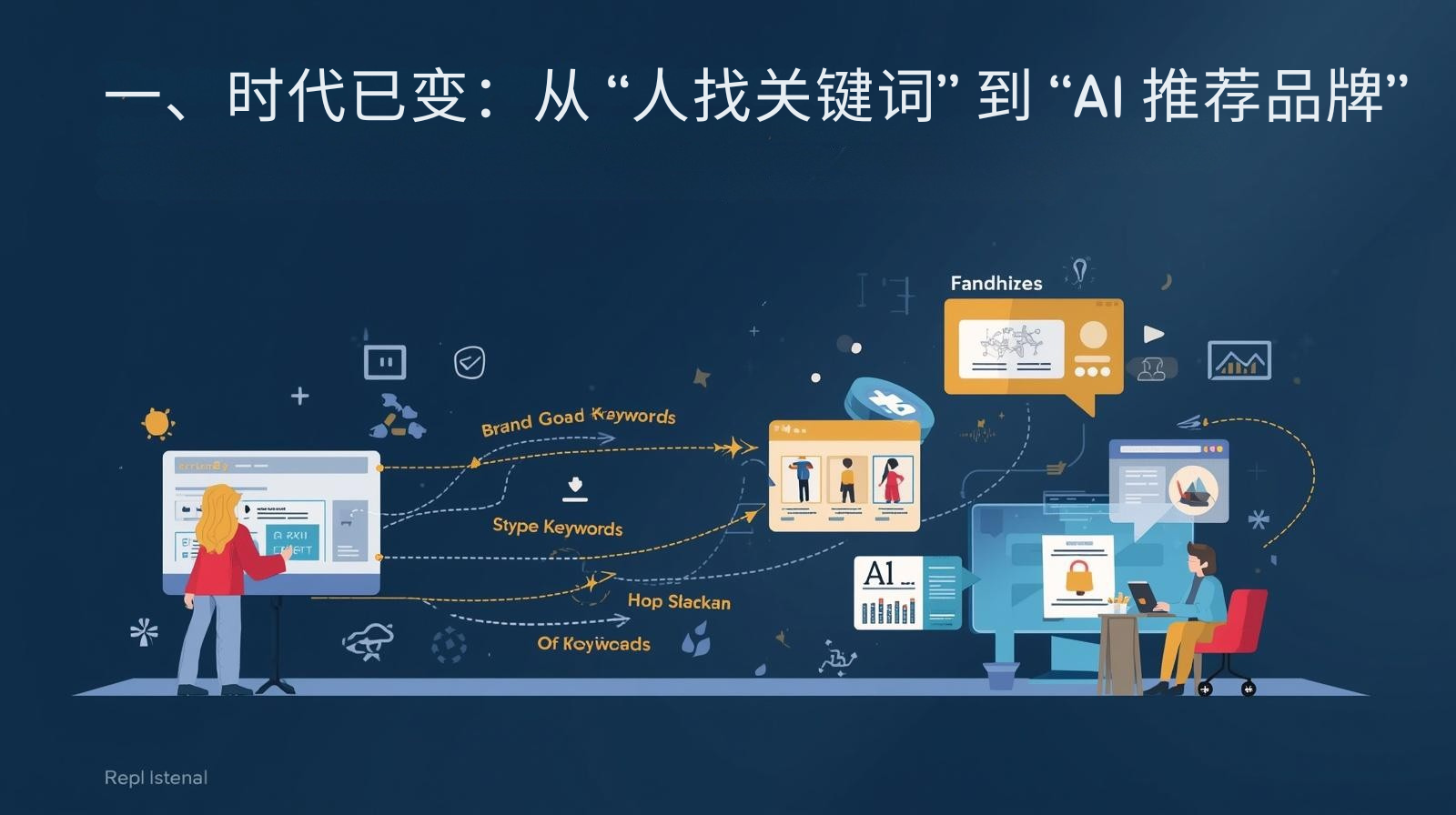
1. Times have changed: from “people looking for keywords” to “AI recommending brands”
Traditional search logic is being reconstructed by AI, and traffic rules are completely rewritten
In the past, foreign trade customers were acquired through the typical people looking for goods model:
Customers have needs → think of keywords → open Google → turn the page for comparison → enter the website → send an inquiry.
This set of logic has supported SEO, advertising, and keyword optimization for more than ten years, but it has begun to decline rapidly in 2026.
According to the February 2026 Overseas B2B Procurement Behavior Report, more than 47% of European and American procurement decision-makers prioritize the use of AI tools such as ChatGPT to screen suppliers, and the AI usage rate among young procurement groups has exceeded 85% https://www.tmcnet.com/usubmit/2026/02/25/10337821.htm.
These users no longer enter keywords, but use natural language, scenarios, conditions, needs to directly let AI give answers, which means:
No matter how high your ranking is, as long as AI does not recommend you, you will be "invisible" in new traffic.
OpenAI officials clearly stated in the 2026 GPTBot Guide that AI crawlers have independent crawling, understanding and trust evaluation systems, and traditional SEO optimization cannot guarantee correct recognition and reference by AI https://platform.openai.com/docs/guides/gptbot.
Simply put:Google can search ≠ AI can recommend.
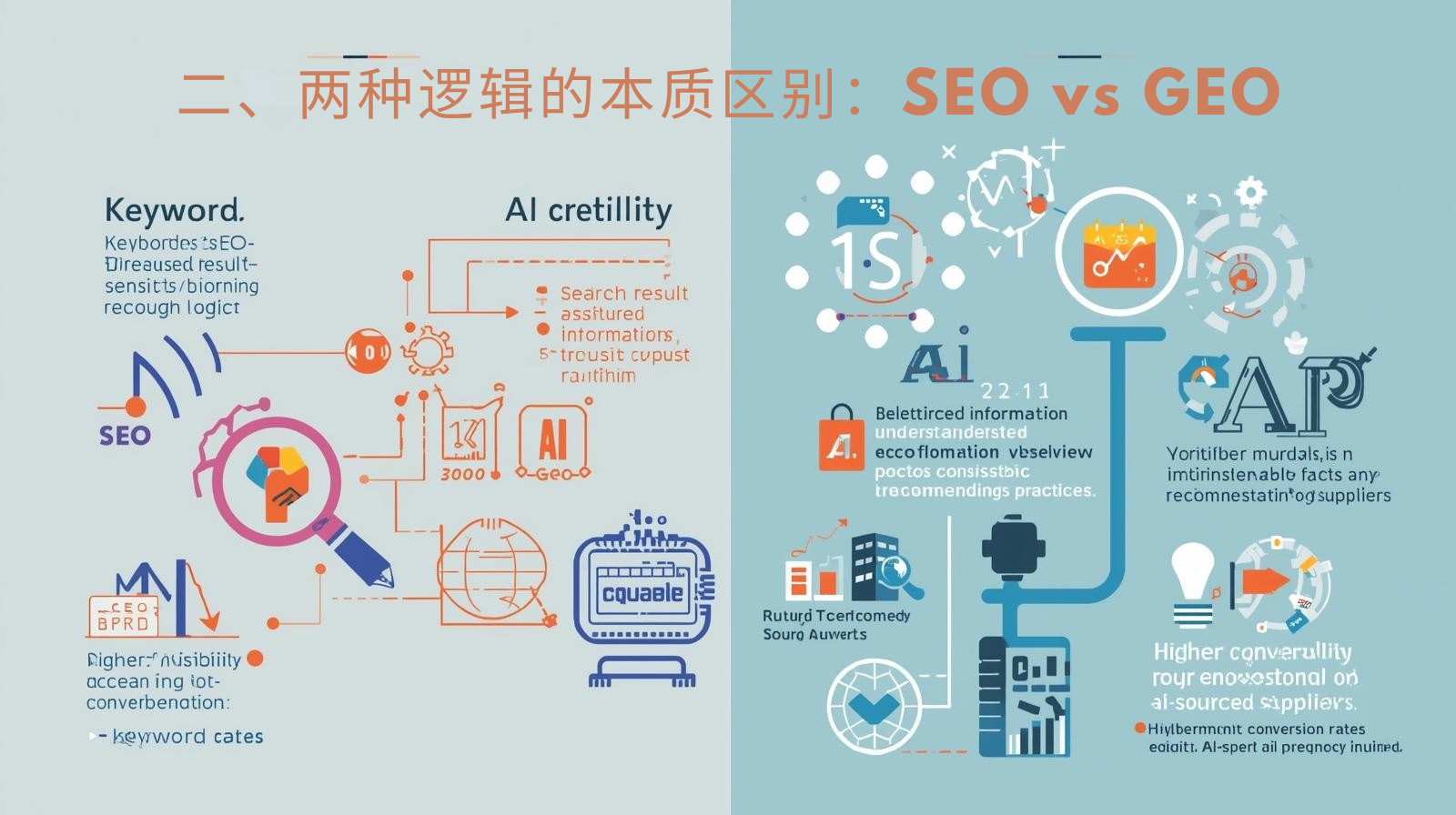
2. The essential difference between the two logics: SEO vs GEO
SEO does "keyword visibility", GEO does "AI trustworthy"
2.1 Different traffic source logic
Traditional SEO is keyword-driven: you write content around keywords, build external links, and grab rankings, and the traffic comes from "search result clicks."
GEO is AI recommendation driven: AI screens, judges, and recommends the most suitable suppliers in the entire network information based on user needs, and the traffic comes from "AI active recommendations".
2.2 Different identification mechanisms
SEO lets the machine "read" you, focusing on keyword density, title structure, page speed, and number of external links.
GEO allows AI to "understand" you, focusing on structured information, verifiable facts, unified business, and credible qualifications. AI will understand your products, capabilities, services, and advantages instead of just matching text https://www.semrush.com/blog/traditional-seo-vs-ai-seo/.
2.3 Different trust transfer methods
SEO relies on rankings and page appearance to build initial trust.
GEO is AI that trusts you first and then passes the trust to customers. AI will automatically verify whether your qualifications, certifications, cases, and parameters are true and reliable https://ec.europa.eu/growth/tools-databases/nando/index.cfm?fuseaction=notifiedbody.main.
2.4 Inquiry quality is different
The traffic intentions from keywords are uneven, with many invalid inquiries and serious price comparisons.
Customers recommended by AI have been initially screened by AI and have higher matching needs, faster decision-making, and higher conversion rates.
AI-sourced inquiries have an effective conversion rate 2.3 times higher than traditional search, according to an analysis of 20 million leads in February 2026 https://www.prnewswire.com/news-releases/analysis-of-20m-leads-reveals-how-ai-search-is-driving-customer-discovery-302671219.html.
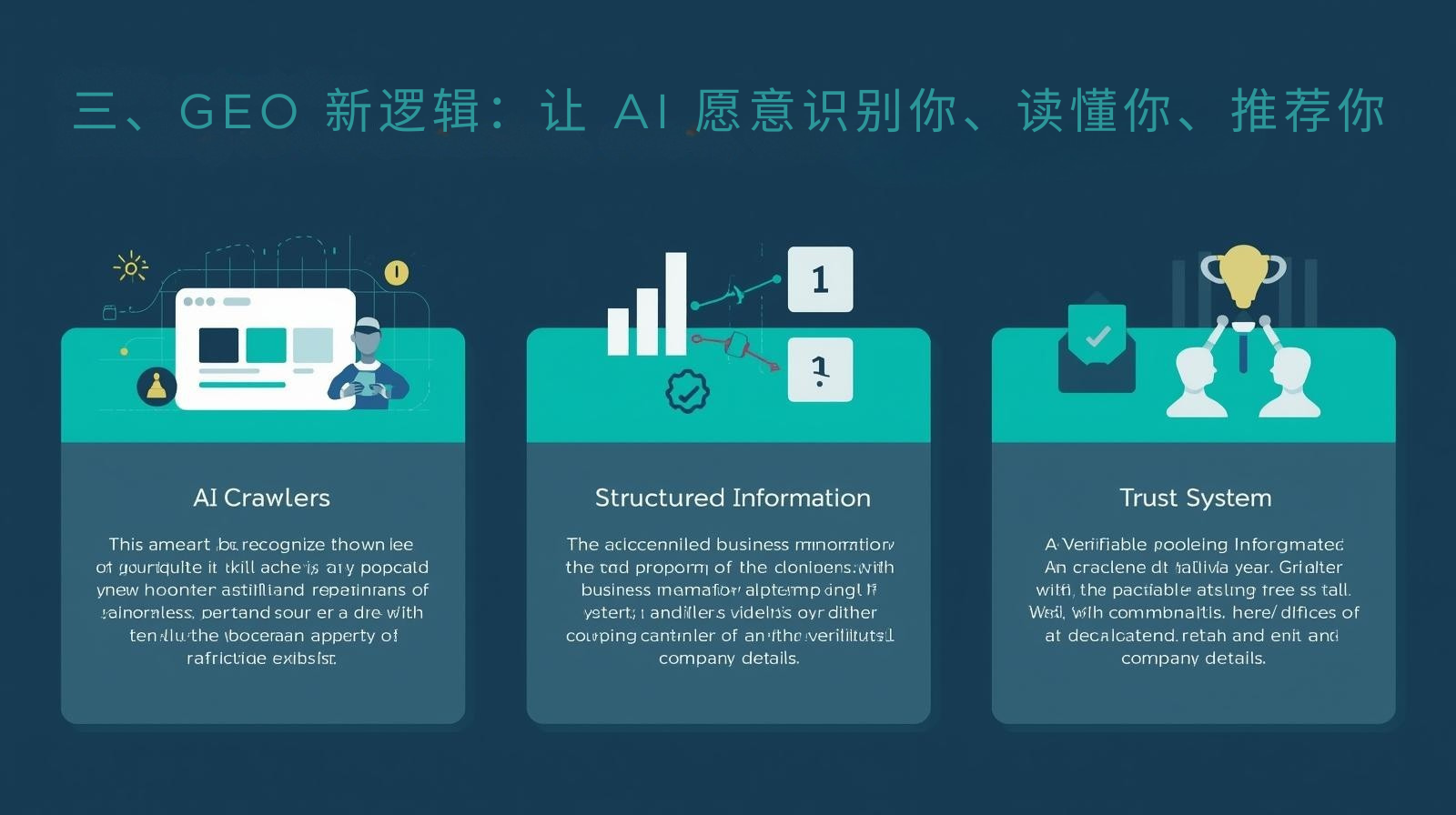
3. GEO’s new logic: Let AI be willing to recognize you, understand you, and recommend you
The core of GEO is not to optimize rankings, but to become a “trusted information source” for AI
3.1 Let AI “find you”: open the AI crawling channel
AI must be able to access your website normally before it can recommend you.
You need to ensure that AI crawlers such as GPTBot can freely crawl content without being blocked, speed-limited, or excessively intercepting pop-up windows and verification https://platform.openai.com/docs/guides/gptbot.
At the same time, the website structure is optimized, using a flat structure, with no more than 3 clicks on core pages, improving AI crawling efficiency, and ensuring smooth overseas opening speed through PageSpeed Insights https://pagespeed.web.dev/.
3.2 Let AI “read you”: structure your business information
AI does not understand vague, confusing, and graphic content, but only standardized, unified, and structured information.
GEO requires you to turn all of this content into clear and readable text:
- Product name, parameters, material, size, MOQ, delivery date, port
- Certification qualifications: CE, FDA, ISO, ROHS, etc.
- Service scope: customization, OEM, after-sales, logistics, proofing
- Target market, industry, application scenarios
Only when the information on the entire site is unified, non-contradictory, and non-cluttered can AI quickly establish an understanding of your business.
3.3 Let AI dare to “recommend you”: Build a verifiable trust system
The bottom line of AI recommendations is no mistakes, no rumors, and traceable.
The key step in GEO is to allow AI to verify that your information is authentic and reliable:
- The certification is attached with the official query link
- The case clearly states the country, needs, plans, and results
- Complete company information, unified address, phone number, and social media
When AI can cross-verify your information, the recommendation weight will be greatly improved https://www.mckinsey.com/business-functions/marketing-and-sales/our-insights.
3.4 Let AI “think of you” often: content adaptation to AI question and answer scenarios
Don’t pile on keywords, but write content directly that AI will quote.
Create around buyers’ real problems:
- How to choose?
- What are the certification requirements?
- How long is the delivery time?
- Can small batches be made?
This type of content is easier to extract by AI and used to answer users, allowing you to be recommended in more scenarios.
Related article recommendations: Your peers have not yet reacted: using GEO to build an independent foreign trade station is the biggest blue ocean strategy at the moment
4. The correct way to play in the new era: SEO retention, GEO upgrade
SEO maintains the existing stock, GEO seizes the increase, and dual-line growth is the long-term strategy
SEO is not going away, it is still the foundation of Google search traffic.
But if you only do SEO, you willcompletely miss the incremental traffic in the AI era.
The healthiest independent foreign trade website strategy in 2026 is:
- SEO: Keep traditional search traffic and ensure basic exposure
- GEO: Seize AI recommended traffic and obtain high-intention inquiries
GEO does not replace SEO, but adds a layer of "recommendation-level capabilities" to the website in the AI era, upgrading your brand from "people can search" to "AI will recommend".
End: Keep up with the AI era and use GEO to redefine your way of acquiring customers
From “people looking for keywords” to “AI recommending brands” is not a trend, but a reality that has already happened.
In 2026, whoever lets AI understand itself, trust itself, and recommend itself first will be able to win the next generation of foreign trade traffic dividends.
If you want the GEO effect to be more stable and lasting, the underlying architecture of the website is crucial.
Pindian Technology has more than ten years of experience in building foreign trade websites and has served more than 7,000 customers in total. It uses React technology to build websites. The page browsing is smoother, overseas opening is faster, and the structure is naturally adapted to AI crawling and GEO optimization. It helps you build an "independent website that AI is willing to recommend" from the bottom up.
Whether it is building a new site or upgrading an old site with GEO, Pindian Technology can quickly allow you to enter the AI recommendation list, truly realizing the leap from "human search for goods" to "AI recommended brands".