Foreign trade website marketing funnel design practice

  • Independent website industry application
  • Foreign trade website
Posted by 广州品店科技有限公司 On Aug 28 2025

Why do foreign trade websites need marketing funnels?

In foreign trade, the customer journey from initial visit to final inquiry is complex and diverse. Based on data from the Baidu Search Resource Platform , a systematically designed marketing funnel effectively captures potential customers and converts traffic into actual inquiries.

Nielsen Norman Group research indicates that user experience is closely related to conversion rates. Websites with clear structures and easy access to information are more likely to retain visitors and encourage them to take action (such as submitting inquiries or contacting sales staff).

Furthermore, Google Search Central emphasizes that optimizing a website's access path, CTA layout, and content hierarchy are crucial factors in improving conversion rates. By designing a scientific marketing funnel, foreign trade companies can systematically manage customer behavior and improve sales efficiency.

The core stage of the foreign trade website marketing funnel

The marketing funnel is typically divided into four key stages:

  1. Traffic introduction : Attract potential customers to the website through SEO optimization, social media operations, Google Ads and multilingual website construction.

  2. Interest cultivation : Use content marketing to showcase corporate strengths, product advantages, and customer cases to generate customer interest in your products.

  3. Decision guidance : Design clear inquiry buttons, quotation forms, and online customer service to reduce decision-making friction and increase conversion willingness.

  4. Action conversion : Ensure that customers complete their inquiries or place orders through multi-channel follow-up, data analysis and personalized recommendations.

Reasonable funnel design not only optimizes user experience, but also helps companies establish a long-term and sustainable inquiry acquisition mechanism.

How to optimize the structure of foreign trade websites to support the funnel

The page structure of a foreign trade website is the basis for the implementation of the marketing funnel. Optimization methods include:

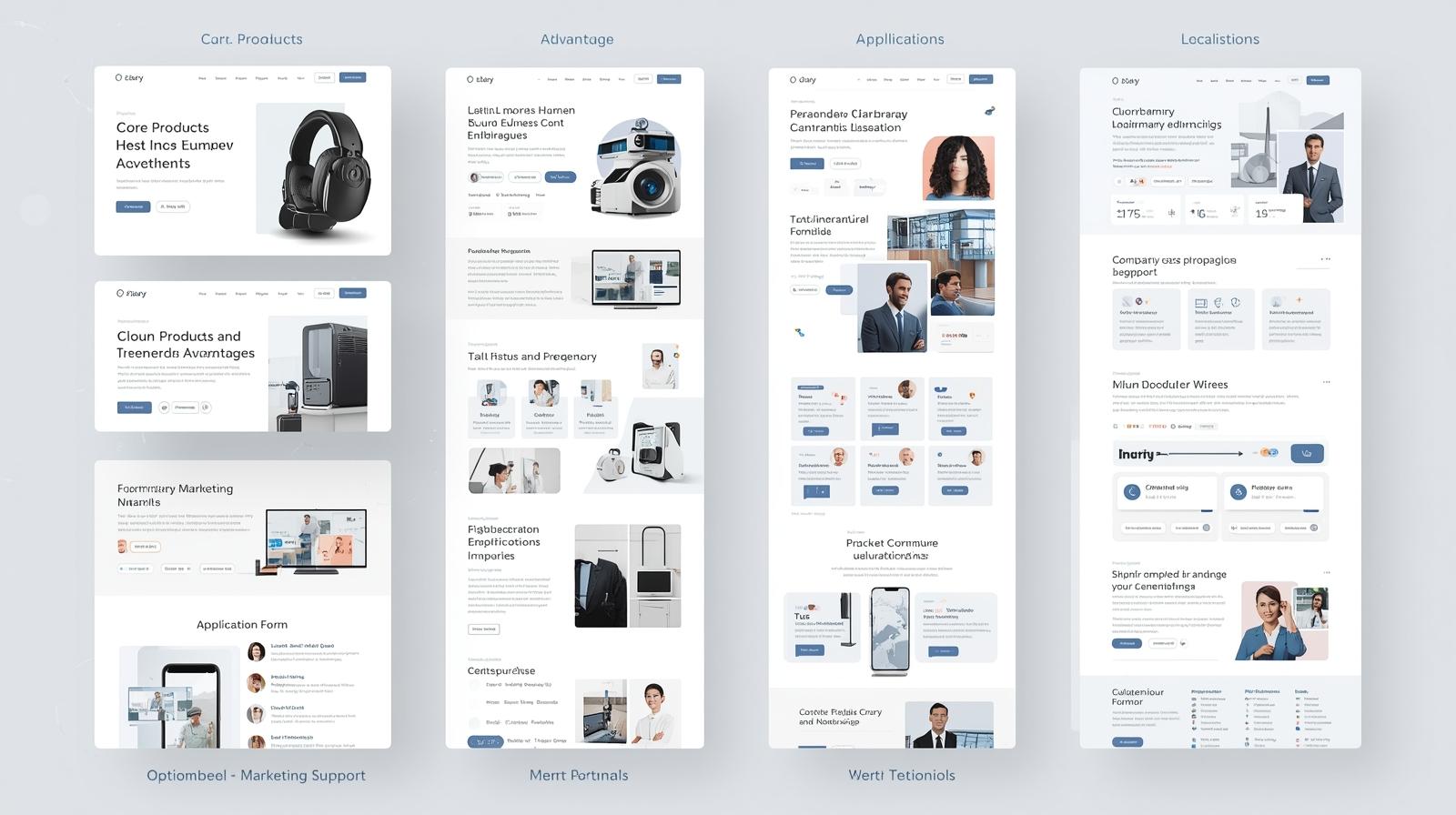
  • Home page and column page design : The home page highlights core products and corporate advantages, and the column pages are clearly categorized, allowing users to quickly find target information.

  • Modular content layout : Product information, application cases, technical parameters, and customer reviews are displayed separately to facilitate user browsing and understanding.

  • Guided interactive design : Add CTA buttons, inquiry forms, and online customer service portals in key locations to guide customers to complete their consultations.

  • Multilingual support and localization : Integrate the target market's language, culture, and search habits to enhance access experience and trust.

These methods are recognized by ** W3C ** and help improve website accessibility and search engine friendliness, while enhancing user experience and conversion rates.
How to optimize the structure of foreign trade websites to support the funnel

Data analysis and continuous optimization

The marketing funnel is not static, and continuous data analysis is the key to optimization. Companies can improve the conversion efficiency of their foreign trade websites through the following means:

  • Access path analysis : Identify customer stay points and exit points on the website and optimize page layout.

  • Conversion rate tracking : Analyze form submission, online consultation, and inquiry conversion data to identify bottlenecks.

  • A/B testing : Test different page designs, copy, and CTA buttons to select the best solution.

With the help of data-driven methods, foreign trade companies can continuously iterate website design and content layout to make the marketing funnel more efficient.

Pinshop website building platform helps foreign trade websites obtain inquiries

Pinshop website building platform provides professional foreign trade website construction and marketing funnel optimization support:

  • Modular page design and multi-language website building functions enable you to quickly build logically clear and easy-to-navigate web pages;

  • Built-in SEO and social media content tools to increase potential customer visits and traffic quality;

  • Configurable CTA layout and online customer service system ensure that inquiries can be effectively captured at every stage;

  • Data analysis and conversion monitoring help companies continuously optimize funnel strategies and improve inquiry conversion rates.

Through the Pinshop website building platform, foreign trade companies can not only optimize website structure and user experience, but also build a complete marketing funnel to achieve sustained growth in overseas markets.


CTA (Call to Action):
Want to achieve efficient inquiry conversion for your foreign trade website? Use the Pinshop website building platform now to create a professional marketing funnel and successfully convert every visitor into a potential customer!

pinshop foreign trade website

【Extended Reading】

特色博客
Is it difficult to break through traditional website SEO? 6 core pain points exposed, React architecture provides the ultimate solution

Is it difficult to break through traditional website SEO? 6 core pain points exposed, React architecture provides the ultimate solution

Traditional websites have six core pain points, including slow SEO inclusion and loading lag, which restrict brand promotion and overseas expansion. Pinshop relies on the React+Next.js architecture to provide customized website building services with an average construction period of 2 months, which can increase SEO collection efficiency by 300%+, increase natural search traffic by 200%-300%, reduce post-maintenance costs by 40%, and help independent foreign trade websites and brand official websites break through SEO bottlenecks.

Is it difficult to break through traditional website SEO? Change to React architecture and see immediate results

Is it difficult to break through traditional website SEO? Change to React architecture and see immediate results

Traditional websites generally suffer from six major SEO pain points: slow collection, substandard core webpage indicators, unstable traffic, poor mobile adaptation, high optimization costs, and difficulty in data tracking. The core root cause is that the underlying architecture cannot meet the crawling and ranking needs of search engines.

Use Next.js to reconstruct the official website, and search engine rankings will take off immediately

Use Next.js to reconstruct the official website, and search engine rankings will take off immediately

Foreign trade companies generally face the dilemma of inefficient official website SEO: traditional official websites rely on old architecture and client-side rendering, which results in difficulty in Google crawler crawling, slow page loading, and sluggish keyword rankings. Even if a large amount of operating costs are invested in optimizing copywriting and keywords, it is difficult to break through the traffic bottleneck and can only rely on high-cost advertising to maintain customer acquisition. Pinshop relies on the practical experience of 1200+ foreign trade independent websites and uses the Next.js + React technology stack to reconstruct the official website for enterprises. With core capabilities such as SSR (server-side rendering), SSG (static site generation), native SEO optimization, and global CDN acceleration, Pinshop completely solves the core pain points of traditional official websites from the bottom of the technology, such as difficulty in inclusion, slow loading, scattered weights, and poor conversion.

React+Next.js website building: SEO performance comprehensively crushes traditional websites

React+Next.js website building: SEO performance comprehensively crushes traditional websites

Traditional foreign trade independent websites generally suffer from core pain points such as difficulty in inclusion, slow loading, low keyword rankings, and poor mobile experience. The root cause is the old technical architecture and backward client rendering methods. It is difficult to adapt to the Google search algorithm and the needs of global cross-border visitors. Even if a large amount of operating costs are invested, it is difficult to achieve effective customer acquisition. The React+Next.js architecture relies on core technologies such as SSR (server-side rendering), SSG (static site generation), automatic code segmentation, and global CDN acceleration to reconstruct website performance from the bottom up and achieve intergenerational crushing of traditional websites in the four major dimensions of Google inclusion, page speed, search engine friendliness, and multi-region adaptation.

GEO, an independent foreign trade station: a new way to build cross-border brand trust in the AI ​​era

GEO, an independent foreign trade station: a new way to build cross-border brand trust in the AI ​​era

Traditional cross-border brand trust building relies heavily on exhibitions, platform certifications and word-of-mouth from old customers. In the era of AI search, it has been difficult to reach new buyers. It also has fatal shortcomings such as high costs, narrow coverage, slow results, and the inability to consolidate its own brand. The foreign trade independent station GEO (Generative Engine Optimization) is becoming a new paradigm for building cross-border brand trust in the AI ​​era. Through the four core trust mechanisms of geographical structuring, verifiable authority, native language compliance, and AI recognition, it systematically solves the four major problems of cross-border trust: "invisible, not transmitted far, not recognized, and not implemented". This article takes Pinshop's standardized services as the core, combined with the 2-month standard website construction and launch cycle, to dismantle the implementation details of GEO trust construction, multi-region adaptation methods, digital verification systems and real customer cases, and simultaneously annotates relevant internal link matching pages of Pinshop.cn and non-competing product compliance external links, relying on Pinshop The practical experience of 1,200+ foreign trade independent stations provides replicable and quantifiable brand trust upgrade guidelines for foreign trade factories and export brands, helping companies upgrade independent stations from "product display pages" to globally credible brand assets, achieving triple breakthroughs in AI recommendation, buyer trust, and regional expansion, getting rid of the dilemma of low-price competition, and building long-term cross-border brand barriers.

Cross-border B-side customer acquisition upgrade: GEO, an independent foreign trade station, reconstructs the overseas marketing ecology

Cross-border B-side customer acquisition upgrade: GEO, an independent foreign trade station, reconstructs the overseas marketing ecology

Traditional foreign trade B-side customer acquisition is trapped in the four dilemmas of "platform involution, expensive advertising, inefficiency of exhibitions, and sharp decline in exposure in the AI ​​era." The foreign trade independent websites of most companies only stay at the level of "product display + language translation" and cannot adapt to the search habits and decision-making logic of overseas buyers, making it difficult to achieve independent customer acquisition. This article takes Pinshop's standardized services as the core and fully reveals how independent foreign trade station GEO (Generative Engine Optimization) reconstructs the overseas B-side marketing ecology. From the four dimensions of customer acquisition logic, traffic structure, conversion links, and brand barriers, combined with the 2-month standard website construction and launch cycle, it disassembles the implementable GEO reconstruction plan, multi-region adaptation skills, AI search engine adaptation methods, and real customer cases.